

- Industry Size (2026)
- USD 329.8 Bn
- Forecast (2036)
- USD 977.4 Bn
- CAGR (2026-2036)
- 12.8%
Video Game Market Size, Market Forecast and Outlook By FMI
The video game market is expected to expand from USD 329.8 billion in 2026 to USD 977.4 billion by 2036. The market is anticipated to register a 12.8% CAGR during the forecast period. Mobile devices are likely to lead with a 47.3% share, and online games are projected to account for 62.8% of type-based revenue in 2026.
Summary of the Video Game Market
- Demand and Growth Drivers
- Mobile gaming access is likely to widen the global player base across income groups.
- Live-service formats are set to extend engagement beyond one-time game purchases.
- Cloud gaming is anticipated to reduce hardware barriers for casual and subscription users.
- Product and Segment View
- Mobile devices are likely to lead due to smartphone reach and app-based distribution.
- Online games are expected to retain strength through multiplayer play and recurring content.
- Console gaming is anticipated to keep relevance through premium titles and franchise loyalty.
- Geography and Competitive Outlook
- Asia Pacific is likely to retain leadership due to mobile-first play and strong publisher ecosystems.
- North America is expected to sustain demand through cloud gaming and subscription platforms.
- Europe is anticipated to show stable growth as digital downloads and online titles deepen.
- Analyst Opinion
- Sudip Saha, Principal Consultant for Technology at FMI, suggests, “The video game market is moving toward connected entertainment ecosystems where players spend across devices and services. Publishers with strong mobile reach, live-service depth, and cross-platform execution are likely to gain advantage as gaming shifts toward recurring engagement.”
- Video Game Market Value Analysis
- The video game market is moving from one-time purchases into recurring digital engagement.
- Player spending is likely to strengthen as live-service titles extend content cycles.
- Platform value is expected to improve as cloud access widens participation beyond consoles.
- Investment is anticipated to rise around mobile ecosystems and cross-platform game development.
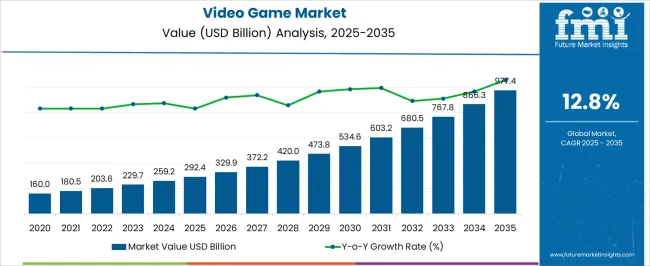
Key Takeaways, Market Size, and Forecast
- The video game market was valued at USD 292.4 billion in 2025.
- The market is likely to stand at USD 329.8 billion in 2026.
- By 2036, the video game market is projected to total USD 977.4 billion.
- Video game demand is anticipated to expand at a 12.8% CAGR from 2026 to 2036.
- Mobile devices are likely to account for 47.3% of device-based revenue in 2026.
- Online games are expected to hold 62.8% of type-based demand in 2026.
- Asia Pacific is likely to command over 55.0% share in 2026.
Video Game Market Definition
The video game market encompasses the development, publishing, and distribution of interactive digital entertainment across multiple platforms including consoles, mobile devices, and personal computers. It includes game software, in-game content, subscriptions, and associated services spanning casual mobile games to AAA console titles, massively multiplayer online games, and emerging cloud gaming platforms. The market is characterized by diverse monetization models including premium purchases, free-to-play with in-app purchases, subscriptions, and advertising, serving a global audience across all age demographics .
Video Game Market Inclusions
The report includes a comprehensive analysis of market dynamics, featuring Global and Regional Market Sizes (Volume and Value) and a 10-year Forecast (2026-2036). It covers segmental breakdowns by device (Console, Mobile, Computer), type (Online, Offline), and geographic regions.
Video Game Market Exclusions
The scope excludes gambling and casino-style games, non-interactive entertainment content, and hardware manufacturing not directly bundled with gaming services. It also omits esports event revenue and tournament prize pools unless directly related to game publisher revenues, focusing strictly on game software and associated digital services.
Video Game Market Research Methodology
- Primary Research: Interviews were conducted with game developers, publishers, platform operators, and industry analysts across major regions. Technology specialists clarified cloud gaming and AR/VR advancements.
- Desk Research: Industry association reports, platform analytics, and corporate financial filings supported revenue benchmarking.
- Market-Sizing and Forecasting: A hybrid top-down and bottom-up model was developed. Demand was reconstructed from platform install bases, player spending patterns, and regional market data, then validated against publisher financial reports and platform revenue disclosures.
- Data Validation and Update Cycle: Outputs undergo anomaly screening, variance checks across production and trade datasets, and structured peer review prior to release.
Segmental Analysis
Video Game Market Analysis by Device
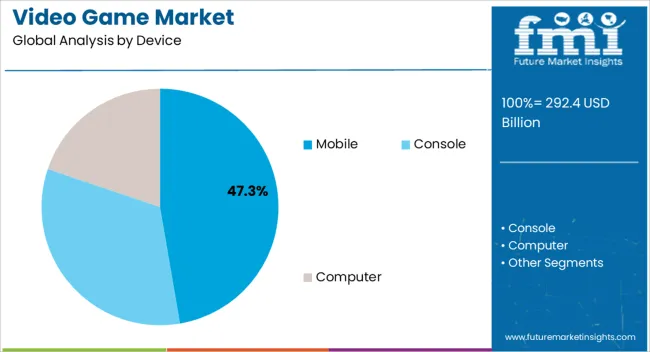
Based on FMI’s video game market report, mobile devices are estimated to hold 47.3% share in 2026. Growth in mobile gaming comes from widespread smartphone and tablet penetration, frictionless app store distribution, social connectivity layers, and the ability of publishers to extend console intellectual property into always-on ecosystems that monetise through microtransactions, advertising, and live services. The device segment is evolving beyond standalone gameplay into a cross-platform gateway that links cloud infrastructure, console franchises, and living room screens into a unified engagement architecture.
- • Strategic Cross-Platform Blueprint: As executives at Electronic Arts highlighted regarding franchise portability, “FC Mobile is the blueprint for our mobile strategy.” [2]. The statement reflects how leading publishers are treating mobile as an IP amplification engine rather than a peripheral revenue stream.
- • Cloud-Integrated Living Room Play: Netflix is repositioning smartphones as controllers within a broader cloud ecosystem, with co-CEO Greg Peters describing gaming as the foundation for “interactivity broadly,” while rolling out TV-based party games where phones function as controllers [3]. This integration redefines device hierarchy and expands mobile’s strategic footprint.
- • Distribution Scale Advantage: Integrated app stores on iOS and Android allow global publishers to deploy updates, seasonal content, and monetisation experiments at scale without physical retail constraints, strengthening mobile’s role as the fastest iteration channel within the broader gaming ecosystem.
Video Game Market Analysis by Type
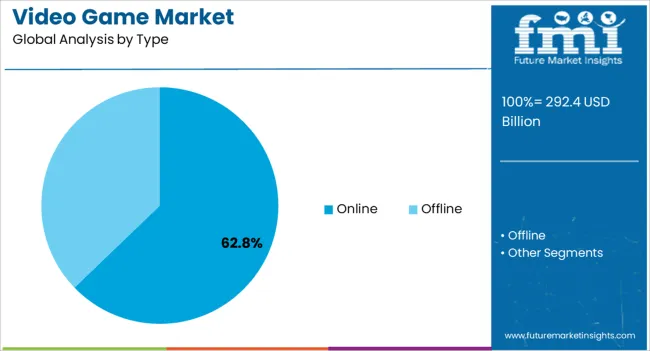
Based on FMI’s video game market report, online games are estimated to hold 62.8% share in 2026. Growth in online gaming stems from rising demand for multiplayer and competitive formats, persistent digital worlds, AI-enabled matchmaking, and continuous live content cycles that extend monetisation windows far beyond initial release. The segment’s structural strength lies in its recurring revenue mechanics, including subscriptions, downloadable expansions, and in-game purchases that stabilise publisher cash flows.
- • Engagement-Led Monetisation: Ubisoft emphasised the importance of live services in sustaining player engagement, noting, “This performance reflect the strength of our portfolio and the breadth of our player engagement across our core franchises, supported by recent releases and live content updates that continue to resonate with players.” [4].
- • Network Services Profit Expansion: Sony Group reported a 19% increase in operating profit in its gaming segment, driven by higher sales of network services and self-developed game software despite a decline in PlayStation 5 unit sales [5]. This shift highlights digital distribution and subscription ecosystems as the primary profitability lever within online gaming.
- • Cross-Platform Accessibility: The rise of unified accounts, cloud saves, and cross-play functionality enables players to transition seamlessly between console, PC, and mobile environments, reinforcing online gaming’s dominance by lowering switching friction and expanding lifetime engagement metrics.
Video Game Market Drivers, Restraints, and Opportunities
Future Market Insights analysis indicates that historical performance patterns point to a structurally expanding global industry where gaming has evolved from a discretionary entertainment category into a persistent digital engagement ecosystem spanning console, PC, and mobile platforms. The estimated 2026 valuation reflects a “content scale cycle,” where publishers are absorbing elevated development, marketing, and platform infrastructure costs to compete in an increasingly selective AAA environment while simultaneously scaling live-service ecosystems and subscription platforms. Capital allocation is increasingly directed toward cross-platform IP development, cloud infrastructure, and data-driven personalization engines that extend lifetime player value.
While blockbuster franchises can generate unprecedented monetization upside through downloadable content, microtransactions, and network services, the industry faces margin compression from rising AAA development budgets, platform fees, and user acquisition costs. Growth in value is increasingly tied to digital distribution and recurring revenue models rather than one-time boxed sales. The forecast assumes the market reaches a structurally normalized phase in which live-service architectures, cross-play ecosystems, and subscription gaming represent the dominant monetization baseline, aligning long-term expansion with global broadband penetration, device upgrades, and entertainment time allocation trends.
- • Content-Driven Monetization Expansion: Growth is shifting from one-time unit sales to persistent digital ecosystems built around live updates, seasonal content, esports integration, and in-game purchases that expand average revenue per user while stabilizing cash flow visibility.
- • Platform and Regulatory Pressure: App store revenue-sharing models, data privacy regulations, and intensifying scrutiny around microtransactions and loot box mechanics are compressing publisher margins and increasing compliance complexity across North America and Europe.
- • Cloud and Cross-Platform Acceleration: Expansion opportunities are concentrated in cloud gaming infrastructure, subscription services, and cross-device interoperability, enabling publishers to extend flagship franchises across mobile, console, PC, and smart TV environments to maximize lifetime engagement.
Regional Analysis
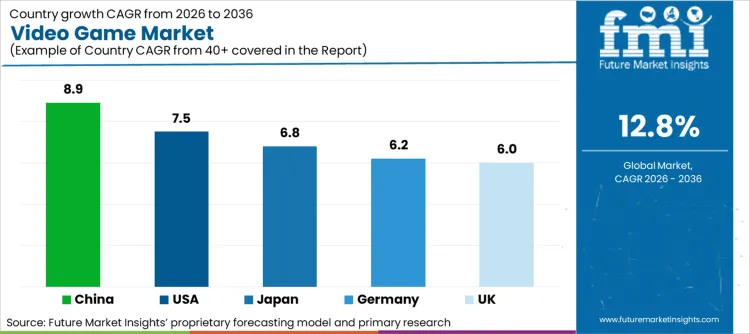
Based on the regional analysis, the video game market is segmented into North America, Latin America, Europe, Asia Pacific, and Middle East & Africa across 40+ countries. The full report also offers market attractiveness analysis based on regional trends.
| Country | CAGR (2026 to 2036) |
|---|---|
| China | 8.9% |
| United States | 7.5% |
| Japan | 6.8% |
| Germany | 6.2% |
| United Kingdom | 6.0% |
Source: Future Market Insights (FMI) analysis, based on proprietary forecasting model and primary research
North America Video Game Market Analysis
North America is characterized by platform convergence and cloud-enabled distribution, where publishers are expanding beyond console exclusivity toward device-agnostic ecosystems. Market value is increasingly driven by subscription services, network monetization, and cross-platform interoperability rather than pure hardware sales. Major players operating in the region include Microsoft, Electronic Arts, Activision Blizzard, and Take-Two Interactive.
- • United States: Demand for video games in the United States is projected to rise at 7.5% CAGR through 2036. Growth is fueled by rapid cloud gaming adoption, console-agnostic publishing strategies, and strong monetization from live-service franchises that extend engagement beyond initial launch cycles. [6]
FMI’s report includes a detailed analysis of growth in the North American region, along with a country-wise assessment that includes the USA and Canada. Readers can also find regional trends, regulatory developments, and market growth across different gaming segments in North America.
Asia Pacific Video Game Market Analysis
Asia Pacific remains the global epicenter of gaming consumption, supported by smartphone penetration, large-scale esports ecosystems, and integrated digital payment infrastructure. The region benefits from strong domestic publishers and high player density, particularly in China and Japan. Leading companies include Tencent, Sony Interactive Entertainment, and Nintendo.
- • China: Leading with an 8.9% CAGR, the Chinese market is transitioning high-fidelity PC intellectual property into advanced mobile ecosystems, driving record digital engagement and strengthening monetization through live-service frameworks. [7]
- • Japan: Demand in Japan is projected to expand at 6.8% CAGR through 2036, supported by next-generation console cycles and strong first-party franchise performance that continues to anchor hardware sales and digital software revenue. [8]
The full report analyzes the video game market across East and Southeast Asia from 2021–2036, covering pricing trends, platform dynamics, and growth drivers in China, Japan, South Korea, India, Indonesia, Malaysia, and Thailand. The assessment highlights structural shifts shaping regional monetization strategies.
Europe Video Game Market Analysis
Europe represents a digitally mature market characterized by high digital download penetration and strong engagement with annualized sports and live-service titles. Growth is anchored in subscription adoption and cross-platform play rather than pure hardware expansion. Key players active in Europe include Ubisoft, CD Projekt, Electronic Arts, and Sony Group.
- • Germany: Demand for video games in Germany is projected to rise at 6.2% CAGR through 2036, driven by sustained popularity of simulation and sports franchises alongside increasing digital-only purchases. [9]
- • United Kingdom: The UK market is expected to grow at 6.0% CAGR through 2036, supported by strong subscription penetration and increased daily time spent on digital entertainment services. [10]
FMI’s analysis of the video game market in Europe consists of country-wise assessment including Germany, France, Italy, Spain, the UK, the Nordics, Benelux, and the Rest of Europe. Readers can understand regulatory considerations, digital distribution trends, and evolving player engagement patterns shaping regional performance.
Competitive Aligners for Market Players
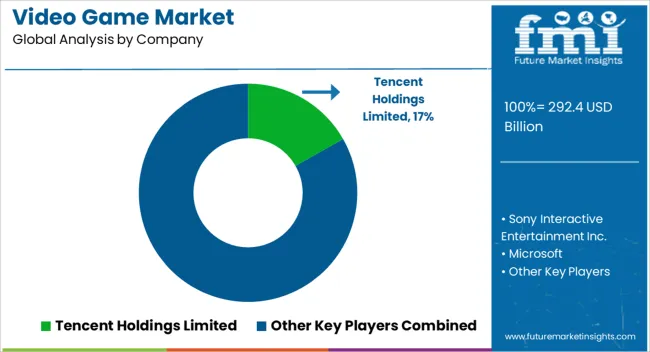
Market structure remains fragmented at the studio level, yet practical competition is concentrated among a limited group of global publishers capable of financing AAA-scale development, sustaining live-service ecosystems, and negotiating favorable platform placement. A small cluster of multinational players controls a disproportionate share of premium IP, distribution visibility, and recurring network revenue, while mid-tier studios operate with narrower franchise depth and higher project concentration risk. The primary competitive variable is capital endurance across multi-year development cycles rather than peak launch sales alone.
Publishers with diversified portfolios across console, PC, and mobile absorb volatility in hit-driven performance more effectively and smooth cash flows through subscriptions, downloadable content, and microtransactions. Firms lacking cross-platform scale or proprietary engines face higher outsourcing costs, greater dependence on third-party distribution, and margin compression from platform revenue-sharing models. Rising development budgets and marketing expenditures further narrow the field, as fewer studios can justify $100 million plus production commitments without global franchise recognition.
Customer concentration reinforces platform leverage. Digital storefront operators and console ecosystems control discoverability, pricing mechanics, and revenue splits, limiting publisher pricing autonomy. Multi-platform deployment and direct-to-consumer engagement strategies therefore serve as defensive mechanisms to reduce dependency and preserve long-term monetization control.
Recent Developments
In February 2026, Sony shared a new patent idea for AI-generated PlayStation podcasts. These would give players personalized updates, tips, and game suggestions, delivered in the voices of their favorite characters [11].
In February 2026, Take-Two Interactive confirmed that Grand Theft Auto VI will launch on November 19, 2026, with marketing starting this summer. The company expressed strong confidence in the release despite previous delays [12].
Key Players in Video Game Market
- Tencent Holdings Limited
- Sony Interactive Entertainment Inc.
- Microsoft Corporation
- Apple Inc.
- Activision Blizzard, Inc. (Microsoft)
- Nintendo Co., Ltd.
- Electronic Arts Inc.
- The Walt Disney Company
- Rovio Entertainment Corporation (Sega)
- Lucid Games
- Epic Games, Inc.
- Ubisoft Entertainment SA
- Take-Two Interactive Software, Inc.
- Bandai Namco Holdings Inc.
- Sega Corporation
- Square Enix Holdings Co., Ltd.
- NetEase, Inc.
- Krafton Inc.
- Roblox Corporation
- Unity Technologies
Scope of the Report
| Metric | Value |
|---|---|
| Quantitative Units | USD 329.8 billion (2026) to USD 977.4 billion (2036), at a CAGR of 12.8% |
| Market Definition | The video game market comprises the global development, publishing, distribution, and monetization of interactive digital entertainment software across consoles, mobile devices, and computers. It includes premium game sales, in-game purchases, subscriptions, downloadable content, cloud gaming services, and associated digital ecosystems serving casual, competitive, and AAA gaming audiences worldwide. |
| Device Segmentation | Console (Home Consoles, Handheld Consoles), Mobile (Smartphones, Tablets, Handheld Gaming Devices), Computer (PC – Windows/Mac, Laptops) |
| Type Segmentation | Online (Multiplayer Online Games, Cloud Gaming, Browser Games, Mobile Online Games), Offline (Single-Player Games, Local Multiplayer) |
| Application Coverage | Game Software, In-Game Content and Microtransactions, Subscription Services, Cloud Gaming Platforms, Digital Distribution Services |
| Regions Covered | North America, Latin America, Europe, East Asia, South Asia & Pacific, Middle East & Africa |
| Countries Covered | United States, Canada, Mexico, Brazil, Argentina, Germany, United Kingdom, France, Spain, Italy, China, Japan, South Korea, India, Australia, New Zealand, GCC Countries, South Africa, Israel and 40+ countries |
| Key Companies Profiled | Tencent Holdings Limited, Sony Interactive Entertainment Inc., Microsoft Corporation, Nintendo Co., Ltd., Electronic Arts Inc., Activision Blizzard, Inc., NetEase, Inc., Epic Games, Inc., Ubisoft Entertainment SA, Take-Two Interactive Software, Inc. |
| Forecast Period | 2026 to 2036 |
| Approach | Hybrid top-down and bottom-up market modeling validated through primary interviews with game developers, publishers, and platform operators, supported by platform install base data, player spending analytics, and publisher financial disclosures. |
Top Segments Studied in the Video Game Market Research Report
Device
- Console
- Home Consoles
- Handheld Consoles
- Mobile
- Smartphones
- Tablets
- Handheld Gaming Devices
- Computer
- PC (Windows/Mac)
- Laptops
Type
- Online
- Multiplayer Online Games
- Cloud Gaming
- Browser Games
- Mobile Online Games
- Offline
- Single-Player Games
- Local Multiplayer
Region
- North America
- United States
- Canada
- Latin America
- Brazil
- Mexico
- Argentina
- Rest of Latin America
- Europe
- Western Europe
- Germany
- United Kingdom
- France
- Spain
- Italy
- Rest of Western Europe
- Eastern Europe
- Poland
- Russia
- Czech Republic
- Romania
- Rest of Eastern Europe
- Western Europe
- South Asia & Pacific
- India
- Bangladesh
- Australia
- New Zealand
- Rest of South Asia & Pacific
- East Asia
- China
- Japan
- South Korea
- Middle East & Africa
- GCC Countries
- South Africa
- Israel
- Rest of Middle East & Africa
Bibliography
- [1] Ubisoft Entertainment S.A. (2025, January). Press release draft (Ubisoft_Jan_PR_draft_vF.pdf). Ubisoft.
- [2] PocketGamer.biz. (2025). EA makes $254m on mobile this Q3 as FC Mobile drives net bookings. PocketGamer.biz.
- [3] The Tech Buzz. (2025). Netflix pivots gaming strategy beyond mobile to TV interactive. The Tech Buzz.
- [4] Investing.com. (2025). Earnings call transcript: Ubisoft Q3 2025 shows strong digital growth. Investing.com.
- [5] Yahoo Finance. (2025). Sony (SONY) boosts annual forecast amid strong gaming and music. Yahoo Finance.
- [6] Xbox Wire. (2025). GDC 2025: Opening a billion doors with Xbox. Microsoft.
- [7] Tencent Holdings Ltd. (2025, November 13). Investor presentation (PDF). Tencent.
- [8] Nintendo Co., Ltd. (2025). Investor relations: Earnings summary & outlook. Nintendo.
- [9] game – Verband der deutschen Games-Branche. (2025). The game annual charts show the most successful new games in Germany in 2025. game.
- [10] S&P Global. (2026). State of the UK digital entertainment market, 2026. S&P Global.
- [11] [Publisher Unknown]. (2025). Sony patents system to generate AI podcasts in the voices of your favorite PlayStation characters.
- [12] The Times of India. (2025). Take-Two Interactive reaffirms Grand Theft Auto 6 release date; launch marketing to begin. The Times of India.
This Report Addresses
- Market intelligence to enable structured strategic decision-making across mature and emerging video game markets
- Market size estimation and 10-year revenue forecasts from 2026 to 2036, supported by validated platform data and publisher financial reports
- Growth opportunity mapping across devices and types with emphasis on mobile and online gaming
- Segment and regional revenue forecasts covering all major platforms and geographic regions
- Competition strategy assessment including platform ecosystems, intellectual property, and live-service capabilities benchmarking
- Technology roadmap tracking including cloud gaming, AR/VR integration, AI-driven gameplay, and blockchain applications
- Regulatory impact analysis covering monetization practices, data privacy, and content regulations
- Market report delivery in PDF, Excel, PPT, and interactive dashboard formats for executive and operational use
Frequently Asked Questions
How large is the demand for Video Games in the global market in 2026?
Demand for Video Games in the global market is estimated to be valued at USD 329.8 billion in 2026.
What will be the market size of Video Games in the global market by 2036?
Market size for Video Games is projected to reach USD 977.4 billion by 2036.
What is the expected demand growth for Video Games in the global market between 2026 and 2036?
Demand for Video Games in the global market is expected to grow at a CAGR of 12.8% between 2026 and 2036.
Which Device is poised to lead global sales by 2026?
Mobile is expected to be the dominant device segment, capturing approximately 47.3% of global market share in 2026 due to widespread smartphone adoption and app-based distribution ecosystems.
How significant is the role of Online Type in driving Video Game adoption in 2026?
Online games represent a critical segment, projected to hold a substantial 62.8% share of the total market in 2026 as multiplayer engagement and live-service monetization models dominate revenue streams.
What is driving Video Game demand in the United States?
Cloud gaming expansion, cross-platform accessibility, AR/VR integration, and live-service franchises are driving growth in the United States.
What monetization shift is referenced for the global market?
The market reflects a Play or Pay shift, where traditional one-time purchases are increasingly replaced by subscriptions, in-game purchases, and recurring live-service ecosystems.
What is the United States growth outlook in this report?
The United States is projected to grow at a CAGR of 7.5% during 2026 to 2036.
Why is Asia Pacific described as the dominant region in this report?
Asia Pacific holds over 55% market share, driven by China’s large player base, mobile-first engagement patterns, and aggressive publisher expansion strategies.
What is China’s growth outlook in this report?
China is projected to expand at a CAGR of 8.9% during 2026 to 2036.
Does the report cover Japan in its regional analysis?
Japan is included within East Asia under the regional scope of analysis.
What is the main demand theme linked to Japan in Asia coverage?
Next-generation console cycles and strong first-party franchise performance support sustained digital and hardware-driven revenue growth.
Does the report cover South Korea in its regional analysis?
South Korea is included within East Asia under the regional coverage framework.
What is the main Korea-related demand theme in Asia coverage?
Competitive online gaming ecosystems, esports participation, and high broadband penetration underpin growth.
Which device formats are strategically important for global expansion?
Mobile devices are strategically important due to accessibility, global reach, and seamless digital monetization infrastructure.
What are Video Games and what are they mainly used for?
Video games are interactive digital entertainment software across console, mobile, and computer platforms, primarily used for entertainment, social interaction, and competitive engagement.
What does Video Game Market mean in this report?
Video Game Market refers to the global development, publishing, distribution, and monetization of interactive gaming software and associated digital services.
What is included in the scope of this Video Game Market report?
Scope covers video games by device, type, monetization models, and geographic regions, including subscriptions and cloud gaming services.
What is excluded from the scope of this report?
Gambling-style games, non-interactive digital content, standalone hardware manufacturing not bundled with services, and esports prize revenues are excluded.
What does Market Forecast mean on this page?
Market forecast represents a model-based projection built on defined technology, consumer spending, and platform adoption assumptions for strategic planning purposes.
How does FMI build and validate the Video Game Market forecast?
Forecast is developed using hybrid top-down and bottom-up modeling validated through platform install base data, publisher financial disclosures, and primary interviews.
What does zero reliance on speculative third-party market research mean here?
Primary interviews, verifiable corporate filings, and platform-level spending data are used instead of unverified syndicated market estimates.
Preview the report firsthand - request a free sample
Get SampleGet the brochure for pricing and purchase details.
Get PDFTable of Content
- Executive Summary
- Global Market Outlook
- Demand-side Trends
- Supply-side Trends
- Technology Roadmap Analysis
- Analysis and Recommendations
- Market Overview
- Market Coverage / Taxonomy
- Market Definition / Scope / Limitations
- Research Methodology
- Chapter Orientation
- Analytical Lens and Working Hypotheses
- Market Structure, Signals, and Trend Drivers
- Benchmarking and Cross-market Comparability
- Market Sizing, Forecasting, and Opportunity Mapping
- Research Design and Evidence Framework
- Desk Research Programme (Secondary Evidence)
- Company Annual and Sustainability Reports
- Peer-reviewed Journals and Academic Literature
- Corporate Websites, Product Literature, and Technical Notes
- Earnings Decks and Investor Briefings
- Statutory Filings and Regulatory Disclosures
- Technical White Papers and Standards Notes
- Trade Journals, Industry Magazines, and Analyst Briefs
- Conference Proceedings, Webinars, and Seminar Materials
- Government Statistics Portals and Public Data Releases
- Press Releases and Reputable Media Coverage
- Specialist Newsletters and Curated Briefings
- Sector Databases and Reference Repositories
- FMI Internal Proprietary Databases and Historical Market Datasets
- Subscription Datasets and Paid Sources
- Social Channels, Communities, and Digital Listening Inputs
- Additional Desk Sources
- Expert Input and Fieldwork (Primary Evidence)
- Primary Modes
- Qualitative Interviews and Expert Elicitation
- Quantitative Surveys and Structured Data Capture
- Blended Approach
- Why Primary Evidence is Used
- Field Techniques
- Interviews
- Surveys
- Focus Groups
- Observational and In-context Research
- Social and Community Interactions
- Stakeholder Universe Engaged
- C-suite Leaders
- Board Members
- Presidents and Vice Presidents
- R&D and Innovation Heads
- Technical Specialists
- Domain Subject-matter Experts
- Scientists
- Physicians and Other Healthcare Professionals
- Governance, Ethics, and Data Stewardship
- Research Ethics
- Data Integrity and Handling
- Primary Modes
- Tooling, Models, and Reference Databases
- Desk Research Programme (Secondary Evidence)
- Data Engineering and Model Build
- Data Acquisition and Ingestion
- Cleaning, Normalisation, and Verification
- Synthesis, Triangulation, and Analysis
- Quality Assurance and Audit Trail
- Market Background
- Market Dynamics
- Drivers
- Restraints
- Opportunity
- Trends
- Scenario Forecast
- Demand in Optimistic Scenario
- Demand in Likely Scenario
- Demand in Conservative Scenario
- Opportunity Map Analysis
- Product Life Cycle Analysis
- Supply Chain Analysis
- Investment Feasibility Matrix
- Value Chain Analysis
- PESTLE and Porter’s Analysis
- Regulatory Landscape
- Regional Parent Market Outlook
- Production and Consumption Statistics
- Import and Export Statistics
- Market Dynamics
- Global Market Analysis 2021 to 2025 and Forecast, 2026 to 2036
- Historical Market Size Value (USD Billion) Analysis, 2021 to 2025
- Current and Future Market Size Value (USD Billion) Projections, 2026 to 2036
- Y-o-Y Growth Trend Analysis
- Absolute $ Opportunity Analysis
- Global Market Pricing Analysis 2021 to 2025 and Forecast 2026 to 2036
- Global Market Analysis 2021 to 2025 and Forecast 2026 to 2036, By Device
- Introduction / Key Findings
- Historical Market Size Value (USD Billion) Analysis By Device , 2021 to 2025
- Current and Future Market Size Value (USD Billion) Analysis and Forecast By Device , 2026 to 2036
- Mobile Devices
- Console
- Computer
- Mobile Devices
- Y-o-Y Growth Trend Analysis By Device , 2021 to 2025
- Absolute $ Opportunity Analysis By Device , 2026 to 2036
- Global Market Analysis 2021 to 2025 and Forecast 2026 to 2036, By Type
- Introduction / Key Findings
- Historical Market Size Value (USD Billion) Analysis By Type, 2021 to 2025
- Current and Future Market Size Value (USD Billion) Analysis and Forecast By Type, 2026 to 2036
- Online
- Offline
- Online
- Y-o-Y Growth Trend Analysis By Type, 2021 to 2025
- Absolute $ Opportunity Analysis By Type, 2026 to 2036
- Global Market Analysis 2021 to 2025 and Forecast 2026 to 2036, By Region
- Introduction
- Historical Market Size Value (USD Billion) Analysis By Region, 2021 to 2025
- Current Market Size Value (USD Billion) Analysis and Forecast By Region, 2026 to 2036
- North America
- Latin America
- Western Europe
- Eastern Europe
- East Asia
- South Asia and Pacific
- Middle East & Africa
- Market Attractiveness Analysis By Region
- North America Market Analysis 2021 to 2025 and Forecast 2026 to 2036, By Country
- Historical Market Size Value (USD Billion) Trend Analysis By Market Taxonomy, 2021 to 2025
- Market Size Value (USD Billion) Forecast By Market Taxonomy, 2026 to 2036
- By Country
- USA
- Canada
- Mexico
- By Device
- By Type
- By Country
- Market Attractiveness Analysis
- By Country
- By Device
- By Type
- Key Takeaways
- Latin America Market Analysis 2021 to 2025 and Forecast 2026 to 2036, By Country
- Historical Market Size Value (USD Billion) Trend Analysis By Market Taxonomy, 2021 to 2025
- Market Size Value (USD Billion) Forecast By Market Taxonomy, 2026 to 2036
- By Country
- Brazil
- Chile
- Rest of Latin America
- By Device
- By Type
- By Country
- Market Attractiveness Analysis
- By Country
- By Device
- By Type
- Key Takeaways
- Western Europe Market Analysis 2021 to 2025 and Forecast 2026 to 2036, By Country
- Historical Market Size Value (USD Billion) Trend Analysis By Market Taxonomy, 2021 to 2025
- Market Size Value (USD Billion) Forecast By Market Taxonomy, 2026 to 2036
- By Country
- Germany
- UK
- Italy
- Spain
- France
- Nordic
- BENELUX
- Rest of Western Europe
- By Device
- By Type
- By Country
- Market Attractiveness Analysis
- By Country
- By Device
- By Type
- Key Takeaways
- Eastern Europe Market Analysis 2021 to 2025 and Forecast 2026 to 2036, By Country
- Historical Market Size Value (USD Billion) Trend Analysis By Market Taxonomy, 2021 to 2025
- Market Size Value (USD Billion) Forecast By Market Taxonomy, 2026 to 2036
- By Country
- Russia
- Poland
- Hungary
- Balkan & Baltic
- Rest of Eastern Europe
- By Device
- By Type
- By Country
- Market Attractiveness Analysis
- By Country
- By Device
- By Type
- Key Takeaways
- East Asia Market Analysis 2021 to 2025 and Forecast 2026 to 2036, By Country
- Historical Market Size Value (USD Billion) Trend Analysis By Market Taxonomy, 2021 to 2025
- Market Size Value (USD Billion) Forecast By Market Taxonomy, 2026 to 2036
- By Country
- China
- Japan
- South Korea
- By Device
- By Type
- By Country
- Market Attractiveness Analysis
- By Country
- By Device
- By Type
- Key Takeaways
- South Asia and Pacific Market Analysis 2021 to 2025 and Forecast 2026 to 2036, By Country
- Historical Market Size Value (USD Billion) Trend Analysis By Market Taxonomy, 2021 to 2025
- Market Size Value (USD Billion) Forecast By Market Taxonomy, 2026 to 2036
- By Country
- India
- ASEAN
- Australia & New Zealand
- Rest of South Asia and Pacific
- By Device
- By Type
- By Country
- Market Attractiveness Analysis
- By Country
- By Device
- By Type
- Key Takeaways
- Middle East & Africa Market Analysis 2021 to 2025 and Forecast 2026 to 2036, By Country
- Historical Market Size Value (USD Billion) Trend Analysis By Market Taxonomy, 2021 to 2025
- Market Size Value (USD Billion) Forecast By Market Taxonomy, 2026 to 2036
- By Country
- Kingdom of Saudi Arabia
- Other GCC Countries
- Turkiye
- South Africa
- Other African Union
- Rest of Middle East & Africa
- By Device
- By Type
- By Country
- Market Attractiveness Analysis
- By Country
- By Device
- By Type
- Key Takeaways
- Key Countries Market Analysis
- USA
- Pricing Analysis
- Market Share Analysis, 2025
- By Device
- By Type
- Canada
- Pricing Analysis
- Market Share Analysis, 2025
- By Device
- By Type
- Mexico
- Pricing Analysis
- Market Share Analysis, 2025
- By Device
- By Type
- Brazil
- Pricing Analysis
- Market Share Analysis, 2025
- By Device
- By Type
- Chile
- Pricing Analysis
- Market Share Analysis, 2025
- By Device
- By Type
- Germany
- Pricing Analysis
- Market Share Analysis, 2025
- By Device
- By Type
- UK
- Pricing Analysis
- Market Share Analysis, 2025
- By Device
- By Type
- Italy
- Pricing Analysis
- Market Share Analysis, 2025
- By Device
- By Type
- Spain
- Pricing Analysis
- Market Share Analysis, 2025
- By Device
- By Type
- France
- Pricing Analysis
- Market Share Analysis, 2025
- By Device
- By Type
- India
- Pricing Analysis
- Market Share Analysis, 2025
- By Device
- By Type
- ASEAN
- Pricing Analysis
- Market Share Analysis, 2025
- By Device
- By Type
- Australia & New Zealand
- Pricing Analysis
- Market Share Analysis, 2025
- By Device
- By Type
- China
- Pricing Analysis
- Market Share Analysis, 2025
- By Device
- By Type
- Japan
- Pricing Analysis
- Market Share Analysis, 2025
- By Device
- By Type
- South Korea
- Pricing Analysis
- Market Share Analysis, 2025
- By Device
- By Type
- Russia
- Pricing Analysis
- Market Share Analysis, 2025
- By Device
- By Type
- Poland
- Pricing Analysis
- Market Share Analysis, 2025
- By Device
- By Type
- Hungary
- Pricing Analysis
- Market Share Analysis, 2025
- By Device
- By Type
- Kingdom of Saudi Arabia
- Pricing Analysis
- Market Share Analysis, 2025
- By Device
- By Type
- Turkiye
- Pricing Analysis
- Market Share Analysis, 2025
- By Device
- By Type
- South Africa
- Pricing Analysis
- Market Share Analysis, 2025
- By Device
- By Type
- USA
- Market Structure Analysis
- Competition Dashboard
- Competition Benchmarking
- Market Share Analysis of Top Players
- By Regional
- By Device
- By Type
- Competition Analysis
- Competition Deep Dive
- Tencent Holdings Limited
- Overview
- Product Portfolio
- Profitability by Market Segments (Product/Age /Sales Channel/Region)
- Sales Footprint
- Strategy Overview
- Marketing Strategy
- Product Strategy
- Channel Strategy
- Sony Interactive Entertainment Inc.
- Microsoft Corporation
- Apple Inc.
- Activision Blizzard, Inc. (Microsoft)
- Nintendo Co., Ltd.
- Electronic Arts Inc.
- Tencent Holdings Limited
- Competition Deep Dive
- Assumptions & Acronyms Used


