The Demand for Weight Loss Supplements in USA Market is segmented by Type (Vitamins, Minerals, Amino Acids, Protein, Natural/ Botanical Extracts, Others), Form (Powder, Capsule, Tablet, Liquid, Others), End Use (19-40 years, Under 18 Years, 41 to 50 Years, Above 50 Years), Distribution Channel (Supermarket/Hypermarket, Pharmacies/ Drug Stores, Specialty Stores, Online Retail, Others) and Region. Forecast for 2026 to 2036.

Methodology

Demand for Weight Loss Supplements in USA Market Size, Market Forecast and Outlook By FMI

Usa Weight Loss Supplements Market Market Value Analysis

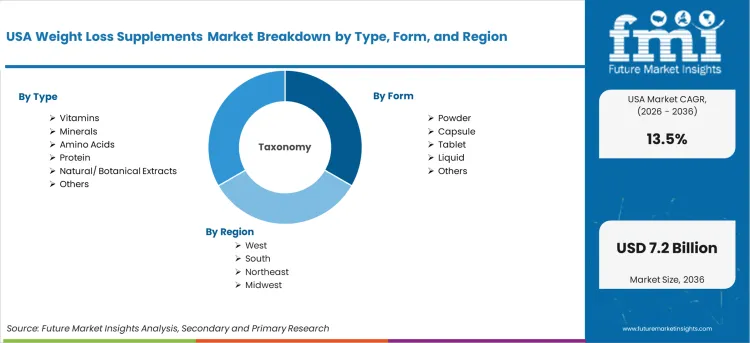
The demand for weight loss supplements in usa market was valued at USD 1.80 billion in 2025, projected to reach USD 2.04 billion in 2026, and is forecast to expand to USD 7.25 billion by 2036 at a 13.5% CAGR. Demand for weight loss supplements in the USA is accelerating as consumer spending on body composition management products shifts from seasonal dieting cycles to year-round health maintenance routines.

The convergence of clinical nutrition awareness, social media-driven body image culture, and expanding e-commerce distribution is creating sustained purchasing volumes across vitamins, minerals, amino acids, protein concentrates, and botanical extract categories. Supplement manufacturers are reformulating products to meet clean-label, third-party tested, and clinically substantiated positioning requirements as regulatory scrutiny from the FDA and FTC intensifies around weight management marketing claims.

Summary of Demand for Weight Loss Supplements in USA Market

  • Market Overview
    • The market is valued at USD 1.80 billion in 2025 and is projected to reach USD 7.25 billion by 2036.
    • The industry is expected to grow at a 13.5% CAGR from 2026 to 2036, creating an incremental opportunity of USD 5.21 billion.
    • The market is a consumer health category where clinical substantiation, regulatory compliance, format innovation, and direct-to-consumer distribution capabilities define competitive positioning across the United States.
  • Demand and Growth Drivers
    • FDA and FTC enforcement actions against unsubstantiated weight loss claims are forcing manufacturers to invest in randomized controlled trials, published peer-reviewed efficacy data, and third-party laboratory certifications, creating a credibility moat that separates compliant brands from commodity supplement sellers.
    • The 65.0% market share held by powder format products reflects deep integration into daily smoothie and meal replacement routines among the primary 19-to-40 consumer demographic, with powder formulations offering perceived dosing flexibility and ingredient transparency that capsule and tablet formats cannot match.
    • Online subscription models are capturing an increasing share of repeat purchases by offering automated delivery, personalized formulation algorithms, and loyalty pricing that reduces consumer switching to retail shelf alternatives, compressing traditional specialty store and pharmacy distribution channel margins.
    • Among key regions, West at 15.5%, South at 13.9%, Northeast at 12.4%, Midwest at 10.8%.
  • Product and Segment View
    • The market includes products segmented by Type, Form, End Use, Distribution Channel, covering Vitamins, Minerals, Amino Acids, Protein, Natural/ Botanical Extracts, Others under Type and Powder, Capsule, Tablet, Liquid, Others under Form.
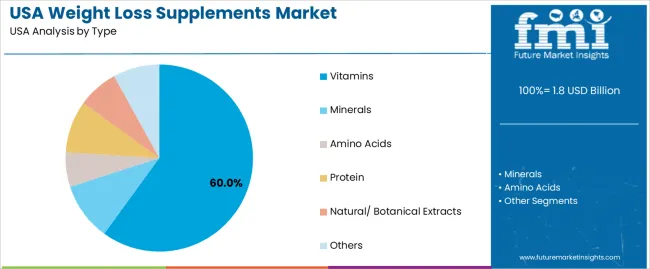
    • Vitamins leads Type segmentation with 60.0% share in 2026.
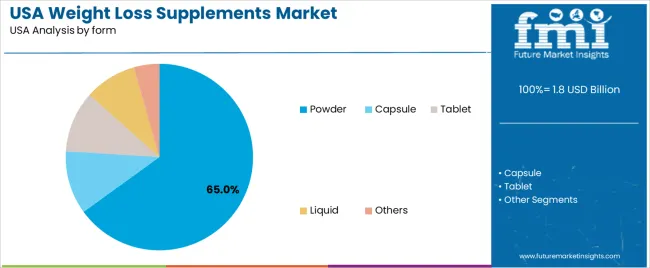
    • Powder leads Form segmentation with 65.0% share in 2026.
  • Geography and Competitive Outlook
    • West is the fastest-growing area at 15.5% CAGR.
    • Competition is shaped by product quality, supply reliability, and distribution reach, with key players including Amway Corporation, Herbalife Nutrition, GNC, Glanbia Performance Nutrition Inc., Ajinomoto Health & Nutrition.
  • Analyst Opinion at FMI
    • Nandini Roy Choudhury, Principal Consultant at FMI, opines: 'In my analysis, I have observed that the weight loss supplements market in the USA is entering a credibility-driven phase where third-party certification and published clinical evidence become the primary gatekeepers to retail shelf access and consumer trust. Manufacturers who delay investment in NSF, USP, or Informed Choice certification programs face progressive delisting from major retail platforms and e-commerce marketplaces. Brands that build proprietary clinical trial databases will establish defensible market positions that marketing-only competitors cannot replicate.'
  • Strategic Implications / Executive Takeaways
    • Supplement manufacturers must allocate capital to randomized controlled trials and third-party certification programs to secure retail shelf placement and e-commerce platform visibility as regulatory enforcement intensifies.
    • Product development teams should prioritize powder and liquid format innovation that integrates with daily smoothie and meal replacement routines, targeting the 19-to-40 primary demographic while developing age-specific formulations for the 41-to-50 growth segment.
    • Distribution strategists must build direct-to-consumer subscription infrastructure to capture recurring revenue streams and reduce dependence on retail shelf placement decisions that are increasingly influenced by certification status rather than brand marketing spend.

Demand for Weight Loss Supplements in USA Market Key Takeaways

Metric Details
Industry Size (2026) USD 2.04 Billion
Industry Value (2036) USD 7.25 Billion
CAGR (2026-2036) 13.5%

Source: Future Market Insights, 2026

FMI analysts observe that the weight loss supplements market in the USA is undergoing a structural shift from generic fat-burner formulations toward targeted, evidence-based products aligned with specific metabolic pathways. Powder formats continue to command 65.0% of the market, driven by smoothie culture integration and the perceived dosing flexibility that powder formats offer over capsules and tablets. The 19-to-40 age demographic anchors consumption volume, but the fastest adoption acceleration is occurring in the 41-to-50 age segment as midlife metabolic management becomes a mainstream health priority. As per FMI, distribution channel diversification is reshaping competitive dynamics: specialty store dominance is eroding as hypermarket pharmacy sections and direct-to-consumer online subscriptions capture an increasing share of first-time and repeat purchasers.

Regional demand trajectories reflect distinct structural conditions within the United States. West USA leads with a 15.5% CAGR, driven by the concentration of fitness culture, wellness-oriented consumers, and supplement brand headquarters in California, Colorado, and Washington. South USA registers 13.9% growth, supported by population expansion and increasing health awareness across suburban and urban demographics. Northeast USA maintains a 12.4% expansion trajectory anchored by high disposable income urban consumer segments in the New York, Boston, and Philadelphia metropolitan areas. Midwest USA records 10.8% growth as mainstream retail penetration of weight loss supplements broadens beyond specialty store channels into mass grocery and pharmacy distribution.

Demand for Weight Loss Supplements in USA Market Definition

Weight loss supplements are dietary supplement products formulated to support body weight reduction, fat metabolism, appetite suppression, or metabolic rate enhancement. Product categories include vitamins, minerals, amino acids, protein concentrates, and natural or botanical extracts delivered in powder, capsule, tablet, and liquid formats. These products are distributed through supermarkets, hypermarkets, pharmacies, drug stores, specialty nutrition stores, and online retail channels. The USA market encompasses products targeting consumers across age demographics from under 18 to above 50 years.

Demand for Weight Loss Supplements in USA Market Inclusions

Market scope includes all dietary supplement products marketed for weight loss, fat reduction, appetite management, or metabolic support across vitamins, minerals, amino acids, protein, and botanical extract categories. Format coverage spans powder, capsule, tablet, liquid, and other delivery systems. Distribution channel analysis covers supermarkets, hypermarkets, pharmacies, drug stores, specialty stores, online retail, and other channels. Regional coverage spans West, South, Northeast, and Midwest USA with forecast projections from 2026 to 2036.

Demand for Weight Loss Supplements in USA Market Exclusions

Prescription weight loss medications, surgical weight management devices, meal replacement products not classified as dietary supplements, and general fitness equipment are excluded. Clinical nutrition products administered under medical supervision in hospital or clinical settings fall outside the scope. Sports nutrition products not specifically marketed for weight loss are excluded from the valuation.

Demand for Weight Loss Supplements in USA Market Research Methodology

  • Primary Research: Analysts conducted structured interviews with supply chain managers, product procurement leads, and distribution network operators to map decision triggers that shape purchasing volumes and vendor selection criteria.
  • Desk Research: Data collection phases aggregated regulatory filings, trade body publications, national consumption surveys, and public procurement records from government statistical agencies.
  • Market-Sizing and Forecasting: Baseline values derive from a bottom-up aggregation of category-level consumption volumes, applying region-specific penetration curves and pricing benchmarks to project future demand trajectories.
  • Data Validation and Update Cycle: Projections are cross-checked against publicly reported trade statistics, manufacturer shipment disclosures, and import-export databases maintained by customs authorities.

Demand for Weight Loss Supplements in USA Market Drivers, Restraints, and Opportunities

Future Market Insights analysis indicates the weight loss supplements market in the USA has matured from a fringe fitness category into a mainstream consumer health segment with annual purchasing patterns that extend beyond seasonal dieting behavior. The structural demand base now encompasses clinical weight management programs, preventive health maintenance routines, fitness performance optimization, and aesthetic body composition goals. FMI opines that the category growth rate of 13.5% reflects not merely consumer interest expansion but a fundamental shift in how Americans allocate health expenditure: supplements are increasingly budgeted as recurring monthly wellness expenses rather than discretionary impulse purchases.

Regulatory and credibility dynamics are reshaping the competitive landscape. The FDA enforcement posture on supplement marketing claims has tightened, compelling manufacturers to invest in clinical substantiation, third-party testing certifications, and transparent ingredient sourcing documentation. Brands that achieve NSF Certified for Sport, Informed Choice, or USP Verified designations command retail shelf placement priority and consumer trust premiums that uncertified competitors cannot access. FMI analysts note that this certification barrier is accelerating market consolidation, as smaller brands lacking the resources to fund clinical trials and third-party testing programs face progressive exclusion from major retail and e-commerce platform listings.

  • Clinical Substantiation Mandates: FDA and FTC enforcement actions against unsubstantiated weight loss claims are forcing manufacturers to invest in randomized controlled trials, published peer-reviewed efficacy data, and third-party laboratory certifications, creating a credibility moat that separates compliant brands from commodity supplement sellers.
  • Powder Format Dominance and Smoothie Integration: The 65.0% market share held by powder format products reflects deep integration into daily smoothie and meal replacement routines among the primary 19-to-40 consumer demographic, with powder formulations offering perceived dosing flexibility and ingredient transparency that capsule and tablet formats cannot match.
  • Direct-to-Consumer Subscription Growth: Online subscription models are capturing an increasing share of repeat purchases by offering automated delivery, personalized formulation algorithms, and loyalty pricing that reduces consumer switching to retail shelf alternatives, compressing traditional specialty store and pharmacy distribution channel margins.

What Is Driving the Demand for Weight Loss Supplements in USA?

The demand for weight loss supplements in USA is influenced by rising rates of overweight and obesity, together with growing consumer interest in quick and convenient options for managing body weight. Many individuals seek supplements as adjuncts to diet and exercise, motivated by wellness trends and appearance-related goals. Over-the-counter products that claim to suppress appetite, boost metabolism or support fat burning are widely available in retail outlets and online, reflecting both consumer interest and commercial availability.

Consumer behaviour and retail distribution also play significant roles in shaping demand. Busy lifestyles increase appeal of ready-to-take supplements, while marketing emphasises natural ingredients and clean labels to align with wellness mindsets. The availability of direct-to-consumer brands and subscription models further lowers entry barriers for users. On the supply side, price competition and proliferation of new brands create choice but also confusion, and the effectiveness of many products remains contested. Despite these limitations, demand for weight-loss supplements in USA continues at a strong pace as consumers seek accessible weight-management tools.

What Factors Are Affecting the Demand for Weight Loss Supplements in USA in Terms of Type and Form?

The demand for weight loss supplements in the USA is shaped by the range of supplement types and the forms in which they are consumed. Types include vitamins, minerals, amino acids, protein, natural or botanical extracts and other specialized blends that support metabolic activity or appetite management. Forms such as powders, capsules, tablets, liquids and other delivery formats influence how easily consumers incorporate these products into daily routines. As individuals pursue structured weight management strategies, the combination of diverse supplement types and convenient consumption forms guides overall demand across health-focused households and fitness-oriented buyers in the USA.
What Drives the Leading Demand for Vitamins in Weight Loss Supplements in USA?

Usa Weight Loss Supplements Market Analysis By Type

Vitamins account for 60% of total demand for weight loss supplements in the USA. Their leading position reflects widespread use of vitamin-based formulations that support energy metabolism and help maintain nutrient balance during calorie-restricted diets. Consumers often select vitamin blends to complement exercise routines and manage fatigue while pursuing weight goals. Many products combine B-complex vitamins and other essential nutrients to support daily functioning, which encourages consistent adoption. Vitamin-based supplements appeal to a broad audience because they are familiar, easy to understand and compatible with other wellness habits practiced by USA consumers.

Demand for vitamin-focused supplements is also strengthened by the prevalence of multivitamin formats designed specifically for weight management. These formulations provide structured support for users who want clear dosing and predictable intake. Vitamins are frequently included in combination products that target metabolism, hydration or appetite control, increasing their presence across retail shelves. As weight management routines remain common among adults, the reliability, accessibility and versatility of vitamins maintain their position as the most frequently chosen supplement type in this category.
What Drives the Leading Demand for Powder-form Weight Loss Supplements in USA?

Usa Weight Loss Supplements Market Analysis By Form

Powder forms account for 65.0% of total demand for weight loss supplements in the USA. Their popularity stems from ease of mixing into beverages, shakes and meal replacements, which supports structured dieting practices. Powders allow users to adjust serving sizes and integrate supplements into morning routines or workout recovery periods. Many consumers prefer powders because they blend well with protein shakes and other functional drinks commonly used in weight management. Longer shelf life and flexible storage further contribute to frequent household use.

Demand for powder formats is reinforced by the growth of personalized nutrition and the popularity of daily smoothie preparation. Powders support concentrated nutrient delivery and can incorporate protein, amino acids or botanical extracts that appeal to fitness-oriented users. The format also enables clear labeling and straightforward customization, helping consumers align supplement intake with specific weight loss goals. As the preference for convenient, adaptable products continues to grow, powder-based supplements maintain their leading role in USA weight management routines.

What Are the Key Trends, Drivers, and Barriers in the Demand for Weight Loss Supplements in USA?

Demand for weight loss supplements in the USA continues to expand as consumers pursue convenient options that support weight management alongside dietary and lifestyle changes. Increased awareness of metabolic health, wider availability through retail and online channels and interest in natural or plant-based ingredients contribute to growth. At the same time, questions around product efficacy, regulatory pressure and strong competition from prescription treatments create obstacles. These combined factors lead to steady but selective adoption across different consumer segments in the US wellness market.

How Are Shifting Lifestyle Patterns Influencing Demand for Weight Loss Supplements in USA?

American consumers are adjusting to busier routines and reduced physical activity, which encourages reliance on supplemental support for weight control. Many individuals prefer products that promise appetite regulation, energy support or metabolic balance without complex regimens. This aligns with rising health awareness driven by preventive-care messaging and digital wellness culture. The presence of these supplements in convenience stores, pharmacies and online platforms increases visibility and accessibility. As a result, interest grows among adults seeking manageable solutions that fit daily schedules.

Where Are New Opportunities Emerging for Weight Loss Supplements in USA?

Opportunities are expanding in plant-based formulations, clean-label products and personalised nutrition offerings. Brands that incorporate familiar natural ingredients or mild flavour profiles tend to appeal to consumers who favour simplicity and transparency. Subscription platforms and direct-to-consumer models offer additional growth potential by providing tailored product bundles and consistent delivery. These formats attract buyers who prefer structured routines. As wellness platforms and digital retail channels continue to grow, suppliers can engage niche groups with focused claims and specialised formulations.

What Challenges Are Limiting Wider Adoption of Weight Loss Supplements in USA?

Several constraints reduce broader adoption. Higher-priced supplements may deter cost-sensitive buyers, especially when compared with traditional dietary approaches. Some consumers remain sceptical about the effectiveness or long-term value of supplements, creating hesitation in repeat purchases. Regulatory scrutiny surrounding health claims further complicates marketing and product positioning. Competition from fitness programmes, lifestyle applications and prescription treatments also draws attention away from over-the-counter solutions. These challenges influence the pace of expansion and prevent uniform adoption across all demographic groups.

What is the Demand for Weight Loss Supplements in USA by Region?

Top Country Growth Comparison Usa Weight Loss Supplements Market Cagr (2026 2036)

Region CAGR (%)
West 15.5%
South 13.9%
Northeast 12.4%
Midwest 10.8%

Source: FMI analysis based on primary research and proprietary forecasting model

Usa Weight Loss Supplements Market Cagr Analysis By Country

Demand for weight loss supplements in the USA is rising across regions, with the West leading at 15.5%. Growth in this region reflects strong interest in fitness products, wide retail availability, and steady engagement in weight management routines. The South follows at 13.9%, supported by expanding consumer focus on lifestyle improvement and higher participation in nutrition programs. The Northeast records 12.4%, shaped by dense urban markets and consistent supplement purchases across pharmacies and online channels. The Midwest shows a 10.8% CAGR, influenced by gradual adoption among consumers seeking accessible options for managing body weight. Together, these regions show a broad shift toward supplement-based routines as part of general wellness habits.

How Is West USA Driving Demand for Weight Loss Supplements?

West USA is projected to grow at a CAGR of 15.5% through 2036 in demand for weight loss supplements. California and neighboring states are increasingly consuming capsules, powders, and functional beverages designed to support metabolism, appetite control, and fat reduction. Retailers and e-commerce platforms offer a wide variety of products to meet health-conscious consumer demand. Manufacturers are producing plant-based, protein-enriched, and natural ingredient formulations. Rising awareness of fitness, wellness, and lifestyle health trends drives adoption. Urban centers with high disposable income and active lifestyles contribute to strong growth in weight loss supplement consumption across West USA.
  • California residents adopt capsules, powders, and functional beverages.
  • Supplements targeting metabolism, appetite, and fat reduction drive adoption.
  • Plant-based and natural ingredient formulations increase consumer demand.
  • Fitness and wellness trends support weight loss supplement consumption.

How Is South USA Supporting Demand for Weight Loss Supplements?

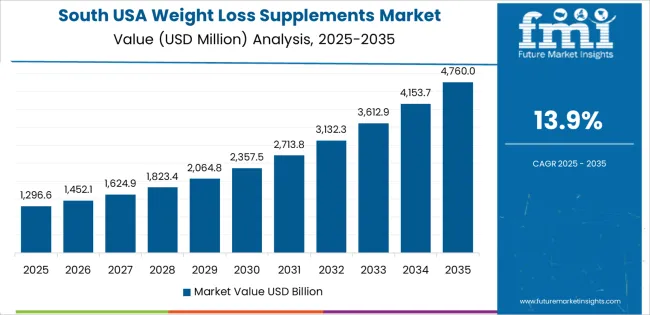
Usa Weight Loss Supplements Market Country Value Analysis

South USA is projected to grow at a CAGR of 13.9% through 2036 in demand for weight loss supplements. Urban centers such as Houston, Miami, and Atlanta increasingly adopt supplements including protein powders, herbal capsules, and functional drinks. Rising health awareness, dietary control, and lifestyle-focused consumption drive adoption. Manufacturers produce natural, plant-based, and nutrient-fortified formulations to meet diverse consumer needs. Retail and e-commerce channels expand product accessibility. The combination of fitness trends, obesity management initiatives, and rising disposable income supports steady growth in weight loss supplement consumption across South USA.

  • Houston, Miami, and Atlanta adopt protein powders and herbal capsules.
  • Functional drinks and nutrient-fortified products increase supplement adoption.
  • Fitness trends and dietary awareness drive regional consumer demand.
  • Retail and e-commerce channels expand weight loss supplement accessibility.

How Is Northeast USA Contributing to Demand for Weight Loss Supplements?

Northeast USA is projected to grow at a CAGR of 12.4% through 2036 in demand for weight loss supplements. Cities including New York, Boston, and Philadelphia increasingly consume capsules, powders, and drinks aimed at fat reduction, metabolism enhancement, and appetite management. Rising awareness of wellness, active lifestyles, and preventive health measures drive adoption. Manufacturers are producing natural, plant-based, and functional ingredient formulations. Retailers and e-commerce platforms expand availability in urban and suburban areas. Health-conscious populations, urban fitness trends, and lifestyle-focused consumption ensure steady adoption of weight loss supplements throughout Northeast USA.

  • New York, Boston, and Philadelphia consume capsules, powders, and drinks.
  • Fat reduction, metabolism, and appetite management drive supplement adoption.
  • Plant-based and functional ingredient formulations support consumer demand.
  • Urban fitness and lifestyle trends increase Northeast supplement consumption.

How Is Midwest USA Contributing to Demand for Weight Loss Supplements?

Midwest USA is projected to grow at a CAGR of 10.8% through 2036 in demand for weight loss supplements. Urban and suburban centers, including Chicago, Detroit, and Minneapolis, are increasingly adopting capsules, powders, and functional beverages for weight management, metabolism enhancement, and appetite control. Rising health awareness and lifestyle-focused consumption drive adoption. Manufacturers are supplying natural, plant-based, and nutrient-enriched formulations. Retail and online channels expand product accessibility in smaller cities. Fitness trends, preventive health initiatives, and urban wellness programs contribute to steady adoption of weight loss supplements across Midwest USA.

  • Chicago, Detroit, and Minneapolis adopt capsules, powders, and beverages.
  • Weight management and metabolism enhancement drive regional supplement demand.
  • Plant-based and nutrient-enriched formulations increase product adoption.
  • Retail and online channels expand availability across smaller cities.

Competitive Aligners for Market Players

Usa Weight Loss Supplements Market Analysis By Company

The competitive structure of the weight loss supplements market in the USA is moderately concentrated, with the top five manufacturers holding a combined retail and online value share exceeding 45%. Amway Corporation, Herbalife Nutrition, GNC, Glanbia Performance Nutrition Inc., and Ajinomoto Health & Nutrition compete through brand portfolio breadth, clinical substantiation investment, distribution channel coverage, and the ability to convert first-time buyers into subscription-based repeat customers. Competitive differentiation is increasingly defined by third-party certification status and the depth of published clinical evidence supporting product efficacy claims.

Companies with vertically integrated supply chains spanning ingredient sourcing, formulation, manufacturing, and direct-to-consumer fulfillment achieve cost structure advantages and quality control capabilities that contract-manufacturer-dependent brands cannot replicate. Multi-level marketing distribution models operated by Amway and Herbalife continue to generate meaningful volume, though the growth rate of these channels is decelerating relative to e-commerce direct-to-consumer platforms. Buyer leverage is fragmented across millions of individual consumers, but institutional buyers such as clinical weight management programs and corporate wellness platforms are emerging as volume aggregators that negotiate preferential pricing.

New entrant activity is concentrated in the personalized nutrition segment, where AI-driven formulation algorithms and at-home biomarker testing kits create differentiated consumer experiences that established mass-market brands have been slow to replicate. Startup brands with strong social media presence and influencer marketing capabilities are building consumer communities that function as both distribution channels and product development feedback loops. Private label programs at major retailers represent a growing competitive threat in the value tier of the market.
Key Players in Demand for Weight Loss Supplements in USA Market

  • Amway Corporation
  • Herbalife Nutrition
  • GNC
  • Glanbia Performance Nutrition Inc.
  • Ajinomoto Health & Nutrition

Scope of the Report

Usa Weight Loss Supplements Market Breakdown By Type, Form, And Region

Metric Value
Quantitative Units USD 2.04 Billion to USD 7.25 Billion, at a CAGR of 13.5%
Market Definition Weight loss supplements are dietary supplement products formulated to support body weight reduction, fat metabolism, appetite suppression, or metabolic rate enhancement. Product categories include vitamins, minerals, amino acids, protein concentrates, and natural or botanical extracts delivered in powder, capsule, tablet, and liquid formats.
Type Segmentation Vitamins, Minerals, Amino Acids, Protein, Natural/ Botanical Extracts, Others
Form Segmentation Powder, Capsule, Tablet, Liquid, Others
End Use Segmentation 19-40 years, Under 18 Years, 41 to 50 Years, Above 50 Years
Distribution Channel Segmentation Supermarket/Hypermarket, Pharmacies/ Drug Stores, Specialty Stores, Online Retail, Others
Regions Covered West, South, Northeast, Midwest
Key Companies Profiled Amway Corporation, Herbalife Nutrition, GNC, Glanbia Performance Nutrition Inc., Ajinomoto Health & Nutrition
Forecast Period 2026 to 2036
Approach Bottom-up methodology starting with category-level consumption data and applying regional penetration assumptions.

Demand for Weight Loss Supplements in USA Market Analysis by Segments

By Type:

Vitamins, Minerals, Amino Acids, Protein, Natural/ Botanical Extracts, Others

By Form:

Powder, Capsule, Tablet, Liquid, Others

By End Use:

19-40 years, Under 18 Years, 41 to 50 Years, Above 50 Years

By Distribution Channel:

Supermarket/Hypermarket, Pharmacies/ Drug Stores, Specialty Stores, Online Retail, Others

By Region:

West, South, Northeast, Midwest

Bibliography

  • 1. Food and Drug Administration. (2024). Dietary Supplement Labeling and Marketing Compliance Guidance. FDA.
  • 2. National Institutes of Health. (2024). Office of Dietary Supplements: Weight Loss Supplement Fact Sheet. NIH ODS.
  • 3. Federal Trade Commission. (2024). Enforcement Actions on Weight Loss Advertising Claims. FTC.
  • 4. United States Pharmacopeia. (2024). Dietary Supplement Verification Program Standards. USP.
  • 5. Centers for Disease Control and Prevention. (2024). National Health and Nutrition Examination Survey: Dietary Supplement Use Data. CDC NHANES.

This bibliography is provided for reader reference. The full Future Market Insights report contains the complete reference list with primary research documentation.

Frequently Asked Questions

How large is the Demand for Weight Loss Supplements in USA Market in 2026?

The Demand for Weight Loss Supplements in USA market is estimated to be valued at USD 2.04 billion in 2026.

What will be the market size of Demand for Weight Loss Supplements in USA by 2036?

The Demand for Weight Loss Supplements in USA market is projected to reach USD 7.25 billion by 2036.

What is the expected CAGR for Demand for Weight Loss Supplements in USA between 2026 and 2036?

The Demand for Weight Loss Supplements in USA market is expected to grow at a CAGR of 13.5% between 2026 and 2036.

Which Type is poised to lead in 2026?

Vitamins accounts for 60.0% share in 2026, maintaining its position as the leading type segment.

Which region is projected to grow the fastest?

West is projected to grow at a CAGR of 15.5% during 2026 to 2036, the fastest among all covered regions.

What does Demand for Weight Loss Supplements in USA mean in this report?

Weight loss supplements are dietary supplement products formulated to support body weight reduction, fat metabolism, appetite suppression, or metabolic rate enhancement. Product categories include vitamins, minerals, amino acids, protein concentrates, and natural or botanical extracts delivered in powder, capsule, tablet, and liquid formats.

What is included in the scope of this report?

Market scope includes all dietary supplement products marketed for weight loss, fat reduction, appetite management, or metabolic support across vitamins, minerals, amino acids, protein, and botanical extract categories. Format coverage spans powder, capsule, tablet, liquid, and other delivery systems.

How does FMI build and validate the Demand for Weight Loss Supplements in USA forecast?

Forecasting models apply a bottom-up methodology starting with category-level consumption data and cross-validate projections against trade statistics, manufacturer shipment disclosures, and regulatory filings.

Table of Content

  1. Executive Summary
    • USA Market Outlook
    • Demand to side Trends
    • Supply to side Trends
    • Technology Roadmap Analysis
    • Analysis and Recommendations
  2. Market Overview
    • Market Coverage / Taxonomy
    • Market Definition / Scope / Limitations
  3. Research Methodology
    • Chapter Orientation
    • Analytical Lens and Working Hypotheses
      • Market Structure, Signals, and Trend Drivers
      • Benchmarking and Cross-market Comparability
      • Market Sizing, Forecasting, and Opportunity Mapping
    • Research Design and Evidence Framework
      • Desk Research Programme (Secondary Evidence)
        • Company Annual and Sustainability Reports
        • Peer-reviewed Journals and Academic Literature
        • Corporate Websites, Product Literature, and Technical Notes
        • Earnings Decks and Investor Briefings
        • Statutory Filings and Regulatory Disclosures
        • Technical White Papers and Standards Notes
        • Trade Journals, Industry Magazines, and Analyst Briefs
        • Conference Proceedings, Webinars, and Seminar Materials
        • Government Statistics Portals and Public Data Releases
        • Press Releases and Reputable Media Coverage
        • Specialist Newsletters and Curated Briefings
        • Sector Databases and Reference Repositories
        • FMI Internal Proprietary Databases and Historical Market Datasets
        • Subscription Datasets and Paid Sources
        • Social Channels, Communities, and Digital Listening Inputs
        • Additional Desk Sources
      • Expert Input and Fieldwork (Primary Evidence)
        • Primary Modes
          • Qualitative Interviews and Expert Elicitation
          • Quantitative Surveys and Structured Data Capture
          • Blended Approach
        • Why Primary Evidence is Used
        • Field Techniques
          • Interviews
          • Surveys
          • Focus Groups
          • Observational and In-context Research
          • Social and Community Interactions
        • Stakeholder Universe Engaged
          • C-suite Leaders
          • Board Members
          • Presidents and Vice Presidents
          • R&D and Innovation Heads
          • Technical Specialists
          • Domain Subject-matter Experts
          • Scientists
          • Physicians and Other Healthcare Professionals
        • Governance, Ethics, and Data Stewardship
          • Research Ethics
          • Data Integrity and Handling
      • Tooling, Models, and Reference Databases
    • Data Engineering and Model Build
      • Data Acquisition and Ingestion
      • Cleaning, Normalisation, and Verification
      • Synthesis, Triangulation, and Analysis
    • Quality Assurance and Audit Trail
  4. Market Background
    • Market Dynamics
      • Drivers
      • Restraints
      • Opportunity
      • Trends
    • Scenario Forecast
      • Demand in Optimistic Scenario
      • Demand in Likely Scenario
      • Demand in Conservative Scenario
    • Opportunity Map Analysis
    • Product Life Cycle Analysis
    • Supply Chain Analysis
    • Investment Feasibility Matrix
    • Value Chain Analysis
    • PESTLE and Porter’s Analysis
    • Regulatory Landscape
    • Regional Parent Market Outlook
    • Production and Consumption Statistics
    • Import and Export Statistics
  5. USA Market Analysis 2021 to 2025 and Forecast, 2026 to 2036
    • Historical Market Size Value (USD Million) Analysis, 2021 to 2025
    • Current and Future Market Size Value (USD Million) Projections, 2026 to 2036
      • Y to o to Y Growth Trend Analysis
      • Absolute $ Opportunity Analysis
  6. USA Market Pricing Analysis 2021 to 2025 and Forecast 2026 to 2036
  7. USA Market Analysis 2021 to 2025 and Forecast 2026 to 2036, By Type
    • Introduction / Key Findings
    • Historical Market Size Value (USD Million) Analysis By Type , 2021 to 2025
    • Current and Future Market Size Value (USD Million) Analysis and Forecast By Type , 2026 to 2036
      • Vitamins
      • Minerals
      • Amino Acids
      • Protein
      • Natural/ Botanical Extracts
      • Others
    • Y to o to Y Growth Trend Analysis By Type , 2021 to 2025
    • Absolute $ Opportunity Analysis By Type , 2026 to 2036
  8. USA Market Analysis 2021 to 2025 and Forecast 2026 to 2036, By Form
    • Introduction / Key Findings
    • Historical Market Size Value (USD Million) Analysis By Form, 2021 to 2025
    • Current and Future Market Size Value (USD Million) Analysis and Forecast By Form, 2026 to 2036
      • Powder
      • Capsule
      • Tablet
      • Liquid
      • Others
    • Y to o to Y Growth Trend Analysis By Form, 2021 to 2025
    • Absolute $ Opportunity Analysis By Form, 2026 to 2036
  9. USA Market Analysis 2021 to 2025 and Forecast 2026 to 2036, By End Use
    • Introduction / Key Findings
    • Historical Market Size Value (USD Million) Analysis By End Use, 2021 to 2025
    • Current and Future Market Size Value (USD Million) Analysis and Forecast By End Use, 2026 to 2036
      • 19-40 years
      • Under 18 Years
      • 41 to 50 Years
      • Above 50 Years
    • Y to o to Y Growth Trend Analysis By End Use, 2021 to 2025
    • Absolute $ Opportunity Analysis By End Use, 2026 to 2036
  10. USA Market Analysis 2021 to 2025 and Forecast 2026 to 2036, By Distribution Channel
    • Introduction / Key Findings
    • Historical Market Size Value (USD Million) Analysis By Distribution Channel, 2021 to 2025
    • Current and Future Market Size Value (USD Million) Analysis and Forecast By Distribution Channel, 2026 to 2036
      • Supermarket/Hypermarket
      • Pharmacies/ Drug Stores
      • Specialty Stores
      • Online Retail
      • Others
    • Y to o to Y Growth Trend Analysis By Distribution Channel, 2021 to 2025
    • Absolute $ Opportunity Analysis By Distribution Channel, 2026 to 2036
  11. USA Market Analysis 2021 to 2025 and Forecast 2026 to 2036, By Region
    • Introduction
    • Historical Market Size Value (USD Million) Analysis By Region, 2021 to 2025
    • Current Market Size Value (USD Million) Analysis and Forecast By Region, 2026 to 2036
      • West
      • South
      • Northeast
      • Midwest
    • Market Attractiveness Analysis By Region
  12. West Market Analysis 2021 to 2025 and Forecast 2026 to 2036, By Country
    • Historical Market Size Value (USD Million) Trend Analysis By Market Taxonomy, 2021 to 2025
    • Market Size Value (USD Million) Forecast By Market Taxonomy, 2026 to 2036
      • By Country
      • By Type
      • By Form
      • By End Use
      • By Distribution Channel
    • Market Attractiveness Analysis
      • By Country
      • By Type
      • By Form
      • By End Use
      • By Distribution Channel
    • Key Takeaways
  13. South Market Analysis 2021 to 2025 and Forecast 2026 to 2036, By Country
    • Historical Market Size Value (USD Million) Trend Analysis By Market Taxonomy, 2021 to 2025
    • Market Size Value (USD Million) Forecast By Market Taxonomy, 2026 to 2036
      • By Country
      • By Type
      • By Form
      • By End Use
      • By Distribution Channel
    • Market Attractiveness Analysis
      • By Country
      • By Type
      • By Form
      • By End Use
      • By Distribution Channel
    • Key Takeaways
  14. Northeast Market Analysis 2021 to 2025 and Forecast 2026 to 2036, By Country
    • Historical Market Size Value (USD Million) Trend Analysis By Market Taxonomy, 2021 to 2025
    • Market Size Value (USD Million) Forecast By Market Taxonomy, 2026 to 2036
      • By Country
      • By Type
      • By Form
      • By End Use
      • By Distribution Channel
    • Market Attractiveness Analysis
      • By Country
      • By Type
      • By Form
      • By End Use
      • By Distribution Channel
    • Key Takeaways
  15. Midwest Market Analysis 2021 to 2025 and Forecast 2026 to 2036, By Country
    • Historical Market Size Value (USD Million) Trend Analysis By Market Taxonomy, 2021 to 2025
    • Market Size Value (USD Million) Forecast By Market Taxonomy, 2026 to 2036
      • By Country
      • By Type
      • By Form
      • By End Use
      • By Distribution Channel
    • Market Attractiveness Analysis
      • By Country
      • By Type
      • By Form
      • By End Use
      • By Distribution Channel
    • Key Takeaways
  16. Key Countries Market Analysis
    • USA
      • Pricing Analysis
      • Market Share Analysis, 2025
        • By Type
        • By Form
        • By End Use
        • By Distribution Channel
    • Canada
      • Pricing Analysis
      • Market Share Analysis, 2025
        • By Type
        • By Form
        • By End Use
        • By Distribution Channel
    • Mexico
      • Pricing Analysis
      • Market Share Analysis, 2025
        • By Type
        • By Form
        • By End Use
        • By Distribution Channel
    • Brazil
      • Pricing Analysis
      • Market Share Analysis, 2025
        • By Type
        • By Form
        • By End Use
        • By Distribution Channel
    • Chile
      • Pricing Analysis
      • Market Share Analysis, 2025
        • By Type
        • By Form
        • By End Use
        • By Distribution Channel
    • Germany
      • Pricing Analysis
      • Market Share Analysis, 2025
        • By Type
        • By Form
        • By End Use
        • By Distribution Channel
    • UK
      • Pricing Analysis
      • Market Share Analysis, 2025
        • By Type
        • By Form
        • By End Use
        • By Distribution Channel
    • Italy
      • Pricing Analysis
      • Market Share Analysis, 2025
        • By Type
        • By Form
        • By End Use
        • By Distribution Channel
    • Spain
      • Pricing Analysis
      • Market Share Analysis, 2025
        • By Type
        • By Form
        • By End Use
        • By Distribution Channel
    • France
      • Pricing Analysis
      • Market Share Analysis, 2025
        • By Type
        • By Form
        • By End Use
        • By Distribution Channel
    • India
      • Pricing Analysis
      • Market Share Analysis, 2025
        • By Type
        • By Form
        • By End Use
        • By Distribution Channel
    • ASEAN
      • Pricing Analysis
      • Market Share Analysis, 2025
        • By Type
        • By Form
        • By End Use
        • By Distribution Channel
    • Australia & New Zealand
      • Pricing Analysis
      • Market Share Analysis, 2025
        • By Type
        • By Form
        • By End Use
        • By Distribution Channel
    • China
      • Pricing Analysis
      • Market Share Analysis, 2025
        • By Type
        • By Form
        • By End Use
        • By Distribution Channel
    • Japan
      • Pricing Analysis
      • Market Share Analysis, 2025
        • By Type
        • By Form
        • By End Use
        • By Distribution Channel
    • South Korea
      • Pricing Analysis
      • Market Share Analysis, 2025
        • By Type
        • By Form
        • By End Use
        • By Distribution Channel
    • Russia
      • Pricing Analysis
      • Market Share Analysis, 2025
        • By Type
        • By Form
        • By End Use
        • By Distribution Channel
    • Poland
      • Pricing Analysis
      • Market Share Analysis, 2025
        • By Type
        • By Form
        • By End Use
        • By Distribution Channel
    • Hungary
      • Pricing Analysis
      • Market Share Analysis, 2025
        • By Type
        • By Form
        • By End Use
        • By Distribution Channel
    • Kingdom of Saudi Arabia
      • Pricing Analysis
      • Market Share Analysis, 2025
        • By Type
        • By Form
        • By End Use
        • By Distribution Channel
    • Turkiye
      • Pricing Analysis
      • Market Share Analysis, 2025
        • By Type
        • By Form
        • By End Use
        • By Distribution Channel
    • South Africa
      • Pricing Analysis
      • Market Share Analysis, 2025
        • By Type
        • By Form
        • By End Use
        • By Distribution Channel
  17. Market Structure Analysis
    • Competition Dashboard
    • Competition Benchmarking
    • Market Share Analysis of Top Players
      • By Regional
      • By Type
      • By Form
      • By End Use
      • By Distribution Channel
  18. Competition Analysis
    • Competition Deep Dive
      • Amway Corporation
        • Overview
        • Product Portfolio
        • Profitability by Market Segments (Product/Age /Sales Channel/Region)
        • Sales Footprint
        • Strategy Overview
          • Marketing Strategy
          • Product Strategy
          • Channel Strategy
      • Herbalife Nutrition
      • GNC
      • Glanbia Performance Nutrition Inc.
      • Ajinomoto Health & Nutrition
  19. Assumptions & Acronyms Used

List of Tables

  • Table 1: USA Market Value (USD Million) Forecast by Region, 2021 to 2036
  • Table 2: USA Market Value (USD Million) Forecast by Type , 2021 to 2036
  • Table 3: USA Market Value (USD Million) Forecast by Form, 2021 to 2036
  • Table 4: USA Market Value (USD Million) Forecast by End Use, 2021 to 2036
  • Table 5: USA Market Value (USD Million) Forecast by Distribution Channel, 2021 to 2036
  • Table 6: West Market Value (USD Million) Forecast by Country, 2021 to 2036
  • Table 7: West Market Value (USD Million) Forecast by Type , 2021 to 2036
  • Table 8: West Market Value (USD Million) Forecast by Form, 2021 to 2036
  • Table 9: West Market Value (USD Million) Forecast by End Use, 2021 to 2036
  • Table 10: West Market Value (USD Million) Forecast by Distribution Channel, 2021 to 2036
  • Table 11: South Market Value (USD Million) Forecast by Country, 2021 to 2036
  • Table 12: South Market Value (USD Million) Forecast by Type , 2021 to 2036
  • Table 13: South Market Value (USD Million) Forecast by Form, 2021 to 2036
  • Table 14: South Market Value (USD Million) Forecast by End Use, 2021 to 2036
  • Table 15: South Market Value (USD Million) Forecast by Distribution Channel, 2021 to 2036
  • Table 16: Northeast Market Value (USD Million) Forecast by Country, 2021 to 2036
  • Table 17: Northeast Market Value (USD Million) Forecast by Type , 2021 to 2036
  • Table 18: Northeast Market Value (USD Million) Forecast by Form, 2021 to 2036
  • Table 19: Northeast Market Value (USD Million) Forecast by End Use, 2021 to 2036
  • Table 20: Northeast Market Value (USD Million) Forecast by Distribution Channel, 2021 to 2036
  • Table 21: Midwest Market Value (USD Million) Forecast by Country, 2021 to 2036
  • Table 22: Midwest Market Value (USD Million) Forecast by Type , 2021 to 2036
  • Table 23: Midwest Market Value (USD Million) Forecast by Form, 2021 to 2036
  • Table 24: Midwest Market Value (USD Million) Forecast by End Use, 2021 to 2036
  • Table 25: Midwest Market Value (USD Million) Forecast by Distribution Channel, 2021 to 2036

List of Figures

  • Figure 1: USA Market Pricing Analysis
  • Figure 2: USA Market Value (USD Million) Forecast 2021-2036
  • Figure 3: USA Market Value Share and BPS Analysis by Type , 2026 and 2036
  • Figure 4: USA Market Y-o-Y Growth Comparison by Type , 2026-2036
  • Figure 5: USA Market Attractiveness Analysis by Type
  • Figure 6: USA Market Value Share and BPS Analysis by Form, 2026 and 2036
  • Figure 7: USA Market Y-o-Y Growth Comparison by Form, 2026-2036
  • Figure 8: USA Market Attractiveness Analysis by Form
  • Figure 9: USA Market Value Share and BPS Analysis by End Use, 2026 and 2036
  • Figure 10: USA Market Y-o-Y Growth Comparison by End Use, 2026-2036
  • Figure 11: USA Market Attractiveness Analysis by End Use
  • Figure 12: USA Market Value Share and BPS Analysis by Distribution Channel, 2026 and 2036
  • Figure 13: USA Market Y-o-Y Growth Comparison by Distribution Channel, 2026-2036
  • Figure 14: USA Market Attractiveness Analysis by Distribution Channel
  • Figure 15: USA Market Value (USD Million) Share and BPS Analysis by Region, 2026 and 2036
  • Figure 16: USA Market Y-o-Y Growth Comparison by Region, 2026-2036
  • Figure 17: USA Market Attractiveness Analysis by Region
  • Figure 18: West Market Incremental Dollar Opportunity, 2026-2036
  • Figure 19: South Market Incremental Dollar Opportunity, 2026-2036
  • Figure 20: Northeast Market Incremental Dollar Opportunity, 2026-2036
  • Figure 21: Midwest Market Incremental Dollar Opportunity, 2026-2036
  • Figure 22: West Market Value Share and BPS Analysis by Country, 2026 and 2036
  • Figure 23: West Market Value Share and BPS Analysis by Type , 2026 and 2036
  • Figure 24: West Market Y-o-Y Growth Comparison by Type , 2026-2036
  • Figure 25: West Market Attractiveness Analysis by Type
  • Figure 26: West Market Value Share and BPS Analysis by Form, 2026 and 2036
  • Figure 27: West Market Y-o-Y Growth Comparison by Form, 2026-2036
  • Figure 28: West Market Attractiveness Analysis by Form
  • Figure 29: West Market Value Share and BPS Analysis by End Use, 2026 and 2036
  • Figure 30: West Market Y-o-Y Growth Comparison by End Use, 2026-2036
  • Figure 31: West Market Attractiveness Analysis by End Use
  • Figure 32: West Market Value Share and BPS Analysis by Distribution Channel, 2026 and 2036
  • Figure 33: West Market Y-o-Y Growth Comparison by Distribution Channel, 2026-2036
  • Figure 34: West Market Attractiveness Analysis by Distribution Channel
  • Figure 35: South Market Value Share and BPS Analysis by Country, 2026 and 2036
  • Figure 36: South Market Value Share and BPS Analysis by Type , 2026 and 2036
  • Figure 37: South Market Y-o-Y Growth Comparison by Type , 2026-2036
  • Figure 38: South Market Attractiveness Analysis by Type
  • Figure 39: South Market Value Share and BPS Analysis by Form, 2026 and 2036
  • Figure 40: South Market Y-o-Y Growth Comparison by Form, 2026-2036
  • Figure 41: South Market Attractiveness Analysis by Form
  • Figure 42: South Market Value Share and BPS Analysis by End Use, 2026 and 2036
  • Figure 43: South Market Y-o-Y Growth Comparison by End Use, 2026-2036
  • Figure 44: South Market Attractiveness Analysis by End Use
  • Figure 45: South Market Value Share and BPS Analysis by Distribution Channel, 2026 and 2036
  • Figure 46: South Market Y-o-Y Growth Comparison by Distribution Channel, 2026-2036
  • Figure 47: South Market Attractiveness Analysis by Distribution Channel
  • Figure 48: Northeast Market Value Share and BPS Analysis by Country, 2026 and 2036
  • Figure 49: Northeast Market Value Share and BPS Analysis by Type , 2026 and 2036
  • Figure 50: Northeast Market Y-o-Y Growth Comparison by Type , 2026-2036
  • Figure 51: Northeast Market Attractiveness Analysis by Type
  • Figure 52: Northeast Market Value Share and BPS Analysis by Form, 2026 and 2036
  • Figure 53: Northeast Market Y-o-Y Growth Comparison by Form, 2026-2036
  • Figure 54: Northeast Market Attractiveness Analysis by Form
  • Figure 55: Northeast Market Value Share and BPS Analysis by End Use, 2026 and 2036
  • Figure 56: Northeast Market Y-o-Y Growth Comparison by End Use, 2026-2036
  • Figure 57: Northeast Market Attractiveness Analysis by End Use
  • Figure 58: Northeast Market Value Share and BPS Analysis by Distribution Channel, 2026 and 2036
  • Figure 59: Northeast Market Y-o-Y Growth Comparison by Distribution Channel, 2026-2036
  • Figure 60: Northeast Market Attractiveness Analysis by Distribution Channel
  • Figure 61: Midwest Market Value Share and BPS Analysis by Country, 2026 and 2036
  • Figure 62: Midwest Market Value Share and BPS Analysis by Type , 2026 and 2036
  • Figure 63: Midwest Market Y-o-Y Growth Comparison by Type , 2026-2036
  • Figure 64: Midwest Market Attractiveness Analysis by Type
  • Figure 65: Midwest Market Value Share and BPS Analysis by Form, 2026 and 2036
  • Figure 66: Midwest Market Y-o-Y Growth Comparison by Form, 2026-2036
  • Figure 67: Midwest Market Attractiveness Analysis by Form
  • Figure 68: Midwest Market Value Share and BPS Analysis by End Use, 2026 and 2036
  • Figure 69: Midwest Market Y-o-Y Growth Comparison by End Use, 2026-2036
  • Figure 70: Midwest Market Attractiveness Analysis by End Use
  • Figure 71: Midwest Market Value Share and BPS Analysis by Distribution Channel, 2026 and 2036
  • Figure 72: Midwest Market Y-o-Y Growth Comparison by Distribution Channel, 2026-2036
  • Figure 73: Midwest Market Attractiveness Analysis by Distribution Channel
  • Figure 74: USA Market - Tier Structure Analysis
  • Figure 75: USA Market - Company Share Analysis

Full Research Suite comprises of:

Market outlook & trends analysis

Market outlook & trends analysis

Interviews & case studies

Interviews & case studies

Strategic recommendations

Strategic recommendations

Vendor profiles & capabilities analysis

Vendor profiles & capabilities analysis

5-year forecasts

5-year forecasts

8 regions and 60+ country-level data splits

8 regions and 60+ country-level data splits

Market segment data splits

Market segment data splits

12 months of continuous data updates

12 months of continuous data updates

DELIVERED AS:

PDF EXCEL ONLINE

Full Research Suite


$5000

$7500

$10000

Buy Report Now
Similar Industry Reports

Similar Industry Reports

Future Market Insights

Demand for Weight Loss Supplements in USA

