

- Industry Size (2026)
- USD 64.6 Mn
- Forecast (2036)
- USD 295.7 Mn
- CAGR (2026 to 2036)
- 16.4%
Demand for Egg Substitute in USA 2026 to 2036
The USA egg substitute demand is valued at USD 64.6 million in 2026 and is projected to reach USD 295.7 million by 2036, reflecting a CAGR of 16.4%. Growth is driven by rising adoption of plant-based diets, increased awareness of egg allergies, and strong utilization of alternatives in commercial baking and food manufacturing. Supply volatility and price fluctuations in shell eggs further support transition toward stable, formulation-friendly substitutes.
Dry egg substitutes lead adoption because they offer extended shelf life, easy storage, and consistent functional performance in binding, leavening, and emulsification. Manufacturers strengthen formulations using protein isolates, starches, and fiber-based systems to match the texture and aeration properties of traditional eggs. Convenience in scaling for industrial bakery operations enhances their prominence.
The West, South, and Northeast regions reflect high demand supported by large health-conscious consumer bases and active food innovation ecosystems. Key suppliers include Tate and Lyle, Ingredion Inc., Corbion Puratos, Danone Nutricia, Florida Food Products LLC, and Fiberstar Inc. Their strategies focus on clean-label formulations, improved sensory performance, and ingredient systems tailored for bakery, confectionery, and ready-meal applications requiring reliable egg alternatives.
Quick Stats for USA Egg Substitute Demand
- USA Egg Substitute Sales Value (2026): USD 64.6 million
- USA Egg Substitute Forecast Value (2036): USD 295.7 million
- USA Egg Substitute Forecast CAGR (2026–2036): 16.4%
- Leading Form Segment in USA Egg Substitute Demand: Dry Egg Substitutes
- Key Growth Regions in USA Egg Substitute Demand: West USA, South USA, Northeast USA
- Top Players in USA Egg Substitute Demand: Tate and Lyle, Ingredion Inc., Corbion Puratos, Danone Nutricia, Florida Food Products LLC, Fiberstar Inc.
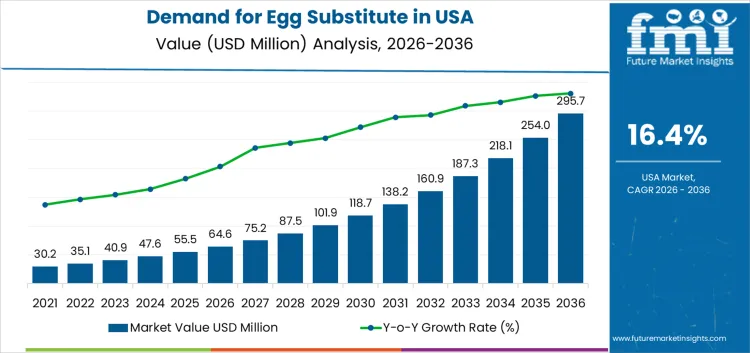
What is the Growth Forecast for Egg Substitute Industry in USA through 2036?
The early vs late growth curve comparison for egg substitute demand in the United States shows a shift from limited initial adoption to broader late-stage expansion shaped by dietary preferences, supply stability, and formulation advances. Early-curve growth remains modest because usage concentrates in niche segments including vegan baking, allergy-specific diets, and select industrial applications. Early adoption progresses slowly because product familiarity, functional consistency, and distribution reach remain constrained across mainstream retail and food service channels. These conditions create a shallow early curve defined by concentrated demand pockets.
Late-curve growth shows stronger momentum as product formulations improve and functional performance aligns more closely with conventional eggs in baking and processed food production. Broader consumer interest in plant-based options increases late-stage demand, supported by clearer labeling standards and wider placement in retail channels. Commercial bakeries and packaged food producers integrate egg substitutes into selected formulations to manage cost exposure and supply variability, adding consistent demand during the later phase.
Institutional buyers expand usage in controlled-diet settings, strengthening the later curve through predictable procurement cycles. The comparison indicates a transition from a narrow early stage shaped by limited awareness and functional constraints to a more robust late stage driven by product refinement, diversified applications, and improved accessibility across domestic food systems.
USA Egg Substitute Key Takeaways
| Metric | Value |
|---|---|
| USA Egg Substitute Sales Value (2026) | USD 64.6 million |
| USA Egg Substitute Forecast Value (2036) | USD 295.7 million |
| USA Egg Substitute Forecast CAGR (2026-2036) | 16.4% |
Why is the Demand for Egg Substitute in USA Growing?
Demand for egg substitutes in the United States grows due to rising interest in plant based ingredients, allergen management, and supply stability across food processing and household consumption. Manufacturers adopt substitutes to maintain consistent formulation quality when egg availability fluctuates due to disease outbreaks or production constraints. Foodservice operators use plant based powders and liquid formulations to support menu options for individuals with egg allergies or dietary preferences that exclude animal derived inputs. Bakeries and packaged food producers incorporate substitutes to achieve reliable texture, binding, and aeration in breads, cakes, snacks, and ready meals.
Consumers purchase alternatives due to interest in products with lower cholesterol and longer shelf life. Retailers expand shelf space for plant based replacements that support vegan and flexitarian eating patterns. Growth in meal kits and prepared foods increases the need for ingredients that maintain functional performance across varied cooking conditions. Institutional programs in schools, hospitals, and corporate campuses integrate substitutes to meet nutritional guidelines and accommodate dietary restrictions. Research in protein extraction and functional starch systems improves the performance of substitute formulations across diverse applications.
Which Form and Source Segments Lead Demand for Egg Substitutes in USA?
Demand for egg substitutes in the USA is shaped by dietary preferences, allergen avoidance, product reformulation needs, and the shift toward plant-forward ingredients across food manufacturing and foodservice. Buyers evaluate functional performance in baking, binding, and emulsification. Adoption patterns reflect nutritional expectations, cost considerations, and suitability for large-scale production environments.
By Form, Dry Egg Substitutes Account for the Largest Share of Demand
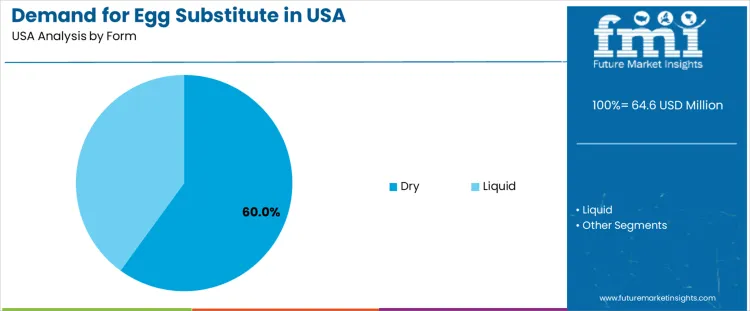
Dry egg substitutes hold 60.0%, making them the leading form segment in USA demand. Their extended shelf life, stability during transport, and consistent performance in baking and industrial mixes support broad adoption. Dry formats integrate easily into powdered blends and processed foods, enabling predictable hydration and functionality. Liquid substitutes hold 40.0%, used in commercial kitchens, ready-mix operations, and applications requiring direct pourability. Liquid forms support convenience and reduce preparation time but require cold storage and shorter handling windows. Form distribution reflects manufacturing needs, storage efficiency, and functional consistency across varied food applications.
Key Points:
- Dry formats offer long shelf life and blending versatility.
- Liquid forms support convenience and ready-use workflows.
- Selection depends on storage capacity and application needs.
- Distribution aligns with industrial and foodservice operations.
By Source, Plant-Based Egg Substitutes Represent the Largest Segment
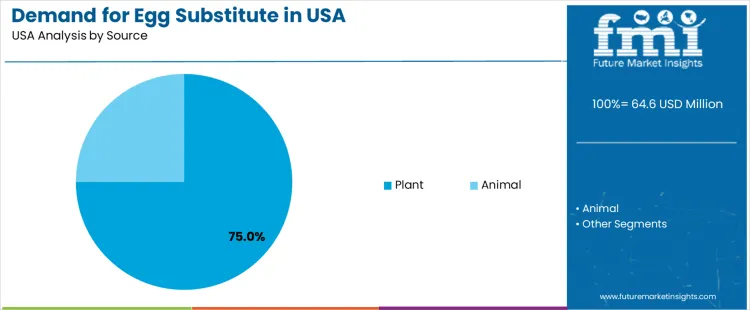
Plant sources hold 75.0%, making them the dominant category in USA egg substitute demand. These substitutes support vegan formulations, allergen-free product development, and sustainability-focused purchasing. Their functional proteins mimic binding and emulsification properties needed in bakery, confectionery, and prepared foods. Animal-based substitutes hold 25.0%, serving niche applications where conventional protein structures remain preferred or where partial replacement is needed. Source distribution reflects consumer dietary trends, regulatory labeling considerations, and manufacturer preference for consistent, scalable plant-derived ingredients.
Key Points:
- Plant-based substitutes dominate due to dietary and functional advantages.
- Animal-based options serve specialized or transitional applications.
- Distribution reflects clean-label and allergen-sensitive preferences.
- Source selection aligns with formulation goals and consumer expectations.
What are the Key Dynamics in the Egg Substitute Industry?
Food manufacturing needs, dietary preferences, and supply stability considerations are driving demand.
Demand increases as US bakeries, packaged food producers, and foodservice chains incorporate egg substitutes to maintain consistent formulation performance during periods of egg price volatility. Commercial kitchens use substitutes to support allergen management programs that require clear ingredient controls. Plant-based diets gain wider adoption, which raises interest in non-egg binding and leavening agents for breads, desserts, and sauces. Large processors select substitutes that deliver stable moisture retention and emulsification across high-volume production. Institutional buyers seek products with longer shelf life for inventory predictability. Regional food manufacturers evaluate powdered and liquid alternatives that match existing equipment workflows.
Cost differentials, functional variability, and regulatory labelling requirements restrain broader utilization.
Procurement teams assess price differences between egg substitutes and conventional shell eggs, which influences adoption during stable egg supply periods. Several facilities report functional variation across substitute types that affects texture, aeration, and colour consistency in baked goods. Reformulation requires testing time and staff expertise, which increases operational workload for smaller manufacturers. Labelling rules for allergens, additives, and nutritional claims add compliance complexity. Foodservice operators with limited storage space reduce inventory of specialized substitutes. Consumer acceptance varies when products display noticeable sensory differences, which affects decisions in retail bakery categories.
Ingredient innovation, clean-label reformulation, and plant-protein diversification shape current trends.
US manufacturers expand development of substitutes based on pea protein, mung bean protein, and starch blends designed for improved foaming and binding behaviour. Food processors request clean-label formulations that reduce reliance on synthetic additives. Bakeries evaluate multifunctional powders that enhance stability across frozen and ambient distribution channels. Ready-to-eat meal producers adopt substitutes compatible with automated mixing and portioning systems. Retail brands introduce allergen-free baking mixes that integrate pre-measured egg alternatives. Ingredient suppliers develop high-solubility proteins that mimic whole-egg functionality in premium bakery products. Sustainability-focused purchasing programs increase interest in plant-based ingredients with predictable supply availability.
Analysis of the Demand for Egg Substitutes in the USA by Region
Demand for egg substitutes in the USA is increasing due to rising interest in plant-based formulations, broader dietary preferences, and strong engagement from food manufacturers seeking allergen-friendly and shelf-stable ingredients. West USA records a CAGR of 18.9% supported by widespread adoption of plant-based foods. South USA shows a 16.9% CAGR driven by expanding retail penetration and higher consumption of packaged goods using egg alternatives. Northeast USA posts a 15.1% CAGR due to dense food-processing activity and strong alignment with dietary diversification. Midwest USA holds a 13.1% CAGR supported by manufacturing demand and consistent use of substitutes in bakery and prepared-food applications.
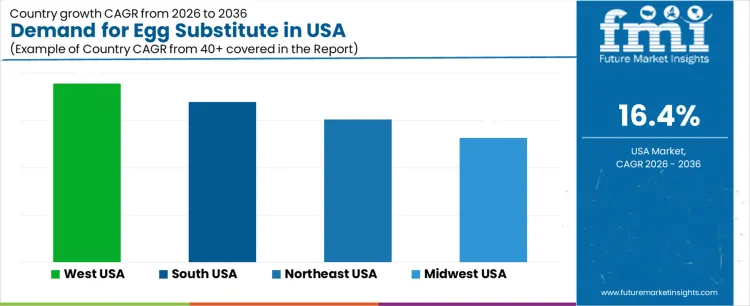
| Region | CAGR (2026-2036) |
|---|---|
| West USA | 18.9% |
| South USA | 16.9% |
| Northeast USA | 15.1% |
| Midwest USA | 13.1% |
How is the West USA driving demand for Egg Substitutes?
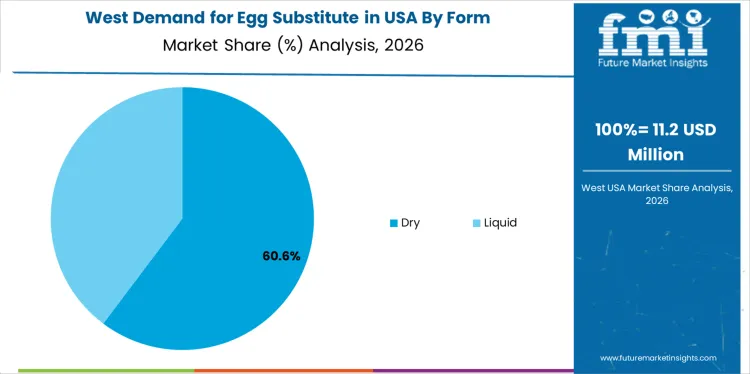
West USA drives demand due to its strong concentration of consumers adopting plant-forward diets and its high presence of food-innovation firms. The region’s CAGR of 18.9% reflects strong uptake of egg alternatives across retail, food service, and packaged-food manufacturing. The region supports continuous usage of plant-based powders, emulsifiers, and liquid egg replacements due to interest in allergen-friendly and vegan formulations. Bakery operations integrate substitutes to maintain consistent product performance while aligning with evolving ingredient expectations. Research and product-development centers test advanced formulations for texture and binding control. The region’s fast-growing packaged-food ecosystem sustains year-round demand for stable, scalable egg-replacement ingredients.
- High adoption of plant-forward consumer diets
- Continuous use of substitutes across bakeries and food service
- Strong presence of food-innovation and R&D facilities
- Steady demand for allergen-friendly ingredient solutions
How is the South USA driving demand for Egg Substitutes?
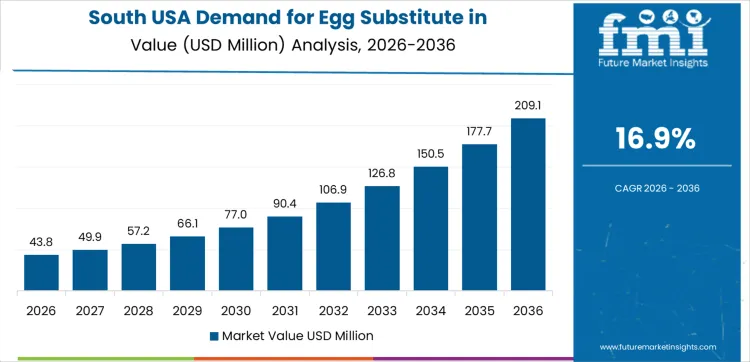
South USA supports rising demand through expanding retail distribution and growing consumption of packaged foods incorporating replacer ingredients. The region’s CAGR of 16.9% reflects increasing use of egg substitutes in bakery manufacturing, quick-service restaurants, and household cooking. Food processors adopt substitutes to manage cost variability and improve formulation stability. Regional consumers show rising interest in low-cholesterol and allergen-reduced products. Large-scale food distributors support consistent movement of egg-replacement powders and liquid formulations. Manufacturing clusters integrate substitutes to standardize production where ingredient consistency is required.
- Expanding retail and food-service distribution
- Rising interest in low-cholesterol and allergen-reduced options
- Steady use in bakery and packaged-food manufacturing
- Reliable supply supported by regional distribution networks
How is the Northeast USA driving demand for Egg Substitutes?
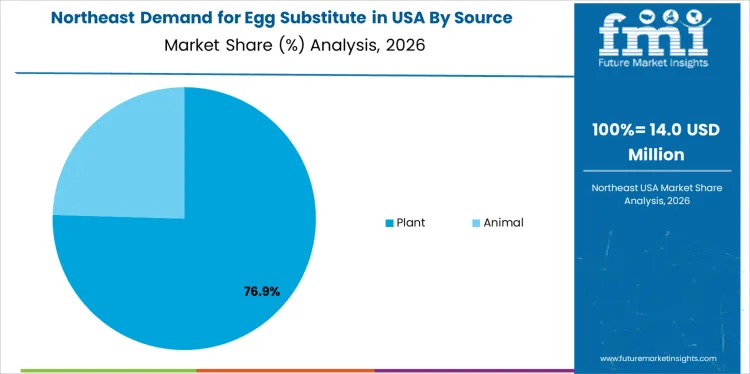
Northeast USA drives demand due to its concentration of food processors, institutional buyers, and consumers adopting diversified dietary patterns. The region’s CAGR of 15.1% reflects consistent integration of egg alternatives in ready-to-eat meals, commercial bakeries, and large-scale kitchens. Manufacturers rely on substitutes to manage formulation risks tied to egg price fluctuations and shelf-life constraints. Universities, healthcare systems, and food-service operators purchase substitutes for standardized menu planning. Interest in allergen management supports ongoing uptake across retail channels. Product developers in the region continue testing optimized blends for binding, aeration, and moisture control.
- Strong presence of commercial bakeries and food processors
- Institutional procurement supporting consistent usage
- Rising consumer focus on diversified dietary preferences
- Ongoing development of optimized egg-replacement blends
How is the Midwest USA driving demand for Egg Substitutes?
Midwest USA maintains steady demand supported by its extensive food-manufacturing base and strong bakery and packaged-food production activity. The region’s CAGR of 13.1% reflects routine use of substitutes to support scalable mixing, binding, and texture requirements. Manufacturers integrate egg alternatives to achieve consistent batch performance across high-volume production lines. Food processors adopt substitutes to reduce allergen-associated operational complexity. Regional grocery chains increase shelf space for plant-based staples, supporting predictable retail demand. Institutional kitchens within schools and healthcare systems maintain steady consumption due to standardized recipe requirements.
- Extensive manufacturing and bakery activity
- Routine use for binding and texture control in production
- Reduced allergen-handling complexity for processors
- Predictable retail and institutional purchasing patterns
What is the competitive landscape of the demand for egg substitutes in the USA?
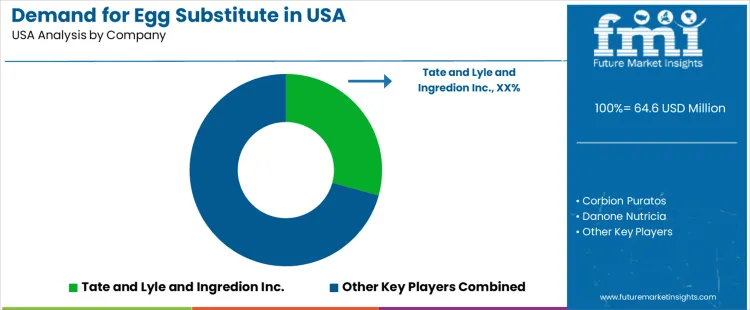
Demand for egg substitutes in the USA aligns with requirements for clean-label ingredients, allergen-free formulations, shelf-stable functionality, and reliable performance in bakery, prepared foods, and plant-based products. Buyers evaluate emulsification strength, foaming stability, moisture retention, and heat tolerance across commercial mixing, baking, and processing environments. Procurement teams consider formulation compatibility, batch consistency, and documented functional performance supporting large-scale food manufacturing. Adoption patterns reflect interest in cost stabilization, dietary diversification, and reduced dependence on shell eggs within industrial applications.
Tate and Lyle together with Ingredion Inc. hold a strong combined position, supported by broad portfolios of starches, hydrocolloids, and texturizing systems that replicate binding and aeration in bakery and snack applications. Corbion Puratos contributes through enzyme systems and fermentation based solutions that improve dough structure and moisture control. Danone Nutricia remains visible through nutritional formulations for specialized diets addressing allergen needs. Florida Food Products and Fiberstar strengthen clean label demand with vegetable and citrus fiber solutions.
Key Players in USA Egg Substitute Demand
- Tate and Lyle and Ingredion Inc.
- Corbion Puratos
- Danone Nutricia
- Florida Food Products LLC
- Fiberstar Inc.
Scope of the Report
| Items | Values |
|---|---|
| Quantitative Units | USD million |
| Form | Dry, Liquid |
| Source | Plant, Animal |
| Ingredient | Dairy Proteins, Starch, Algal Flour, Soy-based Products |
| Distribution Channel | Convenience Stores, Hypermarkets, Departmental Stores |
| Regions Covered | West USA, South USA, Northeast USA, Midwest USA |
| Key Companies Profiled | Tate and Lyle, Ingredion Inc., Corbion Puratos, Danone Nutricia, Florida Food Products LLC, Fiberstar Inc. |
| Additional Attributes | Dollar sales by form, source, ingredient, and distribution channels; regional demand variation across West, South, Northeast, and Midwest USA; adoption trends in plant-based formulations; application alignment with bakery, confectionery, and ready-meal categories; competitive positioning of ingredient manufacturers; development of allergen-free, clean-label, and functional egg replacement systems. |
USA Egg Substitute Demand by Segments
Form:
- Dry
- Liquid
Source:
- Plant
- Animal
Ingredient:
- Dairy Proteins
- Starch
- Algal Flour
- Soy-based Products
Distribution Channel:
- Convenience Stores
- Hypermarkets
- Departmental Stores
Region:
- West USA
- South USA
- Northeast USA
- Midwest USA
Frequently Asked Questions
How big is the demand for egg substitute in USA in 2026?
The demand for egg substitute in USA is estimated to be valued at USD 64.6 million in 2026.
What will be the size of egg substitute in USA in 2036?
The market size for the egg substitute in USA is projected to reach USD 295.7 million by 2036.
How much will be the demand for egg substitute in USA growth between 2026 and 2036?
The demand for egg substitute in USA is expected to grow at a 16.4% CAGR between 2026 and 2036.
What are the key product types in the egg substitute in USA?
The key product types in egg substitute in USA are dry and liquid.
Which source segment is expected to contribute significant share in the egg substitute in USA in 2026?
In terms of source, plant segment is expected to command 75.0% share in the egg substitute in USA in 2026.
Preview the report firsthand - request a free sample
Get SampleGet the brochure for pricing and purchase details.
Get PDFTable of Content
- Executive Summary
- USA Market Outlook
- Demand-side Trends
- Supply-side Trends
- Technology Roadmap Analysis
- Analysis and Recommendations
- Executive Summary
- USA Market Outlook
- Demand-side Trends
- Supply-side Trends
- Technology Roadmap Analysis
- Analysis and Recommendations
- Market Overview
- Market Coverage / Taxonomy
- Market Definition / Scope / Limitations
- Market Background
- Market Dynamics
- Drivers
- Restraints
- Opportunity
- Trends
- Scenario Forecast
- Demand in Optimistic Scenario
- Demand in Likely Scenario
- Demand in Conservative Scenario
- Opportunity Map Analysis
- Product Life Cycle Analysis
- Supply Chain Analysis
- Investment Feasibility Matrix
- Value Chain Analysis
- PESTLE and Porter’s Analysis
- Regulatory Landscape
- Regional Parent Market Outlook
- Production and Consumption Statistics
- Import and Export Statistics
- Market Dynamics
- USA Market Analysis 2021 to 2026 and Forecast, 2026 to 2036
- Historical Market Size Value (USD Million) Analysis, 2021 to 2026
- Current and Future Market Size Value (USD Million) Projections, 2026 to 2036
- Y-o-Y Growth Trend Analysis
- Absolute $ Opportunity Analysis
- USA Market Pricing Analysis 2021 to 2026 and Forecast 2026 to 2036
- USA Market Analysis 2021 to 2026 and Forecast 2026 to 2036, By Form
- Introduction / Key Findings
- Historical Market Size Value (USD Million) Analysis By Form , 2021 to 2026
- Current and Future Market Size Value (USD Million) Analysis and Forecast By Form , 2026 to 2036
- Dry
- Liquid
- Y-o-Y Growth Trend Analysis By Form , 2021 to 2026
- Absolute $ Opportunity Analysis By Form , 2026 to 2036
- USA Market Analysis 2021 to 2026 and Forecast 2026 to 2036, By Source
- Introduction / Key Findings
- Historical Market Size Value (USD Million) Analysis By Source, 2021 to 2026
- Current and Future Market Size Value (USD Million) Analysis and Forecast By Source, 2026 to 2036
- Plant
- Animal
- Y-o-Y Growth Trend Analysis By Source, 2021 to 2026
- Absolute $ Opportunity Analysis By Source, 2026 to 2036
- USA Market Analysis 2021 to 2026 and Forecast 2026 to 2036, By Ingredient
- Introduction / Key Findings
- Historical Market Size Value (USD Million) Analysis By Ingredient, 2021 to 2026
- Current and Future Market Size Value (USD Million) Analysis and Forecast By Ingredient, 2026 to 2036
- Dairy Proteins
- Starch
- Algal Flour
- Soy-based Products
- Y-o-Y Growth Trend Analysis By Ingredient, 2021 to 2026
- Absolute $ Opportunity Analysis By Ingredient, 2026 to 2036
- USA Market Analysis 2021 to 2026 and Forecast 2026 to 2036, By Distribution Channel
- Introduction / Key Findings
- Historical Market Size Value (USD Million) Analysis By Distribution Channel, 2021 to 2026
- Current and Future Market Size Value (USD Million) Analysis and Forecast By Distribution Channel, 2026 to 2036
- Hypermarkets
- Departmental Stores
- Convenience Stores
- Y-o-Y Growth Trend Analysis By Distribution Channel, 2021 to 2026
- Absolute $ Opportunity Analysis By Distribution Channel, 2026 to 2036
- Market Structure Analysis
- Competition Dashboard
- Competition Benchmarking
- Market Share Analysis of Top Players
- By Regional
- By Form
- By Source
- By Ingredient
- By Distribution Channel
- Competition Analysis
- Competition Deep Dive
- Tate and Lyle and Ingredion Inc.
- Overview
- Product Portfolio
- Profitability by Market Segments (Product/Age /Sales Channel/Region)
- Sales Footprint
- Strategy Overview
- Marketing Strategy
- Product Strategy
- Channel Strategy
- Corbion Puratos
- Danone Nutricia
- Florida Food Products LLC
- Fiberstar Inc.
- Tate and Lyle and Ingredion Inc.
- Competition Deep Dive
- Assumptions & Acronyms Used
- Research Methodology
- Market Overview
- Market Coverage / Taxonomy
- Market Definition / Scope / Limitations
- Market Background
- Market Dynamics
- Drivers
- Restraints
- Opportunity
- Trends
- Scenario Forecast
- Demand in Optimistic Scenario
- Demand in Likely Scenario
- Demand in Conservative Scenario
- Opportunity Map Analysis
- Product Life Cycle Analysis
- Supply Chain Analysis
- Investment Feasibility Matrix
- Value Chain Analysis
- PESTLE and Porter’s Analysis
- Regulatory Landscape
- Regional Parent Market Outlook
- Production and Consumption Statistics
- Import and Export Statistics
- Market Dynamics
- USA Market Analysis 2020 to 2024 and Forecast, 2025 to 2035
- Historical Market Size Value (USD Million) Analysis, 2020 to 2024
- Current and Future Market Size Value (USD Million) Projections, 2025 to 2035
- Y-o-Y Growth Trend Analysis
- Absolute $ Opportunity Analysis
- USA Market Pricing Analysis 2020 to 2024 and Forecast 2025 to 2035
- USA Market Analysis 2020 to 2024 and Forecast 2025 to 2035, By Form
- Introduction / Key Findings
- Historical Market Size Value (USD Million) Analysis By Form , 2020 to 2024
- Current and Future Market Size Value (USD Million) Analysis and Forecast By Form , 2025 to 2035
- Dry
- Liquid
- Y-o-Y Growth Trend Analysis By Form , 2020 to 2024
- Absolute $ Opportunity Analysis By Form , 2025 to 2035
- USA Market Analysis 2020 to 2024 and Forecast 2025 to 2035, By Source
- Introduction / Key Findings
- Historical Market Size Value (USD Million) Analysis By Source, 2020 to 2024
- Current and Future Market Size Value (USD Million) Analysis and Forecast By Source, 2025 to 2035
- Plant
- Animal
- Y-o-Y Growth Trend Analysis By Source, 2020 to 2024
- Absolute $ Opportunity Analysis By Source, 2025 to 2035
- USA Market Analysis 2020 to 2024 and Forecast 2025 to 2035, By Ingredient
- Introduction / Key Findings
- Historical Market Size Value (USD Million) Analysis By Ingredient, 2020 to 2024
- Current and Future Market Size Value (USD Million) Analysis and Forecast By Ingredient, 2025 to 2035
- Dairy Proteins
- Starch
- Algal Flour
- Soy-based Products
- Y-o-Y Growth Trend Analysis By Ingredient, 2020 to 2024
- Absolute $ Opportunity Analysis By Ingredient, 2025 to 2035
- USA Market Analysis 2020 to 2024 and Forecast 2025 to 2035, By Distribution Channel
- Introduction / Key Findings
- Historical Market Size Value (USD Million) Analysis By Distribution Channel, 2020 to 2024
- Current and Future Market Size Value (USD Million) Analysis and Forecast By Distribution Channel, 2025 to 2035
- Hypermarkets
- Departmental Stores
- Convenience Stores
- Y-o-Y Growth Trend Analysis By Distribution Channel, 2020 to 2024
- Absolute $ Opportunity Analysis By Distribution Channel, 2025 to 2035
- Market Structure Analysis
- Competition Dashboard
- Competition Benchmarking
- Market Share Analysis of Top Players
- By Regional
- By Form
- By Source
- By Ingredient
- By Distribution Channel
- Competition Analysis
- Competition Deep Dive
- Tate and Lyle and Ingredion Inc.
- Overview
- Product Portfolio
- Profitability by Market Segments (Product/Age /Sales Channel/Region)
- Sales Footprint
- Strategy Overview
- Marketing Strategy
- Product Strategy
- Channel Strategy
- Corbion Puratos
- Danone Nutricia
- Florida Food Products LLC
- Fiberstar Inc.
- Tate and Lyle and Ingredion Inc.
- Competition Deep Dive
- Assumptions & Acronyms Used
- Research Methodology


