

- Industry Size (2026)
- USD 3.50 Bn
- Forecast (2036)
- USD 11.89 Bn
- CAGR (2026 to 2036)
- 13.00%
Supply Chain Visibility Software Market size, market forecast and outlook by FMI
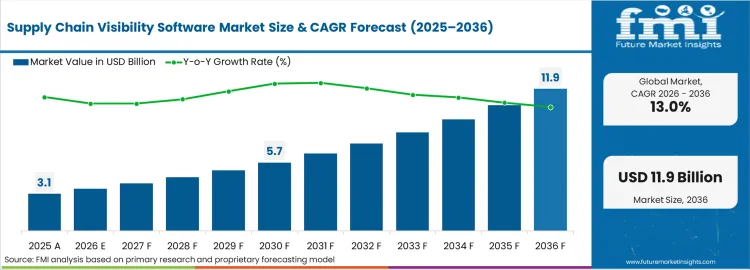
The supply chain visibility software market was valued at USD 3.10 billion in 2025, projected to reach USD 3.50 billion in 2026, and is forecast to expand to USD 11.89 billion by 2036 at a 13.00% CAGR. Based on Future Market Insights analysis, the market is set to add an incremental opportunity worth USD 8.39 billion over the forecast period. As per FMI, the procurement landscape for supply chain visibility software is being reshaped by evolving specification requirements, regional capacity investments, and shifting end-use demand patterns across established and emerging buyer segments.
Summary of Supply Chain Visibility Software Market
- Supply Chain Visibility Software Market definition
- Supply chain visibility software platforms aggregate, normalize, and present real-time data from transportation management systems, warehouse management systems, IoT sensor networks, and trading partner EDI feeds to provide end-to-end shipment tracking, inventory positioning, and exception alerting across multi-tier supply chain networks.
- Demand drivers in the market
- Supply chain disruption frequency across ocean freight, land transport, and air cargo networks has compelled logistics directors to invest in real-time shipment visibility platforms that identify delays and rerouting options before downstream production schedules are affected.
- Cloud-based deployment models are enabling mid-market manufacturers and distributors to access supply chain visibility capabilities that were previously available only through enterprise-scale platform investments requiring multi-million-dollar implementation budgets.
- Customs and trade compliance digitization mandates across the EU, United States, and Asia Pacific are forcing importers to integrate visibility platforms with customs brokerage systems to maintain audit-ready shipment documentation and automated duty calculation.
- Key segments analyzed in the FMI report
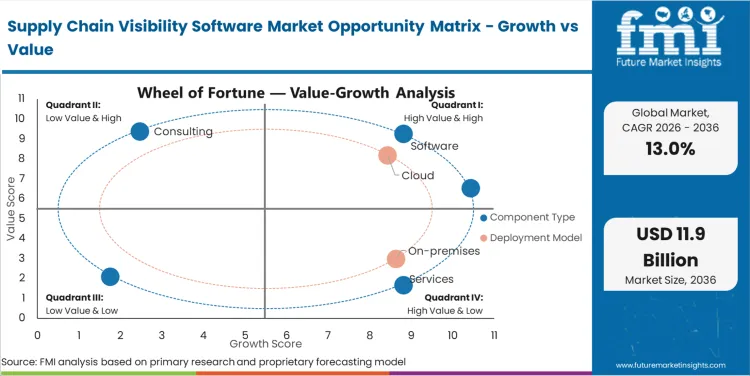
- Software component type: 61.0% share in 2026, reflecting established procurement specifications and supply chain infrastructure favoring this variant.
- Cloud deployment model: 68.0% share in 2026, driven by end-use requirements in the primary application channels.
- China: 17.60% compound growth, supported by domestic investment and rising consumption.
- Analyst opinion at FMI
- Sudip saha, Principal Consultant for Technology observe that The supply chain visibility software market is transitioning from a standalone technology purchase to an embedded layer within broader supply chain execution platforms. FMI is of the opinion that the vendors capturing durable market share are those building multi-enterprise networks where each additional carrier, supplier, or logistics provider participant increases the platform value for all existing users. The risk for single-enterprise visibility tools is network irrelevance: buyers will migrate to platforms where their trading partners already participate rather than maintaining parallel data collection agreements with non-networked solutions.
- Strategic implications / executive takeaways
- Logistics directors should evaluate supply chain visibility platforms based on the size and relevance of their pre-existing carrier and supplier network rather than feature functionality alone, because network breadth determines data completeness.
- IT architects must prioritize platforms with API-first integration architectures that connect to existing TMS, WMS, and ERP systems without requiring middleware layers that introduce latency and maintenance overhead.
- Supply chain risk managers should specify visibility platforms with predictive ETA and exception scoring capabilities to shift from reactive disruption response to proactive supply chain risk mitigation.
Supply Chain Visibility Software Market key takeaways
| Metric | Details |
|---|---|
| Industry Size (2026) | USD 3.50 billion |
| Industry Value (2036) | USD 11.89 billion |
| CAGR (2026 to 2036) | 13.00% |
Source: Future Market Insights, 2026
Three parallel forces are accelerating supply chain visibility software adoption beyond early-adopter logistics organizations. First, shipper expectations for real-time tracking granularity have shifted from milestone-based updates to continuous GPS-level visibility, and carriers that cannot provide this data face exclusion from preferred carrier programs operated by major retailers and manufacturers. Second, the convergence of visibility and planning is creating integrated platforms where real-time tracking data feeds directly into demand sensing and inventory repositioning algorithms, replacing the disconnected spreadsheet reconciliation processes that previously delayed response to supply disruptions.
Third, multi-enterprise data sharing models are maturing as visibility networks achieve critical mass of carrier and supplier participants, reducing the onboarding friction that previously limited platform utility for organizations with fragmented supplier bases. Across tracked geographies, China sets the pace at 17.60% CAGR. India follows at 16.30%. Germany follows at 15.00%. France follows at 13.70%. UK follows at 12.40%. USA follows at 11.10%. Brazil follows at 9.80%.
Supply Chain Visibility Software Market definition
Supply chain visibility software represents the enterprise technology layer that collects and correlates supply chain event data from disparate operational systems to deliver a unified view of material flow, inventory position, and logistics execution status. These platforms process structured and unstructured data from carriers, warehouses, customs brokers, and production facilities to enable proactive exception management and predictive ETA computation.
Supply Chain Visibility Software Market inclusions
Market scope includes all commercially traded supply chain visibility solutions segmented by component type (software, services), deployment model (cloud, on-premise), and enterprise size (large enterprises, small and medium enterprises). Revenue sizing spans the 2026 to 2036 forecast period with regional and country-level assessments.
Supply Chain Visibility Software Market exclusions
The scope excludes standalone transportation management systems, warehouse management systems, and enterprise resource planning platforms unless they include dedicated multi-enterprise visibility modules. Fleet telematics hardware and IoT sensor devices sold without visibility software are outside the defined boundary.
Supply Chain Visibility Software Market research methodology
- Primary research: FMI analysts conducted interviews with procurement directors, engineering leads, and supply chain managers across key supply chain visibility software organizations to map decision gates and sourcing specifications.
- Desk research: Data collection phases aggregated regulatory filings, trade association publications, standards body documentation, and company annual reports to establish verifiable baseline parameters.
- Market sizing and forecasting: Baseline values derive from a bottom-up aggregation of supply chain visibility software transaction volumes, applying region-specific adoption curves and pricing indices to project forward demand through 2036.
- Data validation and update cycle: Projections are tested against publicly reported procurement volumes, trade flow statistics, and company financial disclosures on a quarterly refresh schedule.
Why is the Supply Chain Visibility Software Market Growing?
Enterprises are actively pursuing digital transformation strategies that integrate advanced visibility platforms across logistics, inventory, and procurement functions. Supply chain transparency is being prioritized to comply with ESG mandates, combat counterfeiting, and enhance multi-tier supplier collaboration. The post-pandemic emphasis on risk reduction and responsiveness has reinforced the need for cloud-based platforms that support dynamic, end-to-end network monitoring.
Regulatory frameworks such as traceability standards in pharmaceuticals, food, and electronics are further accelerating software adoption. Integration of AI, IoT, and blockchain technologies is expected to strengthen platform capabilities, enabling smarter decision-making and improved resilience across global value chains.
Segmental Analysis
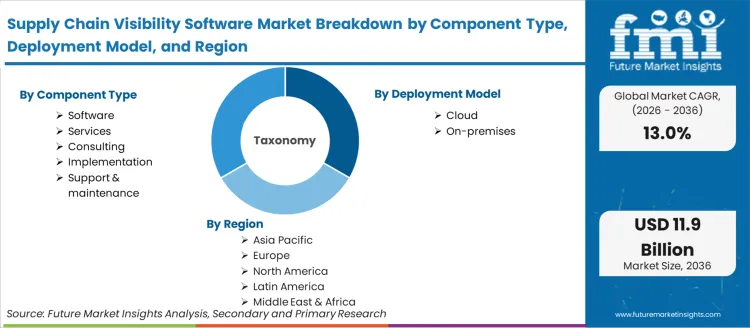
The supply chain visibility software market is segmented by component type, deployment model, enterprise size, application type, industry vertical, and region. By component type, the segmentation includes software, services, consulting, implementation, and support and maintenance, addressing different stages of solution delivery. In terms of deployment model, the market is categorized into cloud and on-premises options, supporting diverse IT infrastructures. Based on enterprise size, it is classified into large enterprises and SMEs, indicating adoption across varied organizational scales.
By application type, the market encompasses inventory management, order management, asset tracking, shipment tracking, supply chain planning, and other related processes. Industry vertical segmentation includes transportation and logistics, retail and consumer goods, healthcare and pharmaceuticals, manufacturing, automotive, aerospace and defense, food and beverage, and additional sectors. Regionally, the market spans North America, Latin America, Western and Eastern Europe, Balkan and Baltic countries, Russia and Belarus, Central Asia, East Asia, South Asia and Pacific, and the Middle East and Africa.
Insights into the Software Component Type Segment
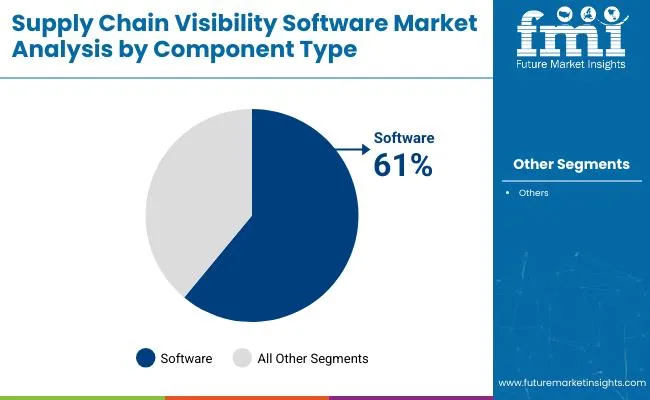
Software is projected to hold 61.0% of the total market revenue in 2026, making it the dominant component type in the supply chain visibility software landscape. This leadership is driven by increasing adoption of integrated dashboards, analytics engines, and real-time tracking systems that offer centralized visibility across complex, multi-node supply networks.
Software platforms are being preferred due to their flexibility in configuration, compatibility with existing ERP systems, and support for automation across order management and inventory functions. The rise of supply chain control towers and digital twins has further expanded demand for advanced software modules capable of scenario planning, exception management, and sustainability reporting.
As organizations prioritize digital infrastructure that enables data-driven insights, the software segment is expected to maintain its lead in delivering scalability and cross-border transparency.
Insights into the Cloud Deployment Segment
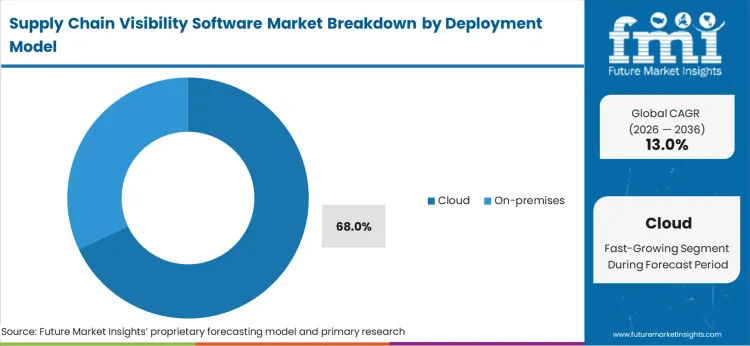
Cloud deployment is expected to account for 68.0% of the market revenue in 2026, establishing it as the leading deployment model. This segment’s dominance is being driven by its cost efficiency, scalability, and ease of remote access across global operations.
Cloud-based platforms facilitate seamless integration with logistics partners, carriers, and suppliers, enabling real-time data exchange and collaborative workflows. As enterprises increasingly shift toward distributed and hybrid supply chain models, the flexibility and low upfront investment associated with cloud solutions have proven essential.
Cybersecurity advancements and adherence to global compliance frameworks have improved confidence in cloud environments, further accelerating their adoption. In a market defined by rapid demand fluctuations and geopolitical risks, cloud-based visibility tools are enabling faster response times and continuous process optimization..
Insights into the Enterprise Size Segment
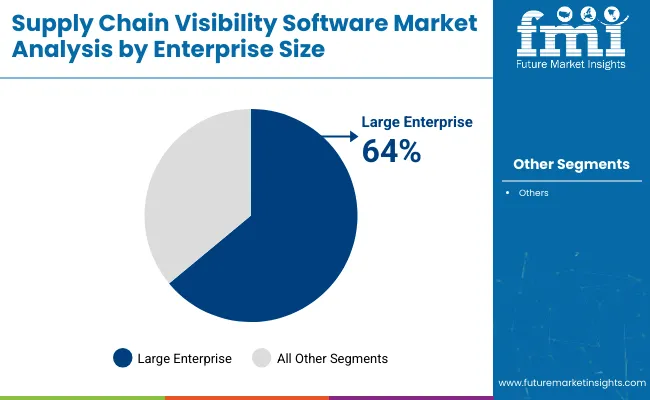
Large enterprises are forecast to represent 64.0% of the market revenue in 2026, making them the leading customer segment in the supply chain visibility software market. Their dominance is attributed to the scale and complexity of their supply chains, which span multiple regions, suppliers, and transportation nodes.
These enterprises have greater budget flexibility to invest in advanced analytics platforms, control towers, and AI-enabled insights that support predictive and prescriptive decision-making. Compliance requirements, global customer demands, and internal performance benchmarks have driven the need for integrated visibility platforms that can manage high transaction volumes and multi-tier risk exposure.
Large enterprises are increasingly investing in digital sustainability tracking and carbon footprint analytics, functions best served by sophisticated software solutions. This continued focus on digital supply chain orchestration is expected to reinforce their leadership position.
What are the Drivers, Restraints, and Key Trends of the Supply Chain Visibility Software Market?
The integration of IoT sensors, AI-powered analytics, and blockchain frameworks is enabling comprehensive monitoring of goods flow, inventory levels, and production processes across global supply networks. Adoption is most prominent in automotive, pharmaceutical, and retail sectors, where precision in inventory management, risk control, and regulatory compliance is essential.
Modern SCV solutions incorporate interactive digital dashboards, predictive alerting systems, and seamless interoperability with transportation and warehouse management platforms, which collectively enhance operational resilience and minimize disruption risks.
Real-Time Tracking and Compliance Drive Adoption
Enterprises are investing in visibility solutions to ensure end-to-end shipment traceability, minimize disruptions, and maintain compliance with cross-border regulations. Event-based alerts for route deviations, cold chain failures, and customs delays help mitigate risks and improve operational decisions. Industries handling high-value goods such as electronics and pharmaceuticals have accelerated adoption to ensure the integrity of goods across transit.
Integration of IoT sensors and connected GPS devices is providing accurate data streams to centralized dashboards. Platforms offering compliance automation for trade documentation and safety certifications have simplified audits and reduced delays. As businesses transition to multi-modal and global networks, digital visibility has become a strategic priority for cost control and timely delivery.
Data Fragmentation and Integration Complexity Limit Efficiency
Despite growing adoption, many organizations face difficulties in consolidating data from diverse sources, including carriers, ports, and suppliers. Fragmented ecosystems create inconsistencies in shipment status updates and delay event notifications, impacting decision-making accuracy. Integrating visibility software with legacy enterprise systems like ERP and WMS requires significant customization and high upfront investment. Data security concerns persist as platforms exchange sensitive trade and supplier information across multiple regions.
Variability in digital maturity among supply chain partners limits real-time collaboration and predictive modelling. Additionally, compliance differences across countries complicate software configuration and increase implementation timelines, making adoption challenging for small and mid-sized enterprises operating under cost constraints.
Analysis of Supply Chain Visibility Software Market By Key Countries
.webp "Top Country Growth Comparison Supply Chain Visibility Software Market Cagr (2026 2036)")
| Country | CAGR |
|---|---|
| China | 17.6% |
| India | 16.3% |
| Germany | 15.0% |
| France | 13.7% |
| UK | 12.4% |
| USA | 11.1% |
| Brazil | 9.8% |
Source: FMI analysis based on primary research and proprietary forecasting model
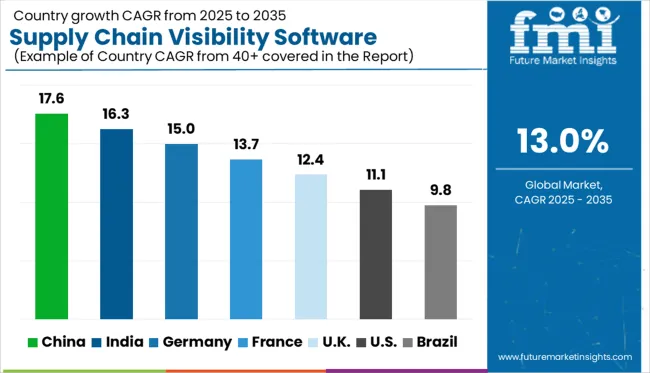
The supply chain visibility software market is projected to grow at a 13% CAGR from 2026 to 2036, driven by heightened demand for real-time tracking, predictive analytics, and multi-tier supply transparency. China leads with 17.6%, propelled by e-commerce ecosystems, manufacturing exports, and AI-enabled logistics platforms. India follows at 16.3%, supported by government-led digital logistics programs and 3PL adoption across retail and automotive sectors. Germany, at 15.0%, emphasizes SCV deployment in industrial IoT-integrated manufacturing networks and compliance-driven supply operations. France grows at 13.7%, leveraging SCV in luxury goods, pharma cold chains, and food traceability programs. The United Kingdom, at 12.4%, focuses on SCV integration in retail, FMCG, and warehouse automation post-Brexit, ensuring regulatory alignment and customs optimization. The report includes an analysis of over 40 countries, with key countries profiled below for reference.
Digital Integration Trends in Supply Chain Visibility Software Market in China
China is expected to grow at a 17.6% CAGR, leading global SCV adoption with real-time visibility platforms integrated across e-commerce and manufacturing ecosystems. Major logistics providers deploy AI-enabled route optimization, predictive analytics, and IoT tracking for multi-modal shipments. Cross-border trade and compliance-driven transparency for export markets fuel demand for integrated SCV dashboards. SCV solutions are embedded into ERP systems by large enterprises to synchronize production schedules and inventory flows. Domestic tech giants and SaaS providers are expanding cloud-based SCV platforms tailored for SMEs, further accelerating adoption across the value chain.
- AI-based predictive visibility platforms dominate large-scale operations
- Cloud-native SCV solutions tailored for SME logistics networks
- Integrated SCV tools enable synchronized production and inventory control
Emerging Digital Logistics in the SCV Software Market in India
Adoption of SCV software in India is forecast to grow at a 16.3% CAGR, driven by e-commerce expansion, government-led logistics digitization, and the rollout of the Unified Logistics Interface Platform (ULIP). Multi-tier tracking is becoming standard in pharma cold chains and food supply networks. Tech-enabled logistics players deploy SCV for last-mile visibility and dynamic rerouting. SaaS models offering API-based integration with transport management systems and customs platforms are gaining traction. Private equity investments in SCV-focused startups underline India’s shift toward real-time, compliance-ready supply networks. Demand from FMCG and automotive OEMs remains dominant, reinforced by GST-based multi-warehouse optimization needs.
- ULIP framework drives interoperability across logistics platforms
- API-enabled SCV systems integrated with customs clearance tools
- Cold chain operators adopt SCV for end-to-end temperature tracking
Technology Convergence in the SCV Software Market in Germany
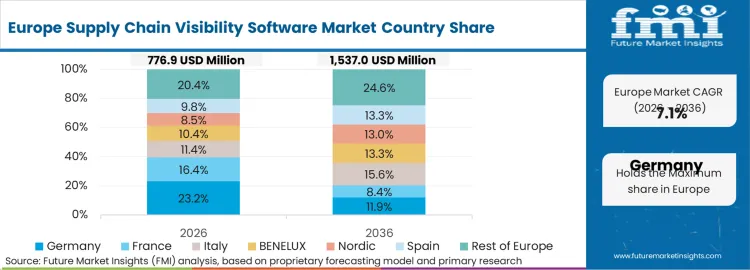
Germany is projected to expand at a 15.0% CAGR, supported by Industry 4.0 adoption and integration of SCV software with IoT-driven production lines. Automotive and heavy machinery sectors implement SCV systems to enable predictive supply planning and compliance tracking under EU trade norms. Real-time dashboards connected with RFID and telematics enhance traceability across inbound and outbound flows. SCV platforms are integrated with advanced warehouse execution systems to streamline cross-docking and order fulfillment. Strategic investments focus on AI-powered demand forecasting combined with supplier risk analytics. Cybersecurity integration is prioritized to protect SCV data exchange in interconnected manufacturing ecosystems.
- IoT-linked SCV platforms optimize predictive supply planning
- RFID-driven transparency deployed in automotive value chains
- AI-based risk and demand forecasting embedded in SCV tools
Adoption Drivers in the SCV Software Market in France
France is expected to grow at a 13.7% CAGR, driven by SCV applications in luxury goods, food traceability, and healthcare supply networks. Retailers and logistics providers are implementing visibility software to ensure compliance with EU labeling, temperature control, and origin traceability mandates. Cloud-based SCV solutions integrated with ERP and TMS platforms dominate enterprise adoption models. Investments in AI for demand sensing and blockchain for authenticity verification in wine and luxury segments are gaining traction. France’s strong export market for perishable goods has accelerated SCV adoption in cold chain networks, aligning with EU Green Deal sustainability metrics.
- Blockchain-integrated SCV platforms for luxury product traceability
- AI-enabled demand sensing tools integrated with logistics workflows
- Temperature-controlled visibility systems standard in food exports
Visibility Transformation in the SCV Software Market in the United Kingdom
The United Kingdom is forecast to grow at a 12.4% CAGR, with SCV adoption accelerated by post-Brexit customs complexities and retail omnichannel expansion. Retail and FMCG players prioritize SCV for real-time shipment visibility and customs clearance optimization. Integration of SCV tools with warehouse automation and robotics is shaping next-generation distribution centers. Cloud-native SCV solutions offering predictive analytics for inventory optimization and demand fluctuations are in high demand. Third-party logistics (3PL) providers deploy API-based visibility tools for multi-carrier orchestration. SCV innovation aligns with UK regulatory focus on transparent trade flows and carbon reduction reporting for supply networks.
- SCV-enabled customs compliance for post-Brexit trade ecosystems
- Predictive SCV analytics enhance inventory optimization strategies
- API-driven platforms standardize multi-carrier visibility management
Competitive Landscape of Supply Chain Visibility Software Market
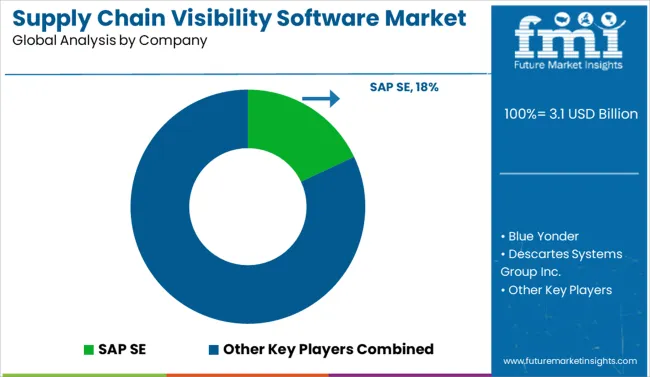
The SCV software market is moderately consolidated, led by SAP SE, which commands a leading position with deep integration of AI-enabled tracking modules and advanced analytics across its ERP ecosystem. Oracle, IBM, and Blue Yonder follow closely, focusing on predictive insights and cloud-native architectures for end-to-end visibility. Blue Yonder, bolstered by Panasonic’s investment, emphasizes machine learning for demand-supply orchestration, positioning itself as a pioneer in predictive analytics for real-time logistics decision-making.
FourKites emerges as a specialist player, managing over three million shipments daily across multi-modal transport and providing advanced ML-based ETA predictions, giving it a strong edge in real-time insights. Kinaxis leverages visibility data to power concurrent planning and risk mitigation, complementing its core S&OP and supply chain planning suite. Vendors like Descartes, Infor, Epicor, and Manhattan Associates differentiate through modular SCV components integrated with ERP, WMS, and TMS platforms, appealing to mid-market enterprises seeking interoperability without full-suite replacements.
Competitive differentiation is increasingly driven by API-driven interoperability, predictive ETA accuracy, compliance frameworks, and vertical-specific customization. Partnerships with IoT device manufacturers, integration of blockchain for traceability, and AI-driven risk forecasting are emerging as key strategic levers for sustaining market leadership.
Key Developments in Supply Chain Visibility Software Market
In August 2024, FourKites introduced its YardWorks™ suite of solutions, featuring advanced AI-driven tools for gate and yard optimization, along with strategic partnerships and investments aimed at transforming facilities management and improving operational efficiency.
Scope of the report
| Metric | Value |
|---|---|
| Quantitative Units | USD 3.50 billion to USD 11.89 billion, at a CAGR of 13.00% |
| Market Definition | Supply chain visibility software platforms aggregate, normalize, and present real-time data from transportation management systems, warehouse management systems, IoT sensor networks, and trading partner EDI feeds to provide end-to-end shipment tracking, inventory positioning, and exception alerting across multi-tier supply chain networks. |
| Segmentation | Component Type (Software), Deployment Model (Cloud), Enterprise Size (Large enterprises) |
| Regions Covered | North America, Latin America, Europe, East Asia, South Asia, Oceania, Middle East and Africa |
| Countries Covered | India, China, USA, Canada, UK, Germany, Japan, and 40 plus countries |
| Key Companies Profiled | SAP SE, Oracle, IBM, Blue Yonder |
| Forecast Period | 2026 to 2036 |
| Approach | Forecasting models apply a hybrid bottom-up and top-down methodology starting with verified supply chain visibility software transaction data and projecting adoption velocity across defined segments and regions. |
Supply Chain Visibility Software Market by Segments
By Component Type:
- Software
- Services
- Consulting
- Implementation
- Support & maintenance
By Deployment Model:
- Cloud
- On-premises
By Enterprise Size:
- Large enterprises
- SME
By Application Type:
- Inventory management
- Order management
- Asset tracking
- Shipment tracking
- Supply chain planning
- Others
By Industry Vertical:
- Transportation and logistics
- Retail and consumer goods
- Healthcare and pharmaceuticals
- Manufacturing
- Automotive
- Aerospace and defense
- Food and beverage
- Others
By Region:
- North America
- USA
- Canada
- Mexico
- Latin America
- Brazil
- Chile
- Rest of Latin America
- Western Europe
- Germany
- UK
- Italy
- Spain
- France
- Nordic
- BENELUX
- Rest of Western Europe
- Eastern Europe
- Russia
- Poland
- Hungary
- Balkan & Baltic
- Rest of Eastern Europe
- East Asia
- China
- Japan
- South Korea
- South Asia and Pacific
- India
- ASEAN
- Australia & New Zealand
- Rest of South Asia and Pacific
- Middle East & Africa
- Kingdom of Saudi Arabia
- Other GCC Countries
- Turkiye
- South Africa
- Other African Union
- Rest of Middle East & Africa
Bibliography
- 1. World Customs Organization. (2024). Framework of Standards to Secure and Facilitate Global Trade. WCO.
- 2. European Commission. (2024). Import Control System 2 (ICS2): Implementation Guidelines. EC.
- 3. United States Customs and Border Protection. (2024). Automated Commercial Environment: Trade Compliance Requirements. USA CBP.
- 4. International Chamber of Commerce. (2024). ICC Digital Standards Initiative: Supply Chain Digitisation Framework. ICC.
- 5. Organisation for Economic Co-operation and Development. (2024). OECD Trade Facilitation Indicators: Digital Customs Assessment. OECD.
- 6. GS1 AISBL. (2024). EPCIS 2.0: Supply Chain Event Data Standard. GS1.
This bibliography is provided for reader reference. The full FMI report contains the complete reference list with primary research documentation.
Frequently Asked Questions
How large is the demand for Supply Chain Visibility Software in the global market in 2026?
Demand for supply chain visibility software in the global market is estimated to be valued at USD 3.50 billion in 2026.
What will be the market size of Supply Chain Visibility Software by 2036?
Market size for supply chain visibility software is projected to reach USD 11.89 billion by 2036.
What is the expected demand growth for Supply Chain Visibility Software between 2026 and 2036?
Demand for supply chain visibility software is expected to grow at a CAGR of 13.00% between 2026 and 2036.
Which Component Type is poised to lead global sales by 2026?
Software accounts for 61.0% in 2026, reflecting established procurement specifications across primary buyer channels.
How is Cloud driving Supply Chain Visibility Software adoption in 2026?
Cloud represents 68.0% of segment demand as end-use requirements favor this category.
What is driving demand in China?
China registers a 17.60% CAGR through 2036, propelled by domestic investment and rising end-use consumption.
What does Supply Chain Visibility Software Market definition mean in this report?
Supply chain visibility software platforms aggregate, normalize, and present real-time data from transportation management systems, warehouse management systems, IoT sensor networks, and trading partner EDI feeds to provide end-to-end shipment tracking, inventory positioning, and exception alerting across multi-tier supply chain networks.
How does FMI build and validate the Supply Chain Visibility Software forecast?
Forecasting models apply a hybrid bottom-up methodology starting with verified transaction data, cross-validated against publicly reported procurement volumes and company financial disclosures on a quarterly refresh schedule.
Preview the report firsthand - request a free sample
Get SampleGet the brochure for pricing and purchase details.
Get PDFTable of Content
- Executive Summary
- Global Market Outlook
- Demand-side Trends
- Supply-side Trends
- Technology Roadmap Analysis
- Analysis and Recommendations
- Market Overview
- Market Coverage / Taxonomy
- Market Definition / Scope / Limitations
- Research Methodology
- Chapter Orientation
- Analytical Lens and Working Hypotheses
- Market Structure, Signals, and Trend Drivers
- Benchmarking and Cross-market Comparability
- Market Sizing, Forecasting, and Opportunity Mapping
- Research Design and Evidence Framework
- Desk Research Programme (Secondary Evidence)
- Company Annual and Sustainability Reports
- Peer-reviewed Journals and Academic Literature
- Corporate Websites, Product Literature, and Technical Notes
- Earnings Decks and Investor Briefings
- Statutory Filings and Regulatory Disclosures
- Technical White Papers and Standards Notes
- Trade Journals, Industry Magazines, and Analyst Briefs
- Conference Proceedings, Webinars, and Seminar Materials
- Government Statistics Portals and Public Data Releases
- Press Releases and Reputable Media Coverage
- Specialist Newsletters and Curated Briefings
- Sector Databases and Reference Repositories
- FMI Internal Proprietary Databases and Historical Market Datasets
- Subscription Datasets and Paid Sources
- Social Channels, Communities, and Digital Listening Inputs
- Additional Desk Sources
- Expert Input and Fieldwork (Primary Evidence)
- Primary Modes
- Qualitative Interviews and Expert Elicitation
- Quantitative Surveys and Structured Data Capture
- Blended Approach
- Why Primary Evidence is Used
- Field Techniques
- Interviews
- Surveys
- Focus Groups
- Observational and In-context Research
- Social and Community Interactions
- Stakeholder Universe Engaged
- C-suite Leaders
- Board Members
- Presidents and Vice Presidents
- R&D and Innovation Heads
- Technical Specialists
- Domain Subject-matter Experts
- Scientists
- Physicians and Other Healthcare Professionals
- Governance, Ethics, and Data Stewardship
- Research Ethics
- Data Integrity and Handling
- Primary Modes
- Tooling, Models, and Reference Databases
- Desk Research Programme (Secondary Evidence)
- Data Engineering and Model Build
- Data Acquisition and Ingestion
- Cleaning, Normalisation, and Verification
- Synthesis, Triangulation, and Analysis
- Quality Assurance and Audit Trail
- Market Background
- Market Dynamics
- Drivers
- Restraints
- Opportunity
- Trends
- Scenario Forecast
- Demand in Optimistic Scenario
- Demand in Likely Scenario
- Demand in Conservative Scenario
- Opportunity Map Analysis
- Product Life Cycle Analysis
- Supply Chain Analysis
- Investment Feasibility Matrix
- Value Chain Analysis
- PESTLE and Porter’s Analysis
- Regulatory Landscape
- Regional Parent Market Outlook
- Production and Consumption Statistics
- Import and Export Statistics
- Market Dynamics
- Global Market Analysis 2021 to 2025 and Forecast, 2026 to 2036
- Historical Market Size Value (USD Million) Analysis, 2021 to 2025
- Current and Future Market Size Value (USD Million) Projections, 2026 to 2036
- Y-o-Y Growth Trend Analysis
- Absolute $ Opportunity Analysis
- Global Market Pricing Analysis 2021 to 2025 and Forecast 2026 to 2036
- Global Market Analysis 2021 to 2025 and Forecast 2026 to 2036, By Component Type
- Introduction / Key Findings
- Historical Market Size Value (USD Million) Analysis By Component Type , 2021 to 2025
- Current and Future Market Size Value (USD Million) Analysis and Forecast By Component Type , 2026 to 2036
- Software
- Services
- Consulting
- Implementation
- Support & maintenance
- Software
- Y-o-Y Growth Trend Analysis By Component Type , 2021 to 2025
- Absolute $ Opportunity Analysis By Component Type , 2026 to 2036
- Global Market Analysis 2021 to 2025 and Forecast 2026 to 2036, By Deployment Model
- Introduction / Key Findings
- Historical Market Size Value (USD Million) Analysis By Deployment Model, 2021 to 2025
- Current and Future Market Size Value (USD Million) Analysis and Forecast By Deployment Model, 2026 to 2036
- Cloud
- On-premises
- Cloud
- Y-o-Y Growth Trend Analysis By Deployment Model, 2021 to 2025
- Absolute $ Opportunity Analysis By Deployment Model, 2026 to 2036
- Global Market Analysis 2021 to 2025 and Forecast 2026 to 2036, By Enterprise Size
- Introduction / Key Findings
- Historical Market Size Value (USD Million) Analysis By Enterprise Size, 2021 to 2025
- Current and Future Market Size Value (USD Million) Analysis and Forecast By Enterprise Size, 2026 to 2036
- Large enterprises
- SME
- Large enterprises
- Y-o-Y Growth Trend Analysis By Enterprise Size, 2021 to 2025
- Absolute $ Opportunity Analysis By Enterprise Size, 2026 to 2036
- Global Market Analysis 2021 to 2025 and Forecast 2026 to 2036, By Application Type
- Introduction / Key Findings
- Historical Market Size Value (USD Million) Analysis By Application Type, 2021 to 2025
- Current and Future Market Size Value (USD Million) Analysis and Forecast By Application Type, 2026 to 2036
- Inventory management
- Order management
- Asset tracking
- Shipment tracking
- Supply chain planning
- Others
- Inventory management
- Y-o-Y Growth Trend Analysis By Application Type, 2021 to 2025
- Absolute $ Opportunity Analysis By Application Type, 2026 to 2036
- Global Market Analysis 2021 to 2025 and Forecast 2026 to 2036, By Industry Vertical
- Introduction / Key Findings
- Historical Market Size Value (USD Million) Analysis By Industry Vertical, 2021 to 2025
- Current and Future Market Size Value (USD Million) Analysis and Forecast By Industry Vertical, 2026 to 2036
- Transportation and logistics
- Retail and consumer goods
- Healthcare and pharmaceuticals
- Manufacturing
- Automotive
- Aerospace and defense
- Food and beverage
- Others
- Transportation and logistics
- Y-o-Y Growth Trend Analysis By Industry Vertical, 2021 to 2025
- Absolute $ Opportunity Analysis By Industry Vertical, 2026 to 2036
- Global Market Analysis 2021 to 2025 and Forecast 2026 to 2036, By Region
- Introduction
- Historical Market Size Value (USD Million) Analysis By Region, 2021 to 2025
- Current Market Size Value (USD Million) Analysis and Forecast By Region, 2026 to 2036
- North America
- Latin America
- Western Europe
- Eastern Europe
- East Asia
- South Asia and Pacific
- Middle East & Africa
- Market Attractiveness Analysis By Region
- North America Market Analysis 2021 to 2025 and Forecast 2026 to 2036, By Country
- Historical Market Size Value (USD Million) Trend Analysis By Market Taxonomy, 2021 to 2025
- Market Size Value (USD Million) Forecast By Market Taxonomy, 2026 to 2036
- By Country
- USA
- Canada
- Mexico
- By Component Type
- By Deployment Model
- By Enterprise Size
- By Application Type
- By Industry Vertical
- By Country
- Market Attractiveness Analysis
- By Country
- By Component Type
- By Deployment Model
- By Enterprise Size
- By Application Type
- By Industry Vertical
- Key Takeaways
- Latin America Market Analysis 2021 to 2025 and Forecast 2026 to 2036, By Country
- Historical Market Size Value (USD Million) Trend Analysis By Market Taxonomy, 2021 to 2025
- Market Size Value (USD Million) Forecast By Market Taxonomy, 2026 to 2036
- By Country
- Brazil
- Chile
- Rest of Latin America
- By Component Type
- By Deployment Model
- By Enterprise Size
- By Application Type
- By Industry Vertical
- By Country
- Market Attractiveness Analysis
- By Country
- By Component Type
- By Deployment Model
- By Enterprise Size
- By Application Type
- By Industry Vertical
- Key Takeaways
- Western Europe Market Analysis 2021 to 2025 and Forecast 2026 to 2036, By Country
- Historical Market Size Value (USD Million) Trend Analysis By Market Taxonomy, 2021 to 2025
- Market Size Value (USD Million) Forecast By Market Taxonomy, 2026 to 2036
- By Country
- Germany
- UK
- Italy
- Spain
- France
- Nordic
- BENELUX
- Rest of Western Europe
- By Component Type
- By Deployment Model
- By Enterprise Size
- By Application Type
- By Industry Vertical
- By Country
- Market Attractiveness Analysis
- By Country
- By Component Type
- By Deployment Model
- By Enterprise Size
- By Application Type
- By Industry Vertical
- Key Takeaways
- Eastern Europe Market Analysis 2021 to 2025 and Forecast 2026 to 2036, By Country
- Historical Market Size Value (USD Million) Trend Analysis By Market Taxonomy, 2021 to 2025
- Market Size Value (USD Million) Forecast By Market Taxonomy, 2026 to 2036
- By Country
- Russia
- Poland
- Hungary
- Balkan & Baltic
- Rest of Eastern Europe
- By Component Type
- By Deployment Model
- By Enterprise Size
- By Application Type
- By Industry Vertical
- By Country
- Market Attractiveness Analysis
- By Country
- By Component Type
- By Deployment Model
- By Enterprise Size
- By Application Type
- By Industry Vertical
- Key Takeaways
- East Asia Market Analysis 2021 to 2025 and Forecast 2026 to 2036, By Country
- Historical Market Size Value (USD Million) Trend Analysis By Market Taxonomy, 2021 to 2025
- Market Size Value (USD Million) Forecast By Market Taxonomy, 2026 to 2036
- By Country
- China
- Japan
- South Korea
- By Component Type
- By Deployment Model
- By Enterprise Size
- By Application Type
- By Industry Vertical
- By Country
- Market Attractiveness Analysis
- By Country
- By Component Type
- By Deployment Model
- By Enterprise Size
- By Application Type
- By Industry Vertical
- Key Takeaways
- South Asia and Pacific Market Analysis 2021 to 2025 and Forecast 2026 to 2036, By Country
- Historical Market Size Value (USD Million) Trend Analysis By Market Taxonomy, 2021 to 2025
- Market Size Value (USD Million) Forecast By Market Taxonomy, 2026 to 2036
- By Country
- India
- ASEAN
- Australia & New Zealand
- Rest of South Asia and Pacific
- By Component Type
- By Deployment Model
- By Enterprise Size
- By Application Type
- By Industry Vertical
- By Country
- Market Attractiveness Analysis
- By Country
- By Component Type
- By Deployment Model
- By Enterprise Size
- By Application Type
- By Industry Vertical
- Key Takeaways
- Middle East & Africa Market Analysis 2021 to 2025 and Forecast 2026 to 2036, By Country
- Historical Market Size Value (USD Million) Trend Analysis By Market Taxonomy, 2021 to 2025
- Market Size Value (USD Million) Forecast By Market Taxonomy, 2026 to 2036
- By Country
- Kingdom of Saudi Arabia
- Other GCC Countries
- Turkiye
- South Africa
- Other African Union
- Rest of Middle East & Africa
- By Component Type
- By Deployment Model
- By Enterprise Size
- By Application Type
- By Industry Vertical
- By Country
- Market Attractiveness Analysis
- By Country
- By Component Type
- By Deployment Model
- By Enterprise Size
- By Application Type
- By Industry Vertical
- Key Takeaways
- Key Countries Market Analysis
- USA
- Pricing Analysis
- Market Share Analysis, 2025
- By Component Type
- By Deployment Model
- By Enterprise Size
- By Application Type
- By Industry Vertical
- Canada
- Pricing Analysis
- Market Share Analysis, 2025
- By Component Type
- By Deployment Model
- By Enterprise Size
- By Application Type
- By Industry Vertical
- Mexico
- Pricing Analysis
- Market Share Analysis, 2025
- By Component Type
- By Deployment Model
- By Enterprise Size
- By Application Type
- By Industry Vertical
- Brazil
- Pricing Analysis
- Market Share Analysis, 2025
- By Component Type
- By Deployment Model
- By Enterprise Size
- By Application Type
- By Industry Vertical
- Chile
- Pricing Analysis
- Market Share Analysis, 2025
- By Component Type
- By Deployment Model
- By Enterprise Size
- By Application Type
- By Industry Vertical
- Germany
- Pricing Analysis
- Market Share Analysis, 2025
- By Component Type
- By Deployment Model
- By Enterprise Size
- By Application Type
- By Industry Vertical
- UK
- Pricing Analysis
- Market Share Analysis, 2025
- By Component Type
- By Deployment Model
- By Enterprise Size
- By Application Type
- By Industry Vertical
- Italy
- Pricing Analysis
- Market Share Analysis, 2025
- By Component Type
- By Deployment Model
- By Enterprise Size
- By Application Type
- By Industry Vertical
- Spain
- Pricing Analysis
- Market Share Analysis, 2025
- By Component Type
- By Deployment Model
- By Enterprise Size
- By Application Type
- By Industry Vertical
- France
- Pricing Analysis
- Market Share Analysis, 2025
- By Component Type
- By Deployment Model
- By Enterprise Size
- By Application Type
- By Industry Vertical
- India
- Pricing Analysis
- Market Share Analysis, 2025
- By Component Type
- By Deployment Model
- By Enterprise Size
- By Application Type
- By Industry Vertical
- ASEAN
- Pricing Analysis
- Market Share Analysis, 2025
- By Component Type
- By Deployment Model
- By Enterprise Size
- By Application Type
- By Industry Vertical
- Australia & New Zealand
- Pricing Analysis
- Market Share Analysis, 2025
- By Component Type
- By Deployment Model
- By Enterprise Size
- By Application Type
- By Industry Vertical
- China
- Pricing Analysis
- Market Share Analysis, 2025
- By Component Type
- By Deployment Model
- By Enterprise Size
- By Application Type
- By Industry Vertical
- Japan
- Pricing Analysis
- Market Share Analysis, 2025
- By Component Type
- By Deployment Model
- By Enterprise Size
- By Application Type
- By Industry Vertical
- South Korea
- Pricing Analysis
- Market Share Analysis, 2025
- By Component Type
- By Deployment Model
- By Enterprise Size
- By Application Type
- By Industry Vertical
- Russia
- Pricing Analysis
- Market Share Analysis, 2025
- By Component Type
- By Deployment Model
- By Enterprise Size
- By Application Type
- By Industry Vertical
- Poland
- Pricing Analysis
- Market Share Analysis, 2025
- By Component Type
- By Deployment Model
- By Enterprise Size
- By Application Type
- By Industry Vertical
- Hungary
- Pricing Analysis
- Market Share Analysis, 2025
- By Component Type
- By Deployment Model
- By Enterprise Size
- By Application Type
- By Industry Vertical
- Kingdom of Saudi Arabia
- Pricing Analysis
- Market Share Analysis, 2025
- By Component Type
- By Deployment Model
- By Enterprise Size
- By Application Type
- By Industry Vertical
- Turkiye
- Pricing Analysis
- Market Share Analysis, 2025
- By Component Type
- By Deployment Model
- By Enterprise Size
- By Application Type
- By Industry Vertical
- South Africa
- Pricing Analysis
- Market Share Analysis, 2025
- By Component Type
- By Deployment Model
- By Enterprise Size
- By Application Type
- By Industry Vertical
- USA
- Market Structure Analysis
- Competition Dashboard
- Competition Benchmarking
- Market Share Analysis of Top Players
- By Regional
- By Component Type
- By Deployment Model
- By Enterprise Size
- By Application Type
- By Industry Vertical
- Competition Analysis
- Competition Deep Dive
- SAP SE
- Overview
- Product Portfolio
- Profitability by Market Segments (Product/Age /Sales Channel/Region)
- Sales Footprint
- Strategy Overview
- Marketing Strategy
- Product Strategy
- Channel Strategy
- Oracle
- IBM
- Blue Yonder
- SAP SE
- Competition Deep Dive
- Assumptions & Acronyms Used


