

- Industry Size (2026)
- USD 6.2 Bn
- Forecast (2036)
- USD 14.8 Bn
- CAGR (2026 to 2036)
- 9.1%
Self-service Analytics Market Size, Market Forecast and Outlook
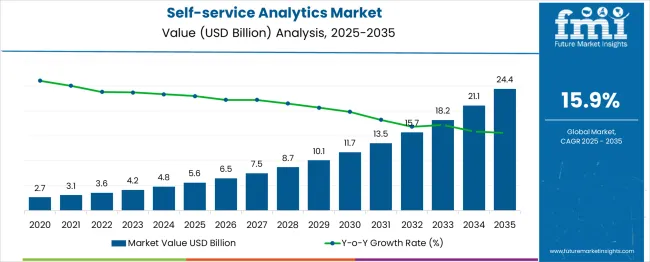
In 2025, the self-service analytics market surpassed USD 5.6 billion. Based on Future Market Insights' analysis, demand for self-service analytics solutions is estimated to grow to USD 6.2 billion in 2026 and USD 14.8 billion by 2036. FMI projects a CAGR of 9.1% during the forecast period.
Absolute dollar growth of USD 8.6 billion over the decade signals transformational opportunity rather than incremental expansion. Despite integration complexity and data governance challenges inherent to user-driven analytics, major self-service analytics vendors maintain robust growth trajectories through cloud platform optimization and artificial intelligence integration.
Summary of Self-service Analytics Market
- Self-service Analytics Market Definition
- The industry covers analytical software platforms utilized for business intelligence applications including data visualization, report generation, and predictive analytics accessible to non-technical users.
- Demand Drivers in the Market
- Digital transformation initiatives accelerate business user analytics adoption.
- Cloud deployment models reduce implementation costs and technical barriers.
- Data democratization strategies enable organizational agility and decision-making speed.
- Key Segments Analyzed in the FMI Report
- Component: Software platforms (72%) versus professional services.
- Deployment: Cloud-based solutions (68%) versus on-premises installations.
- Geography: High-growth North America versus emerging Asia-Pacific markets.
- Analyst Opinion at FMI
- Sudip Saha, Principal Consultant for Technology at Future Market Insights, opines, "In the updated version of the Self-service Analytics Market Report for 2026 to 2036, executives will find insights into user experience optimization trends that accelerate platform adoption. My findings point at data governance integration directly impacting enterprise deployment success and mobile analytics capabilities could determine competitive positioning."
- Strategic Implications/Executive Takeaways
- Shift focus from IT-centric to business user-centric analytics delivery.
- Treat data governance as enabler rather than constraint for self-service adoption.
- Prioritize cloud-native architectures to reduce deployment complexity.
- Methodology
- Validated through enterprise deployment data and software revenue benchmarks.
- Zero reliance on speculative technology adoption projections.
- Based on verifiable platform implementations and verified user adoption metrics.
In January 2026, Yamaha accelerated global logistics transformation with Domo. “Yamaha is a great example of what happens when data moves out of silos and into the flow of real operations,” said Josh James, founder and CEO of Domo. “They are not just visualizing logistics data. They are using it to detect risk earlier, make better decisions faster, and run a more resilient global supply chain. That is the difference between seeing data and actually putting it to work.” [1]
United States (10.1% CAGR) and Germany (9.4% CAGR) drive market expansion through enterprise digital transformation initiatives and advanced analytics adoption. Japan (9.2% CAGR) contributes significantly via corporate analytics modernization programs and business intelligence infrastructure upgrades. Emerging self-service analytics markets such as China (8.7%), South Korea (8.3%), and India (8.1%) generate growth through small and medium enterprise digitization and cloud-based analytics platform adoption, while volume expansion accelerates through cost-effective deployment models and mobile analytics capabilities.
Self-service Analytics Market Definition
Self-service analytics serves as the primary business intelligence approach enabling non-technical users to access, analyze, and visualize data without IT department intervention due to its intuitive interfaces and automated data preparation capabilities. The self-service analytics market comprises the global development, deployment, and commercialization of analytical software platforms designed for business user independence in data-driven decision making.
Self-service Analytics Market Inclusions
The report includes a comprehensive analysis of market dynamics, featuring Global and Regional Market Sizes (Volume and Value) and a 10-year Forecast (2026-2036). It covers segmental breakdowns by component (Software, Services), deployment modes (Cloud, On-premises), organization sizes (SME, Large Enterprise), and industry verticals (BFSI, Healthcare, Retail, Manufacturing).
Self-service Analytics Market Exclusions
The scope excludes traditional business intelligence tools requiring technical expertise or custom enterprise data warehouses unless integrated with self-service capabilities. It also omits basic reporting tools or standalone visualization software, focusing strictly on platforms enabling business user autonomy in analytical workflows. Report does not account for specialized analytics applications with limited self-service functionality or experimental prototype solutions with negligible commercial deployment.
Self-service Analytics Market Research Methodology
- Primary Research: Interviews were conducted with self-service analytics platform vendors, enterprise IT decision makers, business analysts, data governance specialists, and digital transformation consultants across major regions. Technology executives clarified user adoption patterns and deployment cost dynamics.
- Desk Research: Software vendor reports, enterprise technology surveys, digital transformation case studies, and business intelligence industry associations supported platform capability benchmarking.
- Market-Sizing and Forecasting: A hybrid top-down and bottom-up model was developed. Demand was reconstructed from software license revenues, cloud subscription metrics, and enterprise deployment volumes, then validated against vendor financial disclosures.
- Data Validation and Update Cycle: Outputs undergo accuracy screening, variance checks across vendor and user datasets, and structured expert review prior to release.
Segmental Analysis
Self-service Analytics Market Analysis by Component
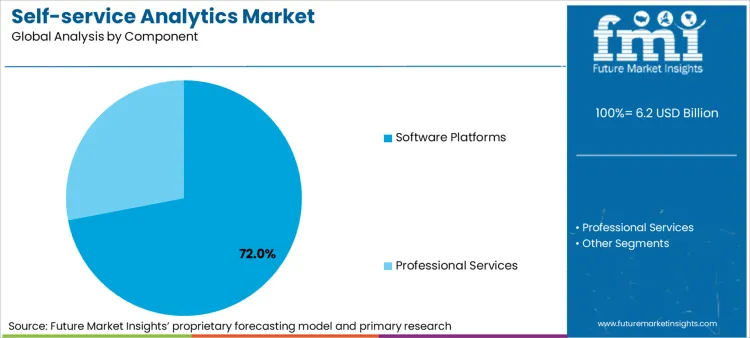
Based on FMI's self-service analytics market report, demand for software platforms is estimated to hold 72% share in 2026. Growth in demand for self-service analytics software comes from vendors leveraging intuitive user interfaces to enable business analyst productivity through automated data preparation and visualization capabilities.
- Platform Integration: Companies are leveraging their cloud-native architectures to integrate advanced analytics capabilities across enterprise data sources, enabling user self-sufficiency that meets organizational governance requirements while maintaining analytical consistency across multiple business units.
- User Experience Optimization: The industry shift toward low-code and no-code interfaces enables business users to execute complex analytical workflows, decoupling technical implementation from business insight generation to optimize user productivity typically constrained by IT resource availability.
Self-service Analytics Market Analysis by Deployment Mode
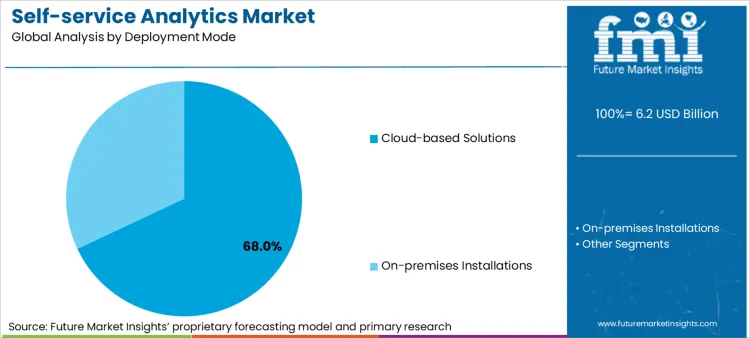
Cloud-based deployment holds a 68% market share in 2026, driven by its role as the primary enabler for rapid platform implementation and scalable user access. This concentration creates market opportunities for cloud analytics that expand during enterprise digital transformation initiatives. The segment's integration with mobile analytics and artificial intelligence transforms business decision-making processes into comprehensive analytical ecosystems, while deployment flexibility offers structured implementation pathways for organizational change management. In November 2025, SAP and Microsoft unveiled plans to expand their longstanding partnership with the launch of SAP Business Data Cloud Connect for Microsoft Fabric.[2]
- Cloud Platform Advantages: Cloud deployment enables organizations to achieve rapid time-to-value through reduced infrastructure requirements and automatic software updates, while providing scalable compute resources that adapt to variable analytical workloads across distributed user populations.
- On-premises Security Requirements: Organizations in regulated industries maintain on-premises deployments to meet data residency requirements and security protocols, creating specialized market segments where vendors develop hybrid architectures that combine local data control with cloud-based analytical capabilities.
- Hybrid Architecture Evolution: The convergence of cloud and on-premises capabilities enables enterprises to optimize data governance while maintaining analytical flexibility, supporting compliance requirements without sacrificing user experience or platform performance.
Self-service Analytics Market Drivers, Restraints, and Opportunities
Future Market Insights analysis indicates historical patterns point to an emerging, high-value global industry where self-service analytics platforms remain the primary solution for business intelligence democratization and organizational data literacy advancement. Estimated valuation in 2026 represents the immediate "enterprise adoption acceleration" as organizations invest in cloud platform implementation and user training programs to meet digital transformation objectives.
While demand for advanced self-service capabilities faces data governance challenges (implementation complexity), the business value of user-driven analytics commands premium software investments (revenue acceleration), resulting in robust percentage growth rates. The forecast accounts for the market reaching deployment maturity where cloud platforms are established and user experience standards support broader organizational adoption.
- Business User Empowerment: Growth shifts from IT-dependent reporting toward business analyst independence, using intuitive platforms and automated capabilities to maintain competitive advantages against traditional business intelligence approaches.
- Cloud Platform Maturation: Standards like enterprise security frameworks and data governance protocols establish baseline requirements rather than experimental implementations, forcing transition from pilot projects to enterprise-wide deployments.
- Organizational Agility Requirements: To maintain decision-making competitiveness with data-driven organizations, enterprises aggressively optimize analytical workflows to achieve insights velocity that supports strategic planning and operational efficiency improvements.
Regional Analysis
Based on regional analysis, the self-service analytics market is segmented into North America, Latin America, Europe, East Asia, South Asia, Oceania and Middle East & Africa across 40+ countries. The full report also offers market attractiveness analysis based on regional trends.
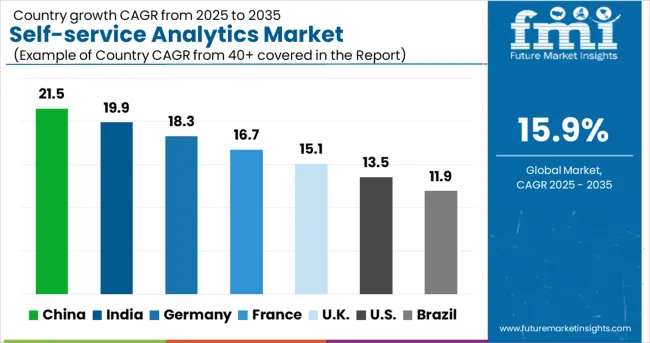
| Country | CAGR (2026 to 2036) |
|---|---|
| United States | 10.1% |
| Germany | 9.4% |
| Japan | 9.2% |
| China | 8.7% |
| South Korea | 8.3% |
Source: Future Market Insights (FMI) analysis, based on proprietary forecasting model and primary research
North America Self-service Analytics Market Analysis
North America is characterized by "enterprise adoption leadership," where established cloud infrastructure combines with mature data governance frameworks to drive commercial deployment of validated analytics platforms. Key players in North America include Tableau and Microsoft, which lead in visualization and business intelligence applications, Qlik and Sisense specialize in associative analytics and artificial intelligence-driven insights.
- United States: Demand for self-service analytics solutions in the United States is projected to rise at 10.1% CAGR through 2036. Growth is driven by enterprise digital transformation acceleration and expanded cloud platform adoption for distributed workforce analytics requirements.
FMI's report includes detailed analysis of growth in the North American region, along with country-wise assessment that includes the USA and Canada. Readers can find technology adoption trends, enterprise deployment strategies, and market development based on different industry verticals and organization sizes.
Asia Pacific Self-service Analytics Market Analysis
Asia Pacific represents the global growth acceleration hub, leveraging cost-effective cloud deployments and emerging enterprise digitization initiatives to achieve platform adoption rates that enable competitive analytical capabilities compared to established markets. Alibaba Cloud and Baidu lead in regional platform development, NEC and Fujitsu drive enterprise analytics modernization. In December 2025, Microsoft invested USD 17.5 billion over four years (CY 2026 to 2029) to advance India’s cloud and artificial intelligence (AI) infrastructure, skilling and ongoing operations.[3]
- China: Leading with an 8.7% CAGR, the market benefits from government digital economy initiatives and enterprise cloud adoption programs that accelerate self-service analytics implementation across manufacturing and financial services sectors.
- Japan: Domestic demand accelerates at 9.2% CAGR, supported by corporate digital transformation mandates that enable business user analytics adoption and integrated business intelligence modernization programs.
The full report analyzes the self-service analytics market across East and South Asia from 2021-2036, covering technology deployment, user adoption trends, and platform capabilities in China, Japan, South Korea, India, Singapore, and Australia. The assessment highlights industry verticals that drive regional analytics democratization.
Europe Self-service Analytics Market Analysis
Europe functions as the "regulatory compliance laboratory," where market development is driven by data privacy frameworks and coordinated enterprise governance standards across member states. Leading players include SAP, SAS Institute, and TIBCO Software driving advanced analytics platform development with GDPR compliance integration.
- Germany: Demand for self-service analytics solutions in Germany rises at 9.4% CAGR through 2036, driven by Industry 4.0 initiatives and manufacturing analytics requirements that support both operational efficiency and regulatory compliance objectives.
FMI's analysis of the European self-service analytics market includes country-specific assessment covering Germany, France, Italy, UK, Spain, Netherlands, and Scandinavia. Readers can access detailed regulatory framework analysis and enterprise adoption trends across the European region.
Competitive Landscape for Market Players
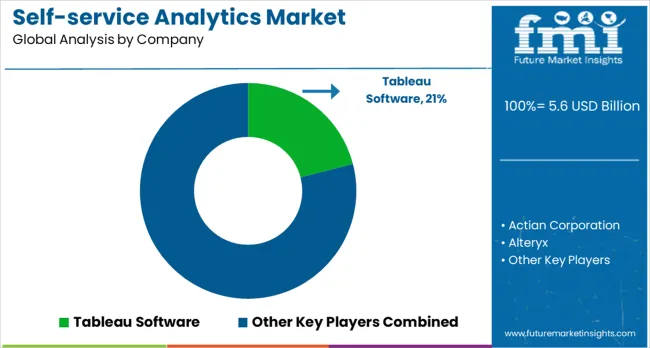
Market structure remains concentrated among established software vendors with validated cloud platforms and enterprise customer relationships. Primary competitive variables include user experience design, data integration capabilities, and deployment speed rather than analytical functionality breadth.
Companies with cloud-native architectures and established enterprise relationships demonstrate superior ability to scale user adoption while maintaining platform performance. Partnership strategies with systems integrators provide market access for specialized vendors while larger technology companies leverage acquisition approaches to access innovative user interface capabilities.
Platform maturity creates distinct competitive tiers. Companies with proven enterprise deployments command premium pricing and customer retention, while emerging vendors compete primarily on user experience innovation and deployment flexibility.
Recent Developments
The report includes comprehensive coverage of key industry developments and competitive positioning:
- In January 2026, Microsoft announced to acquire Osmos, an agentic AI data engineering platform designed to help simplify complex and time-consuming data workflows. [4]
- In December 2025, IBM and Confluent, Inc., the data streaming pioneer, announced they have entered into a definitive agreement under which IBM will acquire all of the issued and outstanding common shares of Confluent capabilities. [5]
- In May 2025, Qlik Technologies, a global leader in data integration, data quality, analytics, and AI, announced the closing of a previously disclosed significant minority investment led by a wholly owned subsidiary of the Abu Dhabi Investment Authority (ADIA). As part of the transaction, Thoma Bravo, a leading software investment firm, remains Qlik’s majority owner and has made a new equity investment alongside ADIA. [6]
Key Players in Self-service Analytics Market
- Tableau Software
- Microsoft Corporation
- Qlik Technologies
- IBM Corporation
- SAS Institute
- Sisense Ltd.
- TIBCO Software
- Alteryx Inc.
- Domo Inc.
- Looker (Google Cloud)
Scope of the Report
| Metric | Value |
|---|---|
| Quantitative Units | USD 6.2 billion (2026) to USD 14.8 billion (2036), at a CAGR of 9.1% |
| Market Definition | The self-service analytics market comprises the global development, deployment, and commercialization of analytical software platforms designed for business user independence in data-driven decision making including data visualization, report generation, and predictive analytics capabilities. |
| Component Segmentation | Software, Services |
| Deployment Coverage | Cloud-based, On-premises |
| Organization Segmentation | Small and Medium Enterprises, Large Enterprises |
| Regions Covered | North America, Latin America, Europe, East Asia, South Asia, Oceania, Middle East and Africa |
| Countries Covered | United States, Canada, Germany, France, United Kingdom, Japan, China, South Korea, India, Australia and 40 plus countries |
| Key Companies Profiled | Tableau Software, Microsoft Corporation, Qlik Technologies, IBM Corporation, SAS Institute, Sisense Ltd., TIBCO Software, Alteryx Inc., Domo Inc., Looker (Google Cloud) |
| Forecast Period | 2026 to 2036 |
| Approach | Hybrid top down and bottom up market modeling validated through enterprise deployment databases and software revenue tracking, supported by user adoption verification and platform capability benchmarking |
Self-service Analytics Market Analysis by Segments
Component:
- Software Platforms
- Professional Services
Deployment Mode:
- Cloud-based Solutions
- On-premises Installations
Organization Size:
- Small and Medium Enterprises
- Large Enterprises
Vertical:
- Banking, Financial Services and Insurance (BFSI)
- Healthcare and Life Sciences
- Retail and eCommerce
- Manufacturing and Industrial
- Government and Public Sector
- Others (Education, Media, Telecommunications)
End Use:
- Business Analysts
- Data Scientists
- Marketing Teams
- Operations Teams
Region:
- Asia Pacific
- China
- Japan
- South Korea
- India
- Australia
- Singapore
- Thailand
- Rest of Asia Pacific
- Europe
- Germany
- France
- United Kingdom
- Italy
- Spain
- Netherlands
- Scandinavia
- Switzerland
- Rest of Europe
- North America
- United States
- Canada
- Latin America
- Brazil
- Mexico
- Argentina
- Rest of Latin America
- Middle East & Africa
- Saudi Arabia
- United Arab Emirates
- South Africa
- Israel
- Rest of Middle East & Africa
Bibliography
- [1] Domo, Inc. (2025). Yamaha accelerates global logistics transformation with Domo. Domo Press Release.
- [2] Microsoft. (2025). Transforming enterprise analytics with Microsoft Fabric: New capabilities and platform updates. Microsoft Fabric Blog.
- [3] Microsoft. (2025, December 9). Microsoft invests USD17.5 billion in India to drive AI diffusion at population scale. Microsoft Asia Newsroom.
- [4] Microsoft. (2026, January 5). Microsoft announces acquisition of Osmos to accelerate autonomous data engineering in Fabric. Microsoft Official Blog.
- [5] IBM. (2025, December 8). IBM to acquire Confluent to create smart data platform for enterprise generative AI. IBM Newsroom.
- [6] Qlik. (2025). Qlik announces close of significant investment led by ADIA and Thoma Bravo. Qlik Press Release.
This Report Addresses
- Market intelligence to enable strategic decision making across established and emerging self-service analytics markets
- Market size estimation and 10-year revenue forecasts from 2026 to 2036, supported by validated enterprise deployment data and software revenue benchmarks
- Growth opportunity mapping across components and deployment modes with emphasis on cloud platform optimization
- Segment and regional revenue forecasts covering software platforms, professional services, enterprise implementations, and business user adoption
- Competition strategy assessment including platform capabilities, user experience design, and enterprise integration requirements
- Technology development tracking including cloud platform enhancements, artificial intelligence integration, and mobile analytics capabilities
- Market access analysis covering deployment frameworks, user training programs, and organizational change management
- Market report delivery in PDF, Excel, PPT, and interactive dashboard formats for executive and operational use
Frequently Asked Questions
How large is the demand for Self-service Analytics in the global market in 2026?
Demand for Self-service Analytics in the global market is estimated to be valued at USD 6.2 billion in 2026.
What will be the market size of Self-service Analytics in the global market by 2036?
Market size for Self-service Analytics is projected to reach USD 14.8 billion by 2036.
What is the expected demand growth for Self-service Analytics in the global market between 2026 and 2036?
Demand for Self-service Analytics in the global market is expected to grow at a CAGR of 9.1% between 2026 and 2036.
Which Component is poised to lead global sales by 2026?
Software platforms are expected to be the dominant component, capturing approximately 72.0% of global market share in 2026 due to user interface innovation and cloud deployment advantages.
How significant is the role of Large Enterprises in driving Self-service Analytics adoption in 2026?
Large enterprises represent the primary customer segment, projected to hold approximately 78% share of the total market in 2026 as digital transformation initiatives accelerate platform deployment.
What is Driving Self-service Analytics Demand in the United States?
Enterprise digital transformation acceleration and expanded cloud platform adoption for distributed workforce analytics requirements are driving growth.
What Technology Standards are Referenced for the United States?
Cloud security frameworks and data governance protocols are referenced as key implementation standards for enterprise deployments.
What is the United States Growth Outlook in this Report?
The United States is projected to grow at a CAGR of 10.1% during 2026 to 2036.
Why is Europe described as Important for Regulatory Development in this Report?
Growth is driven by data privacy frameworks and coordinated enterprise governance standards that establish international compliance requirements.
What Type of Development Dominates in Europe?
GDPR-compliant analytics platform development for regulated industry applications dominates regional activity.
What is Germany Growth Outlook in this Report?
Germany is projected to expand at a CAGR of 9.4% during 2026 to 2036.
Does the Report Cover Japan in its Regional Analysis?
Japan is included within East Asia under the regional scope of analysis.
What are the Sources referred to for analyzing the Market in Japan?
Enterprise technology surveys, digital transformation case studies, and business intelligence industry associations covering platform deployment, user adoption progress, and organizational change management are cited as primary reference sources.
What is the Main Development Theme Linked to Japan in Asia Coverage?
Asia Pacific development is associated with cost-effective cloud deployments to enable competitive analytical capabilities across regional enterprises.
Does the Report Cover South Korea in its Regional Analysis?
South Korea is included within East Asia under the regional coverage framework.
What is the Main Korea Related Development Theme in Asia Coverage?
Government digital economy initiatives and enterprise cloud adoption programs for self-service analytics acceleration are emphasized.
Which Deployment Approaches are Strategically Important for Asia Pacific Technology Adoption?
Cloud-based platforms and mobile analytics capabilities are prioritized for rapid implementation across regional enterprise markets.
What is Self-service Analytics and What is It Mainly Used For?
Self-service analytics involves business intelligence platforms primarily used for data visualization, report generation, and predictive analytics accessible to non-technical business users without IT department intervention.
What does Self-service Analytics Market Mean in this Report?
Self-service analytics market refers to global development, deployment, and commercialization of analytical software platforms designed for business user independence across various industry applications.
What is Included in the Scope of this Self-service Analytics Market Report?
Scope covers analytical software platforms by component, key deployment modes such as cloud and on-premises, and organization sizes including small businesses and large enterprises.
What is Excluded from the Scope of this Report?
Traditional business intelligence tools, basic reporting software, and specialized analytics applications are excluded unless integrated with comprehensive self-service capabilities.
What does Market Forecast Mean on this Page?
Market forecast represents model-based projections built on enterprise deployment timelines and technology adoption assumptions for strategic planning purposes.
How does FMI Build and Validate the Self-service Analytics Market Forecast?
Forecast is developed using hybrid modeling validated through enterprise deployment databases, software revenue tracking, and user adoption verification.
What does Zero Reliance on Speculative Third Party Market Research Mean Here?
Market analysis is based on verifiable platform implementations, software revenue data, and verified user adoption metrics rather than speculative technology valuations.
Preview the report firsthand - request a free sample
Get SampleGet the brochure for pricing and purchase details.
Get PDFTable of Content
- Executive Summary
- Global Market Outlook
- Demand-side Trends
- Supply-side Trends
- Technology Roadmap Analysis
- Analysis and Recommendations
- Market Overview
- Market Coverage / Taxonomy
- Market Definition / Scope / Limitations
- Research Methodology
- Chapter Orientation
- Analytical Lens and Working Hypotheses
- Market Structure, Signals, and Trend Drivers
- Benchmarking and Cross-market Comparability
- Market Sizing, Forecasting, and Opportunity Mapping
- Research Design and Evidence Framework
- Desk Research Programme (Secondary Evidence)
- Company Annual and Sustainability Reports
- Peer-reviewed Journals and Academic Literature
- Corporate Websites, Product Literature, and Technical Notes
- Earnings Decks and Investor Briefings
- Statutory Filings and Regulatory Disclosures
- Technical White Papers and Standards Notes
- Trade Journals, Industry Magazines, and Analyst Briefs
- Conference Proceedings, Webinars, and Seminar Materials
- Government Statistics Portals and Public Data Releases
- Press Releases and Reputable Media Coverage
- Specialist Newsletters and Curated Briefings
- Sector Databases and Reference Repositories
- FMI Internal Proprietary Databases and Historical Market Datasets
- Subscription Datasets and Paid Sources
- Social Channels, Communities, and Digital Listening Inputs
- Additional Desk Sources
- Expert Input and Fieldwork (Primary Evidence)
- Primary Modes
- Qualitative Interviews and Expert Elicitation
- Quantitative Surveys and Structured Data Capture
- Blended Approach
- Why Primary Evidence is Used
- Field Techniques
- Interviews
- Surveys
- Focus Groups
- Observational and In-context Research
- Social and Community Interactions
- Stakeholder Universe Engaged
- C-suite Leaders
- Board Members
- Presidents and Vice Presidents
- R&D and Innovation Heads
- Technical Specialists
- Domain Subject-matter Experts
- Scientists
- Physicians and Other Healthcare Professionals
- Governance, Ethics, and Data Stewardship
- Research Ethics
- Data Integrity and Handling
- Primary Modes
- Tooling, Models, and Reference Databases
- Desk Research Programme (Secondary Evidence)
- Data Engineering and Model Build
- Data Acquisition and Ingestion
- Cleaning, Normalisation, and Verification
- Synthesis, Triangulation, and Analysis
- Quality Assurance and Audit Trail
- Market Background
- Market Dynamics
- Drivers
- Restraints
- Opportunity
- Trends
- Scenario Forecast
- Demand in Optimistic Scenario
- Demand in Likely Scenario
- Demand in Conservative Scenario
- Opportunity Map Analysis
- Product Life Cycle Analysis
- Supply Chain Analysis
- Investment Feasibility Matrix
- Value Chain Analysis
- PESTLE and Porter’s Analysis
- Regulatory Landscape
- Regional Parent Market Outlook
- Production and Consumption Statistics
- Import and Export Statistics
- Market Dynamics
- Global Market Analysis 2021 to 2025 and Forecast, 2026 to 2036
- Historical Market Size Value (USD Million) Analysis, 2021 to 2025
- Current and Future Market Size Value (USD Million) Projections, 2026 to 2036
- Y-o-Y Growth Trend Analysis
- Absolute $ Opportunity Analysis
- Global Market Pricing Analysis 2021 to 2025 and Forecast 2026 to 2036
- Global Market Analysis 2021 to 2025 and Forecast 2026 to 2036, By Deployment Mode
- Introduction / Key Findings
- Historical Market Size Value (USD Million) Analysis By Deployment Mode , 2021 to 2025
- Current and Future Market Size Value (USD Million) Analysis and Forecast By Deployment Mode , 2026 to 2036
- Cloud-based Solutions
- On-premises Installations
- Cloud-based Solutions
- Y-o-Y Growth Trend Analysis By Deployment Mode , 2021 to 2025
- Absolute $ Opportunity Analysis By Deployment Mode , 2026 to 2036
- Global Market Analysis 2021 to 2025 and Forecast 2026 to 2036, By Component
- Introduction / Key Findings
- Historical Market Size Value (USD Million) Analysis By Component, 2021 to 2025
- Current and Future Market Size Value (USD Million) Analysis and Forecast By Component, 2026 to 2036
- Software Platforms
- Professional Services
- Software Platforms
- Y-o-Y Growth Trend Analysis By Component, 2021 to 2025
- Absolute $ Opportunity Analysis By Component, 2026 to 2036
- Global Market Analysis 2021 to 2025 and Forecast 2026 to 2036, By Region
- Introduction
- Historical Market Size Value (USD Million) Analysis By Region, 2021 to 2025
- Current Market Size Value (USD Million) Analysis and Forecast By Region, 2026 to 2036
- North America
- Latin America
- Western Europe
- Eastern Europe
- East Asia
- South Asia and Pacific
- Middle East & Africa
- Market Attractiveness Analysis By Region
- North America Market Analysis 2021 to 2025 and Forecast 2026 to 2036, By Country
- Historical Market Size Value (USD Million) Trend Analysis By Market Taxonomy, 2021 to 2025
- Market Size Value (USD Million) Forecast By Market Taxonomy, 2026 to 2036
- By Country
- USA
- Canada
- Mexico
- By Deployment Mode
- By Component
- By Country
- Market Attractiveness Analysis
- By Country
- By Deployment Mode
- By Component
- Key Takeaways
- Latin America Market Analysis 2021 to 2025 and Forecast 2026 to 2036, By Country
- Historical Market Size Value (USD Million) Trend Analysis By Market Taxonomy, 2021 to 2025
- Market Size Value (USD Million) Forecast By Market Taxonomy, 2026 to 2036
- By Country
- Brazil
- Chile
- Rest of Latin America
- By Deployment Mode
- By Component
- By Country
- Market Attractiveness Analysis
- By Country
- By Deployment Mode
- By Component
- Key Takeaways
- Western Europe Market Analysis 2021 to 2025 and Forecast 2026 to 2036, By Country
- Historical Market Size Value (USD Million) Trend Analysis By Market Taxonomy, 2021 to 2025
- Market Size Value (USD Million) Forecast By Market Taxonomy, 2026 to 2036
- By Country
- Germany
- UK
- Italy
- Spain
- France
- Nordic
- BENELUX
- Rest of Western Europe
- By Deployment Mode
- By Component
- By Country
- Market Attractiveness Analysis
- By Country
- By Deployment Mode
- By Component
- Key Takeaways
- Eastern Europe Market Analysis 2021 to 2025 and Forecast 2026 to 2036, By Country
- Historical Market Size Value (USD Million) Trend Analysis By Market Taxonomy, 2021 to 2025
- Market Size Value (USD Million) Forecast By Market Taxonomy, 2026 to 2036
- By Country
- Russia
- Poland
- Hungary
- Balkan & Baltic
- Rest of Eastern Europe
- By Deployment Mode
- By Component
- By Country
- Market Attractiveness Analysis
- By Country
- By Deployment Mode
- By Component
- Key Takeaways
- East Asia Market Analysis 2021 to 2025 and Forecast 2026 to 2036, By Country
- Historical Market Size Value (USD Million) Trend Analysis By Market Taxonomy, 2021 to 2025
- Market Size Value (USD Million) Forecast By Market Taxonomy, 2026 to 2036
- By Country
- China
- Japan
- South Korea
- By Deployment Mode
- By Component
- By Country
- Market Attractiveness Analysis
- By Country
- By Deployment Mode
- By Component
- Key Takeaways
- South Asia and Pacific Market Analysis 2021 to 2025 and Forecast 2026 to 2036, By Country
- Historical Market Size Value (USD Million) Trend Analysis By Market Taxonomy, 2021 to 2025
- Market Size Value (USD Million) Forecast By Market Taxonomy, 2026 to 2036
- By Country
- India
- ASEAN
- Australia & New Zealand
- Rest of South Asia and Pacific
- By Deployment Mode
- By Component
- By Country
- Market Attractiveness Analysis
- By Country
- By Deployment Mode
- By Component
- Key Takeaways
- Middle East & Africa Market Analysis 2021 to 2025 and Forecast 2026 to 2036, By Country
- Historical Market Size Value (USD Million) Trend Analysis By Market Taxonomy, 2021 to 2025
- Market Size Value (USD Million) Forecast By Market Taxonomy, 2026 to 2036
- By Country
- Kingdom of Saudi Arabia
- Other GCC Countries
- Turkiye
- South Africa
- Other African Union
- Rest of Middle East & Africa
- By Deployment Mode
- By Component
- By Country
- Market Attractiveness Analysis
- By Country
- By Deployment Mode
- By Component
- Key Takeaways
- Key Countries Market Analysis
- USA
- Pricing Analysis
- Market Share Analysis, 2025
- By Deployment Mode
- By Component
- Canada
- Pricing Analysis
- Market Share Analysis, 2025
- By Deployment Mode
- By Component
- Mexico
- Pricing Analysis
- Market Share Analysis, 2025
- By Deployment Mode
- By Component
- Brazil
- Pricing Analysis
- Market Share Analysis, 2025
- By Deployment Mode
- By Component
- Chile
- Pricing Analysis
- Market Share Analysis, 2025
- By Deployment Mode
- By Component
- Germany
- Pricing Analysis
- Market Share Analysis, 2025
- By Deployment Mode
- By Component
- UK
- Pricing Analysis
- Market Share Analysis, 2025
- By Deployment Mode
- By Component
- Italy
- Pricing Analysis
- Market Share Analysis, 2025
- By Deployment Mode
- By Component
- Spain
- Pricing Analysis
- Market Share Analysis, 2025
- By Deployment Mode
- By Component
- France
- Pricing Analysis
- Market Share Analysis, 2025
- By Deployment Mode
- By Component
- India
- Pricing Analysis
- Market Share Analysis, 2025
- By Deployment Mode
- By Component
- ASEAN
- Pricing Analysis
- Market Share Analysis, 2025
- By Deployment Mode
- By Component
- Australia & New Zealand
- Pricing Analysis
- Market Share Analysis, 2025
- By Deployment Mode
- By Component
- China
- Pricing Analysis
- Market Share Analysis, 2025
- By Deployment Mode
- By Component
- Japan
- Pricing Analysis
- Market Share Analysis, 2025
- By Deployment Mode
- By Component
- South Korea
- Pricing Analysis
- Market Share Analysis, 2025
- By Deployment Mode
- By Component
- Russia
- Pricing Analysis
- Market Share Analysis, 2025
- By Deployment Mode
- By Component
- Poland
- Pricing Analysis
- Market Share Analysis, 2025
- By Deployment Mode
- By Component
- Hungary
- Pricing Analysis
- Market Share Analysis, 2025
- By Deployment Mode
- By Component
- Kingdom of Saudi Arabia
- Pricing Analysis
- Market Share Analysis, 2025
- By Deployment Mode
- By Component
- Turkiye
- Pricing Analysis
- Market Share Analysis, 2025
- By Deployment Mode
- By Component
- South Africa
- Pricing Analysis
- Market Share Analysis, 2025
- By Deployment Mode
- By Component
- USA
- Market Structure Analysis
- Competition Dashboard
- Competition Benchmarking
- Market Share Analysis of Top Players
- By Regional
- By Deployment Mode
- By Component
- Competition Analysis
- Competition Deep Dive
- Tableau Software
- Overview
- Product Portfolio
- Profitability by Market Segments (Product/Age /Sales Channel/Region)
- Sales Footprint
- Strategy Overview
- Marketing Strategy
- Product Strategy
- Channel Strategy
- Microsoft Corporation
- Qlik Technologies
- IBM Corporation
- SAS Institute
- Sisense Ltd.
- TIBCO Software
- Alteryx Inc.
- Domo Inc.
- Tableau Software
- Competition Deep Dive
- Assumptions & Acronyms Used


