


Risk Management Market
This study analyzes the risk management market with a focus on market size estimation, revenue forecasting, competitive benchmarking, demand patterns, growth catalysts, market restraints, component outlook trends, deployment outlook outlook, and long-term strategic opportunities.
Historical Data Covered: 2016 to 2024 | Base Year: 2025 | Estimated Year: 2026 | Forecast Period: 2027 to 2036
Risk Management Market Size, Market Forecast and Outlook By FMI
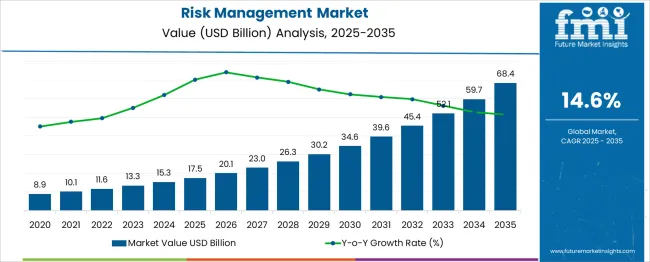
The risk management market was valued at USD 17.50 billion in 2025. Based on Future Market Insights' analysis, demand for risk management solutions is estimated to reach USD 20.06 billion in 2026 and USD 78.36 billion by 2036. FMI projects a CAGR of 14.6% during the forecast period.
Summary of Risk Management Market
- Market Overview
- The risk management market is valued at USD 17.50 billion in 2025 and is projected to reach USD 78.36 billion by 2036.
- The industry is expected to grow at a 14.6% CAGR from 2026 to 2036, creating an incremental opportunity of USD 58.30 billion.
- The market is a high-growth enterprise software category where regulatory compliance acceleration, cybersecurity risk convergence, and cloud platform migration define competitive dynamics.
- Demand and Growth Drivers
- Demand is driven by escalating regulatory compliance requirements and increasing board-level demand for real-time enterprise risk visibility.
- Rising frequency and cost of cybersecurity incidents are forcing organizations to integrate cyber risk scoring into enterprise risk management platforms.
- Cloud-based deployment is absorbing the majority of new license revenue as organizations prioritize rapid implementation and cross-functional access.
- Among key countries, China leads at 19.7% CAGR, followed by India at 18.2%, Germany at 16.7%, France at 15.3%, the UK at 13.8%, the USA at 12.4%, and Brazil at 10.9%.
- Product and Segment View
- The market covers GRC platforms, financial risk analytics, cybersecurity risk scoring, and operational continuity planning tools across cloud and on-premises deployments.
- Risk types span financial, compliance, cybersecurity, enterprise, and operational risk management across large enterprises and SMEs.
- Solutions lead by Component with 64.0% share in 2026.
- Cloud-Based leads by Deployment with 63.9% share in 2026.
- The scope excludes standalone cybersecurity products, insurance brokerage services, and manual consulting engagements without platform delivery.
- Geography and Competitive Outlook
- China and India are the fastest-growing markets due to financial sector digitization mandates and expanding cybersecurity regulatory frameworks.
- The USA and UK maintain large installed bases with growth driven by financial services regulation and enterprise platform consolidation.
- Competition is shaped by platform breadth, AI-driven risk analytics, and regulatory domain expertise, with key players including IBM Corporation, Microsoft Corporation, ServiceNow, Oracle Corporation, MetricStream, and SAS Institute Inc.
- Analyst Opinion at FMI
- Sudip saha, Principal Consultant for Technology, opines: 'In my analysis, I have observed that risk management procurement is converging around unified platforms that merge financial, cyber, and operational risk into a single executive dashboard. Chief risk officers can no longer justify maintaining separate point solutions for compliance, cybersecurity, and operational continuity. Platform vendors without AI-driven risk correlation capabilities and pre-built regulatory content libraries will lose enterprise deals to competitors offering integrated risk intelligence from a single deployment.'
- Strategic Implications / Executive Takeaways
- Platform vendors must develop AI-driven risk correlation capabilities that unify financial, cyber, and operational risk signals into a single executive-level risk dashboard.
- Sales teams should target chief risk officer and board-level stakeholders with total cost-of-risk visibility narratives rather than point-solution functional pitches.
- Product teams need to build pre-configured regulatory content libraries for BFSI, healthcare, and government verticals to reduce implementation timelines and accelerate time-to-value for enterprise deployments.
Risk Management Market Key Takeaways
| Metric | Details |
|---|---|
| Industry Size (2026) | USD 20.06 billion |
| Industry Value (2036) | USD 78.36 billion |
| CAGR (2026-2036) | 14.6% |
Source: Future Market Insights, 2026
Escalating regulatory compliance requirements, the rising frequency and cost of cybersecurity incidents, and increasing board-level demand for real-time enterprise risk visibility are accelerating platform adoption. Cloud-based deployment is absorbing the majority of new license revenue as organizations prioritize rapid implementation and cross-functional access over on-premises infrastructure control. The convergence of financial risk, cybersecurity risk, and operational risk into unified enterprise platforms is compressing the traditional GRC market into broader integrated risk management (IRM) architectures that serve chief risk officers, compliance teams, and security operations from a single data layer.
China leads at 19.7% CAGR, driven by financial sector digitization mandates and expanding cybersecurity regulatory frameworks. India follows at 18.2%, supported by banking sector technology modernization and data protection law implementation. Germany registers 16.7%, reflecting structured compliance culture and industrial cybersecurity investment. France records 15.3% and the United Kingdom 13.8%, both driven by financial services regulation and cross-border data governance requirements. The United States tracks at 12.4% with mature but expanding enterprise adoption, and Brazil at 10.9% with financial sector technology upgrades driving growth.
Risk Management Market Definition
Risk management software and services encompass enterprise platforms designed to identify, assess, monitor, and mitigate financial, compliance, cybersecurity, operational, and enterprise-wide risks. The category spans cloud-based and on-premises solutions including governance, risk, and compliance (GRC) platforms, financial risk analytics, cybersecurity risk scoring, and operational continuity planning tools deployed across banking, technology, government, healthcare, and manufacturing sectors.
Risk Management Market Inclusions
Market scope covers solutions and services across cloud-based and on-premises deployments. Risk type analysis includes financial, compliance, cybersecurity, enterprise, and operational risk management. Organization size coverage spans large enterprises and SMEs. End use coverage includes BFSI, IT & telecom, government, healthcare, retail, manufacturing, professional services, and energy. Regional forecast data from 2026 to 2036 is included.
Risk Management Market Exclusions
Standalone cybersecurity products without integrated risk scoring (firewalls, endpoint protection), insurance brokerage services, and financial auditing services not delivered through software platforms are excluded. Manual risk assessment consulting engagements without technology platform delivery fall outside the scope.
Risk Management Market Research Methodology
- Primary Research: Analysts engaged with procurement directors, operations managers, and industry specialists to map decision gates triggering purchasing shifts and technology transitions.
- Desk Research: Data collection aggregated regulatory filings, standards documentation, trade body publications, and public company disclosures relevant to market sizing.
- Market-Sizing and Forecasting: Baseline values derive from a bottom-up aggregation of revenue and shipment data, applying region-specific adoption curves to project forecast period demand.
- Data Validation and Update Cycle: Projections are cross-validated against publicly reported financial guidance from leading market participants and updated on a quarterly review cycle.
Why the Risk Management Market is Growing?
Market expansion is being supported by the increasing complexity of business operations and regulatory environments worldwide, creating corresponding demand for comprehensive risk identification, assessment, and mitigation solutions. Organizations across various industries are implementing integrated risk management frameworks that provide visibility into potential threats and enable proactive response strategies. Regulatory bodies are establishing stringent compliance requirements that mandate documented risk assessment procedures and continuous monitoring capabilities across financial services, healthcare, manufacturing, and other sectors.
The growing frequency and sophistication of cybersecurity threats are driving demand for specialized risk management solutions that can identify vulnerabilities and protect critical business assets. Companies are adopting comprehensive risk management platforms that integrate cybersecurity risk assessment with operational risk monitoring and regulatory compliance management. The increasing adoption of cloud technologies and digital transformation initiatives is creating new risk categories that require specialized monitoring and mitigation approaches, driving market growth for advanced risk management solutions.
Segmental Analysis
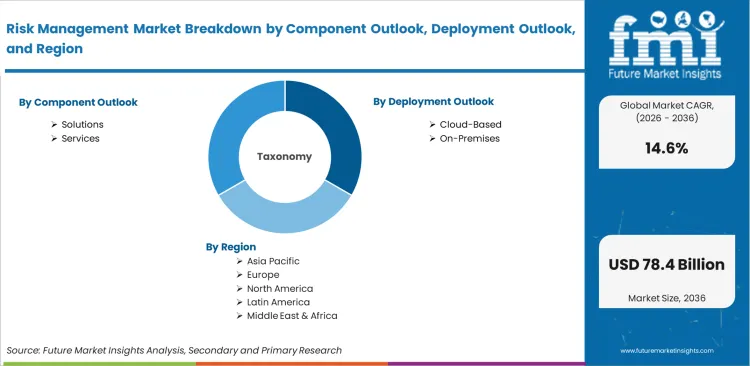
The market is segmented by component outlook, deployment outlook, risk type outlook, organization size outlook, end use outlook, and region. By component outlook, the market includes solutions and services. Based on deployment outlook, the market is categorized into cloud-based and on-premises. In terms of risk type outlook, the market is segmented into financial risk management, compliance risk management, cybersecurity risk management, enterprise risk management, operational risk management, and others. By organization size outlook, the market is classified into large enterprises and small and medium-sized enterprises. By end use outlook, the market is divided into BFSI, IT & telecom, government defense and aerospace, healthcare & life science, retail & consumer goods, manufacturing, professional services, energy & utilities, and others. Regionally, the market is divided into North America, Europe, East Asia, South Asia & Pacific, Latin America, and Middle East & Africa.
By Component Outlook, Solutions Segment Accounts for 63.95% Market Share
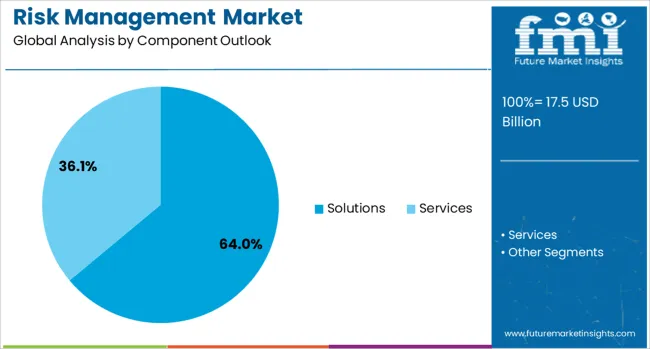
Solutions are projected to account for 63.95% of the risk management market in 2026. This leading share is supported by the widespread adoption of integrated risk management platforms that provide comprehensive risk assessment, monitoring, and reporting capabilities across various business functions. Risk management solutions offer automated risk identification, real-time monitoring, and advanced analytics that enable organizations to proactively manage potential threats and maintain regulatory compliance. The segment benefits from continuous technological innovation and the development of industry-specific risk management applications that address diverse organizational requirements.
By Deployment Outlook, Cloud-Based Segment Accounts for 64% Market Share
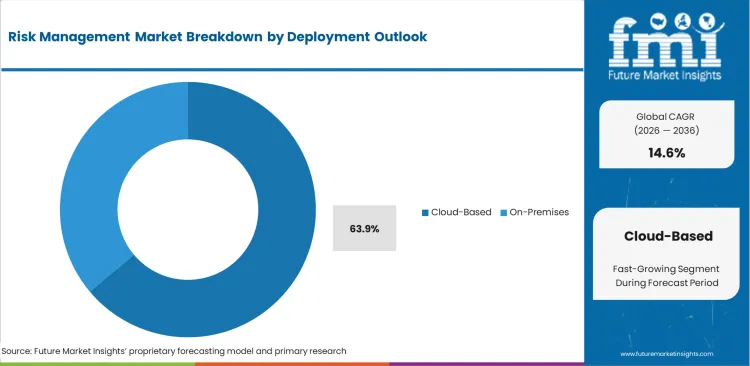
Cloud-based deployment is expected to represent 64% of the risk management market in 2026. This dominant share reflects the growing preference for scalable, cost-effective risk management solutions that can be rapidly deployed and easily updated to address evolving threat landscapes. Cloud-based risk management platforms offer enhanced accessibility, real-time collaboration capabilities, and reduced infrastructure requirements compared to traditional on-premises solutions. The segment benefits from the increasing adoption of cloud technologies across various industries and the availability of comprehensive security measures that protect sensitive risk management data.
By Risk Type Outlook, Financial Risk Management Segment Accounts for 29% Market Share
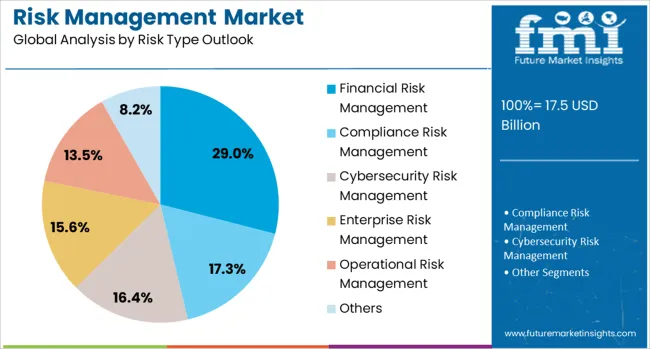
Financial risk management is projected to contribute 29% of the market in 2026, representing the largest single risk category due to the critical importance of financial stability and regulatory compliance across all industries. Financial risk management solutions address credit risk, market risk, operational risk, and liquidity risk through comprehensive monitoring and assessment capabilities. The segment is supported by stringent regulatory requirements in the financial services industry and the growing complexity of global financial markets that require sophisticated risk modeling and analysis tools.
By Organization Size Outlook, Large Enterprises Segment Accounts for 59% Market Share
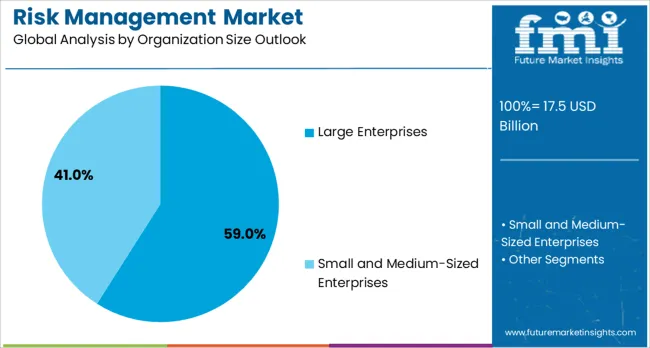
Large enterprises are estimated to hold 59% of the market share in 2026. This dominance reflects the extensive risk management requirements of large organizations that operate across multiple business units, geographic regions, and regulatory environments. Large enterprises typically face complex risk profiles that require comprehensive, integrated risk management solutions capable of addressing diverse operational, financial, and compliance challenges. The segment provides stable demand for advanced risk management platforms through ongoing regulatory compliance requirements and the need for enterprise-wide risk governance frameworks.
By End Use Outlook, BFSI Segment Accounts for 30% Market Share
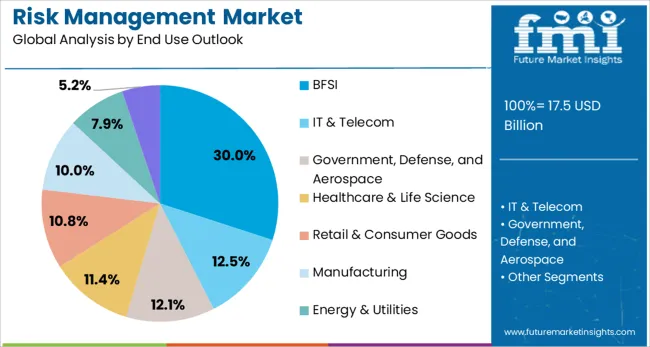
Banking, Financial Services, and Insurance (BFSI) sector is estimated to hold 30% of the market share in 2026. This significant share reflects the highly regulated nature of the financial services industry and the critical importance of comprehensive risk management for maintaining operational stability and regulatory compliance. BFSI organizations face diverse risk categories, including credit risk, market risk, operational risk, and cybersecurity risk, requiring sophisticated monitoring and assessment capabilities. The segment benefits from stringent regulatory frameworks and the need for real-time risk monitoring to maintain stakeholder confidence and regulatory approval.
What are the Drivers, Restraints, and Key Trends of the Risk Management Market ?
The risk management market is advancing rapidly due to increasing regulatory requirements and growing awareness of operational risks across various industries. The market faces challenges including implementation complexity in legacy systems, need for specialized expertise in risk assessment methodologies, and varying regulatory requirements across different geographic regions. Technology integration and standardization efforts continue to influence solution development and market adoption patterns.
Integration of Artificial Intelligence and Machine Learning Technologies
The growing deployment of artificial intelligence and machine learning capabilities is enabling automated risk identification, predictive risk modeling, and enhanced threat detection across various risk categories. AI-powered risk management solutions provide real-time analysis of large datasets and can identify patterns that indicate potential risks before they materialize into significant threats. These technologies are particularly valuable for cybersecurity risk management and fraud detection applications where rapid response capabilities are critical for minimizing potential damage.
Development of Industry-Specific Risk Management Solutions
Modern risk management platforms are incorporating industry-specific functionality and regulatory compliance features that address unique risk profiles across different sectors. Healthcare organizations require specialized solutions for patient data protection and regulatory compliance, while manufacturing companies need operational risk monitoring and supply chain risk assessment capabilities. Industry-specific solutions provide targeted functionality and compliance features that enhance risk management effectiveness and reduce implementation complexity for specialized applications.
Analysis of Risk Management Market by Key Country
.webp "Top Country Growth Comparison Risk Management Market Cagr (2026 2036)")
| Countries | CAGR (%) |
|---|---|
| China | 19.7 |
| India | 18.2 |
| Germany | 16.7 |
| France | 15.3 |
| United Kingdom | 13.8 |
| United States | 12.4 |
| Brazil | 10.9 |
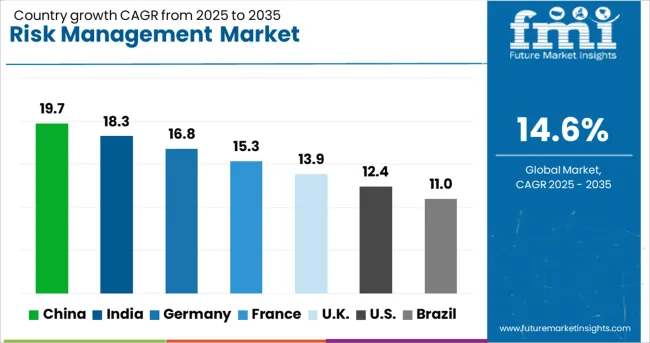
The risk management market demonstrates significant variation in growth rates across major economies, reflecting differences in digital adoption, regulatory frameworks, and sectoral priorities. China leads with the highest CAGR of 19.7%, driven by rapid digital transformation, stringent regulatory requirements, and robust expansion in financial services and technology sectors. India follows closely at 18.2%, supported by growing digital banking adoption, cybersecurity initiatives, and IT sector expansion. Germany grows at 16.7%, emphasizing manufacturing excellence, regulatory compliance, and operational risk monitoring. France records 15.3%, fueled by financial services and aerospace industry risk management needs. The UK achieves 13.8% growth, focusing on cybersecurity and integrated governance frameworks. The USA grows steadily at 12.4%, supported by enterprise-wide risk management and regulatory compliance initiatives. Brazil shows emerging potential with a CAGR of 10.9%, driven by financial services modernization and adoption of digital risk management solutions.
The report covers an in-depth analysis of 40+ countries; seven top-performing OECD countries are highlighted below.
China Leads Global Market Growth with Digital Transformation Acceleration
Revenue from risk management in China is projected to exhibit strong growth with a CAGR of 19.7% through 2035, driven by rapid digital transformation initiatives and increasing regulatory requirements for risk assessment across financial services and technology sectors. The country's expanding financial services industry and growing emphasis on cybersecurity risk management are creating significant demand for comprehensive risk management solutions. Major organizations are implementing integrated risk management platforms that address operational, compliance, and cybersecurity risks across urban and rural business environments.
China's technology sector modernization and financial services expansion are supporting the development of advanced risk management capabilities and regulatory compliance programs that meet international standards. Government initiatives emphasizing data protection and operational resilience are driving demand for documented risk assessment procedures and continuous monitoring capabilities. The growing complexity of business operations and international trade relationships is creating additional opportunities for enterprise risk management applications and specialized consulting services.
- Digital transformation acceleration programs are supporting widespread adoption of cloud-based risk management platforms across state-owned enterprises and private organizations nationwide.
- Financial services sector expansion is creating demand for specialized risk assessment solutions that meet domestic regulatory requirements and international banking standards.
India Demonstrates Strong Market Potential with Financial Services Growth
Revenue from risk management in India is expanding at a CAGR of 18.2%, supported by rapid financial services sector development and increasing adoption of digital banking technologies across urban and rural markets. The country's expanding information technology industry and growing emphasis on cybersecurity risk management are driving demand for comprehensive risk assessment solutions. Organizations are implementing integrated risk management frameworks that address operational risks, regulatory compliance requirements, and cybersecurity threats in diverse business environments.
India's technology sector growth and financial inclusion initiatives are facilitating adoption of advanced risk management solutions and professional training programs that meet international quality standards. The growing emphasis on digital payments and financial technology innovation is creating demand for specialized cybersecurity risk management systems and real-time monitoring capabilities. Professional certification programs and industry standards development are enhancing technical expertise among risk management professionals and enabling comprehensive risk assessment services.
- Financial inclusion programs are promoting adoption of risk management solutions across microfinance institutions, regional banks, and financial technology companies serving diverse market segments.
- Information technology sector expansion is driving demand for cybersecurity risk management platforms and operational risk monitoring solutions that support global service delivery capabilities.
Germany Focuses on Manufacturing and Financial Services Risk Management
Demand for risk management in Germany is projected to grow at a CAGR of 16.7%, supported by the country's emphasis on manufacturing excellence and comprehensive financial services regulatory frameworks. German organizations prioritize operational risk management and regulatory compliance across automotive, chemical, and financial services industries. The market is characterized by focus on precision risk assessment, advanced analytics integration, and compliance with comprehensive data protection and operational risk regulations.
Germany's manufacturing sector leadership and financial services innovation require extensive risk management capabilities to maintain operational efficiency and regulatory compliance standards. Organizations are implementing advanced risk management platforms that support Industry 4.0 initiatives and provide comprehensive monitoring of supply chain risks, operational hazards, and cybersecurity threats. Professional certification programs ensure specialized expertise among risk management professionals, enabling comprehensive risk assessment services and regulatory compliance support.
- Manufacturing sector digitalization initiatives require advanced operational risk management solutions that integrate with production systems and supply chain monitoring capabilities.
- Financial services regulatory excellence promotes comprehensive risk assessment frameworks and automated compliance reporting systems that meet European banking standards and data protection requirements.
France Emphasizes Financial Services and Aerospace Industry Risk Management
Demand for risk management in France is expanding at a CAGR of 15.3%, driven by the country's well-established financial services sector and aerospace industry risk assessment requirements. French organizations maintain comprehensive risk management protocols across banking, insurance, and manufacturing industries that require extensive regulatory compliance and operational risk monitoring. The market benefits from regulatory requirements that mandate documented risk assessment procedures and ongoing compliance monitoring across diverse business sectors.
France's aerospace and defense industry creates stable demand for specialized risk management solutions that meet international security standards and operational requirements. Financial services organizations are implementing advanced risk management technologies and comprehensive documentation systems that support regulatory compliance and stakeholder confidence objectives. Professional development programs and industry standards ensure technical expertise among risk management professionals in specialized applications and regulatory compliance procedures.
- Aerospace industry excellence requires comprehensive operational risk management systems that demonstrate consistent safety standards and regulatory compliance across international operations.
- Financial services innovation promotes advanced risk assessment technologies and integrated compliance reporting systems that support European regulatory requirements and international banking standards.
United Kingdom Emphasizes Financial Services and Cybersecurity Risk Management
Demand for risk management in the UK is projected to grow at a CAGR of 13.8%, supported by the country's leadership in financial services innovation and comprehensive cybersecurity risk assessment requirements. British organizations implement extensive risk management protocols that ensure regulatory compliance and maintain operational resilience across banking, insurance, and technology sectors. The market is characterized by emphasis on comprehensive risk governance frameworks and integrated monitoring systems that support business continuity and stakeholder confidence.
The UK's financial services sector prioritizes advanced risk management capabilities through comprehensive regulatory compliance programs and cybersecurity risk assessment initiatives. Organizations are implementing integrated risk management platforms and automated monitoring systems that enhance operational resilience and regulatory reporting capabilities. Professional training and certification programs develop specialized expertise among risk management professionals, enabling comprehensive risk assessment services and regulatory compliance support.
- Financial services leadership promotes comprehensive risk management frameworks that integrate operational risk monitoring with cybersecurity threat assessment and regulatory compliance reporting.
- Cybersecurity excellence initiatives require advanced threat detection and risk assessment capabilities that support national security objectives and business continuity requirements.
United States Emphasizes Enterprise Risk Management and Regulatory Compliance
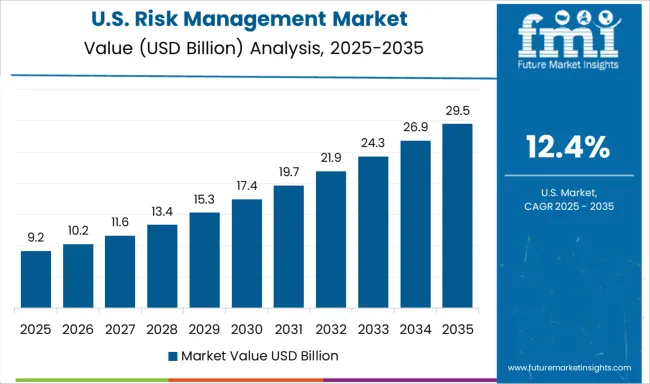
Demand for risk management in the USA is expanding at a CAGR of 12.4%, driven by comprehensive regulatory requirements and emphasis on enterprise-wide risk governance frameworks across various industries. American organizations implement extensive risk management protocols that ensure regulatory compliance and maintain operational resilience across financial services, healthcare, and technology sectors. The market benefits from established regulatory frameworks and compliance requirements that mandate documented risk assessment procedures and continuous monitoring programs.
The USA business environment emphasizes comprehensive risk management capabilities through integrated governance frameworks and automated compliance reporting systems. Organizations are implementing advanced risk management platforms that support regulatory compliance, operational risk monitoring, and cybersecurity threat assessment across diverse business units. Professional certification programs and industry standards ensure technical expertise among risk management professionals in specialized applications and regulatory compliance procedures.
- Regulatory compliance leadership promotes comprehensive risk management systems that demonstrate effective governance and operational resilience across multiple industry sectors.
- Enterprise risk management initiatives support integrated risk assessment frameworks and automated reporting systems that enhance business decision-making and stakeholder confidence.
Brazil Maintains Steady Growth with Financial Services Modernization
Revenue from risk management in Brazil is growing at a CAGR of 10.9%, driven by financial services sector modernization and increasing adoption of digital banking technologies across domestic and international markets. The country's expanding financial technology sector and growing emphasis on regulatory compliance are creating demand for comprehensive risk management solutions. Organizations are implementing integrated risk management frameworks that address operational risks, regulatory requirements, and cybersecurity threats in evolving business environments.
Brazil's financial services modernization initiatives are facilitating adoption of advanced risk management technologies and professional training programs that meet international standards. The growing emphasis on digital financial services and regulatory compliance is creating opportunities for specialized risk management solutions and automated monitoring capabilities. Professional development programs and regulatory harmonization efforts are enhancing risk management expertise and enabling comprehensive compliance services.
- Financial services modernization programs support adoption of integrated risk management platforms across banks, credit unions, and financial technology companies serving diverse customer segments.
- Regulatory compliance enhancement initiatives promote comprehensive risk assessment frameworks and automated reporting systems that meet domestic and international banking standards.
Europe Market Split by Country
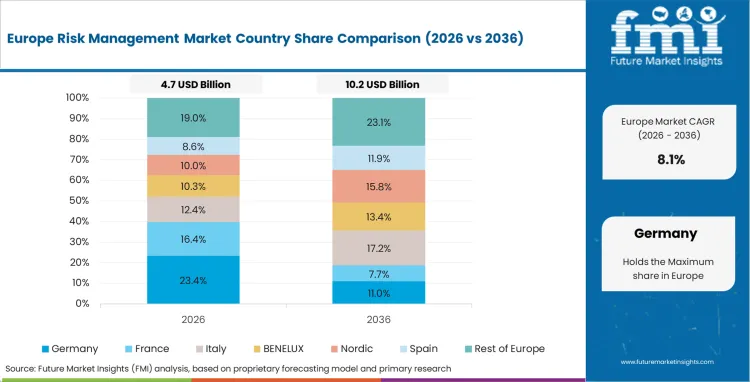
The European risk management market is expanding steadily, driven by strong regulatory frameworks, GDPR compliance, and advanced business infrastructure. Germany leads with advanced risk assessment in banking, insurance, and manufacturing, while France emphasizes regulatory compliance across financial services, pharmaceuticals, and aerospace. The UK focuses on cybersecurity and operational resilience post-Brexit, and Italy strengthens risk monitoring in banking and manufacturing. Spain invests in financial services and energy sector risk management. Nordic countries prioritize cybersecurity and operational continuity, BENELUX emphasizes integrated compliance, and Eastern Europe shows growing potential through regulatory harmonization and infrastructure development, collectively driving demand for advanced risk management solutions.
Competitive Landscape of Risk Management Market
The risk management market is defined by competition among established technology companies, specialized risk management solution providers, and emerging fintech innovators. Companies are investing in artificial intelligence capabilities, cloud-based platforms, industry-specific solutions, and professional consulting services to deliver comprehensive, scalable, and cost-effective risk management solutions. Strategic partnerships, technological innovation, and geographic expansion are central to strengthening product portfolios and market presence.
IBM Corporation, USA-based, offers comprehensive risk management solutions with focus on artificial intelligence, advanced analytics, and integrated governance capabilities for enterprise applications. Microsoft Corporation, operating globally, provides cloud-based risk management platforms integrated with business productivity and security solutions. BitSight delivers specialized cybersecurity risk assessment services with emphasis on third-party risk monitoring and threat intelligence. FIS Global offers financial services risk management solutions with comprehensive regulatory compliance and operational risk capabilities.
Fiserv provides banking and financial services risk management platforms with emphasis on payment processing risk and regulatory compliance. LogicGate Inc. delivers governance, risk, and compliance solutions with focus on workflow automation and integrated risk assessment. Moody's Corporation offers risk assessment and credit analysis services with comprehensive financial risk modeling capabilities. NAVEX Global, Riskonnect Inc., ServiceNow, Oracle Corporation, MetricStream, SAS Institute Inc., and Qualys Inc. provide specialized risk management expertise, comprehensive platform solutions, and industry-specific capabilities across global and regional markets.
Key Players in the Risk Management Market
- IBM Corporation
- Microsoft Corporation
- BitSight
- FIS Global
- Fiserv
- LogicGate, Inc.
- Moody's Corporation
- NAVEX Global
- Riskonnect, Inc.
- ServiceNow
- Oracle Corporation
- MetricStream
- SAS Institute Inc.
- Qualys, Inc.
Scope of the Report
| Metric | Value |
|---|---|
| Quantitative Units | USD 20.06 billion to USD 78.36 billion, at a CAGR of 14.6% |
| Market Definition | Risk management software and services encompass enterprise platforms designed to identify, assess, monitor, and mitigate financial, compliance, cybersecurity, operational, and enterprise-wide risks. T... |
| Component Outlook Segmentation | Solutions, Services |
| Deployment Outlook Segmentation | Cloud-Based, On-Premises |
| Risk Type Outlook Segmentation | Financial Risk Management, Compliance Risk Management, Cybersecurity Risk Management, Enterprise Risk Management, Operational Risk Management, Others |
| Organization Size Outlook Segmentation | Large Enterprises, Small and Medium-Sized Enterprises |
| End Use Outlook Segmentation | BFSI, IT & Telecom, Government, Defense, and Aerospace, Healthcare & Life Science, Retail & Consumer Goods, Manufacturing, Professional Services, Energy & Utilities, Others |
| Regions Covered | North America, Latin America, Europe, East Asia, South Asia, Oceania, Middle East & Africa |
| Countries Covered | China, India, Germany, France, UK, USA, Brazil, and 40 plus countries |
| Key Companies Profiled | IBM Corporation, Microsoft Corporation, BitSight, FIS Global, Fiserv, LogicGate, Inc., Moody's Corporation, NAVEX Global, Riskonnect, Inc., ServiceNow, Oracle Corporation, MetricStream, SAS Institute Inc., Qualys, Inc. |
| Forecast Period | 2026 to 2036 |
| Approach | Forecasting models apply a bottom-up methodology with cross-validation against quarterly revenue data. |
Risk Management Market by Segmentation
Component Outlook:
- Solutions
- Services
Deployment Outlook:
- Cloud-Based
- On-Premises
Risk Type Outlook:
- Financial Risk Management
- Compliance Risk Management
- Cybersecurity Risk Management
- Enterprise Risk Management
- Operational Risk Management
- Others
Organization Size Outlook:
- Large Enterprises
- Small and Medium-Sized Enterprises
End Use Outlook:
- BFSI
- IT & Telecom
- Government, Defense, and Aerospace
- Healthcare & Life Science
- Retail & Consumer Goods
- Manufacturing
- Professional Services
- Energy & Utilities
- Others
Region:
- North America
- United States
- Canada
- Mexico
- Europe
- Germany
- United Kingdom
- France
- Italy
- Spain
- Nordic
- BENELUX
- Rest of Europe
- East Asia
- China
- Japan
- South Korea
- South Asia & Pacific
- India
- ASEAN
- Australia & New Zealand
- Rest of South Asia & Pacific
- Latin America
- Brazil
- Chile
- Rest of Latin America
- Middle East & Africa
- Kingdom of Saudi Arabia
- Other GCC Countries
- Turkiye
- South Africa
- Other African Union
- Rest of Middle East & Africa
Bibliography
- 1. Bank for International Settlements. (2025). Basel III monitoring report: Operational risk and compliance technology requirements. BIS.
- 2. National Institute of Standards and Technology, USA. (2025). NIST Cybersecurity Framework 2.0: Updated implementation guidance. NIST.
- 3. European Banking Authority. (2025). Guidelines on ICT and security risk management for financial institutions. EBA.
- 4. Reserve Bank of India. (2025). Master direction on information technology governance, risk, controls and assurance practices. RBI.
- 5. International Organization for Standardization. (2025). ISO 31000: Risk management guidelines, second edition amendment. ISO.
This bibliography is provided for reader reference. The full Future Market Insights report contains the complete reference list with primary research documentation.
Frequently Asked Questions
How large is the demand for Risk Management in the global market in 2026?
Demand for Risk Management in the global market is estimated to be valued at USD 20.06 billion in 2026.
What will be the market size of Risk Management in the global market by 2036?
Market size for Risk Management is projected to reach USD 78.36 billion by 2036.
What is the expected demand growth for Risk Management between 2026 and 2036?
Demand for Risk Management is expected to grow at a CAGR of 14.6% between 2026 and 2036.
Which Component Outlook is poised to lead global sales by 2026?
Solutions accounts for 64.0% in 2026 based on FMI's analysis.
How is Cloud-Based positioned within Deployment Outlook in 2026?
Cloud-Based holds 63.9% of segment share in 2026.
What is China's growth outlook in this report?
China is projected to grow at a CAGR of 19.7% during 2026 to 2036.
What does this market forecast represent?
The market forecast is a model-based projection built on defined industry and supply chain assumptions for strategic planning purposes. FMI applies a bottom-up methodology cross-validated against primary research and public financial disclosures.
What is included in the scope of this report?
Market scope covers solutions and services across cloud-based and on-premises deployments.
Table of Content
- Executive Summary
- Global Market Outlook
- Demand to side Trends
- Supply to side Trends
- Technology Roadmap Analysis
- Analysis and Recommendations
- Market Overview
- Market Coverage / Taxonomy
- Market Definition / Scope / Limitations
- Research Methodology
- Chapter Orientation
- Analytical Lens and Working Hypotheses
- Market Structure, Signals, and Trend Drivers
- Benchmarking and Cross-market Comparability
- Market Sizing, Forecasting, and Opportunity Mapping
- Research Design and Evidence Framework
- Desk Research Programme (Secondary Evidence)
- Company Annual and Sustainability Reports
- Peer-reviewed Journals and Academic Literature
- Corporate Websites, Product Literature, and Technical Notes
- Earnings Decks and Investor Briefings
- Statutory Filings and Regulatory Disclosures
- Technical White Papers and Standards Notes
- Trade Journals, Industry Magazines, and Analyst Briefs
- Conference Proceedings, Webinars, and Seminar Materials
- Government Statistics Portals and Public Data Releases
- Press Releases and Reputable Media Coverage
- Specialist Newsletters and Curated Briefings
- Sector Databases and Reference Repositories
- FMI Internal Proprietary Databases and Historical Market Datasets
- Subscription Datasets and Paid Sources
- Social Channels, Communities, and Digital Listening Inputs
- Additional Desk Sources
- Expert Input and Fieldwork (Primary Evidence)
- Primary Modes
- Qualitative Interviews and Expert Elicitation
- Quantitative Surveys and Structured Data Capture
- Blended Approach
- Why Primary Evidence is Used
- Field Techniques
- Interviews
- Surveys
- Focus Groups
- Observational and In-context Research
- Social and Community Interactions
- Stakeholder Universe Engaged
- C-suite Leaders
- Board Members
- Presidents and Vice Presidents
- R&D and Innovation Heads
- Technical Specialists
- Domain Subject-matter Experts
- Scientists
- Physicians and Other Healthcare Professionals
- Governance, Ethics, and Data Stewardship
- Research Ethics
- Data Integrity and Handling
- Primary Modes
- Tooling, Models, and Reference Databases
- Desk Research Programme (Secondary Evidence)
- Data Engineering and Model Build
- Data Acquisition and Ingestion
- Cleaning, Normalisation, and Verification
- Synthesis, Triangulation, and Analysis
- Quality Assurance and Audit Trail
- Market Background
- Market Dynamics
- Drivers
- Restraints
- Opportunity
- Trends
- Scenario Forecast
- Demand in Optimistic Scenario
- Demand in Likely Scenario
- Demand in Conservative Scenario
- Opportunity Map Analysis
- Product Life Cycle Analysis
- Supply Chain Analysis
- Investment Feasibility Matrix
- Value Chain Analysis
- PESTLE and Porter’s Analysis
- Regulatory Landscape
- Regional Parent Market Outlook
- Production and Consumption Statistics
- Import and Export Statistics
- Market Dynamics
- Global Market Analysis 2021 to 2025 and Forecast, 2026 to 2036
- Historical Market Size Value (USD Million) Analysis, 2021 to 2025
- Current and Future Market Size Value (USD Million) Projections, 2026 to 2036
- Y to o to Y Growth Trend Analysis
- Absolute $ Opportunity Analysis
- Global Market Pricing Analysis 2021 to 2025 and Forecast 2026 to 2036
- Global Market Analysis 2021 to 2025 and Forecast 2026 to 2036, By Component Outlook
- Introduction / Key Findings
- Historical Market Size Value (USD Million) Analysis By Component Outlook , 2021 to 2025
- Current and Future Market Size Value (USD Million) Analysis and Forecast By Component Outlook , 2026 to 2036
- Solutions
- Services
- Solutions
- Y to o to Y Growth Trend Analysis By Component Outlook , 2021 to 2025
- Absolute $ Opportunity Analysis By Component Outlook , 2026 to 2036
- Global Market Analysis 2021 to 2025 and Forecast 2026 to 2036, By Deployment Outlook
- Introduction / Key Findings
- Historical Market Size Value (USD Million) Analysis By Deployment Outlook, 2021 to 2025
- Current and Future Market Size Value (USD Million) Analysis and Forecast By Deployment Outlook, 2026 to 2036
- Cloud-Based
- On-Premises
- Cloud-Based
- Y to o to Y Growth Trend Analysis By Deployment Outlook, 2021 to 2025
- Absolute $ Opportunity Analysis By Deployment Outlook, 2026 to 2036
- Global Market Analysis 2021 to 2025 and Forecast 2026 to 2036, By Risk Type Outlook
- Introduction / Key Findings
- Historical Market Size Value (USD Million) Analysis By Risk Type Outlook, 2021 to 2025
- Current and Future Market Size Value (USD Million) Analysis and Forecast By Risk Type Outlook, 2026 to 2036
- Financial Risk Management
- Compliance Risk Management
- Cybersecurity Risk Management
- Enterprise Risk Management
- Operational Risk Management
- Others
- Financial Risk Management
- Y to o to Y Growth Trend Analysis By Risk Type Outlook, 2021 to 2025
- Absolute $ Opportunity Analysis By Risk Type Outlook, 2026 to 2036
- Global Market Analysis 2021 to 2025 and Forecast 2026 to 2036, By Organization Size Outlook
- Introduction / Key Findings
- Historical Market Size Value (USD Million) Analysis By Organization Size Outlook, 2021 to 2025
- Current and Future Market Size Value (USD Million) Analysis and Forecast By Organization Size Outlook, 2026 to 2036
- Large Enterprises
- Small and Medium-Sized Enterprises
- Large Enterprises
- Y to o to Y Growth Trend Analysis By Organization Size Outlook, 2021 to 2025
- Absolute $ Opportunity Analysis By Organization Size Outlook, 2026 to 2036
- Global Market Analysis 2021 to 2025 and Forecast 2026 to 2036, By End Use Outlook
- Introduction / Key Findings
- Historical Market Size Value (USD Million) Analysis By End Use Outlook, 2021 to 2025
- Current and Future Market Size Value (USD Million) Analysis and Forecast By End Use Outlook, 2026 to 2036
- BFSI
- IT & Telecom
- Government, Defense, and Aerospace
- Healthcare & Life Science
- Retail & Consumer Goods
- Manufacturing
- Professional Services
- Energy & Utilities
- Others
- BFSI
- Y to o to Y Growth Trend Analysis By End Use Outlook, 2021 to 2025
- Absolute $ Opportunity Analysis By End Use Outlook, 2026 to 2036
- Global Market Analysis 2021 to 2025 and Forecast 2026 to 2036, By Region
- Introduction
- Historical Market Size Value (USD Million) Analysis By Region, 2021 to 2025
- Current Market Size Value (USD Million) Analysis and Forecast By Region, 2026 to 2036
- North America
- Latin America
- Western Europe
- Eastern Europe
- East Asia
- South Asia and Pacific
- Middle East & Africa
- Market Attractiveness Analysis By Region
- North America Market Analysis 2021 to 2025 and Forecast 2026 to 2036, By Country
- Historical Market Size Value (USD Million) Trend Analysis By Market Taxonomy, 2021 to 2025
- Market Size Value (USD Million) Forecast By Market Taxonomy, 2026 to 2036
- By Country
- USA
- Canada
- Mexico
- By Component Outlook
- By Deployment Outlook
- By Risk Type Outlook
- By Organization Size Outlook
- By End Use Outlook
- By Country
- Market Attractiveness Analysis
- By Country
- By Component Outlook
- By Deployment Outlook
- By Risk Type Outlook
- By Organization Size Outlook
- By End Use Outlook
- Key Takeaways
- Latin America Market Analysis 2021 to 2025 and Forecast 2026 to 2036, By Country
- Historical Market Size Value (USD Million) Trend Analysis By Market Taxonomy, 2021 to 2025
- Market Size Value (USD Million) Forecast By Market Taxonomy, 2026 to 2036
- By Country
- Brazil
- Chile
- Rest of Latin America
- By Component Outlook
- By Deployment Outlook
- By Risk Type Outlook
- By Organization Size Outlook
- By End Use Outlook
- By Country
- Market Attractiveness Analysis
- By Country
- By Component Outlook
- By Deployment Outlook
- By Risk Type Outlook
- By Organization Size Outlook
- By End Use Outlook
- Key Takeaways
- Western Europe Market Analysis 2021 to 2025 and Forecast 2026 to 2036, By Country
- Historical Market Size Value (USD Million) Trend Analysis By Market Taxonomy, 2021 to 2025
- Market Size Value (USD Million) Forecast By Market Taxonomy, 2026 to 2036
- By Country
- Germany
- UK
- Italy
- Spain
- France
- Nordic
- BENELUX
- Rest of Western Europe
- By Component Outlook
- By Deployment Outlook
- By Risk Type Outlook
- By Organization Size Outlook
- By End Use Outlook
- By Country
- Market Attractiveness Analysis
- By Country
- By Component Outlook
- By Deployment Outlook
- By Risk Type Outlook
- By Organization Size Outlook
- By End Use Outlook
- Key Takeaways
- Eastern Europe Market Analysis 2021 to 2025 and Forecast 2026 to 2036, By Country
- Historical Market Size Value (USD Million) Trend Analysis By Market Taxonomy, 2021 to 2025
- Market Size Value (USD Million) Forecast By Market Taxonomy, 2026 to 2036
- By Country
- Russia
- Poland
- Hungary
- Balkan & Baltic
- Rest of Eastern Europe
- By Component Outlook
- By Deployment Outlook
- By Risk Type Outlook
- By Organization Size Outlook
- By End Use Outlook
- By Country
- Market Attractiveness Analysis
- By Country
- By Component Outlook
- By Deployment Outlook
- By Risk Type Outlook
- By Organization Size Outlook
- By End Use Outlook
- Key Takeaways
- East Asia Market Analysis 2021 to 2025 and Forecast 2026 to 2036, By Country
- Historical Market Size Value (USD Million) Trend Analysis By Market Taxonomy, 2021 to 2025
- Market Size Value (USD Million) Forecast By Market Taxonomy, 2026 to 2036
- By Country
- China
- Japan
- South Korea
- By Component Outlook
- By Deployment Outlook
- By Risk Type Outlook
- By Organization Size Outlook
- By End Use Outlook
- By Country
- Market Attractiveness Analysis
- By Country
- By Component Outlook
- By Deployment Outlook
- By Risk Type Outlook
- By Organization Size Outlook
- By End Use Outlook
- Key Takeaways
- South Asia and Pacific Market Analysis 2021 to 2025 and Forecast 2026 to 2036, By Country
- Historical Market Size Value (USD Million) Trend Analysis By Market Taxonomy, 2021 to 2025
- Market Size Value (USD Million) Forecast By Market Taxonomy, 2026 to 2036
- By Country
- India
- ASEAN
- Australia & New Zealand
- Rest of South Asia and Pacific
- By Component Outlook
- By Deployment Outlook
- By Risk Type Outlook
- By Organization Size Outlook
- By End Use Outlook
- By Country
- Market Attractiveness Analysis
- By Country
- By Component Outlook
- By Deployment Outlook
- By Risk Type Outlook
- By Organization Size Outlook
- By End Use Outlook
- Key Takeaways
- Middle East & Africa Market Analysis 2021 to 2025 and Forecast 2026 to 2036, By Country
- Historical Market Size Value (USD Million) Trend Analysis By Market Taxonomy, 2021 to 2025
- Market Size Value (USD Million) Forecast By Market Taxonomy, 2026 to 2036
- By Country
- Kingdom of Saudi Arabia
- Other GCC Countries
- Turkiye
- South Africa
- Other African Union
- Rest of Middle East & Africa
- By Component Outlook
- By Deployment Outlook
- By Risk Type Outlook
- By Organization Size Outlook
- By End Use Outlook
- By Country
- Market Attractiveness Analysis
- By Country
- By Component Outlook
- By Deployment Outlook
- By Risk Type Outlook
- By Organization Size Outlook
- By End Use Outlook
- Key Takeaways
- Key Countries Market Analysis
- USA
- Pricing Analysis
- Market Share Analysis, 2025
- By Component Outlook
- By Deployment Outlook
- By Risk Type Outlook
- By Organization Size Outlook
- By End Use Outlook
- Canada
- Pricing Analysis
- Market Share Analysis, 2025
- By Component Outlook
- By Deployment Outlook
- By Risk Type Outlook
- By Organization Size Outlook
- By End Use Outlook
- Mexico
- Pricing Analysis
- Market Share Analysis, 2025
- By Component Outlook
- By Deployment Outlook
- By Risk Type Outlook
- By Organization Size Outlook
- By End Use Outlook
- Brazil
- Pricing Analysis
- Market Share Analysis, 2025
- By Component Outlook
- By Deployment Outlook
- By Risk Type Outlook
- By Organization Size Outlook
- By End Use Outlook
- Chile
- Pricing Analysis
- Market Share Analysis, 2025
- By Component Outlook
- By Deployment Outlook
- By Risk Type Outlook
- By Organization Size Outlook
- By End Use Outlook
- Germany
- Pricing Analysis
- Market Share Analysis, 2025
- By Component Outlook
- By Deployment Outlook
- By Risk Type Outlook
- By Organization Size Outlook
- By End Use Outlook
- UK
- Pricing Analysis
- Market Share Analysis, 2025
- By Component Outlook
- By Deployment Outlook
- By Risk Type Outlook
- By Organization Size Outlook
- By End Use Outlook
- Italy
- Pricing Analysis
- Market Share Analysis, 2025
- By Component Outlook
- By Deployment Outlook
- By Risk Type Outlook
- By Organization Size Outlook
- By End Use Outlook
- Spain
- Pricing Analysis
- Market Share Analysis, 2025
- By Component Outlook
- By Deployment Outlook
- By Risk Type Outlook
- By Organization Size Outlook
- By End Use Outlook
- France
- Pricing Analysis
- Market Share Analysis, 2025
- By Component Outlook
- By Deployment Outlook
- By Risk Type Outlook
- By Organization Size Outlook
- By End Use Outlook
- India
- Pricing Analysis
- Market Share Analysis, 2025
- By Component Outlook
- By Deployment Outlook
- By Risk Type Outlook
- By Organization Size Outlook
- By End Use Outlook
- ASEAN
- Pricing Analysis
- Market Share Analysis, 2025
- By Component Outlook
- By Deployment Outlook
- By Risk Type Outlook
- By Organization Size Outlook
- By End Use Outlook
- Australia & New Zealand
- Pricing Analysis
- Market Share Analysis, 2025
- By Component Outlook
- By Deployment Outlook
- By Risk Type Outlook
- By Organization Size Outlook
- By End Use Outlook
- China
- Pricing Analysis
- Market Share Analysis, 2025
- By Component Outlook
- By Deployment Outlook
- By Risk Type Outlook
- By Organization Size Outlook
- By End Use Outlook
- Japan
- Pricing Analysis
- Market Share Analysis, 2025
- By Component Outlook
- By Deployment Outlook
- By Risk Type Outlook
- By Organization Size Outlook
- By End Use Outlook
- South Korea
- Pricing Analysis
- Market Share Analysis, 2025
- By Component Outlook
- By Deployment Outlook
- By Risk Type Outlook
- By Organization Size Outlook
- By End Use Outlook
- Russia
- Pricing Analysis
- Market Share Analysis, 2025
- By Component Outlook
- By Deployment Outlook
- By Risk Type Outlook
- By Organization Size Outlook
- By End Use Outlook
- Poland
- Pricing Analysis
- Market Share Analysis, 2025
- By Component Outlook
- By Deployment Outlook
- By Risk Type Outlook
- By Organization Size Outlook
- By End Use Outlook
- Hungary
- Pricing Analysis
- Market Share Analysis, 2025
- By Component Outlook
- By Deployment Outlook
- By Risk Type Outlook
- By Organization Size Outlook
- By End Use Outlook
- Kingdom of Saudi Arabia
- Pricing Analysis
- Market Share Analysis, 2025
- By Component Outlook
- By Deployment Outlook
- By Risk Type Outlook
- By Organization Size Outlook
- By End Use Outlook
- Turkiye
- Pricing Analysis
- Market Share Analysis, 2025
- By Component Outlook
- By Deployment Outlook
- By Risk Type Outlook
- By Organization Size Outlook
- By End Use Outlook
- South Africa
- Pricing Analysis
- Market Share Analysis, 2025
- By Component Outlook
- By Deployment Outlook
- By Risk Type Outlook
- By Organization Size Outlook
- By End Use Outlook
- USA
- Market Structure Analysis
- Competition Dashboard
- Competition Benchmarking
- Market Share Analysis of Top Players
- By Regional
- By Component Outlook
- By Deployment Outlook
- By Risk Type Outlook
- By Organization Size Outlook
- By End Use Outlook
- Competition Analysis
- Competition Deep Dive
- IBM Corporation
- Overview
- Product Portfolio
- Profitability by Market Segments (Product/Age /Sales Channel/Region)
- Sales Footprint
- Strategy Overview
- Marketing Strategy
- Product Strategy
- Channel Strategy
- Microsoft Corporation
- BitSight
- FIS Global
- Fiserv
- LogicGate, Inc.
- Moody's Corporation
- NAVEX Global
- Riskonnect, Inc.
- ServiceNow
- Oracle Corporation
- MetricStream
- SAS Institute Inc.
- Qualys, Inc.
- IBM Corporation
- Competition Deep Dive
- Assumptions & Acronyms Used
List of Tables
- Table 1: Global Market Value (USD Million) Forecast by Region, 2021 to 2036
- Table 2: Global Market Value (USD Million) Forecast by Component Outlook , 2021 to 2036
- Table 3: Global Market Value (USD Million) Forecast by Deployment Outlook, 2021 to 2036
- Table 4: Global Market Value (USD Million) Forecast by Risk Type Outlook, 2021 to 2036
- Table 5: Global Market Value (USD Million) Forecast by Organization Size Outlook, 2021 to 2036
- Table 6: Global Market Value (USD Million) Forecast by End Use Outlook, 2021 to 2036
- Table 7: North America Market Value (USD Million) Forecast by Country, 2021 to 2036
- Table 8: North America Market Value (USD Million) Forecast by Component Outlook , 2021 to 2036
- Table 9: North America Market Value (USD Million) Forecast by Deployment Outlook, 2021 to 2036
- Table 10: North America Market Value (USD Million) Forecast by Risk Type Outlook, 2021 to 2036
- Table 11: North America Market Value (USD Million) Forecast by Organization Size Outlook, 2021 to 2036
- Table 12: North America Market Value (USD Million) Forecast by End Use Outlook, 2021 to 2036
- Table 13: Latin America Market Value (USD Million) Forecast by Country, 2021 to 2036
- Table 14: Latin America Market Value (USD Million) Forecast by Component Outlook , 2021 to 2036
- Table 15: Latin America Market Value (USD Million) Forecast by Deployment Outlook, 2021 to 2036
- Table 16: Latin America Market Value (USD Million) Forecast by Risk Type Outlook, 2021 to 2036
- Table 17: Latin America Market Value (USD Million) Forecast by Organization Size Outlook, 2021 to 2036
- Table 18: Latin America Market Value (USD Million) Forecast by End Use Outlook, 2021 to 2036
- Table 19: Western Europe Market Value (USD Million) Forecast by Country, 2021 to 2036
- Table 20: Western Europe Market Value (USD Million) Forecast by Component Outlook , 2021 to 2036
- Table 21: Western Europe Market Value (USD Million) Forecast by Deployment Outlook, 2021 to 2036
- Table 22: Western Europe Market Value (USD Million) Forecast by Risk Type Outlook, 2021 to 2036
- Table 23: Western Europe Market Value (USD Million) Forecast by Organization Size Outlook, 2021 to 2036
- Table 24: Western Europe Market Value (USD Million) Forecast by End Use Outlook, 2021 to 2036
- Table 25: Eastern Europe Market Value (USD Million) Forecast by Country, 2021 to 2036
- Table 26: Eastern Europe Market Value (USD Million) Forecast by Component Outlook , 2021 to 2036
- Table 27: Eastern Europe Market Value (USD Million) Forecast by Deployment Outlook, 2021 to 2036
- Table 28: Eastern Europe Market Value (USD Million) Forecast by Risk Type Outlook, 2021 to 2036
- Table 29: Eastern Europe Market Value (USD Million) Forecast by Organization Size Outlook, 2021 to 2036
- Table 30: Eastern Europe Market Value (USD Million) Forecast by End Use Outlook, 2021 to 2036
- Table 31: East Asia Market Value (USD Million) Forecast by Country, 2021 to 2036
- Table 32: East Asia Market Value (USD Million) Forecast by Component Outlook , 2021 to 2036
- Table 33: East Asia Market Value (USD Million) Forecast by Deployment Outlook, 2021 to 2036
- Table 34: East Asia Market Value (USD Million) Forecast by Risk Type Outlook, 2021 to 2036
- Table 35: East Asia Market Value (USD Million) Forecast by Organization Size Outlook, 2021 to 2036
- Table 36: East Asia Market Value (USD Million) Forecast by End Use Outlook, 2021 to 2036
- Table 37: South Asia and Pacific Market Value (USD Million) Forecast by Country, 2021 to 2036
- Table 38: South Asia and Pacific Market Value (USD Million) Forecast by Component Outlook , 2021 to 2036
- Table 39: South Asia and Pacific Market Value (USD Million) Forecast by Deployment Outlook, 2021 to 2036
- Table 40: South Asia and Pacific Market Value (USD Million) Forecast by Risk Type Outlook, 2021 to 2036
- Table 41: South Asia and Pacific Market Value (USD Million) Forecast by Organization Size Outlook, 2021 to 2036
- Table 42: South Asia and Pacific Market Value (USD Million) Forecast by End Use Outlook, 2021 to 2036
- Table 43: Middle East & Africa Market Value (USD Million) Forecast by Country, 2021 to 2036
- Table 44: Middle East & Africa Market Value (USD Million) Forecast by Component Outlook , 2021 to 2036
- Table 45: Middle East & Africa Market Value (USD Million) Forecast by Deployment Outlook, 2021 to 2036
- Table 46: Middle East & Africa Market Value (USD Million) Forecast by Risk Type Outlook, 2021 to 2036
- Table 47: Middle East & Africa Market Value (USD Million) Forecast by Organization Size Outlook, 2021 to 2036
- Table 48: Middle East & Africa Market Value (USD Million) Forecast by End Use Outlook, 2021 to 2036
List of Figures
- Figure 1: Global Market Pricing Analysis
- Figure 2: Global Market Value (USD Million) Forecast 2021-2036
- Figure 3: Global Market Value Share and BPS Analysis by Component Outlook , 2026 and 2036
- Figure 4: Global Market Y-o-Y Growth Comparison by Component Outlook , 2026-2036
- Figure 5: Global Market Attractiveness Analysis by Component Outlook
- Figure 6: Global Market Value Share and BPS Analysis by Deployment Outlook, 2026 and 2036
- Figure 7: Global Market Y-o-Y Growth Comparison by Deployment Outlook, 2026-2036
- Figure 8: Global Market Attractiveness Analysis by Deployment Outlook
- Figure 9: Global Market Value Share and BPS Analysis by Risk Type Outlook, 2026 and 2036
- Figure 10: Global Market Y-o-Y Growth Comparison by Risk Type Outlook, 2026-2036
- Figure 11: Global Market Attractiveness Analysis by Risk Type Outlook
- Figure 12: Global Market Value Share and BPS Analysis by Organization Size Outlook, 2026 and 2036
- Figure 13: Global Market Y-o-Y Growth Comparison by Organization Size Outlook, 2026-2036
- Figure 14: Global Market Attractiveness Analysis by Organization Size Outlook
- Figure 15: Global Market Value Share and BPS Analysis by End Use Outlook, 2026 and 2036
- Figure 16: Global Market Y-o-Y Growth Comparison by End Use Outlook, 2026-2036
- Figure 17: Global Market Attractiveness Analysis by End Use Outlook
- Figure 18: Global Market Value (USD Million) Share and BPS Analysis by Region, 2026 and 2036
- Figure 19: Global Market Y-o-Y Growth Comparison by Region, 2026-2036
- Figure 20: Global Market Attractiveness Analysis by Region
- Figure 21: North America Market Incremental Dollar Opportunity, 2026-2036
- Figure 22: Latin America Market Incremental Dollar Opportunity, 2026-2036
- Figure 23: Western Europe Market Incremental Dollar Opportunity, 2026-2036
- Figure 24: Eastern Europe Market Incremental Dollar Opportunity, 2026-2036
- Figure 25: East Asia Market Incremental Dollar Opportunity, 2026-2036
- Figure 26: South Asia and Pacific Market Incremental Dollar Opportunity, 2026-2036
- Figure 27: Middle East & Africa Market Incremental Dollar Opportunity, 2026-2036
- Figure 28: North America Market Value Share and BPS Analysis by Country, 2026 and 2036
- Figure 29: North America Market Value Share and BPS Analysis by Component Outlook , 2026 and 2036
- Figure 30: North America Market Y-o-Y Growth Comparison by Component Outlook , 2026-2036
- Figure 31: North America Market Attractiveness Analysis by Component Outlook
- Figure 32: North America Market Value Share and BPS Analysis by Deployment Outlook, 2026 and 2036
- Figure 33: North America Market Y-o-Y Growth Comparison by Deployment Outlook, 2026-2036
- Figure 34: North America Market Attractiveness Analysis by Deployment Outlook
- Figure 35: North America Market Value Share and BPS Analysis by Risk Type Outlook, 2026 and 2036
- Figure 36: North America Market Y-o-Y Growth Comparison by Risk Type Outlook, 2026-2036
- Figure 37: North America Market Attractiveness Analysis by Risk Type Outlook
- Figure 38: North America Market Value Share and BPS Analysis by Organization Size Outlook, 2026 and 2036
- Figure 39: North America Market Y-o-Y Growth Comparison by Organization Size Outlook, 2026-2036
- Figure 40: North America Market Attractiveness Analysis by Organization Size Outlook
- Figure 41: North America Market Value Share and BPS Analysis by End Use Outlook, 2026 and 2036
- Figure 42: North America Market Y-o-Y Growth Comparison by End Use Outlook, 2026-2036
- Figure 43: North America Market Attractiveness Analysis by End Use Outlook
- Figure 44: Latin America Market Value Share and BPS Analysis by Country, 2026 and 2036
- Figure 45: Latin America Market Value Share and BPS Analysis by Component Outlook , 2026 and 2036
- Figure 46: Latin America Market Y-o-Y Growth Comparison by Component Outlook , 2026-2036
- Figure 47: Latin America Market Attractiveness Analysis by Component Outlook
- Figure 48: Latin America Market Value Share and BPS Analysis by Deployment Outlook, 2026 and 2036
- Figure 49: Latin America Market Y-o-Y Growth Comparison by Deployment Outlook, 2026-2036
- Figure 50: Latin America Market Attractiveness Analysis by Deployment Outlook
- Figure 51: Latin America Market Value Share and BPS Analysis by Risk Type Outlook, 2026 and 2036
- Figure 52: Latin America Market Y-o-Y Growth Comparison by Risk Type Outlook, 2026-2036
- Figure 53: Latin America Market Attractiveness Analysis by Risk Type Outlook
- Figure 54: Latin America Market Value Share and BPS Analysis by Organization Size Outlook, 2026 and 2036
- Figure 55: Latin America Market Y-o-Y Growth Comparison by Organization Size Outlook, 2026-2036
- Figure 56: Latin America Market Attractiveness Analysis by Organization Size Outlook
- Figure 57: Latin America Market Value Share and BPS Analysis by End Use Outlook, 2026 and 2036
- Figure 58: Latin America Market Y-o-Y Growth Comparison by End Use Outlook, 2026-2036
- Figure 59: Latin America Market Attractiveness Analysis by End Use Outlook
- Figure 60: Western Europe Market Value Share and BPS Analysis by Country, 2026 and 2036
- Figure 61: Western Europe Market Value Share and BPS Analysis by Component Outlook , 2026 and 2036
- Figure 62: Western Europe Market Y-o-Y Growth Comparison by Component Outlook , 2026-2036
- Figure 63: Western Europe Market Attractiveness Analysis by Component Outlook
- Figure 64: Western Europe Market Value Share and BPS Analysis by Deployment Outlook, 2026 and 2036
- Figure 65: Western Europe Market Y-o-Y Growth Comparison by Deployment Outlook, 2026-2036
- Figure 66: Western Europe Market Attractiveness Analysis by Deployment Outlook
- Figure 67: Western Europe Market Value Share and BPS Analysis by Risk Type Outlook, 2026 and 2036
- Figure 68: Western Europe Market Y-o-Y Growth Comparison by Risk Type Outlook, 2026-2036
- Figure 69: Western Europe Market Attractiveness Analysis by Risk Type Outlook
- Figure 70: Western Europe Market Value Share and BPS Analysis by Organization Size Outlook, 2026 and 2036
- Figure 71: Western Europe Market Y-o-Y Growth Comparison by Organization Size Outlook, 2026-2036
- Figure 72: Western Europe Market Attractiveness Analysis by Organization Size Outlook
- Figure 73: Western Europe Market Value Share and BPS Analysis by End Use Outlook, 2026 and 2036
- Figure 74: Western Europe Market Y-o-Y Growth Comparison by End Use Outlook, 2026-2036
- Figure 75: Western Europe Market Attractiveness Analysis by End Use Outlook
- Figure 76: Eastern Europe Market Value Share and BPS Analysis by Country, 2026 and 2036
- Figure 77: Eastern Europe Market Value Share and BPS Analysis by Component Outlook , 2026 and 2036
- Figure 78: Eastern Europe Market Y-o-Y Growth Comparison by Component Outlook , 2026-2036
- Figure 79: Eastern Europe Market Attractiveness Analysis by Component Outlook
- Figure 80: Eastern Europe Market Value Share and BPS Analysis by Deployment Outlook, 2026 and 2036
- Figure 81: Eastern Europe Market Y-o-Y Growth Comparison by Deployment Outlook, 2026-2036
- Figure 82: Eastern Europe Market Attractiveness Analysis by Deployment Outlook
- Figure 83: Eastern Europe Market Value Share and BPS Analysis by Risk Type Outlook, 2026 and 2036
- Figure 84: Eastern Europe Market Y-o-Y Growth Comparison by Risk Type Outlook, 2026-2036
- Figure 85: Eastern Europe Market Attractiveness Analysis by Risk Type Outlook
- Figure 86: Eastern Europe Market Value Share and BPS Analysis by Organization Size Outlook, 2026 and 2036
- Figure 87: Eastern Europe Market Y-o-Y Growth Comparison by Organization Size Outlook, 2026-2036
- Figure 88: Eastern Europe Market Attractiveness Analysis by Organization Size Outlook
- Figure 89: Eastern Europe Market Value Share and BPS Analysis by End Use Outlook, 2026 and 2036
- Figure 90: Eastern Europe Market Y-o-Y Growth Comparison by End Use Outlook, 2026-2036
- Figure 91: Eastern Europe Market Attractiveness Analysis by End Use Outlook
- Figure 92: East Asia Market Value Share and BPS Analysis by Country, 2026 and 2036
- Figure 93: East Asia Market Value Share and BPS Analysis by Component Outlook , 2026 and 2036
- Figure 94: East Asia Market Y-o-Y Growth Comparison by Component Outlook , 2026-2036
- Figure 95: East Asia Market Attractiveness Analysis by Component Outlook
- Figure 96: East Asia Market Value Share and BPS Analysis by Deployment Outlook, 2026 and 2036
- Figure 97: East Asia Market Y-o-Y Growth Comparison by Deployment Outlook, 2026-2036
- Figure 98: East Asia Market Attractiveness Analysis by Deployment Outlook
- Figure 99: East Asia Market Value Share and BPS Analysis by Risk Type Outlook, 2026 and 2036
- Figure 100: East Asia Market Y-o-Y Growth Comparison by Risk Type Outlook, 2026-2036
- Figure 101: East Asia Market Attractiveness Analysis by Risk Type Outlook
- Figure 102: East Asia Market Value Share and BPS Analysis by Organization Size Outlook, 2026 and 2036
- Figure 103: East Asia Market Y-o-Y Growth Comparison by Organization Size Outlook, 2026-2036
- Figure 104: East Asia Market Attractiveness Analysis by Organization Size Outlook
- Figure 105: East Asia Market Value Share and BPS Analysis by End Use Outlook, 2026 and 2036
- Figure 106: East Asia Market Y-o-Y Growth Comparison by End Use Outlook, 2026-2036
- Figure 107: East Asia Market Attractiveness Analysis by End Use Outlook
- Figure 108: South Asia and Pacific Market Value Share and BPS Analysis by Country, 2026 and 2036
- Figure 109: South Asia and Pacific Market Value Share and BPS Analysis by Component Outlook , 2026 and 2036
- Figure 110: South Asia and Pacific Market Y-o-Y Growth Comparison by Component Outlook , 2026-2036
- Figure 111: South Asia and Pacific Market Attractiveness Analysis by Component Outlook
- Figure 112: South Asia and Pacific Market Value Share and BPS Analysis by Deployment Outlook, 2026 and 2036
- Figure 113: South Asia and Pacific Market Y-o-Y Growth Comparison by Deployment Outlook, 2026-2036
- Figure 114: South Asia and Pacific Market Attractiveness Analysis by Deployment Outlook
- Figure 115: South Asia and Pacific Market Value Share and BPS Analysis by Risk Type Outlook, 2026 and 2036
- Figure 116: South Asia and Pacific Market Y-o-Y Growth Comparison by Risk Type Outlook, 2026-2036
- Figure 117: South Asia and Pacific Market Attractiveness Analysis by Risk Type Outlook
- Figure 118: South Asia and Pacific Market Value Share and BPS Analysis by Organization Size Outlook, 2026 and 2036
- Figure 119: South Asia and Pacific Market Y-o-Y Growth Comparison by Organization Size Outlook, 2026-2036
- Figure 120: South Asia and Pacific Market Attractiveness Analysis by Organization Size Outlook
- Figure 121: South Asia and Pacific Market Value Share and BPS Analysis by End Use Outlook, 2026 and 2036
- Figure 122: South Asia and Pacific Market Y-o-Y Growth Comparison by End Use Outlook, 2026-2036
- Figure 123: South Asia and Pacific Market Attractiveness Analysis by End Use Outlook
- Figure 124: Middle East & Africa Market Value Share and BPS Analysis by Country, 2026 and 2036
- Figure 125: Middle East & Africa Market Value Share and BPS Analysis by Component Outlook , 2026 and 2036
- Figure 126: Middle East & Africa Market Y-o-Y Growth Comparison by Component Outlook , 2026-2036
- Figure 127: Middle East & Africa Market Attractiveness Analysis by Component Outlook
- Figure 128: Middle East & Africa Market Value Share and BPS Analysis by Deployment Outlook, 2026 and 2036
- Figure 129: Middle East & Africa Market Y-o-Y Growth Comparison by Deployment Outlook, 2026-2036
- Figure 130: Middle East & Africa Market Attractiveness Analysis by Deployment Outlook
- Figure 131: Middle East & Africa Market Value Share and BPS Analysis by Risk Type Outlook, 2026 and 2036
- Figure 132: Middle East & Africa Market Y-o-Y Growth Comparison by Risk Type Outlook, 2026-2036
- Figure 133: Middle East & Africa Market Attractiveness Analysis by Risk Type Outlook
- Figure 134: Middle East & Africa Market Value Share and BPS Analysis by Organization Size Outlook, 2026 and 2036
- Figure 135: Middle East & Africa Market Y-o-Y Growth Comparison by Organization Size Outlook, 2026-2036
- Figure 136: Middle East & Africa Market Attractiveness Analysis by Organization Size Outlook
- Figure 137: Middle East & Africa Market Value Share and BPS Analysis by End Use Outlook, 2026 and 2036
- Figure 138: Middle East & Africa Market Y-o-Y Growth Comparison by End Use Outlook, 2026-2036
- Figure 139: Middle East & Africa Market Attractiveness Analysis by End Use Outlook
- Figure 140: Global Market - Tier Structure Analysis
- Figure 141: Global Market - Company Share Analysis


