

- Industry Size (2026)
- USD 5.45 Bn
- Forecast (2036)
- USD 23.82 Bn
- CAGR (2026 to 2036)
- 15.9%
Respiratory Analysers Market Size, Market Forecast and Outlook By FMI
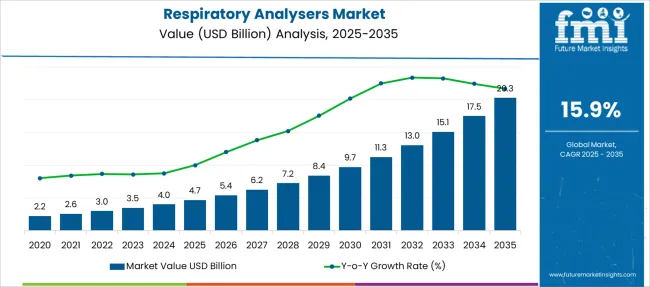
The respiratory analysers market was valued at USD 4.7 billion in 2025, projected to reach USD 5.45 billion in 2026, and is forecast to expand to USD 23.82 billion by 2036 at a 15.9% CAGR. Expanding hospital critical care infrastructure, growing home care respiratory monitoring adoption, and increasing point-of-care diagnostic demand are creating parallel procurement channels for gas analysis equipment. Paramagnetic oxygen analysers command 47.3% share as their precision measurement capability serves both ventilator management in intensive care and anaesthesia monitoring in surgical settings.
Summary of Respiratory Analysers Market
- Market Snapshot
- The respiratory analysers market is valued at USD 4.7 billion in 2025 and is projected to reach USD 23.82 billion by 2036.
- The industry is expected to grow at a 15.9% CAGR from 2026 to 2036, creating an incremental opportunity of USD 18.37 billion.
- The market is a clinical infrastructure category where measurement precision, connectivity, and deployment across hospital, home care, and point-of-care settings define competitive positioning.
- Demand and Growth Drivers
- Hospital critical care infrastructure expansion in Asia Pacific and Latin America is generating first-time procurement of respiratory gas analysis equipment for ICU, emergency, and surgical departments.
- Growing home care respiratory monitoring adoption for COPD and sleep apnoea patients is creating a new distribution channel for compact, connected respiratory analysers.
- Technology refresh cycles replacing legacy analogue analysers with digital platforms offering wireless connectivity and electronic health record integration are driving replacement procurement in mature markets.
- Among key countries, China at 21.5%, India at 19.9%, Germany at 18.3%, Brazil at 16.7%, USA at 15.1%, UK at 13.5%, Japan at 11.9%.
- Product and Segment View
- The market includes paramagnetic oxygen analysers, carbon dioxide analysers, capnography systems, and multi-gas platforms for hospital, home care, and clinical monitoring applications.
- Paramagnetic Oxygen Analyser leads by Product Name with 47.3% share in 2026.
- Hospitals leads by Applications with 52.6% share in 2026.
- Scope includes market scope includes paramagnetic oxygen analysers, infrared carbon dioxide analysers, mainstream and sidestream capnography systems, and multi-gas analysis platforms. Blood gas analysers and pulse oximeters are excluded.
- Geography and Competitive Outlook
- China and India are the fastest-growing markets at 21.5% and 19.9% CAGR respectively, driven by expanding hospital critical care infrastructure expansion and home respiratory monitoring adoption.
- USA represents a mature demand base where hospital capital expenditure cycles and home care respiratory monitoring reimbursement sustain analyser procurement.
- Competition is shaped by measurement precision, connectivity integration, deployment versatility, and clinical workflow compatibility, with key players including Philips Healthcare, ResMed Inc., Medtronic plc, Fisher & Paykel Healthcare, BD (Becton Dickinson and Company), Smiths Medical, Masimo Corporation.
- Analyst Opinion at FMI
- Sabyasachi Ghosh, Principal Consultant for Healthcare, opines: 'In my analysis, I have observed that respiratory analysers are becoming embedded infrastructure in every tier of healthcare delivery, from ICU bedside monitoring to home care COPD management. Medical device manufacturers maintaining product portfolios concentrated in hospital-grade systems face market share erosion from compact, connected analysers designed for home care and point-of-care deployment. Distributors that fail to offer wireless-enabled, EHR-integrated analyser platforms will lose procurement contracts to competitors matching hospital IT integration requirements.'
- Strategic Implications / Executive Takeaways
- Medical device manufacturers must develop compact, wireless-enabled respiratory analysers designed for home care and point-of-care deployment to capture the growing market beyond traditional hospital procurement.
- Hospital capital equipment procurement directors should prioritize respiratory analysers with EHR integration and wireless connectivity to meet clinical workflow digitization requirements.
- Home care service providers must integrate respiratory gas monitoring into remote patient management platforms to capture the expanding COPD and sleep apnoea monitoring market.
Respiratory Analysers Market Key Takeaways
| Metric | Details |
|---|---|
| Industry Size (2026) | USD 5.45 billion |
| Industry Value (2036) | USD 23.82 billion |
| CAGR (2026-2036) | 15.9% |
Source: Future Market Insights, 2026
The incremental opportunity of USD 18.37 billion over the forecast period reflects hospital infrastructure expansion in Asia Pacific, growing home care respiratory monitoring adoption in ageing societies, and technology upgrades from legacy analysers to digital platforms with wireless connectivity. Hospitals account for 52.6% of application share as intensive care, emergency, and surgical departments maintain the highest density of respiratory gas analysis equipment per patient bed.
China leads at 21.5% CAGR, driven by hospital infrastructure expansion under the Healthy China 2030 initiative and growing critical care bed capacity requiring respiratory gas monitoring equipment. India follows at 19.9%, propelled by the Ayushman Bharat hospital modernization programme and expanding intensive care infrastructure in tier-2 and tier-3 city hospitals. Germany registers 18.3%, anchored by established critical care infrastructure and technology refresh cycles replacing legacy analysers with digital platforms in university hospital networks. Brazil advances at 16.7%, supported by SUS public health system ICU capacity expansion and growing adoption of point-of-care respiratory diagnostics in emergency departments.
The United States expands at 15.1%, driven by hospital capital expenditure cycles for critical care equipment upgrades and growing home care respiratory monitoring reimbursement coverage. The United Kingdom posts 13.5%, driven by NHS ICU capacity expansion programmes and growing home respiratory monitoring adoption for COPD management under integrated care pathways. Japan registers 11.9% growth as the ageing population drives expanding respiratory care infrastructure and home oxygen therapy monitoring equipment procurement.
Respiratory Analysers Market Definition
The respiratory analysers market covers medical and clinical gas measurement instruments designed to analyse oxygen, carbon dioxide, and other respiratory gas concentrations in patient breathing circuits and ambient environments. Products include paramagnetic oxygen analysers, infrared carbon dioxide analysers, capnography systems, and multi-gas analysis platforms deployed in hospitals, home care settings, clinics, and research laboratories.
Respiratory Analysers Market Inclusions
Market scope includes paramagnetic oxygen analysers, infrared carbon dioxide analysers, mainstream and sidestream capnography systems, and multi-gas analysis platforms. Hospital bedside, operating theatre, emergency department, and home care monitoring configurations are covered.
Respiratory Analysers Market Exclusions
Blood gas analysers and pulse oximeters are excluded. The scope omits spirometry systems, peak flow meters, and mechanical ventilators. Laboratory-grade mass spectrometry and chromatography systems for research gas analysis fall outside analytical parameters.
Respiratory Analysers Market Research Methodology
- Primary Research: Analysts engaged with hospital biomedical engineers, respiratory therapy departments, and home care equipment providers to map analyser specification requirements and procurement scheduling.
- Desk Research: Data collection phases aggregated medical device certification registries, hospital capital equipment procurement databases, home care equipment reimbursement schedules, and clinical respiratory monitoring guidelines.
- Market-Sizing and Forecasting: Baseline values derive from a bottom-up aggregation of procurement and installation tracking data, applying region-specific adoption curves to project future deployment velocity.
- Data Validation and Update Cycle: Projections are tested against publicly reported expenditure guidance from leading industry participants and cross-referenced with regulatory filing data.
Rising Trend of Home Care Setting to Generate Growth Opportunities
Over the forecast period, rising healthcare expenditure, emphasis on medical tourism in emerging economies, and the growing need for these medical devices to tap potential are projected to propel the expansion of the global respiratory analysers market and strengthen growth opportunities for the key market players.
The increased demand for therapeutic respiratory devices in home healthcare applications is one important aspect that is projected to generate growth opportunities over the forecast period. In recent years, home healthcare devices have gained recognition and market share.
As the adoption rate of respiratory analyzers keeps increasing, the market for these devices is anticipated to experience profitable opportunities. The respiratory analysers market is also anticipated to develop as a consequence of the increased emphasis on projects by private and governmental organizations to manufacture nanotechnology items that may be used in conjunction with medical equipment.
Manufacturers Focus on Technological Advancements to Lead the Market
To attain a competitive advantage market players are making numerous technological developments, such as the invention of product versions that can be linked to Bluetooth for personalized tracking and analyzers integrated with fuel cell and semiconductor sensor technologies to deliver more precise findings.
Another area of interest for both well-established industry players and other developing players is the development of therapeutic respiratory equipment for home healthcare. For example, Movair, a respiratory therapy company formerly known as International Biophysics Corporation, officially confirmed the USA commercial advent of Luisa in October 2024.
Luisa is a novel ventilator that is intended for use in homes, healthcare facilities, and other institutions as well as portable applications for both invasive and noninvasive airflow.
Respiratory Analysers Market: Drivers
At present, North America is the leading global respiratory analyser market. As per the WHO, chronic obstructive pulmonary disease (COPD) is expected to be the 3rd leading cause of global deaths. According to the National Sleep Foundation, 40 million Americans suffered from insomnia or some other form of chronic sleep disorders.
There are many cases of both COPD and Asthma reported there. While North America leads these statistics, Europe is second in terms of the people complaining of respiratory ailments.The key respiratory analyser market to focus on for long-term growth would be the APAC region.
It is undergoing rapid modernization, with little to no concern for environmental or biological factors, thus giving rise to health issues for its citizens. Increasing focus on medical programs and awareness, both from the government and the private sector all point to a bright future for this market. Hospitals form the largest end users of respiratory analysers and they are also expected to record the highest growth rate.
Respiratory Analysers Market: Restraints
Any equipment which serves a specialised function tends to be expensive and this holds true for the Respiratory Analysers Market as well. The high cost is such a detriment that customers hesitate purchasing modern equipment and prefer using the old, archaic ones.
Even lack of awareness in underdiagnosed, undertreated poorer countries can be a major impediment to growth. Along with this, the installation and usage of such advanced respiratory analysers requires highly skilled professionals, who are in short supply in these nations.
Another issue is the saturation in developed countries due to the oligopolistic market situation. Hence, there are moderate to high barriers for entry for new players seeking to enter this market, thereby limiting competition and customer choice.
Respiratory Analysers Market: Key Regions
.webp "Top Country Growth Comparison Respiratory Analysers Market Cagr (2026 2036)")
The Respiratory Analysers Market can be divided into five key regions viz. North America, Europe, Asia Pacific, Latin America and the Middle East and North Africa. (MENA) North America is the largest market at present and is expected to remain so for the near future.
The fastest growing market for this is unquestionably the Asia- Pacific region. China and India are the fastest growing major economies in the world. Their large populations, increasing government attention towards healthcare, booming medical tourism in them and Southeast Asian nations like Thailand will ensure continued demand for products sold in the respiratory analyser market.
Key players would also be advised to look at Latin America to provide ample growth opportunities in the years to come.
Respiratory Analysers Market: Key Market Players
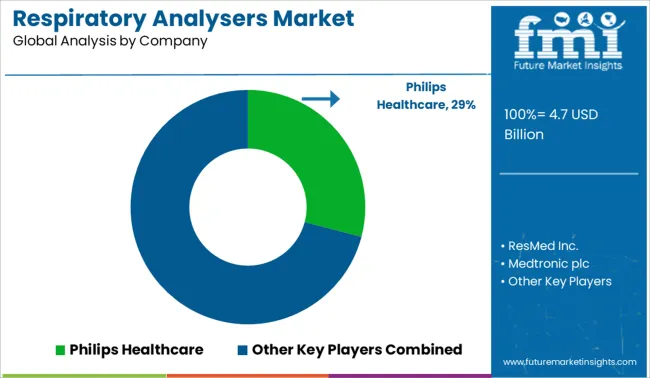
The main manufacturers in the Respiratory analyser market include globally renowned companies like Smiths Medical (UK), Philips Healthcare (Netherlands), ResMed, Inc. (USA), Covidien plc (Ireland), Masimo Corporation (USA), Fisher and Paykel Healthcare Limited (New Zealand), and CareFusion Corporation (USA).
The research report presents a comprehensive assessment of the market and contains thoughtful insights, facts, historical data, and statistically supported and industry-validated market data. It also contains projections using a suitable set of assumptions and methodologies.
The research report provides analysis and information according to market segments such as geographies, types and applications.
Scope of the Report
| Metric | Value |
|---|---|
| Quantitative Units | USD 5.45 billion to USD 23.82 billion, at a CAGR of 15.9% |
| Market Definition | The respiratory analysers market covers medical and clinical gas measurement instruments designed to analyse oxygen, carbon dioxide, and other respiratory gas concentrations in patient breathing circuit. |
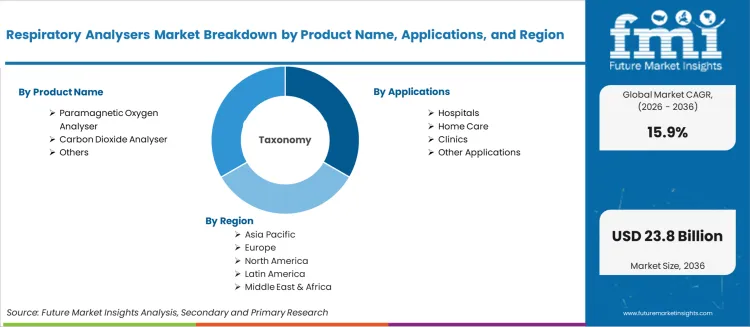
| Segmentation | Product Name: Paramagnetic Oxygen Analyser, Carbon Dioxide Analyser, Others; Applications: Hospitals, Home Care, Clinics, Other Applications |
| Regions Covered | North America, Latin America, Europe, East Asia, South Asia, Oceania, Middle East & Africa |
| Countries Covered | China, India, Germany, Brazil, USA, UK, Japan, and 40 plus countries |
| Key Companies Profiled | Philips Healthcare, ResMed Inc., Medtronic plc, Fisher & Paykel Healthcare, BD (Becton Dickinson and Company), Smiths Medical, Masimo Corporation, Invacare Corporation, GE Healthcare |
| Forecast Period | 2026 to 2036 |
| Approach | Forecasting models apply a bottom-up methodology starting with procurement tracking data and projecting adoption rates using region-specific deployment curves. |
Key Segment
By Product Type:
- Paramagnetic Oxygen Analyser
- Carbon Dioxide Analyser
- Others
By Application:
- Hospitals
- Home Care
- Clinics
- Other Applications
By Region:
- North America
- Latin America
- Western Europe
- Eastern Europe
- East Asia
- South Asia and Pacific
- Middle East & Africa
Bibliography
- World Health Organization. (2024). Medical devices for respiratory care: Global procurement guidance. WHO.
- USA Food and Drug Administration. (2024). Respiratory gas analyser premarket notification requirements. FDA.
- International Organization for Standardization. (2024). ISO 80601-2-55: Respiratory gas monitors. ISO.
- European Commission. (2024). Medical Device Regulation 2017/745 respiratory analyser classification guidance. European Commission.
- National Health Service. (2024). NHS Long Term Plan: Home respiratory monitoring equipment procurement guidelines. NHS.
This bibliography is provided for reader reference. The full Future Market Insights report contains the complete reference list with primary research documentation.
Frequently Asked Questions
How large is the demand for Respiratory Analysers Market in the global market in 2026?
Demand for respiratory analysers in the global market is estimated to be valued at USD 5.45 billion in 2026.
What will be the market size of Respiratory Analysers Market in the global market by 2036?
Market size for respiratory analysers is projected to reach USD 23.82 billion by 2036.
What is the expected demand growth for Respiratory Analysers Market between 2026 and 2036?
Demand for respiratory analysers is expected to grow at a CAGR of 15.9% between 2026 and 2036.
Which Product Name is poised to lead global sales by 2026?
Paramagnetic Oxygen Analyser accounts for 47.3% share in 2026 as paramagnetic measurement delivers the precision required for ventilator management in intensive care and anaesthesia gas monitoring in surgical settings.
How is the role of Hospitals in driving Respiratory Analysers Market adoption in 2026?
Hospitals represents 52.6% of Applications share in 2026 as hospital ICU, emergency, and surgical departments maintain the highest density of respiratory gas analysis equipment per patient bed.
What is driving demand in China?
China is projected to grow at a CAGR of 21.5% during 2026 to 2036, driven by hospital infrastructure expansion under the Healthy China 2030 initiative and growing critical care bed capacity requiring respiratory monitoring equipment.
What is Respiratory Analysers and what is it mainly used for?
Respiratory analysers are medical instruments that measure oxygen, carbon dioxide, and other gas concentrations in patient breathing circuits. They are used in hospital intensive care, anaesthesia monitoring, emergency departments, and home care respiratory management.
How does FMI build and validate the Respiratory Analysers Market forecast?
Forecasting models apply a bottom-up methodology starting with medical device procurement contracts and hospital capital equipment installation tracking data and cross-validate projections against publicly reported expenditure data from leading industry participants.
Preview the report firsthand - request a free sample
Get SampleGet the brochure for pricing and purchase details.
Get PDFTable of Content
- Executive Summary
- Global Market Outlook
- Demand-side Trends
- Supply-side Trends
- Technology Roadmap Analysis
- Analysis and Recommendations
- Market Overview
- Market Coverage / Taxonomy
- Market Definition / Scope / Limitations
- Research Methodology
- Chapter Orientation
- Analytical Lens and Working Hypotheses
- Market Structure, Signals, and Trend Drivers
- Benchmarking and Cross-market Comparability
- Market Sizing, Forecasting, and Opportunity Mapping
- Research Design and Evidence Framework
- Desk Research Programme (Secondary Evidence)
- Company Annual and Sustainability Reports
- Peer-reviewed Journals and Academic Literature
- Corporate Websites, Product Literature, and Technical Notes
- Earnings Decks and Investor Briefings
- Statutory Filings and Regulatory Disclosures
- Technical White Papers and Standards Notes
- Trade Journals, Industry Magazines, and Analyst Briefs
- Conference Proceedings, Webinars, and Seminar Materials
- Government Statistics Portals and Public Data Releases
- Press Releases and Reputable Media Coverage
- Specialist Newsletters and Curated Briefings
- Sector Databases and Reference Repositories
- FMI Internal Proprietary Databases and Historical Market Datasets
- Subscription Datasets and Paid Sources
- Social Channels, Communities, and Digital Listening Inputs
- Additional Desk Sources
- Expert Input and Fieldwork (Primary Evidence)
- Primary Modes
- Qualitative Interviews and Expert Elicitation
- Quantitative Surveys and Structured Data Capture
- Blended Approach
- Why Primary Evidence is Used
- Field Techniques
- Interviews
- Surveys
- Focus Groups
- Observational and In-context Research
- Social and Community Interactions
- Stakeholder Universe Engaged
- C-suite Leaders
- Board Members
- Presidents and Vice Presidents
- R&D and Innovation Heads
- Technical Specialists
- Domain Subject-matter Experts
- Scientists
- Physicians and Other Healthcare Professionals
- Governance, Ethics, and Data Stewardship
- Research Ethics
- Data Integrity and Handling
- Primary Modes
- Tooling, Models, and Reference Databases
- Desk Research Programme (Secondary Evidence)
- Data Engineering and Model Build
- Data Acquisition and Ingestion
- Cleaning, Normalisation, and Verification
- Synthesis, Triangulation, and Analysis
- Quality Assurance and Audit Trail
- Market Background
- Market Dynamics
- Drivers
- Restraints
- Opportunity
- Trends
- Scenario Forecast
- Demand in Optimistic Scenario
- Demand in Likely Scenario
- Demand in Conservative Scenario
- Opportunity Map Analysis
- Product Life Cycle Analysis
- Supply Chain Analysis
- Investment Feasibility Matrix
- Value Chain Analysis
- PESTLE and Porter’s Analysis
- Regulatory Landscape
- Regional Parent Market Outlook
- Production and Consumption Statistics
- Import and Export Statistics
- Market Dynamics
- Global Market Analysis 2021 to 2025 and Forecast, 2026 to 2036
- Historical Market Size Value (USD Million) Analysis, 2021 to 2025
- Current and Future Market Size Value (USD Million) Projections, 2026 to 2036
- Y-o-Y Growth Trend Analysis
- Absolute $ Opportunity Analysis
- Global Market Pricing Analysis 2021 to 2025 and Forecast 2026 to 2036
- Global Market Analysis 2021 to 2025 and Forecast 2026 to 2036, By Product Name
- Introduction / Key Findings
- Historical Market Size Value (USD Million) Analysis By Product Name , 2021 to 2025
- Current and Future Market Size Value (USD Million) Analysis and Forecast By Product Name , 2026 to 2036
- Paramagnetic Oxygen Analyser
- Carbon Dioxide Analyser
- Others
- Paramagnetic Oxygen Analyser
- Y-o-Y Growth Trend Analysis By Product Name , 2021 to 2025
- Absolute $ Opportunity Analysis By Product Name , 2026 to 2036
- Global Market Analysis 2021 to 2025 and Forecast 2026 to 2036, By Applications
- Introduction / Key Findings
- Historical Market Size Value (USD Million) Analysis By Applications, 2021 to 2025
- Current and Future Market Size Value (USD Million) Analysis and Forecast By Applications, 2026 to 2036
- Hospitals
- Home Care
- Clinics
- Other Applications
- Hospitals
- Y-o-Y Growth Trend Analysis By Applications, 2021 to 2025
- Absolute $ Opportunity Analysis By Applications, 2026 to 2036
- Global Market Analysis 2021 to 2025 and Forecast 2026 to 2036, By Region
- Introduction
- Historical Market Size Value (USD Million) Analysis By Region, 2021 to 2025
- Current Market Size Value (USD Million) Analysis and Forecast By Region, 2026 to 2036
- North America
- Latin America
- Western Europe
- Eastern Europe
- East Asia
- South Asia and Pacific
- Middle East & Africa
- Market Attractiveness Analysis By Region
- North America Market Analysis 2021 to 2025 and Forecast 2026 to 2036, By Country
- Historical Market Size Value (USD Million) Trend Analysis By Market Taxonomy, 2021 to 2025
- Market Size Value (USD Million) Forecast By Market Taxonomy, 2026 to 2036
- By Country
- USA
- Canada
- Mexico
- By Product Name
- By Applications
- By Country
- Market Attractiveness Analysis
- By Country
- By Product Name
- By Applications
- Key Takeaways
- Latin America Market Analysis 2021 to 2025 and Forecast 2026 to 2036, By Country
- Historical Market Size Value (USD Million) Trend Analysis By Market Taxonomy, 2021 to 2025
- Market Size Value (USD Million) Forecast By Market Taxonomy, 2026 to 2036
- By Country
- Brazil
- Chile
- Rest of Latin America
- By Product Name
- By Applications
- By Country
- Market Attractiveness Analysis
- By Country
- By Product Name
- By Applications
- Key Takeaways
- Western Europe Market Analysis 2021 to 2025 and Forecast 2026 to 2036, By Country
- Historical Market Size Value (USD Million) Trend Analysis By Market Taxonomy, 2021 to 2025
- Market Size Value (USD Million) Forecast By Market Taxonomy, 2026 to 2036
- By Country
- Germany
- UK
- Italy
- Spain
- France
- Nordic
- BENELUX
- Rest of Western Europe
- By Product Name
- By Applications
- By Country
- Market Attractiveness Analysis
- By Country
- By Product Name
- By Applications
- Key Takeaways
- Eastern Europe Market Analysis 2021 to 2025 and Forecast 2026 to 2036, By Country
- Historical Market Size Value (USD Million) Trend Analysis By Market Taxonomy, 2021 to 2025
- Market Size Value (USD Million) Forecast By Market Taxonomy, 2026 to 2036
- By Country
- Russia
- Poland
- Hungary
- Balkan & Baltic
- Rest of Eastern Europe
- By Product Name
- By Applications
- By Country
- Market Attractiveness Analysis
- By Country
- By Product Name
- By Applications
- Key Takeaways
- East Asia Market Analysis 2021 to 2025 and Forecast 2026 to 2036, By Country
- Historical Market Size Value (USD Million) Trend Analysis By Market Taxonomy, 2021 to 2025
- Market Size Value (USD Million) Forecast By Market Taxonomy, 2026 to 2036
- By Country
- China
- Japan
- South Korea
- By Product Name
- By Applications
- By Country
- Market Attractiveness Analysis
- By Country
- By Product Name
- By Applications
- Key Takeaways
- South Asia and Pacific Market Analysis 2021 to 2025 and Forecast 2026 to 2036, By Country
- Historical Market Size Value (USD Million) Trend Analysis By Market Taxonomy, 2021 to 2025
- Market Size Value (USD Million) Forecast By Market Taxonomy, 2026 to 2036
- By Country
- India
- ASEAN
- Australia & New Zealand
- Rest of South Asia and Pacific
- By Product Name
- By Applications
- By Country
- Market Attractiveness Analysis
- By Country
- By Product Name
- By Applications
- Key Takeaways
- Middle East & Africa Market Analysis 2021 to 2025 and Forecast 2026 to 2036, By Country
- Historical Market Size Value (USD Million) Trend Analysis By Market Taxonomy, 2021 to 2025
- Market Size Value (USD Million) Forecast By Market Taxonomy, 2026 to 2036
- By Country
- Kingdom of Saudi Arabia
- Other GCC Countries
- Turkiye
- South Africa
- Other African Union
- Rest of Middle East & Africa
- By Product Name
- By Applications
- By Country
- Market Attractiveness Analysis
- By Country
- By Product Name
- By Applications
- Key Takeaways
- Key Countries Market Analysis
- USA
- Pricing Analysis
- Market Share Analysis, 2025
- By Product Name
- By Applications
- Canada
- Pricing Analysis
- Market Share Analysis, 2025
- By Product Name
- By Applications
- Mexico
- Pricing Analysis
- Market Share Analysis, 2025
- By Product Name
- By Applications
- Brazil
- Pricing Analysis
- Market Share Analysis, 2025
- By Product Name
- By Applications
- Chile
- Pricing Analysis
- Market Share Analysis, 2025
- By Product Name
- By Applications
- Germany
- Pricing Analysis
- Market Share Analysis, 2025
- By Product Name
- By Applications
- UK
- Pricing Analysis
- Market Share Analysis, 2025
- By Product Name
- By Applications
- Italy
- Pricing Analysis
- Market Share Analysis, 2025
- By Product Name
- By Applications
- Spain
- Pricing Analysis
- Market Share Analysis, 2025
- By Product Name
- By Applications
- France
- Pricing Analysis
- Market Share Analysis, 2025
- By Product Name
- By Applications
- India
- Pricing Analysis
- Market Share Analysis, 2025
- By Product Name
- By Applications
- ASEAN
- Pricing Analysis
- Market Share Analysis, 2025
- By Product Name
- By Applications
- Australia & New Zealand
- Pricing Analysis
- Market Share Analysis, 2025
- By Product Name
- By Applications
- China
- Pricing Analysis
- Market Share Analysis, 2025
- By Product Name
- By Applications
- Japan
- Pricing Analysis
- Market Share Analysis, 2025
- By Product Name
- By Applications
- South Korea
- Pricing Analysis
- Market Share Analysis, 2025
- By Product Name
- By Applications
- Russia
- Pricing Analysis
- Market Share Analysis, 2025
- By Product Name
- By Applications
- Poland
- Pricing Analysis
- Market Share Analysis, 2025
- By Product Name
- By Applications
- Hungary
- Pricing Analysis
- Market Share Analysis, 2025
- By Product Name
- By Applications
- Kingdom of Saudi Arabia
- Pricing Analysis
- Market Share Analysis, 2025
- By Product Name
- By Applications
- Turkiye
- Pricing Analysis
- Market Share Analysis, 2025
- By Product Name
- By Applications
- South Africa
- Pricing Analysis
- Market Share Analysis, 2025
- By Product Name
- By Applications
- USA
- Market Structure Analysis
- Competition Dashboard
- Competition Benchmarking
- Market Share Analysis of Top Players
- By Regional
- By Product Name
- By Applications
- Competition Analysis
- Competition Deep Dive
- Philips Healthcare
- Overview
- Product Portfolio
- Profitability by Market Segments (Product/Age /Sales Channel/Region)
- Sales Footprint
- Strategy Overview
- Marketing Strategy
- Product Strategy
- Channel Strategy
- ResMed Inc.
- Medtronic plc
- Fisher & Paykel Healthcare
- BD (Becton Dickinson and Company)
- Smiths Medical
- Masimo Corporation
- Invacare Corporation
- GE Healthcare
- Philips Healthcare
- Competition Deep Dive
- Assumptions & Acronyms Used


