

- Industry Size (2026)
- USD 20.1 Bn
- Forecast (2036)
- USD 116.7 Bn
- CAGR (2026 to 2036)
- 19.2%
RegTech Market Size, Market Forecast and Outlook By FMI
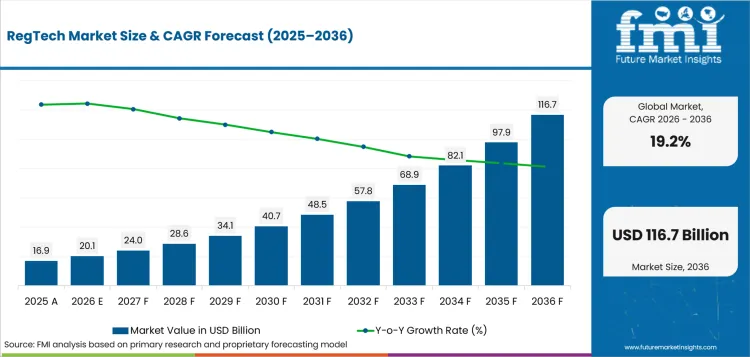
The RegTech market is predicted to rise from USD 20.1 billion in 2026 to USD 116.7 billion by 2036 at a 19.2% CAGR, driven by compliance workflow digitization with faster regulatory-rule updates and wider adoption of cloud-based AML screening as software accounts for 68.4% share and cloud platforms contribute 63.7% share as companies prioritize compliance automation.
Key Takeaways, Market Size, and Forecast
| Metric | Value |
|---|---|
| Market Size (2025) | USD 16.9 Billion |
| Market Size (2026) | USD 20.1 Billion |
| Market Size (2036) | USD 116.7 Billion |
| CAGR (2026–2036) | 19.2% |
| Incremental Opportunity | USD 96.6 Billion |
| Leading Component (2026) | Software (>68.4%) |
| Leading Component (2026) | Cloud Platforms |
| Cloud Platforms Share (2026) | 63.7% |
| Fastest-Growing Country | India |
| India CAGR | 22.8% |
Summary of RegTech Market
- Demand and Growth Drivers
- Financial institutions are replacing manual review files with workflow software as rule changes arrive faster across reporting and financial crime teams.
- Cloud systems gain attention as sanctions screening and transaction monitoring need frequent data refreshes across multi-country operations.
- Digital payment volume keeps RegTech use active as fraud checks must work across instant payment rails and remote onboarding channels.
- Product and Segment View
- Software is estimated to hold 68.4% share in 2026, influenced by recurring platform spend for reporting and control testing.
- Cloud platforms are projected to secure 63.7% share in 2026, reflected by firms reducing upgrade delays after rule changes.
- AML screening is expected to represent 34.8% share in 2026 due to financial crime checks staying central to compliance budgets.
- Geography and Competitive Outlook
- India is likely to record 22.8% CAGR by 2036, backed by digital payment scale and bank fraud-control automation.
- Singapore is expected to expand at 21.9% CAGR by 2036, led by financial crime data sharing and bank compliance investment.
- Thomson Reuters and NICE Actimize compete based on regulatory content depth and bank-grade financial crime analytics.
- Fenergo and Regnology compete depending on client lifecycle management and regulatory reporting workflows for complex institutions.
- Analyst Opinion
- Anurag Sharma, Principal Consultant for Technology at FMI, observes, “RegTech buying is moving from policy documentation toward proof-ready compliance workflow. I expect banks and payment firms to compare audit evidence and rule update discipline before selecting vendors. Suppliers with strong regulatory content and clean workflow records should protect repeat contracts.”
- RegTech Market Value Analysis
- Market value is tied to recurring software use and rule-update frequency before consulting hours affect total spend.
- Supplier pricing reflects workflow depth and data coverage before seat count changes contract size.
- Revenue improves as firms move from manual sampling toward automated screening and evidence logs.
- Platform trust rises as vendors connect regulatory content with case workflow and audit records.
Compliance teams now need faster systems since rules are changing quickly and audit records must stay easy to check. In September 2025, the Bank of England Prudential Regulation Authority published Banking Taxonomy v3.7.0 for step-in risk reporting. Its CP21/25 consultation proposed deleting 37 banking reporting templates and estimated about £26.0 million in yearly savings. Banks will prefer RegTech tools being able to update reporting taxonomies quickly and remove old forms without heavy manual work.
Payment screening is also moving toward clearer message checks. In June 2025, Financial Action Task Force updated Recommendation 16 after more than 300 consultation responses. It focuses on clearer sender and receiver information in cross-border payments. Payment firms will need screening systems reading payment message details before alerts reach review teams.
AI-based compliance tools are gaining more trust through supervised testing. In December 2024, Hong Kong Monetary Authority selected 15 Gen.AI Sandbox use cases from 10 banks and 4 technology partners. Vendors proving fraud detection and document review under regulator guidance will gain stronger acceptance in bank compliance budgets.
RegTech Market Definition
RegTech means regulatory technology software and services used by small regulated firms to manage compliance, risk reporting, financial crime checks and audit evidence. Scope includes anti-money laundering tools, transaction monitoring, regulatory reporting platforms, customer due diligence, identity checks and governance workflow. General enterprise software is outside scope unless it contains dedicated compliance workflow for regulated industries.
RegTech Market Inclusions
Scope includes regulatory reporting solutions, anti-money laundering, transaction monitoring, sanctions screening, customer onboarding, identity checks, risk monitoring and audit workflow. Software licenses, cloud subscriptions, professional services and compliance data tools are counted when sold for regulated financial workflows. Banking, insurance, wealth management, payments and crypto compliance use are included.
RegTech Market Exclusions
Scope excludes broad enterprise resource planning tools without dedicated compliance workflow. Legal consulting, manual audit services and cybersecurity tools are excluded unless they directly support regulatory reporting or financial crime control. Generic data storage and document management tools are counted only when sold inside a RegTech workflow.
RegTech Market Research Methodology
- Primary Research: FMI analysts reviewed compliance buying needs across banks and regulated technology providers.
- Desk Research: Official regulator updates and company releases supported scope mapping and demand checks.
- Market Sizing and Forecasting: Forecast values used software contract exposure and financial crime workflow adoption.
- Data Validation: Checks compared 2026 value with 2036 value and tested CAGR consistency across seven country rates.
Why is the RegTech Market Growing?
- Financial firms are moving compliance work into software platforms as manual reviews cannot keep pace with digital reporting duties.
- Regulators are adding machine-readable access points and stricter control evidence rules across filings and financial crime checks.
- Cloud software is gaining buyer attention as vendors update rules and screening lists faster than internal teams can manage.
Growth is becoming clearer as regulators push firms toward safer data handling and faster evidence trails. United States Securities and Exchange Commission opened EDGAR Next beta in September 2024 with 15 optional application programming interfaces for filing access. Financial Crimes Enforcement Network finalized anti-money laundering duties for registered investment advisers in August 2024. More digital rule interaction raises demand for systems joining filing workflow and audit records.
Market Segmentation Analysis
- Software is forecast to capture 68.4% share in 2026 due to small regulated firms preferring configured platforms with audit logs and rule libraries.
- Cloud platforms are expected to represent 63.7% share in 2026, influenced by faster updates for rule packs and sanctions data.
- AML screening is projected at 34.8% share in 2026, reflecting sanctions updates and customer risk scoring needs.
- Large enterprises are anticipated to hold 58.9% share in 2026 since multi-entity groups need common controls across business units.
- Banking is estimated to secure 46.2% share in 2026, guided by reporting duties and financial crime surveillance across accounts.
The market for RegTech is divided into groups based on component, deployment, application, organization size and end user. Component covers software, services, data tools, analytics and consulting used for compliance programs. Deployment separates cloud, on premise and hybrid systems. Application includes AML screening, regulatory reporting, risk monitoring, identity checks and audit management. Organization size divides large enterprises and SMEs. End user coverage includes banking, insurance, wealth management, payments and crypto firms across the global compliance software landscape.
Insights into RegTech Market by Component
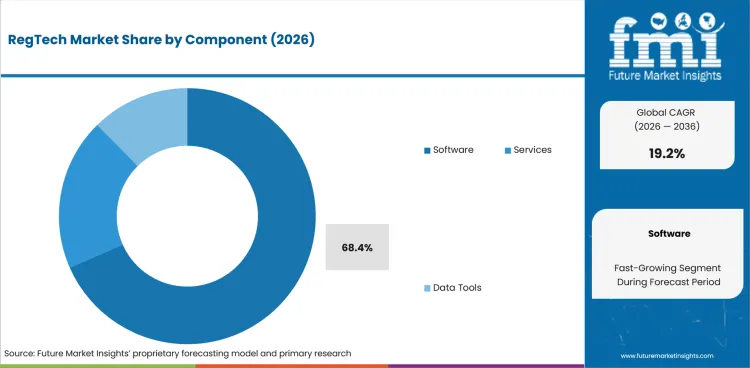
- Software is projected to account for 68.4% share in 2026, led by recurring platform contracts carrying regulatory information management and audit workflows.
- Services retain value as banks need integration support for governance controls and legacy case management migration.
Insights into RegTech Market by Deployment
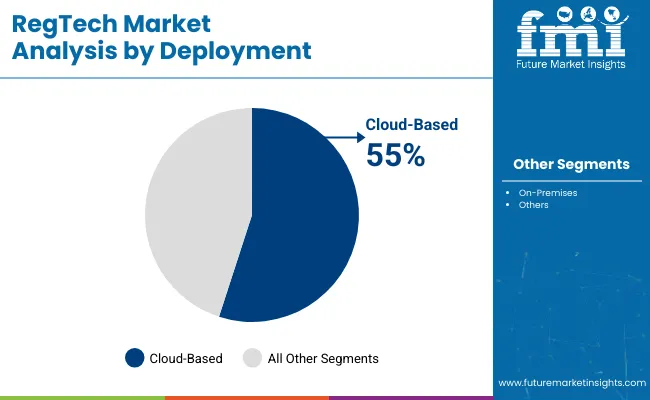
- Cloud platforms are forecast to hold 63.7% share in 2026, driven by vendors able to update rule packs and screening data across clients quickly.
- On premise tools keep use in select banks with strict data residency rules and complex internal access controls.
Insights into RegTech Market by Application
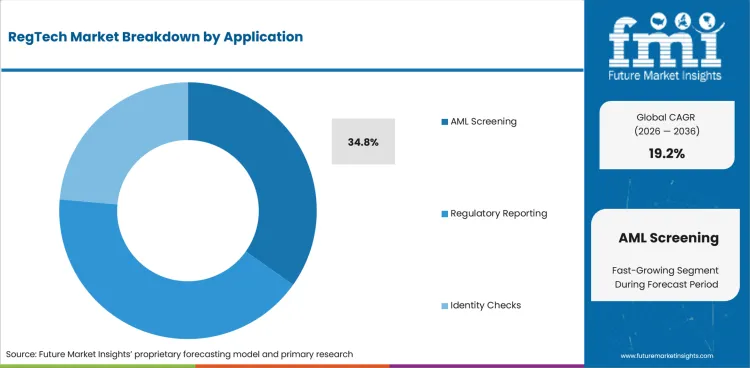
- AML screening is expected to account for 34.8% share in 2026 due to sanctions alerts and customer risk scoring across financial institutions.
- Regulatory reporting gains steady use as firms connect filing systems with regulator data formats and evidence logs.
Insights into RegTech Market by Organization Size
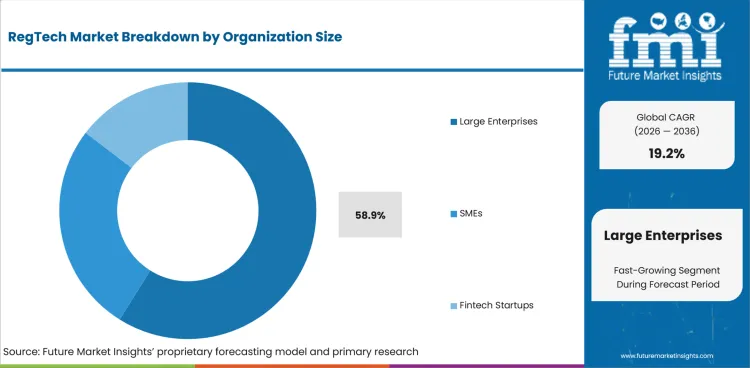
- Large enterprises are projected to represent 58.9% share in 2026 since multinational firms need shared controls across regulated entities.
- SMEs expand through modular subscriptions as fintechs seek affordable identity checks and simplified reporting workflows.
Insights into RegTech Market by End User
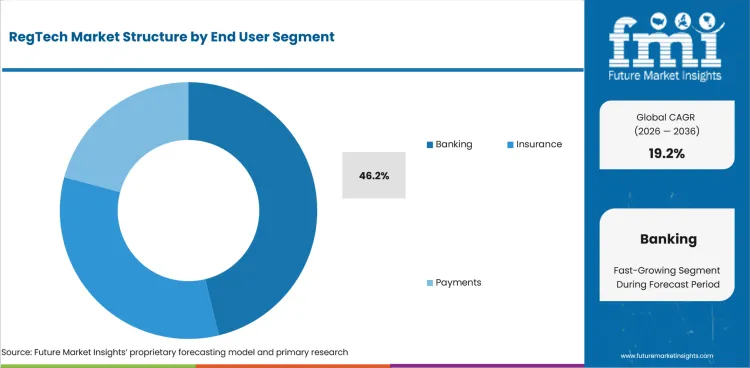
- Banking is anticipated to capture 46.2% share in 2026 as banks face reporting and transaction monitoring duties at scale.
- Payments and crypto firms gain attention as transaction monitoring tools address fast payment flows and wallet screening needs.
RegTech Market Drivers, Restraints and Opportunities
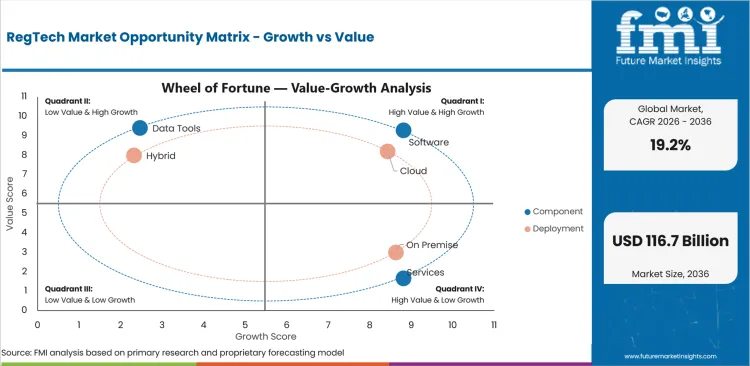
- Driver: Automated evidence trails are pushing small regulated firms toward platforms joining rule mapping with case workflow.
- Restraint: Data residency and model oversight concerns can slow cloud conversion among large financial institutions.
- Opportunity: AI-assisted screening can expand as payment firms seek fewer false alerts and cleaner investigator queues.
Regulated financial firms are adding software controls as supervisory expectations become more data based. Financial Conduct Authority annual reporting in July 2025 cited a survey in which 75.0% of 118 responding firms used artificial intelligence. Monetary Authority of Singapore imposed S$27.45 million in composition penalties on 9 financial institutions in July 2025 for anti-money laundering breaches. Such evidence is likely to favor vendors with strong model governance and case workflow proof.
Regulatory Compliance and Operating Standards Analysis
RegTech compliance is shifting toward payment-message validation and operational readiness as ISO 20022 becomes the core standard for cross-border payments. Swift stated in October 2025 reporting average daily ISO 20022 payment instruction messages crossed 60.0% in September 2025. Swift also stated, older CBPR+ message versions would not work after 22 November 2025. RegTech vendors can use this shift to support message testing and payment-data checks for banks upgrading compliance workflows.
Competitive Benchmarking and Technology Positioning Analysis
Competitive positioning in RegTech is moving toward AI-led surveillance depth as vendors compete on alert quality and investigation speed. NICE Actimize stated in May 2025, SURVEIL-X with Actimize Intelligence can reduce false positives by up to 85.0% and detect up to 4.0 times more true misconduct risk than rule-based surveillance. This supports benchmarking around AI surveillance and regulated communication coverage across banks and capital market firms.
Competitive Landscape and Strategic Positioning
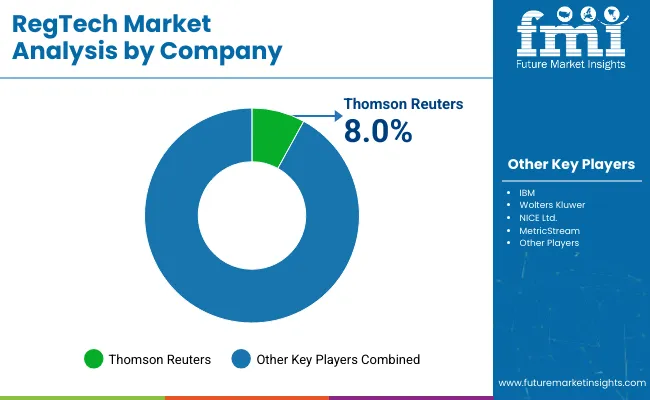
- Global regulatory content providers hold an advantage through rule libraries and financial institution relationships.
- Financial crime platform specialists gain orders by linking screening accuracy with case workflow and alert control.
- Reporting software vendors strengthen repeat revenue as institutions seek audit-ready filings and regulator format updates.
- Client lifecycle platforms support onboarding and due diligence across complex customer structures.
Competitive structure is led by regulatory content providers and reporting software vendors. Thomson Reuters and Wolters Kluwer hold strong positions based on regulatory content and workflow reach. NICE Actimize and ComplyAdvantage compete across anti-money laundering screening and transaction monitoring. Fenergo and Regnology support client lifecycle and regulatory reporting needs. Workiva, Oracle Financial Services and Moody’s Analytics add strength in evidence management and financial data workflows.
Supplier selection starts with evidence quality before license cost is reviewed. Banks ask for sanctions data quality and workflow audit trails. Payment firms compare real-time scoring and implementation support in the same buying step. Vendors with strong regulatory libraries and financial crime workflow depth are expected to gain stronger repeat orders.
Key Companies in the RegTech Market
Competitive structure is differentiated by regulatory content providers, financial crime platforms and reporting workflow specialists. Platform reliability and data lineage shape premium positioning.
- Regulatory Content Providers: Thomson Reuters, Wolters Kluwer and Moody’s Analytics compete based on rule libraries, entity data and workflow integration.
- Financial Crime Platforms: NICE Actimize, ComplyAdvantage and Oracle Financial Services compete based on AML screening, transaction monitoring and case automation.
- Reporting and Lifecycle Specialists: Regnology, Workiva, Fenergo and Nasdaq compete through regulatory filing, onboarding and data validation tools.
Competitive Benchmarking: RegTech Market
| Company | Regulatory Content Depth | Financial Crime Analytics | Reporting Workflow Depth | Audit Trail Strength | Geographic Footprint |
|---|---|---|---|---|---|
| Thomson Reuters | Very Strong | Strong | Strong | Strong | Global |
| NICE Actimize | Strong | Very Strong | Moderate | Strong | Global |
| Fenergo | Strong | Strong | Moderate | Very Strong | Global |
| ComplyAdvantage | Strong | Very Strong | Moderate | Strong | Global |
| Regnology | Very Strong | Moderate | Very Strong | Strong | Europe based global |
| Wolters Kluwer | Very Strong | Moderate | Very Strong | Strong | Global |
| Workiva | Strong | Limited | Very Strong | Very Strong | Global |
| Oracle Financial Services | Strong | Very Strong | Strong | Strong | Global |
Source: Future Market Insights competitive analysis, 2026.
Key Developments in RegTech Market
- In November 2025, Regnology launched RRH Ascend as the next generation of its Regnology Reporting Hub for banking and transaction reporting.
- In October 2025, ComplyAdvantage launched Mesh as an AI-native platform combining screening, customer risk scoring, transaction monitoring and real-time payment analysis.
- In June 2024, Fenergo launched AI-powered client lifecycle management using Amazon Bedrock for KYC, AML and sanctions workflow automation.
Key Players in the RegTech Market
- Thomson Reuters
- NICE Actimize
- Fenergo
- ComplyAdvantage
- Regnology
- Wolters Kluwer
- Workiva
- Oracle Financial Services
- Moody’s Analytics
- Nasdaq
Analysis of RegTech Market by Key Countries
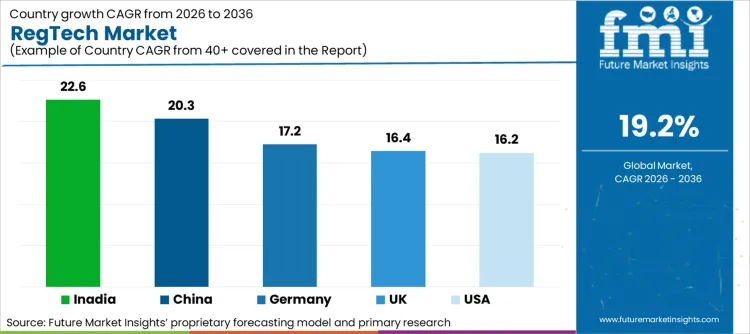
.webp "Top Country Growth Comparison Regtech Market Cagr (2026 2036)")
| Country | CAGR |
|---|---|
| India | 22.8% |
| Singapore | 21.9% |
| China | 20.7% |
| United States | 19.6% |
| United Kingdom | 18.9% |
| Germany | 17.8% |
| Australia | 16.9% |
Source: Future Market Insights, 2026.
Sales Analysis of RegTech Market in India
Fastest-growing digital payments compliance sector · 2026 to 2036
India Market Outlook
India records the fastest country pace by 2036, influenced by digital payment scale and bank fraud controls. Payment systems create large volumes of transaction data requiring automated alerts and post-event review. RegTech demand is rising due to banks and fintech as a service seek cleaner case records across onboarding and payment monitoring.
Key Growth Drivers
- Press Information Bureau reported in March 2025 stating digital payment transactions reached 18,120.8 crore in 2024-25 through January 2025, raising demand for fraud monitoring and KYC workflow tools.
- Government communication in March 2026 said MuleHunter.AI was live in 26 banks, improving acceptance of AI-based account-risk scoring for suspected mule accounts.
- Reserve Bank of India’s 2025 digital payments safety focus keeps regulated entities attentive to customer protection and reporting workflow across high-volume payment rails.
Key Restraints
- Reserve Bank of India fraud-risk FAQs published in April 2025 require regulated entities to report fraud incidents of INR 100 thousand or more to law enforcement agencies, leading smaller lenders requiring case systems with clear escalation records before automation works cleanly.
- Reserve Bank of India KYC FAQs published in June 2025 set re-KYC cycles at 2 years for high-risk customers and 8 years for medium-risk customers, making weak customer records a direct limit on automated screening quality.
What makes India unique?
India combines payment volume, public fraud analytics and bank digitization. RegTech suppliers gain more by showing proof against real-time fraud patterns than by selling generic compliance modules.
Key Companies
- Fenergo
- ComplyAdvantage
- NICE Actimize
- Oracle Financial Services
- Tata Consultancy Services
- Infosys Finacle
- Wolters Kluwer
- Thomson Reuters
Sales & Marketing Channels
- Bank technology partners
- Fintech platform vendors
- System integrators
- Cloud marketplaces
- Risk advisory firms
- Direct enterprise sales
Market Taxonomy & Sub-Regions Covered
| Segment | Sub-Segments |
|---|---|
| By Component | Software · Services · Data Tools · Analytics · Consulting |
| By Deployment | Cloud · On Premise · Hybrid |
| By Application | AML Screening · Regulatory Reporting · Risk Monitoring · Identity Checks · Audit Management |
| By Organization Size | Large Enterprises · SMEs · Midmarket Firms · Fintech Startups · Small Regulated Firms |
| By End User | Banking · Insurance · Wealth Management · Payments · Crypto Firms |
| Key Sub-Regions Covered - States / Union Territories | Maharashtra, Karnataka, Delhi NCR, Telangana, Tamil Nadu, Gujarat, Uttar Pradesh, Haryana |
Frequently Asked Questions
How fast is India’s RegTech market growing?
India is projected to grow at 22.8% CAGR from 2026 to 2036.
Who leads India’s RegTech market?
Fenergo, ComplyAdvantage, NICE Actimize, Oracle Financial Services, Tata Consultancy Services, Infosys Finacle, Wolters Kluwer, and Thomson Reuters compete across financial services channels.
What is driving demand in India?
Demand is driven by digital payments scale and fraud-control automation across banks and fintechs.
Sales Analysis of RegTech Market in Singapore
Financial crime data-sharing hub · 2026 to 2036
Singapore Market Outlook
Singapore expands by 2036 through regulator-backed data sharing and strong bank technology use. RegTech demand is shaped by financial crime screening and AI governance. Compliance investment is concentrated in banks and payment firms requiring trusted systems for cross-border risk review.
Key Growth Drivers
- Monetary Authority of Singapore launched COSMIC on April 1, 2024 with six major banks, supporting collaborative money laundering and terrorism financing risk checks.
- Monetary Authority of Singapore imposed S$27.5 million in composition penalties on 9 financial institutions in July 2025, raising attention on screening quality and alert review.
- Monetary Authority of Singapore proposed AI risk management guidelines in November 2025, creating demand for model controls inside compliance and fraud workflows.
Key Restraints
- Monetary Authority of Singapore incident-reporting guidance issued in December 2025 requires an initial incident report no later than 24 hours after discovery, resulting in smaller fintech firms needing tighter logs before expanding automated compliance tools.
- Personal Data Protection Commission reported in October 2025 a Marina Bay Sands breach affecting 665.5 thousand individuals and a S$315 thousand penalty, leading data-handling proof to create a hard filter during vendor selection.
What makes Singapore unique?
Singapore stands out for supervised data sharing and regulator support for responsible AI. Vendors with bank-grade AML data and local hosting can build stronger trust.
Key Companies
- ComplyAdvantage
- Fenergo
- NICE Actimize
- LSEG Risk Intelligence
- Wolters Kluwer
- Regnology
- Sumsub
- Moody’s Analytics
Sales & Marketing Channels
- Regional bank sales
- Fintech accelerators
- Cloud partner programs
- Compliance consultancies
- Direct vendor teams
- System integrators
Market Taxonomy & Sub-Regions Covered
| Segment | Sub-Segments |
|---|---|
| By Component | Software · Services · Data Tools · Analytics · Consulting |
| By Deployment | Cloud · On Premise · Hybrid |
| By Application | AML Screening · Regulatory Reporting · Risk Monitoring · Identity Checks · Audit Management |
| By Organization Size | Large Enterprises · SMEs · Midmarket Firms · Fintech Startups · Small Regulated Firms |
| By End User | Banking · Insurance · Wealth Management · Payments · Crypto Firms |
| Key Sub-Regions Covered - Districts / Business Areas | Central Business District, Marina Bay, Changi, Jurong East, Tampines, Woodlands, One-North, Paya Lebar |
Frequently Asked Questions
How fast is Singapore’s RegTech market growing?
Singapore is projected to grow at 21.9% CAGR from 2026 to 2036.
Who leads Singapore’s RegTech market?
ComplyAdvantage, Fenergo, NICE Actimize, LSEG Risk Intelligence, Wolters Kluwer, Regnology, Sumsub, and Moody’s Analytics compete across financial services channels.
What is driving demand in Singapore?
Demand is reflected by financial crime data sharing and bank compliance investment.
Sales Analysis of RegTech Market in China
AML law modernization sector · 2026 to 2036
China Market Outlook
China grows faster than several established markets by 2036, driven by payment scale and anti-money laundering law modernization. Banks and payment firms need stronger customer checks as regulators sharpen risk-based obligations. Local compliance vendors gain from language support and domestic data hosting requirements.
Key Growth Drivers
- State Council of China reported in November 2024 stating the revised Anti-Money Laundering Law has 65 articles across 7 chapters, promoting demand for rule mapping tools.
- Revised anti-money laundering law took effect on January 1, 2025 and forced financial institutions to refresh customer risk and transaction review controls.
- China’s 2025 data security measures for the central bank business field added clearer compliance duties for financial data management and system governance.
Key Restraints
- China’s network data security regulation became effective on January 1, 2025 and sets annual risk assessment duties for important data processors, so foreign vendors need stronger local storage controls before bank use.
- People’s Bank of China business-field data security measures took effect on June 30, 2025 after promulgation on May 1, 2025, making cross-border data transfer proof a restraint for providers without China-hosted workflows.
What makes China unique?
China combines high digital finance scale with domestic compliance control. Supplier success is tied to local rule coverage and strong data-governance support.
Key Companies
- Hundsun Technologies
- Yusys Technologies
- Ant Group
- Tencent Cloud
- Thomson Reuters China
- Oracle China
- Moody’s Analytics
- NICE Actimize
Sales & Marketing Channels
- Bank technology tenders
- Cloud vendor channels
- Local system integrators
- Regulatory consulting teams
- Direct enterprise sales
- Fintech partner networks
Market Taxonomy & Sub-Regions Covered
| Segment | Sub-Segments |
|---|---|
| By Component | Software · Services · Data Tools · Analytics · Consulting |
| By Deployment | Cloud · On Premise · Hybrid |
| By Application | AML Screening · Regulatory Reporting · Risk Monitoring · Identity Checks · Audit Management |
| By Organization Size | Large Enterprises · SMEs · Midmarket Firms · Fintech Startups · Small Regulated Firms |
| By End User | Banking · Insurance · Wealth Management · Payments · Crypto Firms |
| Key Sub-Regions Covered - Provinces / Municipalities | Beijing, Shanghai, Guangdong, Zhejiang, Jiangsu, Shenzhen, Sichuan, Shandong |
Frequently Asked Questions
How fast is China’s RegTech market growing?
China is projected to grow at 20.7% CAGR from 2026 to 2036.
Who leads China’s RegTech market?
Hundsun Technologies, Yusys Technologies, Ant Group, Tencent Cloud, Thomson Reuters China, Oracle China, Moody’s Analytics, and NICE Actimize compete across financial services channels.
What is driving demand in China?
Demand is led by anti-money laundering modernization and domestic data governance requirements.
Sales Analysis of RegTech Market in the United States
Filing modernization and AML control sector · 2026 to 2036
United States Market Outlook
United States demand stays high-value by 2036, shaped by securities filing modernization and financial crime supervision. Public companies and banks need systems linking identity access and evidence records. Cloud compliance platforms gain from regulator data modernization and anti-money laundering program changes.
Key Growth Drivers
- United States Securities and Exchange Commission opened EDGAR Next beta in September 2024 with 15 optional application programming interfaces, influencing automated filing workflow tools.
- Financial Crimes Enforcement Network issued the investment adviser AML final rule in August 2024, pushing advisers toward program and suspicious activity reporting systems.
- EDGAR Next account management changes in 2025 propel demand for access controls and filing evidence across public company reporting teams.
Key Restraints
- Financial Crimes Enforcement Network moved adviser AML obligations from January 1, 2026 to January 1, 2028 in its 2025 delay notice, slowing immediate software conversion among smaller advisory firms.
- United States Securities and Exchange Commission EDGAR Next enrollment requirements moved into required compliance after September 15, 2025, so issuers without clean user records faced heavier implementation work before full filing automation.
What makes the United States unique?
United States demand links filing modernization with financial crime supervision. Vendors gain by connecting regulatory content, data access and investigator workflow for large institutions.
Key Companies
- Thomson Reuters
- NICE Actimize
- Oracle Financial Services
- Workiva
- Moody’s Analytics
- Nasdaq
- Fenergo
- ComplyAdvantage
Sales & Marketing Channels
- Direct enterprise sales
- Bank technology partners
- Capital markets platforms
- Cloud marketplaces
- Compliance consultancies
- System integrators
Market Taxonomy & Sub-Regions Covered
| Segment | Sub-Segments |
|---|---|
| By Component | Software · Services · Data Tools · Analytics · Consulting |
| By Deployment | Cloud · On Premise · Hybrid |
| By Application | AML Screening · Regulatory Reporting · Risk Monitoring · Identity Checks · Audit Management |
| By Organization Size | Large Enterprises · SMEs · Midmarket Firms · Fintech Startups · Small Regulated Firms |
| By End User | Banking · Insurance · Wealth Management · Payments · Crypto Firms |
| Key Sub-Regions Covered - States / Regions | New York, California, Illinois, Texas, Massachusetts, New Jersey, North Carolina, Georgia |
Frequently Asked Questions
How fast is the United States RegTech market growing?
United States demand is projected at 19.6% CAGR from 2026 to 2036.
Who leads the United States RegTech market?
Thomson Reuters, NICE Actimize, Oracle Financial Services, Workiva, Moody’s Analytics, Nasdaq, Fenergo, and ComplyAdvantage compete across compliance technology channels.
What is driving demand in the United States?
Demand is shaped by filing modernization and anti-money laundering control expansion.
Sales Analysis of RegTech Market in the United Kingdom
AI and financial conduct supervision sector · 2026 to 2036
United Kingdom Market Outlook
United Kingdom demand is forecast to expand through AI oversight and conduct reporting. Banks and insurers are adopting compliance tools reflecting model accountability and customer outcome records. London’s financial services concentration keeps vendor activity focused on surveillance and anti-money laundering workflow.
Key Growth Drivers
- Financial Conduct Authority annual reporting in July 2025 cited a survey in which 75.0% of 118 responding firms used artificial intelligence, increasing demand for model governance records.
- Financial Conduct Authority work for 2026/27 includes using data and technology to improve financial crime detection, supporting automated screening and surveillance tools.
- Financial Conduct Authority strategy work by 2030 keeps operational resilience and data-led supervision central to compliance software planning.
Key Restraints
- Financial Conduct Authority survey findings published in May 2025 showed 39.0% of adults had confidence in United Kingdom financial services, so firms must prove conduct controls before scaling AI-driven compliance decisions.
- National Cyber Security Centre reported in October 2025 stating United Kingdom teams handled 204 nationally significant cyber attacks and 18 highly significant incidents in the latest review year, making weak resilience evidence a restraint for cloud compliance platforms.
What makes the United Kingdom unique?
United Kingdom stands out for regulator testing and financial crime oversight. RegTech vendors gain by proving explainability and conduct-risk evidence inside daily workflows.
Key Companies
- Fenergo
- ComplyAdvantage
- SteelEye
- Thomson Reuters
- NICE Actimize
- Workiva
- Quantexa
- Wolters Kluwer
Sales & Marketing Channels
- Bank compliance teams
- Capital markets vendors
- Regulatory sandboxes
- Risk consultancies
- Cloud marketplaces
- Direct software sales
Market Taxonomy & Sub-Regions Covered
| Segment | Sub-Segments |
|---|---|
| By Component | Software · Services · Data Tools · Analytics · Consulting |
| By Deployment | Cloud · On Premise · Hybrid |
| By Application | AML Screening · Regulatory Reporting · Risk Monitoring · Identity Checks · Audit Management |
| By Organization Size | Large Enterprises · SMEs · Midmarket Firms · Fintech Startups · Small Regulated Firms |
| By End User | Banking · Insurance · Wealth Management · Payments · Crypto Firms |
| Key Sub-Regions Covered - Nations / Financial Centers | England, Scotland, Wales, Northern Ireland, London, Manchester, Edinburgh, Leeds |
Frequently Asked Questions
How fast is the United Kingdom RegTech market growing?
United Kingdom demand is projected at 18.9% CAGR from 2026 to 2036.
Who leads the United Kingdom RegTech market?
Fenergo, ComplyAdvantage, SteelEye, Thomson Reuters, NICE Actimize, Workiva, Quantexa, and Wolters Kluwer compete across financial services channels.
What is driving demand in the United Kingdom?
Demand is led by AI governance and financial crime supervision across banks and insurers.
Sales Analysis of RegTech Market in Germany
DORA and regulatory reporting sector · 2026 to 2036
Germany Market Outlook
Germany progresses by 2036 through European digital resilience rules and banking reporting discipline. RegTech demand is concentrated in banks and investment firms depending on clean data lineage. Vendors with German reporting templates and Digital Operational Resilience Act support gain preference during platform selection.
Key Growth Drivers
- European Banking Authority stated that the Digital Operational Resilience Act became applicable on January 17, 2025, requiring financial entities to strengthen ICT risk controls.
- Federal Financial Supervisory Authority issued DORA implementation guidance in July 2024, giving German banks and insurers clearer planning signals for technology controls.
- European Banking Authority reporting templates in 2025 increased attention on third-party risk registers and structured supervisory data across financial entities.
Key Restraints
- European Banking Authority FAQ issued in February 2025 says DORA Article 28(3) requires financial entities to maintain registers for all ICT service contracts, so German banks face detailed vendor-record work before platform rollouts.
- Federal Financial Supervisory Authority guidance issued in January 2026 links AI use with DORA Article 28 third-party risk principles, making AI compliance tools harder to approve without complete supplier-control records.
What makes Germany unique?
Germany combines strict documentation culture with European rule harmonization. RegTech vendors win by offering DORA registers, reporting templates and German implementation support.
Key Companies
- Regnology
- Wolters Kluwer
- Fenergo
- Thomson Reuters
- SAP
- Workiva
- NICE Actimize
Sales & Marketing Channels
- Bank IT departments
- Regulatory reporting teams
- Systems integrators
- Audit consultancies
- Cloud partner channels
- Direct vendor sales
Market Taxonomy & Sub-Regions Covered
| Segment | Sub-Segments |
|---|---|
| By Component | Software · Services · Data Tools · Analytics · Consulting |
| By Deployment | Cloud · On Premise · Hybrid |
| By Application | AML Screening · Regulatory Reporting · Risk Monitoring · Identity Checks · Audit Management |
| By Organization Size | Large Enterprises · SMEs · Midmarket Firms · Fintech Startups · Small Regulated Firms |
| By End User | Banking · Insurance · Wealth Management · Payments · Crypto Firms |
| Key Sub-Regions Covered - Federal States / Cities | Hesse, Bavaria, North Rhine-Westphalia, Baden-Württemberg, Berlin, Hamburg, Lower Saxony, Saxony |
Frequently Asked Questions
How fast is Germany’s RegTech market growing?
Germany is forecast to grow at 17.8% CAGR from 2026 to 2036.
Who leads Germany’s RegTech market?
Regnology, Wolters Kluwer, Fenergo, Thomson Reuters, SAP, Workiva and NICE Actimize compete across financial services channels.
What is driving demand in Germany?
Demand is influenced by DORA compliance and structured regulatory reporting needs.
Sales Analysis of RegTech Market in Australia
AML reform expansion sector · 2026 to 2036
Australia Market Outlook
Australia expands by 2036 as anti-money laundering reform brings new professional service sectors into regulated workflows. Banks and professional advisers need simpler onboarding and reporting systems. RegTech vendors gain from tools built for firms entering the regime for the first time.
Key Growth Drivers
- Australian Transaction Reports and Analysis Centre said in June 2025, about 80,000 more businesses would enter the AML/CTF regime, expanding software demand beyond banks.
- Australian Transaction Reports and Analysis Centre guidance in March 2026 requires newly regulated entities to notify an AML/CTF compliance officer within 14 days of appointment.
- AUSTRAC collected over 56.0 million cash deposit data points from major banks for collaborative analytics, supporting automated risk review tools.
Key Restraints
- AUSTRAC’s Tranche 2 factsheet issued in July 2025 gives newly regulated entities 28 days to enrol and 14 days to update enrolment details, influencing small firms to face tight administrative work before software value is clear.
- AUSTRAC reform guidance sets July 1, 2026 as the start date for newly regulated professional and real estate services, making education workload a restraint before routine AML software use.
What makes Australia unique?
Australia stands out as a reform expansion case. RegTech vendors can reach new customer groups by simplifying AML workflows for real estate and accounting firms.
Key Companies
- ComplyAdvantage
- Fenergo
- NICE Actimize
- Thomson Reuters
- GBG
- Wolters Kluwer
- Workiva
- Oracle Financial Services
Sales & Marketing Channels
- Bank compliance teams
- Professional service associations
- Cloud marketplaces
- Risk advisers
- Direct SMB software sales
- Financial crime consultants
Market Taxonomy & Sub-Regions Covered
| Segment | Sub-Segments |
|---|---|
| By Component | Software · Services · Data Tools · Analytics · Consulting |
| By Deployment | Cloud · On Premise · Hybrid |
| By Application | AML Screening · Regulatory Reporting · Risk Monitoring · Identity Checks · Audit Management |
| By Organization Size | Large Enterprises · SMEs · Midmarket Firms · Fintech Startups · Small Regulated Firms |
| By End User | Banking · Insurance · Wealth Management · Payments · Crypto Firms |
| Key Sub-Regions Covered - States / Territories | New South Wales, Victoria, Queensland, Western Australia, South Australia, Australian Capital Territory, Tasmania, Northern Territory |
Frequently Asked Questions
How fast is Australia’s RegTech market growing?
Australia is expected to grow at 16.9% CAGR from 2026 to 2036.
Who leads Australia’s RegTech market?
ComplyAdvantage, Fenergo, NICE Actimize, Thomson Reuters, GBG, Wolters Kluwer, Workiva, and Oracle Financial Services compete across financial services channels.
What is driving demand in Australia?
Demand is propelled by AML reform and new regulated entity onboarding outside banks.
Market Report Scope
| Parameter | Details |
|---|---|
| Quantitative units | USD 20.1 billion to USD 116.7 billion at 19.2% CAGR |
| Market definition | Regulatory technology software and services used for compliance workflow, reporting, financial crime checks and audit evidence |
| By component | Software, services, data tools, analytics, consulting |
| By deployment | Cloud, on premise, hybrid |
| By application | AML screening, regulatory reporting, risk monitoring, identity checks, audit management |
| By organization size | Large enterprises, SMEs, midmarket firms, fintech startups, small regulated firms |
| By end user | Banking, insurance, wealth management, payments, crypto firms |
| Regions covered | North America, Latin America, Europe, East Asia, South Asia and Pacific, Middle East and Africa |
| Countries covered | India, Singapore, China, United States, United Kingdom, Germany, Australia |
| Key companies profiled | Thomson Reuters, NICE Actimize, Fenergo, ComplyAdvantage, Regnology, Wolters Kluwer, Workiva, Oracle Financial Services, Moody’s Analytics, Nasdaq |
| Forecast period | 2026 to 2036 |
| Approach | Hybrid top-down and bottom-up sizing with compliance software exposure, regulatory rule timing, application mix and vendor checks |
Source: Future Market Insights competitive analysis, 2026.
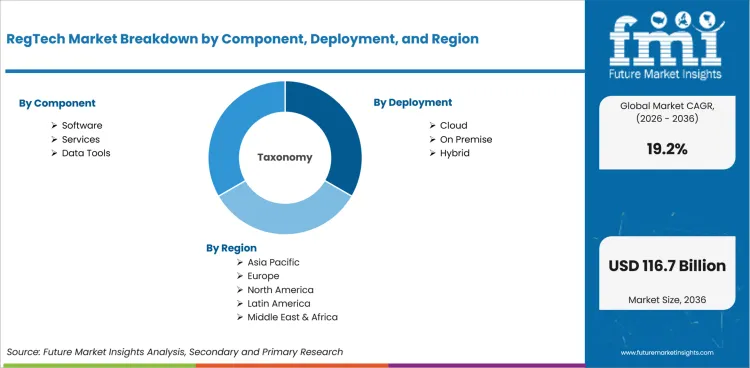
RegTech Market Breakdown by Component, Deployment, Application, Organization Size, End User, and Region
By Component:
- Software
- Services
- Data Tools
- Analytics
- Consulting
By Deployment:
- Cloud
- On Premise
- Hybrid
By Application:
- AML Screening
- Regulatory Reporting
- Risk Monitoring
- Identity Checks
- Audit Management
By Organization Size:
- Large Enterprises
- SMEs
- Midmarket Firms
- Fintech Startups
- Small Regulated Firms
By End User:
- Banking
- Insurance
- Wealth Management
- Payments
- Crypto Firms
By Region:
- North America
- Latin America
- Western Europe
- Eastern Europe
- East Asia
- South Asia and Pacific
- Middle East & Africa
Research Sources and Bibliography
- Bank of England. (2025, September 22). PRA regulatory digest: September 2025. Bank of England.
- Financial Action Task Force. (2025, June 18). FATF updates standards on Recommendation 16 on payment transparency. Financial Action Task Force.
- Hong Kong Monetary Authority. (2024, December 19). HKMA announces inaugural cohort of GenA.I. Sandbox. Hong Kong Monetary Authority.
- Financial Stability Board. (2024, October 21). Implementation of the Legal Entity Identifier: Progress report. Financial Stability Board.
- Swift. (2025, October). ISO 20022 in bytes for payments: One month to go. Swift.
- NICE Actimize. (2025, May 28). NICE Actimize empowers SURVEIL-X with generative AI, launching a new era in market abuse and conduct risk detection. NICE Actimize.
- Nasdaq, Inc. (2025, November 26). Nasdaq AxiomSL expands RegTech deployment with Revolut, accelerating global growth. Nasdaq, Inc.
- United States Securities and Exchange Commission. (2024, September 27). EDGAR Filer Access and Account Management. United States Securities and Exchange Commission.
- Financial Crimes Enforcement Network. (2024, August 28). Anti-Money Laundering and Countering the Financing of Terrorism Program and Suspicious Activity Report Filing Requirements for Registered Investment Advisers and Exempt Reporting Advisers. Financial Crimes Enforcement Network.
- European Banking Authority. (2025, January 17). Preparations for reporting of DORA registers of information. European Banking Authority.
- Financial Conduct Authority. (2025, July 8). Annual Report and Accounts 2024/25. Financial Conduct Authority.
- Financial Conduct Authority. (2026, March 26). FCA annual work programme 2026/27. Financial Conduct Authority.
- Monetary Authority of Singapore. (2025, July 4). MAS takes regulatory actions against 9 financial institutions for AML-related breaches. Monetary Authority of Singapore.
- Press Information Bureau. (2025, March 11). Digital payment transactions surge with over 18,000 crore transactions in 2024-25. Government of India.
- Press Information Bureau. (2026, March 24). RBI strengthens framework on unauthorised electronic banking transactions. Government of India.
- State Council of the People’s Republic of China. (2024, November 9). China revises Anti-Money Laundering Law. State Council of the People’s Republic of China.
- Reserve Bank of India. (2025, April 22). FAQs on Master Directions on Fraud Risk Management in Commercial Banks and All India Financial Institutions. Reserve Bank of India.
- Reserve Bank of India. (2025, June 9). FAQs on Master Direction on KYC. Reserve Bank of India.
- Australian Transaction Reports and Analysis Centre. (2025, June 4). AUSTRAC CEO, Brendan Thomas: Speaking notes at the Integrity Insight Financial Crime Summit 2025. AUSTRAC.
- Australian Transaction Reports and Analysis Centre. (2026, March 31). AML/CTF compliance officer. AUSTRAC.
- Regnology. (2025, November 19). Regnology launches RRH Ascend. Regnology.
- ComplyAdvantage. (2025, October 27). ComplyAdvantage launches AI-native platform to combat surging financial crime. ComplyAdvantage.
- Fenergo. (2024, June 4). Fenergo launches AI Powered CLM to supercharge efficiency gains amid intensifying regulation and cost challenges. Fenergo.
- Personal Data Protection Commission. (2025, October 28). PDPC imposes financial penalty on Marina Bay Sands for data breach. Personal Data Protection Commission.
- National Cyber Security Centre. (2025, October 14). UK experiencing four nationally significant cyber attacks weekly. National Cyber Security Centre.
- Financial Conduct Authority. (2025, May 16). Key findings from the FCA’s Financial Lives May 2024 survey. Financial Conduct Authority.
- London Stock Exchange Group. (2024, July 29). LSEG rebrand: Changes requiring customer action in 2024. London Stock Exchange Group.
This Report Answers
- What is the current and forecast value of the RegTech market from 2026 to 2036?
- Which component is expected to hold the leading 2026 share in the market?
- How do software and services shape RegTech buying across small regulated firms?
- How do financial crime checks and regulatory reporting duties shape RegTech demand?
- Which seven countries show the most important commercial movement for suppliers and investors?
- How do key market companies compete across rule libraries and financial crime analytics?
- Which developments changed RegTech positioning in bank compliance and financial crime channels?
- How should suppliers position cloud platforms and reporting workflow tools for small regulated firms?
Frequently Asked Questions
What is the RegTech market size in 2026?
The RegTech market value is expected to cross USD 20.1 billion in 2026 and reach USD 116.7 billion by 2036.
What is the forecast CAGR for RegTech market?
The RegTech sector is likely to expand at 19.2% CAGR from 2026 to 2036 globally.
Which component leads RegTech market?
Software is set to lead with an estimated 68.4% share in 2026, led by small regulated firms requiring reusable compliance workflow and audit records.
Which deployment leads RegTech market?
Cloud platforms are projected to hold 63.7% share in 2026 due to vendors updating rule content and screening data faster.
Which country grows fastest in RegTech market?
India is expected to record 22.8% CAGR by 2036, led by digital payment scale and fraud-control automation.
Who are key companies in RegTech market?
Thomson Reuters, NICE Actimize, Fenergo, ComplyAdvantage, Regnology, Wolters Kluwer, Workiva, Oracle Financial Services, Moody’s Analytics, and Nasdaq are key companies.
Preview the report firsthand - request a free sample
Get SampleGet the brochure for pricing and purchase details.
Get PDFTable of Content
- Executive Summary
- Global Market Outlook
- Demand-side Trends
- Supply-side Trends
- Technology Roadmap Analysis
- Analysis and Recommendations
- Market Overview
- Market Coverage / Taxonomy
- Market Definition / Scope / Limitations
- Research Methodology
- Chapter Orientation
- Analytical Lens and Working Hypotheses
- Market Structure, Signals, and Trend Drivers
- Benchmarking and Cross-market Comparability
- Market Sizing, Forecasting, and Opportunity Mapping
- Research Design and Evidence Framework
- Desk Research Programme (Secondary Evidence)
- Company Annual and Sustainability Reports
- Peer-reviewed Journals and Academic Literature
- Corporate Websites, Product Literature, and Technical Notes
- Earnings Decks and Investor Briefings
- Statutory Filings and Regulatory Disclosures
- Technical White Papers and Standards Notes
- Trade Journals, Industry Magazines, and Analyst Briefs
- Conference Proceedings, Webinars, and Seminar Materials
- Government Statistics Portals and Public Data Releases
- Press Releases and Reputable Media Coverage
- Specialist Newsletters and Curated Briefings
- Sector Databases and Reference Repositories
- FMI Internal Proprietary Databases and Historical Market Datasets
- Subscription Datasets and Paid Sources
- Social Channels, Communities, and Digital Listening Inputs
- Additional Desk Sources
- Expert Input and Fieldwork (Primary Evidence)
- Primary Modes
- Qualitative Interviews and Expert Elicitation
- Quantitative Surveys and Structured Data Capture
- Blended Approach
- Why Primary Evidence is Used
- Field Techniques
- Interviews
- Surveys
- Focus Groups
- Observational and In-context Research
- Social and Community Interactions
- Stakeholder Universe Engaged
- C-suite Leaders
- Board Members
- Presidents and Vice Presidents
- R&D and Innovation Heads
- Technical Specialists
- Domain Subject-matter Experts
- Scientists
- Physicians and Other Healthcare Professionals
- Governance, Ethics, and Data Stewardship
- Research Ethics
- Data Integrity and Handling
- Primary Modes
- Tooling, Models, and Reference Databases
- Desk Research Programme (Secondary Evidence)
- Data Engineering and Model Build
- Data Acquisition and Ingestion
- Cleaning, Normalisation, and Verification
- Synthesis, Triangulation, and Analysis
- Quality Assurance and Audit Trail
- Market Background
- Market Dynamics
- Drivers
- Restraints
- Opportunity
- Trends
- Scenario Forecast
- Demand in Optimistic Scenario
- Demand in Likely Scenario
- Demand in Conservative Scenario
- Opportunity Map Analysis
- Product Life Cycle Analysis
- Supply Chain Analysis
- Investment Feasibility Matrix
- Value Chain Analysis
- PESTLE and Porter’s Analysis
- Regulatory Landscape
- Regional Parent Market Outlook
- Production and Consumption Statistics
- Import and Export Statistics
- Market Dynamics
- Global Market Analysis 2016 to 2025 and Forecast, 2026 to 2036
- Historical Market Size Value (USD Billion) Analysis, 2016 to 2025
- Current and Future Market Size Value (USD Billion) Projections, 2026 to 2036
- Y-o-Y Growth Trend Analysis
- Absolute $ Opportunity Analysis
- Global Market Pricing Analysis 2016 to 2025 and Forecast 2026 to 2036
- Global Market Analysis 2016 to 2025 and Forecast 2026 to 2036, By Component
- Introduction / Key Findings
- Historical Market Size Value (USD Billion) Analysis By Component, 2016 to 2025
- Current and Future Market Size Value (USD Billion) Analysis and Forecast By Component, 2026 to 2036
- Software
- Services
- Data Tools
- Analytics
- Consulting
- Software
- Y-o-Y Growth Trend Analysis By Component, 2016 to 2025
- Absolute $ Opportunity Analysis By Component, 2026 to 2036
- Global Market Analysis 2016 to 2025 and Forecast 2026 to 2036, By Deployment
- Introduction / Key Findings
- Historical Market Size Value (USD Billion) Analysis By Deployment, 2016 to 2025
- Current and Future Market Size Value (USD Billion) Analysis and Forecast By Deployment, 2026 to 2036
- Cloud
- On Premise
- Hybrid
- Cloud
- Y-o-Y Growth Trend Analysis By Deployment, 2016 to 2025
- Absolute $ Opportunity Analysis By Deployment, 2026 to 2036
- Global Market Analysis 2016 to 2025 and Forecast 2026 to 2036, By Application
- Introduction / Key Findings
- Historical Market Size Value (USD Billion) Analysis By Application, 2016 to 2025
- Current and Future Market Size Value (USD Billion) Analysis and Forecast By Application, 2026 to 2036
- AML Screening
- Regulatory Reporting
- Risk Monitoring
- Identity Checks
- Audit Management
- AML Screening
- Y-o-Y Growth Trend Analysis By Application, 2016 to 2025
- Absolute $ Opportunity Analysis By Application, 2026 to 2036
- Global Market Analysis 2016 to 2025 and Forecast 2026 to 2036, By Organization Size
- Introduction / Key Findings
- Historical Market Size Value (USD Billion) Analysis By Organization Size, 2016 to 2025
- Current and Future Market Size Value (USD Billion) Analysis and Forecast By Organization Size, 2026 to 2036
- Large Enterprises
- SMEs
- Midmarket Firms
- Fintech Startups
- Small Regulated Firms
- Large Enterprises
- Y-o-Y Growth Trend Analysis By Organization Size, 2016 to 2025
- Absolute $ Opportunity Analysis By Organization Size, 2026 to 2036
- Global Market Analysis 2016 to 2025 and Forecast 2026 to 2036, By End User
- Introduction / Key Findings
- Historical Market Size Value (USD Billion) Analysis By End User, 2016 to 2025
- Current and Future Market Size Value (USD Billion) Analysis and Forecast By End User, 2026 to 2036
- Banking
- Insurance
- Wealth Management
- Payments
- Crypto Firms
- Banking
- Y-o-Y Growth Trend Analysis By End User, 2016 to 2025
- Absolute $ Opportunity Analysis By End User, 2026 to 2036
- Global Market Analysis 2016 to 2025 and Forecast 2026 to 2036, By Region
- Introduction
- Historical Market Size Value (USD Billion) Analysis By Region, 2016 to 2025
- Current Market Size Value (USD Billion) Analysis and Forecast By Region, 2026 to 2036
- North America
- Latin America
- Western Europe
- Eastern Europe
- East Asia
- South Asia and Pacific
- Middle East & Africa
- Market Attractiveness Analysis By Region
- North America Market Analysis 2016 to 2025 and Forecast 2026 to 2036, By Country
- Historical Market Size Value (USD Billion) Trend Analysis By Market Taxonomy, 2016 to 2025
- Market Size Value (USD Billion) Forecast By Market Taxonomy, 2026 to 2036
- By Country
- USA
- Canada
- Mexico
- By Component
- By Deployment
- By Application
- By Organization Size
- By End User
- By Country
- Market Attractiveness Analysis
- By Country
- By Component
- By Deployment
- By Application
- By Organization Size
- By End User
- Key Takeaways
- Latin America Market Analysis 2016 to 2025 and Forecast 2026 to 2036, By Country
- Historical Market Size Value (USD Billion) Trend Analysis By Market Taxonomy, 2016 to 2025
- Market Size Value (USD Billion) Forecast By Market Taxonomy, 2026 to 2036
- By Country
- Brazil
- Chile
- Rest of Latin America
- By Component
- By Deployment
- By Application
- By Organization Size
- By End User
- By Country
- Market Attractiveness Analysis
- By Country
- By Component
- By Deployment
- By Application
- By Organization Size
- By End User
- Key Takeaways
- Western Europe Market Analysis 2016 to 2025 and Forecast 2026 to 2036, By Country
- Historical Market Size Value (USD Billion) Trend Analysis By Market Taxonomy, 2016 to 2025
- Market Size Value (USD Billion) Forecast By Market Taxonomy, 2026 to 2036
- By Country
- Germany
- UK
- Italy
- Spain
- France
- Nordic
- BENELUX
- Rest of Western Europe
- By Component
- By Deployment
- By Application
- By Organization Size
- By End User
- By Country
- Market Attractiveness Analysis
- By Country
- By Component
- By Deployment
- By Application
- By Organization Size
- By End User
- Key Takeaways
- Eastern Europe Market Analysis 2016 to 2025 and Forecast 2026 to 2036, By Country
- Historical Market Size Value (USD Billion) Trend Analysis By Market Taxonomy, 2016 to 2025
- Market Size Value (USD Billion) Forecast By Market Taxonomy, 2026 to 2036
- By Country
- Russia
- Poland
- Hungary
- Balkan & Baltic
- Rest of Eastern Europe
- By Component
- By Deployment
- By Application
- By Organization Size
- By End User
- By Country
- Market Attractiveness Analysis
- By Country
- By Component
- By Deployment
- By Application
- By Organization Size
- By End User
- Key Takeaways
- East Asia Market Analysis 2016 to 2025 and Forecast 2026 to 2036, By Country
- Historical Market Size Value (USD Billion) Trend Analysis By Market Taxonomy, 2016 to 2025
- Market Size Value (USD Billion) Forecast By Market Taxonomy, 2026 to 2036
- By Country
- China
- Japan
- South Korea
- By Component
- By Deployment
- By Application
- By Organization Size
- By End User
- By Country
- Market Attractiveness Analysis
- By Country
- By Component
- By Deployment
- By Application
- By Organization Size
- By End User
- Key Takeaways
- South Asia and Pacific Market Analysis 2016 to 2025 and Forecast 2026 to 2036, By Country
- Historical Market Size Value (USD Billion) Trend Analysis By Market Taxonomy, 2016 to 2025
- Market Size Value (USD Billion) Forecast By Market Taxonomy, 2026 to 2036
- By Country
- India
- ASEAN
- Australia & New Zealand
- Rest of South Asia and Pacific
- By Component
- By Deployment
- By Application
- By Organization Size
- By End User
- By Country
- Market Attractiveness Analysis
- By Country
- By Component
- By Deployment
- By Application
- By Organization Size
- By End User
- Key Takeaways
- Middle East & Africa Market Analysis 2016 to 2025 and Forecast 2026 to 2036, By Country
- Historical Market Size Value (USD Billion) Trend Analysis By Market Taxonomy, 2016 to 2025
- Market Size Value (USD Billion) Forecast By Market Taxonomy, 2026 to 2036
- By Country
- Kingdom of Saudi Arabia
- Other GCC Countries
- Turkiye
- South Africa
- Other African Union
- Rest of Middle East & Africa
- By Component
- By Deployment
- By Application
- By Organization Size
- By End User
- By Country
- Market Attractiveness Analysis
- By Country
- By Component
- By Deployment
- By Application
- By Organization Size
- By End User
- Key Takeaways
- Key Countries Market Analysis
- USA
- Pricing Analysis
- Market Share Analysis, 2025
- By Component
- By Deployment
- By Application
- By Organization Size
- By End User
- Canada
- Pricing Analysis
- Market Share Analysis, 2025
- By Component
- By Deployment
- By Application
- By Organization Size
- By End User
- Mexico
- Pricing Analysis
- Market Share Analysis, 2025
- By Component
- By Deployment
- By Application
- By Organization Size
- By End User
- Brazil
- Pricing Analysis
- Market Share Analysis, 2025
- By Component
- By Deployment
- By Application
- By Organization Size
- By End User
- Chile
- Pricing Analysis
- Market Share Analysis, 2025
- By Component
- By Deployment
- By Application
- By Organization Size
- By End User
- Germany
- Pricing Analysis
- Market Share Analysis, 2025
- By Component
- By Deployment
- By Application
- By Organization Size
- By End User
- UK
- Pricing Analysis
- Market Share Analysis, 2025
- By Component
- By Deployment
- By Application
- By Organization Size
- By End User
- Italy
- Pricing Analysis
- Market Share Analysis, 2025
- By Component
- By Deployment
- By Application
- By Organization Size
- By End User
- Spain
- Pricing Analysis
- Market Share Analysis, 2025
- By Component
- By Deployment
- By Application
- By Organization Size
- By End User
- France
- Pricing Analysis
- Market Share Analysis, 2025
- By Component
- By Deployment
- By Application
- By Organization Size
- By End User
- India
- Pricing Analysis
- Market Share Analysis, 2025
- By Component
- By Deployment
- By Application
- By Organization Size
- By End User
- ASEAN
- Pricing Analysis
- Market Share Analysis, 2025
- By Component
- By Deployment
- By Application
- By Organization Size
- By End User
- Australia & New Zealand
- Pricing Analysis
- Market Share Analysis, 2025
- By Component
- By Deployment
- By Application
- By Organization Size
- By End User
- China
- Pricing Analysis
- Market Share Analysis, 2025
- By Component
- By Deployment
- By Application
- By Organization Size
- By End User
- Japan
- Pricing Analysis
- Market Share Analysis, 2025
- By Component
- By Deployment
- By Application
- By Organization Size
- By End User
- South Korea
- Pricing Analysis
- Market Share Analysis, 2025
- By Component
- By Deployment
- By Application
- By Organization Size
- By End User
- Russia
- Pricing Analysis
- Market Share Analysis, 2025
- By Component
- By Deployment
- By Application
- By Organization Size
- By End User
- Poland
- Pricing Analysis
- Market Share Analysis, 2025
- By Component
- By Deployment
- By Application
- By Organization Size
- By End User
- Hungary
- Pricing Analysis
- Market Share Analysis, 2025
- By Component
- By Deployment
- By Application
- By Organization Size
- By End User
- Kingdom of Saudi Arabia
- Pricing Analysis
- Market Share Analysis, 2025
- By Component
- By Deployment
- By Application
- By Organization Size
- By End User
- Turkiye
- Pricing Analysis
- Market Share Analysis, 2025
- By Component
- By Deployment
- By Application
- By Organization Size
- By End User
- South Africa
- Pricing Analysis
- Market Share Analysis, 2025
- By Component
- By Deployment
- By Application
- By Organization Size
- By End User
- USA
- Market Structure Analysis
- Competition Dashboard
- Competition Benchmarking
- Market Share Analysis of Top Players
- By Region
- By Component
- By Deployment
- By Application
- By Organization Size
- By End User
- Competition Analysis
- Competition Deep Dive
- Böllhoff China
- Overview
- Product Portfolio
- Profitability by Market Segments (Component/Deployment/Application/Organization Size/End User/Region)
- Sales Footprint
- Strategy Overview
- Marketing Strategy
- Product Strategy
- Channel Strategy
- Bossard China
- Böllhoff China
- Competition Deep Dive
- Assumptions & Acronyms Used


