

- Market Size (2026)
- USD 9.8 Bn
- Forecast (2036)
- USD 16.7 Bn
- CAGR (2026 to 2036)
- 5.5%
How big is Precision Cutting Tools Market in 2026?
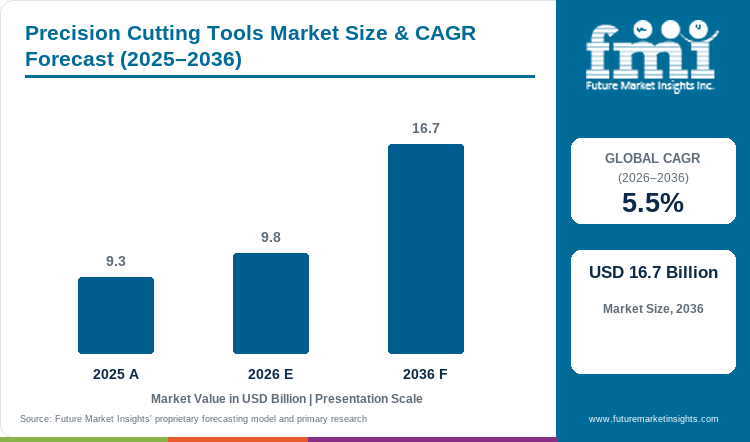
The precision cutting tools market is valued at USD 9.8 billion in 2026 and is projected to reach USD 16.7 billion by 2036, growing at a of 5.5% CAGR.
The precision cutting tools market was valued at USD 9.3 Billion in 2025 and is estimated at USD 9.8 Billion in 2026. Sales of precision cutting tools are estimated to grow at 5.5% from 2026 to 2036, reaching USD 16.7 Billion by 2036. A longer-lasting edge can reduce stoppages and help hold dimensions, while better chip control and surface finish can lower scrap on expensive components. OICA reported in April 2026 that global motor vehicle production increased from 92.7 million units in 2024 to 96.4 million in 2025, supporting steady demand for turning, milling, drilling and threading tools. NIST machining research published in 2026 continues to examine in-process measurement and thermal deformation, both of which directly affect dimensional control.
Key Takeaways of Precision Cutting Tools Market
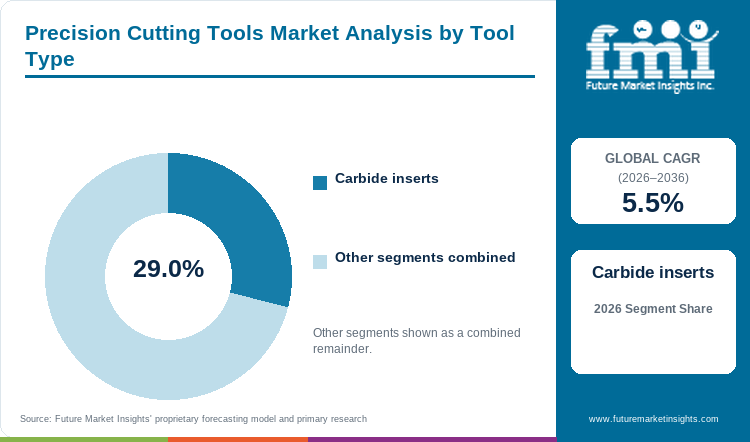
- Carbide inserts account for 29.0% of Tool Type revenue in 2026 because replaceable cutting edges support recurring production without requiring replacement of the complete holder.
- Cemented carbide represents 54.0% of Material revenue, while TiAlN accounts for 28.0% of Coating revenue as machining programs balance edge toughness with resistance to elevated cutting temperatures.
- Automotive represents 31.0% of End Use revenue. Global vehicle production reached 96.4 million units in 2025, sustaining repeated machining demand across component programs.
- Industrial distributors account for 42.0% of Sales Channel revenue owing to the fact that machine shops often need local availability across multiple tool forms, workpiece materials and diameters.
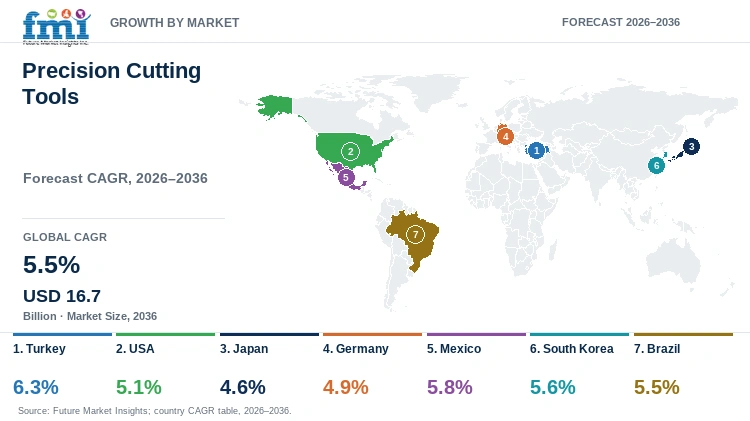
- Country CAGR ranges from 6.3% in Turkey to 4.6% in Japan. Mexico is forecast at 5.8%, while South Korea is forecast at 5.6%.
Analyst Perspective
The real commercial hurdle is proving that a tool works reliably on the intended production setup. A harder coating or a longer stated tool life means little if the buyer cannot hold dimensions, control chips and maintain surface quality on the actual component. Suppliers that make this trial process easier, and show a clear cost-per-part benefit, are more likely to convert testing into repeat business.
- Nikhil Kaitwade, Principal Consultant, Future Market Insights
How is the Precision Cutting Tools Market segmented?
The market is segmented by Tool Type, Material, Coating, End Use, Sales Channel, and Region.
The precision cutting tools market uses five segment axes with region as the geographic split.
Tool type covers carbide inserts, end mills, drills, reamers, threading tools, and PCD/CBN tools.
Material covers cemented carbide, HSS, ceramic, PCD, CBN, and cermet.
Coating covers TiAlN, TiN, AlCrN, diamond-like carbon, and uncoated/polished tools.
End use covers automotive, aerospace, mold & die, medical devices, and general machining.
Sales channel covers industrial distributors, direct OEM supply, catalog/e-commerce, and tool management services.
Why do Carbide inserts lead demand within the Tool Type category?
Carbide inserts work well in repeat production because the cutting edge can be indexed or replaced without replacing the full holder. This is especially useful in turning and indexable milling, where plants want predictable edge changes and minimal interruption. A shop can also change the grade, chipbreaker or coating while keeping the same basic tool body, making the format practical across different jobs.
- Carbide inserts account for 29.0% of Tool Type revenue in 2026 because replaceable edges fit recurring turning and indexable milling programs.
- Seco Tools introduced the TS0501 Duratomic finishing grade in November 2025 for high-hardness superalloys and lights-out finishing applications.
Why does Cemented carbide lead demand within the Material category?
Cemented carbide is widely used because the material can be tuned for either wear resistance or toughness and then applied across inserts, drills and end mills. It gives toolmakers a flexible base for many machining conditions without forcing buyers into unfamiliar tool formats. HSS still has a role where lower cutting speeds, interrupted cuts or higher toughness are more important. That trade-off also shapes the high-speed steel metal cutting tools market. Similar material choices influence the sawing and cutting tools market, where tool wear and replacement cost remain central operating concerns.
- Cemented carbide represents 54.0% of Material revenue in 2026 because it supports both indexable and solid-tool formats across a wide range of machining conditions.
- Sandvik Coromant introduced CoroDrill Dura 462 in 2025 as a solid-carbide drilling platform for multi-material applications with reconditioning support.
Why does TiAlN lead demand within the Coating category?
TiAlN is valuable when the cutting zone gets hot enough to accelerate wear on less temperature-resistant coatings. It helps the cutting edge retain hardness under heat, which can support longer tool life or higher machining speed when the rest of the process is set correctly. The coating earns its value through thermal performance during cutting rather than through any cosmetic property.
- TiAlN accounts for 28.0% of Coating revenue in 2026 because elevated cutting temperature is a major wear mechanism in many production machining operations.
Why does Automotive lead demand within the End Use category?
Automotive plants and their suppliers machine large volumes of components across powertrain systems, chassis parts, brakes, molds and electrified driveline hardware. OICA recorded 96.4 million vehicles produced globally in 2025. In such high-volume operations, an unexpected tool change can affect cycle time as well as part quality. Shifts in steel and aluminum use also change cutting conditions, linking tooling demand with the automotive metal market.
- Automotive represents 31.0% of End Use revenue in 2026 because high-volume component programs create recurring cutting-tool consumption.
- OICA reported global vehicle production of 96.4 million units in 2025, compared with 92.7 million units in 2024.
Why do Industrial distributors lead demand within the Sales Channel category?
Industrial distributors matter because cutting tools are often needed quickly and in many specifications. A mixed-machine shop may use different diameters, coatings, grades and thread forms at the same time, so local stock reduces the risk of waiting for a direct OEM delivery. The distributor becomes more useful when inventory is backed by application knowledge and a practical replacement option for a worn or unavailable tool.
- Industrial distributors account for 42.0% of Sales Channel revenue in 2026 because buyers need local replenishment across many tool forms and workpiece materials.
- OSG USA introduced the HY-PRO SIGMA SFT and POT taps in July 2026, expanding its threading portfolio for job shops across a wide range of materials and applications.
What are the drivers, restraints and opportunities in the Precision Cutting Tools Market?
In the precision cutting tools market, the key driver is high-throughput machining where longer stable cutting time reduces machine stoppages and scrap per finished part, the key restraint is tungsten and cobalt exposure raising carbide economics alongside part-specific machining qualification for every replacement grade, and the key opportunity is lifecycle programs combining reconditioning, carbide recovery, managed inventory and application support to reduce effective tooling cost.
- Driver: High-throughput machining creates recurring demand when longer stable cutting time reduces machine stoppages and scrap per finished part.
- Restraint: Tungsten and cobalt exposure can raise carbide economics, while every replacement grade still has to pass part-specific machining qualification.
- Opportunity: Lifecycle programs can combine reconditioning, carbide recovery, managed inventory and application support to reduce effective tooling cost.
Demand grows when manufacturers can produce more acceptable parts with fewer tool changes. A cutting edge that holds its geometry for longer can reduce stoppages and help protect machine utilization. OICA reported a 3.9% increase in global motor vehicle production during 2025, keeping a large base of repetitive machining active. Harder steels and high-temperature alloys add pressure because they can shorten tool life unless the substrate, coating and geometry are matched to the job.
The main restraint is a combination of material cost exposure and the effort involved in changing a proven machining setup. USGS included tungsten on the 2025 U.S. List of Critical Minerals and identifies cutting equipment among important uses for wear-resistant tungsten materials. That raises the value of extending carbide life and recovering used material. At the same time, buyers need confidence that a replacement grade will hold dimensions, maintain surface finish and control chips before it becomes part of routine production.
Lifecycle services create additional value after the first tool sale. Seco Tools launched a self-service carbide recycling portal in March 2025, allowing customers to request quotes, order collection containers and track returns. Reconditioning can also keep selected solid tools in use for longer. These services become more important on high-cost equipment such as systems covered in the double-column machining centers market, where lost machine time can outweigh the purchase price of the tool itself.
Which country CAGRs are profiled in the Precision Cutting Tools Market?
| Country | CAGR |
|---|---|
| Turkey | 6.3% |
| USA | 5.1% |
| Japan | 4.6% |
| Germany | 4.9% |
| Mexico | 5.8% |
| South Korea | 5.6% |
| Brazil | 5.5% |
How do country-level CAGRs compare in the Precision Cutting Tools Market?
Projected CAGR across the seven profiled countries ranges from 6.3% in Turkey down to 4.6% in Japan, a spread of 1.7 percentage points. Mexico at 5.8% and South Korea at 5.6% sit above the global rate, while Brazil aligns with the global CAGR at 5.5%. The USA at 5.1% and Germany at 4.9% trail the group. These figures indicate pace rather than market size, and actual commercial weight still depends on installed machining capacity along with how difficult it is to displace a tool grade that has already been qualified for production.
- Turkey's 6.3% CAGR runs 0.5 percentage points ahead of Mexico's 5.8%. TurkStat reported that motor vehicles accounted for 9.7% of sold industrial production in 2025, a figure that reflects the manufacturing base rather than tooling demand on its own.
- Mexico at 5.8% and South Korea at 5.6% sit just 0.2 percentage points apart, though the two economies reach that pace differently — Mexico through export-oriented vehicle assembly paired with extensive supplier machining, South Korea through a combination of automotive production with machinery and electronics manufacturing.
- Brazil's 5.5% CAGR lines up with the global rate. IBGE recorded 0.6% industrial production growth in 2025, a modest figure that reinforces an uneven picture across manufacturing sub-sectors.
- The USA, Germany and Japan close the ranking at 5.1%, 4.9% and 4.6%, respectively. All three run mature production systems where a new cutting tool typically must displace an established grade through demonstrated process improvement rather than price alone.
Country-wise Analysis
- Precision cutting tools demand in Turkey is forecast to expand at 6.3% CAGR from 2026 to 2036, the fastest pace among the profiled countries. TurkStat reported that motor vehicles, trailers and semi-trailers made up 9.7% of sold industrial production in 2025, with capital goods accounting for 21.8%. That manufacturing composition creates a steady baseline of demand from vehicle-component and equipment producers. Tool suppliers stand to gain ground where longer edge life translates into fewer interruptions on repeat production jobs.
- Sales of precision cutting tools in the USA are set to rise at 5.1% CAGR over the same period. OICA recorded 10.2 million vehicles produced domestically in 2025, and NIST machining research through 2026 continued to examine in-process measurement alongside thermal deformation. This pairing of high production scale with exacting dimensional tolerances means buyers evaluate stable, repeatable machining outcomes ahead of tool price when qualifying a new supplier.
- Precision cutting tools adoption in Japan is likely to advance at 4.6% CAGR from 2026 to 2036, the slowest rate in this group. METI's FY2025 Vision for the Machine Parts and Tooling Industries points to labor shortages and expanding use of digital technologies as structural issues facing manufacturers. That backdrop favors tools engineered to run predictably in automated or lightly attended production, where a single unexpected edge failure risks affecting more than one downstream operation.
- Germany's precision cutting tools market is projected to progress at 4.9% CAGR through 2036. Destatis reported a 2.6% decline in German machinery production during 2025, even as fabricated metal products rose 3.2% month on month in December of that year. That uneven industrial backdrop adds pressure to tooling budgets across manufacturers. Suppliers operating here need to demonstrate how extended tool life or improved process stability lowers overall manufacturing cost within an already-established machining base.
- Demand for precision cutting tools in Mexico is expected to expand at 5.8% CAGR from 2026 to 2036. INEGI reported roughly 4.0 million light vehicles produced in 2025, with light trucks representing 77.2% of that output. Export-focused vehicle assembly keeps machining schedules active across the wider supplier network. Once a tool grade clears qualification for these programs, regional availability becomes a commercial priority, since a stockout can disrupt production against fixed delivery commitments.
- South Korea's precision cutting tools adoption is set to scale at 5.6% CAGR through 2036. Government industrial activity data for June 2026 showed mining and manufacturing output climbing 6.4% from the prior month, with automobiles and machinery among the contributing sectors. High-utilization production environments place a premium on tools capable of maintaining chip control and dimensional consistency across long automated runs.
- Sales of precision cutting tools in Brazil are forecast to expand at 5.5% CAGR from 2026 to 2036, matching the global average. IBGE reported industrial production growth of 0.6% in 2025, and machinery, metal products and vehicle manufacturing continued moving unevenly through 2026. This variability makes distributor inventory planning a bigger factor in commercial outcomes, and stocking commonly used carbide formats tends to serve buyers better than carrying a broad range of slower-moving specifications.
Who are the notable companies in the Precision Cutting Tools Market?
Sandvik Coromant; Kennametal; Iscar / IMC; Mitsubishi Materials; Sumitomo Electric; Kyocera; Seco Tools; Walter; OSG; YG-1
Competition reflects how much of the machining job each supplier can handle. Sandvik Coromant, Kennametal, Iscar / IMC and Walter cover several cutting processes through indexable and solid-tool portfolios. Mitsubishi Materials, Sumitomo Electric and Kyocera bring depth in carbide, ceramic, CBN and PCD systems. Seco Tools combines cutting tools with lifecycle services, OSG is strong in threading and round tools, and YG-1 spans solid carbide, HSS and indexable formats.
- Integrated machining platforms: Sandvik Coromant, Kennametal, Iscar / IMC and Walter compete through multi-process tooling and application engineering.
- Materials-led cutting portfolios: Mitsubishi Materials, Sumitomo Electric and Kyocera compete through substrate and superhard-tool depth for difficult workpiece materials.
- Focused application and lifecycle portfolios: Seco Tools, OSG and YG-1 combine round tools, threading, inserts, regrinding, recycling or distributor access around specific machining requirements.
Competitive Benchmarking: Precision Cutting Tools Market
| Company | Indexable Insert Breadth | Solid Round Tool Breadth | Lifecycle & Application Support | Geographic Reach |
|---|---|---|---|---|
| Sandvik Coromant | High | High | High | North America, Europe, Asia-Pacific, Latin America |
| Kennametal | High | High | High | Americas, Europe, Asia-Pacific |
| Iscar / IMC | High | High | Medium | Americas, Europe, Asia-Pacific |
| Mitsubishi Materials | High | High | Medium | Japan, Asia, Europe, Americas |
| Sumitomo Electric | High | Medium | Medium | Japan, Asia, Europe, Americas |
| Kyocera | High | High | High | Japan, Asia, Europe, Americas |
| Seco Tools | High | High | High | Europe, Americas, Asia-Pacific |
| Walter | High | High | Medium | Europe, Americas, Asia-Pacific |
| OSG | Medium | High | High | Japan, Americas, Europe, Asia-Pacific |
| YG-1 | Medium | High | Medium | South Korea, Americas, Europe, Asia |
Scoring basis: Indexable Insert Breadth reflects coverage across replaceable-edge turning, milling and holemaking systems. Solid Round Tool Breadth reflects depth in end mills, drills, reamers and threading tools. Lifecycle & Application Support reflects application engineering, tool-management functions, reconditioning, recycling and process-selection resources. High denotes broad documented capability. Medium denotes a more focused position.
Key Developments in the Precision Cutting Tools Market
- In July 2026, OSG USA released HY-PRO SIGMA SFT and POT taps with redesigned flute forms, enhanced cutting-edge geometry and a powder metallurgy high-speed steel substrate for mixed-material threading applications.
- In November 2025, Seco Tools introduced the TS0501 Duratomic finishing grade for high-hardness superalloys, with geometries intended for precision finishing and lights-out machining.
- In March 2025, Sandvik Coromant introduced CoroDrill Dura 462 as a multi-material solid-carbide drilling family with a Zertivo 2.0 PVD coating and reconditioning compatibility.
Key Players in the Precision Cutting Tools Market
Integrated Multi-Process Machining Platforms
- Sandvik Coromant
- Kennametal
- Iscar / IMC
- Walter
Materials-Led Cutting Portfolios
- Mitsubishi Materials
- Sumitomo Electric
- Kyocera
Focused Application and Lifecycle Portfolios
- Seco Tools
- OSG
- YG-1
Precision Cutting Tools Market - Report Scope
| Coverage field | Report scope |
|---|---|
| Market breakdown | Tool Type; Material; Coating; End Use; Sales Channel |
| Quantitative Units | Revenue in USD Billion and CAGR in %. |
| Market Definition | Revenue includes precision cutting tools within the listed tool types, materials, coatings, end uses and sales channels. It excludes machine tools, toolholders, coolants, standalone reconditioning fees, downstream machined components and adjacent substitute product revenue. |
| Regions Covered | North America; Latin America; Western Europe; Eastern Europe; East Asia; South Asia & Pacific; Middle East & Africa |
| Countries Covered | Turkey; USA; Japan; Germany; Mexico; South Korea; Brazil; plus more than twenty-five additional countries in the full report |
| Key Companies Profiled | Sandvik Coromant; Kennametal; Iscar / IMC; Mitsubishi Materials; Sumitomo Electric; Kyocera; Seco Tools; Walter; OSG; YG-1 |
| Forecast Period | 2026 to 2036 |
| Approach | Hybrid bottom-up and top-down sizing connecting tool consumption with end-use machining activity, replacement intensity, channel structure and supplier participation within the defined revenue boundary. |
Precision Cutting Tools Market - Research Methodology
| Method | Approach |
|---|---|
| Primary Research | Structured discussions with cutting-tool manufacturers, industrial distributors, machining specialists, procurement teams and end users. Interviews examine tool qualification, replacement cycles, channel behavior, cost-per-part economics and application constraints. |
| Desk Research | Review of official manufacturing statistics, critical-material information, technical publications, company filings and first-party product documentation relevant to market scope, buyer behavior, operating conditions and dated company activity. |
| Market Sizing and Forecasting | Tool-type demand is reconciled with material, coating, end-use, channel and country views. Forecast assumptions consider manufacturing activity, replacement intensity, tool-life improvement, application mix, qualification friction and pricing conditions. |
| Data Validation | Findings are checked across multiple evidence types within the defined revenue boundary. Machine tools, toolholders, standalone service fees and downstream component revenue are excluded from market value. |
Precision Cutting Tools Market by Segments
Precision Cutting Tools Market segmented by Tool Type:
- Carbide inserts
- End mills
- Drills
- Reamers
- Threading tools
- PCD/CBN tools
Precision Cutting Tools Market segmented by Material:
- Cemented carbide
- HSS
- Ceramic
- PCD
- CBN
- Cermet
Precision Cutting Tools Market segmented by Coating:
- TiAlN
- TiN
- AlCrN
- Diamond-like carbon
- Uncoated/polished
Precision Cutting Tools Market segmented by End Use:
- Automotive
- Aerospace
- Mold & die
- Medical devices
- General machining
Precision Cutting Tools Market segmented by Sales Channel:
- Industrial distributors
- Direct OEM supply
- Catalog/e-commerce
- Tool management services
Precision Cutting Tools Market by Region:
- North America
- United States
- Canada
- Latin America
- Brazil
- Mexico
- Argentina
- Chile
- Western Europe
- Germany
- France
- United Kingdom
- Italy
- Spain
- Benelux
- Nordics
- Eastern Europe
- Poland
- Czech Republic
- Romania
- Hungary
- East Asia
- China
- Japan
- South Korea
- South Asia & Pacific
- India
- ASEAN
- Australia and New Zealand
- Middle East & Africa
- GCC Countries
- South Africa
- Türkiye
- Israel
Research Sources and Bibliography
- International Organization of Motor Vehicle Manufacturers (OICA). (2026, April 23). Auto Industry Growth Shifted East in 2025 amid Global Repositioning.
- National Institute of Standards and Technology (NIST). (2026, June 9). In-Process Optical Measurement and Compensation of Machine Tool Thermal Deformations.
- U.S. Geological Survey (USGS). (2025). Methodology and Technical Input for the 2025 U.S. List of Critical Minerals.
- Kennametal. (2025, March 6). Tech Tip: Grades and Coatings for Solid Carbide End Mills.
- Sandvik Coromant. (2025, March 2). CoroDrill Dura 462: Next-Generation Versatile Solution for Multi-Material Drilling.
- Seco Tools. (2025, March 18). Seco Transforms Used Carbide Recycling with Self-Service Platform.
- Seco Tools. (2025, November 25). TS0501: The New Benchmark in Superalloy Turning.
- OSG USA. (2026, July 1). OSG USA Announces the Release of the HY-PRO SIGMA Tap.
- Turkish Statistical Institute (TurkStat). (2026, June 26). Annual Industrial Products (PRODCOM) Statistics, 2025.
- Ministry of Economy, Trade and Industry, Japan. (2025, March 28). FY2025 Vision for the Machine Parts and Tooling Industries.
- German Federal Statistical Office (Destatis). (2026). Production in December 2025: -1.9% on the Previous Month.
- Instituto Nacional de Estadística y Geografía (INEGI). (2026, January 9). Registro Administrativo de la Industria Automotriz de Vehículos Ligeros: December 2025.
- National Data Agency, Republic of Korea. (2026, July 31). Industrial Activity Trends for June 2026.
- Brazilian Institute of Geography and Statistics (IBGE). (2026, February 3). Industrial Output Retreats 1.2% in December.
This Report Answers
- What is the size of the Precision Cutting Tools Market in 2026 and what value is forecast for 2036?
- Which machining conditions support recurring demand for precision cutting tools?
- Why do Carbide inserts account for 29.0% of Tool Type revenue in 2026?
- Why does Cemented carbide represent 54.0% of Material revenue in 2026?
- Why does TiAlN account for 28.0% of Coating revenue in 2026?
- How do growth rates differ across Turkey, USA, Japan, Germany, Mexico, South Korea and Brazil?
- How do major suppliers differ in process coverage, cutting-material depth and lifecycle support?
- What should machining and procurement teams evaluate before qualifying a new cutting tool?
Frequently Asked Questions
What is driving growth in the Precision Cutting Tools Market?
Growth comes from machining programs that need longer stable cutting time and fewer interruptions. Automotive production creates repeated tool demand, while harder materials make coating choice, edge geometry and application-specific grades more important.
Who are the key players in the Precision Cutting Tools Market?
The profiled companies are Sandvik Coromant, Kennametal, Iscar / IMC, Mitsubishi Materials, Sumitomo Electric, Kyocera, Seco Tools, Walter, OSG and YG-1. They compete across indexable tooling, solid round tools, cutting materials, application support and lifecycle services.
What notable restraint affects the Precision Cutting Tools Market?
Carbide tools remain exposed to tungsten and cobalt economics, and buyers still have to qualify a new grade on the intended machine and workpiece. A poor trial can create scrap or downtime, so switching is usually more involved than comparing catalog specifications.
Why should executives track the Precision Cutting Tools Market?
Cutting tools influence machine utilization and the cost of every finished component. Changes in tool life or process stability can affect throughput, scrap and inventory requirements across a full production program.
What business problem does the Precision Cutting Tools Market address?
Precision cutting tools allow machine tools to remove material while holding the required tolerance and surface finish. They help control wear, heat, chip formation and dimensional drift during production.
What limits return on investment in the Precision Cutting Tools Market?
Returns fall when a tool needs frequent replacement, creates scrap or forces the machine to run at conservative cutting conditions. Purchase price matters, but lost machine time and an unstable process can cost far more.
Preview the report firsthand - request a free sample
Get SampleGet the brochure for pricing and purchase details.
Get PDFTable of Content
- Key Takeaways
- Market Size and CAGR
- Top Growth Driver
- Fastest Growing Segment
- Leading Region
- Key Companies
- Emerging Opportunities
- Executive Summary
- Global Market Outlook
- Demand-side Trends
- Supply-side Trends
- Technology Roadmap Analysis
- Analysis and Recommendations
- Analyst Perspective (What is happening? Why now? What should investors know?)
- Key Questions Answered
- How large is the market?
- What is the CAGR?
- What are key trends?
- Which region dominates?
- Who are the leaders?
- Market Overview
- Market Coverage / Taxonomy
- Market Definition / Scope / Limitations
- Research Methodology
- Chapter Orientation
- Analytical Lens and Working Hypotheses
- Market Structure, Signals, and Trend Drivers
- Benchmarking and Cross-market Comparability
- Market Sizing, Forecasting, and Opportunity Mapping
- Research Design and Evidence Framework
- Desk Research Programme (Secondary Evidence)
- Expert Input and Fieldwork (Primary Evidence)
- Tooling, Models, and Reference Databases
- Data Engineering and Model Build
- Quality Assurance and Audit Trail
- Market Background
- Market Dynamics (Drivers, Restraints, Opportunity, Trends)
- Scenario Forecast (Optimistic, Likely, Conservative)
- Impact Analysis
- AI Impact
- Sustainability Impact
- Regulatory Impact
- Technology Impact
- Consumer / Buyer Analysis
- Purchase Drivers
- Adoption Barriers
- Buyer Journey
- Opportunity Map Analysis
- Product Life Cycle Analysis
- Supply Chain Analysis
- Investment Feasibility Matrix
- Value Chain Analysis
- PESTLE and Porter's Analysis
- Regulatory Landscape
- Regional Parent Market Outlook
- Production and Consumption Statistics
- Import and Export Statistics
- Global Market Analysis and Forecast, 2021 to 2036
- Historical Market Size Value (USD Billion) Analysis, 2021 to 2025
- Current and Future Market Size Value (USD Billion) Projections, 2026 to 2036
- Y-o-Y Growth Trend Analysis
- Absolute $ Opportunity Analysis
- Global Market Pricing Analysis, 2021 to 2036
- Global Market Analysis and Forecast, By End Use, 2021 to 2036
- Introduction / Key Findings
- Historical Market Size Value (USD Billion) Analysis By End Use, 2021 to 2025
- Current and Future Market Size Value (USD Billion) Analysis and Forecast By End Use, 2026 to 2036
- Automotive
- Aerospace
- Mold & die
- Medical devices
- General machining
- Precision Cutting Tools Market segmented
- Automotive
- Y-o-Y Growth Trend Analysis By End Use, 2021 to 2025
- Absolute $ Opportunity Analysis By End Use, 2026 to 2036
- Global Market Analysis and Forecast, By Tool Type, 2021 to 2036
- Introduction / Key Findings
- Historical Market Size Value (USD Billion) Analysis By Tool Type, 2021 to 2025
- Current and Future Market Size Value (USD Billion) Analysis and Forecast By Tool Type, 2026 to 2036
- Carbide inserts
- End mills
- Drills
- Reamers
- Threading tools
- PCD/CBN tools
- Carbide inserts
- Y-o-Y Growth Trend Analysis By Tool Type, 2021 to 2025
- Absolute $ Opportunity Analysis By Tool Type, 2026 to 2036
- Global Market Analysis and Forecast, By Material, 2021 to 2036
- Introduction / Key Findings
- Historical Market Size Value (USD Billion) Analysis By Material, 2021 to 2025
- Current and Future Market Size Value (USD Billion) Analysis and Forecast By Material, 2026 to 2036
- Cemented carbide
- HSS
- Ceramic
- PCD
- CBN
- Cermet
- Cemented carbide
- Y-o-Y Growth Trend Analysis By Material, 2021 to 2025
- Absolute $ Opportunity Analysis By Material, 2026 to 2036
- Global Market Analysis and Forecast, By Coating, 2021 to 2036
- Introduction / Key Findings
- Historical Market Size Value (USD Billion) Analysis By Coating, 2021 to 2025
- Current and Future Market Size Value (USD Billion) Analysis and Forecast By Coating, 2026 to 2036
- TiAIN
- TiN
- AICrN
- Diamond-like carbon
- Uncoated/polished
- TiAIN
- Y-o-Y Growth Trend Analysis By Coating, 2021 to 2025
- Absolute $ Opportunity Analysis By Coating, 2026 to 2036
- Global Market Analysis and Forecast, By Sales Channel, 2021 to 2036
- Introduction / Key Findings
- Historical Market Size Value (USD Billion) Analysis By Sales Channel, 2021 to 2025
- Current and Future Market Size Value (USD Billion) Analysis and Forecast By Sales Channel, 2026 to 2036
- Industrial distributors
- Direct OEM supply
- Catalog/e-commerce
- Tool management services
- Industrial distributors
- Y-o-Y Growth Trend Analysis By Sales Channel, 2021 to 2025
- Absolute $ Opportunity Analysis By Sales Channel, 2026 to 2036
- Global Market Analysis and Forecast, By Region, 2021 to 2036
- Introduction
- Historical Market Size Value (USD Billion) Analysis By Region, 2021 to 2025
- Current Market Size Value (USD Billion) Analysis and Forecast By Region, 2026 to 2036
- North America
- Latin America
- Western Europe
- Eastern Europe
- East Asia
- South Asia and Pacific
- Middle East & Africa
- Market Attractiveness Analysis By Region
- North America Market Analysis and Forecast, By Country, 2021 to 2036
- Historical Market Size Value (USD Billion) Trend Analysis By Market Taxonomy, 2021 to 2025
- Market Size Value (USD Billion) Forecast By Market Taxonomy, 2026 to 2036
- By Country
- USA
- Canada
- By End Use
- By Tool Type
- By Material
- By Coating
- By Sales Channel
- By Country
- Market Attractiveness Analysis
- By Country
- By End Use
- By Tool Type
- By Material
- By Coating
- By Sales Channel
- Key Takeaways
- Latin America Market Analysis and Forecast, By Country
- Historical Market Size Value (USD Billion) Trend Analysis By Market Taxonomy, 2021 to 2025
- Market Size Value (USD Billion) Forecast By Market Taxonomy, 2026 to 2036
- By Country
- Brazil
- Mexico
- Chile
- Rest of Latin America
- By End Use
- By Tool Type
- By Material
- By Coating
- By Sales Channel
- By Country
- Market Attractiveness Analysis
- By Country
- By End Use
- By Tool Type
- By Material
- By Coating
- By Sales Channel
- Key Takeaways
- Western Europe Market Analysis and Forecast, By Country
- Historical Market Size Value (USD Billion) Trend Analysis By Market Taxonomy, 2021 to 2025
- Market Size Value (USD Billion) Forecast By Market Taxonomy, 2026 to 2036
- By Country
- Germany
- UK
- Italy
- Spain
- France
- Nordic
- BENELUX
- Rest of Western Europe
- By End Use
- By Tool Type
- By Material
- By Coating
- By Sales Channel
- By Country
- Market Attractiveness Analysis
- By Country
- By End Use
- By Tool Type
- By Material
- By Coating
- By Sales Channel
- Key Takeaways
- Eastern Europe Market Analysis and Forecast, By Country
- Historical Market Size Value (USD Billion) Trend Analysis By Market Taxonomy, 2021 to 2025
- Market Size Value (USD Billion) Forecast By Market Taxonomy, 2026 to 2036
- By Country
- Russia
- Poland
- Hungary
- Balkan & Baltic
- Rest of Eastern Europe
- By End Use
- By Tool Type
- By Material
- By Coating
- By Sales Channel
- By Country
- Market Attractiveness Analysis
- By Country
- By End Use
- By Tool Type
- By Material
- By Coating
- By Sales Channel
- Key Takeaways
- East Asia Market Analysis and Forecast, By Country
- Historical Market Size Value (USD Billion) Trend Analysis By Market Taxonomy, 2021 to 2025
- Market Size Value (USD Billion) Forecast By Market Taxonomy, 2026 to 2036
- By Country
- China
- Japan
- South Korea
- By End Use
- By Tool Type
- By Material
- By Coating
- By Sales Channel
- By Country
- Market Attractiveness Analysis
- By Country
- By End Use
- By Tool Type
- By Material
- By Coating
- By Sales Channel
- Key Takeaways
- South Asia and Pacific Market Analysis and Forecast, By Country
- Historical Market Size Value (USD Billion) Trend Analysis By Market Taxonomy, 2021 to 2025
- Market Size Value (USD Billion) Forecast By Market Taxonomy, 2026 to 2036
- By Country
- India
- ASEAN
- Australia & New Zealand
- Rest of South Asia and Pacific
- By End Use
- By Tool Type
- By Material
- By Coating
- By Sales Channel
- By Country
- Market Attractiveness Analysis
- By Country
- By End Use
- By Tool Type
- By Material
- By Coating
- By Sales Channel
- Key Takeaways
- Middle East & Africa Market Analysis and Forecast, By Country
- Historical Market Size Value (USD Billion) Trend Analysis By Market Taxonomy, 2021 to 2025
- Market Size Value (USD Billion) Forecast By Market Taxonomy, 2026 to 2036
- By Country
- Kingdom of Saudi Arabia
- Other GCC Countries
- Türkiye
- South Africa
- Other African Union
- Rest of Middle East & Africa
- By End Use
- By Tool Type
- By Material
- By Coating
- By Sales Channel
- By Country
- Market Attractiveness Analysis
- By Country
- By End Use
- By Tool Type
- By Material
- By Coating
- By Sales Channel
- Key Takeaways
- Key Countries Market Analysis
- USA
- Pricing Analysis
- Market Share Analysis, 2025
- By End Use
- By Tool Type
- By Material
- By Coating
- By Sales Channel
- Canada
- Pricing Analysis
- Market Share Analysis, 2025
- By End Use
- By Tool Type
- By Material
- By Coating
- By Sales Channel
- Mexico
- Pricing Analysis
- Market Share Analysis, 2025
- By End Use
- By Tool Type
- By Material
- By Coating
- By Sales Channel
- Brazil
- Pricing Analysis
- Market Share Analysis, 2025
- By End Use
- By Tool Type
- By Material
- By Coating
- By Sales Channel
- Chile
- Pricing Analysis
- Market Share Analysis, 2025
- By End Use
- By Tool Type
- By Material
- By Coating
- By Sales Channel
- Germany
- Pricing Analysis
- Market Share Analysis, 2025
- By End Use
- By Tool Type
- By Material
- By Coating
- By Sales Channel
- UK
- Pricing Analysis
- Market Share Analysis, 2025
- By End Use
- By Tool Type
- By Material
- By Coating
- By Sales Channel
- Italy
- Pricing Analysis
- Market Share Analysis, 2025
- By End Use
- By Tool Type
- By Material
- By Coating
- By Sales Channel
- Spain
- Pricing Analysis
- Market Share Analysis, 2025
- By End Use
- By Tool Type
- By Material
- By Coating
- By Sales Channel
- France
- Pricing Analysis
- Market Share Analysis, 2025
- By End Use
- By Tool Type
- By Material
- By Coating
- By Sales Channel
- India
- Pricing Analysis
- Market Share Analysis, 2025
- By End Use
- By Tool Type
- By Material
- By Coating
- By Sales Channel
- ASEAN
- Pricing Analysis
- Market Share Analysis, 2025
- By End Use
- By Tool Type
- By Material
- By Coating
- By Sales Channel
- Australia & New Zealand
- Pricing Analysis
- Market Share Analysis, 2025
- By End Use
- By Tool Type
- By Material
- By Coating
- By Sales Channel
- China
- Pricing Analysis
- Market Share Analysis, 2025
- By End Use
- By Tool Type
- By Material
- By Coating
- By Sales Channel
- Japan
- Pricing Analysis
- Market Share Analysis, 2025
- By End Use
- By Tool Type
- By Material
- By Coating
- By Sales Channel
- South Korea
- Pricing Analysis
- Market Share Analysis, 2025
- By End Use
- By Tool Type
- By Material
- By Coating
- By Sales Channel
- Russia
- Pricing Analysis
- Market Share Analysis, 2025
- By End Use
- By Tool Type
- By Material
- By Coating
- By Sales Channel
- Poland
- Pricing Analysis
- Market Share Analysis, 2025
- By End Use
- By Tool Type
- By Material
- By Coating
- By Sales Channel
- Hungary
- Pricing Analysis
- Market Share Analysis, 2025
- By End Use
- By Tool Type
- By Material
- By Coating
- By Sales Channel
- Kingdom of Saudi Arabia
- Pricing Analysis
- Market Share Analysis, 2025
- By End Use
- By Tool Type
- By Material
- By Coating
- By Sales Channel
- Türkiye
- Pricing Analysis
- Market Share Analysis, 2025
- By End Use
- By Tool Type
- By Material
- By Coating
- By Sales Channel
- South Africa
- Pricing Analysis
- Market Share Analysis, 2025
- By End Use
- By Tool Type
- By Material
- By Coating
- By Sales Channel
- USA
- Market Structure Analysis
- Competition Dashboard
- Competition Benchmarking
- Market Share Analysis of Top Players
- By Regional
- By End Use
- By Tool Type
- By Material
- By Coating
- By Sales Channel
- Emerging Startups
- Innovation Benchmarking
- Competition Analysis
- Competition Deep Dive
- Sandvik Coromant
- Overview
- Product Portfolio
- Profitability by Market Segments
- Sales Footprint
- Strategy Overview
- Marketing Strategy
- Product Strategy
- Channel Strategy
- Kennametal
- Iscar IMC
- Mitsubishi Materials
- Sumitomo Electric
- Kyocera
- Seco Tools
- Walter
- OSG
- YG-1
- Sandvik Coromant
- Case Studies
- Success Stories
- Recent Developments
- Competition Deep Dive
- Assumptions & Acronyms Used


