

- Market Size (2026)
- USD 2.9 Bn
- Forecast (2036)
- USD 5.2 Bn
- CAGR (2026 to 2036)
- 6.2%
How big is Non-Dairy Creamers Market in 2026?
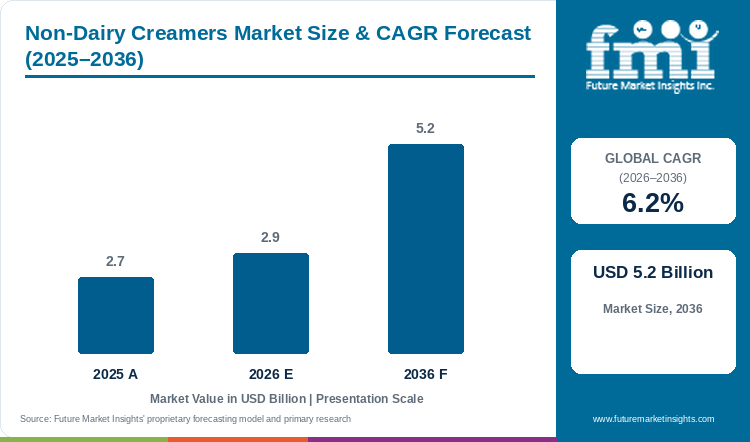
Demand for non-dairy creamers is projected to expand at 6.2% CAGR between 2026 and 2036. Industry value grows from USD 2.7 billion in 2025 to USD 2.9 billion in 2026 and is projected to reach USD 5.2 billion by 2036.
Demand for non-dairy creamers is projected to expand at 6.2% CAGR between 2026 and 2036. Valuation is expected to rise from USD 2.9 billion to USD 5.2 billion over the forecast period. Coffee consumption outside the home remains an important demand driver because cafés, restaurants and beverage-service operators purchase creamers on a recurring basis. USDA Economic Research Service reported a 0.4% increase in real U.S. food-away-from-home spending during 2024. That service-channel resilience supports coffee creamer demand because cafés and restaurant beverage programs purchase creamer repeatedly.
Country adoption depends partly on how familiar consumers already are with dairy alternatives. The UK government reported in July 2025 that roughly 10% of surveyed people consumed plant-based drinks during 2019-2023. Oat was the most popular alternative in that assessment. This familiarity gives plant-based milk choices a clearer route into coffee customization than markets where alternative drinks require more consumer explanation.
Key Takeaways of Non-Dairy Creamers Market
- Increasing coffee personalization and more hot as well as cold serving occasions are expected to support repeat demand across retail and foodservice.
- Powder is projected to account for 62.0% in 2026, owing to ambient handling, longer storage convenience and easy reconstitution.
- Vegetable oil is estimated to hold 55.0% share in 2026, as processors already use it for whitening, mouthfeel and stable emulsion performance.
- Food and beverage processing is expected to lead with 48.0% share in 2026, supported by repeat formulations and the need for similar cup performance in every batch.
- South Korea is projected at 7.6% CAGR and Poland at 7.2%, however, café density supports the former while labeling conditions shape the latter.
- Notable companies in the non-dairy creamers market include Nestlé, TreeHouse Foods, Danone, Rich Products, FrieslandCampina, Custom Food Group, Compact Industries, and DreamPak.
Analyst Perspective
“Cold beverage adoption will move creamers beyond one regular cup. Stable taste and dispersion will decide which products gain repeat demand.”
- Nandini Roy Choudhury, Principal Consultant, Future Market Insights.
How is the Non-Dairy Creamers Market segmented?
Non-dairy creamers market is segmented by four primary commercial axes and region: form, base, end use, distribution channel, and region. Powder is projected at 62.0%, vegetable oil at 55.0%, and food and beverage processing at 48.0% in 2026.
Form covers powder and liquid.
Base covers vegetable oil and plant-based milk.
End use covers food and beverage processing, HoReCa/foodservice, and household/retail.
Distribution channel covers indirect sales/B2C and direct sales/B2B.
Region covers North America, Latin America, Western Europe, Eastern Europe, East Asia, South Asia and Pacific, and Middle East and Africa.
Why does powder hold notable form demand?
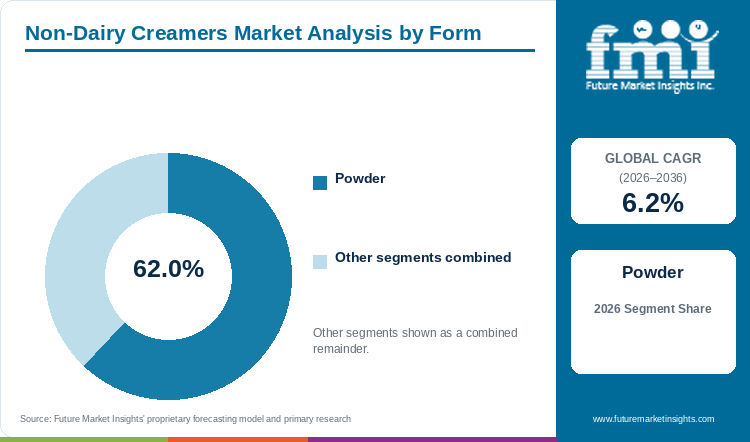
Based on form, powder is projected to account for 62.0% in 2026, owing to ambient storage and quick reconstitution.
Powder non-dairy creamer is made by keeping oil, carrier and emulsifier in one dry dose. This format can be stored without refrigeration and can be used when only measured addition is required. Due to these handling advantages, powder is highly used in vending, collagen coffee mixes and dry beverage blends. A June 2026 review identified wetting, sinking and dispersion as important functions after water is added [3]. Thus, powder which dissolves faster and does not float is expected to gain higher preference, especially in processors having long storage routes and several small production runs.
- Powder is projected to account for 62.0% of form demand in 2026, owing to ambient handling and quick reconstitution.
- Cold-soluble grades can support iced beverages, where ordinary powder may float, settle or require longer mixing.
What supports vegetable oil as a preferred base for non-dairy creamers?
By base, vegetable oil is estimated to hold 55.0% in 2026, supported by established whitening and emulsion performance.
Vegetable oil provides the fat phase which gives whitening and mouthfeel in coffee or tea. Oil selection also changes heat stability, salt response and final dispersion, due to which processors generally continue with a system already tested in their recipes. Plant-based milk can provide a cleaner identity, however, the proteins can become unstable when acidity, heat or minerals are changed. A December 2025 study in Foods evaluated plant proteins as alternative natural emulsifiers, observing that pea and rice preparations exhibited 62% to 65% emulsion stability while identifying solubility and interfacial aggregation challenges in coffee creamer formulations [4]. Therefore, established performance and easier qualification is expected to maintain higher adoption of vegetable oil-based creamers.
- Vegetable oil is estimated to hold 55.0% of base demand in 2026, supported by familiar whitening and emulsion performance.
- Processors are likely to retain systems that keep mouthfeel and color similar when coffee strength or serving temperature changes.
Why does food and beverage processing lead the end use category?
In 2026, food and beverage processing is expected to lead end use with 48.0% share, underpinned by repeatable formulations.
Food and beverage processors use non-dairy creamers inside a recipe and not only as an addition after preparation. The same color, foam, texture and dispersion is required in every production batch, as a small change can alter the final beverage. Custom Food Group offers non-dairy, foaming and cold-soluble creamers for coffee, tea, milk tea and ready-to-drink beverages [5]. Wider application from one ingredient system is expected to increase preference among processors, because changing the base formulation for every beverage will increase testing and production work.
- Food and beverage processing is expected to account for 48.0% of end use in 2026, supported by repeat formulations and controlled batch performance.
- Application-specific grades reduce the adjustment required when one processor serves coffee, tea, cereal drinks and milk tea lines.
Why do indirect routes remain relevant for distribution?
Indirect sales/B2C is projected to hold 58.0% share in 2026, with direct sales/B2B accounting for the remaining 42.0%, reflecting the dominance of retail reach and distributor replenishment over direct producer-to-buyer sourcing in this market.
Indirect sales combine household grocery purchases with foodservice demand for coffee programs, bakery beverages, and imitation whipped cream toppings across independent café operators. This makes shelf life, case size and distributor availability more important than only the formulation. In April 2026, the National Association of Convenience Stores reported convenience-store merchandise and packaged foodservice sales reached USD 341.2 billion in 2025 [6]. Therefore, indirect route is expected to remain relevant, as retailers and distributors can combine many smaller orders which may not be suitable for direct purchase from the producer.
- Indirect sales/B2C is projected to hold 58.0% share in 2026, supported by retail reach and distributor replenishment.
- Smaller packs and predictable shelf life can improve rotation where household demand and independent cafés are served together.
What are the drivers, restraints, and opportunities in the Non-Dairy Creamers Market?
In the non-dairy creamers market, the key driver is beverage customization, the key restraint is formulation stability, and the key opportunity is plant-protein improvement.
- Driver: Beverage customization will continue to expand non-dairy creamer demand across hot, iced, and seasonal serving formats through 2036.
- Restraint: Formulation stability and protein aggregation will continue to extend qualification trials in finished beverages through 2036.
- Opportunity: Improved protein treatment can support plant-based creamers without losing cup performance.
Coffee Customization Expands Serving Occasions
Increasing customization of coffee is one of the main key factors supporting non-dairy creamer demand. Nestlé stated in January 2025 that consumers whiten more than 70% of coffee cups, with younger consumers expected to increase the proportion [7]. This is creating demand for flavors and packs used in iced drinks, seasonal specialty beverages, and functional adaptogen coffee formats. However, a flavor which does not provide the same whitening and mouthfeel during outlet preparation can lose repeat use. Therefore, flexible production will create trial, while stable cup performance will decide whether the product remains in regular demand.
Formulation Stability Restrains Rapid Qualification
Plant proteins can adsorb slowly at the oil-water interface and can also aggregate under heat, salts or acidity. A June 2026 review in Food Chemistry: X identified low solubility and off-flavors as recurring formulation issues [8]. This is expected to restrain faster adoption, because a product that performs well in water may not show the same behavior in the buyer's coffee or tea. Therefore, qualification becomes longer and manufacturers need to test whitening, flavor and stability in soy milk bases and blended hot beverages before commercial use.
Plant-Protein Improvement Supports Category Expansion
Plant-based consumption is creating an opportunity for reformulation of non-dairy creamers. A July 2025 UK government assessment found that nearly 10% of surveyed people consumed plant-based drinks, with oat ahead of soya and almond [9]. This gives manufacturers a consumer base for oat milk formulations and mixed plant systems. However, the opportunity will convert into regular demand only when these formulations disperse quickly, do not carry unwanted flavor and provide clear nutrition information when compared with dairy and other plant alternatives.
Which country CAGRs are profiled in the Non-Dairy Creamers Market?
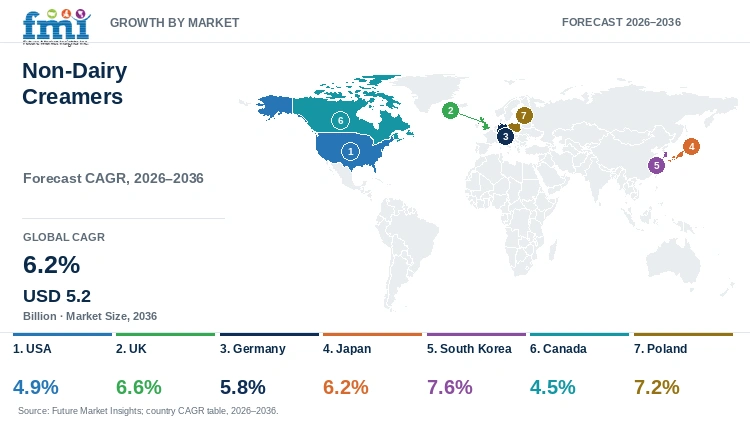
| Country | CAGR, 2026 to 2036 |
|---|---|
| USA | 4.9% |
| UK | 6.6% |
| Germany | 5.8% |
| Japan | 6.2% |
| South Korea | 7.6% |
| Canada | 4.5% |
| Poland | 7.2% |
How do country-level CAGRs compare in the non-dairy creamers market?
Country outlooks divide between menu-led expansion, plant-based reformulation, established coffee systems, and labeling control. Growth does not follow one route, because the frequency of coffee use, retail structure, and product naming rules change the conversion path.
- USA demand follows large retail, private-label, and foodservice systems with frequent product rotation.
- UK demand is supported by plant-based drink use, while nutrition comparison remains visible.
- Germany combines high coffee throughput with stronger price pressure on roasters and retailers.
- Japan favors precise preparation and labels that distinguish plant products from dairy foods.
- South Korea has a dense café base that gives new drink formats many test points.
- Canada combines large coffee imports with long replenishment routes and rising input costs.
- Poland requires plant-based products to use names that do not imply dairy origin.
Full report country CAGRs cover: North America; Latin America; Western Europe; Eastern Europe; East Asia; South Asia and Pacific; Middle East and Africa.
Country demand is expected to develop through menu expansion, plant-based reformulation, established coffee consumption and labeling control. Hence, a higher CAGR will not describe one common demand condition. According to FMI, coffee frequency, outlet structure, product naming rules and cost per serving are likely to decide how quickly non-dairy creamers move from trial to regular use in each country.
Country-wise Analysis
- The USA non-dairy creamers market is forecast to expand at 4.9% CAGR through 2036. Large retail and foodservice routes provide repeated product movement, however, mature shelves make entry difficult for a product having no clear use. In June 2026, the National Coffee Association reported that 66% of American adults drink coffee daily, with specialty and iced beverages leading regular consumption [10]. As noted by FMI, products made for cold coffee, flavored drinks or easier operator handling are expected to find better placement than a general creamer having no separate use case.
- The UK market is anticipated to advance at 6.6% CAGR through 2036. The British Coffee Association reported in September 2026 that 103 million cups of coffee are consumed daily across the United Kingdom [11]. This daily consumption volume provides a substantial base for plant-based and specialty creamers. However, plant identity alone will not maintain demand, because nutrition and fortification are different across products. Stable whitening, neutral flavor and clear nutrient information are expected to move these products from trial towards regular retail and foodservice use.
- Non-dairy creamer demand in Germany is forecast to rise at 5.8% CAGR. Destatis reported that Germany imported 1.25 million tonnes of raw and roasted coffee in 2024, increasing 14.1% year on year, while producer prices for roasted coffee were 43.3% higher in April 2025 [12]. High coffee movement creates application for creamers, but rising coffee prices can make every additional cost more visible. Therefore, measured dosing, lower waste and easier storage are expected to gain preference when cafés and retailers are already changing price per cup.
- Adoption of non-dairy creamers in Japan is estimated to expand at 6.2% CAGR through 2036. The Consumer Affairs Agency allows familiar product terms when the complete label clearly explains the non-dairy nature [13]. This provides room for communicating use, however, product name, ingredient statement and preparation direction need to work together. Weak dispersion or flavor carryover becomes visible in coffee and tea, due to which localized labeling and reliable solubility are likely to reduce the buyer risk during first shelf or menu introduction.
- The South Korean market is projected to record 7.6% CAGR through 2036. The Korea Customs Service reported coffee bean imports reached USD 1.24 billion and 194,809 tons in 2024, rising to a record 215,792 metric tons in 2025 [14]. The demand and trend analysis of non-dairy creamer in Korea highlights a dense café network that provides many places for testing cold, flavored and value-priced drinks. At the same time, nearby competition can shorten the life of a product which does not sell again. Hence, creamer suppliers require fast outlet preparation, stable performance and distributor reach, which together are expected to convert menu trial into repeated demand.
- Sales in Canada are forecast to expand at 4.5% CAGR through 2036, while coffee cost and long replenishment routes are likely to shape purchases. Statistics Canada reported imports of 131.0 million kilograms of unroasted coffee between January and July 2025, while grocery coffee prices were 27.9% higher in August 2025 [15]. This indicates a large coffee base facing cost pressure. Shelf-stable formats, predictable case packs and measured dosing are expected to support adoption, however, delivered cost must remain workable across long transport distances.
- Poland is estimated to post 7.2% CAGR through 2036, supported by growing plant-based choices but controlled by product naming rules. In March 2026, the Ministry of Agriculture stated that milk and cream terms are reserved for dairy products, including presentation which can imply dairy origin [16]. As a result, a plant-based creamer requires a name which tells the product function without using protected identity. FMI data suggests that ambient storage, reliable whitening and suitable cost per serving can support demand, but compliant packaging will remain the first condition for reaching the buyer.
Who are the notable companies in the Non-Dairy Creamers Market?
Nestlé S.A., TreeHouse Foods Inc., Danone S.A., Custom Food Group, Compact Industries, DreamPak LLC, FrieslandCampina Kievit BV, and Rich Products Corp. are notable companies in this market.
Competition in non-dairy creamers market is moderately fragmented, as each buyer does not require the same capability. Branded retail companies compete through shelf presence and flavor rotation, while private-label manufacturers compete through customer-specific production. Powder specialists are mainly selected for dispersion, foaming and cold-soluble systems, whereas foodservice suppliers require menu application support. Thus, a company can be strong in one route without leading every route. Product performance, production flexibility and channel reach are expected to decide the competitive position during the forecast period.
- Branded retail and plant-based platforms: Nestlé S.A. and Danone S.A.
- Customer-brand and private-label manufacturers: TreeHouse Foods Inc. and DreamPak LLC.
- Powder and foodservice specialists: FrieslandCampina Kievit BV, Custom Food Group, Compact Industries, Inc., and Rich Products Corp.
Competitive Benchmarking: Non-Dairy Creamers Market
| Company | Powder depth | Beverage breadth | Custom model | Geographic reach |
|---|---|---|---|---|
| Nestlé S.A. | Medium | High | Medium | High |
| TreeHouse Foods Inc. | Medium | Medium | High | High |
| Danone S.A. | Low | High | Low | High |
| Custom Food Group | High | High | High | Medium |
| Compact Industries, Inc. | High | Medium | High | Medium |
| DreamPak LLC | Low | High | High | Medium |
| FrieslandCampina Kievit BV | High | High | High | High |
| Rich Products Corp. | Medium | High | Medium | High |
Scoring basis: High means broad current public evidence, Medium means narrower documented capability, and Low means limited breadth in the stated aspect. Ratings describe public capability and are not product-quality or market-share rankings.
Key Developments in the Non-Dairy Creamers Market
- In September 2026, Rich Products completed a USD 3.2 million redesign of its Customer Innovation Center at its global headquarters in Buffalo, integrating hospitality, culinary expertise and advanced production capabilities to support customer collaboration and product development [17].
- In June 2026, Danone agreed to acquire MADE Group, expanding its presence in regional healthy beverage and coconut platforms in Asia Pacific [19].
- In February 2026, Investindustrial completed its acquisition of TreeHouse Foods at a stated enterprise value of USD 2.9 billion [20].
Key Players in the Non-Dairy Creamers Market
Branded and retail platforms
- Nestlé S.A.
- Danone S.A.
Private-brand and customer-program manufacturers
- TreeHouse Foods Inc.
- DreamPak LLC
Powder and ingredient specialists
- Custom Food Group
- Compact Industries, Inc.
- FrieslandCampina Kievit BV
Foodservice beverage platform
- Rich Products Corp.
Non-Dairy Creamers Market - Report Scope
| Coverage field | Report scope |
|---|---|
| Market breakdown | Form, base, end use, distribution channel, and region. |
| Quantitative units | USD billion. |
| Market definition | Revenue from powder and liquid non-dairy creamers within the defined base, end-use, and channel universe. Finished beverages, standalone plant milks, dairy creamers, and separately sold raw ingredients are excluded. |
| Regions covered | North America; Latin America; Western Europe; Eastern Europe; East Asia; South Asia and Pacific; Middle East and Africa. |
| Countries covered | USA, UK, Germany, Japan, South Korea, Canada, Poland, and additional countries in the full report. |
| Key companies profiled | Nestlé; TreeHouse Foods; Danone; Custom Food Group; Compact Industries; DreamPak; FrieslandCampina Kievit; Rich Products. |
| Forecast period | 2026 to 2036. |
| Approach | The report covers product demand, segment structure, channel conditions, and country adoption within the defined revenue boundary. |
Non-Dairy Creamers Market - Research Methodology
| Method | Approach |
|---|---|
| Primary Research | Analysts gathered input from manufacturers, service providers, technology developers, distributors, end users, procurement teams, and subject-matter experts. Interviews examined purchasing decisions, product or service evaluation, adoption barriers, approval requirements, pricing considerations, and expectations for technical or commercial support. Respondents were also asked what evidence is required before a trial, pilot, or initial order develops into regular purchasing. |
| Desk Research | Desk research covered government statistics, regulatory publications, trade data, industry associations, technical literature, standards, company filings, product information, and official corporate announcements. Sources were reviewed for relevance, publication date, geographic coverage, and consistency with the defined market scope. Claims relating to performance, applications, approvals, capacity, investment, and commercial activity were retained only when supported by credible public evidence. |
| Market Sizing and Forecasting | The market model combined the baseline value with historical performance, segment structure, pricing and volume indicators, adoption levels, company participation, and country-level demand conditions. Forecast assumptions considered economic activity, investment trends, regulatory developments, technology adoption, purchasing cycles, supply availability, and barriers to wider market use. Segment and regional estimates were reconciled before the final market total was calculated. |
| Data Validation | Estimates were checked against multiple independent indicators, including public data, company activity, trade patterns, industry developments, and findings from primary interviews. Validation also tested whether products, services, applications, and company revenues fell within the defined market boundaries. Adjacent categories, unsupported claims, overlapping revenues, and activities without direct market relevance were excluded to reduce double counting and maintain consistency across segments and countries. |
Non-Dairy Creamers Market by Segments
Form
- Powder
- Liquid
Base
- Vegetable oil
- Plant-based milk
End use
- Food and beverage processing
- HoReCa/foodservice
- Household/retail
Distribution channel
- Indirect sales/B2C
- Direct sales/B2B
Non-Dairy Creamers Market by Region
- North America
- United States
- Canada
- Latin America
- Brazil
- Mexico
- Argentina
- Chile
- Western Europe
- Germany
- France
- United Kingdom
- Italy
- Spain
- Benelux
- Nordics
- Eastern Europe
- Poland
- Czech Republic
- Romania
- Hungary
- East Asia
- Japan
- South Korea
- South Asia and Pacific
- ASEAN
- Australia and New Zealand
- Middle East and Africa
- GCC Countries
- South Africa
- Türkiye
- Israel
Research Sources and Bibliography
- [1] Nestlé USA. (2025, January 28). Nestlé expands U.S. manufacturing network with opening of beverage factory and distribution center in Arizona.
- [2] Ministry of Agriculture, Food and Rural Affairs, Republic of Korea. (2026, August 21). Korea’s coffee industry surges to over KRW 3.7 trillion.
- [3] Wang, X., Chen, B., Yan, C., Guan, H., Liu, M., Li, N., & Liu, H. (2026, June 13). Plant-protein non-dairy creamers: A comprehensive review of structural modifications and processing innovations for improved performance. Food Chemistry: X.
- [4] Włodarczyk, M., et al. (2025, December 13). Plant proteins as alternative natural emulsifiers in food emulsions. Foods, 14(24), 4291.
- [5] Custom Food Group. (2026). Markets: Non-dairy creamer and beverage applications.
- [6] National Association of Convenience Stores. (2026, April 15). C-store foodservice and merchandise sales surpass $340 billion in 2025.
- [7] Nestlé USA. (2025, January 28). Coffee customization and whitened-cup demand statement.
- [8] Wang, X., et al. (2026). Plant-protein solubility, adsorption, aggregation, and flavor constraints. Food Chemistry: X.
- [9] Office for Health Improvement and Disparities. (2025, July 16). SACN and COT assessment of the health benefits and risks of consuming plant-based drinks: Summary.
- [10] National Coffee Association USA. (2026, June 2). Specialty coffee consumption remains at record high: Spring 2026 National Coffee Data Trends.
- [11] British Coffee Association. (2026, September 25). Coffee consumption in the United Kingdom rises to 103 million cups daily.
- [12] German Federal Statistical Office. (2025, June 2). Coffee imports and producer price changes.
- [13] Consumer Affairs Agency, Japan. (2026). Plant-based food labeling leaflet and Q&A.
- [14] Korea Customs Service. (2025, October 8). South Korea’s coffee bean imports surge in 2024 and 2025.
- [15] Statistics Canada. (2025, September 18). It’s costing you a latte more for that cup of coffee lately, and here’s why.
- [16] Ministry of Agriculture and Rural Development, Poland. (2026, March 26). Plant drinks are not milk: Regulations clearly define labeling rules.
- [17] Rich Products Corporation. (2026, September 29). Rich Products deepens investment in Buffalo and company growth with reimagined Customer Innovation Center at global headquarters.
- [18] Danone S.A. (2026, September 4). Danone completes its acquisition of Huel, extending its portfolio in functional nutrition.
- [19] Danone S.A. (2026, June 21). Danone to acquire MADE Group, expanding its presence in the healthy nutrition space in Asia Pacific.
- [20] TreeHouse Foods, Inc. (2026, February 11). Investindustrial completes acquisition of TreeHouse Foods.
This bibliography is provided for reader reference. The full report contains the complete reference list and detailed citations.
This Report Answers
- What is Non-Dairy Creamers Market worth during 2026?
- What value is Non-Dairy Creamers Market projected by 2036?
- Which form holds notable Non-Dairy Creamers Market share?
- Which base holds notable Non-Dairy Creamers Market share?
- Which countries have notable Non-Dairy Creamers Market growth?
- Which companies are notable in Non-Dairy Creamers Market today?
Frequently Asked Questions
How big is the non-dairy creamers market in 2026?
Future Market Insights estimates that the non-dairy creamers market will reach USD 2.9 billion in 2026. The market is projected to expand further and reach USD 5.2 billion by 2036.
What CAGR is projected for non-dairy creamers through 2036?
As per FMI, the non-dairy creamers market is projected to grow at a 6.2% CAGR from 2026 to 2036. Growth is supported by coffee customization and wider cold-beverage use.
Which form leads the non-dairy creamers market in 2026?
Future Market Insights projects powder to hold 62.0% of form demand in 2026. Ambient storage and measured dosing support its use in dry beverage systems.
Which base holds a leading share in the market?
FMI finds that vegetable oil will hold 55.0% of base demand in 2026. Familiar whitening, mouthfeel and emulsion behavior support the segment.
Which country has a notable growth outlook through 2036?
Future Market Insights predicts South Korea to expand at a 7.6% CAGR from 2026 to 2036. Dense café coverage and frequent menu testing support the outlook.
Who are the key players in the non-dairy creamers market?
Future Market Insights highlights notable companies including Nestlé S.A., TreeHouse Foods Inc., Danone S.A., Custom Food Group, Compact Industries, DreamPak LLC, FrieslandCampina Kievit BV, and Rich Products Corp. These companies are focusing on formulation flexibility, powder dispersion, and customer-specific beverage programs.
Preview the report firsthand - request a free sample
Get SampleGet the brochure for pricing and purchase details.
Get PDFTable of Content
- Key Takeaways
- Market Size and CAGR
- Top Growth Driver
- Fastest Growing Segment
- Leading Region
- Key Companies
- Emerging Opportunities
- Executive Summary
- Global Market Outlook
- Demand-side Trends
- Supply-side Trends
- Technology Roadmap Analysis
- Analysis and Recommendations
- Analyst Perspective (What is happening? Why now? What should investors know?)
- Key Questions Answered
- How large is the market?
- What is the CAGR?
- What are key trends?
- Which region dominates?
- Who are the leaders?
- Market Overview
- Market Coverage / Taxonomy
- Market Definition / Scope / Limitations
- Research Methodology
- Chapter Orientation
- Analytical Lens and Working Hypotheses
- Market Structure, Signals, and Trend Drivers
- Benchmarking and Cross-market Comparability
- Market Sizing, Forecasting, and Opportunity Mapping
- Research Design and Evidence Framework
- Desk Research Programme (Secondary Evidence)
- Expert Input and Fieldwork (Primary Evidence)
- Tooling, Models, and Reference Databases
- Data Engineering and Model Build
- Quality Assurance and Audit Trail
- Market Background
- Market Dynamics (Drivers, Restraints, Opportunity, Trends)
- Scenario Forecast (Optimistic, Likely, Conservative)
- Impact Analysis
- AI Impact
- Sustainability Impact
- Regulatory Impact
- Technology Impact
- Consumer / Buyer Analysis
- Purchase Drivers
- Adoption Barriers
- Buyer Journey
- Opportunity Map Analysis
- Product Life Cycle Analysis
- Supply Chain Analysis
- Investment Feasibility Matrix
- Value Chain Analysis
- PESTLE and Porter's Analysis
- Regulatory Landscape
- Regional Parent Market Outlook
- Production and Consumption Statistics
- Import and Export Statistics
- Global Market Analysis and Forecast, 2021 to 2036
- Historical Market Size Value (USD Billion) Analysis, 2021 to 2025
- Current and Future Market Size Value (USD Billion) Projections, 2026 to 2036
- Y-o-Y Growth Trend Analysis
- Absolute $ Opportunity Analysis
- Global Market Pricing Analysis, 2021 to 2036
- Global Market Analysis and Forecast, By Form, 2021 to 2036
- Introduction / Key Findings
- Historical Market Size Value (USD Billion) Analysis By Form, 2021 to 2025
- Current and Future Market Size Value (USD Billion) Analysis and Forecast By Form, 2026 to 2036
- Powder
- Liquid
- Y-o-Y Growth Trend Analysis By Form, 2021 to 2025
- Absolute $ Opportunity Analysis By Form, 2026 to 2036
- Global Market Analysis and Forecast, By Base, 2021 to 2036
- Introduction / Key Findings
- Historical Market Size Value (USD Billion) Analysis By Base, 2021 to 2025
- Current and Future Market Size Value (USD Billion) Analysis and Forecast By Base, 2026 to 2036
- Vegetable oil
- Plant-based milk
- Y-o-Y Growth Trend Analysis By Base, 2021 to 2025
- Absolute $ Opportunity Analysis By Base, 2026 to 2036
- Global Market Analysis and Forecast, By End use, 2021 to 2036
- Introduction / Key Findings
- Historical Market Size Value (USD Billion) Analysis By End use, 2021 to 2025
- Current and Future Market Size Value (USD Billion) Analysis and Forecast By End use, 2026 to 2036
- Food and beverage processing
- HoReCa/foodservice
- Household/retail
- Y-o-Y Growth Trend Analysis By End use, 2021 to 2025
- Absolute $ Opportunity Analysis By End use, 2026 to 2036
- Global Market Analysis and Forecast, By Distribution channel, 2021 to 2036
- Introduction / Key Findings
- Historical Market Size Value (USD Billion) Analysis By Distribution channel, 2021 to 2025
- Current and Future Market Size Value (USD Billion) Analysis and Forecast By Distribution channel, 2026 to 2036
- Indirect sales/B2C
- Direct sales/B2B
- Y-o-Y Growth Trend Analysis By Distribution channel, 2021 to 2025
- Absolute $ Opportunity Analysis By Distribution channel, 2026 to 2036
- Global Market Analysis and Forecast, By Region, 2021 to 2036
- Introduction
- Historical Market Size Value (USD Billion) Analysis By Region, 2021 to 2025
- Current Market Size Value (USD Billion) Analysis and Forecast By Region, 2026 to 2036
- North America
- Latin America
- Western Europe
- Eastern Europe
- East Asia
- South Asia and Pacific
- Middle East and Africa
- Market Attractiveness Analysis By Region
- North America Market Analysis and Forecast, By Country, 2021 to 2036
- Historical Market Size Value (USD Billion) Trend Analysis By Market Taxonomy, 2021 to 2025
- Market Size Value (USD Billion) Forecast By Market Taxonomy, 2026 to 2036
- By Country
- United States
- Canada
- By Form
- By Base
- By End use
- By Distribution channel
- By Country
- Market Attractiveness Analysis
- By Country
- By Form
- By Base
- By End use
- By Distribution channel
- Key Takeaways
- Latin America Market Analysis and Forecast, By Country
- Historical Market Size Value (USD Billion) Trend Analysis By Market Taxonomy, 2021 to 2025
- Market Size Value (USD Billion) Forecast By Market Taxonomy, 2026 to 2036
- By Country
- Brazil
- Mexico
- Argentina
- Chile
- By Form
- By Base
- By End use
- By Distribution channel
- By Country
- Market Attractiveness Analysis
- By Country
- By Form
- By Base
- By End use
- By Distribution channel
- Key Takeaways
- Western Europe Market Analysis and Forecast, By Country
- Historical Market Size Value (USD Billion) Trend Analysis By Market Taxonomy, 2021 to 2025
- Market Size Value (USD Billion) Forecast By Market Taxonomy, 2026 to 2036
- By Country
- Germany
- France
- United Kingdom
- Italy
- Spain
- Benelux
- Nordics
- By Form
- By Base
- By End use
- By Distribution channel
- By Country
- Market Attractiveness Analysis
- By Country
- By Form
- By Base
- By End use
- By Distribution channel
- Key Takeaways
- Eastern Europe Market Analysis and Forecast, By Country
- Historical Market Size Value (USD Billion) Trend Analysis By Market Taxonomy, 2021 to 2025
- Market Size Value (USD Billion) Forecast By Market Taxonomy, 2026 to 2036
- By Country
- Poland
- Czech Republic
- Romania
- Hungary
- By Form
- By Base
- By End use
- By Distribution channel
- By Country
- Market Attractiveness Analysis
- By Country
- By Form
- By Base
- By End use
- By Distribution channel
- Key Takeaways
- East Asia Market Analysis and Forecast, By Country
- Historical Market Size Value (USD Billion) Trend Analysis By Market Taxonomy, 2021 to 2025
- Market Size Value (USD Billion) Forecast By Market Taxonomy, 2026 to 2036
- By Country
- Japan
- South Korea
- By Form
- By Base
- By End use
- By Distribution channel
- By Country
- Market Attractiveness Analysis
- By Country
- By Form
- By Base
- By End use
- By Distribution channel
- Key Takeaways
- South Asia and Pacific Market Analysis and Forecast, By Country
- Historical Market Size Value (USD Billion) Trend Analysis By Market Taxonomy, 2021 to 2025
- Market Size Value (USD Billion) Forecast By Market Taxonomy, 2026 to 2036
- By Country
- ASEAN
- Australia and New Zealand
- By Form
- By Base
- By End use
- By Distribution channel
- By Country
- Market Attractiveness Analysis
- By Country
- By Form
- By Base
- By End use
- By Distribution channel
- Key Takeaways
- Middle East and Africa Market Analysis and Forecast, By Country
- Historical Market Size Value (USD Billion) Trend Analysis By Market Taxonomy, 2021 to 2025
- Market Size Value (USD Billion) Forecast By Market Taxonomy, 2026 to 2036
- By Country
- GCC Countries
- South Africa
- Türkiye
- Israel
- By Form
- By Base
- By End use
- By Distribution channel
- By Country
- Market Attractiveness Analysis
- By Country
- By Form
- By Base
- By End use
- By Distribution channel
- Key Takeaways
- Key Countries Market Analysis
- United States
- Pricing Analysis
- Market Share Analysis, 2025
- By Form
- By Base
- By End use
- By Distribution channel
- Canada
- Pricing Analysis
- Market Share Analysis, 2025
- By Form
- By Base
- By End use
- By Distribution channel
- Mexico
- Pricing Analysis
- Market Share Analysis, 2025
- By Form
- By Base
- By End use
- By Distribution channel
- Brazil
- Pricing Analysis
- Market Share Analysis, 2025
- By Form
- By Base
- By End use
- By Distribution channel
- Chile
- Pricing Analysis
- Market Share Analysis, 2025
- By Form
- By Base
- By End use
- By Distribution channel
- Germany
- Pricing Analysis
- Market Share Analysis, 2025
- By Form
- By Base
- By End use
- By Distribution channel
- United Kingdom
- Pricing Analysis
- Market Share Analysis, 2025
- By Form
- By Base
- By End use
- By Distribution channel
- Italy
- Pricing Analysis
- Market Share Analysis, 2025
- By Form
- By Base
- By End use
- By Distribution channel
- Spain
- Pricing Analysis
- Market Share Analysis, 2025
- By Form
- By Base
- By End use
- By Distribution channel
- France
- Pricing Analysis
- Market Share Analysis, 2025
- By Form
- By Base
- By End use
- By Distribution channel
- ASEAN
- Pricing Analysis
- Market Share Analysis, 2025
- By Form
- By Base
- By End use
- By Distribution channel
- Australia and New Zealand
- Pricing Analysis
- Market Share Analysis, 2025
- By Form
- By Base
- By End use
- By Distribution channel
- Japan
- Pricing Analysis
- Market Share Analysis, 2025
- By Form
- By Base
- By End use
- By Distribution channel
- South Korea
- Pricing Analysis
- Market Share Analysis, 2025
- By Form
- By Base
- By End use
- By Distribution channel
- Poland
- Pricing Analysis
- Market Share Analysis, 2025
- By Form
- By Base
- By End use
- By Distribution channel
- Hungary
- Pricing Analysis
- Market Share Analysis, 2025
- By Form
- By Base
- By End use
- By Distribution channel
- Türkiye
- Pricing Analysis
- Market Share Analysis, 2025
- By Form
- By Base
- By End use
- By Distribution channel
- South Africa
- Pricing Analysis
- Market Share Analysis, 2025
- By Form
- By Base
- By End use
- By Distribution channel
- United States
- Market Structure Analysis
- Competition Dashboard
- Competition Benchmarking
- Market Share Analysis of Top Players
- By Regional
- By Form
- By Base
- By End use
- By Distribution channel
- Emerging Startups
- Innovation Benchmarking
- Competition Analysis
- Competition Deep Dive
- Nestlé S.A.
- Overview
- Product Portfolio
- Profitability by Market Segments
- Sales Footprint
- Strategy Overview
- Marketing Strategy
- Product Strategy
- Channel Strategy
- TreeHouse Foods Inc.
- Danone S.A.
- Custom Food Group
- Compact Industries, Inc.
- DreamPak LLC
- FrieslandCampina Kievit BV
- Rich Products Corp.
- Nestlé S.A.
- Case Studies
- Success Stories
- Recent Developments
- Competition Deep Dive
- Assumptions & Acronyms Used


