

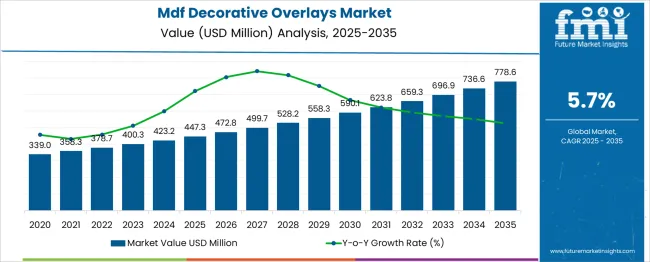
The mdf decorative overlays market was valued at USD 447.30 million in 2025, projected to reach USD 472.80 million in 2026, and is forecast to expand to USD 823.05 million by 2036 at a 5.7% CAGR. Expanding furniture manufacturing, kitchen cabinet renovation activity, and the adoption of premium surface finish aesthetics in residential and commercial interiors are sustaining procurement volumes for MDF decorative overlay films. Furniture manufacturers operating under brand-owner surface specification requirements treat overlay selection as a design-critical input that determines both visual appeal and surface durability.
PVC overlays retain the lead position at 46.0% share in 2026, driven by their cost-effectiveness, thermoforming capability for 3D surface wrapping, and broad color and texture availability. Softwood MDF substrates command 54.0% share as the preferred base material due to their uniform density, smooth surface, and machinability. Furniture applications account for 49.0% of demand as residential and commercial furniture manufacturers require consistent surface finishes that replicate natural wood, stone, and fabric textures. As per FMI, the convergence of interior design trends favoring matte and textured finishes with the cost advantages of overlay-clad MDF over solid wood and high-pressure laminate is expanding the addressable market. PET overlays are gaining specification momentum in kitchen and bathroom applications where chemical resistance and scratch hardness exceed PVC performance thresholds.
All key markets reflect differentiated growth trajectories. China advances at 7.7% driven by furniture manufacturing scale-up and residential interior finishing demand. India advances at 7.1% fueled by expanding furniture production and kitchen cabinet market growth. Germany advances at 6.6% supported by kitchen renovation cycles and premium surface finish specifications. France advances at 6.0% sustained by interior design trends and commercial fit-out activity. UK advances at 5.4% anchored by kitchen and bathroom renovation demand. USA advances at 4.8% maintained by residential furniture and cabinet refacing market activity. Brazil advances at 4.3% supported by expanding furniture manufacturing and residential construction.
| Metric | Details |
|---|---|
| Industry Size (2026) | USD 472.80 million |
| Industry Value (2036) | USD 823.05 million |
| CAGR (2026-2036) | 5.7% |
Source: Future Market Insights, 2026
MDF Decorative Overlays represent thermoplastic films applied to medium-density fiberboard substrates to create finished surfaces that replicate natural wood, stone, fabric, and solid-color aesthetics. The market encompasses PVC, PET, and specialty overlay films applied to softwood and hardwood MDF for furniture, kitchen cabinet, door, and architectural panel applications.
Market scope includes PVC, PET, and specialty decorative overlay films for MDF surface finishing across all application categories. Global and regional market sizes, forecast period 2026 to 2036, and segment breakdowns by Product, MDF type, and Application are fully covered.
The scope excludes high-pressure laminate sheets, melamine-impregnated paper overlays, and natural wood veneer. Decorative films for non-MDF substrates such as particleboard and plywood are omitted from the valuation.
The MDF decorative overlays market is witnessing sustained growth, supported by the expanding global furniture and interior design industries. A shift toward aesthetically pleasing, cost-effective alternatives to solid wood has driven the adoption of overlay solutions on MDF boards.
Increasing urbanization, rising demand for ready-to-assemble (RTA) furniture, and growth in modular construction have contributed to heightened demand for laminated surfaces that enhance durability and appearance. Environmental regulations promoting low-emission wood products have accelerated the adoption of engineered substrates like MDF, further boosting the market for decorative overlays.
Manufacturers are also investing in high-definition printing and advanced lamination technologies to meet the demand for premium visual finishes and moisture-resistant surfaces. Looking forward, the integration of eco-friendly overlay materials and recyclable laminates is expected to influence procurement decisions, with end-users prioritizing both design and sustainability in furniture applications.
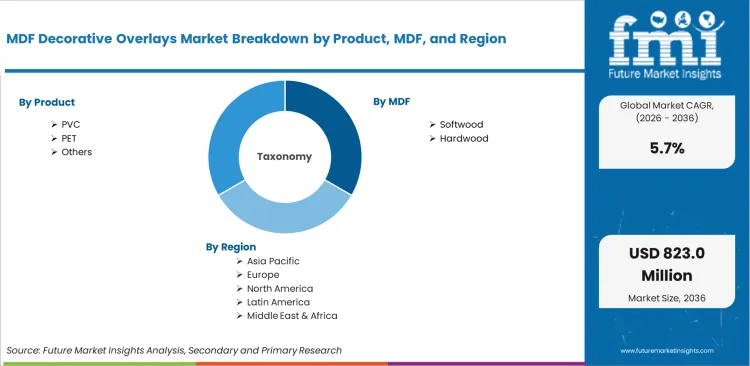
The MDF decorative overlays market is segmented by product, application, and geographic regions. The product of the MDF decorative overlays market is divided into PVC, PET, and others. In terms of MDF, the MDF decorative overlays market is classified into Softwood and Hardwood. Based on the application of the MDF decorative overlays market, it is segmented into Furniture, Kitchen Cabinet, Doors, and Others. Regionally, the MDF decorative overlays industry is classified into North America, Latin America, Western Europe, Eastern Europe, Balkan & Baltic Countries, Russia & Belarus, Central Asia, East Asia, South Asia & Pacific, and the Middle East & Africa.
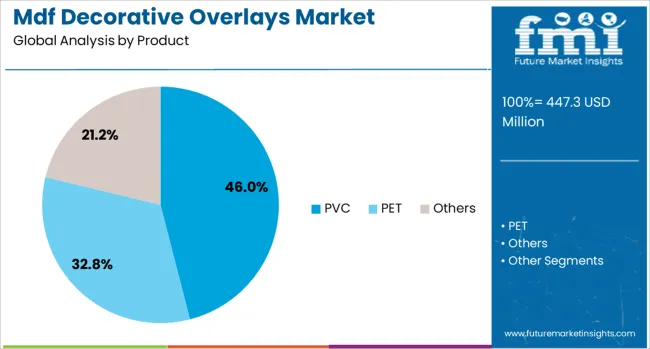
PVC overlays are expected to account for 46.00% of the total market share by 2026, making them the leading product segment in MDF decorative overlays. Their popularity is being supported by PVC’s superior moisture resistance, flexibility, and low cost, which make it ideal for residential and commercial furniture surfaces.
The material's ability to mimic wood grain and metallic finishes while maintaining durability and scratch resistance has enhanced its adoption in both low-end and premium applications. PVC overlays are also preferred due to ease of maintenance and compatibility with various MDF grades.
As furniture brands seek customizable, easy-to-apply finishes for mass production, PVC remains the dominant choice, particularly in developing economies where price sensitivity is high. Additionally, innovations in PVC film printing and surface texture enhancement are driving its continued market preference.
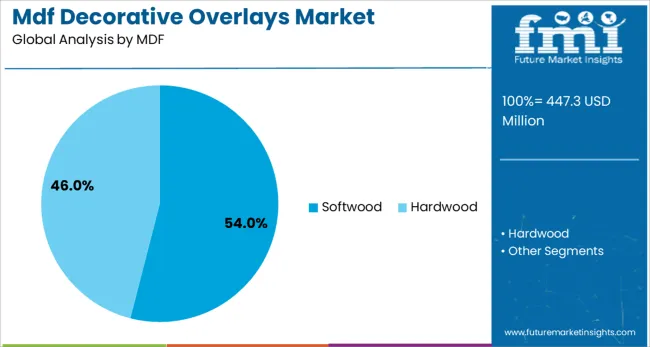
Softwood MDF is projected to hold 54.00% of the market share by 2026, making it the dominant MDF substrate used for overlays. This segment's strength lies in the material’s lighter weight, better machinability, and relatively lower cost compared to hardwood MDF.
It is widely utilized in applications where moderate strength is sufficient, such as decorative paneling and general-purpose furniture. The availability of softwood-based MDF in large sheet formats and its compatibility with various laminating and coating technologies have supported widespread adoption.
Moreover, producers are increasingly optimizing softwood MDF production to align with green building certifications, boosting its appeal in both residential and commercial interior markets. As cost-efficiency and environmental compliance remain top priorities for furniture manufacturers, softwood MDF continues to lead as a substrate for decorative overlays.
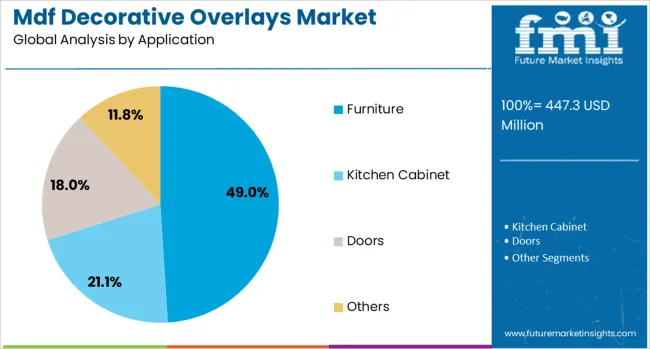
Furniture applications are expected to contribute 49.00% of the revenue share in 2026, making it the largest end-use segment in the MDF decorative overlays market. The segment’s dominance is being driven by high demand for customizable, lightweight, and aesthetically consistent furniture in residential and commercial interiors.
MDF overlays enable smooth finishes and enhanced surface properties, making them ideal for visible components such as cabinet doors, tabletops, and shelving. With the global rise in small-space urban housing and the shift toward modular and DIY furniture formats, MDF-based panels with decorative finishes offer an efficient and affordable solution.
The segment is also benefiting from the expansion of online and DTC furniture brands that prioritize visually appealing yet cost-effective materials. As consumer demand grows for eco-conscious and stylish furniture, overlays on MDF continue to deliver both form and function in diverse design applications.
The market has witnessed growth driven by the demand for enhanced aesthetics and functional finishes in furniture, interior design, and construction sectors. These overlays are thin decorative sheets applied to medium-density fiberboard (MDF) surfaces to provide appealing textures, colors, and protective properties. The rising popularity of cost-effective interior solutions that mimic natural wood grains, stone patterns, and other designs has supported market expansion. Manufacturers have focused on producing overlays with improved scratch resistance, UV stability, and fire retardancy to meet diverse application requirements.
The furniture manufacturing sector has been a significant consumer of MDF decorative overlays, leveraging their ability to enhance visual appeal and durability of products such as cabinets, wardrobes, and tables. Overlay applications have allowed manufacturers to replicate expensive natural materials at lower costs, aligning with consumer preferences for stylish yet affordable furniture. The demand for lightweight, easy-to-install components has increased the use of decorative overlays in modular and flat-pack furniture. Enhanced surface finishes have improved resistance to moisture, scratches, and wear, extending product lifespan. Additionally, overlays with anti-fingerprint and easy-clean properties have gained popularity in high-use furniture pieces. The furniture sector’s emphasis on customization and rapid product cycles has driven innovations in overlay materials and printing processes.
Advancements in overlay manufacturing have introduced features such as textured embossing, antimicrobial coatings, and enhanced fire resistance to meet evolving industry standards and consumer expectations. Digital printing technologies have enabled high-resolution, photorealistic designs, broadening aesthetic options. Environmentally friendly adhesives and coating materials have been developed to reduce volatile organic compound (VOC) emissions, supporting regulatory compliance and indoor air quality improvements. Integration of UV-cured finishes has improved surface hardness and chemical resistance without prolonging production times. These technological improvements have allowed MDF decorative overlays to be used in a wider range of applications, including commercial interiors, hospitality, and retail displays. Product innovations focusing on sustainability and durability have strengthened market competitiveness.
In the construction industry, MDF decorative overlays have been utilized for wall panels, ceiling elements, doors, and partition systems to deliver visually appealing and functional interiors. The overlays offer architects and designers versatile options to achieve design aesthetics aligned with modern architectural trends. Their ease of installation and compatibility with standard MDF substrates have facilitated rapid deployment in residential and commercial projects. Renovation and refurbishment activities have also favored the use of decorative overlays as a cost-effective alternative to solid wood or natural stone finishes. Furthermore, overlays with enhanced fire retardant properties have been preferred for compliance with building safety codes. Increasing urbanization and commercial infrastructure development have supported sustained demand growth within this sector.
Despite growing adoption, challenges remain related to the environmental impact of synthetic overlay materials and production processes. The use of formaldehyde-based resins in MDF cores and certain coatings has raised health and safety concerns, prompting demand for low-emission alternatives. Price sensitivity among end users has limited widespread adoption in price-competitive markets, especially in emerging economies. Variability in raw material availability and fluctuating costs have influenced production expenses and final product pricing. Additionally, competition from alternative decorative materials such as laminates, veneers, and PVC films has created pressure on market share. Overcoming these challenges will require continued innovation in eco-friendly materials, cost optimization, and enhanced product differentiation strategies.
.webp "Top Country Growth Comparison Mdf Decorative Overlays Market Cagr (2026 2036)")
| Country | CAGR |
|---|---|
| China | 7.7% |
| India | 7.1% |
| Germany | 6.6% |
| France | 6.0% |
| UK | 5.4% |
| USA | 4.8% |
| Brazil | 4.3% |
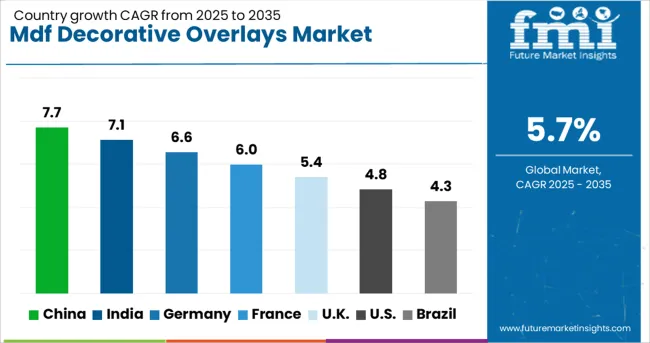
The MDF decorative overlays market is projected to grow at a CAGR of 5.7% from 2026 to 2036, driven by increasing demand in furniture manufacturing, interior design, and building renovations. China leads with a 7.7% CAGR, supported by large-scale production capabilities and growing construction activity. India follows at 7.1%, fueled by expanding residential and commercial real estate sectors. Germany, growing at 6.6%, benefits from high-quality manufacturing standards and design innovations. The UK, with a 5.4% CAGR, experiences steady demand from refurbishment and custom cabinetry projects. The USA, at 4.8%, reflects growth in home improvement and premium furniture markets. This report includes insights on 40+ countries; the top markets are shown here for reference.
China is projected to grow at a CAGR of 7.7% between 2026 and 2036 in the MDF decorative overlays market, propelled by extensive residential and commercial construction activities. Demand for decorative surfaces combining aesthetics and durability is rising, particularly in urban housing projects. Domestic manufacturers are enhancing product designs with improved textures and environmental compliance. Collaborations with furniture producers and interior design firms are expanding market penetration. Companies such as Dongguan Yuming and Shenzhen Henglun are focusing on innovation to meet evolving consumer preferences.
India is forecasted to grow at a CAGR of 7.1% in the MDF decorative overlays market, supported by rising affordable housing projects and demand for cost-effective interior finishes. Local manufacturers are developing overlays that combine durability with attractive finishes suited for tropical climates. Increasing adoption in modular furniture and interior refurbishment projects is driving growth. Government housing schemes and urban development plans are indirectly boosting the market.
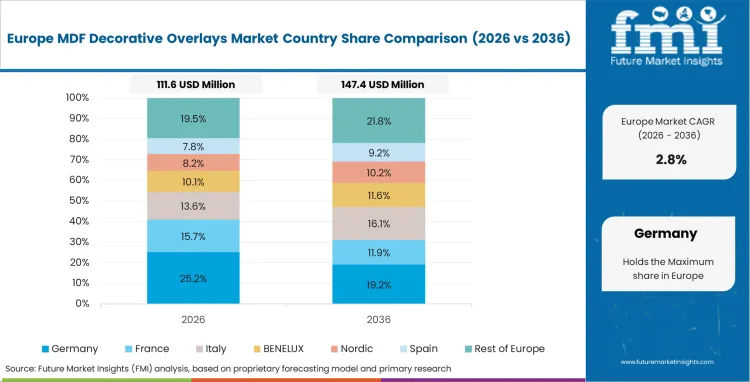
Germany is expected to grow at a CAGR of 6.6% in the MDF decorative overlays market, focusing on high-quality products with sustainable sourcing and low emissions. Manufacturers are complying with strict European standards for formaldehyde emissions and are innovating with recyclable and bio-based overlay materials. Demand from premium furniture and architectural applications is significant. Partnerships between overlay producers and green building projects are advancing.
The United Kingdom is projected to grow at a CAGR of 5.4% in the MDF decorative overlays market, driven by consumer preference for customizable and designer finishes. Growth in home renovation and bespoke furniture segments is encouraging innovation in overlay patterns and textures. Manufacturers are collaborating with interior designers to create trend-responsive products. Expansion of online retail channels for decorative materials is supporting market reach.
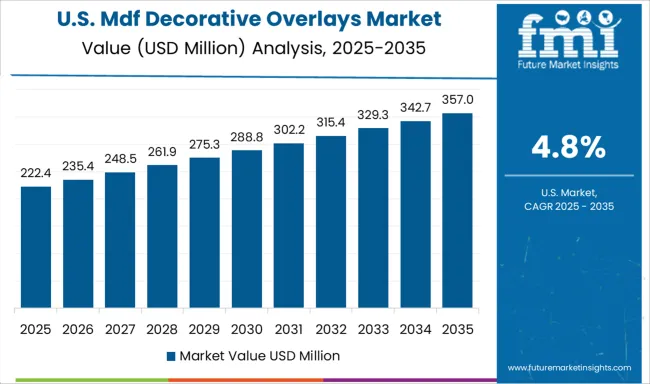
The United States is anticipated to grow at a CAGR of 4.8% in the MDF decorative overlays market, focusing on overlays with enhanced durability and resistance to wear. Demand from commercial furniture and cabinetry sectors is increasing. Innovation in surface treatments and UV-resistant coatings is gaining traction. Manufacturers such as Formica and Wilsonart are investing in R&D to expand product portfolios and address evolving consumer demands for long-lasting decorative materials.
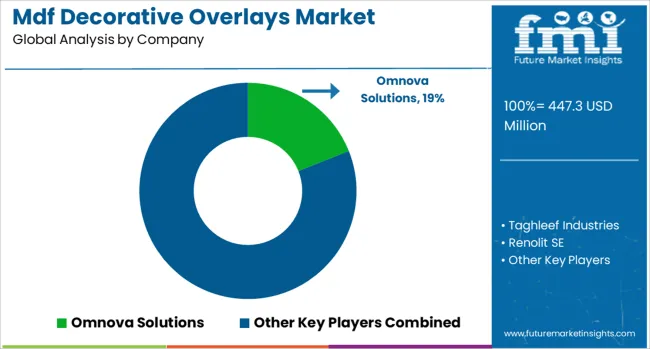
The market consists of companies supplying thin films and laminates applied to medium-density fiberboard surfaces to enhance aesthetics and durability in furniture, cabinetry, and interior design. These overlays contribute to improved scratch resistance, color stability, and texture variation, meeting growing demand for customizable and cost-effective surface finishes. Key competitive factors include product innovation, pattern variety, ease of application, and environmental compliance. Omnova Solutions offers a broad portfolio of decorative films featuring advanced coating technologies that improve wear resistance and color retention. Taghleef Industries specializes in sustainable, high-performance films with diverse patterns suited for modern interior applications.
Renolit SE provides premium textured overlays that mimic natural materials such as wood and stone, supporting high-end furniture production. Hueck Folien GmbH and Dackor focus on producing films with enhanced printability and adhesive compatibility to facilitate efficient manufacturing processes. Hyundai L&C Europe delivers decorative overlays combining aesthetic appeal with environmental certifications aligned with green building standards. Eurovinyl Plus and ISA International cater to regional markets with tailored product lines emphasizing cost-efficiency and application versatility. The market is evolving with increasing interest in eco-friendly materials, UV-resistant coatings, and digital printing capabilities that allow for rapid design customization. Providers investing in research and development to address these trends while maintaining quality and affordability are positioned to expand their footprint in the competitive MDF overlay segment.
| Metric | Value |
|---|---|
| Quantitative Units | USD 472.80 million to USD 823.05 million, at a CAGR of 5.7% |
| Market Definition | MDF Decorative Overlays represent thermoplastic films applied to medium-density fiberboard substrates to create finished surfaces that replicate natural wood, stone, fabric, and solid-color aesthetics. The market encompasses PVC, PET, and specialty overlay films applied to softwood and hardwood MDF for furniture, kitchen cabinet, door, and architectural panel applications. |
| Segmentation | Product: PVC, PET, Others; MDF: Softwood, Hardwood; Application: Furniture, Kitchen Cabinet, Doors, Others |
| Regions Covered | North America, Latin America, Europe, East Asia, South Asia, Oceania, Middle East & Africa |
| Countries Covered | China, India, Germany, France, UK, USA, Brazil, and 40 plus countries |
| Key Companies Profiled | Omnova Solutions, Taghleef Industries, Renolit SE, Hueck Folien GmbH, Dackor, Hyundai L&C Europe, Eurovinyl Plus, ISA International |
| Forecast Period | 2026 to 2036 |
| Approach | Forecasting models apply a hybrid bottom-up and top-down methodology starting with installed base metrics and cross-validating projections against primary research and public disclosure data. |
This bibliography is provided for reader reference. The full Future Market Insights report contains the complete reference list with primary research documentation.
How large is the demand for MDF Decorative Overlays in the global market in 2026?
Demand for MDF Decorative Overlays in the global market is estimated to be valued at USD 472.80 million in 2026.
What will be the market size of MDF Decorative Overlays in the global market by 2036?
Market size for MDF Decorative Overlays is projected to reach USD 823.05 million by 2036.
What is the expected demand growth for MDF Decorative Overlays between 2026 and 2036?
Demand for MDF Decorative Overlays is expected to grow at a CAGR of 5.7% between 2026 and 2036.
Which Product is poised to lead global sales by 2026?
PVC accounts for 46.0% share in 2026.
How significant is Softwood in driving MDF Decorative Overlays adoption in 2026?
Softwood represents 54.0% of segment share in 2026.
What is China's growth outlook in this report?
China is projected to grow at a CAGR of 7.7% during 2026 to 2036.
What is MDF Decorative Overlays and what is it mainly used for?
MDF Decorative Overlays represent thermoplastic films applied to medium-density fiberboard substrates to create finished surfaces that replicate natural wood, stone, fabric, and solid-color aesthetics. The market encompasses PVC, PET, and specialty overlay films applied to softwood and hardwood MDF for furniture, kitchen cabinet, door, and architectural panel applications.
What is included in the scope of this MDF Decorative Overlays report?
Market scope includes PVC, PET, and specialty decorative overlay films for MDF surface finishing across all application categories. Global and regional market sizes, forecast period 2026 to 2036, and segment breakdowns by Product, MDF type, and Application are fully covered.
Full Research Suite comprises of:

Market outlook & trends analysis
Interviews & case studies
Strategic recommendations
Vendor profiles & capabilities analysis
5-year forecasts
8 regions and 60+ country-level data splits
Market segment data splits
12 months of continuous data updates
DELIVERED AS:
PDF EXCEL ONLINE

MDF Decorative Overlays Market

Thank you!
You will receive an email from our Business Development Manager. Please be sure to check your SPAM/JUNK folder too.

