

- Industry Size (2026)
- USD 2.8 Bn
- Forecast (2036)
- USD 5.0 Bn
- CAGR (2026 to 2036)
- 6.0%
Maple Extracts Market Size, Market Forecast and Outlook By FMI
In 2025, the maple extracts market reached a valuation of USD 2.6 billion. Based on Future Market Insights’ assessment, sales are forecast to total USD 2.8 billion in 2026 and USD 5.0 billion by 2036. FMI anticipates a CAGR of 6.0% over the forecast timeframe.
Absolute dollar growth of USD 2.2 billion over the decade signals robust expansion driven by procurement specification shifts rather than purely volume increases. Procurement cycles prioritize verified origin ingredients over synthetic alternatives to satisfy stricter clean-label mandates. Buyers demand consistent flavor profiles despite underlying crop volatility, prompting a transition toward standardized natural flavor extract formulations to maintain label integrity across multinational bakery chains.
Summary of Maple Extracts
- Maple Extracts Market Definition:
- Concentrated natural sap derivatives serve as primary commercial flavoring agents across industrial food manufacturing sectors.
- Demand Drivers in Market:
- Clean-label mandates force industrial formulators to substitute synthetic flavors with natural botanical extracts.
- Beverage category expansion requires premium sweetening agents to differentiate specialty coffee and seasonal menus.
- Regional sugar taxes penalize artificial syrups, pushing brands toward naturally derived functional ingredients.
- Key Segments Analyzed in FMI Report:
- Product Type: Maple Syrup formats capture 41.8% segment share.
- Application: Bar and Donuts formulations generate 47.2% consumption share.
- Geography: North American production dominates supply, aided by Asian import volume expansion.
- Analyst Opinion at FMI:
- Nandini Roy Choudhury, Principal Consultant for Food & Beverage, opines, "Procurement directors must secure multi-year supply contracts to insulate operations against inherent weather-driven crop yield fluctuations."
- Strategic Implications/Executive Takeaways:
- Diversify sourcing networks across multiple cooperatives to mitigate localized climate disruptions.
- Invest in powder extraction capabilities to reduce cross-border liquid transport costs.
- Target Asian premium bakery channels where Western flavor profiles command higher margin structures.
- Methodology:
- Validated through first-hand corporate production and capacity data.
- Zero reliance on speculative third-party market research reports.
- Based on verifiable industrial benchmarks and verified sources.
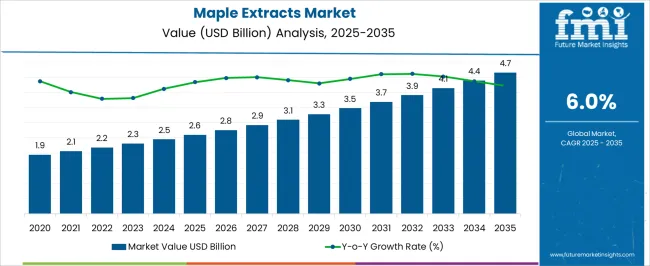
China (6.5% CAGR) and Canada (6.2% CAGR) drive new opportunities through bakery chain expansion and export-led ingredient pull. India (6.0% CAGR) contributes modestly via modern trade dessert formats. Mature maple extract markets including United States (5.8%), Japan (5.7%), and United Kingdom (5.5%) generate steady replacement demand, with volume expansion linked to premium confectionery launches and strict clean-label flavor compliance.
Maple Extracts Market Definition
Maple extracts comprise concentrated flavorings derived from natural sap tapped from sugar maple trees. Processors distill raw sap into highly concentrated liquid or powder formats for industrial integration. Buyers utilize these ingredients to impart distinct aromatic and sweet profiles into commercial food formulations. High concentration allows manufacturers to achieve desired taste profiles using minimal volume.
Maple Extracts Market Inclusions
Coverage incorporates liquid concentrates, natural powder derivatives, and pure commercial-grade flavored syrups intended for industrial flavoring. Analysis tracks volume consumption across commercial bakeries, beverage formulators, and dairy processors. Output measurements capture cross-border trade flows originating from North American production zones.
Maple Extracts Market Exclusions
Analysis omits synthetic maple-flavored products manufactured from high-fructose corn syrup and artificial chemical compounds. Retail-packaged table syrups intended strictly for direct consumer household consumption fall outside current scope. Downstream finished goods containing maple ingredients remain excluded to prevent double-counting of raw material value.
Maple Extracts Market Research Methodology
- Primary Research: Interviews were conducted with flavor house executives and cooperative supply managers to map bulk pricing dynamics.
- Desk Research: Evaluators aggregated export datasets from national agricultural boards to triangulate baseline cross-border ingredient flows.
- Market-Sizing and Forecasting: Analysts constructed a hybrid bottom-up model linking industrial bakery output to regional flavor formulation ratios.
- Data Validation and Update Cycle: Verification protocols cross-reference supplier capacity disclosures against reported regional import volumes prior to release.
Segmental Analysis
Maple Extracts Market Analysis by Product Type
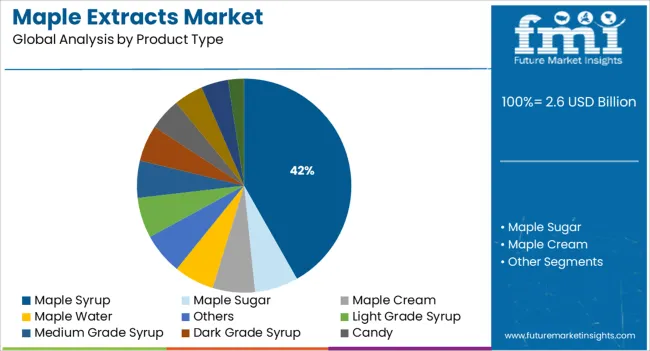
Maple Syrup leads commercial formatting choices, commanding 41.8% volume share in 2026. According to FMI's estimates, industrial buyers prefer raw syrup formats for direct integration into large-scale liquid processing lines. Unprocessed maple syrup requires less chemical manipulation, satisfying strict clean-label packaging requirements dictated by modern retail buyers. Suppliers prioritize bulk distribution to bypass expensive secondary extraction processes. Formulators blend these pure formats into secondary ingredients to create complex taste architectures.
- Formulation trigger: Clean-label compliance forces food engineers to select pure syrup over artificial compounds, improving nutritional profiles across premium product tiers by 2026. Buyer preference shifts toward organic certifications, prompting suppliers to validate origin purity.
- Cost efficiency: Bulk liquid syrup integration bypasses secondary processing premiums, protecting manufacturer margins against rising ingredient costs during inflationary cycles. Processors maintain long-term agreements with regional cooperatives to secure pricing stability across seasonal harvests.
- Handling parameters: Viscosity requirements dictate format selection, causing facility managers to upgrade pump systems to accommodate natural liquid ingredients. Upgraded handling infrastructure allows bakeries to transition fully away from synthetic alternatives.
Maple Extracts Market Analysis by Application
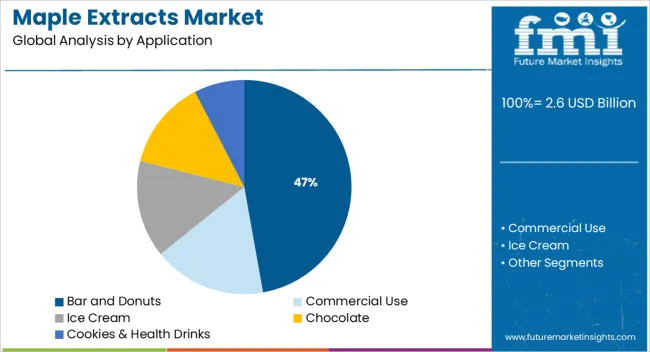
Bar and Donuts categories generate 47.2% consumption share through specialized bakery utilization. FMI analysts opine that commercial bakers integrate robust sweet profiles to mask off-notes in high-protein nutrition bars. Flavor houses engineer heat-stable extracts capable of surviving high-temperature frying processes inherent to donut manufacturing. Consistent ingredient performance prevents flavor degradation during extended ambient shelf storage. Manufacturers formulate complex glazes to capture younger demographics seeking novel sensory experiences.
- Sensory shift: Consumer palate evolution drives commercial bakeries to incorporate complex botanical notes, replacing generic white sugar with distinct regional flavors. High-temperature stability ensures active flavor compounds survive industrial frying cycles intact.
- Menu premiumization: Foodservice operators utilize natural origin claims to justify elevated price points on seasonal pastry offerings. Brands expand specialized product lines to capture increased foot traffic during peak autumn consumption windows.
- Moisture retention: Natural humectant properties improve baked good shelf life, allowing commercial distributors to extend logistical reach without staling. Improved texture profiles translate into higher repeat purchase rates among retail consumers.
Maple Extracts Market Drivers, Restraints, and Opportunities
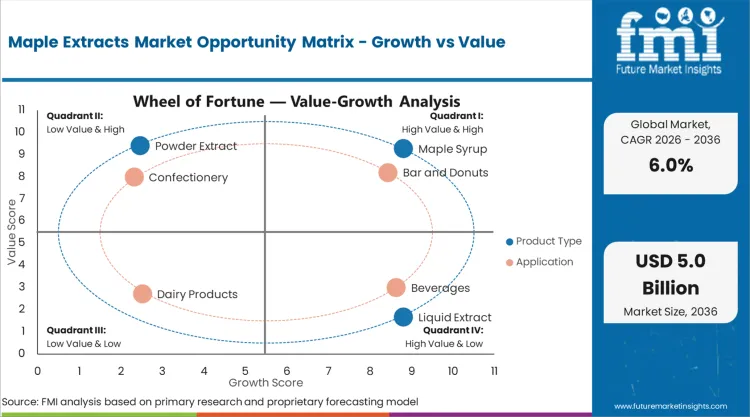
Export momentum acts as primary catalyst for capacity expansion across North American production zones. Global flavor houses require massive raw material volumes to supply multinational food conglomerates. Local cooperatives expand tapping infrastructure to feed surging international demand networks. As per FMI's projection, stable international trade flows encourage long-term capital investments in advanced evaporation technologies. Canada reported export values reaching USD 715.9 million, demonstrating robust structural demand pull from overseas processing facilities. [3] Producers leverage state-backed promotional funding to penetrate emerging culinary markets in Asia. Supply chain digitization accelerates cross-border raw material distribution.
Climate volatility restrains steady production planning, causing severe year-over-year yield fluctuations. Unpredictable freeze-thaw cycles disrupt natural sap flow, leaving industrial buyers vulnerable to sudden raw material shortages. Processors mitigate yield risk by managing strategic reserves to buffer against poor harvest seasons. Buyers execute rigid forward contracts to lock in baseline volume requirements before spring tapping commences. Advanced sensor networks deployed across forests help operators optimize collection timing during erratic weather patterns.
- Capacity Expansion: Expanding forestry operations increases baseline ingredient availability for industrial processors. Producers authorized 7 million new taps to expand commercial supply buffers.
- Portfolio Diversification: Flavor manufacturers capture new revenue streams by engineering dairy-compatible extracts. Developers introduced specialized milky flavor profiles to penetrate global beverage formulation sectors.
- Corporate Consolidation: Well-capitalized food groups acquire regional processors to secure vertically integrated supply chains. Valeo Foods acquired Appalaches Nature to guarantee steady ingredient access for global distribution networks.
Regional Analysis
Based on regional analysis, maple extracts market is segmented into North America, Latin America, Europe, East Asia, South Asia, Oceania and Middle East & Africa across 40+ countries. The full report also offers market attractiveness analysis based on regional trends.
.webp "Top Country Growth Comparison Maple Extracts Market Cagr (2026 2036)")
| Country | CAGR (2026 to 2036) |
|---|---|
| China | 6.5% |
| Canada | 6.2% |
| India | 6.0% |
| United States | 5.8% |
| Japan | 5.7% |
| United Kingdom | 5.5% |
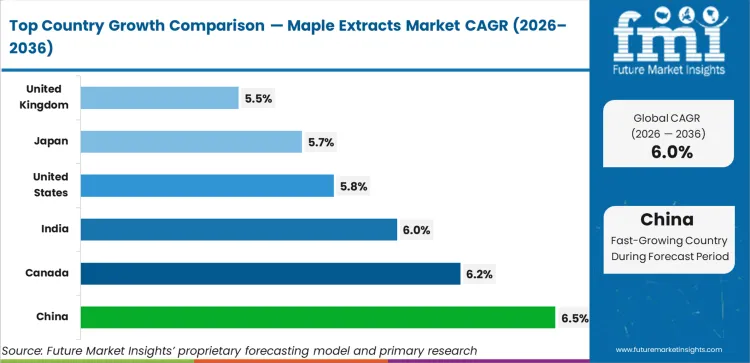
Source: Future Market Insights (FMI) analysis, based on proprietary forecasting model and primary research
North America Maple Extracts Analysis
North American operations dictate global supply metrics through concentrated harvesting infrastructure. FMI analysts opine that regional producers transition from fragmented farming models toward industrialized extraction facilities. Government agricultural departments deploy funding mechanisms to bolster international export capabilities. Domestic commercial bakeries secure primary allocation before processors route remaining volume overseas. United States production reached 5.86 million gallons, providing crucial secondary supply base alongside dominant Canadian outputs. [1] Extract manufacturers cluster processing facilities near major forestry reserves to minimize raw sap degradation during transit.
- Canada: Over 2026 to 2036, maple extracts in Canada is projected to grow at 6.2% CAGR, reflecting export momentum that steadily raises adoption intensity in core end users. Output expansion reaching 18.0 million gallons allows local processors to fulfill massive international corporate supply agreements. [2]
- United States: United States is expected to record 5.8% CAGR in maple extracts demand over 2026 to 2036 as domestic tapping infrastructure scales, tightening procurement links between operational constraints and adoption-led investment. Domestic food brands introduce expanded foodservice product lines to capture rising away-from-home dining expenditure. [9]
FMI's report includes detailed supply chain mapping covering North American processing hubs. Expansion into Mexico presents unexploited consumer channels for sweetened bakery mixes. Buyers monitor infrastructure upgrades across Eastern provinces to forecast future global pricing stability.
Europe Maple Extracts Analysis
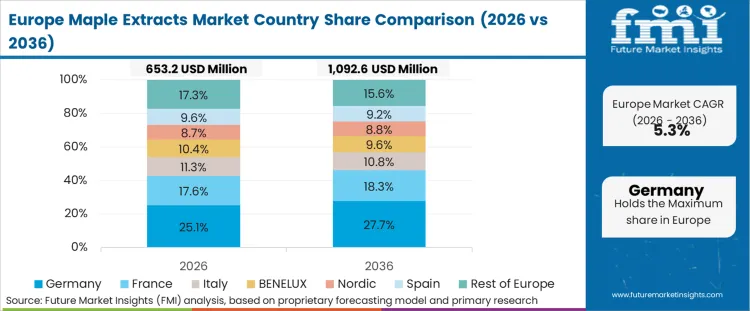
European formulators rely heavily on imported ingredients to satisfy regional clean-label consumer preferences. As per FMI's projection, strict chemical additive regulations force food manufacturers to utilize natural botanical extracts. High import tariffs require brands to position maple-flavored goods within premium retail tiers. Bakery chains utilize recognized North American origin claims to validate elevated consumer pricing. Organic certification acts as mandatory baseline for securing shelf space within premium grocery networks. [8] Formulators engineer highly concentrated derivatives to minimize volumetric shipping costs across ocean routes.
- United Kingdom: United Kingdom is forecast to register 5.5% CAGR in maple extracts sales through 2036 as clean-label flavor pull accelerates, raising volume pipeline for vendors with local-ready integration. Brands pursue organic certifications to align imported product ranges with strict local health mandates.
FMI's report includes import dependency ratios governing European flavor markets. France and Germany command attention as primary manufacturing hubs for multinational confectionery brands. Processors navigate shifting regulatory frameworks governing imported natural food flavors to maintain market access.
East Asia Maple Extracts Analysis
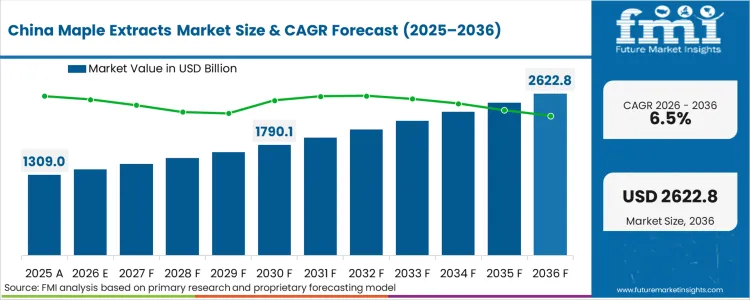
East Asian consumption expands as younger demographics adopt Western-style bakery and cafe culture. According to FMI's estimates, coffee shop chains integrate premium sweet profiles into seasonal beverage menus. Lack of domestic harvesting infrastructure forces total reliance on refined North American imports. Multinational flavor houses establish regional blending facilities to tailor extract profiles toward local taste preferences. Local manufacturers blend authentic extracts with familiar regional ingredients to accelerate consumer acceptance.
- China: China's maple extracts landscape is forecast to expand at 6.5% CAGR through 2036, as coffee flavor flavoring systems proliferate and market participants respond with scaled deployment plans. Western-style bakery chains utilize premium imported extracts to differentiate retail menus from local competitors. [4]
- Japan: Growth in maple extracts across Japan is estimated at 5.7% CAGR through 2036, driven by premium sweet spread trends that increases emphasis on reliability and compliance in buyer criteria. Retail category analysis indicates sustained consumer willingness to purchase imported natural sweeteners. [7]
FMI's report includes precise mapping of Asian import distribution networks. South Korea and Taiwan demonstrate aggressive adoption patterns within premium dessert categories. Processors establish direct trade relationships with Asian food conglomerates to bypass intermediate distribution markups, boosting efficiency across regional flavors supply chains.
South Asia Maple Extracts Analysis
South Asian utilization remains concentrated within elite hospitality and premium urban retail environments. Multinational food brands introduce imported flavor profiles through luxury dessert offerings. High landed costs restrict mass-market penetration, limiting usage to high-margin formulation segments. Domestic flavor houses experiment with minimal extract blending to achieve cost-viable market entry. Evolving middle-class palates demonstrate increasing openness to foreign botanical taste experiences. Formulators balance authentic flavor delivery with extreme price sensitivity across developing consumer bases.
- India: Demand for maple extracts in India is set to grow at 6.0% CAGR through 2036, supported by modern trade bakery expansion before procurement and budgeting cycles translate into higher deployment volumes. Foodservice operators test premium sweet profiles to gauge consumer response across expanding urban cafe networks.
FMI's report includes penetration models for emerging consumer classes. Expanding modern retail in Indonesia and Thailand provides necessary cold-chain infrastructure for premium imported spreads. Suppliers innovate concentrated powder formats to overcome tropical climate storage limitations.
Competitive Aligners for Market Players
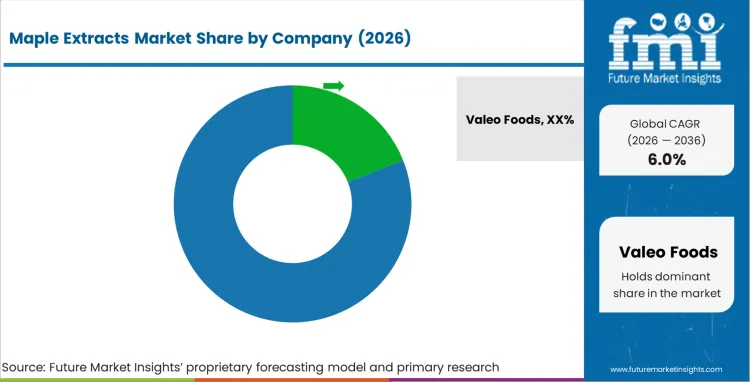
Market fragmentation exists at harvesting level, but processing capabilities remain consolidated among specialized industrial extractors. Mid-tier suppliers face severe margin pressure during poor harvest years when raw material costs spike. Vertically integrated entities controlling both forestry assets and advanced evaporation facilities dictate global pricing benchmarks. Processors commanding extensive reserve capacities ensure supply continuity, capturing lucrative long-term contracts from risk-averse multinational bakeries.
Technological upgrades separate premium flavor houses from bulk commodity shippers. Advanced membrane filtration and steam optimization allow leading processors to maximize yield from volatile sap runs. Firms investing in automated extraction infrastructure reduce labor costs and improve batch consistency. Regulatory demands force mid-sized players to implement expensive traceability software to prove natural origin claims. Facilities lacking modern certification capabilities lose access to highly regulated European and Japanese buyer networks.
Strategic geographic positioning determines long-term viability for international distributors. Companies establishing localized blending facilities in target growth regions bypass expensive finished-product shipping tariffs. Flavor houses partner directly with Asian and European bakery conglomerates to custom-engineer extracts optimized for specific regional manufacturing equipment. Developing proprietary powder formats opens distribution channels into tropical climates where liquid formats suffer rapid degradation.
Recent Developments:
Report includes full coverage of key trends from competitive benchmarking. Some recent developments covered in reports:
- In July 2024, Valeo Foods announced acquisition of Canadian maple syrup business Appalaches Nature to expand North American footprint. [5]
- In June 2025, Québec Maple Syrup Producers announced emission of 7 million new taps to expand commercial supply buffers. [6]
Key Players in Maple Extracts
- Valeo Foods
- dsm-firmenich
- Runamok Maple
- Pure Maple
- Les Industries Bernard et Fils
- Appalaches Nature
- Lantic Inc. (Rogers Sugar)
- H2O Innovation
- CDL Corporate Group
- Prestige Maple Products
Scope of the Report
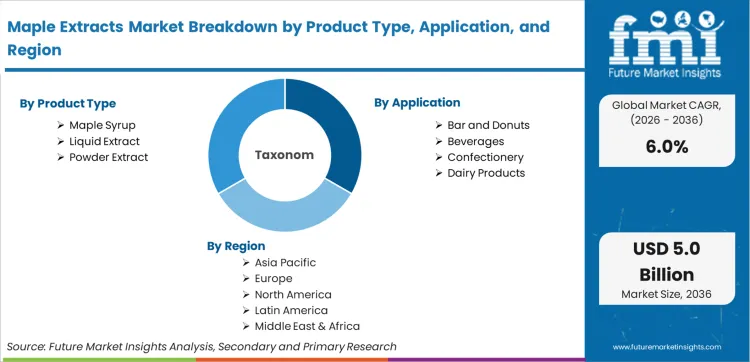
| Metric | Value |
|---|---|
| Quantitative Units | USD 2.8 billion (2026) to USD 5.0 billion (2036), at a CAGR of 6.0% |
| Market Definition | Concentrated flavorings derived from natural sap tapped from sugar maple trees used for industrial food formulation. |
| Product Type Segmentation | Maple Syrup, Liquid Extract, Powder Extract |
| Application Segmentation | Bar and Donuts, Beverages, Confectionery, Dairy Products, Others |
| Regions Covered | North America, Latin America, Europe, East Asia, South Asia, Oceania, Middle East and Africa |
| Countries Covered | United States, Canada, Mexico, Brazil, Argentina, Germany, France, United Kingdom, Italy, Spain, China, India, Japan, South Korea, Indonesia, Australia and 40 plus countries |
| Key Companies Profiled | Valeo Foods, dsm-firmenich, Runamok Maple, Pure Maple, Les Industries Bernard et Fils, Appalaches Nature, Lantic Inc., H2O Innovation, CDL Corporate Group, Prestige Maple Products |
| Forecast Period | 2026 to 2036 |
| Approach | Hybrid top down and bottom up market modeling validated through primary interviews and trade data benchmarking |
Maple Extracts Market Analysis by Segments
Product Type:
- Maple Syrup
- Liquid Extract
- Powder Extract
Application:
- Bar and Donuts
- Beverages
- Confectionery
- Dairy Products
- Others
Region:
- Asia Pacific
- India
- China
- Japan
- South Korea
- Indonesia
- Australia & New Zealand
- ASEAN
- Rest of Asia Pacific
- Europe
- Germany
- Italy
- France
- United Kingdom
- Spain
- Benelux
- Nordics
- Central & Eastern Europe
- Rest of Europe
- North America
- United States
- Canada
- Mexico
- Latin America
- Brazil
- Argentina
- Chile
- Rest of Latin America
- Middle East & Africa
- Kingdom of Saudi Arabia
- United Arab Emirates
- South Africa
- Turkey
- Rest of Middle East & Africa
Bibliography
- [1] USDA NASS. (2025). USA 2024 maple syrup production, taps, and yield.
- [2] Statistics Canada. (2024). Quebec 2024 maple production.
- [3] Agriculture and Agri-Food Canada. (2025). Statistical Overview of Canadian Maple Industry 2024.
- [4] dsm-firmenich. (2024). Milky Maple named Flavor of the Year 2025.
- [5] FoodManufacture.co.uk. (2024). Valeo Foods acquires Canadian maple syrup supplier Appalaches Nature.
- [6] Québec Maple Syrup Producers. (2025). Emission of 7 million new taps.
- [7] Agriculture and Agri-Food Canada. (2026). Sector Trend Analysis: Sweet Spreads, Honey, and Maple Products - Japan.
- [8] International Food & Drink Event. (2025). Pure Maple launches organic certification and brand refresh.
- [9] Informa Connect. (2025). Runamok Maple debuts expanded foodservice lineup at NRA Show.
This bibliography is provided for reader reference and is not exhaustive. The full report contains the complete reference list and detailed citations.
This Report Addresses
- Market intelligence to enable structured strategic decision making across mature and emerging extract economies
- Market size estimation and 10 year revenue forecasts from 2026 to 2036, supported by validated capacity benchmarks
- Growth opportunity mapping across powder, liquid, and pure syrup forms with emphasis on clean-label transitions
- Segment and regional revenue forecasts covering commercial bakery, beverage, and confectionery applications
- Competition strategy assessment including integration models, cost survivability positioning, and compliance benchmarking
- Product reformulation tracking including organic certification and botanical origin aligned grades
- Regulatory impact analysis covering natural flavor mandates, indoor processing thresholds, and export specification upgrades
- Market report delivery in PDF, Excel, PPT, and interactive dashboard formats for executive use
Frequently Asked Questions
How large is the demand for Maple Extracts in the global market in 2026?
Demand for Maple Extracts in the global market is estimated to be valued at USD 2.8 billion in 2026.
What will be the market size of Maple Extracts in the global market by 2036?
Market size for Maple Extracts is projected to reach USD 5.0 billion by 2036.
What is the expected demand growth for Maple Extracts in the global market between 2026 and 2036?
Demand for Maple Extracts in the global market is expected to grow at a CAGR of 6.0% between 2026 and 2036.
Which Product Type is poised to lead global sales by 2026?
Maple Syrup is expected to be the dominant format, capturing approximately 41.8% of global market share in 2026 due to minimal secondary processing requirements.
How significant is the role of Bar and Donuts End Use in driving Maple Extracts adoption in 2026?
Bar and Donuts represent a critical segment, projected to hold a substantial 47.2% share of total market in 2026 as industrial bakeries replace synthetic sweeteners.
What is driving demand in China?
Western-style bakery chain expansion and premium coffee flavorings drive demand.
What compliance standards or regulations are referenced for China?
Strict clean-label mandates govern imported natural botanical extracts.
What is the China growth outlook in this report?
China is projected to grow at a CAGR of 6.5% during 2026 to 2036.
Why is Europe described as a priority region in this report?
High import tariffs force brands to position natural extracts within premium retail tiers.
What type of demand dominates in Europe?
Clean-label replacement demand for organic certified natural ingredients dominates regional consumption.
What is Canada growth outlook in this report?
Canada is projected to expand at a CAGR of 6.2% during 2026 to 2036.
Does the report cover India in its regional analysis?
India is included within South Asia under regional scope of analysis.
What are the sources referred to for analyzing India?
Analysis utilizes retail category stats and sweet spread import flow data.
What is the main demand theme linked to India in its region coverage?
Demand tracks premium sweet spread penetration across modern retail formats.
Does the report cover United States in its regional analysis?
United States is included within North America under regional coverage framework.
What is the main United States related demand theme in its region coverage?
Domestic infrastructure scaling supports expanded foodservice product lines.
Which product formats or configurations are strategically important for North America supply chains?
Bulk liquid syrup dominates due to vast domestic processing infrastructure.
What is Maple Extracts and what is it mainly used for?
Concentrated natural flavorings used to impart sweet profiles into commercial bakery and beverage goods.
What does Maple Extracts Market mean in this report?
Maple extracts market refers to global production, trade, and industrial consumption of natural sap derivatives processed for food formulation.
What is included in the scope of this Maple Extracts Market report?
Scope covers liquid concentrates, powders, and pure syrups used in commercial processing.
What is excluded from the scope of this report?
Synthetic artificial syrups and household retail table syrups are excluded.
What does market forecast mean on this page?
Market forecast represents a model based projection built on verified industrial supply metrics.
How does FMI build and validate the Maple Extracts Market forecast?
Forecast relies on hybrid models validated against cooperative extraction capacities and export flows.
What does zero reliance on speculative third party market research mean here?
Primary interviews with flavor houses and official agricultural data drive insights instead of unverified syndicated market estimates.
Preview the report firsthand - request a free sample
Get SampleGet the brochure for pricing and purchase details.
Get PDFTable of Content
- Executive Summary
- Global Market Outlook
- Demand-side Trends
- Supply-side Trends
- Technology Roadmap Analysis
- Analysis and Recommendations
- Market Overview
- Market Coverage / Taxonomy
- Market Definition / Scope / Limitations
- Research Methodology
- Chapter Orientation
- Analytical Lens and Working Hypotheses
- Market Structure, Signals, and Trend Drivers
- Benchmarking and Cross-market Comparability
- Market Sizing, Forecasting, and Opportunity Mapping
- Research Design and Evidence Framework
- Desk Research Programme (Secondary Evidence)
- Company Annual and Sustainability Reports
- Peer-reviewed Journals and Academic Literature
- Corporate Websites, Product Literature, and Technical Notes
- Earnings Decks and Investor Briefings
- Statutory Filings and Regulatory Disclosures
- Technical White Papers and Standards Notes
- Trade Journals, Industry Magazines, and Analyst Briefs
- Conference Proceedings, Webinars, and Seminar Materials
- Government Statistics Portals and Public Data Releases
- Press Releases and Reputable Media Coverage
- Specialist Newsletters and Curated Briefings
- Sector Databases and Reference Repositories
- FMI Internal Proprietary Databases and Historical Market Datasets
- Subscription Datasets and Paid Sources
- Social Channels, Communities, and Digital Listening Inputs
- Additional Desk Sources
- Expert Input and Fieldwork (Primary Evidence)
- Primary Modes
- Qualitative Interviews and Expert Elicitation
- Quantitative Surveys and Structured Data Capture
- Blended Approach
- Why Primary Evidence is Used
- Field Techniques
- Interviews
- Surveys
- Focus Groups
- Observational and In-context Research
- Social and Community Interactions
- Stakeholder Universe Engaged
- C-suite Leaders
- Board Members
- Presidents and Vice Presidents
- R&D and Innovation Heads
- Technical Specialists
- Domain Subject-matter Experts
- Scientists
- Physicians and Other Healthcare Professionals
- Governance, Ethics, and Data Stewardship
- Research Ethics
- Data Integrity and Handling
- Primary Modes
- Tooling, Models, and Reference Databases
- Desk Research Programme (Secondary Evidence)
- Data Engineering and Model Build
- Data Acquisition and Ingestion
- Cleaning, Normalisation, and Verification
- Synthesis, Triangulation, and Analysis
- Quality Assurance and Audit Trail
- Market Background
- Market Dynamics
- Drivers
- Restraints
- Opportunity
- Trends
- Scenario Forecast
- Demand in Optimistic Scenario
- Demand in Likely Scenario
- Demand in Conservative Scenario
- Opportunity Map Analysis
- Product Life Cycle Analysis
- Supply Chain Analysis
- Investment Feasibility Matrix
- Value Chain Analysis
- PESTLE and Porter’s Analysis
- Regulatory Landscape
- Regional Parent Market Outlook
- Production and Consumption Statistics
- Import and Export Statistics
- Market Dynamics
- Global Market Analysis 2021 to 2025 and Forecast, 2026 to 2036
- Historical Market Size Value (USD Million) Analysis, 2021 to 2025
- Current and Future Market Size Value (USD Million) Projections, 2026 to 2036
- Y-o-Y Growth Trend Analysis
- Absolute $ Opportunity Analysis
- Global Market Pricing Analysis 2021 to 2025 and Forecast 2026 to 2036
- Global Market Analysis 2021 to 2025 and Forecast 2026 to 2036, By Product Type
- Introduction / Key Findings
- Historical Market Size Value (USD Million) Analysis By Product Type , 2021 to 2025
- Current and Future Market Size Value (USD Million) Analysis and Forecast By Product Type , 2026 to 2036
- Maple Syrup
- Liquid Extract
- Powder Extract
- Maple Syrup
- Y-o-Y Growth Trend Analysis By Product Type , 2021 to 2025
- Absolute $ Opportunity Analysis By Product Type , 2026 to 2036
- Global Market Analysis 2021 to 2025 and Forecast 2026 to 2036, By Application
- Introduction / Key Findings
- Historical Market Size Value (USD Million) Analysis By Application, 2021 to 2025
- Current and Future Market Size Value (USD Million) Analysis and Forecast By Application, 2026 to 2036
- Bar and Donuts
- Beverages
- Confectionery
- Dairy Products
- Bar and Donuts
- Y-o-Y Growth Trend Analysis By Application, 2021 to 2025
- Absolute $ Opportunity Analysis By Application, 2026 to 2036
- Global Market Analysis 2021 to 2025 and Forecast 2026 to 2036, By Region
- Introduction
- Historical Market Size Value (USD Million) Analysis By Region, 2021 to 2025
- Current Market Size Value (USD Million) Analysis and Forecast By Region, 2026 to 2036
- North America
- Latin America
- Western Europe
- Eastern Europe
- East Asia
- South Asia and Pacific
- Middle East & Africa
- Market Attractiveness Analysis By Region
- North America Market Analysis 2021 to 2025 and Forecast 2026 to 2036, By Country
- Historical Market Size Value (USD Million) Trend Analysis By Market Taxonomy, 2021 to 2025
- Market Size Value (USD Million) Forecast By Market Taxonomy, 2026 to 2036
- By Country
- USA
- Canada
- Mexico
- By Product Type
- By Application
- By Country
- Market Attractiveness Analysis
- By Country
- By Product Type
- By Application
- Key Takeaways
- Latin America Market Analysis 2021 to 2025 and Forecast 2026 to 2036, By Country
- Historical Market Size Value (USD Million) Trend Analysis By Market Taxonomy, 2021 to 2025
- Market Size Value (USD Million) Forecast By Market Taxonomy, 2026 to 2036
- By Country
- Brazil
- Chile
- Rest of Latin America
- By Product Type
- By Application
- By Country
- Market Attractiveness Analysis
- By Country
- By Product Type
- By Application
- Key Takeaways
- Western Europe Market Analysis 2021 to 2025 and Forecast 2026 to 2036, By Country
- Historical Market Size Value (USD Million) Trend Analysis By Market Taxonomy, 2021 to 2025
- Market Size Value (USD Million) Forecast By Market Taxonomy, 2026 to 2036
- By Country
- Germany
- UK
- Italy
- Spain
- France
- Nordic
- BENELUX
- Rest of Western Europe
- By Product Type
- By Application
- By Country
- Market Attractiveness Analysis
- By Country
- By Product Type
- By Application
- Key Takeaways
- Eastern Europe Market Analysis 2021 to 2025 and Forecast 2026 to 2036, By Country
- Historical Market Size Value (USD Million) Trend Analysis By Market Taxonomy, 2021 to 2025
- Market Size Value (USD Million) Forecast By Market Taxonomy, 2026 to 2036
- By Country
- Russia
- Poland
- Hungary
- Balkan & Baltic
- Rest of Eastern Europe
- By Product Type
- By Application
- By Country
- Market Attractiveness Analysis
- By Country
- By Product Type
- By Application
- Key Takeaways
- East Asia Market Analysis 2021 to 2025 and Forecast 2026 to 2036, By Country
- Historical Market Size Value (USD Million) Trend Analysis By Market Taxonomy, 2021 to 2025
- Market Size Value (USD Million) Forecast By Market Taxonomy, 2026 to 2036
- By Country
- China
- Japan
- South Korea
- By Product Type
- By Application
- By Country
- Market Attractiveness Analysis
- By Country
- By Product Type
- By Application
- Key Takeaways
- South Asia and Pacific Market Analysis 2021 to 2025 and Forecast 2026 to 2036, By Country
- Historical Market Size Value (USD Million) Trend Analysis By Market Taxonomy, 2021 to 2025
- Market Size Value (USD Million) Forecast By Market Taxonomy, 2026 to 2036
- By Country
- India
- ASEAN
- Australia & New Zealand
- Rest of South Asia and Pacific
- By Product Type
- By Application
- By Country
- Market Attractiveness Analysis
- By Country
- By Product Type
- By Application
- Key Takeaways
- Middle East & Africa Market Analysis 2021 to 2025 and Forecast 2026 to 2036, By Country
- Historical Market Size Value (USD Million) Trend Analysis By Market Taxonomy, 2021 to 2025
- Market Size Value (USD Million) Forecast By Market Taxonomy, 2026 to 2036
- By Country
- Kingdom of Saudi Arabia
- Other GCC Countries
- Turkiye
- South Africa
- Other African Union
- Rest of Middle East & Africa
- By Product Type
- By Application
- By Country
- Market Attractiveness Analysis
- By Country
- By Product Type
- By Application
- Key Takeaways
- Key Countries Market Analysis
- USA
- Pricing Analysis
- Market Share Analysis, 2025
- By Product Type
- By Application
- Canada
- Pricing Analysis
- Market Share Analysis, 2025
- By Product Type
- By Application
- Mexico
- Pricing Analysis
- Market Share Analysis, 2025
- By Product Type
- By Application
- Brazil
- Pricing Analysis
- Market Share Analysis, 2025
- By Product Type
- By Application
- Chile
- Pricing Analysis
- Market Share Analysis, 2025
- By Product Type
- By Application
- Germany
- Pricing Analysis
- Market Share Analysis, 2025
- By Product Type
- By Application
- UK
- Pricing Analysis
- Market Share Analysis, 2025
- By Product Type
- By Application
- Italy
- Pricing Analysis
- Market Share Analysis, 2025
- By Product Type
- By Application
- Spain
- Pricing Analysis
- Market Share Analysis, 2025
- By Product Type
- By Application
- France
- Pricing Analysis
- Market Share Analysis, 2025
- By Product Type
- By Application
- India
- Pricing Analysis
- Market Share Analysis, 2025
- By Product Type
- By Application
- ASEAN
- Pricing Analysis
- Market Share Analysis, 2025
- By Product Type
- By Application
- Australia & New Zealand
- Pricing Analysis
- Market Share Analysis, 2025
- By Product Type
- By Application
- China
- Pricing Analysis
- Market Share Analysis, 2025
- By Product Type
- By Application
- Japan
- Pricing Analysis
- Market Share Analysis, 2025
- By Product Type
- By Application
- South Korea
- Pricing Analysis
- Market Share Analysis, 2025
- By Product Type
- By Application
- Russia
- Pricing Analysis
- Market Share Analysis, 2025
- By Product Type
- By Application
- Poland
- Pricing Analysis
- Market Share Analysis, 2025
- By Product Type
- By Application
- Hungary
- Pricing Analysis
- Market Share Analysis, 2025
- By Product Type
- By Application
- Kingdom of Saudi Arabia
- Pricing Analysis
- Market Share Analysis, 2025
- By Product Type
- By Application
- Turkiye
- Pricing Analysis
- Market Share Analysis, 2025
- By Product Type
- By Application
- South Africa
- Pricing Analysis
- Market Share Analysis, 2025
- By Product Type
- By Application
- USA
- Market Structure Analysis
- Competition Dashboard
- Competition Benchmarking
- Market Share Analysis of Top Players
- By Regional
- By Product Type
- By Application
- Competition Analysis
- Competition Deep Dive
- Valeo Foods
- Overview
- Product Portfolio
- Profitability by Market Segments (Product/Age /Sales Channel/Region)
- Sales Footprint
- Strategy Overview
- Marketing Strategy
- Product Strategy
- Channel Strategy
- dsm-firmenich
- Runamok Maple
- Pure Maple
- Les Industries Bernard et Fils
- Appalaches Nature
- Lantic Inc. (Rogers Sugar)
- H2O Innovation
- CDL Corporate Group
- Prestige Maple Products
- Valeo Foods
- Competition Deep Dive
- Assumptions & Acronyms Used


