

- Industry Size (2026)
- USD 12.01 Bn
- Forecast (2036)
- USD 26.41 Bn
- CAGR (2026 to 2036)
- 8.20%
High Energy Laser Market Size, Market Forecast and Outlook By FMI
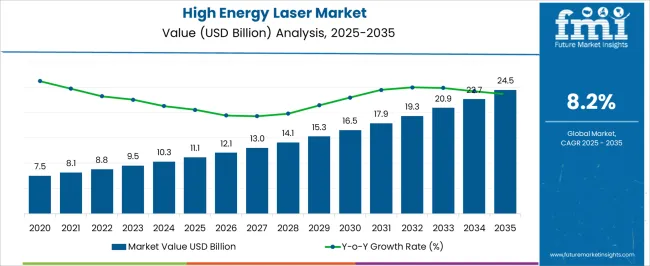
In 2025, the high energy laser market was valued at USD 11.10 billion. Based on Future Market Insights' analysis, demand is estimated to grow to USD 12.01 billion in 2026 and USD 26.41 billion by 2036. FMI projects a CAGR of 8.20% during the forecast period.
The market is set to add approximately USD 14.40 billion in absolute terms between 2026 and 2036. Military counter-drone and short-range air defense applications are the fastest-growing demand segment, with defense ministries in the USA, Germany, UK, and Israel procuring HEL weapon prototypes for fielding by 2028 to 2030. Industrial fiber laser adoption for thick-section metal cutting and additive manufacturing provides the volume manufacturing demand base.
Summary of High Energy Laser Market
- High Energy Laser Market Definition
- High energy lasers (HEL) are directed-energy systems generating continuous or pulsed laser beams at power levels exceeding 10 kW, used in industrial manufacturing (cutting, welding, additive manufacturing), military and defense applications (counter-drone, missile defense, area denial), and medical procedures (lithotripsy, surgical ablation) requiring concentrated energy delivery at range.
- Demand Drivers in the Market
- Defense ministry counter-UAS (unmanned aerial systems) procurement programs in the USA (DE-SHORAD), Germany (Rheinmetall HEL effector), and UK (DragonFire) are transitioning high energy laser weapons from prototype testing to production procurement, creating multi-year defense contract pipelines.
- Industrial fiber laser systems operating at 20 to 100 kW for thick-section steel and aluminum cutting in shipbuilding, heavy equipment manufacturing, and structural steel fabrication generate the largest installed base by unit count.
- Medical HEL applications for holmium laser lithotripsy and thulium fiber laser prostatectomy are expanding beyond urology into orthopedic and neurosurgical applications where precise tissue ablation at controlled energy levels reduces collateral thermal damage.
- Key Segments Analyzed in the FMI Report
- Lethal type: 65.0% share in 2026, reflecting its structural position as the primary category across established procurement channels.
- Solid-State Laser technology: 32.1% share in 2026, reflecting its structural position as the primary category across established procurement channels.
- Manufacturing application: 39.3% share in 2026, reflecting its structural position as the primary category across established procurement channels.
- China: 11.10% compound growth through 2036, indicating concentrated demand acceleration.
- Analyst Opinion at FMI
- Sudip saha, Principal Consultant for Technology analysts observe that The high energy laser market is a dual-use technology category where military defense procurement is driving the highest per-unit revenue while industrial manufacturing generates the largest installed base. FMI analysts observe that lethal applications command 65.0% type share because defense HEL systems carry per-unit price tags exceeding USD 50 million, dwarfing industrial laser system pricing. Solid-state laser technology at 32.1% share leads because diode-pumped solid-state architectures deliver the beam quality and power scaling required for both defense directed-energy and industrial cutting applications. Manufacturing at 39.3% application share reflects the volume demand from fiber laser cutting systems, while military and defense spending generates the highest revenue per unit deployed.
- Strategic Implications / Executive Takeaways
- Defense prime contractors must achieve 100+ kW continuous-wave output with beam quality sufficient for 1 km engagement range to meet counter-drone weapon system performance specifications in current procurement programs.
- Industrial laser system integrators should evaluate 30+ kW fiber laser sources for thick-section cutting applications where plasma and oxy-fuel cutting currently dominate, capturing the productivity and edge quality advantages that HEL cutting delivers.
- Medical device companies should pursue FDA 510(k) clearance for thulium fiber laser surgical platforms to expand HEL medical applications beyond urology into ENT, orthopedic, and neurosurgical specialties.
High Energy Laser Market Key Takeaways
| Metric | Details |
|---|---|
| Industry Size (2026) | USD 12.01 Billion |
| Industry Value (2036) | USD 26.41 Billion |
| CAGR (2026 to 2036) | 8.20% |
Source: Future Market Insights, 2026
As per FMI, country-level growth rates through 2036 are projected as follows: China at 11.10%, India at 10.30%, Germany at 9.40%, France at 8.60%, UK at 7.80%, USA at 7.00%, Brazil at 6.20%. China records the fastest expansion driven by concentrated industry investment.
High Energy Laser Market Definition
The high energy laser market encompasses directed-energy systems operating above 10 kW output power across solid-state, fiber, free electron, chemical, and liquid laser technologies. Applications span industrial manufacturing (metal cutting, welding, additive manufacturing), military defense (counter-UAS, missile defense, area denial), and medical procedures (lithotripsy, surgical ablation). As per FMI, the market is experiencing a defense-driven investment surge where counter-drone weapon procurement is accelerating HEL power scaling and beam director technology development that simultaneously benefits industrial and medical applications.
High Energy Laser Market Inclusions
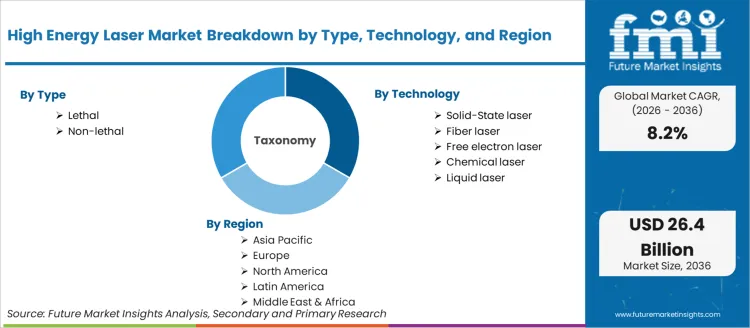
Market scope covers solid-state, fiber, free electron, chemical, and liquid laser systems operating above 10 kW output power for manufacturing, military, defense, and medical applications in lethal and non-lethal configurations.
High Energy Laser Market Exclusions
Low-power laser systems below 10 kW used in telecommunications, barcode scanning, laser pointers, and standard industrial laser marking are excluded. Laser components (diodes, crystals, mirrors) sold separately are outside scope.
High Energy Laser Market Research Methodology
- Primary Research: Analysts conducted structured interviews with procurement managers, product engineers, and distribution channel operators to map purchase decision triggers and specification requirements across key verticals.
- Desk Research: Data collection aggregated regulatory filings, industry standards documentation, patent registries, trade body publications, and company annual reports across all target geographies.
- Market-Sizing and Forecasting: Baseline values derive from a bottom-up aggregation of product shipment volumes and average selling prices, validated against publicly disclosed revenue figures from leading suppliers.
- Data Validation and Update Cycle: Projections are cross-referenced against quarterly earnings data, import-export trade statistics, and industry association production reports to maintain forecast integrity.
Why is the High Energy Laser Market Growing?
The market is experiencing accelerated growth, driven by rising adoption in defense, industrial, and precision manufacturing applications. Advancements in beam control, power scaling, and energy efficiency have enhanced operational reliability and expanded deployment scenarios. Growing demand for cost-effective and high-precision solutions has been supported by technological improvements that allow for reduced maintenance and improved output stability.
Defense modernization programs across multiple regions have fueled demand for both lethal and non-lethal laser systems, while industrial sectors are increasingly leveraging these technologies for high-speed cutting, welding, and material processing. The shift toward directed-energy solutions has also been encouraged by the ability to deliver pinpoint accuracy with minimal collateral impact.
Continued R&D investment, along with cross-sector partnerships, is expected to support new use cases, making high energy lasers more versatile and commercially viable With expanding capabilities and integration into advanced platforms, the market is positioned for sustained long-term growth across multiple sectors.
Segmental Analysis
The high energy laser market is segmented by type, technology, application, and geographic regions. By type, high energy laser market is divided into lethal and non-lethal. In terms of technology, high energy laser market is classified into solid-state laser, fiber laser, free electron laser, chemical laser, and liquid laser. Based on application, high energy laser market is segmented into manufacturing, military & defense, medical, and others. Regionally, the high energy laser industry is classified into North America, Latin America, Western Europe, Eastern Europe, Balkan & Baltic Countries, Russia & Belarus, Central Asia, East Asia, South Asia & Pacific, and the Middle East & Africa.
Insights into the Lethal Type Segment
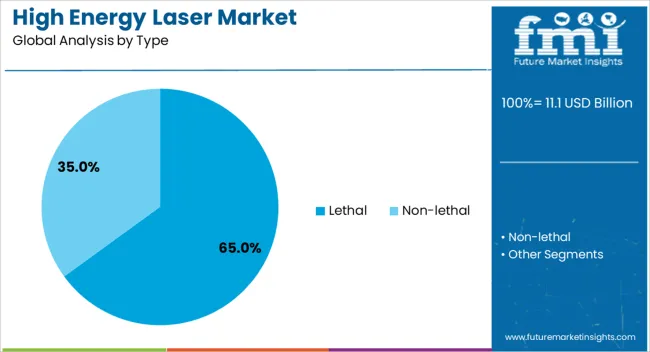
The lethal type segment is projected to hold 65% of the high energy laser market revenue share in 2026, establishing it as the leading type category. This dominance has been driven by the growing emphasis on advanced defense capabilities that offer precision targeting with reduced collateral damage.
Military modernization programs have increasingly prioritized directed-energy systems due to their speed-of-light engagement capabilities and reduced logistical burdens compared to conventional munitions. The lethal category’s rise has also been supported by operational advantages such as deep magazine capacity, lower per-shot costs, and adaptability to different combat environments.
Integration of lethal laser systems into ground, naval, and airborne platforms has been enabled by advancements in compact power sources and improved beam control technologies With ongoing geopolitical tensions and the demand for advanced defense deterrence strategies, lethal high energy lasers have continued to attract substantial government investment, reinforcing their dominant market position.
Insights into the Solid State Laser Technology Segment
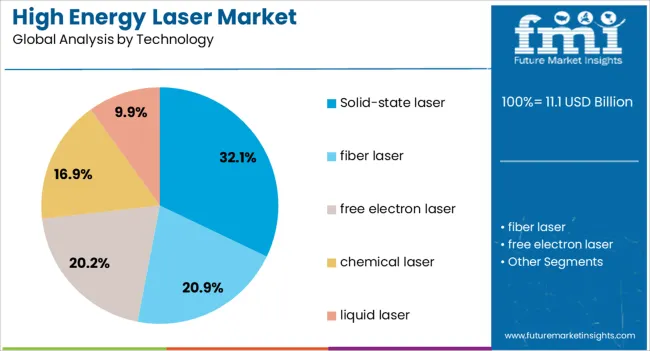
The solid state laser technology segment is expected to account for 32.10% of the market revenue share in 2026, making it the leading technology category. Growth in this segment has been attributed to its higher efficiency, compact size, and operational durability compared to alternative technologies. Solid state lasers have gained preference due to their ability to generate high beam quality while maintaining stable performance in challenging environmental conditions.
The technology supports a range of applications, from military defense systems to industrial manufacturing, by enabling faster targeting and precision material processing. Advancements in thermal management and modular design have further improved their scalability, allowing deployment across multiple platforms.
Reduced operational and maintenance costs, coupled with the ability to integrate with evolving control software, have enhanced their appeal As industries and defense sectors seek reliable and adaptable laser solutions, solid state technology is expected to maintain its leadership in the market.
Insights into the Manufacturing Application Segment
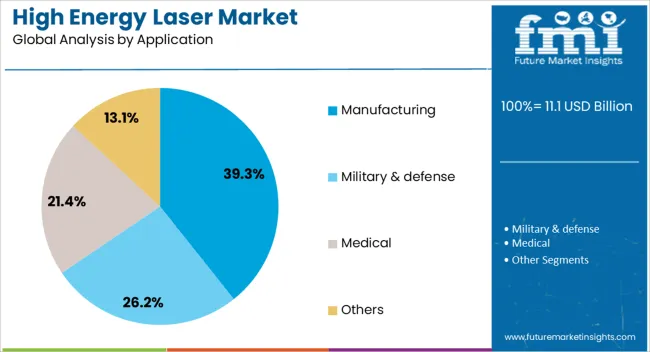
The manufacturing application segment is anticipated to command 39.30% of the market revenue share in 2026, establishing itself as the leading application category. The segment’s growth has been propelled by the increasing demand for high-precision material processing in automotive, aerospace, electronics, and heavy machinery industries. High energy lasers offer unparalleled accuracy, faster processing speeds, and the ability to work with a wide range of materials, which enhances production efficiency.
The adoption of these systems in manufacturing has been reinforced by their ability to deliver consistent quality with minimal waste, supporting cost optimization efforts. Integration with automation and robotics has further expanded their use in advanced production lines.
Continuous technological improvements have enabled better beam control, reduced power consumption, and enhanced compatibility with Industry 4.0 initiatives As manufacturers prioritize productivity, precision, and scalability, high energy lasers are expected to remain an essential tool in modern production environments.
What are the Drivers, Restraints, and Key Trends of the High Energy Laser Market?
The high energy laser market is advancing as defense agencies adopt directed-energy solutions for precision engagement, threat neutralization, and cost efficiency. Opportunities are expanding in aerospace, industrial manufacturing, and research applications, while trends emphasize higher power scaling, modular deployment, and advanced targeting integration. Challenges remain in energy supply, thermal management, and cost barriers. In my opinion, long-term growth will favor companies capable of delivering reliable, mobile, and affordable laser systems, positioning them as critical assets in both military modernization and emerging civilian industries worldwide.
Rising Demand for Defense and Strategic Applications
Demand for high energy lasers has been propelled by their growing role in defense systems, offering precision targeting, rapid engagement, and cost-effective per-shot performance compared to conventional munitions. Defense agencies are prioritizing laser adoption for counter-drone operations, missile interception, and vehicle protection systems. Their ability to neutralize threats with minimal collateral damage makes them highly attractive for military modernization programs. In my opinion, demand will continue to rise as global defense forces seek advanced, reliable, and scalable directed-energy solutions to strengthen security and operational dominance.
Expanding Opportunities in Aerospace and Industrial Uses
Opportunities are emerging beyond defense, with aerospace and industrial sectors showing interest in high energy lasers. Aircraft integration for missile defense and satellite protection is creating new adoption pathways. Industrial opportunities include heavy-duty cutting, welding, and drilling, where lasers deliver higher precision and reduced processing times. Research institutions are also exploring high energy lasers for medical and nuclear fusion applications. I believe companies that diversify offerings across both defense and civilian industries will secure long-term opportunities, benefiting from the expanding scope of laser applications worldwide.
Key Trends in Power Scaling and Mobility Solutions
Trends in the high energy laser market highlight the focus on scaling power output and improving mobility. Defense organizations are moving toward mobile and modular systems that can be deployed on ships, aircraft, and ground vehicles. Industry players are investing in beam-combining technologies to increase range and effectiveness. Another trend is the integration of lasers with advanced tracking and targeting systems for greater accuracy. In my opinion, these developments point toward a decisive shift, where high energy lasers are evolving into adaptable tools suited for multi-domain operations.
Persistent Challenges in Cost and Energy Requirements
Challenges include the high cost of development, complex integration with existing defense platforms, and significant energy requirements. Reliable power supply systems remain critical, especially for mobile platforms where energy storage is limited. Heat management and optical degradation issues also pose hurdles for long-term use. Competition from conventional missile defense systems creates another barrier for broader adoption. In my assessment, overcoming these challenges will require innovations in energy storage, thermal management, and cost-efficient design to ensure high energy lasers become viable alternatives in global defense and industrial markets.
Analysis of High Energy Laser Market By Key Countries
.webp "Top Country Growth Comparison High Energy Laser Market Cagr (2026 2036)")
| Country | CAGR |
|---|---|
| China | 11.1% |
| India | 10.3% |
| Germany | 9.4% |
| France | 8.6% |
| UK | 7.8% |
| USA | 7.0% |
| Brazil | 6.2% |
Source: FMI analysis based on primary research and proprietary forecasting model
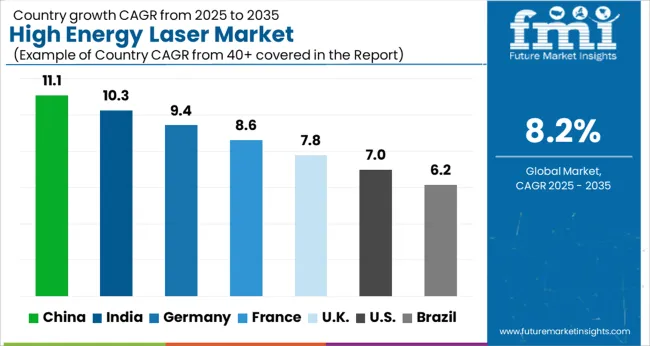
The global high energy laser market is projected to grow at a CAGR of 8.2% from 2026 to 2036. China leads with a growth rate of 11.1%, followed by India at 10.3%, and Germany at 9.4%. The United Kingdom records a growth rate of 7.8%, while the United States shows the slowest growth at 7%. Expansion is being fueled by increasing defense modernization programs, applications in aerospace and industrial manufacturing, and rising interest in directed-energy weapons. Emerging markets such as China and India are recording rapid growth due to escalating defense budgets and technology adoption, while developed markets like the USA, UK, and Germany are emphasizing advanced R&D, integration in combat platforms, and wider industrial applications. This analysis covers insights from 40+ countries, highlighting key markets for reference.
Growth Analysis of High Energy Laser Market in China
The high energy laser market in China is projected to grow at a CAGR of 11.1%. China is investing heavily in directed-energy weapons as part of its defense modernization programs. Significant applications in aerospace, naval defense, and missile interception systems are boosting demand. Beyond defense, industries such as automotive and manufacturing are adopting laser systems for welding, cutting, and precision applications. Continuous state-led funding and collaboration between research institutes and defense contractors are ensuring rapid technological progress and commercial adoption of high energy lasers.
- Defense modernization programs fuel demand for high energy laser weapons.
- Adoption in manufacturing and automotive sectors supports growth.
- Government-backed R&D accelerates innovation and commercialization.
Demand Outlook on High Energy Laser Market in India
The high energy laser market in India is expected to grow at a CAGR of 10.3%. Rising defense expenditure and government-backed projects to develop indigenous laser weapon systems are major drivers. The growing need for border security and missile defense systems further boosts adoption. Expanding aerospace and industrial sectors are integrating high energy lasers for precision-based applications. Collaborations with global defense firms and investments in domestic R&D under the “Make in India” initiative are expected to expand production capacity and enhance India’s market presence.
- Government-backed projects for indigenous laser weapons drive growth.
- Increasing demand for missile defense and border security enhances adoption.
- “Make in India” and global collaborations strengthen domestic capabilities.
Analysis of High Energy Laser Market in Germany
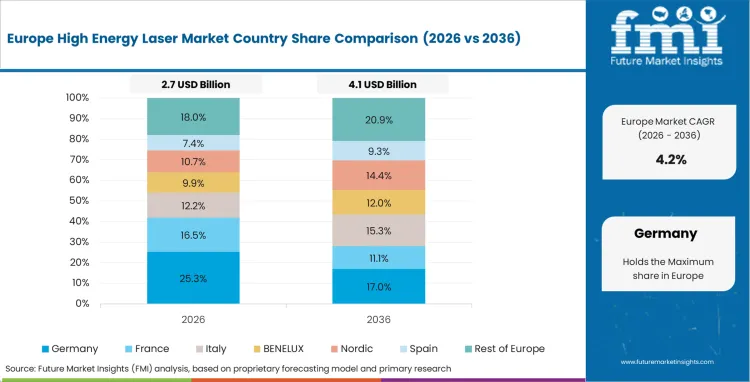
The high energy laser market in Germany is projected to grow at a CAGR of 9.4%. Germany’s strong defense and industrial base is fueling adoption of high energy laser systems. Defense contractors are developing prototypes for naval and land-based directed-energy weapons, focusing on precision and cost efficiency. Industrial applications in automotive, shipbuilding, and precision manufacturing also contribute to demand. Government investments in R&D and collaboration with EU defense projects provide additional growth momentum. Germany’s reputation as a leader in advanced manufacturing and engineering underpins steady market expansion.
- Defense contractors drive innovation in naval and land-based laser systems.
- Industrial adoption in automotive and shipbuilding enhances demand.
- Government and EU-backed R&D projects fuel technology development.
Demand Forecast for High Energy Laser Market in United Kingdom
The high energy laser market in the UK is projected to grow at a CAGR of 7.8%. Defense programs targeting the development of next-generation directed-energy weapons for land and naval forces are the primary drivers. The country is also investing in aerospace applications, where lasers are used for targeting and communications. Industrial adoption is rising gradually, particularly in welding and material processing applications. Research partnerships between universities, defense contractors, and government agencies are ensuring ongoing innovation and market advancement.
- Defense modernization programs fuel adoption of directed-energy weapons.
- Expanding aerospace applications support steady demand for lasers.
- University and defense collaborations strengthen R&D innovation.
High Energy Laser Market Growth Outlook in the United States
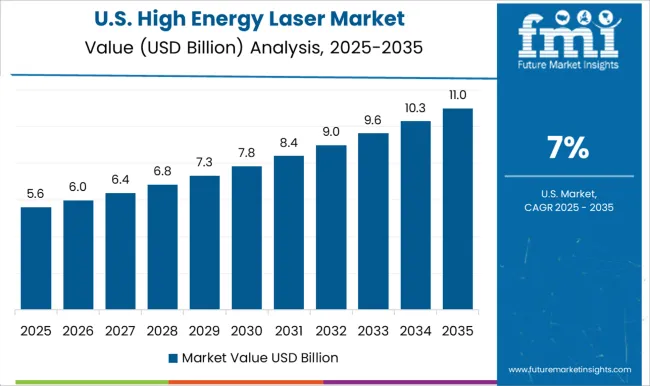
The high energy laser market in the USA is projected to grow at a CAGR of 7%. While slower compared to emerging economies, the USA remains the global leader in R&D and deployment of laser-based defense systems. Significant investments by the Department of Defense in missile interception, drone neutralization, and naval laser platforms are sustaining demand. Industrial applications, including advanced manufacturing, aerospace, and automotive, also contribute to adoption. Strong presence of leading defense contractors and continuous innovation in solid-state and fiber lasers ensure steady expansion, despite a more mature market environment.
- DoD investments in missile defense and naval platforms sustain market growth.
- Industrial adoption in manufacturing and aerospace supports steady demand.
- Leading defense contractors drive innovation in solid-state and fiber lasers.
Competitive Landscape of High Energy Laser Market
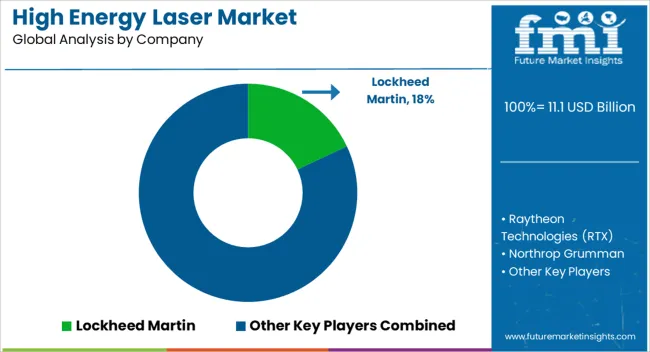
Competition in the high energy laser market has been shaped by defense contractors and advanced technology firms that direct significant resources into directed-energy systems. Lockheed Martin has been regarded as a leader, with extensive work on scalable laser weapon systems that integrate into land, air, and naval platforms. RTX Corporation has been competing by demonstrating high-energy laser systems for vehicle-mounted and ground-based defense, highlighting rapid deployment and battlefield adaptability. Northrop Grumman has been focusing on beam control technologies and integration with missile defense architectures, positioning itself as a key innovator.
BAE Systems has been strengthening its role with modular directed-energy solutions, emphasizing adaptability across different mission requirements. General Dynamics has been contributing through advanced systems integration and research collaborations aimed at making laser weapons practical for combat readiness. Rheinmetall has been expanding its footprint in Europe, where high-energy laser demonstrators for ground and naval defense have been emphasized.
L3Harris has been recognized for contributions in power management, beam combination, and subsystems that enable operational deployment of laser technologies. Other emerging firms and specialized suppliers have been complementing the market by offering components, optics, and subsystems that support these large defense contractors. Strategic positioning among these companies has been influenced by their ability to scale prototypes into deployable solutions while securing defense contracts. Lockheed Martin, RTX Corporation, and Northrop Grumman have been regarded as front-runners, leveraging strong defense ties and advanced research to demonstrate functional, combat-ready laser systems.
BAE Systems and Rheinmetall have been focusing on modular platforms, providing defense agencies with flexibility in integrating lasers into existing vehicles or naval ships. General Dynamics has been emphasizing collaborative approaches, enhancing its credibility through partnerships and integration expertise. L3Harris has been positioned as an essential enabler, supplying technologies that ensure lasers operate efficiently in demanding environments. The competitive field has therefore been shaped by performance validation, contract wins, and integration capability, with long-term leadership granted to companies capable of combining engineering scale with proven battlefield readiness.
Key Players in the High Energy Laser Market
- Lockheed Martin
- RTX Corporation
- Northrop Grumman
- BAE Systems
- General Dynamics
- Rheinmetall
- L3Harris
- Others
Scope of the Report
| Metric | Value |
|---|---|
| Quantitative Units | USD 12.01 Bn to USD 26.41 Bn, at a CAGR of 8.20% |
| Market Definition | High energy lasers (HEL) are directed-energy systems generating continuous or pulsed laser beams at power levels exceeding 10 kW, used in industrial manufacturing (cutting, welding, additive manufacturing), military and defense applications (counter-drone, missile defense, area denial), and medical procedures (lithotripsy, surgical ablation) requiring concentrated energy delivery at range. |
| Type Segmentation | Lethal, Non-lethal |
| Technology Segmentation | Solid-State Laser, Fiber Laser, Free Electron Laser, Chemical Laser, Liquid Laser |
| Application Segmentation | Manufacturing, Military & Defense, Medical, Others |
| Regions Covered | North America, Latin America, Europe, East Asia, South Asia, Oceania, Middle East & Africa |
| Countries Covered | China, India, Germany, France, UK, USA, Brazil, and 40 plus countries |
| Key Companies Profiled | Lockheed Martin, RTX Corporation, Northrop Grumman, BAE Systems, General Dynamics, Rheinmetall, L3Harris |
| Forecast Period | 2026 to 2036 |
| Approach | Hybrid bottom-up and top-down modeling validated against primary research inputs and publicly available industry data. |
High Energy Laser Market by Segments
Type:
- Lethal
- Non-lethal
Technology:
- Solid-state laser
- fiber laser
- free electron laser
- chemical laser
- liquid laser
Application:
- Manufacturing
- Military & defense
- Medical
- Others
Region:
- North America
- USA
- Canada
- Mexico
- Latin America
- Brazil
- Chile
- Rest of Latin America
- Western Europe
- Germany
- UK
- Italy
- Spain
- France
- Nordic
- BENELUX
- Rest of Western Europe
- Eastern Europe
- Russia
- Poland
- Hungary
- Balkan & Baltic
- Rest of Eastern Europe
- East Asia
- China
- Japan
- South Korea
- South Asia and Pacific
- India
- ASEAN
- Australia & New Zealand
- Rest of South Asia and Pacific
- Middle East & Africa
- Kingdom of Saudi Arabia
- Other GCC Countries
- Turkiye
- South Africa
- Other African Union
- Rest of Middle East & Africa
Bibliography
- [1] US Department of Defense. (2024). Directed Energy Weapons Programme: DE-SHORAD Acquisition Update. DOD.
- [2] Rheinmetall AG. (2024). High Energy Laser Effector: Product Development and Testing Programme. Rheinmetall.
- [3] International Organization for Standardization. (2024). ISO 11553: Safety of Machinery, Laser Processing Machines. ISO.
- [4] Lockheed Martin. (2024). Annual Report 2024: Missiles and Fire Control Division. Lockheed Martin.
- [5] International Electrotechnical Commission. (2024). IEC 60825-1: Safety of Laser Products. IEC.
This bibliography is provided for reader reference. The full FMI report contains the complete reference list with primary research documentation.
Frequently Asked Questions
How large is the demand for High Energy Laser in the global market in 2026?
Demand for High Energy Laser in the global market is estimated to be valued at USD 12.01 billion in 2026.
What will be the market size of High Energy Laser by 2036?
Market size for High Energy Laser is projected to reach USD 26.41 billion by 2036.
What is the expected demand growth between 2026 and 2036?
Demand is expected to grow at a CAGR of 8.20% between 2026 and 2036.
Which Type is poised to lead by 2026?
Lethal accounts for 65.0% in 2026.
How significant is Solid-State Laser in driving adoption?
Solid-State Laser represents 32.1% of segment share in 2026.
What country records the fastest growth?
China is projected to grow at a CAGR of 11.10% during 2026 to 2036.
What is the projected growth for India?
India is projected to expand at a CAGR of 10.30% during 2026 to 2036.
What is included in the scope of this report?
Market scope covers solid-state, fiber, free electron, chemical, and liquid laser systems operating above 10 kW output power for manufacturing, military, defense, and medical applications in lethal and non-lethal configurations.
Preview the report firsthand - request a free sample
Get SampleGet the brochure for pricing and purchase details.
Get PDFTable of Content
- Executive Summary
- Global Market Outlook
- Demand-side Trends
- Supply-side Trends
- Technology Roadmap Analysis
- Analysis and Recommendations
- Market Overview
- Market Coverage / Taxonomy
- Market Definition / Scope / Limitations
- Research Methodology
- Chapter Orientation
- Analytical Lens and Working Hypotheses
- Market Structure, Signals, and Trend Drivers
- Benchmarking and Cross-market Comparability
- Market Sizing, Forecasting, and Opportunity Mapping
- Research Design and Evidence Framework
- Desk Research Programme (Secondary Evidence)
- Company Annual and Sustainability Reports
- Peer-reviewed Journals and Academic Literature
- Corporate Websites, Product Literature, and Technical Notes
- Earnings Decks and Investor Briefings
- Statutory Filings and Regulatory Disclosures
- Technical White Papers and Standards Notes
- Trade Journals, Industry Magazines, and Analyst Briefs
- Conference Proceedings, Webinars, and Seminar Materials
- Government Statistics Portals and Public Data Releases
- Press Releases and Reputable Media Coverage
- Specialist Newsletters and Curated Briefings
- Sector Databases and Reference Repositories
- FMI Internal Proprietary Databases and Historical Market Datasets
- Subscription Datasets and Paid Sources
- Social Channels, Communities, and Digital Listening Inputs
- Additional Desk Sources
- Expert Input and Fieldwork (Primary Evidence)
- Primary Modes
- Qualitative Interviews and Expert Elicitation
- Quantitative Surveys and Structured Data Capture
- Blended Approach
- Why Primary Evidence is Used
- Field Techniques
- Interviews
- Surveys
- Focus Groups
- Observational and In-context Research
- Social and Community Interactions
- Stakeholder Universe Engaged
- C-suite Leaders
- Board Members
- Presidents and Vice Presidents
- R&D and Innovation Heads
- Technical Specialists
- Domain Subject-matter Experts
- Scientists
- Physicians and Other Healthcare Professionals
- Governance, Ethics, and Data Stewardship
- Research Ethics
- Data Integrity and Handling
- Primary Modes
- Tooling, Models, and Reference Databases
- Desk Research Programme (Secondary Evidence)
- Data Engineering and Model Build
- Data Acquisition and Ingestion
- Cleaning, Normalisation, and Verification
- Synthesis, Triangulation, and Analysis
- Quality Assurance and Audit Trail
- Market Background
- Market Dynamics
- Drivers
- Restraints
- Opportunity
- Trends
- Scenario Forecast
- Demand in Optimistic Scenario
- Demand in Likely Scenario
- Demand in Conservative Scenario
- Opportunity Map Analysis
- Product Life Cycle Analysis
- Supply Chain Analysis
- Investment Feasibility Matrix
- Value Chain Analysis
- PESTLE and Porter’s Analysis
- Regulatory Landscape
- Regional Parent Market Outlook
- Production and Consumption Statistics
- Import and Export Statistics
- Market Dynamics
- Global Market Analysis 2021 to 2025 and Forecast, 2026 to 2036
- Historical Market Size Value (USD Million) Analysis, 2021 to 2025
- Current and Future Market Size Value (USD Million) Projections, 2026 to 2036
- Y-o-Y Growth Trend Analysis
- Absolute $ Opportunity Analysis
- Global Market Pricing Analysis 2021 to 2025 and Forecast 2026 to 2036
- Global Market Analysis 2021 to 2025 and Forecast 2026 to 2036, By Type
- Introduction / Key Findings
- Historical Market Size Value (USD Million) Analysis By Type , 2021 to 2025
- Current and Future Market Size Value (USD Million) Analysis and Forecast By Type , 2026 to 2036
- Lethal
- Non-lethal
- Lethal
- Y-o-Y Growth Trend Analysis By Type , 2021 to 2025
- Absolute $ Opportunity Analysis By Type , 2026 to 2036
- Global Market Analysis 2021 to 2025 and Forecast 2026 to 2036, By Technology
- Introduction / Key Findings
- Historical Market Size Value (USD Million) Analysis By Technology, 2021 to 2025
- Current and Future Market Size Value (USD Million) Analysis and Forecast By Technology, 2026 to 2036
- Solid-State laser
- Fiber laser
- Free electron laser
- Chemical laser
- Liquid laser
- Solid-State laser
- Y-o-Y Growth Trend Analysis By Technology, 2021 to 2025
- Absolute $ Opportunity Analysis By Technology, 2026 to 2036
- Global Market Analysis 2021 to 2025 and Forecast 2026 to 2036, By Application
- Introduction / Key Findings
- Historical Market Size Value (USD Million) Analysis By Application, 2021 to 2025
- Current and Future Market Size Value (USD Million) Analysis and Forecast By Application, 2026 to 2036
- Manufacturing
- Military & defense
- Medical
- Others
- Manufacturing
- Y-o-Y Growth Trend Analysis By Application, 2021 to 2025
- Absolute $ Opportunity Analysis By Application, 2026 to 2036
- Global Market Analysis 2021 to 2025 and Forecast 2026 to 2036, By Region
- Introduction
- Historical Market Size Value (USD Million) Analysis By Region, 2021 to 2025
- Current Market Size Value (USD Million) Analysis and Forecast By Region, 2026 to 2036
- North America
- Latin America
- Western Europe
- Eastern Europe
- East Asia
- South Asia and Pacific
- Middle East & Africa
- Market Attractiveness Analysis By Region
- North America Market Analysis 2021 to 2025 and Forecast 2026 to 2036, By Country
- Historical Market Size Value (USD Million) Trend Analysis By Market Taxonomy, 2021 to 2025
- Market Size Value (USD Million) Forecast By Market Taxonomy, 2026 to 2036
- By Country
- USA
- Canada
- Mexico
- By Type
- By Technology
- By Application
- By Country
- Market Attractiveness Analysis
- By Country
- By Type
- By Technology
- By Application
- Key Takeaways
- Latin America Market Analysis 2021 to 2025 and Forecast 2026 to 2036, By Country
- Historical Market Size Value (USD Million) Trend Analysis By Market Taxonomy, 2021 to 2025
- Market Size Value (USD Million) Forecast By Market Taxonomy, 2026 to 2036
- By Country
- Brazil
- Chile
- Rest of Latin America
- By Type
- By Technology
- By Application
- By Country
- Market Attractiveness Analysis
- By Country
- By Type
- By Technology
- By Application
- Key Takeaways
- Western Europe Market Analysis 2021 to 2025 and Forecast 2026 to 2036, By Country
- Historical Market Size Value (USD Million) Trend Analysis By Market Taxonomy, 2021 to 2025
- Market Size Value (USD Million) Forecast By Market Taxonomy, 2026 to 2036
- By Country
- Germany
- UK
- Italy
- Spain
- France
- Nordic
- BENELUX
- Rest of Western Europe
- By Type
- By Technology
- By Application
- By Country
- Market Attractiveness Analysis
- By Country
- By Type
- By Technology
- By Application
- Key Takeaways
- Eastern Europe Market Analysis 2021 to 2025 and Forecast 2026 to 2036, By Country
- Historical Market Size Value (USD Million) Trend Analysis By Market Taxonomy, 2021 to 2025
- Market Size Value (USD Million) Forecast By Market Taxonomy, 2026 to 2036
- By Country
- Russia
- Poland
- Hungary
- Balkan & Baltic
- Rest of Eastern Europe
- By Type
- By Technology
- By Application
- By Country
- Market Attractiveness Analysis
- By Country
- By Type
- By Technology
- By Application
- Key Takeaways
- East Asia Market Analysis 2021 to 2025 and Forecast 2026 to 2036, By Country
- Historical Market Size Value (USD Million) Trend Analysis By Market Taxonomy, 2021 to 2025
- Market Size Value (USD Million) Forecast By Market Taxonomy, 2026 to 2036
- By Country
- China
- Japan
- South Korea
- By Type
- By Technology
- By Application
- By Country
- Market Attractiveness Analysis
- By Country
- By Type
- By Technology
- By Application
- Key Takeaways
- South Asia and Pacific Market Analysis 2021 to 2025 and Forecast 2026 to 2036, By Country
- Historical Market Size Value (USD Million) Trend Analysis By Market Taxonomy, 2021 to 2025
- Market Size Value (USD Million) Forecast By Market Taxonomy, 2026 to 2036
- By Country
- India
- ASEAN
- Australia & New Zealand
- Rest of South Asia and Pacific
- By Type
- By Technology
- By Application
- By Country
- Market Attractiveness Analysis
- By Country
- By Type
- By Technology
- By Application
- Key Takeaways
- Middle East & Africa Market Analysis 2021 to 2025 and Forecast 2026 to 2036, By Country
- Historical Market Size Value (USD Million) Trend Analysis By Market Taxonomy, 2021 to 2025
- Market Size Value (USD Million) Forecast By Market Taxonomy, 2026 to 2036
- By Country
- Kingdom of Saudi Arabia
- Other GCC Countries
- Turkiye
- South Africa
- Other African Union
- Rest of Middle East & Africa
- By Type
- By Technology
- By Application
- By Country
- Market Attractiveness Analysis
- By Country
- By Type
- By Technology
- By Application
- Key Takeaways
- Key Countries Market Analysis
- USA
- Pricing Analysis
- Market Share Analysis, 2025
- By Type
- By Technology
- By Application
- Canada
- Pricing Analysis
- Market Share Analysis, 2025
- By Type
- By Technology
- By Application
- Mexico
- Pricing Analysis
- Market Share Analysis, 2025
- By Type
- By Technology
- By Application
- Brazil
- Pricing Analysis
- Market Share Analysis, 2025
- By Type
- By Technology
- By Application
- Chile
- Pricing Analysis
- Market Share Analysis, 2025
- By Type
- By Technology
- By Application
- Germany
- Pricing Analysis
- Market Share Analysis, 2025
- By Type
- By Technology
- By Application
- UK
- Pricing Analysis
- Market Share Analysis, 2025
- By Type
- By Technology
- By Application
- Italy
- Pricing Analysis
- Market Share Analysis, 2025
- By Type
- By Technology
- By Application
- Spain
- Pricing Analysis
- Market Share Analysis, 2025
- By Type
- By Technology
- By Application
- France
- Pricing Analysis
- Market Share Analysis, 2025
- By Type
- By Technology
- By Application
- India
- Pricing Analysis
- Market Share Analysis, 2025
- By Type
- By Technology
- By Application
- ASEAN
- Pricing Analysis
- Market Share Analysis, 2025
- By Type
- By Technology
- By Application
- Australia & New Zealand
- Pricing Analysis
- Market Share Analysis, 2025
- By Type
- By Technology
- By Application
- China
- Pricing Analysis
- Market Share Analysis, 2025
- By Type
- By Technology
- By Application
- Japan
- Pricing Analysis
- Market Share Analysis, 2025
- By Type
- By Technology
- By Application
- South Korea
- Pricing Analysis
- Market Share Analysis, 2025
- By Type
- By Technology
- By Application
- Russia
- Pricing Analysis
- Market Share Analysis, 2025
- By Type
- By Technology
- By Application
- Poland
- Pricing Analysis
- Market Share Analysis, 2025
- By Type
- By Technology
- By Application
- Hungary
- Pricing Analysis
- Market Share Analysis, 2025
- By Type
- By Technology
- By Application
- Kingdom of Saudi Arabia
- Pricing Analysis
- Market Share Analysis, 2025
- By Type
- By Technology
- By Application
- Turkiye
- Pricing Analysis
- Market Share Analysis, 2025
- By Type
- By Technology
- By Application
- South Africa
- Pricing Analysis
- Market Share Analysis, 2025
- By Type
- By Technology
- By Application
- USA
- Market Structure Analysis
- Competition Dashboard
- Competition Benchmarking
- Market Share Analysis of Top Players
- By Regional
- By Type
- By Technology
- By Application
- Competition Analysis
- Competition Deep Dive
- Lockheed Martin
- Overview
- Product Portfolio
- Profitability by Market Segments (Product/Age /Sales Channel/Region)
- Sales Footprint
- Strategy Overview
- Marketing Strategy
- Product Strategy
- Channel Strategy
- RTX Corporation
- Northrop Grumman
- BAE Systems
- General Dynamics
- Rheinmetall
- L3Harris
- Others
- Lockheed Martin
- Competition Deep Dive
- Assumptions & Acronyms Used


