


Enterprise Data Observability Software Market
This report covers the Enterprise Data Observability Software market through analysis of market size, revenue forecast, competitive landscape, demand outlook, growth drivers, restraints, deployment type trends, application analysis, supply chain developments, strategic growth opportunities.
Historical Data Covered: 2016 to 2024 | Base Year: 2025 | Estimated Year: 2026 | Forecast Period: 2027 to 2036
Enterprise Data Observability Software Market Size, Market Forecast and Outlook By FMI
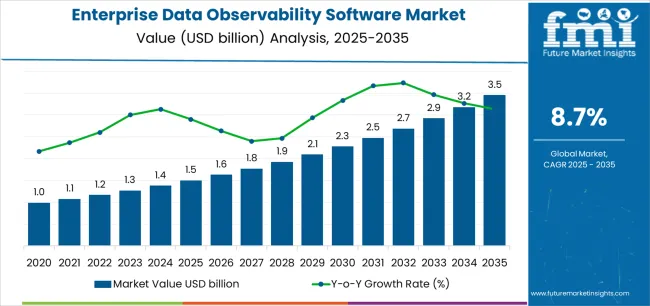
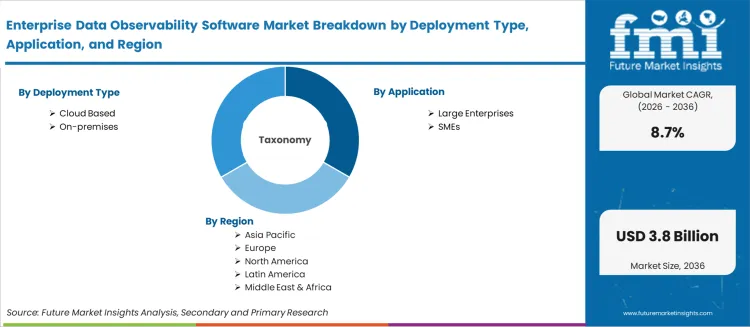
The enterprise data observability software market was valued at USD 1.50 billion in 2025, projected to reach USD 1.63 billion in 2026, and is forecast to expand to USD 3.76 billion by 2036 at a 8.7% CAGR. Expanding enterprise data infrastructure complexity, rising data quality governance requirements, and growing dependence on data pipelines for AI model training and business intelligence are driving adoption of data observability platforms that provide automated monitoring, anomaly detection, and root cause analysis across data ecosystems. As per FMI, the transition from reactive data quality firefighting toward proactive, automated data observability is the primary technology shift reshaping data engineering team procurement priorities.
Summary of Enterprise Data Observability Software Market
- Market Overview
- The market is valued at USD 1.50 billion in 2025 and is projected to reach USD 3.76 billion by 2036.
- The industry is expected to grow at a 8.7% CAGR from 2026 to 2036, creating an incremental opportunity of USD 2.13 billion.
- The market is an enterprise data infrastructure software category where cloud data stack integration depth, anomaly detection accuracy, and data lineage visualization capability define competitive positioning.
- Demand and Growth Drivers
- Demand is accelerating as enterprise data pipeline complexity increases and organizations discover that AI model failures and analytics errors trace to undetected data quality anomalies.
- Data governance regulatory requirements are creating mandatory quality monitoring obligations that manual testing approaches cannot satisfy at enterprise scale.
- Cloud-native data stack adoption is driving preference for observability platforms that integrate natively with cloud data warehouses, lake houses, and orchestration tools.
- Among countries, China (11.7% CAGR), India (10.9% CAGR), Germany (10% CAGR), Brazil (9.1% CAGR), USA (8.3% CAGR), UK (7.4% CAGR), Japan (6.5% CAGR).
- Product and Segment View
- Cloud Based leads by Deployment Type with 53.6% share in 2026.
- Large Enterprises leads by Application with 78% share in 2026.
- Geography and Competitive Outlook
- China and India are the fastest growing markets, while mature economies sustain demand through compliance, technology upgrade, and replacement procurement cycles.
- Key players include Monte Carlo, Acceldata, Bigeye, Soda.io, IBM, Great Expectations, Cribl.
- Analyst Opinion at FMI
- 'Consultant Name', Principal Consultant for Data Technology, opines: 'In my analysis, I have observed that data observability is transitioning from a nice-to-have monitoring layer to a mandatory component of enterprise data infrastructure as organizations discover that downstream AI model failures and business intelligence errors trace back to undetected data pipeline anomalies. Data engineering teams deploying complex multi-source pipelines without automated observability face escalating incident response costs that exceed annual platform subscription fees within the first major data quality incident.'
- Strategic Implications / Executive Takeaways
- Data observability platform vendors must deliver native integrations with leading cloud data warehouses, lake house architectures, and orchestration tools to achieve zero-friction deployment within existing enterprise data stacks.
- Chief data officers should mandate data observability deployment as a prerequisite for production data pipeline certification to prevent downstream analytics and AI model failures from undetected data quality degradation.
- Data engineering teams need to implement automated data quality SLA monitoring through observability platforms to shift from reactive incident response to proactive anomaly prevention across critical business data pipelines.
The incremental opportunity of USD 2.13 billion between 2026 and 2036 reflects cumulative growth in enterprise data pipeline complexity, expanding data quality governance mandates from regulatory and business stakeholders, and rising AI/ML model training requirements where input data quality directly impacts model performance. Cloud-based deployment leads at 53.6% because modern data stacks are increasingly cloud-native and observability platforms must integrate with cloud data warehouses, lake houses, and ETL/ELT orchestration tools. Large enterprises dominate at 78% application share because they operate the most complex data estates with hundreds of interconnected pipelines where manual monitoring is infeasible.
All major regional markets reflect differentiated growth trajectories. China leads with a 11.7% CAGR, India follows at 10.9%, Germany follows at 10%, Brazil follows at 9.1%, USA follows at 8.3%, UK follows at 7.4%, and Japan registers 6.5% growth. China's lead growth rate reflects its expanding enterprise data infrastructure investment and growing cloud data platform adoption. India's pace is driven by IT services sector data engineering capability expansion and enterprise digital transformation programs. Germany maintains growth through data governance compliance requirements under GDPR and financial regulatory frameworks. The USA and UK contribute through advanced data stack adoption and AI/ML model governance requirements that mandate data input quality monitoring.
Enterprise Data Observability Software Market Key Takeaways
| Metric | Details |
|---|---|
| Industry Size (2026) | USD 1.63 Billion |
| Industry Value (2036) | USD 3.76 Billion |
| CAGR (2026 to 2036) | 8.7% |
Source: Future Market Insights, 2026
Enterprise Data Observability Software Market Definition
The enterprise data observability software market encompasses platforms that provide automated monitoring, anomaly detection, lineage tracking, and root cause analysis for enterprise data pipelines, warehouses, and lake architectures. Deployment types include cloud-based and on-premises configurations. These platforms serve large enterprises and SMEs by providing visibility into data freshness, volume, schema changes, and distribution anomalies across the data estate to prevent downstream analytics and AI model failures.
Enterprise Data Observability Software Market Inclusions
Market scope includes data observability software platforms sold across cloud and on-premises deployment types for large enterprise and SME applications. Global and regional market sizes, deployment type and application segment breakdowns, and forecast projections from 2026 to 2036 are covered.
Enterprise Data Observability Software Market Exclusions
The scope excludes general application performance monitoring (APM) tools without data pipeline specific capability, standalone data catalog platforms, data integration/ETL tools, and business intelligence dashboards without underlying data quality monitoring functions.
Enterprise Data Observability Software Market Research Methodology
- Primary Research: Analysts engaged with data engineering team leads, chief data officers, and data platform architecture directors to map observability platform selection criteria, data stack integration requirements, and data quality governance workflows.
- Desk Research: Data collection aggregated published enterprise data infrastructure surveys, data engineering hiring and tooling trend reports, cloud data platform adoption statistics, and data governance regulatory requirement databases.
- Market Sizing and Forecasting: Baseline values derive from a bottom up aggregation of enterprise data observability software procurement volumes by segment, applying regional pricing benchmarks and adoption rates to project market growth.
- Data Validation and Update Cycle: Projections are tested against published manufacturer revenue disclosures, industry association statistics, and regulatory compliance adoption surveys.
Why is the Enterprise Data Observability Software Market Growing?
Market expansion is being supported by the increasing global complexity of enterprise data architectures driven by cloud migration and modern data stack adoption, alongside the corresponding need for comprehensive monitoring solutions that can detect data quality issues, prevent pipeline failures, and maintain analytics reliability across various cloud data platforms, real-time streaming systems, and distributed data processing applications. Modern data engineering teams and analytics organizations are increasingly focused on implementing data observability solutions that can provide proactive anomaly detection, deliver automated incident alerting, and ensure consistent data quality in demanding production environments.
The growing emphasis on data-driven decision making and analytics trustworthiness is driving demand for enterprise data observability software that can support automated data quality monitoring, enable rapid incident resolution, and ensure comprehensive visibility across complex data pipelines. Technology organizations' preference for observability platforms that combine automated anomaly detection with root cause analysis capabilities and operational efficiency is creating opportunities for innovative data observability implementations. The rising influence of artificial intelligence applications and machine learning model deployment is also contributing to increased adoption of data observability software that can provide superior data quality assurance without compromising pipeline performance or development velocity.
What Is the Market Segmentation for Enterprise Data Observability Software Market?
The market is segmented by deployment type, application, and region. By deployment type, the market is divided into cloud based and on-premises. Based on application, the market is categorized into large enterprises and SMEs. Regionally, the market is divided into East Asia, Europe, North America, South Asia, Latin America, Middle East & Africa, and Eastern Europe.
By Deployment Type, the Cloud Based Segment Leads the Market
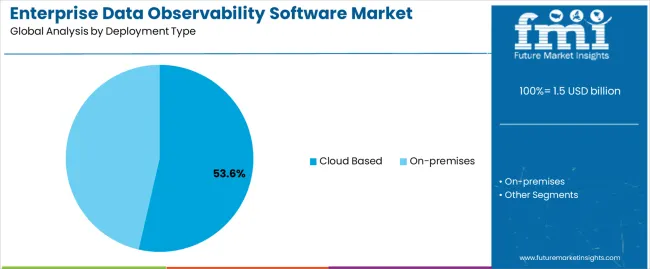
The cloud based segment is projected to maintain its leading position in the enterprise data observability software market in 2026 with a 53.6% market share, reaffirming its role as the preferred deployment model for modern data observability implementations and cloud-native data platform monitoring. Data engineering teams and platform architects increasingly utilize cloud-based data observability software for its rapid deployment capabilities, seamless integration with cloud data platforms, and proven effectiveness in monitoring distributed data systems while maintaining scalability and operational flexibility. Cloud based deployment technology's proven effectiveness and implementation versatility directly address the industry requirements for agile data quality monitoring and comprehensive observability coverage across diverse cloud data warehouses and data lake environments.
This deployment segment forms the foundation of modern data observability strategies, as it represents the approach with the greatest contribution to deployment velocity and established integration capabilities across multiple cloud platforms and data processing frameworks. Technology industry investments in cloud-native data infrastructure continue to strengthen adoption among data teams and platform operators. With architectural trends requiring elastic observability scaling and improved monitoring coverage, cloud-based enterprise data observability software aligns with both operational agility objectives and cost efficiency requirements, making it the central component of comprehensive data reliability strategies.
By Application, the Large Enterprises Segment Dominates Market Demand
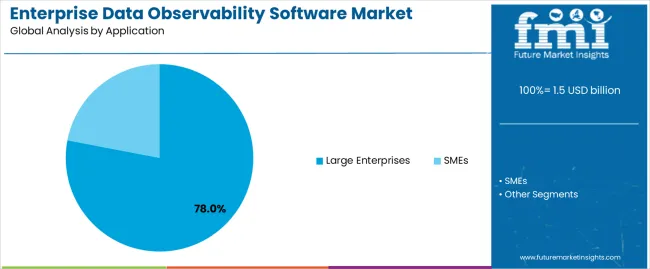
The large enterprises application segment is projected to represent the largest share of enterprise data observability software demand in 2026 with a 78% market share, underscoring its critical role as the primary driver for platform adoption across Fortune 500 companies, global technology firms, and established corporations operating complex data ecosystems. Large enterprise organizations prefer data observability software due to its ability to monitor extensive data infrastructure, detect quality issues across numerous data pipelines, and support enterprise-scale data operations while enabling centralized monitoring and governance capabilities. Positioned as essential platforms for modern enterprise data management, data observability software offers both operational risk mitigation and analytics reliability assurance.
The segment is supported by continuous expansion in enterprise data volumes and the growing complexity of data architectures that necessitate sophisticated monitoring capabilities with enhanced anomaly detection and comprehensive lineage tracking. Additionally, large enterprises are investing in data observability platforms to support increasingly critical data-driven operations and organizational demands for trusted analytics powering business decisions across multiple functions and regions. As data infrastructure complexity increases and analytics dependence grows, the large enterprises application will continue to dominate the market while supporting advanced observability adoption and data quality optimization strategies.
What are the Drivers, Restraints, and Key Trends of the Enterprise Data Observability Software Market?
The enterprise data observability software market is advancing steadily due to increasing complexity of modern data architectures driven by cloud migration and microservices adoption and growing implementation of data quality requirements that necessitate platforms providing automated anomaly detection and proactive monitoring capabilities across diverse cloud data warehouses, streaming data platforms, and machine learning pipelines. However, the market faces challenges, including integration complexity with legacy data systems and diverse technology stacks, skills gaps related to data observability implementation and interpretation, and competition from traditional data quality tools and application performance monitoring solutions. Innovation in machine learning-based anomaly detection and automated root cause analysis continues to influence product development and market expansion patterns.
Expansion of Cloud Data Platform Adoption and Modern Data Stack
The growing migration to cloud data platforms is driving demand for observability solutions that address unique monitoring challenges including distributed data processing, multi-cloud data movement, and real-time streaming analytics requiring continuous quality verification. Modern data stack implementations require sophisticated data observability software that delivers comprehensive monitoring across diverse data technologies while supporting agile development practices and operational efficiency objectives. Data platform teams are increasingly recognizing the operational advantages of data observability integration for preventing data incidents and maintaining analytics reliability, creating opportunities for cloud-native monitoring platforms specifically designed for Snowflake, Databricks, BigQuery, and other modern data warehouse environments.
Integration of Artificial Intelligence and Machine Learning Capabilities
Modern enterprise data observability software providers are incorporating artificial intelligence algorithms and machine learning models to enhance anomaly detection accuracy, reduce false positive alerts, and support comprehensive data quality management through intelligent pattern recognition and predictive issue detection. Leading companies are developing platforms with automated threshold learning, implementing behavior-based anomaly detection, and advancing root cause analysis capabilities that provide actionable insights and resolution guidance. These technologies improve operational efficiency while enabling new capabilities, including predictive data quality forecasting, automated incident classification, and intelligent alert routing. Advanced AI integration also allows data teams to support comprehensive data reliability objectives and operational excellence beyond traditional rule-based monitoring approaches.
Development of Data Lineage and Impact Analysis Capabilities
The expansion of complex data transformation workflows and increasing need for understanding data dependencies is driving development of advanced data lineage tracking and downstream impact analysis capabilities within observability platforms. These advanced applications require comprehensive metadata collection and sophisticated graph analysis technologies that enable visualization of data flows and assessment of issue impacts, creating premium market segments with differentiated value propositions. Providers are investing in metadata extraction technologies and lineage visualization systems to serve organizations requiring detailed dependency understanding while supporting innovation in data governance, compliance reporting, and change impact assessment capabilities.
How Does the Demand for Enterprise Data Observability Software Market Vary Across Countries?
.webp "Top Country Growth Comparison Enterprise Data Observability Software Market Cagr (2026 2036)")
| Country | CAGR (2026-2036) |
|---|---|
| China | 11.7% |
| India | 10.9% |
| Germany | 10% |
| Brazil | 9.1% |
| United States | 8.3% |
| United Kingdom | 7.4% |
| Japan | 6.5% |
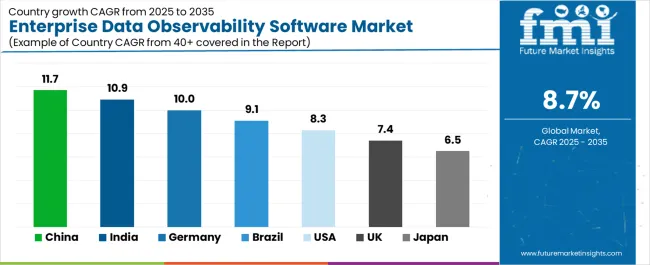
The enterprise data observability software market is experiencing solid growth globally, with China leading at a 11.7% CAGR through 2036, driven by rapid digital transformation, expanding cloud infrastructure adoption, and increasing emphasis on data-driven business operations across technology companies and financial services. India follows at 10.9%, supported by growing technology sector, expanding data analytics adoption, and increasing investments in cloud-based data platforms among enterprises and digital-native companies. Germany shows growth at 10%, emphasizing data governance requirements, manufacturing sector digitalization, and strong enterprise software adoption supporting advanced data management practices. Brazil demonstrates 9.1% growth, supported by digital banking expansion, e-commerce growth, and increasing cloud adoption requiring data quality assurance capabilities. The United States records 8.3%, focusing on mature data infrastructure, extensive cloud data platform adoption, and established DataOps practices among technology companies and data-driven enterprises. The United Kingdom exhibits 7.4% growth, emphasizing financial services technology advancement, cloud migration initiatives, and data governance regulatory requirements. Japan shows 6.5% growth, supported by enterprise digital transformation, manufacturing sector data initiatives, and quality-focused data management practices.
The report covers an in-depth analysis of 40+ countries, top-performing countries are highlighted below.
How Does the Demand for Enterprise Data Observability Software Market Perform in China?
Revenue from enterprise data observability software in China is projected to exhibit exceptional growth with a CAGR of 11.7% through 2036, driven by massive digital transformation initiatives and rapidly expanding cloud infrastructure adoption supported by government digitalization policies and technology sector innovation programs. The country's large technology sector and increasing investment in data analytics capabilities are creating substantial demand for data observability solutions. Major cloud platform providers and enterprise software companies are establishing comprehensive data observability offerings to serve both domestic technology companies and multinational enterprises.
- Government support for digital economy development and cloud computing adoption is driving demand for enterprise data observability software throughout major technology hubs and innovation zones across internet companies, financial technology firms, and e-commerce platforms.
- Strong cloud data platform adoption and an expanding network of data-driven enterprises are supporting the rapid implementation of data observability technologies among organizations seeking reliable analytics infrastructure and data quality assurance.
What Are the Trends in the Demand for Enterprise Data Observability Software Market in India?
Revenue from enterprise data observability software in India is expanding at a CAGR of 10.9%, supported by the country's rapidly growing technology sector, expanding data analytics adoption, and increasing cloud platform implementation among enterprises and digital-native organizations. The country's comprehensive software development capabilities and rising data maturity are driving sophisticated data observability adoption throughout diverse industry sectors. Leading technology companies and cloud service providers are establishing data observability product offerings and implementation services to address growing market demand.
- Rising technology sector growth and expanding digital services are creating opportunities for enterprise data observability software adoption across software companies, financial services firms, and e-commerce platforms in major technology centers.
- Growing cloud migration initiatives and increasing data analytics investments under digital India programs are driving adoption of data quality monitoring platforms among enterprises seeking reliable data infrastructure and analytics trustworthiness.
How Is the Demand for Enterprise Data Observability Software Market Evolving in Germany?
Revenue from enterprise data observability software in Germany is expanding at a CAGR of 10%, supported by the country's strong data governance requirements, manufacturing sector digitalization initiatives, and comprehensive enterprise software adoption supporting advanced data management practices. The nation's technological capabilities and quality emphasis are driving sophisticated data observability implementations throughout industrial and enterprise sectors. Leading enterprise software companies and consulting firms are investing extensively in data observability platform integration and implementation expertise.
- Advanced data governance requirements and Industry 4.0 initiatives are creating demand for enterprise data observability software among manufacturing enterprises seeking reliable data infrastructure for analytics and operational intelligence applications.
- Strong enterprise software market and emphasis on data quality are supporting the adoption of comprehensive data monitoring platforms in financial services and industrial companies throughout major business centers.
What Is the Outlook for Enterprise Data Observability Software Market in Brazil?
Revenue from enterprise data observability software in Brazil is expanding at a CAGR of 9.1%, supported by the country's expanding digital banking sector, growing e-commerce platforms, and increasing cloud adoption requiring data quality assurance capabilities. Brazil's digital economy growth and improving technology infrastructure are driving demand for data observability solutions. Technology vendors and system integrators are investing in market development to serve both financial services and digital commerce sectors.
- Digital banking expansion and financial technology innovation are creating demand for enterprise data observability software among banks and fintech companies seeking reliable data infrastructure for customer analytics and risk management applications.
- Growing e-commerce sector and cloud infrastructure adoption are driving implementation of data monitoring platforms in retail technology companies across major metropolitan areas.
How Does the Demand for Enterprise Data Observability Software Market Vary in the United States?
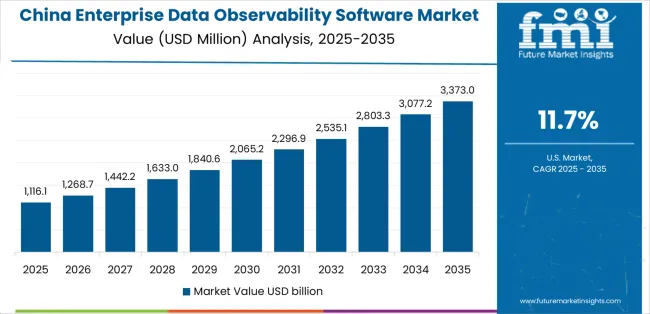
Revenue from enterprise data observability software in the United States is expanding at a CAGR of 8.3%, supported by the country's mature data infrastructure, extensive cloud data platform adoption, and established DataOps practices among technology companies and data-driven enterprises. The nation's technology leadership and data-centric business models are driving demand for advanced data observability platforms. Software vendors and platform providers are investing in product innovation and market expansion to serve diverse enterprise requirements.
- Extensive cloud data warehouse adoption and established data engineering practices are creating demand for enterprise data observability software among technology companies seeking proactive data quality monitoring and incident prevention capabilities.
- Strong data-driven enterprise culture and growing machine learning deployment are driving adoption of comprehensive observability platforms in organizations across technology, financial services, and retail sectors.
How Is the Demand for Enterprise Data Observability Software Market Performing in the United Kingdom?
Revenue from enterprise data observability software in the United Kingdom is expanding at a CAGR of 7.4%, supported by the country's financial services technology advancement, cloud migration initiatives, and data governance regulatory requirements driving data quality monitoring adoption. The UK's financial sector sophistication and technology innovation are driving demand for data observability solutions. Software vendors and consulting firms are establishing data observability implementation practices and technical expertise.
- Financial services technology advancement and regulatory compliance requirements are creating opportunities for enterprise data observability software throughout banking institutions, insurance companies, and fintech organizations across London and regional financial centers.
- Cloud migration initiatives and data governance emphasis are supporting the adoption of data monitoring platforms in enterprises seeking data quality assurance and analytics reliability across diverse industry sectors.
What Are the Trends in the Demand for Enterprise Data Observability Software Market in Japan?
Revenue from enterprise data observability software in Japan is expanding at a CAGR of 6.5%, supported by the country's enterprise digital transformation initiatives, manufacturing sector data programs, and quality-focused data management practices among established corporations. Japan's technological sophistication and operational excellence culture are driving demand for reliable data observability platforms. Software providers and system integrators are investing in product localization and implementation expertise for Japanese enterprise requirements.
- Enterprise digital transformation programs and manufacturing sector data initiatives are creating demand for data observability software throughout corporations seeking reliable data infrastructure for analytics and operational intelligence applications.
- Strong quality management culture and comprehensive enterprise technology adoption are driving implementation of data monitoring platforms in organizations meeting stringent data reliability and operational standards.
What Is the Europe Market Split for Enterprise Data Observability Software Market by Country?
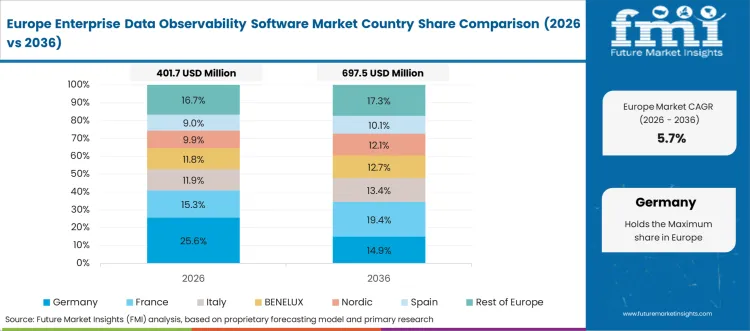
The enterprise data observability software market in Europe is projected to grow from USD 531.3 million in 2026 to USD 1.2 billion by 2036, registering a CAGR of 8.6% over the forecast period. Germany is expected to maintain leadership with a 27.8% market share in 2026, moderating to 27.5% by 2036, supported by strong enterprise software adoption, manufacturing sector digitalization, and comprehensive data governance frameworks.
France follows with 19.5% in 2026, projected at 19.7% by 2036, driven by financial services technology, cloud migration initiatives, and data governance regulatory compliance. The United Kingdom holds 17.3% in 2026, reaching 17% by 2036 on the back of financial services technology advancement and digital transformation programs. Italy commands 13.2% in 2026, rising slightly to 13.4% by 2036, while Spain accounts for 10.1% in 2026, reaching 10.3% by 2036 aided by digital banking growth and enterprise cloud adoption. The Netherlands maintains 5.6% in 2026, up to 5.7% by 2036 due to technology sector concentration and data-driven business practices. The Rest of Europe region, including Nordics, Central & Eastern Europe, and other markets, is anticipated to hold 6.5% in 2026 and 6.4% by 2036, reflecting steady development in enterprise data infrastructure, cloud platform adoption, and data quality monitoring implementation.
What Is the Competitive Landscape of the Enterprise Data Observability Software Market?
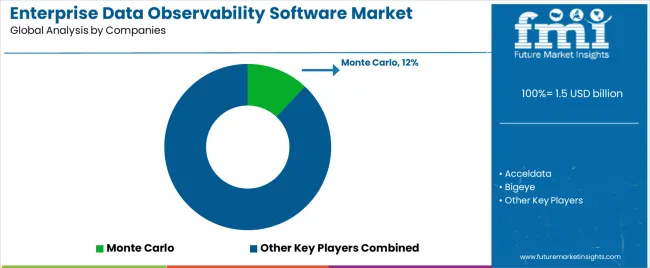
The enterprise data observability software market is characterized by competition among specialized data observability startups, established enterprise software companies, and cloud platform providers. Companies are investing in machine learning algorithm development, platform integration capabilities, user experience enhancement, and customer success programs to deliver intelligent, comprehensive, and actionable data observability solutions. Innovation in automated anomaly detection, data lineage visualization, and incident management workflows is central to strengthening market position and competitive advantage.
Monte Carlo leads the market with comprehensive data observability platform focusing on automated anomaly detection, data lineage tracking, and incident management across cloud data warehouses and data lakes. Acceldata provides multi-layered data observability solutions with emphasis on performance monitoring and data reliability assurance. Bigeye offers user-friendly data quality monitoring with focus on automated anomaly detection and SQL-based metric definition. Soda.io delivers data quality testing and monitoring with emphasis on data contract verification and collaborative workflows. IBM provides enterprise-grade data quality and observability capabilities integrated with comprehensive data management platforms. Great Expectations specializes in open-source data validation and documentation frameworks.
Additional market participants include Cribl, Lightup, Informatica, Cisco, AWS, Datadog, Dynatrace, Elastic, New Relic, Splunk, StackState, Pantomath, Telmai, Apica, Greptime, Integrate.io, Metaplane, Precisely, Sifflet, and Synq, each contributing specialized expertise in data monitoring technologies, integration capabilities, and industry-specific solutions.
Enterprise Data Observability Software Market - Stakeholder Contribution Framework
Enterprise data observability software represents a rapidly growing data infrastructure category within enterprise technology and analytics platforms, projected to grow from USD 1.5 billion in 2025 to USD 3.6 billion by 2035 at a 8.7% CAGR. These specialized monitoring platforms, providing comprehensive visibility into data pipeline health and quality issues, serve as critical infrastructure for data engineering teams, analytics organizations, and data-driven enterprises where data reliability, pipeline monitoring, and analytics trustworthiness are paramount. Market expansion is driven by increasing data architecture complexity, growing cloud data platform adoption, expanding machine learning applications, and rising demand for proactive data quality management across diverse technology companies, financial services firms, and enterprise organizations.
How Technology Regulators Could Strengthen Data Quality Standards and Governance Requirements?
- Data Quality Standards: Establish industry-specific requirements for data quality monitoring and validation, including accuracy thresholds, completeness verification, and timeliness standards that ensure reliable data for critical business applications and regulatory reporting.
- Observability Framework Guidelines: Develop regulatory guidance for data observability implementation, addressing monitoring coverage requirements, incident response protocols, and documentation standards that support data governance and accountability objectives.
- Transparency and Audit Requirements: Implement mandatory audit trail capabilities for data quality monitoring, requiring comprehensive logging of data issues, resolution actions, and quality metrics that enable regulatory oversight and internal governance.
- Integration Standards: Create technical standards for data observability platform integration with data catalogs, governance platforms, and compliance systems that enable comprehensive data management and regulatory compliance.
- Certification Programs: Establish vendor certification frameworks for data observability platforms addressing security standards, data privacy compliance, and functional capabilities that support enterprise procurement and technology selection.
How Industry Associations Could Advance Best Practices and Implementation Standards?
- Implementation Guidelines: Develop comprehensive recommendations for data observability platform selection, deployment strategies, and organizational adoption that maximize monitoring effectiveness, ensure proper coverage, and maintain operational efficiency across diverse data environments.
- Maturity Assessment Frameworks: Establish industry benchmarks for data observability maturity, including coverage metrics, incident response effectiveness, and organizational adoption levels that enable comparative analysis and continuous improvement.
- Technical Training Programs: Create specialized education initiatives for data engineers, analytics professionals, and platform administrators covering observability concepts, platform implementation, and incident resolution techniques across modern data technologies.
- Integration Standards: Develop standardized approaches for connecting data observability platforms with data processing frameworks, orchestration tools, and business intelligence systems that facilitate ecosystem integration and comprehensive monitoring.
- Knowledge Sharing Forums: Facilitate information exchange between practitioners, platform vendors, and consulting firms to advance implementation understanding, address adoption challenges, and accelerate data observability best practices.
How Enterprise Data Observability Software Providers Could Drive Innovation and Market Leadership?
- Machine Learning Innovation: Invest in advanced machine learning algorithms for anomaly detection, automated threshold learning, and predictive issue identification that improve detection accuracy while reducing false positives and operational overhead.
- Integration Ecosystem Development: Develop comprehensive integration capabilities with cloud data platforms, orchestration tools, and business intelligence systems through native connectors, APIs, and partnership programs that enable seamless deployment and broad monitoring coverage.
- User Experience Enhancement: Implement intuitive interfaces, customizable dashboards, and collaborative workflows that enable rapid issue investigation, efficient incident resolution, and effective cross-team communication for data quality management.
- Customer Success Programs: Establish comprehensive implementation support, best practice guidance, and ongoing optimization services that strengthen customer relationships and ensure successful platform adoption and value realization.
- Open Standards Support: Contribute to open-source projects, participate in standards development, and provide interoperable solutions that support customer flexibility and prevent vendor lock-in while building ecosystem partnerships.
How Enterprise Organizations Could Optimize Data Observability Implementation?
- Strategic Platform Selection: Conduct comprehensive evaluations of monitoring requirements, technology compatibility, scalability needs, and vendor capabilities to select appropriate data observability platforms that align with organizational objectives and technical architecture.
- Phased Implementation Approach: Implement systematic deployment strategies starting with critical data pipelines, expanding coverage progressively, and establishing organizational processes that ensure successful adoption and sustained value delivery.
- Cross-Functional Collaboration: Establish partnerships between data engineering teams, analytics organizations, and business stakeholders for shared understanding of data quality requirements, collaborative incident resolution, and comprehensive data reliability objectives.
- Metrics and Governance: Define data quality metrics, establish monitoring standards, and implement governance processes that provide accountability, track improvement progress, and demonstrate observability value to organizational leadership.
- Continuous Optimization: Create improvement programs including regular coverage assessments, alert tuning initiatives, and capability expansion that enhance monitoring effectiveness and adapt to evolving data architecture requirements.
How Research Institutions Could Enable Technology Advancement?
- Algorithm Research: Conduct fundamental investigations into anomaly detection methodologies, time series analysis techniques, and pattern recognition approaches that advance machine learning capabilities for automated data quality monitoring.
- Architecture Studies: Develop novel approaches for distributed monitoring, metadata collection, and lineage tracking in complex data environments that improve observability coverage and reduce performance overhead.
- Evaluation Frameworks: Create standardized methodologies for assessing data observability platform effectiveness, comparing detection capabilities, and measuring organizational impact that guide technology selection and investment decisions.
- Emerging Technology Integration: Investigate data observability applications for streaming analytics, edge computing, and real-time AI systems that expand monitoring capabilities and address emerging data architecture patterns.
- Knowledge Dissemination: Facilitate technology transfer through academic publications, industry conferences, open-source contributions, and collaborative research programs that accelerate innovation adoption and strengthen practitioner knowledge.
How Investors and Financial Enablers Could Support Market Growth and Innovation?
- Platform Development Investment: Provide capital for data observability software development, engineering team expansion, and product innovation that addresses market demands while advancing monitoring capabilities and platform sophistication.
- Market Expansion Financing: Fund sales organization development, marketing initiatives, partnership programs, and geographic expansion that accelerate customer acquisition and strengthen market positions in high-growth regions.
- Acquisition Support: Finance strategic acquisitions of complementary technologies, talent acquisition, and market consolidation that expand product capabilities and strengthen competitive positions in evolving data infrastructure markets.
- Ecosystem Development: Support technology partnerships, integration development, and marketplace programs that expand platform compatibility and enable comprehensive data observability ecosystems serving diverse enterprise requirements.
- Customer Adoption Programs: Provide financing for enterprise implementations, proof-of-concept projects, and customer success initiatives that reduce adoption barriers and accelerate market penetration among data-driven organizations.
Who Are the Key Players in the Enterprise Data Observability Software Market?
- Monte Carlo
- Acceldata
- Bigeye
- Soda.io
- IBM
- Great Expectations
- Cribl
- Lightup
- Informatica
- Cisco
- AWS
- Datadog
- Dynatrace
- Elastic
- New Relic
- Splunk
- StackState
- Pantomath
- Telmai
- Apica
- Greptime
- Integrate.io
- Metaplane
- Precisely
- Sifflet
- Synq
Scope of the Report
| Metric | Value |
|---|---|
| Quantitative Units | USD 1.63 Billion to USD 3.76 Billion, at a CAGR of 8.7% |
| Market Definition | The enterprise data observability software market encompasses platforms that provide automated monitoring, anomaly detection, lineage tracking, and root cause analysis for enterprise data pipelines, w... |
| Segmentation | Deployment Type: Cloud Based, On-premises; Application: Large Enterprises, SMEs |
| Regions Covered | North America, Latin America, Europe, East Asia, South Asia, Oceania, Middle East & Africa |
| Countries Covered | China, India, Germany, Brazil, USA, UK, Japan, and 40 plus countries |
| Key Companies Profiled | Monte Carlo, Acceldata, Bigeye, Soda.io, IBM, Great Expectations, Cribl, Lightup, Informatica, Cisco, AWS, Datadog, Dynatrace, Elastic, New Relic, Splunk |
| Forecast Period | 2026 to 2036 |
| Approach | Hybrid bottom up methodology combining primary research, supply chain analysis, and proprietary forecasting models. |
Enterprise Data Observability Software Market by Segments
Deployment Type:
- Cloud Based
- On-premises
Application:
- Large Enterprises
- SMEs
Region:
- East Asia
- China
- Japan
- South Korea
- Taiwan
- Rest of East Asia
- Europe
- Germany
- United Kingdom
- France
- Italy
- Spain
- Netherlands
- Nordic
- BENELUX
- Rest of Europe
- North America
- United States
- Canada
- Mexico
- South Asia
- India
- Pakistan
- Bangladesh
- Rest of South Asia
- Latin America
- Brazil
- Argentina
- Chile
- Rest of Latin America
- Middle East & Africa
- Kingdom of Saudi Arabia
- Other GCC Countries
- Turkey
- South Africa
- Other African Union
- Rest of Middle East & Africa
- Eastern Europe
- Russia
- Poland
- Czech Republic
- Rest of Eastern Europe
Bibliography
- 1. Gartner, Inc. (2025). Market guide for data observability tools. Gartner.
- 2. National Institute of Standards and Technology. (2024). Data quality framework for AI systems. NIST.
- 3. European Data Protection Board. (2024). Data governance requirements under GDPR: Technical implementation guidance. EDPB.
- 4. Snowflake Inc. (2025). Annual report 2024: Data cloud ecosystem. Snowflake.
- 5. Organisation for Economic Co-operation and Development. (2024). Data governance: Enterprise frameworks and practices. OECD.
- 6. Monte Carlo Data, Inc. (2025). State of data observability report 2024. Monte Carlo.
This bibliography is provided for reader reference. The full Future Market Insights report contains the complete reference list with primary research documentation.
Frequently Asked Questions
How large is the demand for Enterprise Data Observability Software in the global market in 2026?
Demand for Enterprise Data Observability Software in the global market is estimated to be valued at USD 1.63 billion in 2026.
What will be the market size of Enterprise Data Observability Software by 2036?
Market size for Enterprise Data Observability Software is projected to reach USD 3.76 billion by 2036.
What is the expected demand growth between 2026 and 2036?
Demand for Enterprise Data Observability Software is expected to grow at a CAGR of 8.7% between 2026 and 2036.
Which Deployment Type is poised to lead global sales by 2026?
Cloud Based accounts for 53.6% share in 2026.
How significant is Large Enterprises in driving adoption in 2026?
Large Enterprises represents 78% of segment share in 2026.
What is driving demand in China?
China leads with a 11.7% CAGR through 2036.
What is Enterprise Data Observability Software and what is it mainly used for?
The enterprise data observability software market encompasses platforms that provide automated monitoring, anomaly detection, lineage tracking, and root cause analysis for enterprise data pipelines, w.
What is included in the scope of this report?
Market scope includes data observability software platforms sold across cloud and on-premises deployment types for large enterprise and SME applications. Global and regional market sizes, deployment type and application segment breakdowns, and forecast projections from 2026 to 2036 are covered.
Table of Content
- Executive Summary
- Global Market Outlook
- Demand to side Trends
- Supply to side Trends
- Technology Roadmap Analysis
- Analysis and Recommendations
- Market Overview
- Market Coverage / Taxonomy
- Market Definition / Scope / Limitations
- Research Methodology
- Chapter Orientation
- Analytical Lens and Working Hypotheses
- Market Structure, Signals, and Trend Drivers
- Benchmarking and Cross-market Comparability
- Market Sizing, Forecasting, and Opportunity Mapping
- Research Design and Evidence Framework
- Desk Research Programme (Secondary Evidence)
- Company Annual and Sustainability Reports
- Peer-reviewed Journals and Academic Literature
- Corporate Websites, Product Literature, and Technical Notes
- Earnings Decks and Investor Briefings
- Statutory Filings and Regulatory Disclosures
- Technical White Papers and Standards Notes
- Trade Journals, Industry Magazines, and Analyst Briefs
- Conference Proceedings, Webinars, and Seminar Materials
- Government Statistics Portals and Public Data Releases
- Press Releases and Reputable Media Coverage
- Specialist Newsletters and Curated Briefings
- Sector Databases and Reference Repositories
- FMI Internal Proprietary Databases and Historical Market Datasets
- Subscription Datasets and Paid Sources
- Social Channels, Communities, and Digital Listening Inputs
- Additional Desk Sources
- Expert Input and Fieldwork (Primary Evidence)
- Primary Modes
- Qualitative Interviews and Expert Elicitation
- Quantitative Surveys and Structured Data Capture
- Blended Approach
- Why Primary Evidence is Used
- Field Techniques
- Interviews
- Surveys
- Focus Groups
- Observational and In-context Research
- Social and Community Interactions
- Stakeholder Universe Engaged
- C-suite Leaders
- Board Members
- Presidents and Vice Presidents
- R&D and Innovation Heads
- Technical Specialists
- Domain Subject-matter Experts
- Scientists
- Physicians and Other Healthcare Professionals
- Governance, Ethics, and Data Stewardship
- Research Ethics
- Data Integrity and Handling
- Primary Modes
- Tooling, Models, and Reference Databases
- Desk Research Programme (Secondary Evidence)
- Data Engineering and Model Build
- Data Acquisition and Ingestion
- Cleaning, Normalisation, and Verification
- Synthesis, Triangulation, and Analysis
- Quality Assurance and Audit Trail
- Market Background
- Market Dynamics
- Drivers
- Restraints
- Opportunity
- Trends
- Scenario Forecast
- Demand in Optimistic Scenario
- Demand in Likely Scenario
- Demand in Conservative Scenario
- Opportunity Map Analysis
- Product Life Cycle Analysis
- Supply Chain Analysis
- Investment Feasibility Matrix
- Value Chain Analysis
- PESTLE and Porter’s Analysis
- Regulatory Landscape
- Regional Parent Market Outlook
- Production and Consumption Statistics
- Import and Export Statistics
- Market Dynamics
- Global Market Analysis 2021 to 2025 and Forecast, 2026 to 2036
- Historical Market Size Value (USD Million) Analysis, 2021 to 2025
- Current and Future Market Size Value (USD Million) Projections, 2026 to 2036
- Y to o to Y Growth Trend Analysis
- Absolute $ Opportunity Analysis
- Global Market Pricing Analysis 2021 to 2025 and Forecast 2026 to 2036
- Global Market Analysis 2021 to 2025 and Forecast 2026 to 2036, By Deployment Type
- Introduction / Key Findings
- Historical Market Size Value (USD Million) Analysis By Deployment Type , 2021 to 2025
- Current and Future Market Size Value (USD Million) Analysis and Forecast By Deployment Type , 2026 to 2036
- Cloud Based
- On-premises
- Cloud Based
- Y to o to Y Growth Trend Analysis By Deployment Type , 2021 to 2025
- Absolute $ Opportunity Analysis By Deployment Type , 2026 to 2036
- Global Market Analysis 2021 to 2025 and Forecast 2026 to 2036, By Application
- Introduction / Key Findings
- Historical Market Size Value (USD Million) Analysis By Application, 2021 to 2025
- Current and Future Market Size Value (USD Million) Analysis and Forecast By Application, 2026 to 2036
- Large Enterprises
- SMEs
- Large Enterprises
- Y to o to Y Growth Trend Analysis By Application, 2021 to 2025
- Absolute $ Opportunity Analysis By Application, 2026 to 2036
- Global Market Analysis 2021 to 2025 and Forecast 2026 to 2036, By Region
- Introduction
- Historical Market Size Value (USD Million) Analysis By Region, 2021 to 2025
- Current Market Size Value (USD Million) Analysis and Forecast By Region, 2026 to 2036
- North America
- Latin America
- Western Europe
- Eastern Europe
- East Asia
- South Asia and Pacific
- Middle East & Africa
- Market Attractiveness Analysis By Region
- North America Market Analysis 2021 to 2025 and Forecast 2026 to 2036, By Country
- Historical Market Size Value (USD Million) Trend Analysis By Market Taxonomy, 2021 to 2025
- Market Size Value (USD Million) Forecast By Market Taxonomy, 2026 to 2036
- By Country
- USA
- Canada
- Mexico
- By Deployment Type
- By Application
- By Country
- Market Attractiveness Analysis
- By Country
- By Deployment Type
- By Application
- Key Takeaways
- Latin America Market Analysis 2021 to 2025 and Forecast 2026 to 2036, By Country
- Historical Market Size Value (USD Million) Trend Analysis By Market Taxonomy, 2021 to 2025
- Market Size Value (USD Million) Forecast By Market Taxonomy, 2026 to 2036
- By Country
- Brazil
- Chile
- Rest of Latin America
- By Deployment Type
- By Application
- By Country
- Market Attractiveness Analysis
- By Country
- By Deployment Type
- By Application
- Key Takeaways
- Western Europe Market Analysis 2021 to 2025 and Forecast 2026 to 2036, By Country
- Historical Market Size Value (USD Million) Trend Analysis By Market Taxonomy, 2021 to 2025
- Market Size Value (USD Million) Forecast By Market Taxonomy, 2026 to 2036
- By Country
- Germany
- UK
- Italy
- Spain
- France
- Nordic
- BENELUX
- Rest of Western Europe
- By Deployment Type
- By Application
- By Country
- Market Attractiveness Analysis
- By Country
- By Deployment Type
- By Application
- Key Takeaways
- Eastern Europe Market Analysis 2021 to 2025 and Forecast 2026 to 2036, By Country
- Historical Market Size Value (USD Million) Trend Analysis By Market Taxonomy, 2021 to 2025
- Market Size Value (USD Million) Forecast By Market Taxonomy, 2026 to 2036
- By Country
- Russia
- Poland
- Hungary
- Balkan & Baltic
- Rest of Eastern Europe
- By Deployment Type
- By Application
- By Country
- Market Attractiveness Analysis
- By Country
- By Deployment Type
- By Application
- Key Takeaways
- East Asia Market Analysis 2021 to 2025 and Forecast 2026 to 2036, By Country
- Historical Market Size Value (USD Million) Trend Analysis By Market Taxonomy, 2021 to 2025
- Market Size Value (USD Million) Forecast By Market Taxonomy, 2026 to 2036
- By Country
- China
- Japan
- South Korea
- By Deployment Type
- By Application
- By Country
- Market Attractiveness Analysis
- By Country
- By Deployment Type
- By Application
- Key Takeaways
- South Asia and Pacific Market Analysis 2021 to 2025 and Forecast 2026 to 2036, By Country
- Historical Market Size Value (USD Million) Trend Analysis By Market Taxonomy, 2021 to 2025
- Market Size Value (USD Million) Forecast By Market Taxonomy, 2026 to 2036
- By Country
- India
- ASEAN
- Australia & New Zealand
- Rest of South Asia and Pacific
- By Deployment Type
- By Application
- By Country
- Market Attractiveness Analysis
- By Country
- By Deployment Type
- By Application
- Key Takeaways
- Middle East & Africa Market Analysis 2021 to 2025 and Forecast 2026 to 2036, By Country
- Historical Market Size Value (USD Million) Trend Analysis By Market Taxonomy, 2021 to 2025
- Market Size Value (USD Million) Forecast By Market Taxonomy, 2026 to 2036
- By Country
- Kingdom of Saudi Arabia
- Other GCC Countries
- Turkiye
- South Africa
- Other African Union
- Rest of Middle East & Africa
- By Deployment Type
- By Application
- By Country
- Market Attractiveness Analysis
- By Country
- By Deployment Type
- By Application
- Key Takeaways
- Key Countries Market Analysis
- USA
- Pricing Analysis
- Market Share Analysis, 2025
- By Deployment Type
- By Application
- Canada
- Pricing Analysis
- Market Share Analysis, 2025
- By Deployment Type
- By Application
- Mexico
- Pricing Analysis
- Market Share Analysis, 2025
- By Deployment Type
- By Application
- Brazil
- Pricing Analysis
- Market Share Analysis, 2025
- By Deployment Type
- By Application
- Chile
- Pricing Analysis
- Market Share Analysis, 2025
- By Deployment Type
- By Application
- Germany
- Pricing Analysis
- Market Share Analysis, 2025
- By Deployment Type
- By Application
- UK
- Pricing Analysis
- Market Share Analysis, 2025
- By Deployment Type
- By Application
- Italy
- Pricing Analysis
- Market Share Analysis, 2025
- By Deployment Type
- By Application
- Spain
- Pricing Analysis
- Market Share Analysis, 2025
- By Deployment Type
- By Application
- France
- Pricing Analysis
- Market Share Analysis, 2025
- By Deployment Type
- By Application
- India
- Pricing Analysis
- Market Share Analysis, 2025
- By Deployment Type
- By Application
- ASEAN
- Pricing Analysis
- Market Share Analysis, 2025
- By Deployment Type
- By Application
- Australia & New Zealand
- Pricing Analysis
- Market Share Analysis, 2025
- By Deployment Type
- By Application
- China
- Pricing Analysis
- Market Share Analysis, 2025
- By Deployment Type
- By Application
- Japan
- Pricing Analysis
- Market Share Analysis, 2025
- By Deployment Type
- By Application
- South Korea
- Pricing Analysis
- Market Share Analysis, 2025
- By Deployment Type
- By Application
- Russia
- Pricing Analysis
- Market Share Analysis, 2025
- By Deployment Type
- By Application
- Poland
- Pricing Analysis
- Market Share Analysis, 2025
- By Deployment Type
- By Application
- Hungary
- Pricing Analysis
- Market Share Analysis, 2025
- By Deployment Type
- By Application
- Kingdom of Saudi Arabia
- Pricing Analysis
- Market Share Analysis, 2025
- By Deployment Type
- By Application
- Turkiye
- Pricing Analysis
- Market Share Analysis, 2025
- By Deployment Type
- By Application
- South Africa
- Pricing Analysis
- Market Share Analysis, 2025
- By Deployment Type
- By Application
- USA
- Market Structure Analysis
- Competition Dashboard
- Competition Benchmarking
- Market Share Analysis of Top Players
- By Regional
- By Deployment Type
- By Application
- Competition Analysis
- Competition Deep Dive
- Monte Carlo
- Overview
- Product Portfolio
- Profitability by Market Segments (Product/Age /Sales Channel/Region)
- Sales Footprint
- Strategy Overview
- Marketing Strategy
- Product Strategy
- Channel Strategy
- Acceldata
- Bigeye
- Soda.io
- IBM
- Great Expectations
- Cribl
- Lightup
- Informatica
- Cisco
- AWS
- Datadog
- Dynatrace
- Elastic
- New Relic
- Splunk
- StackState
- Pantomath
- Telmai
- Apica
- Monte Carlo
- Competition Deep Dive
- Assumptions & Acronyms Used
List of Tables
- Table 1: Global Market Value (USD Million) Forecast by Region, 2021 to 2036
- Table 2: Global Market Value (USD Million) Forecast by Deployment Type , 2021 to 2036
- Table 3: Global Market Value (USD Million) Forecast by Application, 2021 to 2036
- Table 4: North America Market Value (USD Million) Forecast by Country, 2021 to 2036
- Table 5: North America Market Value (USD Million) Forecast by Deployment Type , 2021 to 2036
- Table 6: North America Market Value (USD Million) Forecast by Application, 2021 to 2036
- Table 7: Latin America Market Value (USD Million) Forecast by Country, 2021 to 2036
- Table 8: Latin America Market Value (USD Million) Forecast by Deployment Type , 2021 to 2036
- Table 9: Latin America Market Value (USD Million) Forecast by Application, 2021 to 2036
- Table 10: Western Europe Market Value (USD Million) Forecast by Country, 2021 to 2036
- Table 11: Western Europe Market Value (USD Million) Forecast by Deployment Type , 2021 to 2036
- Table 12: Western Europe Market Value (USD Million) Forecast by Application, 2021 to 2036
- Table 13: Eastern Europe Market Value (USD Million) Forecast by Country, 2021 to 2036
- Table 14: Eastern Europe Market Value (USD Million) Forecast by Deployment Type , 2021 to 2036
- Table 15: Eastern Europe Market Value (USD Million) Forecast by Application, 2021 to 2036
- Table 16: East Asia Market Value (USD Million) Forecast by Country, 2021 to 2036
- Table 17: East Asia Market Value (USD Million) Forecast by Deployment Type , 2021 to 2036
- Table 18: East Asia Market Value (USD Million) Forecast by Application, 2021 to 2036
- Table 19: South Asia and Pacific Market Value (USD Million) Forecast by Country, 2021 to 2036
- Table 20: South Asia and Pacific Market Value (USD Million) Forecast by Deployment Type , 2021 to 2036
- Table 21: South Asia and Pacific Market Value (USD Million) Forecast by Application, 2021 to 2036
- Table 22: Middle East & Africa Market Value (USD Million) Forecast by Country, 2021 to 2036
- Table 23: Middle East & Africa Market Value (USD Million) Forecast by Deployment Type , 2021 to 2036
- Table 24: Middle East & Africa Market Value (USD Million) Forecast by Application, 2021 to 2036
List of Figures
- Figure 1: Global Market Pricing Analysis
- Figure 2: Global Market Value (USD Million) Forecast 2021-2036
- Figure 3: Global Market Value Share and BPS Analysis by Deployment Type , 2026 and 2036
- Figure 4: Global Market Y-o-Y Growth Comparison by Deployment Type , 2026-2036
- Figure 5: Global Market Attractiveness Analysis by Deployment Type
- Figure 6: Global Market Value Share and BPS Analysis by Application, 2026 and 2036
- Figure 7: Global Market Y-o-Y Growth Comparison by Application, 2026-2036
- Figure 8: Global Market Attractiveness Analysis by Application
- Figure 9: Global Market Value (USD Million) Share and BPS Analysis by Region, 2026 and 2036
- Figure 10: Global Market Y-o-Y Growth Comparison by Region, 2026-2036
- Figure 11: Global Market Attractiveness Analysis by Region
- Figure 12: North America Market Incremental Dollar Opportunity, 2026-2036
- Figure 13: Latin America Market Incremental Dollar Opportunity, 2026-2036
- Figure 14: Western Europe Market Incremental Dollar Opportunity, 2026-2036
- Figure 15: Eastern Europe Market Incremental Dollar Opportunity, 2026-2036
- Figure 16: East Asia Market Incremental Dollar Opportunity, 2026-2036
- Figure 17: South Asia and Pacific Market Incremental Dollar Opportunity, 2026-2036
- Figure 18: Middle East & Africa Market Incremental Dollar Opportunity, 2026-2036
- Figure 19: North America Market Value Share and BPS Analysis by Country, 2026 and 2036
- Figure 20: North America Market Value Share and BPS Analysis by Deployment Type , 2026 and 2036
- Figure 21: North America Market Y-o-Y Growth Comparison by Deployment Type , 2026-2036
- Figure 22: North America Market Attractiveness Analysis by Deployment Type
- Figure 23: North America Market Value Share and BPS Analysis by Application, 2026 and 2036
- Figure 24: North America Market Y-o-Y Growth Comparison by Application, 2026-2036
- Figure 25: North America Market Attractiveness Analysis by Application
- Figure 26: Latin America Market Value Share and BPS Analysis by Country, 2026 and 2036
- Figure 27: Latin America Market Value Share and BPS Analysis by Deployment Type , 2026 and 2036
- Figure 28: Latin America Market Y-o-Y Growth Comparison by Deployment Type , 2026-2036
- Figure 29: Latin America Market Attractiveness Analysis by Deployment Type
- Figure 30: Latin America Market Value Share and BPS Analysis by Application, 2026 and 2036
- Figure 31: Latin America Market Y-o-Y Growth Comparison by Application, 2026-2036
- Figure 32: Latin America Market Attractiveness Analysis by Application
- Figure 33: Western Europe Market Value Share and BPS Analysis by Country, 2026 and 2036
- Figure 34: Western Europe Market Value Share and BPS Analysis by Deployment Type , 2026 and 2036
- Figure 35: Western Europe Market Y-o-Y Growth Comparison by Deployment Type , 2026-2036
- Figure 36: Western Europe Market Attractiveness Analysis by Deployment Type
- Figure 37: Western Europe Market Value Share and BPS Analysis by Application, 2026 and 2036
- Figure 38: Western Europe Market Y-o-Y Growth Comparison by Application, 2026-2036
- Figure 39: Western Europe Market Attractiveness Analysis by Application
- Figure 40: Eastern Europe Market Value Share and BPS Analysis by Country, 2026 and 2036
- Figure 41: Eastern Europe Market Value Share and BPS Analysis by Deployment Type , 2026 and 2036
- Figure 42: Eastern Europe Market Y-o-Y Growth Comparison by Deployment Type , 2026-2036
- Figure 43: Eastern Europe Market Attractiveness Analysis by Deployment Type
- Figure 44: Eastern Europe Market Value Share and BPS Analysis by Application, 2026 and 2036
- Figure 45: Eastern Europe Market Y-o-Y Growth Comparison by Application, 2026-2036
- Figure 46: Eastern Europe Market Attractiveness Analysis by Application
- Figure 47: East Asia Market Value Share and BPS Analysis by Country, 2026 and 2036
- Figure 48: East Asia Market Value Share and BPS Analysis by Deployment Type , 2026 and 2036
- Figure 49: East Asia Market Y-o-Y Growth Comparison by Deployment Type , 2026-2036
- Figure 50: East Asia Market Attractiveness Analysis by Deployment Type
- Figure 51: East Asia Market Value Share and BPS Analysis by Application, 2026 and 2036
- Figure 52: East Asia Market Y-o-Y Growth Comparison by Application, 2026-2036
- Figure 53: East Asia Market Attractiveness Analysis by Application
- Figure 54: South Asia and Pacific Market Value Share and BPS Analysis by Country, 2026 and 2036
- Figure 55: South Asia and Pacific Market Value Share and BPS Analysis by Deployment Type , 2026 and 2036
- Figure 56: South Asia and Pacific Market Y-o-Y Growth Comparison by Deployment Type , 2026-2036
- Figure 57: South Asia and Pacific Market Attractiveness Analysis by Deployment Type
- Figure 58: South Asia and Pacific Market Value Share and BPS Analysis by Application, 2026 and 2036
- Figure 59: South Asia and Pacific Market Y-o-Y Growth Comparison by Application, 2026-2036
- Figure 60: South Asia and Pacific Market Attractiveness Analysis by Application
- Figure 61: Middle East & Africa Market Value Share and BPS Analysis by Country, 2026 and 2036
- Figure 62: Middle East & Africa Market Value Share and BPS Analysis by Deployment Type , 2026 and 2036
- Figure 63: Middle East & Africa Market Y-o-Y Growth Comparison by Deployment Type , 2026-2036
- Figure 64: Middle East & Africa Market Attractiveness Analysis by Deployment Type
- Figure 65: Middle East & Africa Market Value Share and BPS Analysis by Application, 2026 and 2036
- Figure 66: Middle East & Africa Market Y-o-Y Growth Comparison by Application, 2026-2036
- Figure 67: Middle East & Africa Market Attractiveness Analysis by Application
- Figure 68: Global Market - Tier Structure Analysis
- Figure 69: Global Market - Company Share Analysis


