

- Industry Size (2026)
- USD 7.22 Bn
- Forecast (2036)
- USD 9.79 Bn
- CAGR (2026 to 2036)
- 3.1%
Energy Efficient Window and Door Market Size, Market Forecast and Outlook By FMI
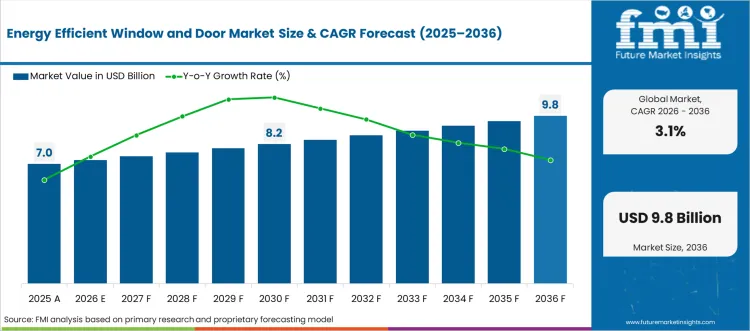
The energy efficient window and door market was valued at USD 7.00 billion in 2025, projected to reach USD 7.22 billion in 2026, and is forecast to expand to USD 9.79 billion by 2036 at a 3.1% CAGR. Tightening building energy codes, rising utility costs, and expanding green building certification programs are driving residential and commercial property developers to specify energy efficient fenestration products. As per FMI, the transition from single pane and standard double pane products toward low emissivity coated, triple glazed, and thermally broken frame systems is the defining specification upgrade cycle across renovation and new construction channels.
Summary of Energy Efficient Window and Door Market
- Market Overview
- The market is valued at USD 7.00 billion in 2025 and is projected to reach USD 9.79 billion by 2036.
- The industry is expected to grow at a 3.1% CAGR from 2026 to 2036, creating an incremental opportunity of USD 2.57 billion.
- The market is a building materials category where thermal performance certification, building code compliance capability, and channel positioning with residential and commercial builders define competitive dynamics.
- Demand and Growth Drivers
- Demand is sustained by progressive tightening of building energy codes that raise minimum thermal performance requirements for fenestration in new construction and major renovation.
- Green building certification programs create specification premiums for energy efficient windows and doors that incentivize developer investment in higher performance products.
- Rising utility costs are accelerating homeowner renovation decisions to replace aging single pane and standard double pane windows with low emissivity coated alternatives.
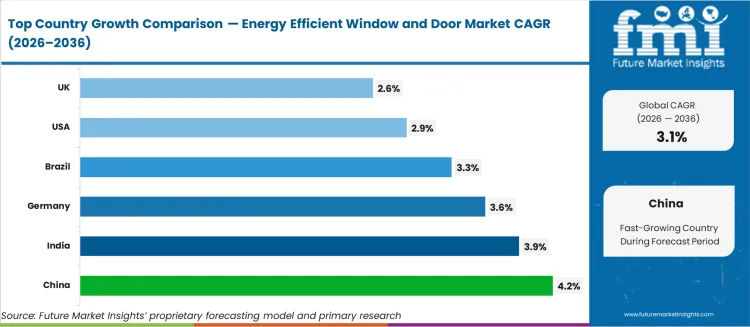
- Among countries, China (4.2% CAGR), India (3.9% CAGR), Germany (3.6% CAGR), Brazil (3.3% CAGR), USA (2.9% CAGR), UK (2.6% CAGR).
- Product and Segment View
- Energy Efficient Window leads by Product Type with 60% share in 2026.
- Residential leads by Application with 62% share in 2026.
- Geography and Competitive Outlook
- China and India are the fastest growing markets, while mature economies sustain demand through technology upgrade and compliance driven procurement cycles.
- Key players include Andersen Windows, Milgard, Pella, Marvin, REHAU, Senator Windows, JELD-WEN.
- Analyst Opinion at FMI
- Rahul Pandita, Principal Consultant for Building Materials, opines: 'In my analysis, I have observed that the energy efficient window and door market is being defined by code driven specification tightening rather than voluntary consumer upgrade demand. Fenestration manufacturers who cannot demonstrate third party certified U-value and solar heat gain coefficient ratings for their product lines are being excluded from builder specification packages in jurisdictions that have adopted 2024 or later energy code editions.'
- Strategic Implications / Executive Takeaways
- Fenestration manufacturers must invest in third party energy performance certification for all product lines to maintain specification eligibility under tightening building energy codes.
- Residential builder procurement teams should consolidate window and door sourcing with manufacturers who offer code compliant products across both new construction and renovation applications to reduce specification management complexity.
- Commercial building developers need to evaluate triple glazed and thermally broken frame systems for projects targeting green building certification premiums that offset higher fenestration costs through tenant occupancy rate advantages.
Energy Efficient Window and Door Market Key Takeaways
| Metric | Details |
|---|---|
| Industry Size (2026) | USD 7.22 Billion |
| Industry Value (2036) | USD 9.79 Billion |
| CAGR (2026 to 2036) | 3.1% |
Source: Future Market Insights, 2026
The incremental opportunity of USD 2.57 billion between 2026 and 2036 reflects steady building code tightening in the USA, EU, and China that raises minimum thermal performance requirements for fenestration products in both new construction and major renovation projects. Residential applications dominate because housing stock renewal cycles generate more fenestration replacement volume than commercial building activity. The window segment leads because buildings typically contain more window area than door area, and because window thermal performance upgrades deliver more measurable energy savings per installed unit. Material innovation in low emissivity glass coatings and thermally broken frame profiles is allowing manufacturers to meet stricter U-value requirements without increasing product weight or installation complexity.
All major regional markets reflect differentiated growth trajectories. China leads with a 4.2% CAGR, India follows at 3.9%, Germany follows at 3.6%, Brazil follows at 3.3%, USA follows at 2.9%, and UK registers 2.6% growth. China's lead growth rate reflects its massive residential construction activity and progressively tighter building energy codes. India's growth is driven by rising urban housing demand and initial adoption of energy performance rated fenestration. Germany maintains growth through its established Passivhaus standards and renovation incentive programs that mandate high performance windows and doors.
Energy Efficient Window and Door Market Definition
The energy efficient window and door market encompasses fenestration products engineered to reduce heat transfer, air infiltration, and solar heat gain in residential and commercial buildings. Products include double and triple glazed windows with low emissivity coatings, thermally broken frame systems, insulated doors, and weatherstripped entry systems. These products are specified to meet building energy code requirements and green building certification standards for thermal performance.
Energy Efficient Window and Door Market Inclusions
Market scope includes energy efficient windows and doors sold for residential and commercial building applications. Global and regional market sizes, product type and application segment breakdowns, and forecast projections from 2026 to 2036 are covered.
Energy Efficient Window and Door Market Exclusions
The scope excludes standard single pane windows and doors not marketed as energy efficient, industrial overhead doors, commercial automatic sliding door systems, and window film or retrofit treatments applied to existing fenestration.
Energy Efficient Window and Door Market Research Methodology
- Primary Research: Analysts engaged with building products procurement directors, architectural specification consultants, and fenestration manufacturing executives to map product selection criteria, code compliance requirements, and replacement cycle triggers.
- Desk Research: Data collection aggregated published building energy code updates, green building certification requirement databases, residential construction statistics, and fenestration industry association production reports.
- Market Sizing and Forecasting: Baseline values derive from a bottom up aggregation of energy efficient fenestration unit shipments by product type and application, applying regional pricing benchmarks and new construction versus renovation mix ratios to project market growth.
- Data Validation and Update Cycle: Projections are tested against published fenestration manufacturer revenue disclosures, residential construction permit statistics, and building energy code compliance reporting.
Imperatives for Stakeholders in Energy Efficient Window and Door Market
Design for performance verification, not claims
- Offer complete performance packages: products + NFRC ratings + energy modeling + installation specifications + performance warranties + commissioning support.
- Preconfigured certification solutions: ENERGY STAR compliance, passive house certification, building code documentation, and thermal performance validation protocols.
Installation quality assurance
- Certified installer networks, comprehensive installation training, air sealing protocols, and thermal bridge mitigation (proper flashing, continuous insulation detailing).
Lifecycle value communication
- Energy savings calculators, utility bill reduction projections, carbon footprint quantification, and return on investment analysis (payback period demonstration, incentive program navigation).
Incentive program integration
- Clear rebate qualification + transparent incentive processing (utility programs, tax credits, government weatherization); simplified documentation for homeowner claims.
How is the Energy Efficient Window and Door Market Segmented?
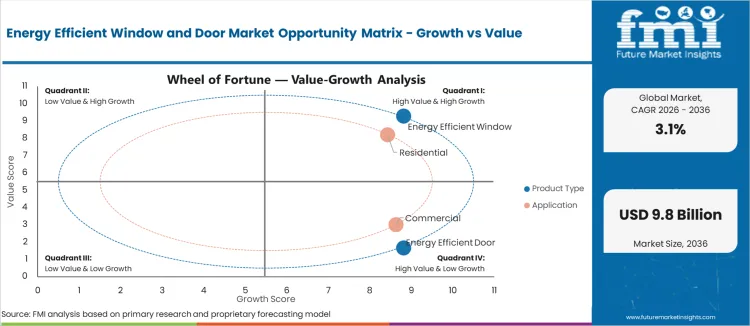
Primary Classification: The market segments by product type into energy efficient window and energy efficient door, representing the evolution from basic thermal barriers to sophisticated building envelope solutions for comprehensive energy conservation optimization.
Secondary Classification: Application segmentation divides the market into residential and commercial sectors, reflecting distinct requirements for thermal performance, operational durability, and lifecycle cost standards.
Regional Classification: Geographic distribution covers North America, Latin America, Western Europe, Eastern Europe, East Asia, South Asia Pacific, and Middle East & Africa, with developed markets leading adoption while emerging economies show accelerating growth patterns driven by energy efficiency expansion programs.
The segmentation structure reveals technology progression from standard insulated products toward advanced multi-layer systems with enhanced thermal breaks and performance specifications, while application diversity spans from single-family residential to commercial buildings requiring certified energy conservation solutions.
By Product Type, the Energy Efficient Window Segment Accounts for Dominant Market Share
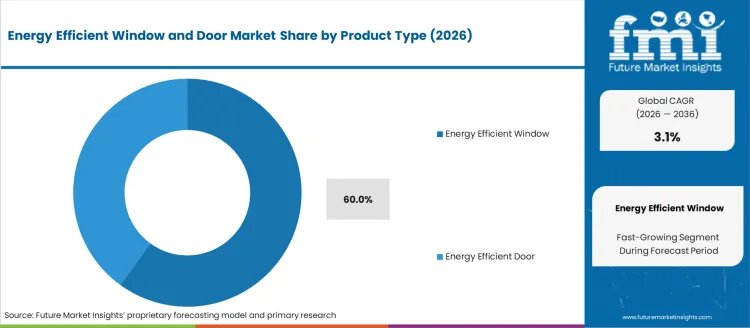
Market Position: Energy Efficient Window systems command the leading position with 60% market share in the energy efficient window and door market with 67% market share through advanced thermal performance features, including superior U-factor ratings, solar heat gain optimization, and residential energy conservation capabilities that enable buildings to achieve optimal heating and cooling efficiency across diverse climate zones and building environments.
Value Drivers: The segment benefits from homeowner and developer preference for certified fenestration systems that provide measurable energy savings, reduced HVAC load, and comfort enhancement without requiring extensive wall modifications. Advanced glazing features enable low-E coatings, inert gas fills, and integration with existing building envelopes, where thermal performance and energy code compliance represent critical project requirements.
Competitive Advantages: Energy Efficient Window systems differentiate through proven energy savings documentation, consistent thermal performance, and integration with green building certification programs that enhance property value while maintaining optimal comfort standards suitable for diverse residential and commercial applications.
Key market characteristics:
- Advanced glazing designs with optimized low-E coating configuration and thermal break capabilities
- Enhanced insulation effectiveness, enabling U-factors of 0.20-0.30 with consistent energy performance
- Building code compatibility, including ENERGY STAR certification, passive house standards, and climate zone optimization for fenestration installations
Energy Efficient Door Systems Show Balanced Market Growth
Energy Efficient Door systems maintain a 33% market position in the energy efficient window and door market due to their thermal barrier properties and security advantages. These systems appeal to facilities requiring building envelope continuity with enhanced weather resistance for entrance and egress applications. Market growth is driven by building code evolution, emphasizing air infiltration reduction and thermal performance through optimized door construction designs.
By Application, the Residential Segment Shows Fastest Growth
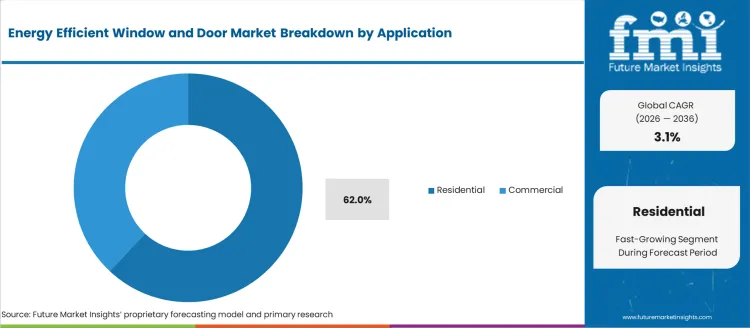
Market Context: Residential applications accounts for 62% market share and demonstrate the highest growth rate in the energy efficient window and door market with 4.2% CAGR due to widespread adoption of energy conservation systems and increasing focus on utility cost reduction, home comfort optimization, and property value applications that maximize energy savings while maintaining living environment standards.
Appeal Factors: Residential operators prioritize lifecycle cost savings, thermal comfort improvement, and integration with existing home infrastructure that enables coordinated energy upgrade projects across multiple improvement initiatives. The segment benefits from substantial government incentive programs and utility rebate availability that emphasize the acquisition of certified energy efficient systems for weatherization and retrofit applications.
Growth Drivers: Weatherization assistance programs incorporate energy efficient fenestration as priority upgrade components, while net-zero energy home construction trends increase demand for ultra-efficient capabilities that comply with passive house standards and maximize on-site renewable energy effectiveness.
Market Challenges: Varying retrofit complexity and upfront cost barriers may limit product standardization across different property ages or construction scenarios.
Application dynamics include:
- Strong growth in whole-house retrofits and new energy-efficient construction requiring certified system capabilities
- Increasing adoption in climate zone-specific applications and extreme weather resilience for residential owners
- Rising integration with renewable energy systems for net-zero energy performance and grid independence assurance
Commercial Applications Maintain Specialized Demand
Commercial applications capture market share through specialized fenestration requirements in office buildings, retail facilities, and institutional properties. These facilities demand high-performance systems capable of managing solar heat gain while providing effective daylighting access and operational durability capabilities.
What are the Drivers, Restraints, and Key Trends of the Energy Efficient Window and Door Market?
| Category | Factor | Impact | Why It Matters |
|---|---|---|---|
| Driver | Building code stringency & energy performance mandates (net-zero targets) | ★★★★★ | Regulatory requirements make high-performance fenestration mandatory; jurisdictions with strict codes drive baseline market demand and technology advancement. |
| Driver | Energy cost escalation & utility expense reduction priorities (operational savings) | ★★★★★ | Rising energy prices turn efficiency investments into economic necessities; vendors offering documented savings and quick payback gain competitive advantage. |
| Driver | Government incentive programs & utility rebates (tax credits, weatherization assistance) | ★★★★☆ | Financial incentives reduce upfront barriers; demand tied to program availability and processing simplicity expanding addressable market through affordability improvement. |
| Restraint | High upfront costs & retrofit complexity (installation challenges) | ★★★★☆ | Budget-constrained projects face adoption barriers; increases project deferral rates and slows market penetration in older building stock requiring extensive modifications. |
| Restraint | Performance verification challenges & measurement complexity (savings quantification) | ★★★☆☆ | Actual savings vary by behavior and climate; difficulty demonstrating ROI creates skepticism and limits adoption among uncertain buyers requiring proof. |
| Trend | Smart fenestration & dynamic glazing (electrochromic windows, automated shading) | ★★★★★ | Intelligent tinting systems with solar tracking and climate response transform performance; real-time optimization and grid interaction become core value propositions. |
| Trend | Circular economy & sustainable materials (recycled content, end-of-life recovery) | ★★★★☆ | Green building certification requirements drive material transparency; manufacturers offering cradle-to-cradle solutions and environmental product declarations drive competition toward responsible sourcing practices. |
How Does the Energy Efficient Window and Door Market Perform Across Key Countries?
The energy efficient window and door market demonstrates varied regional dynamics with Growth Leaders including China (4.2% growth rate) and India (3.9% growth rate) driving expansion through building energy code implementation initiatives and construction modernization development. Steady Performers encompass Germany (3.6% growth rate), United States (2.9% growth rate), and developed regions, benefiting from established green building programs and renovation market activity. Emerging Markets feature Brazil (3.3% growth rate) and developing regions, where building standards advancement and energy cost concerns support consistent growth patterns.
Regional synthesis reveals East Asian markets leading adoption through building code enforcement and urban construction development, while South Asian countries maintain strong growth supported by cooling load reduction priorities and middle-class housing quality expectations. North American markets show steady expansion driven by utility incentive programs and building performance standards, while European markets demonstrate moderate growth influenced by passive house adoption and renovation wave initiatives.
.webp "Top Country Growth Comparison Demand For Hydrocyclone Liners In Usa Cagr (2026 2036)")
| Region/Country | 2026-2036 Growth | How to win | What to watch out |
|---|---|---|---|
| China | 4.2% | Lead with cost-effective certified products | Standards enforcement variability; local competition |
| India | 3.9% | Focus on cooling load reduction | Awareness levels; installation quality gaps |
| Germany | 3.6% | Offer passive house certified systems | Over-engineering; premium pricing limits |
| Brazil | 3.3% | Provide financing options | Economic volatility; inconsistent incentives |
| United States | 2.9% | Push utility rebate programs | Market maturity; replacement cycle dependence |
| United Kingdom | 2.6% | Emphasize heritage compatibility | Planning restrictions; retrofit complexity |
How is China Driving the Fastest Market Growth?
China establishes fastest market growth through aggressive building energy efficiency programs and comprehensive construction standard modernization, integrating energy efficient windows and doors as mandatory components in residential construction, commercial developments, and public building installations. The country's 4.2% growth rate reflects government initiatives promoting carbon neutrality targets and building energy consumption reduction that require the use of certified thermal performance systems in new and retrofit facilities. Growth concentrates in major urban centers, including Beijing, Shanghai, and Shenzhen, where green building demonstration projects showcase advanced fenestration installations that appeal to developers seeking building code compliance and operational cost optimization applications.
Chinese manufacturers are developing competitively-priced energy efficient solutions that combine domestic production advantages with adequate thermal performance features, including double-glazing systems and thermal break frames. Distribution channels through building material markets and developer procurement networks expand market access, while government building energy labeling programs support adoption across diverse residential and commercial segments.
Strategic Market Indicators:
- Residential developers leading adoption with 68% penetration rate in new construction meeting energy efficiency standards
- Government building programs providing substantial incentives for green building certification achievement
- Local manufacturers capturing 58% market share through cost advantages and market-appropriate specifications
- Public building retrofits driving demand for certified energy efficient systems in institutional markets
How is India Emerging as a High-Growth Market?
In Mumbai, Delhi, and Bangalore, residential developments and commercial properties are implementing energy efficient windows and doors as essential features for cooling cost reduction and occupant comfort enhancement applications, driven by increasing electricity costs and construction quality modernization programs that emphasize the importance of thermal performance. The market holds a 3.9% growth rate, supported by government energy conservation initiatives and building code evolution programs that promote energy efficient fenestration for residential and commercial facilities. Indian operators are adopting thermal systems that provide air conditioning load reduction and cost-effective features, particularly appealing in hot climate regions where cooling expenses and thermal comfort represent critical building performance priorities.
Market expansion benefits from growing awareness of energy efficiency benefits and international green building standard adoption that enable domestic demand for thermal performance systems for construction applications. Product adoption follows patterns established in air conditioning markets, where operational cost reduction and comfort improvement drive purchasing decisions and installation deployment.
Market Intelligence Brief:
- Residential and commercial segments are driving initial adoption with 44% annual growth in energy efficient product installations
- Building code programs emphasizing thermal performance requirements for energy conservation compliance
- Local manufacturers partnering with international providers for technology transfer
- Building facilities implementing energy efficient systems for operational cost reduction and comfort optimization
How Does Germany Maintain Technology Leadership?
Germany establishes technology leadership through comprehensive building energy standards and advanced passive house infrastructure development, integrating energy efficient windows and doors across renovation projects and new construction applications. The country's 3.6% growth rate reflects established green building industry relationships and mature thermal performance technology adoption that supports widespread use of ultra-efficient fenestration systems in residential and commercial properties. Growth concentrates in major construction markets, including Bavaria, Baden-Württemberg, and North Rhine-Westphalia, where passive house projects showcase premium system deployment that appeals to developers seeking proven near-zero energy capabilities and operational efficiency applications.
German fenestration providers leverage established distribution networks and comprehensive certification capabilities, including passive house component certification and installation quality programs that create market relationships and performance advantages. The market benefits from mature building physics standards and renovation wave requirements that support advanced fenestration use while encouraging technology advancement and thermal optimization.
Market Intelligence Brief:
- Residential renovation facilities maintaining 82% energy efficient product adoption rate with mature installation practices
- Established passive house standards providing consistent demand for ultra-efficient fenestration technology
- Building networks capturing 71% market share through performance excellence and certification focus
- Renovation programs expanding advanced fenestration capabilities in existing building scenarios
How Does the United States Show Market Leadership?
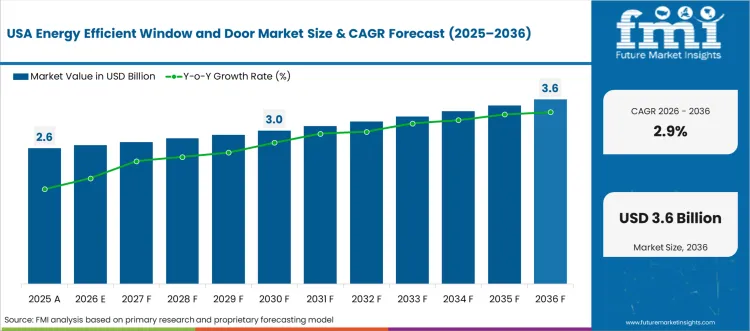
United States demonstrates market leadership through comprehensive energy efficiency programs and advanced green building infrastructure development, integrating energy efficient windows and doors across residential retrofits and commercial construction applications. The country's 2.9% growth rate reflects established utility incentive relationships and mature ENERGY STAR program adoption that supports widespread use of certified fenestration systems in buildings. Growth concentrates in major climate zones, including heating-dominated northern regions and cooling-dominated southern areas, where weatherization projects showcase mature system deployment that appeals to homeowners seeking proven energy savings and comfort improvement applications.
American fenestration providers prioritize ENERGY STAR certification and utility rebate qualification in product development, creating demand for certified solutions with comprehensive support, including contractor networks and performance documentation. The market benefits from established weatherization assistance infrastructure and willingness to invest in energy upgrades that provide utility bill reduction and environmental benefits.
Market Intelligence Brief:
- Residential weatherization focusing on utility incentive programs and tax credit qualification, driving retrofit segment growth
- Building partnerships providing 35% faster rebate processing cycles
- Product collaboration between American manufacturers and utility program administrators
- Homeowner education programs expanding energy efficient fenestration adoption in residential scenarios
How Does Brazil Demonstrate Regional Market Leadership?
Brazil's market expansion benefits from diverse building demand, including construction modernization in São Paulo and Rio de Janeiro, residential comfort upgrades, and government energy efficiency programs that increasingly incorporate thermal performance solutions for cooling cost reduction applications. The country maintains a 3.3% growth rate, driven by rising electricity costs and increasing recognition of energy efficiency benefits, including reduced air conditioning expenses and improved indoor comfort.
Market dynamics focus on cost-effective energy efficient solutions that balance thermal performance with affordability considerations important to Brazilian building operators. Growing middle-class housing development creates continued demand for comfort-enhancing fenestration systems in new construction infrastructure and building improvement projects.
Strategic Market Considerations:
- Residential and commercial segments leading growth with focus on cooling load reduction and operational cost optimization applications
- Regional climate requirements driving diverse product portfolio from basic insulated systems to advanced low-E glazing
- Local production challenges offset by potential manufacturing partnerships with international fenestration companies
- Government energy efficiency initiatives beginning to influence building codes and product requirements
How is the European Market Split by Country?
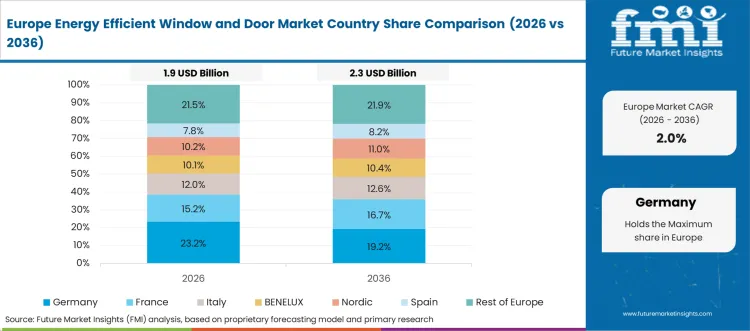
The European energy efficient window and door market is projected to grow from USD 2396.4 million in 2026 to USD 3172.7 million by 2036, registering a CAGR of 2.9% over the forecast period. Germany is expected to maintain its leadership position with a 36.2% market share in 2026, supported by its advanced passive house infrastructure and major renovation wave programs.
United Kingdom follows with a 21.8% share in 2026, driven by comprehensive building decarbonization programs and energy efficiency mandates. France holds a 17.9% share through specialized renovation applications and thermal regulation requirements. Italy commands a 13.6% share, while Spain accounts for 10.5% in 2026. The rest of Europe region is anticipated to gain momentum, expanding its collective share from 6.4% to 7.3% by 2036, attributed to increasing energy efficient fenestration adoption in Nordic countries and emerging Central European building markets implementing energy performance enhancement programs.
How Does Japan Demonstrate Market Maturity?
Japan maintains established market position with 2.3% growth rate through comprehensive building energy standards and advanced construction technology infrastructure, integrating energy efficient windows and doors across residential construction in Tokyo, commercial developments in Osaka, and institutional buildings throughout urban regions. The market demonstrates mature adoption patterns with 74% awareness rate among building professionals, supported by established energy conservation culture and quality construction standards.
Japanese manufacturers emphasize precision engineering and typhoon-resistant thermal performance capabilities, creating demand for high-quality solutions with advanced features including earthquake-compatible installations and extreme weather durability. Building operators prioritize fenestration systems that provide exceptional thermal performance with existing architectural requirements and maintain strict quality standards suitable for Japanese climate conditions.
How is South Korea Advancing Green Building Innovation?
South Korea demonstrates green building innovation with 2.6% growth rate through advanced building energy codes and comprehensive zero-energy building programs, particularly in Seoul and Busan metropolitan areas where developers implement certified energy efficient systems in residential towers and commercial complexes.
The market benefits from aggressive building energy targets and established green building certification programs, enabling adoption of high-performance fenestration solutions with 78% code compliance rate in new construction. Korean manufacturers integrate smart building technologies and advanced thermal break designs, creating distinctive building envelope systems that appeal to developers seeking energy performance leadership. Government support for net-zero building initiatives and renewable energy integration programs drives continued energy efficient fenestration adoption across diverse construction sectors.
What is the Competitive Landscape of the Energy Efficient Window and Door Market?
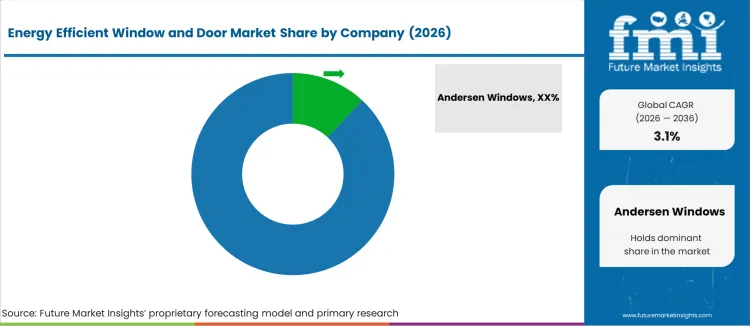
The energy efficient window and door market structure consists of 22-28 credible manufacturers with the top 6-8 companies controlling approximately 54-59% of market revenue. Leadership positions are maintained through certification portfolio breadth, comprehensive distribution networks, and continuous performance innovation encompassing thermal optimization, installation system refinement, and lifecycle cost documentation. Standard double-glazed products and basic thermal break frames are becoming commoditized offerings as market maturity increases and building codes mandate minimum performance thresholds.
Margin opportunities concentrate in ultra-efficient product tiers, custom architectural solutions, and integration into incentive program networks including utility rebate systems, tax credit qualifications, and green building certification pathways. Long-term relationships with builder networks, contractor channels, and architectural specification communities provide stable revenue streams, while value-added services including energy modeling support, performance verification, and installation quality assurance create differentiation opportunities beyond standard product sales.
Manufacturers pursuing growth strategies emphasize product line expansion into passive house certified systems, geographic market penetration through regional distribution partnerships, and vertical integration into installation training programs. Strategic partnerships with utility companies, weatherization agencies, and green building councils enable comprehensive market access addressing diverse customer segments and incentive pathways. Technology investments focus on advanced glazing systems for solar control, thermally-broken frame designs for condensation resistance, and digital tools for performance calculation and specification support.
| Stakeholder | What they actually control | Typical strengths | Typical blind spots |
|---|---|---|---|
| National brands | Distribution scale, certification portfolios, brand trust | Market penetration, quality reputation, warranty backing | Cost competitiveness; specialized applications |
| Performance leaders | Technology innovation; passive house certification; testing capabilities | Superior thermal specs; architect specification | Mass market pricing; builder channel penetration |
| Regional manufacturers | Local relationships, installation networks, climate expertise | Market knowledge; responsive support; appropriate specifications | Technology investment; national reach |
| Builder-focused suppliers | Volume relationships, standardized offerings, efficiency pricing | Delivery reliability; builder specifications; economies of scale | Consumer marketing; performance differentiation |
| Specialty providers | Custom solutions, historic preservation, extreme climate expertise | Unique applications; architectural services; problem-solving | Production scale; cost efficiency |
Key Players in the Energy Efficient Window and Door Market
- Andersen Windows
- Milgard
- Pella
- Marvin
- REHAU
- Senator Windows
- JELD-WEN
- Ply Gem
- Fibertec
- Therma-Tru Doors
- Fenesta
- Croft
- LaCantina Doors
- Alpen High Performance Products
Scope of the Report
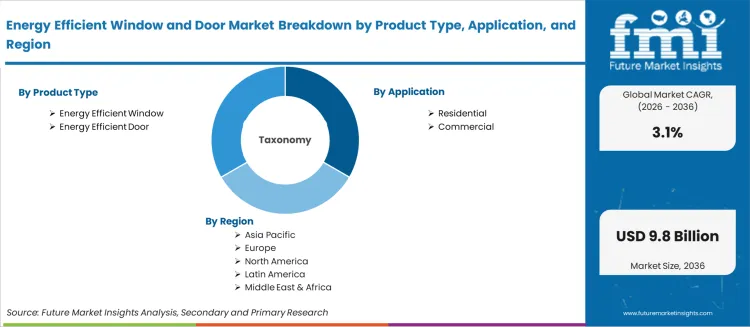
| Metric | Value |
|---|---|
| Quantitative Units | USD 7.22 Billion to USD 9.79 Billion, at a CAGR of 3.1% |
| Market Definition | The energy efficient window and door market encompasses fenestration products engineered to reduce heat transfer, air infiltration, and solar heat gain in residential and commercial buildings. Product... |
| Segmentation | Product Type: Energy Efficient Window, Energy Efficient Door; Application: Residential, Commercial |
| Regions Covered | North America, Latin America, Europe, East Asia, South Asia, Oceania, Middle East & Africa |
| Countries Covered | China, India, Germany, Brazil, USA, UK, and 40 plus countries |
| Key Companies Profiled | Andersen Windows, Milgard, Pella, Marvin, REHAU, Senator Windows, JELD-WEN, Ply Gem, Fibertec, Therma-Tru Doors, Fenesta, Croft, LaCantina Doors, Alpen High Performance Products |
| Forecast Period | 2026 to 2036 |
| Approach | Hybrid bottom up methodology combining primary research, supply chain analysis, and proprietary forecasting models. |
Energy Efficient Window and Door Market by Segments
Product Type:
- Energy Efficient Window
- Energy Efficient Door
Application:
- Residential
- Commercial
Region:
- North America
- United States
- Canada
- Mexico
- Latin America
- Brazil
- Chile
- Rest of Latin America
- Western Europe
- Germany
- United Kingdom
- France
- Italy
- Spain
- Nordic
- BENELUX
- Rest of Western Europe
- Eastern Europe
- Russia
- Poland
- Rest of Eastern Europe
- East Asia
- China
- Japan
- South Korea
- South Asia Pacific
- India
- ASEAN
- Australia & New Zealand
- Rest of South Asia Pacific
- Middle East & Africa
- Kingdom of Saudi Arabia
- Other GCC Countries
- Turkey
- South Africa
- Other African Union
- Rest of Middle East & Africa
Bibliography
- 1. International Energy Agency. (2025). Energy efficiency in buildings: Policy and technology review. IEA.
- 2. USA Department of Energy. (2024). Energy code compliance: Fenestration requirements update. DOE.
- 3. European Commission. (2024). Energy performance of buildings directive (EPBD): Recast implementation guidance. European Commission.
- 4. National Fenestration Rating Council. (2024). NFRC certified products directory 2024. NFRC.
- 5. Andersen Corporation. (2025). Annual report 2024. Andersen Corporation.
- 6. Organisation for Economic Co-operation and Development. (2024). Building energy performance: Policy approaches. OECD.
This bibliography is provided for reader reference. The full Future Market Insights report contains the complete reference list with primary research documentation.
Frequently Asked Questions
How large is the demand for Energy Efficient Window and Door in the global market in 2026?
Demand for Energy Efficient Window and Door in the global market is estimated to be valued at USD 7.22 billion in 2026.
What will be the market size of Energy Efficient Window and Door in the global market by 2036?
Market size for Energy Efficient Window and Door is projected to reach USD 9.79 billion by 2036.
What is the expected demand growth for Energy Efficient Window and Door in the global market between 2026 and 2036?
Demand for Energy Efficient Window and Door is expected to grow at a CAGR of 3.1% between 2026 and 2036.
Which Product Type is poised to lead global sales by 2026?
Energy Efficient Window accounts for 60% in 2026.
How significant is Residential in driving Energy Efficient Window and Door adoption in 2026?
Residential represents 62% of segment share in 2026.
What is driving demand in China?
China leads with a 4.2% CAGR through 2036.
What is Energy Efficient Window and Door and what is it mainly used for?
The energy efficient window and door market encompasses fenestration products engineered to reduce heat transfer, air infiltration, and solar heat gain in residential and commercial buildings. Product.
What is included in the scope of this Energy Efficient Window and Door report?
Market scope includes energy efficient windows and doors sold for residential and commercial building applications. Global and regional market sizes, product type and application segment breakdowns, and forecast projections from 2026 to 2036 are covered.
Preview the report firsthand - request a free sample
Get SampleGet the brochure for pricing and purchase details.
Get PDFTable of Content
- Executive Summary
- Global Market Outlook
- Demand-side Trends
- Supply-side Trends
- Technology Roadmap Analysis
- Analysis and Recommendations
- Market Overview
- Market Coverage / Taxonomy
- Analytical Lens and Working Hypotheses
- Market Structure, Signals, and Trend Drivers
- Benchmarking and Cross-market Comparability
- Market Sizing, Forecasting, and Opportunity Mapping
- Research Design and Evidence Framework
- Desk Research Programme (Secondary Evidence)
- Company Annual and Sustainability Reports
- Peer-reviewed Journals and Academic Literature
- Corporate Websites, Product Literature, and Technical Notes
- Earnings Decks and Investor Briefings
- Statutory Filings and Regulatory Disclosures
- Technical White Papers and Standards Notes
- Trade Journals, Industry Magazines, and Analyst Briefs
- Conference Proceedings, Webinars, and Seminar Materials
- Government Statistics Portals and Public Data Releases
- Press Releases and Reputable Media Coverage
- Specialist Newsletters and Curated Briefings
- Sector Databases and Reference Repositories
- FMI Internal Proprietary Databases and Historical Market Datasets
- Subscription Datasets and Paid Sources
- Social Channels, Communities, and Digital Listening Inputs
- Additional Desk Sources
- Presidents and Vice Presidents
- R&D and Innovation Heads
- Technical Specialists
- Domain Subject-matter Experts
- Scientists
- Physicians and Other Healthcare Professionals
- Desk Research Programme (Secondary Evidence)
- Governance, Ethics, and Data Stewardship
- Research Ethics
- Data Integrity and Handling
- Tooling, Models, and Reference Databases
- Data Engineering and Model Build
- Data Acquisition and Ingestion
- Cleaning, Normalisation, and Verification
- Synthesis, Triangulation, and Analysis
- Quality Assurance and Audit Trail
- Market Background
- Market Dynamics
- Drivers
- Restraints
- Opportunity
- Trends
- Scenario Forecast
- Demand in Optimistic Scenario
- Demand in Likely Scenario
- Demand in Conservative Scenario
- Opportunity Map Analysis
- Product Life Cycle Analysis
- Supply Chain Analysis
- Investment Feasibility Matrix
- Value Chain Analysis
- PESTLE and Porter’s Analysis
- Regulatory Landscape
- Regional Parent Market Outlook
- Production and Consumption Statistics
- Import and Export Statistics
- Market Dynamics
- Global Market Analysis 2021 to 2025 and Forecast, 2026 to 2036
- Historical Market Size Value (USD Million) Analysis, 2021 to 2025
- Current and Future Market Size Value (USD Million) Projections, 2026 to 2036
- Y-o-Y Growth Trend Analysis
- Absolute $ Opportunity Analysis
- Global Market Pricing Analysis 2021 to 2025 and Forecast 2026 to 2036
- Global Market Analysis 2021 to 2025 and Forecast 2026 to 2036, By Product Type
- Introduction / Key Findings
- Historical Market Size Value (USD Million) Analysis By Product Type , 2021 to 2025
- Current and Future Market Size Value (USD Million) Analysis and Forecast By Product Type , 2026 to 2036
- Energy Efficient Window
- Energy Efficient Door
- Energy Efficient Window
- Y-o-Y Growth Trend Analysis By Product Type , 2021 to 2025
- Absolute $ Opportunity Analysis By Product Type , 2026 to 2036
- Global Market Analysis 2021 to 2025 and Forecast 2026 to 2036, By Application
- Introduction / Key Findings
- Historical Market Size Value (USD Million) Analysis By Application, 2021 to 2025
- Current and Future Market Size Value (USD Million) Analysis and Forecast By Application, 2026 to 2036
- Residential
- Commercial
- Residential
- Y-o-Y Growth Trend Analysis By Application, 2021 to 2025
- Absolute $ Opportunity Analysis By Application, 2026 to 2036
- Global Market Analysis 2021 to 2025 and Forecast 2026 to 2036, By Region
- Introduction
- Historical Market Size Value (USD Million) Analysis By Region, 2021 to 2025
- Current Market Size Value (USD Million) Analysis and Forecast By Region, 2026 to 2036
- North America
- Latin America
- Western Europe
- Eastern Europe
- East Asia
- South Asia and Pacific
- Middle East & Africa
- Market Attractiveness Analysis By Region
- North America Market Analysis 2021 to 2025 and Forecast 2026 to 2036, By Country
- Historical Market Size Value (USD Million) Trend Analysis By Market Taxonomy, 2021 to 2025
- Market Size Value (USD Million) Forecast By Market Taxonomy, 2026 to 2036
- By Country
- USA
- Canada
- Mexico
- By Product Type
- By Application
- By Country
- Market Attractiveness Analysis
- By Country
- By Product Type
- By Application
- Key Takeaways
- Latin America Market Analysis 2021 to 2025 and Forecast 2026 to 2036, By Country
- Historical Market Size Value (USD Million) Trend Analysis By Market Taxonomy, 2021 to 2025
- Market Size Value (USD Million) Forecast By Market Taxonomy, 2026 to 2036
- By Country
- Brazil
- Chile
- Rest of Latin America
- By Product Type
- By Application
- By Country
- Market Attractiveness Analysis
- By Country
- By Product Type
- By Application
- Key Takeaways
- Western Europe Market Analysis 2021 to 2025 and Forecast 2026 to 2036, By Country
- Historical Market Size Value (USD Million) Trend Analysis By Market Taxonomy, 2021 to 2025
- Market Size Value (USD Million) Forecast By Market Taxonomy, 2026 to 2036
- By Country
- Germany
- UK
- Italy
- Spain
- France
- Nordic
- BENELUX
- Rest of Western Europe
- By Product Type
- By Application
- By Country
- Market Attractiveness Analysis
- By Country
- By Product Type
- By Application
- Key Takeaways
- Eastern Europe Market Analysis 2021 to 2025 and Forecast 2026 to 2036, By Country
- Historical Market Size Value (USD Million) Trend Analysis By Market Taxonomy, 2021 to 2025
- Market Size Value (USD Million) Forecast By Market Taxonomy, 2026 to 2036
- By Country
- Russia
- Poland
- Hungary
- Balkan & Baltic
- Rest of Eastern Europe
- By Product Type
- By Application
- By Country
- Market Attractiveness Analysis
- By Country
- By Product Type
- By Application
- Key Takeaways
- East Asia Market Analysis 2021 to 2025 and Forecast 2026 to 2036, By Country
- Historical Market Size Value (USD Million) Trend Analysis By Market Taxonomy, 2021 to 2025
- Market Size Value (USD Million) Forecast By Market Taxonomy, 2026 to 2036
- By Country
- China
- Japan
- South Korea
- By Product Type
- By Application
- By Country
- Market Attractiveness Analysis
- By Country
- By Product Type
- By Application
- Key Takeaways
- South Asia and Pacific Market Analysis 2021 to 2025 and Forecast 2026 to 2036, By Country
- Historical Market Size Value (USD Million) Trend Analysis By Market Taxonomy, 2021 to 2025
- Market Size Value (USD Million) Forecast By Market Taxonomy, 2026 to 2036
- By Country
- India
- ASEAN
- Australia & New Zealand
- Rest of South Asia and Pacific
- By Product Type
- By Application
- By Country
- Market Attractiveness Analysis
- By Country
- By Product Type
- By Application
- Key Takeaways
- Middle East & Africa Market Analysis 2021 to 2025 and Forecast 2026 to 2036, By Country
- Historical Market Size Value (USD Million) Trend Analysis By Market Taxonomy, 2021 to 2025
- Market Size Value (USD Million) Forecast By Market Taxonomy, 2026 to 2036
- By Country
- Kingdom of Saudi Arabia
- Other GCC Countries
- Turkiye
- South Africa
- Other African Union
- Rest of Middle East & Africa
- By Product Type
- By Application
- By Country
- Market Attractiveness Analysis
- By Country
- By Product Type
- By Application
- Key Takeaways
- Key Countries Market Analysis
- USA
- Pricing Analysis
- Market Share Analysis, 2025
- By Product Type
- By Application
- Canada
- Pricing Analysis
- Market Share Analysis, 2025
- By Product Type
- By Application
- Mexico
- Pricing Analysis
- Market Share Analysis, 2025
- By Product Type
- By Application
- Brazil
- Pricing Analysis
- Market Share Analysis, 2025
- By Product Type
- By Application
- Chile
- Pricing Analysis
- Market Share Analysis, 2025
- By Product Type
- By Application
- Germany
- Pricing Analysis
- Market Share Analysis, 2025
- By Product Type
- By Application
- UK
- Pricing Analysis
- Market Share Analysis, 2025
- By Product Type
- By Application
- Italy
- Pricing Analysis
- Market Share Analysis, 2025
- By Product Type
- By Application
- Spain
- Pricing Analysis
- Market Share Analysis, 2025
- By Product Type
- By Application
- France
- Pricing Analysis
- Market Share Analysis, 2025
- By Product Type
- By Application
- India
- Pricing Analysis
- Market Share Analysis, 2025
- By Product Type
- By Application
- ASEAN
- Pricing Analysis
- Market Share Analysis, 2025
- By Product Type
- By Application
- Australia & New Zealand
- Pricing Analysis
- Market Share Analysis, 2025
- By Product Type
- By Application
- China
- Pricing Analysis
- Market Share Analysis, 2025
- By Product Type
- By Application
- Japan
- Pricing Analysis
- Market Share Analysis, 2025
- By Product Type
- By Application
- South Korea
- Pricing Analysis
- Market Share Analysis, 2025
- By Product Type
- By Application
- Russia
- Pricing Analysis
- Market Share Analysis, 2025
- By Product Type
- By Application
- Poland
- Pricing Analysis
- Market Share Analysis, 2025
- By Product Type
- By Application
- Hungary
- Pricing Analysis
- Market Share Analysis, 2025
- By Product Type
- By Application
- Kingdom of Saudi Arabia
- Pricing Analysis
- Market Share Analysis, 2025
- By Product Type
- By Application
- Turkiye
- Pricing Analysis
- Market Share Analysis, 2025
- By Product Type
- By Application
- South Africa
- Pricing Analysis
- Market Share Analysis, 2025
- By Product Type
- By Application
- USA
- Market Structure Analysis
- Competition Dashboard
- Competition Benchmarking
- Market Share Analysis of Top Players
- By Regional
- By Product Type
- By Application
- Competition Analysis
- Competition Deep Dive
- Andersen Windows
- Overview
- Product Portfolio
- Profitability by Market Segments (Product/Age /Sales Channel/Region)
- Sales Footprint
- Strategy Overview
- Marketing Strategy
- Product Strategy
- Channel Strategy
- Milgard
- Pella
- Marvin
- REHAU
- Senator Windows
- JELD-WEN
- Ply Gem
- Fibertec
- Therma-Tru Doors
- Fenesta
- Croft
- LaCantina Doors
- Alpen High Performance Products
- Andersen Windows
- Competition Deep Dive
- Assumptions & Acronyms Used


