

- Industry Size (2026)
- USD 5.6 Bn
- Forecast (2036)
- USD 11.4 Bn
- CAGR (2026 to 2036)
- 7.4%
Disposable Bed Sheets Market Size, Market Forecast and Outlook By FMI
Summary of the Disposable Bed Sheets Market
- Demand and Growth Drivers
- Growth in hospital bed capacity and outpatient procedure volumes is sustaining procurement of disposable bed sheets for infection control and patient hygiene management.
- Expansion of salon, spa, and wellness service industries is creating structured demand for single-use bed coverings that reduce laundry costs and cross-contamination risks.
- Consumer adoption of disposable bed sheets for travel, homestay, and personal hygiene applications is expanding the addressable market beyond institutional procurement.
- Product and Segment View
- Waterproof is expected to account for 46.0% of the product type segment in 2026, reflecting concentrated procurement in primary end-use categories.
- Regular disposable bed sheets is expected to account for 58.0% of the nature segment in 2026, reflecting concentrated procurement in primary end-use categories.
- Economy is expected to account for 52.0% of the price segment in 2026, reflecting concentrated procurement in primary end-use categories.
- Geography and Competitive Outlook
- China is expected to lead growth at 7.5% CAGR, supported by strong end-use demand and regulatory drivers across primary application segments.
- South Korea at 7% CAGR reflects sustained procurement activity driven by compliance requirements and infrastructure investment.
- Medline Industries maintains a leading competitive position through integrated manufacturing capabilities and established distribution networks across key regions.
- Analyst Opinion
- Rahul Pandita, Principal Consultant at FMI says, 'Companies that can scale production capacity while maintaining consistent product quality across application segments are expected to strengthen their position over the forecast period. The disposable bed sheets market is transitioning toward a specification-driven procurement environment where compliance, reliability, and supply chain integration determine supplier selection.'
- The disposable bed sheets market is evolving from a fragmented supply base toward consolidated procurement relationships with qualified suppliers.
- Adoption is increasing due to tightening quality standards and performance requirements across key end-use industries.
- Demand is further supported by regulatory compliance timelines and investment cycles across major consuming regions.
- Pricing is expected to remain influenced by raw material costs and production scale improvements during the forecast period.
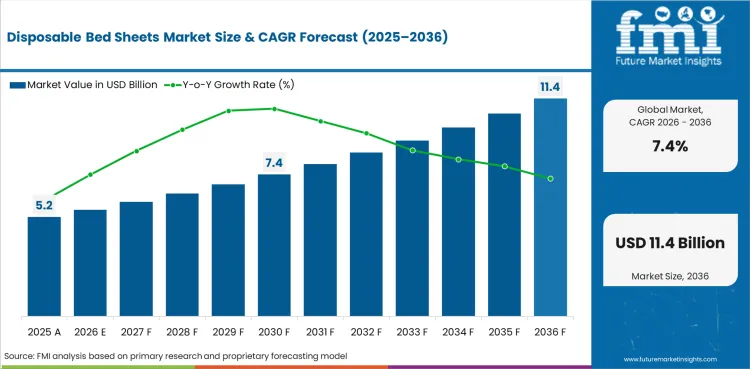
Key Takeaways, Market Size, and Forecast
- The disposable bed sheets market was valued at USD 5.20 billion in 2025.
- By 2036, the disposable bed sheets market is expected to be worth USD 11.40 billion.
- From 2026 to 2036, the market is projected to expand at a CAGR of 7.4%.
- The market is projected to create an incremental opportunity of USD 5.82 billion between 2026 and 2036.
- In 2026, personal use is expected to account for 61.0% of the end user segment, driven by growing consumer hygiene awareness and demand for single-use bedding in travel, hospitality, and home care settings.
- Waterproof disposable bed sheets will dominate with a 46.0% share, while regular disposable bed sheets will lead with a 58.0% share.
- China (7.5%) and South Korea (7%) are among the fastest growing markets globally.
Disposable Bed Sheets Market Definition
The disposable bed sheets market includes all commercially traded products and services categorized under product type, nature, price, application, sales channel, material, end user classifications. This market covers procurement, manufacturing, distribution, and end-use application across global and regional markets.
Disposable Bed Sheets Market Inclusions
Market scope encompasses all commercially traded products in the disposable bed sheets market categorized by product type, nature, price, application, sales channel, material, end user. Revenue coverage spans the 2026 to 2036 forecast period across North America, Latin America, Europe, East Asia, South Asia and Pacific, and Middle East and Africa.
Disposable Bed Sheets Market Exclusions
The scope does not include raw materials sold without processing into finished products, products used exclusively for research and development purposes without commercial distribution, or services and solutions that fall outside the defined segmentation taxonomy.
Disposable Bed Sheets Market Research Methodology
- Primary Research: FMI analysts conducted interviews with manufacturers, distributors, and end-use procurement teams across key markets to validate demand patterns and pricing structures.
- Desk Research: Combined data from industry associations, regulatory databases, trade publications, and manufacturer disclosures to establish market baselines.
- Market Sizing and Forecasting: Bottom-up aggregation across segments and regions, calibrated against top-down macroeconomic indicators and industry production data.
- Data Validation: Cross-checked quarterly against production statistics, trade data, and manufacturer financial disclosures.
Why is the Disposable Bed Sheets Market Growing?
- China leads growth at 7.5%, reflecting hospital capacity expansion, salon industry growth, and increasing consumer hygiene awareness in urban areas.
- Hospital and salon applications together account for the majority of institutional demand, with procurement driven by infection control protocols and service hygiene standards.
- South Korea at 7.0% reflects strong demand from the beauty and wellness services sector and consumer preference for hygiene-forward disposable products.
The disposable bed sheets market is expanding at 7.4% CAGR as healthcare infection control requirements, personal hygiene awareness, and salon industry growth drive procurement across institutional and consumer segments. Waterproof disposable bed sheets hold 46.0% of the product type segment, reflecting demand from healthcare, salon, and spa applications where fluid barrier protection is a procurement requirement. Regular disposable bed sheets dominate the nature segment at 58.0%, with eco-friendly alternatives growing as sustainability concerns influence procurement specifications.
Personal use accounts for 61.0% of the end user segment, reflecting consumer adoption for travel, homestay accommodation, and home care applications. Healthcare facilities represent the institutional procurement channel, with hospitals, clinics, and long-term care facilities purchasing disposable bed sheets as part of infection control and patient hygiene protocols. The economy price segment holds 52.0%, consistent with high-volume, cost-sensitive procurement across both institutional and consumer channels.
Polypropylene is the leading material at 43.0%, valued for its lightweight, breathable, and cost-effective properties in single-use applications. Polyethylene serves applications where waterproof barrier protection is the primary specification requirement. China leads country growth at 7.5% CAGR, driven by hospital bed capacity expansion, salon and wellness industry growth, and increasing urban consumer demand for disposable hygiene products.
Market Segmentation Analysis
- Waterproof accounts for 46.0% of the product type segment, reflecting concentrated demand in primary application categories.
- Regular disposable bed sheets accounts for 58.0% of the nature segment, reflecting concentrated demand in primary application categories.
- Economy accounts for 52.0% of the price segment, reflecting concentrated demand in primary application categories.
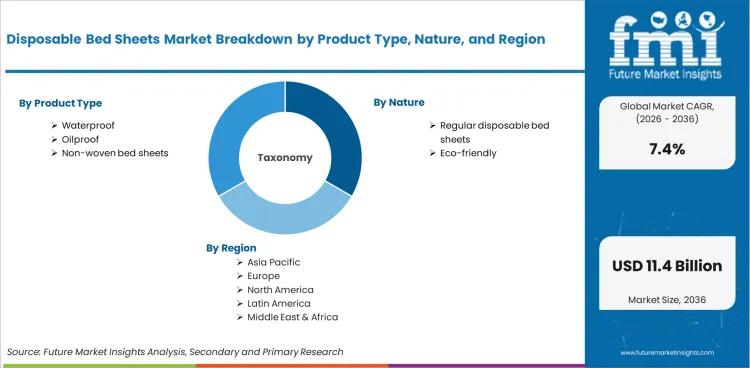
The disposable bed sheets market is segmented by product type, nature, price, application, sales channel, material, end user. Demand is concentrated in primary categories that serve the largest end-use applications, with growth potential in specialty and emerging sub-segments.
Insights into the Waterproof Product Type Segment
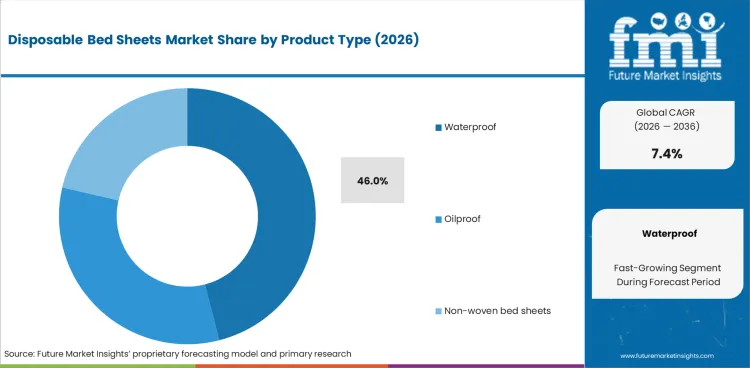
In 2026, waterproof is expected to account for 46.0% of the market in the product type segment. Demand reflects procurement patterns across primary end-use industries where waterproof specifications meet performance, cost, and compliance requirements. This segment benefits from established supply chains and standardized procurement processes.
Oilproof and Non-woven bed sheets represent additional segments with growth potential as end-use applications diversify and new specifications emerge. These segments serve specialized requirements where standard offerings do not meet performance or regulatory thresholds.
Insights into the Regular disposable bed sheets Nature Segment
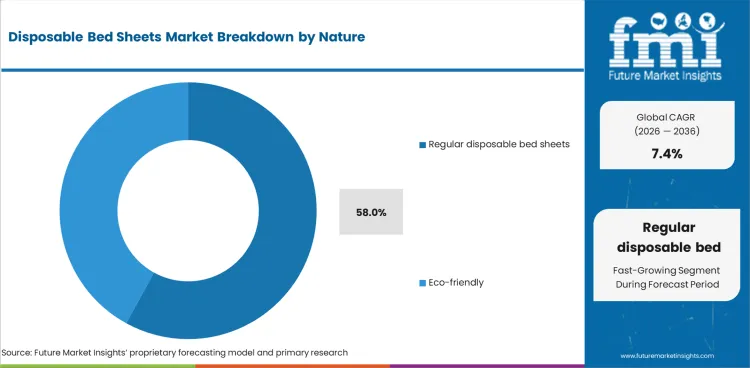
In 2026, regular disposable bed sheets is expected to account for 58.0% of the market in the nature segment. Demand reflects procurement patterns across primary end-use industries where regular disposable bed sheets specifications meet performance, cost, and compliance requirements. This segment benefits from established supply chains and standardized procurement processes.
Eco-friendly represents additional segments with growth potential as end-use applications diversify and new specifications emerge. These segments serve specialized requirements where standard offerings do not meet performance or regulatory thresholds.
Disposable Bed Sheets Market Drivers, Restraints, and Opportunities
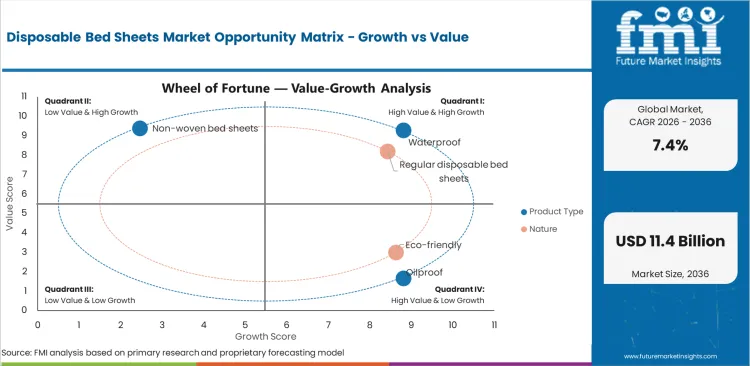
- Structural demand growth across primary end-use applications is expected to sustain procurement volumes through the forecast period.
- Cost pressures from raw material price fluctuations and supply chain complexity remain the primary constraint on margin expansion.
- Regulatory compliance requirements are creating new procurement specifications that favor qualified, certified suppliers.
The disposable bed sheets market is shaped by a combination of end-use demand growth, regulatory requirements, and supply chain dynamics. Growth opportunities exist in premium segments, emerging market expansion, and technology-driven product improvements. Cost pressures and supply chain constraints remain the primary barriers to accelerated adoption.
Healthcare Infection Control Protocols
Hospital and clinic procurement of disposable bed sheets is driven by infection prevention and control (IPC) protocols that mandate single-use bedding for high-risk patients and procedure areas. Surgical suites, emergency departments, and intensive care units are primary consumption points. Growth in hospital bed capacity and outpatient procedure volumes is expanding institutional procurement.
Salon and Wellness Industry Growth
Expansion of beauty salons, spas, massage centers, and aesthetic treatment clinics is creating procurement demand for disposable bed coverings that reduce laundry costs and cross-contamination risks. Service providers prefer disposable sheets for their convenience, hygiene assurance, and client-facing cleanliness perception. This segment is growing rapidly in Asia-Pacific and Europe.
Consumer Hygiene Awareness and Travel Applications
Consumer adoption of disposable bed sheets for hotel stays, train travel, and homestay accommodation is expanding the retail market. Health-conscious travelers use disposable sheets as a personal hygiene layer in unfamiliar sleeping environments. This consumer behavior is most pronounced in China, South Korea, and Japan, where hygiene product adoption rates are high.
Sustainability Pressure on Non-Woven Materials
Environmental concerns about single-use non-woven products are creating demand for biodegradable and compostable alternatives. Eco-friendly disposable bed sheets made from plant-based or recycled fibers are entering the market. Manufacturers investing in sustainable material alternatives are positioning for procurement share growth as institutional buyers adopt green purchasing policies.
Analysis of Disposable Bed Sheets Market By Key Countries
.webp "Top Country Growth Comparison Disposable Bed Sheets Market Cagr (2026 2036)")
| Country | CAGR |
|---|---|
| China | 7.5% |
| South Korea | 7% |
| USA | 6.8% |
| Germany | 6.7% |
| France | 6.6% |
| UK | 6.5% |
| Italy | 6.4% |
| Japan | 6.3% |
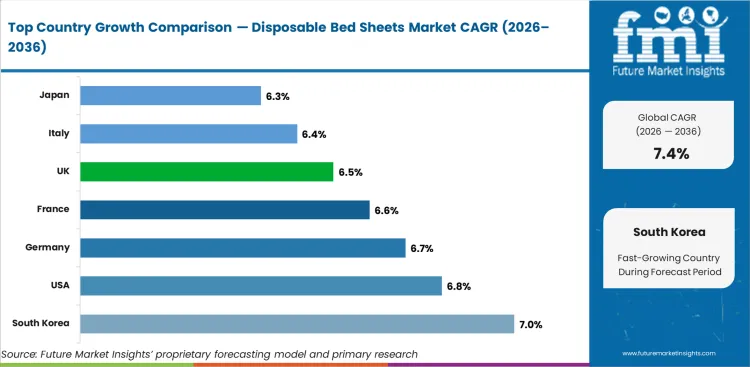
- China at 7.5% CAGR reflects production scale, infrastructure expansion, and government-backed procurement programs.
- South Korea at 7% CAGR reflects manufacturing output growth, technology investment, and export-oriented production.
- USA at 6.8% CAGR reflects strong end-use demand, regulatory compliance, and manufacturing investment.
- Germany at 6.7% CAGR reflects automotive engineering leadership, industrial manufacturing, and regulatory stringency.
The global disposable bed sheets market is projected to expand at 7.4% CAGR from 2026 to 2036. The analysis covers more than 30 countries, with key markets detailed below.
Demand Outlook for Disposable Bed Sheets Market in China
The market in China is expected to grow at 7.5% CAGR through 2036. Production scale, infrastructure expansion, and government investment drive demand. The market is transitioning from price-driven to specification-driven procurement as quality standards tighten across industries.
- End-use demand growth supports procurement volumes across primary application segments.
- Regulatory compliance requirements favor qualified and certified suppliers.
- Infrastructure and production investment creates additional demand across secondary application categories.
Future Outlook for Disposable Bed Sheets Market in South Korea
The market in South Korea is expected to grow at 7% CAGR through 2036. Manufacturing output growth and technology-driven procurement are supporting demand. Strong electronics, automotive, and chemical manufacturing bases drive specification-intensive procurement.
- End-use demand growth supports procurement volumes across primary application segments.
- Regulatory compliance requirements favor qualified and certified suppliers.
- Infrastructure and production investment creates additional demand across secondary application categories.
Opportunity Analysis of Disposable Bed Sheets Market in the United States
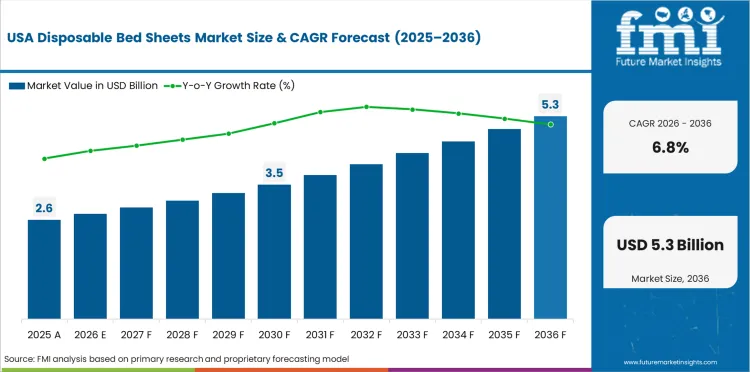
The market in the United States is expected to grow at 6.8% CAGR through 2036. Demand is supported by manufacturing activity, regulatory compliance, and technology adoption across primary end-use sectors. The established industrial base and standardized procurement processes create stable demand for qualified suppliers.
- End-use demand growth supports procurement volumes across primary application segments.
- Regulatory compliance requirements favor qualified and certified suppliers.
- Infrastructure and production investment creates additional demand across secondary application categories.
In-depth Analysis of Disposable Bed Sheets Market in Germany
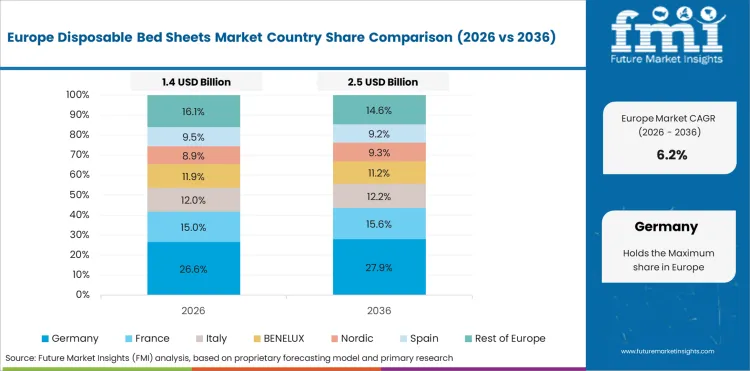
The market in Germany is expected to grow at 6.7% CAGR through 2036. Industrial manufacturing strength, automotive sector scale, and regulatory leadership position Germany as a key procurement market. Engineering-grade specifications and quality requirements favor established, certified suppliers.
- End-use demand growth supports procurement volumes across primary application segments.
- Regulatory compliance requirements favor qualified and certified suppliers.
- Infrastructure and production investment creates additional demand across secondary application categories.
Sales Analysis of Disposable Bed Sheets Market in France
The market in France is expected to grow at 6.6% CAGR through 2036. Structural demand growth and regional investment are supporting market expansion through the forecast period.
- End-use demand growth supports procurement volumes across primary application segments.
- Regulatory compliance requirements favor qualified and certified suppliers.
- Infrastructure and production investment creates additional demand across secondary application categories.
Competitive Landscape and Strategic Positioning
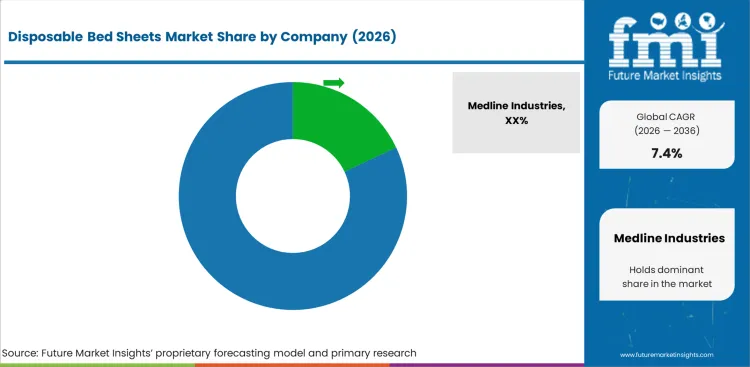
- Medline Industries maintains a leading position through integrated manufacturing capabilities and established end-user relationships across key regions.
- Mid-tier players compete on regional presence, product specialization, and technical service capability.
- Entry barriers include capital intensity, quality certification requirements, and established supply chain relationships.
Medline Industries holds a leading market position through broad product capabilities and global distribution networks. The company serves primary end-use segments across major regions with standardized and custom product offerings.
TIDI Products and Molnlycke Health Care compete through technical specialization, regional market knowledge, and application-specific expertise.
The competitive landscape is shaped by capital requirements for manufacturing infrastructure, quality certification processes, and the need for established end-user relationships. New entrants typically focus on niche applications or regional markets before expanding into broader competition.
Key Companies in the Disposable Bed Sheets Market
Key global companies leading the disposable bed sheets market include:
-
Medline Industries, TIDI Products, Molnlycke Health Care maintain strong positions through global manufacturing infrastructure and established distribution networks.
Competitive Benchmarking: Disposable Bed Sheets Market
| Company | Product Range | Manufacturing Scale | Distribution Reach | Technical Capability |
|---|---|---|---|---|
| Medline Industries | High | High | Global | Strong |
| TIDI Products | High | Medium | Global | Strong |
| Molnlycke Health Care | Medium | High | Regional | Strong |
| Cardinal Health | Medium | Medium | Regional | Moderate |
Source: Future Market Insights competitive analysis, 2026.
Key Developments in Disposable Bed Sheets Market
- In 2025, Medline Industries expanded manufacturing capacity for waterproof products to serve growing demand in China and European markets.
- In 2025, TIDI Products introduced new product specifications aligned with updated regulatory requirements in North America and Europe.
Key Players in the Disposable Bed Sheets Market
Major Global Players
- Medline Industries
- TIDI Products
- Molnlycke Health Care
- Cardinal Health
Emerging Players/Startups
-
Cardinal Health
Report Scope and Coverage
| Parameter | Details |
|---|---|
| Quantitative Units | USD 5.58 billion to USD 11.40 billion, at a CAGR of 7.4% |
| Market Definition | The disposable bed sheets market encompasses products and services related to product type, nature, price, application, sales channel, material, end user applications across key global regions. |
| Regions Covered | North America, Latin America, Europe, East Asia, South Asia and Pacific, Middle East and Africa |
| Countries Covered | USA, UK, France, Germany, Italy, South Korea, Japan, China, India, 30 plus countries |
| Key Companies Profiled | Medline Industries, TIDI Products, Molnlycke Health Care, Cardinal Health |
| Forecast Period | 2026 to 2036 |
| Approach | Hybrid bottom-up and top-down methodology starting with verified transaction data, projecting adoption velocity across segments and regions. |
Segmentation
Disposable Bed Sheets Market Market Segmented by Product Type:
- Waterproof
- Oilproof
- Non-woven bed sheets
Disposable Bed Sheets Market Market Segmented by Nature:
- Regular disposable bed sheets
- Eco-friendly
Disposable Bed Sheets Market Market Segmented by Price:
- Economy
- High
Disposable Bed Sheets Market Market Segmented by Application:
- Hospital
- Salon & spa
- Home
Disposable Bed Sheets Market Market Segmented by Sales Channel:
- Supermarkets/hypermarkets
- E-retailers
- Pharmacies & drug stores
Disposable Bed Sheets Market Market Segmented by Material:
- Polypropylene
- Polyethylene
Disposable Bed Sheets Market Market Segmented by End User:
- Personal use
- Healthcare facilities
Disposable Bed Sheets Market Market by Region:
- North America
- USA
- Canada
- Mexico
- Latin America
- Brazil
- Chile
- Rest of Latin America
- Western Europe
- Germany
- UK
- Italy
- Spain
- France
- Nordic
- BENELUX
- Rest of Western Europe
- Eastern Europe
- Russia
- Poland
- Hungary
- Balkan & Baltic
- Rest of Eastern Europe
- East Asia
- China
- Japan
- South Korea
- South Asia and Pacific
- India
- ASEAN
- Australia & New Zealand
- Rest of South Asia and Pacific
- Middle East & Africa
- Kingdom of Saudi Arabia
- Other GCC Countries
- Turkiye
- South Africa
- Other African Union
- Rest of Middle East & Africa
Research Sources and Bibliography
- 1. World Health Organization. (2025). WHO Guidelines on Infection Prevention and Control in Healthcare Facilities. WHO.
- 2. European Commission. (2025). EU Single-Use Plastics Directive: Non-Woven Products Assessment. EC.
- 3. Centers for Disease Control and Prevention. (2025). CDC Healthcare Infection Control Practices Advisory Committee Guidelines. CDC.
- 4. International Organization for Standardization. (2025). ISO 22609 Protective Clothing Test Methods. ISO.
- 5. Global Wellness Institute. (2025). GWI Global Wellness Economy Monitor. GWI.
This bibliography is provided for reader reference.
This Report Answers
- Estimating the size of the disposable bed sheets market and revenue projections from 2026 to 2036.
- Segmentation analysis by product type, nature, price, application, sales channel, material, end user.
- Regional and country-level market insights covering more than 30 markets.
- Assessment of competitive landscape and key company positioning.
- Analysis of market drivers, restraints, and growth opportunities.
- Investment opportunity identification across primary segments and regions.
- Supply chain and procurement structure analysis.
- Delivery of data in PDF and Excel formats.
Frequently Asked Questions
What is the global market demand for Disposable Bed Sheets Market in 2026?
In 2026, the global disposable bed sheets market is expected to be worth USD 5.58 billion.
How big will the Disposable Bed Sheets Market be in 2036?
By 2036, the disposable bed sheets market is expected to reach USD 11.40 billion.
How much is demand for Disposable Bed Sheets Market expected to grow between 2026 and 2036?
Between 2026 and 2036, demand for disposable bed sheets market is expected to grow at a CAGR of 7.4%.
Which product type segment is expected to lead in 2026?
Personal use is expected to account for 61.0% of the end user segment in 2026, driven by growing consumer hygiene awareness and demand for single-use bedding in travel, hospitality, and home care settings.
What is driving demand in China?
China is expected to grow at 7.5% CAGR through 2036, supported by production scale, infrastructure expansion, and government-backed procurement programs.
What is driving demand in South Korea?
South Korea is expected to grow at 7% CAGR through 2036, reflecting manufacturing output growth, technology investment, and export-oriented production.
What does this report mean by 'Disposable Bed Sheets Market definition'?
The disposable bed sheets market includes all commercially traded products categorized by product type, nature, price, application, sales channel, material, end user across global and regional markets.
How does FMI make the Disposable Bed Sheets Market forecast and validate it?
Forecasting uses a hybrid bottom-up and top-down methodology, starting with verified transaction data and validating against industry production statistics and manufacturer disclosures.
Preview the report firsthand - request a free sample
Get SampleGet the brochure for pricing and purchase details.
Get PDFTable of Content
- Executive Summary
- Global Market Outlook
- Demand-side Trends
- Supply-side Trends
- Technology Roadmap Analysis
- Analysis and Recommendations
- Market Overview
- Market Coverage / Taxonomy
- Market Definition / Scope / Limitations
- Research Methodology
- Chapter Orientation
- Analytical Lens and Working Hypotheses
- Market Structure, Signals, and Trend Drivers
- Benchmarking and Cross-market Comparability
- Market Sizing, Forecasting, and Opportunity Mapping
- Research Design and Evidence Framework
- Desk Research Programme (Secondary Evidence)
- Company Annual and Sustainability Reports
- Peer-reviewed Journals and Academic Literature
- Corporate Websites, Product Literature, and Technical Notes
- Earnings Decks and Investor Briefings
- Statutory Filings and Regulatory Disclosures
- Technical White Papers and Standards Notes
- Trade Journals, Industry Magazines, and Analyst Briefs
- Conference Proceedings, Webinars, and Seminar Materials
- Government Statistics Portals and Public Data Releases
- Press Releases and Reputable Media Coverage
- Specialist Newsletters and Curated Briefings
- Sector Databases and Reference Repositories
- FMI Internal Proprietary Databases and Historical Market Datasets
- Subscription Datasets and Paid Sources
- Social Channels, Communities, and Digital Listening Inputs
- Additional Desk Sources
- Expert Input and Fieldwork (Primary Evidence)
- Primary Modes
- Qualitative Interviews and Expert Elicitation
- Quantitative Surveys and Structured Data Capture
- Blended Approach
- Why Primary Evidence is Used
- Field Techniques
- Interviews
- Surveys
- Focus Groups
- Observational and In-context Research
- Social and Community Interactions
- Stakeholder Universe Engaged
- C-suite Leaders
- Board Members
- Presidents and Vice Presidents
- R&D and Innovation Heads
- Technical Specialists
- Domain Subject-matter Experts
- Scientists
- Physicians and Other Healthcare Professionals
- Governance, Ethics, and Data Stewardship
- Research Ethics
- Data Integrity and Handling
- Primary Modes
- Tooling, Models, and Reference Databases
- Desk Research Programme (Secondary Evidence)
- Data Engineering and Model Build
- Data Acquisition and Ingestion
- Cleaning, Normalisation, and Verification
- Synthesis, Triangulation, and Analysis
- Quality Assurance and Audit Trail
- Market Background
- Market Dynamics
- Drivers
- Restraints
- Opportunity
- Trends
- Scenario Forecast
- Demand in Optimistic Scenario
- Demand in Likely Scenario
- Demand in Conservative Scenario
- Opportunity Map Analysis
- Product Life Cycle Analysis
- Supply Chain Analysis
- Investment Feasibility Matrix
- Value Chain Analysis
- PESTLE and Porter’s Analysis
- Regulatory Landscape
- Regional Parent Market Outlook
- Production and Consumption Statistics
- Import and Export Statistics
- Market Dynamics
- Global Market Analysis 2021 to 2025 and Forecast, 2026 to 2036
- Historical Market Size Value (USD Million) Analysis, 2021 to 2025
- Current and Future Market Size Value (USD Million) Projections, 2026 to 2036
- Y-o-Y Growth Trend Analysis
- Absolute $ Opportunity Analysis
- Global Market Pricing Analysis 2021 to 2025 and Forecast 2026 to 2036
- Global Market Analysis 2021 to 2025 and Forecast 2026 to 2036, By Product Type
- Introduction / Key Findings
- Historical Market Size Value (USD Million) Analysis By Product Type , 2021 to 2025
- Current and Future Market Size Value (USD Million) Analysis and Forecast By Product Type , 2026 to 2036
- Waterproof
- Oilproof
- Non-woven bed sheets
- Waterproof
- Y-o-Y Growth Trend Analysis By Product Type , 2021 to 2025
- Absolute $ Opportunity Analysis By Product Type , 2026 to 2036
- Global Market Analysis 2021 to 2025 and Forecast 2026 to 2036, By Nature
- Introduction / Key Findings
- Historical Market Size Value (USD Million) Analysis By Nature, 2021 to 2025
- Current and Future Market Size Value (USD Million) Analysis and Forecast By Nature, 2026 to 2036
- Regular disposable bed sheets
- Eco-friendly
- Regular disposable bed sheets
- Y-o-Y Growth Trend Analysis By Nature, 2021 to 2025
- Absolute $ Opportunity Analysis By Nature, 2026 to 2036
- Global Market Analysis 2021 to 2025 and Forecast 2026 to 2036, By Price
- Introduction / Key Findings
- Historical Market Size Value (USD Million) Analysis By Price, 2021 to 2025
- Current and Future Market Size Value (USD Million) Analysis and Forecast By Price, 2026 to 2036
- Economy
- High
- Economy
- Y-o-Y Growth Trend Analysis By Price, 2021 to 2025
- Absolute $ Opportunity Analysis By Price, 2026 to 2036
- Global Market Analysis 2021 to 2025 and Forecast 2026 to 2036, By Application
- Introduction / Key Findings
- Historical Market Size Value (USD Million) Analysis By Application, 2021 to 2025
- Current and Future Market Size Value (USD Million) Analysis and Forecast By Application, 2026 to 2036
- Hospital
- Salon & spa
- Home
- Hospital
- Y-o-Y Growth Trend Analysis By Application, 2021 to 2025
- Absolute $ Opportunity Analysis By Application, 2026 to 2036
- Global Market Analysis 2021 to 2025 and Forecast 2026 to 2036, By Sales Channel
- Introduction / Key Findings
- Historical Market Size Value (USD Million) Analysis By Sales Channel, 2021 to 2025
- Current and Future Market Size Value (USD Million) Analysis and Forecast By Sales Channel, 2026 to 2036
- Supermarkets/hypermarkets
- E-retailers
- Pharmacies & drug stores
- Supermarkets/hypermarkets
- Y-o-Y Growth Trend Analysis By Sales Channel, 2021 to 2025
- Absolute $ Opportunity Analysis By Sales Channel, 2026 to 2036
- Global Market Analysis 2021 to 2025 and Forecast 2026 to 2036, By Material
- Introduction / Key Findings
- Historical Market Size Value (USD Million) Analysis By Material, 2021 to 2025
- Current and Future Market Size Value (USD Million) Analysis and Forecast By Material, 2026 to 2036
- Polypropylene
- Polyethylene
- Polypropylene
- Y-o-Y Growth Trend Analysis By Material, 2021 to 2025
- Absolute $ Opportunity Analysis By Material, 2026 to 2036
- Global Market Analysis 2021 to 2025 and Forecast 2026 to 2036, By End User
- Introduction / Key Findings
- Historical Market Size Value (USD Million) Analysis By End User, 2021 to 2025
- Current and Future Market Size Value (USD Million) Analysis and Forecast By End User, 2026 to 2036
- Personal use
- Healthcare facilities
- Personal use
- Y-o-Y Growth Trend Analysis By End User, 2021 to 2025
- Absolute $ Opportunity Analysis By End User, 2026 to 2036
- Global Market Analysis 2021 to 2025 and Forecast 2026 to 2036, By Region
- Introduction
- Historical Market Size Value (USD Million) Analysis By Region, 2021 to 2025
- Current Market Size Value (USD Million) Analysis and Forecast By Region, 2026 to 2036
- North America
- Latin America
- Western Europe
- Eastern Europe
- East Asia
- South Asia and Pacific
- Middle East & Africa
- Market Attractiveness Analysis By Region
- North America Market Analysis 2021 to 2025 and Forecast 2026 to 2036, By Country
- Historical Market Size Value (USD Million) Trend Analysis By Market Taxonomy, 2021 to 2025
- Market Size Value (USD Million) Forecast By Market Taxonomy, 2026 to 2036
- By Country
- USA
- Canada
- Mexico
- By Product Type
- By Nature
- By Price
- By Application
- By Sales Channel
- By Material
- By End User
- By Country
- Market Attractiveness Analysis
- By Country
- By Product Type
- By Nature
- By Price
- By Application
- By Sales Channel
- By Material
- By End User
- Key Takeaways
- Latin America Market Analysis 2021 to 2025 and Forecast 2026 to 2036, By Country
- Historical Market Size Value (USD Million) Trend Analysis By Market Taxonomy, 2021 to 2025
- Market Size Value (USD Million) Forecast By Market Taxonomy, 2026 to 2036
- By Country
- Brazil
- Chile
- Rest of Latin America
- By Product Type
- By Nature
- By Price
- By Application
- By Sales Channel
- By Material
- By End User
- By Country
- Market Attractiveness Analysis
- By Country
- By Product Type
- By Nature
- By Price
- By Application
- By Sales Channel
- By Material
- By End User
- Key Takeaways
- Western Europe Market Analysis 2021 to 2025 and Forecast 2026 to 2036, By Country
- Historical Market Size Value (USD Million) Trend Analysis By Market Taxonomy, 2021 to 2025
- Market Size Value (USD Million) Forecast By Market Taxonomy, 2026 to 2036
- By Country
- Germany
- UK
- Italy
- Spain
- France
- Nordic
- BENELUX
- Rest of Western Europe
- By Product Type
- By Nature
- By Price
- By Application
- By Sales Channel
- By Material
- By End User
- By Country
- Market Attractiveness Analysis
- By Country
- By Product Type
- By Nature
- By Price
- By Application
- By Sales Channel
- By Material
- By End User
- Key Takeaways
- Eastern Europe Market Analysis 2021 to 2025 and Forecast 2026 to 2036, By Country
- Historical Market Size Value (USD Million) Trend Analysis By Market Taxonomy, 2021 to 2025
- Market Size Value (USD Million) Forecast By Market Taxonomy, 2026 to 2036
- By Country
- Russia
- Poland
- Hungary
- Balkan & Baltic
- Rest of Eastern Europe
- By Product Type
- By Nature
- By Price
- By Application
- By Sales Channel
- By Material
- By End User
- By Country
- Market Attractiveness Analysis
- By Country
- By Product Type
- By Nature
- By Price
- By Application
- By Sales Channel
- By Material
- By End User
- Key Takeaways
- East Asia Market Analysis 2021 to 2025 and Forecast 2026 to 2036, By Country
- Historical Market Size Value (USD Million) Trend Analysis By Market Taxonomy, 2021 to 2025
- Market Size Value (USD Million) Forecast By Market Taxonomy, 2026 to 2036
- By Country
- China
- Japan
- South Korea
- By Product Type
- By Nature
- By Price
- By Application
- By Sales Channel
- By Material
- By End User
- By Country
- Market Attractiveness Analysis
- By Country
- By Product Type
- By Nature
- By Price
- By Application
- By Sales Channel
- By Material
- By End User
- Key Takeaways
- South Asia and Pacific Market Analysis 2021 to 2025 and Forecast 2026 to 2036, By Country
- Historical Market Size Value (USD Million) Trend Analysis By Market Taxonomy, 2021 to 2025
- Market Size Value (USD Million) Forecast By Market Taxonomy, 2026 to 2036
- By Country
- India
- ASEAN
- Australia & New Zealand
- Rest of South Asia and Pacific
- By Product Type
- By Nature
- By Price
- By Application
- By Sales Channel
- By Material
- By End User
- By Country
- Market Attractiveness Analysis
- By Country
- By Product Type
- By Nature
- By Price
- By Application
- By Sales Channel
- By Material
- By End User
- Key Takeaways
- Middle East & Africa Market Analysis 2021 to 2025 and Forecast 2026 to 2036, By Country
- Historical Market Size Value (USD Million) Trend Analysis By Market Taxonomy, 2021 to 2025
- Market Size Value (USD Million) Forecast By Market Taxonomy, 2026 to 2036
- By Country
- Kingdom of Saudi Arabia
- Other GCC Countries
- Turkiye
- South Africa
- Other African Union
- Rest of Middle East & Africa
- By Product Type
- By Nature
- By Price
- By Application
- By Sales Channel
- By Material
- By End User
- By Country
- Market Attractiveness Analysis
- By Country
- By Product Type
- By Nature
- By Price
- By Application
- By Sales Channel
- By Material
- By End User
- Key Takeaways
- Key Countries Market Analysis
- USA
- Pricing Analysis
- Market Share Analysis, 2025
- By Product Type
- By Nature
- By Price
- By Application
- By Sales Channel
- By Material
- By End User
- Canada
- Pricing Analysis
- Market Share Analysis, 2025
- By Product Type
- By Nature
- By Price
- By Application
- By Sales Channel
- By Material
- By End User
- Mexico
- Pricing Analysis
- Market Share Analysis, 2025
- By Product Type
- By Nature
- By Price
- By Application
- By Sales Channel
- By Material
- By End User
- Brazil
- Pricing Analysis
- Market Share Analysis, 2025
- By Product Type
- By Nature
- By Price
- By Application
- By Sales Channel
- By Material
- By End User
- Chile
- Pricing Analysis
- Market Share Analysis, 2025
- By Product Type
- By Nature
- By Price
- By Application
- By Sales Channel
- By Material
- By End User
- Germany
- Pricing Analysis
- Market Share Analysis, 2025
- By Product Type
- By Nature
- By Price
- By Application
- By Sales Channel
- By Material
- By End User
- UK
- Pricing Analysis
- Market Share Analysis, 2025
- By Product Type
- By Nature
- By Price
- By Application
- By Sales Channel
- By Material
- By End User
- Italy
- Pricing Analysis
- Market Share Analysis, 2025
- By Product Type
- By Nature
- By Price
- By Application
- By Sales Channel
- By Material
- By End User
- Spain
- Pricing Analysis
- Market Share Analysis, 2025
- By Product Type
- By Nature
- By Price
- By Application
- By Sales Channel
- By Material
- By End User
- France
- Pricing Analysis
- Market Share Analysis, 2025
- By Product Type
- By Nature
- By Price
- By Application
- By Sales Channel
- By Material
- By End User
- India
- Pricing Analysis
- Market Share Analysis, 2025
- By Product Type
- By Nature
- By Price
- By Application
- By Sales Channel
- By Material
- By End User
- ASEAN
- Pricing Analysis
- Market Share Analysis, 2025
- By Product Type
- By Nature
- By Price
- By Application
- By Sales Channel
- By Material
- By End User
- Australia & New Zealand
- Pricing Analysis
- Market Share Analysis, 2025
- By Product Type
- By Nature
- By Price
- By Application
- By Sales Channel
- By Material
- By End User
- China
- Pricing Analysis
- Market Share Analysis, 2025
- By Product Type
- By Nature
- By Price
- By Application
- By Sales Channel
- By Material
- By End User
- Japan
- Pricing Analysis
- Market Share Analysis, 2025
- By Product Type
- By Nature
- By Price
- By Application
- By Sales Channel
- By Material
- By End User
- South Korea
- Pricing Analysis
- Market Share Analysis, 2025
- By Product Type
- By Nature
- By Price
- By Application
- By Sales Channel
- By Material
- By End User
- Russia
- Pricing Analysis
- Market Share Analysis, 2025
- By Product Type
- By Nature
- By Price
- By Application
- By Sales Channel
- By Material
- By End User
- Poland
- Pricing Analysis
- Market Share Analysis, 2025
- By Product Type
- By Nature
- By Price
- By Application
- By Sales Channel
- By Material
- By End User
- Hungary
- Pricing Analysis
- Market Share Analysis, 2025
- By Product Type
- By Nature
- By Price
- By Application
- By Sales Channel
- By Material
- By End User
- Kingdom of Saudi Arabia
- Pricing Analysis
- Market Share Analysis, 2025
- By Product Type
- By Nature
- By Price
- By Application
- By Sales Channel
- By Material
- By End User
- Turkiye
- Pricing Analysis
- Market Share Analysis, 2025
- By Product Type
- By Nature
- By Price
- By Application
- By Sales Channel
- By Material
- By End User
- South Africa
- Pricing Analysis
- Market Share Analysis, 2025
- By Product Type
- By Nature
- By Price
- By Application
- By Sales Channel
- By Material
- By End User
- USA
- Market Structure Analysis
- Competition Dashboard
- Competition Benchmarking
- Market Share Analysis of Top Players
- By Regional
- By Product Type
- By Nature
- By Price
- By Application
- By Sales Channel
- By Material
- By End User
- Competition Analysis
- Competition Deep Dive
- Medline Industries
- Overview
- Product Portfolio
- Profitability by Market Segments (Product/Age /Sales Channel/Region)
- Sales Footprint
- Strategy Overview
- Marketing Strategy
- Product Strategy
- Channel Strategy
- TIDI Products
- Mölnlycke Health Care
- Cardinal Health
- Other Companies (combined)
- Medline Industries
- Competition Deep Dive
- Assumptions & Acronyms Used


