

- Industry Size (2026)
- USD 2.73 Bn
- Forecast (2036)
- USD 6.45 Bn
- CAGR (2026 to 2036)
- 9%
Construction Risk Assessment Software Market Size, Market Forecast and Outlook By FMI
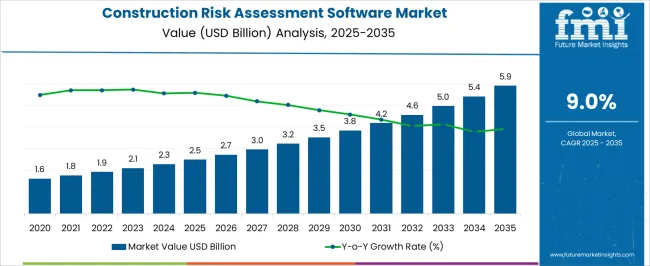
The construction risk assessment software market was valued at USD 2.5 billion in 2025, projected to reach USD 2.73 billion in 2026, and is forecast to expand to USD 6.45 billion by 2036 at a 9% CAGR.Demand is driven by construction firms adopting digital risk identification and mitigation platforms to manage safety, financial, and schedule risks across increasingly complex project portfolios.
Summary of Construction Risk Assessment Software Market
- Market Overview
- The construction risk assessment software market is valued at USD 2.5 billion in 2025 and is projected to reach USD 6.45 billion by 2036.
- The industry is expected to grow at a 9% CAGR from 2026 to 2036, creating an incremental opportunity of USD 3.72 billion.
- The market is a construction technology category where adoption is driven by safety regulation compliance, project liability management, and the digitization of risk identification workflows across construction firms of all sizes.
- Demand and Growth Drivers
- Demand is driven by construction firms digitizing risk identification and mitigation workflows to manage safety, financial, and schedule risks across complex project portfolios.
- Cloud deployment is accelerating as multi-site operations require centralized risk dashboards without dedicated on-site IT infrastructure.
- SME adoption is broadening as subscription pricing and simplified interfaces lower entry thresholds beyond the large enterprise segment.
- Among key countries, China at 12.2%, India at 11.3%, Germany at 10.4%, France at 9.5%, UK at 8.6%, USA at 7.7%, Brazil at 6.8%.
- Product and Segment View
- The market covers digital platforms for construction risk identification, assessment, tracking, and mitigation across safety, financial, and schedule risk categories.
- These platforms serve commercial, residential, industrial, and infrastructure construction project teams.
- Cloud-based leads by Deployment with 61.4% share in 2026, driven by multi-site centralized risk visibility requirements.
- Commercial Construction leads by End-User with 35.2% share in 2026.
- The scope includes construction-specific risk assessment software, excluding general enterprise risk management platforms, insurance underwriting systems, and standalone safety inspection checklists.
- Geography and Competitive Outlook
- China and India are the fastest-growing markets due to tightening construction safety regulations and infrastructure program compliance documentation requirements.
- Germany and USA sustain demand through occupational safety regulations, OSHA compliance, and commercial project liability management requirements.
- Competition is shaped by risk analytics depth, integration with construction management platforms, and regulatory compliance template coverage, with key players including Procore Technologies, Inc., Autodesk, Inc., Oracle Corporation, Buildertrend Solutions, Inc., Trimble Inc., Bentley Systems, Incorporated, Raken, Inc..
- Analyst Opinion at FMI
- Sudip Saha, Principal Consultant at Future Market Insights, opines: 'As per FMI analysis, the construction risk assessment software market is entering a phase where specification precision, compliance documentation, and lifecycle cost evaluation define procurement decisions. Operations teams that delay standardization risk exclusion from major contract cycles where pre-qualification thresholds tighten progressively.'
- Strategic Implications / Executive Takeaways
- Software vendors must develop pre-built regulatory compliance templates covering OSHA, EU-OSHA, and national safety standards to reduce platform configuration time during customer onboarding.
- Construction safety directors should evaluate risk platform integration capability with existing construction management and BIM systems before committing to enterprise deployment.
- Insurance brokers and underwriters should explore data sharing partnerships with risk assessment platform vendors to develop usage-based construction liability pricing models.
Construction Risk Assessment Software Market Key Takeaways
| Metric | Details |
|---|---|
| Industry Size (2026) | USD 2.73 billion |
| Industry Value (2036) | USD 6.45 billion |
| CAGR (2026-2036) | 9% |
Source: Future Market Insights, 2026
Cloud-based deployment holds the leading share as firms operating across multiple project sites require centralized risk dashboards without dedicated IT infrastructure at each location. Small and medium-sized enterprises anchor the largest enterprise size share, reflecting the broadening adoption base beyond large general contractors as subscription pricing and simplified interfaces lower the entry threshold. Commercial construction projects lead the end-user share due to the multi-trade coordination, regulatory compliance, and liability management complexity that characterizes large commercial builds.
All major markets reflect construction digitization and risk management maturity. China leads at 12.2% CAGR as construction safety regulations tighten and project scale increases demand for systematic risk tracking platforms. India follows at 11.3% driven by government infrastructure program compliance documentation requirements. Germany maintains 10.4% growth anchored by occupational safety regulations and BIM-integrated risk management workflows. France at 9.5% and UK at 8.6% reflect steady enterprise adoption driven by construction liability management requirements. USA sustains a 7.7% pace through OSHA compliance documentation and commercial project insurance requirement integration. Brazil at 6.8% is driven by infrastructure project safety regulation enforcement.
Construction Risk Assessment Software Market Definition
Construction Risk Assessment Software Market encompasses digital platforms designed to identify, assess, track, and mitigate construction project risks across safety, financial, and schedule categories. These platforms operate in cloud-based and on-premises deployments serving small, medium, and large construction enterprises. Procurement is tied to safety regulation compliance, project insurance requirements, and construction digitization maturity.
Construction Risk Assessment Software Market Inclusions
Market scope includes cloud-based and on-premises construction risk assessment platforms serving commercial, residential, industrial, and infrastructure construction end-users across all enterprise sizes. Coverage spans global and regional market sizes, the 2026 to 2036 forecast period, and segment breakdowns by deployment, enterprise size, end-user, and region.
Construction Risk Assessment Software Market Exclusions
The scope excludes general enterprise risk management platforms, insurance underwriting and actuarial software, standalone safety inspection checklist applications, and financial portfolio risk management systems. It also omits consulting services revenue.
Construction Risk Assessment Software Market Research Methodology
- Primary Research: Analysts conducted structured interviews with procurement directors, site engineers, and project managers to map decision gates and specification requirements in the construction risk assessment software market.
- Desk Research: Data collection aggregated regulatory filings, industry standards updates, trade association reports, and publicly available corporate disclosures relevant to the construction risk assessment software sector.
- Market-Sizing and Forecasting: Baseline values derive from a bottom-up aggregation of procurement volumes and contract values, applying region-specific adoption curves to project future demand trajectories.
- Data Validation and Update Cycle: Projections are tested against publicly reported capital expenditure guidance and procurement records from major end-use operators.
Why is the Construction Risk Assessment Software Market Growing?
The construction risk assessment software market is experiencing accelerating growth as the industry increasingly embraces digital tools to mitigate delays, safety incidents, and financial losses. The market is being driven by heightened awareness of regulatory compliance, project cost overruns, and the growing complexity of construction projects. As firms prioritize real-time monitoring and predictive analytics, the demand for intelligent software solutions capable of identifying and managing risk across planning, procurement, safety, and execution stages is rising.
Organizations are transitioning from manual or siloed systems toward integrated platforms that offer improved visibility, cross-team collaboration, and proactive decision-making. The increasing push toward digitization, especially among small and medium-sized construction firms, is creating new demand for scalable, cloud-native platforms. Regulatory bodies and insurers are also exerting pressure on contractors to adopt standardized risk protocols, further supporting adoption.
As infrastructure spending continues to rise globally, particularly in urban development and public works, construction risk assessment software is becoming an essential component of project lifecycle management This market is expected to see strong long-term demand driven by technology modernization, operational resilience goals, and stakeholder accountability requirements.
Segmental Analysis
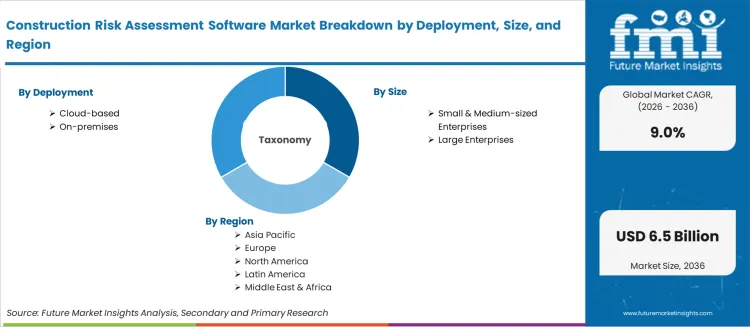
The construction risk assessment software market is segmented by deployment mode, organization size, end user, and geographic regions. By deployment mode, construction risk assessment software market is divided into Cloud-based and On-premises. In terms of organization size, construction risk assessment software market is classified into Small & Medium-sized Enterprises (SME) and Large Enterprises.
Based on end user, construction risk assessment software market is segmented into Commercial Construction, Residential Construction, Industrial Construction, and Infrastructure Construction. Regionally, the construction risk assessment software industry is classified into North America, Latin America, Western Europe, Eastern Europe, Balkan & Baltic Countries, Russia & Belarus, Central Asia, East Asia, South Asia & Pacific, and the Middle East & Africa.
Insights into the Cloud-based Deployment Mode Segment
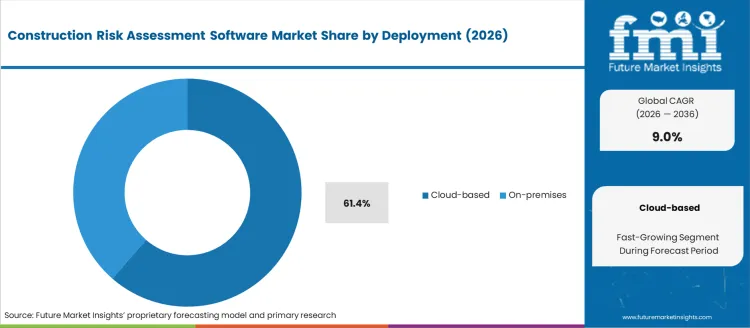
The cloud-based deployment mode is expected to hold 61.4% of the construction risk assessment software market revenue share in 2025, positioning it as the leading deployment model. This dominance is being driven by the increasing demand for scalability, ease of access, and reduced upfront infrastructure costs. Cloud-based platforms allow construction firms to deploy advanced risk assessment tools without the need for extensive IT investments, making them particularly attractive to small and mid-sized companies.
The ability to access real-time risk data and analytics from any location is enhancing collaboration across on-site and remote teams. These solutions also facilitate seamless integration with other construction management tools such as project scheduling, cost tracking, and safety compliance systems. Regular updates, data backups, and lower maintenance responsibilities are further contributing to widespread adoption.
As digital transformation becomes a priority in construction operations, the flexibility and responsiveness of cloud-based solutions are aligning with industry needs. The growing availability of cloud-native applications with advanced machine learning capabilities is reinforcing the segment’s leadership as firms seek to future-proof their risk management strategies.
Insights into the Small and Medium-sized Enterprises (SME) Organization Size Segment
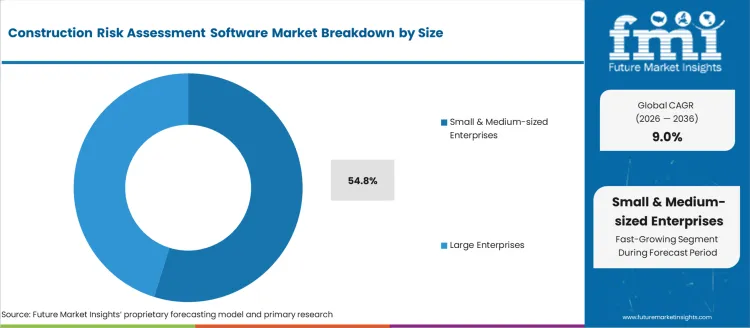
The small and medium-sized enterprises segment is projected to account for 54.8% of the construction risk assessment software market revenue share in 2025, making it the largest segment by organization size. This leadership is being supported by the growing need among SMEs to manage project risks efficiently while working within limited resources and tighter budgets. As construction complexity increases and client expectations rise, small and mid-sized firms are turning to digital solutions that help prevent cost overruns, delays, and safety issues.
Cloud-based and subscription-based platforms are enabling SMEs to access enterprise-grade features without the burden of significant capital expenditure. Government support for digital transformation and increasing availability of user-friendly software tailored for smaller teams are also facilitating adoption. These firms are often more agile and willing to experiment with new tools that streamline operations and improve client satisfaction.
With risk management becoming a core differentiator in competitive bidding processes, SMEs are increasingly integrating risk assessment software to demonstrate compliance, control variability, and improve project outcomes This trend is expected to continue driving the segment’s expansion in the coming years.
Insights into the Commercial Construction End-User Segment
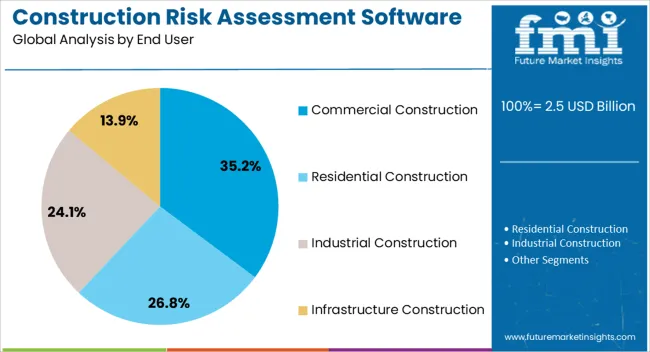
The commercial construction segment is forecasted to capture 35.2% of the construction risk assessment software market revenue share in 2025, making it the leading end-user category. Its dominance is being driven by the heightened risk exposure associated with high-value, deadline-sensitive commercial projects. Developers and contractors in this segment face complex challenges related to site safety, labor availability, budget volatility, and contractual obligations, all of which require structured risk management frameworks.
The use of software platforms enables these stakeholders to identify, assess, and mitigate risks in real time, ensuring projects remain on schedule and within budget. With growing urbanization and the rapid development of office buildings, retail complexes, and hospitality infrastructure, commercial firms are increasingly prioritizing technology investments that reduce liability and enhance operational transparency. Regulatory compliance and insurance requirements are also compelling stakeholders to document and standardize risk control measures.
The scalability and predictive analytics features offered by modern platforms allow commercial builders to handle multiple concurrent projects while minimizing disruption. As competition intensifies and investor scrutiny grows, commercial construction companies are expected to further drive adoption of advanced risk assessment solutions.
What are the Drivers, Restraints, and Key Trends of the Construction Risk Assessment Software Market?
The construction risk assessment software market is being driven by demand from large-scale construction projects and growing needs in project management and safety compliance. Cloud-based, integrated, and collaborative software solutions are emerging as dominant trends, while challenges such as high costs and complex data management are being addressed strategically. The market is being reinforced as construction firms increasingly rely on data-driven tools to predict, mitigate, and manage project risks. Growth is being sustained by the critical role of these solutions in ensuring efficient, safe, and financially controlled construction operations.
Growing Demand From Large-Scale Construction Projects
The demand for construction risk assessment software is being driven by large-scale projects and complex infrastructure developments. Construction firms are increasingly adopting software solutions to identify, evaluate, and mitigate potential risks during project planning and execution. Regulatory compliance, safety monitoring, and resource allocation are being enhanced through digital risk analysis, which reduces financial losses and schedule delays. Contractors and project managers are being supported by software that integrates historical project data, predictive modeling, and scenario analysis. As construction operations become more intricate, reliance on risk assessment software is being reinforced, ensuring that projects are completed efficiently and risks are systematically managed across multiple stages.
Expanding Opportunities In Project Management And Safety Compliance
Opportunities are being unlocked as construction risk assessment software is being leveraged for project management and safety compliance. Construction companies, engineering consultancies, and infrastructure developers are employing these solutions to maintain workplace safety standards, comply with regulations, and optimize workflow. Integration with scheduling tools, cost estimation, and reporting systems is being adopted to enhance decision-making and operational transparency. The growing focus on risk reduction and financial protection in construction projects is providing software vendors with new growth avenues. Market penetration is being driven by the need for consistent, data-driven strategies to safeguard projects and personnel while reducing unforeseen liabilities.
Prevailing Trends In Cloud-Based And Integrated Software Solutions
Trends indicate that cloud-based and integrated risk assessment solutions are being increasingly favored. Construction risk assessment software is being enhanced with remote access, collaborative platforms, and real-time updates to ensure effective project oversight. Integration with Building Information Modeling (BIM), project management suites, and analytics tools is being widely implemented to improve accuracy in risk identification and response planning. Modular and scalable software architectures are being adopted to support multiple project sizes and types. The focus on connected, centralized systems is positioning risk assessment software as a critical tool for streamlined operations and proactive mitigation strategies in construction projects worldwide.
Challenges From High Costs And Data Management Concerns
Challenges in the construction risk assessment software market are arising from high implementation costs and complex data management. Organizations face difficulties in software integration with existing systems, employee training, and ongoing maintenance expenses. Managing large volumes of project data while ensuring accuracy and security is being considered a critical concern. Resistance from traditional project management teams and the learning curve associated with new digital tools are slowing adoption in some regions. Companies are compelled to adopt structured change management strategies and invest in user-friendly solutions to overcome these challenges, making operational efficiency and risk control the primary drivers for long-term market acceptance.
Analysis of Construction Risk Assessment Software Market By Key Countries
.webp "Top Country Growth Comparison Construction Risk Assessment Software Market Cagr (2026 2036)")
| Country | CAGR |
|---|---|
| China | 12.2% |
| India | 11.3% |
| Germany | 10.4% |
| France | 9.5% |
| UK | 8.6% |
| USA | 7.7% |
| Brazil | 6.8% |
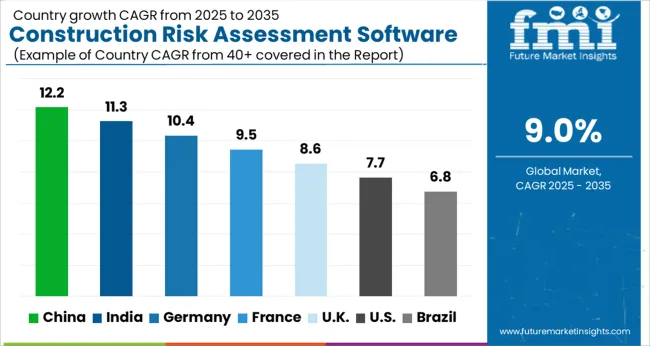
The global construction risk assessment software market is projected to grow at a CAGR of 9% from 2026 to 2036. China leads with a growth rate of 12.2%, followed by India at 11.3%, and France at 9.5%. The United Kingdom records a growth rate of 8.6%, while the United States shows the slowest growth at 7.7%. Increasing construction complexity, growing adoption of digital project management tools, and the need to minimize operational risks are driving market growth. Emerging markets such as China and India benefit from rapid infrastructure development, urban expansion, and government-backed construction projects. Developed markets like the USA, UK, and France focus on regulatory compliance, technological integration, and risk mitigation strategies. This report includes insights on 40+ countries; the top markets are shown here for reference.
Sales Outlook for Construction Risk Assessment Software Market in China
The construction risk assessment software market in China is projected to grow at a CAGR of 12.2%, fueled by rapid urbanization, large-scale infrastructure projects, and government initiatives to ensure construction safety. Contractors and project managers increasingly adopt software solutions to identify, monitor, and mitigate risks, enhancing project efficiency and reducing cost overruns. The demand for integrated digital platforms that combine project planning, risk analytics, and compliance tracking is rising. Rising awareness of occupational safety standards, construction quality requirements, and regulatory compliance drives adoption. Investments in AI-enabled predictive risk assessment tools and cloud-based project monitoring systems further strengthen the market presence.
- Large-scale infrastructure projects accelerate software adoption in China.
- AI-enabled predictive analytics enhance construction risk management.
- Government regulations on construction safety drive market growth.
Demand Analysis for Construction Risk Assessment Software Market in India
The construction risk assessment software market in India is expected to grow at a CAGR of 11.3%, supported by expanding urban infrastructure, commercial construction, and industrial development. Growing emphasis on construction safety, compliance with local and international standards, and digital project management adoption drives software integration. Contractors leverage these solutions to optimize workflows, monitor hazards, and ensure timely completion of projects. Investments in cloud-based, mobile-accessible platforms enable real-time risk tracking across multiple sites. Rising demand for eco-efficient and cost-effective construction practices also contributes to market expansion. The market benefits from strong government support for urbanization initiatives and infrastructure modernization, further fueling software adoption.
- Urban infrastructure expansion drives adoption in India.
- Cloud-based platforms allow real-time risk tracking.
- Government-backed projects enhance market growth.
In-depth Analysis of Construction Risk Assessment Software Market in France
The construction risk assessment software market in France is projected to grow at a CAGR of 9.5%, driven by stringent safety regulations, risk management mandates, and increasing adoption of digital tools in construction management. Large-scale industrial and commercial projects require software solutions that identify hazards, mitigate potential delays, and maintain regulatory compliance. Integration of AI and predictive analytics enhances decision-making in planning and project execution. Growing awareness of environmental safety, labor protection, and operational efficiency is further boosting adoption. Contractors increasingly rely on cloud-based solutions to monitor multiple sites, ensure workflow efficiency, and track compliance in real-time.
- Compliance with strict safety regulations drives adoption in France.
- AI and predictive analytics optimize project risk management.
- Industrial and commercial projects increase software usage.
Opportunity Analysis for Construction Risk Assessment Software Market in United Kingdom
The construction risk assessment software market in the UK is expected to grow at a CAGR of 8.6%, supported by demand from urban redevelopment, commercial, and industrial construction projects. Stringent health and safety standards drive adoption of risk monitoring solutions. Contractors and project managers use software to streamline operations, mitigate hazards, and ensure regulatory compliance. Cloud-based platforms and predictive analytics improve decision-making, reduce delays, and lower operational costs. Awareness of risk management practices and the integration of digital technologies into project management enhance market expansion. Adoption is also influenced by government-backed construction projects and increasing private sector investment in smart construction solutions.
- Urban redevelopment projects drive adoption in the UK
- Predictive analytics enhance decision-making and risk mitigation.
- Government-backed projects encourage market expansion.
Growth and Expansion Outlook for Construction Risk Assessment Software Market in the United States
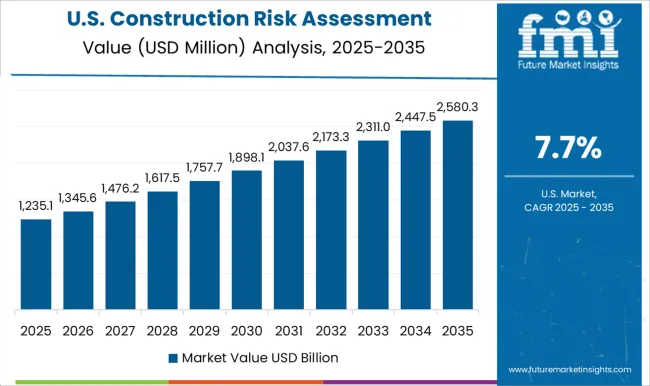
The construction risk assessment software market in the USA is projected to grow at a CAGR of 7.7%, with growth supported by large-scale commercial, industrial, and infrastructure projects. Increasing emphasis on project risk mitigation, regulatory compliance, and digital transformation encourages adoption of advanced software solutions. Contractors use integrated platforms for hazard monitoring, project tracking, and compliance reporting. Investments in AI-enabled predictive tools, cloud computing, and mobile accessibility strengthen operational efficiency. Rising awareness of construction safety standards, environmental requirements, and the need to reduce delays and cost overruns further drive software adoption.
- Commercial and industrial construction projects fuel market demand in the USA
- Cloud-based platforms improve operational efficiency.
- AI-enabled predictive tools support proactive risk management.
Competitive Landscape of Construction Risk Assessment Software Market
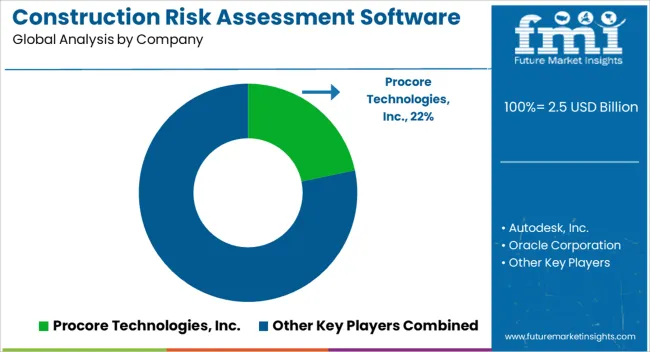
The construction risk assessment software market is increasingly shaped by the need for safety compliance, real-time project monitoring, and risk mitigation in large-scale infrastructure projects. Key players such as Procore Technologies, Inc., Autodesk, Inc., and Oracle Corporation focus on delivering cloud-based platforms that integrate project management, hazard analysis, and reporting tools. Buildertrend Solutions, Inc., Trimble Inc., and Bentley Systems, Incorporated emphasize data-driven risk assessment, leveraging predictive analytics and AI to identify potential project delays, safety incidents, and cost overruns. Software brochures highlight features such as automated risk scoring, customizable dashboards, regulatory compliance tracking, and mobile access, allowing construction managers to make informed decisions while ensuring operational efficiency. Companies such as Raken, Inc. differentiate through mobile-first solutions and field-level risk documentation, enhancing on-site monitoring and accountability. Competition in this market is primarily driven by technological innovation, integration capabilities, and user experience.
Providers aim to offer scalable, customizable platforms that support diverse project types, from commercial buildings to industrial infrastructure. Strategic partnerships and acquisitions are leveraged to expand functionality, while product brochures emphasize workflow automation, safety compliance, and real-time reporting. Market growth is supported by increasing adoption of digital construction solutions, rising regulatory requirements, and the demand for proactive risk management. Overall, the market reflects a convergence of advanced software technology, analytics, and construction expertise, fostering safer and more efficient project execution worldwide.
Key Players in the Construction Risk Assessment Software Market
- Procore Technologies, Inc.
- Autodesk, Inc.
- Oracle Corporation
- Buildertrend Solutions, Inc.
- Trimble Inc.
- Bentley Systems, Incorporated
- Raken, Inc.
Scope of the Report
| Metric | Value |
|---|---|
| Quantitative Units | USD 2.73 billion to USD 6.45 billion, at a CAGR of 9% |
| Market Definition | Construction risk assessment software covers digital platforms for identifying, assessing, tracking, and mitigating safety, financial, and schedule risks on construction projects. |
| Segmentation | Deployment: Cloud-based, On-premises; Size: Small & Medium-sized Enterprises, Large Enterprises; End-User: Commercial Construction, Residential Construction, Industrial Construction, Infrastructure Construction |
| Regions Covered | North America, Latin America, Europe, East Asia, South Asia, Oceania, Middle East & Africa |
| Countries Covered | China, India, Germany, France, UK, USA, Brazil, and 40 plus countries |
| Key Companies Profiled | Procore Technologies, Inc., Autodesk, Inc., Oracle Corporation, Buildertrend Solutions, Inc., Trimble Inc., Bentley Systems, Incorporated, Raken, Inc. |
| Forecast Period | 2026 to 2036 |
| Approach | Forecasting models apply a bottom-up methodology starting with regional construction activity and procurement metrics, cross-validated against industry association data and corporate disclosures. |
Construction Risk Assessment Software Market by Segments
Deployment Mode:
- Cloud-based
- On-premises
Organization Size:
- Small & Medium-sized Enterprises (SME)
- Large Enterprises
End User:
- Commercial Construction
- Residential Construction
- Industrial Construction
- Infrastructure Construction
Region:
- North America
- USA
- Canada
- Mexico
- Latin America
- Brazil
- Chile
- Rest of Latin America
- Western Europe
- Germany
- UK
- Italy
- Spain
- France
- Nordic
- BENELUX
- Rest of Western Europe
- Eastern Europe
- Russia
- Poland
- Hungary
- Balkan & Baltic
- Rest of Eastern Europe
- East Asia
- China
- Japan
- South Korea
- South Asia and Pacific
- India
- ASEAN
- Australia & New Zealand
- Rest of South Asia and Pacific
- Middle East & Africa
- Kingdom of Saudi Arabia
- Other GCC Countries
- Turkiye
- South Africa
- Other African Union
- Rest of Middle East & Africa
Bibliography
- 1. International Organization for Standardization. (2024). ISO 31000: Risk Management, Guidelines (2024 Amendment). ISO.
- 2. Occupational Safety and Health Administration. (2025). Construction Industry Compliance Assistance: Digital Documentation Requirements. OSHA.
- 3. European Agency for Safety and Health at Work. (2024). Construction Risk Assessment: Digital Tools Guidance. EU-OSHA.
- 4. Organisation for Economic Co-operation and Development. (2025). Digital Risk Management in Infrastructure Development. OECD.
- 5. World Bank Group. (2024). Construction Safety and Digital Compliance Standards. World Bank.
This bibliography is provided for reader reference. The full Future Market Insights report contains the complete reference list with primary research documentation.
Frequently Asked Questions
How large is the demand for Construction Risk Assessment Software in the global market in 2026?
Demand for Construction Risk Assessment Software in the global market is estimated to be valued at USD 2.73 billion in 2026.
What will be the market size of Construction Risk Assessment Software in the global market by 2036?
Market size for Construction Risk Assessment Software is projected to reach USD 6.45 billion by 2036.
What is the expected demand growth for Construction Risk Assessment Software between 2026 and 2036?
Demand for Construction Risk Assessment Software is expected to grow at a CAGR of 9% between 2026 and 2036.
Which Deployment is poised to lead global sales by 2026?
Cloud-based accounts for 61.4% share in 2026 based on FMI analysis.
How is the role of Commercial Construction in driving Construction Risk Assessment Software adoption in 2026?
Commercial Construction represents 35.2% of segment share in 2026 as per FMI's construction risk assessment software market report.
What is the fastest-growing country market in this report?
China is projected to grow at a CAGR of 12.2% during 2026 to 2036.
What is Construction Risk Assessment Software and what is it mainly used for?
Construction risk assessment software covers digital platforms for identifying, assessing, tracking, and mitigating safety, financial, and schedule risks on construction projects.
What is included in the scope of this Construction Risk Assessment Software report?
The market covers cloud-based and on-premises risk assessment platforms for commercial, residential, industrial, and infrastructure construction across all enterprise sizes.
Preview the report firsthand - request a free sample
Get SampleGet the brochure for pricing and purchase details.
Get PDFTable of Content
- Executive Summary
- Global Market Outlook
- Demand-side Trends
- Supply-side Trends
- Technology Roadmap Analysis
- Analysis and Recommendations
- Market Overview
- Market Coverage / Taxonomy
- Market Definition / Scope / Limitations
- Research Methodology
- Chapter Orientation
- Analytical Lens and Working Hypotheses
- Market Structure, Signals, and Trend Drivers
- Benchmarking and Cross-market Comparability
- Market Sizing, Forecasting, and Opportunity Mapping
- Research Design and Evidence Framework
- Desk Research Programme (Secondary Evidence)
- Company Annual and Sustainability Reports
- Peer-reviewed Journals and Academic Literature
- Corporate Websites, Product Literature, and Technical Notes
- Earnings Decks and Investor Briefings
- Statutory Filings and Regulatory Disclosures
- Technical White Papers and Standards Notes
- Trade Journals, Industry Magazines, and Analyst Briefs
- Conference Proceedings, Webinars, and Seminar Materials
- Government Statistics Portals and Public Data Releases
- Press Releases and Reputable Media Coverage
- Specialist Newsletters and Curated Briefings
- Sector Databases and Reference Repositories
- FMI Internal Proprietary Databases and Historical Market Datasets
- Subscription Datasets and Paid Sources
- Social Channels, Communities, and Digital Listening Inputs
- Additional Desk Sources
- Expert Input and Fieldwork (Primary Evidence)
- Primary Modes
- Qualitative Interviews and Expert Elicitation
- Quantitative Surveys and Structured Data Capture
- Blended Approach
- Why Primary Evidence is Used
- Field Techniques
- Interviews
- Surveys
- Focus Groups
- Observational and In-context Research
- Social and Community Interactions
- Stakeholder Universe Engaged
- C-suite Leaders
- Board Members
- Presidents and Vice Presidents
- R&D and Innovation Heads
- Technical Specialists
- Domain Subject-matter Experts
- Scientists
- Physicians and Other Healthcare Professionals
- Governance, Ethics, and Data Stewardship
- Research Ethics
- Data Integrity and Handling
- Primary Modes
- Tooling, Models, and Reference Databases
- Desk Research Programme (Secondary Evidence)
- Data Engineering and Model Build
- Data Acquisition and Ingestion
- Cleaning, Normalisation, and Verification
- Synthesis, Triangulation, and Analysis
- Quality Assurance and Audit Trail
- Market Background
- Market Dynamics
- Drivers
- Restraints
- Opportunity
- Trends
- Scenario Forecast
- Demand in Optimistic Scenario
- Demand in Likely Scenario
- Demand in Conservative Scenario
- Opportunity Map Analysis
- Product Life Cycle Analysis
- Supply Chain Analysis
- Investment Feasibility Matrix
- Value Chain Analysis
- PESTLE and Porter’s Analysis
- Regulatory Landscape
- Regional Parent Market Outlook
- Production and Consumption Statistics
- Import and Export Statistics
- Market Dynamics
- Global Market Analysis 2021 to 2025 and Forecast, 2026 to 2036
- Historical Market Size Value (USD Million) Analysis, 2021 to 2025
- Current and Future Market Size Value (USD Million) Projections, 2026 to 2036
- Y-o-Y Growth Trend Analysis
- Absolute $ Opportunity Analysis
- Global Market Pricing Analysis 2021 to 2025 and Forecast 2026 to 2036
- Global Market Analysis 2021 to 2025 and Forecast 2026 to 2036, By Deployment
- Introduction / Key Findings
- Historical Market Size Value (USD Million) Analysis By Deployment , 2021 to 2025
- Current and Future Market Size Value (USD Million) Analysis and Forecast By Deployment , 2026 to 2036
- Cloud-based
- On-premises
- Cloud-based
- Y-o-Y Growth Trend Analysis By Deployment , 2021 to 2025
- Absolute $ Opportunity Analysis By Deployment , 2026 to 2036
- Global Market Analysis 2021 to 2025 and Forecast 2026 to 2036, By Size
- Introduction / Key Findings
- Historical Market Size Value (USD Million) Analysis By Size, 2021 to 2025
- Current and Future Market Size Value (USD Million) Analysis and Forecast By Size, 2026 to 2036
- Small & Medium-sized Enterprises
- Large Enterprises
- Small & Medium-sized Enterprises
- Y-o-Y Growth Trend Analysis By Size, 2021 to 2025
- Absolute $ Opportunity Analysis By Size, 2026 to 2036
- Global Market Analysis 2021 to 2025 and Forecast 2026 to 2036, By End-User
- Introduction / Key Findings
- Historical Market Size Value (USD Million) Analysis By End-User, 2021 to 2025
- Current and Future Market Size Value (USD Million) Analysis and Forecast By End-User, 2026 to 2036
- Commercial Construction
- Residential Construction
- Industrial Construction
- Infrastructure Construction
- Commercial Construction
- Y-o-Y Growth Trend Analysis By End-User, 2021 to 2025
- Absolute $ Opportunity Analysis By End-User, 2026 to 2036
- Global Market Analysis 2021 to 2025 and Forecast 2026 to 2036, By Region
- Introduction
- Historical Market Size Value (USD Million) Analysis By Region, 2021 to 2025
- Current Market Size Value (USD Million) Analysis and Forecast By Region, 2026 to 2036
- North America
- Latin America
- Western Europe
- Eastern Europe
- East Asia
- South Asia and Pacific
- Middle East & Africa
- Market Attractiveness Analysis By Region
- North America Market Analysis 2021 to 2025 and Forecast 2026 to 2036, By Country
- Historical Market Size Value (USD Million) Trend Analysis By Market Taxonomy, 2021 to 2025
- Market Size Value (USD Million) Forecast By Market Taxonomy, 2026 to 2036
- By Country
- USA
- Canada
- Mexico
- By Deployment
- By Size
- By End-User
- By Country
- Market Attractiveness Analysis
- By Country
- By Deployment
- By Size
- By End-User
- Key Takeaways
- Latin America Market Analysis 2021 to 2025 and Forecast 2026 to 2036, By Country
- Historical Market Size Value (USD Million) Trend Analysis By Market Taxonomy, 2021 to 2025
- Market Size Value (USD Million) Forecast By Market Taxonomy, 2026 to 2036
- By Country
- Brazil
- Chile
- Rest of Latin America
- By Deployment
- By Size
- By End-User
- By Country
- Market Attractiveness Analysis
- By Country
- By Deployment
- By Size
- By End-User
- Key Takeaways
- Western Europe Market Analysis 2021 to 2025 and Forecast 2026 to 2036, By Country
- Historical Market Size Value (USD Million) Trend Analysis By Market Taxonomy, 2021 to 2025
- Market Size Value (USD Million) Forecast By Market Taxonomy, 2026 to 2036
- By Country
- Germany
- UK
- Italy
- Spain
- France
- Nordic
- BENELUX
- Rest of Western Europe
- By Deployment
- By Size
- By End-User
- By Country
- Market Attractiveness Analysis
- By Country
- By Deployment
- By Size
- By End-User
- Key Takeaways
- Eastern Europe Market Analysis 2021 to 2025 and Forecast 2026 to 2036, By Country
- Historical Market Size Value (USD Million) Trend Analysis By Market Taxonomy, 2021 to 2025
- Market Size Value (USD Million) Forecast By Market Taxonomy, 2026 to 2036
- By Country
- Russia
- Poland
- Hungary
- Balkan & Baltic
- Rest of Eastern Europe
- By Deployment
- By Size
- By End-User
- By Country
- Market Attractiveness Analysis
- By Country
- By Deployment
- By Size
- By End-User
- Key Takeaways
- East Asia Market Analysis 2021 to 2025 and Forecast 2026 to 2036, By Country
- Historical Market Size Value (USD Million) Trend Analysis By Market Taxonomy, 2021 to 2025
- Market Size Value (USD Million) Forecast By Market Taxonomy, 2026 to 2036
- By Country
- China
- Japan
- South Korea
- By Deployment
- By Size
- By End-User
- By Country
- Market Attractiveness Analysis
- By Country
- By Deployment
- By Size
- By End-User
- Key Takeaways
- South Asia and Pacific Market Analysis 2021 to 2025 and Forecast 2026 to 2036, By Country
- Historical Market Size Value (USD Million) Trend Analysis By Market Taxonomy, 2021 to 2025
- Market Size Value (USD Million) Forecast By Market Taxonomy, 2026 to 2036
- By Country
- India
- ASEAN
- Australia & New Zealand
- Rest of South Asia and Pacific
- By Deployment
- By Size
- By End-User
- By Country
- Market Attractiveness Analysis
- By Country
- By Deployment
- By Size
- By End-User
- Key Takeaways
- Middle East & Africa Market Analysis 2021 to 2025 and Forecast 2026 to 2036, By Country
- Historical Market Size Value (USD Million) Trend Analysis By Market Taxonomy, 2021 to 2025
- Market Size Value (USD Million) Forecast By Market Taxonomy, 2026 to 2036
- By Country
- Kingdom of Saudi Arabia
- Other GCC Countries
- Turkiye
- South Africa
- Other African Union
- Rest of Middle East & Africa
- By Deployment
- By Size
- By End-User
- By Country
- Market Attractiveness Analysis
- By Country
- By Deployment
- By Size
- By End-User
- Key Takeaways
- Key Countries Market Analysis
- USA
- Pricing Analysis
- Market Share Analysis, 2025
- By Deployment
- By Size
- By End-User
- Canada
- Pricing Analysis
- Market Share Analysis, 2025
- By Deployment
- By Size
- By End-User
- Mexico
- Pricing Analysis
- Market Share Analysis, 2025
- By Deployment
- By Size
- By End-User
- Brazil
- Pricing Analysis
- Market Share Analysis, 2025
- By Deployment
- By Size
- By End-User
- Chile
- Pricing Analysis
- Market Share Analysis, 2025
- By Deployment
- By Size
- By End-User
- Germany
- Pricing Analysis
- Market Share Analysis, 2025
- By Deployment
- By Size
- By End-User
- UK
- Pricing Analysis
- Market Share Analysis, 2025
- By Deployment
- By Size
- By End-User
- Italy
- Pricing Analysis
- Market Share Analysis, 2025
- By Deployment
- By Size
- By End-User
- Spain
- Pricing Analysis
- Market Share Analysis, 2025
- By Deployment
- By Size
- By End-User
- France
- Pricing Analysis
- Market Share Analysis, 2025
- By Deployment
- By Size
- By End-User
- India
- Pricing Analysis
- Market Share Analysis, 2025
- By Deployment
- By Size
- By End-User
- ASEAN
- Pricing Analysis
- Market Share Analysis, 2025
- By Deployment
- By Size
- By End-User
- Australia & New Zealand
- Pricing Analysis
- Market Share Analysis, 2025
- By Deployment
- By Size
- By End-User
- China
- Pricing Analysis
- Market Share Analysis, 2025
- By Deployment
- By Size
- By End-User
- Japan
- Pricing Analysis
- Market Share Analysis, 2025
- By Deployment
- By Size
- By End-User
- South Korea
- Pricing Analysis
- Market Share Analysis, 2025
- By Deployment
- By Size
- By End-User
- Russia
- Pricing Analysis
- Market Share Analysis, 2025
- By Deployment
- By Size
- By End-User
- Poland
- Pricing Analysis
- Market Share Analysis, 2025
- By Deployment
- By Size
- By End-User
- Hungary
- Pricing Analysis
- Market Share Analysis, 2025
- By Deployment
- By Size
- By End-User
- Kingdom of Saudi Arabia
- Pricing Analysis
- Market Share Analysis, 2025
- By Deployment
- By Size
- By End-User
- Turkiye
- Pricing Analysis
- Market Share Analysis, 2025
- By Deployment
- By Size
- By End-User
- South Africa
- Pricing Analysis
- Market Share Analysis, 2025
- By Deployment
- By Size
- By End-User
- USA
- Market Structure Analysis
- Competition Dashboard
- Competition Benchmarking
- Market Share Analysis of Top Players
- By Regional
- By Deployment
- By Size
- By End-User
- Competition Analysis
- Competition Deep Dive
- Procore Technologies, Inc.
- Overview
- Product Portfolio
- Profitability by Market Segments (Product/Age /Sales Channel/Region)
- Sales Footprint
- Strategy Overview
- Marketing Strategy
- Product Strategy
- Channel Strategy
- Autodesk, Inc.
- Oracle Corporation
- Buildertrend Solutions, Inc.
- Trimble Inc.
- Bentley Systems, Incorporated
- Raken, Inc.
- Procore Technologies, Inc.
- Competition Deep Dive
- Assumptions & Acronyms Used


