

- Industry Size (2026)
- USD 8.18 Bn
- Forecast (2036)
- USD 19.55 Bn
- CAGR (2026 to 2036)
- 9.1%
Construction Management Software Market Size, Market Forecast and Outlook By FMI
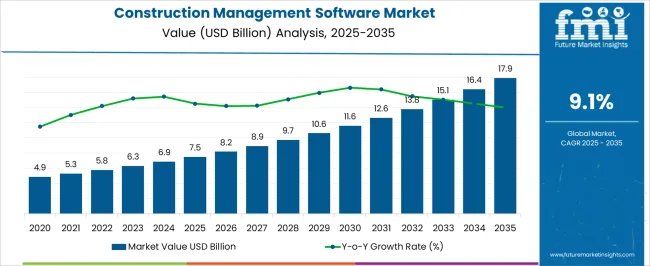
The construction management software market was valued at USD 7.5 billion in 2025, projected to reach USD 8.18 billion in 2026, and is forecast to expand to USD 19.55 billion by 2036 at a 9.1% CAGR. Demand is driven by general contractors and project developers adopting cloud-based platforms to manage scheduling, budgeting, field reporting, and safety compliance across distributed project portfolios. The migration from disconnected spreadsheet-based workflows to integrated construction management platforms is accelerating as project complexity and regulatory documentation requirements increase. Commercial building projects anchor the largest share of software deployment, driven by the multi-trade coordination requirements and compliance documentation volumes that characterize large-scale commercial construction. Subscription-based cloud deployment has crossed the adoption threshold where IT infrastructure cost avoidance offsets the recurring license expenditure for mid-sized contractors.
Summary of Construction Management Software Market
- Market Overview
- The construction management software market is valued at USD 7.5 billion in 2025 and is projected to reach USD 19.55 billion by 2036.
- The industry is expected to grow at a 9.1% CAGR from 2026 to 2036, creating an incremental opportunity of USD 11.37 billion.
- The market is an enterprise software category where adoption is driven by project portfolio complexity, regulatory documentation requirements, and cloud migration economics across construction firms of all sizes.
- Demand and Growth Drivers
- Demand is driven by general contractors consolidating scheduling, budgeting, and field reporting into unified cloud platforms to manage multi-site project portfolios.
- BIM mandate compliance on public works contracts is forcing adoption of integrated design-to-field software workflows.
- Subscription-based cloud deployment is lowering the capital threshold for mid-sized contractor adoption.
- Among key countries, China at 12.3%, India at 11.4%, Germany at 10.5%, France at 9.6%, UK at 8.6%, USA at 7.7%, Brazil at 6.8%.
- Product and Segment View
- The market covers construction-specific project management, scheduling, cost accounting, safety reporting, and field service management software platforms.
- These platforms serve general contractors, specialty subcontractors, project developers, and construction management consultancies.
- Cloud leads by Deployment with 61.3% share in 2026, driven by multi-site project requirements for real-time data access without dedicated server infrastructure.
- Commercial Buildings leads by Building Type with 57.8% share in 2026.
- The scope includes construction management software platforms and related implementation services, excluding general project management tools not configured for construction workflows and standalone BIM modeling software.
- Geography and Competitive Outlook
- China and India are the fastest-growing markets due to large-scale government infrastructure programs requiring digital project management and documentation platforms.
- Germany and USA sustain demand through BIM mandate compliance, commercial construction renewals, and enterprise platform migration cycles.
- Competition is shaped by construction-specific functionality depth, cloud scalability, and integration with BIM and field data capture tools, with key players including Autodesk Inc., Bentley Systems, Inc., Oracle Corporation, Trimble, Inc, Procore Technologies, Sage Group plc, Jonas Construction Software.
- Analyst Opinion at FMI
- Sudip saha, Principal Consultant at Future Market Insights, opines: 'As per FMI analysis, the construction management software market is entering a phase where emissions compliance, fuel logistics, and site-specific power load requirements define procurement qualification thresholds. Operations teams that delay equipment specification decisions risk exclusion from major project contract cycles where pre-qualification requirements progressively tighten.'
- Strategic Implications / Executive Takeaways
- Software vendors must develop pre-certified BIM integration pathways to qualify for public works contracts that mandate digital project documentation.
- Construction firm CIOs should evaluate cloud migration total cost of ownership against current on-premise infrastructure maintenance expenditure before committing to platform transitions.
- Project directors must ensure software platform selection supports regulatory compliance documentation standards required for public and commercial contract deliverables.
Construction Management Software Market Key Takeaways
| Metric | Details |
|---|---|
| Industry Size (2026) | USD 8.18 billion |
| Industry Value (2036) | USD 19.55 billion |
| CAGR (2026-2036) | 9.1% |
Source: Future Market Insights, 2026
All major markets reflect distinct software adoption trajectories. China leads at 12.3% CAGR as massive infrastructure and real estate construction programs concentrate demand for project scheduling and cost management platforms. India follows at 11.4% driven by government smart city and housing programs requiring digital project documentation. Germany maintains 10.5% growth anchored by BIM mandate compliance and multi-trade coordination requirements on public works contracts. France at 9.6% and UK at 8.6% reflect steady enterprise deployment cycles. USA sustains a 7.7% pace through commercial construction project management platform renewals and cloud migration. Brazil at 6.8% is driven by infrastructure program documentation requirements.
Construction Management Software Market Definition
Construction Management Software Market encompasses cloud and on-premise software platforms designed to manage construction project scheduling, cost accounting, field reporting, safety documentation, and multi-trade coordination. These platforms integrate project data across distributed teams and serve general contractors, subcontractors, and project developers. Procurement is tied to project portfolio scale, regulatory compliance requirements, and cloud migration economics.
Construction Management Software Market Inclusions
Market scope includes cloud and on-premise construction management software covering project management, scheduling, cost accounting, safety reporting, field service management, and project design functions. Coverage spans global and regional market sizes, the 2026 to 2036 forecast period, and segment breakdowns by deployment model, building type, application, and region.
Construction Management Software Market Exclusions
The scope excludes general-purpose project management platforms not configured for construction workflows, standalone BIM modeling software, and accounting systems without construction-specific cost control modules. It also omits hardware and mobile device procurement costs.
Construction Management Software Market Research Methodology
- Primary Research: Analysts conducted structured interviews with procurement directors, site engineers, and fleet managers to map decision gates and specification requirements in the construction management software market.
- Desk Research: Data collection aggregated regulatory filings, emissions standards updates, industry association reports, and publicly available corporate disclosures relevant to the construction management software sector.
- Market-Sizing and Forecasting: Baseline values derive from a bottom-up aggregation of equipment procurement and rental contract volumes, applying region-specific adoption curves to project future demand trajectories.
- Data Validation and Update Cycle: Projections are tested against publicly reported capital expenditure guidance and fleet procurement records from major construction and rental operators.
Why is the Construction Management Software Market Growing?
The construction management software market is witnessing strong growth, driven by the increasing need for digital tools that enhance efficiency, coordination, and transparency in construction projects. Rising adoption of advanced technologies such as cloud computing, artificial intelligence, and real-time analytics is transforming the way construction projects are planned, executed, and monitored. The industry is benefiting from the growing focus on reducing project delays, controlling costs, and improving resource allocation, which is prompting contractors, developers, and project managers to invest in integrated software platforms.
Government initiatives promoting smart infrastructure development and public-private partnerships are further supporting market expansion. Vendors are increasingly offering scalable and customizable solutions to meet diverse needs across residential, commercial, and industrial projects.
The ability of modern platforms to integrate with design tools, procurement systems, and financial management applications is improving workflow efficiency and decision-making. With construction activity expected to rise globally and digital transformation accelerating across the sector, the market is positioned for sustained growth over the coming decade.
Segmental Analysis
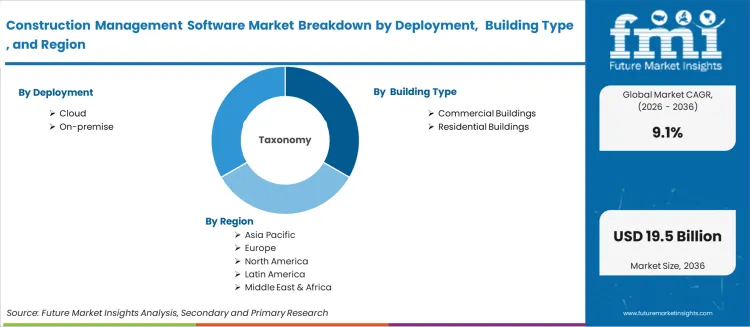
The construction management software market is segmented by deployment, building type, application, end-use, and geographic regions. By deployment, construction management software market is divided into Cloud and On-premise. In terms of building type, construction management software market is classified into Commercial Buildings and Residential Buildings.
Based on application, construction management software market is segmented into Project Management & Scheduling, Safety & Reporting, Project Design, Field Service Management, Cost Accounting, and Others. By end-use, construction management software market is segmented into Builders & Contractors, Construction Managers, and Engineers & Architects. Regionally, the construction management software industry is classified into North America, Latin America, Western Europe, Eastern Europe, Balkan & Baltic Countries, Russia & Belarus, Central Asia, East Asia, South Asia & Pacific, and the Middle East & Africa.
Insights into the Cloud Deployment Segment
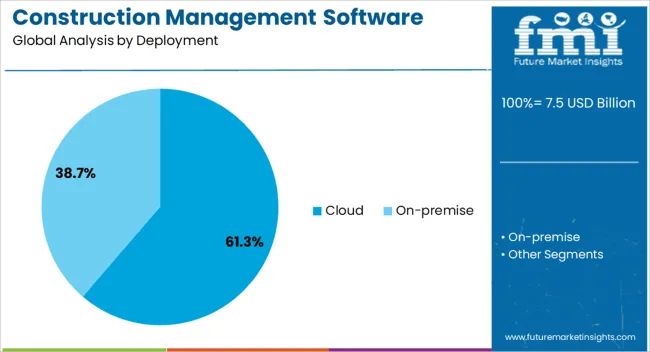
The cloud deployment segment is projected to hold 61.3% of the construction management software market revenue share in 2025, making it the dominant deployment type. Its leadership is supported by the flexibility, scalability, and cost-efficiency it offers compared to on-premises solutions. Cloud-based platforms enable remote access to project data from any location, allowing stakeholders to collaborate in real time, which is critical in multi-site and large-scale construction projects.
Regular updates, data backups, and security enhancements are managed by service providers, reducing the burden on in-house IT teams and ensuring systems remain up-to-date. This deployment model also supports seamless integration with mobile applications, enabling field teams to input and retrieve information instantly, improving accuracy and decision-making.
The growing adoption of subscription-based pricing models is making cloud solutions more accessible to small and medium-sized enterprises, further boosting demand. As construction companies increasingly prioritize agility and operational efficiency, cloud deployment is expected to remain the preferred choice, reinforcing its dominant position in the market.
Insights into the Commercial Buildings Building Type Segment
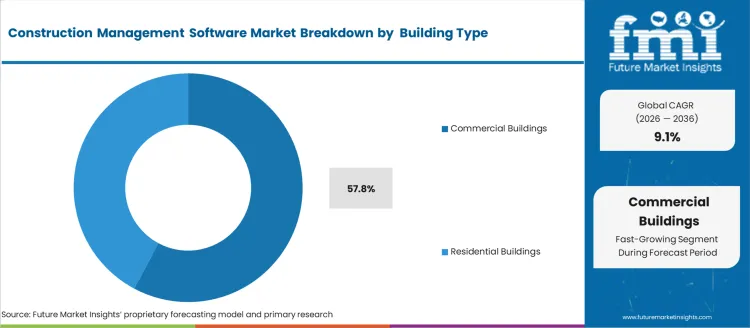
The commercial buildings segment is expected to account for 57.8% of the construction management software market revenue share in 2025, positioning it as the leading building type. Its dominance is being driven by the significant complexity and scale of commercial construction projects, which require robust planning, coordination, and tracking tools to ensure timely delivery and cost control. The software enables integration of various functions such as budgeting, scheduling, procurement, and compliance management, which is critical for high-value projects.
Increasing investment in commercial infrastructure, including office complexes, retail centers, and hospitality facilities, is generating sustained demand for advanced project management tools. The segment is also benefiting from heightened emphasis on sustainability and energy efficiency, as software platforms can support green building certifications and performance monitoring.
Global urbanization trends, coupled with expanding commercial real estate markets in emerging economies, are further reinforcing adoption. As project stakeholders seek to improve transparency, mitigate risks, and streamline workflows, the commercial buildings segment is expected to maintain its leadership in the market.
Insights into the Project Management and Scheduling Application Segment
The project management and scheduling application segment is anticipated to represent 34.2% of the construction management software market revenue share in 2025, making it the leading application area. This leadership is being supported by the critical role scheduling and resource management play in ensuring timely and cost-effective project completion. The software allows project managers to create detailed timelines, allocate resources efficiently, and track progress against milestones in real time.
Enhanced visibility into project workflows helps identify potential delays early, enabling proactive interventions that prevent cost overruns and disruptions. Integration with other modules, such as procurement, budgeting, and quality control, further strengthens the utility of these applications.
The segment is also benefiting from the rising use of mobile and cloud-based solutions, allowing on-site teams to access and update schedules instantly. As construction projects grow in complexity and stakeholders demand greater accountability, project management and scheduling software is expected to remain an indispensable tool, solidifying its position as the largest application segment in the market.
What are the Drivers, Restraints, and Key Trends of the Construction Management Software Market?
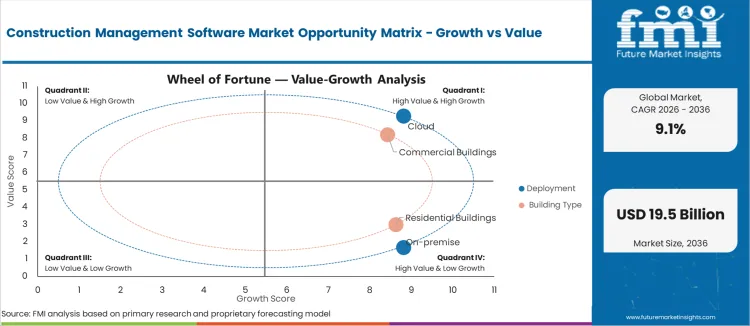
The construction management software market is projected to grow steadily as contractors, owners, and consultants pursue tighter cost control, faster closeout, and transparent collaboration across dispersed project teams. Demand is reinforced by needs around schedule reliability, budget tracking, RFIs, submittals, and field reporting that integrate with accounting and ERP. Opportunities are opening in mid-market design-build firms, specialty trades, and owner-led programs seeking standardized workflows. Trends highlight mobile-first capture, BIM coordination, and analytics tied to earned value. Challenges persist around change management, per-seat pricing clarity, legacy system integration, and uneven jobsite connectivity.
Demand Lifted By Control, Compliance, And Mobility
Demand has been strengthened by general contractors, EPCs, and owner representatives that require predictable delivery, audit-ready documentation, and faster decision cycles. Cloud platforms that combine scheduling, cost codes, commitments, change orders, and pay apps with RFIs, submittals, and transmittals are being selected to reduce rework. Field teams favor mobile apps for daily logs, photos, issues, punch lists, and timecards that sync to the master schedule and budget. Safety and quality checklists with geo-tagged evidence help meet contract compliance while reducing disputes. Owners expect real-time dashboards, earned value metrics, and forecast-at-complete views to keep programs on track. In an opinionated view, the most persuasive pull comes from eliminating siloed spreadsheets and email threads. When drawing management, version control, and e-signatures are tied directly to cost events and look-ahead planning, supervisors gain a single source of truth that consistently shortens closeout and improves cash flow timing.
Opportunities Growing In Integrations, Services, And Verticalization
Opportunities are emerging where software connects natively with accounting, payroll, estimating, procurement, and fleet telematics so that budgets, purchase orders, and equipment hours flow without rekeying. Implementation services, template libraries, and data migration packages are being bundled to de-risk adoption for multi-office contractors. Verticalized offerings for healthcare, education, interiors, and civil infrastructure are gaining traction with prebuilt forms, commissioning checklists, and handover packs aligned to each segment. Partner marketplaces that include reality capture, drone mapping, and payment management widen upsell scope. Mid-market builders favor tiered subscriptions and unlimited-project models, while large enterprises seek API access, SSO, audit logs, and regional data residency. In our view, the richest upside arrives when vendors sell outcomes not modules, pairing training, baseline templates, and KPI reviews that lift schedule adherence and change order recovery. Channel alliances with resellers and consultants help accelerate wins on public and PPP frameworks.
Trends Center On Connected Workflows And Analytics
Trends point to mobile-first capture with offline sync, QR or NFC location tagging, and photo markups that anchor defects to rooms and assets. BIM coordination is being linked to issue tracking so model elements carry assignments, due dates, and status visible in meetings. Real-time dashboards blend field progress, earned value, production rates, and look-ahead constraints to guide pull planning. Document control emphasizes version history, transmittal logs, and automated distribution lists, reducing plan miscommunication. E-signatures and secure share links ease approvals for inspectors and owners. Data warehousing and open APIs support portfolio analytics, while role-based permissions protect commercial terms. From an opinionated stance, the decisive shift is toward end-to-end traceability. When every task, photo, and cost event is timestamped and reportable, closeout manuals and facilities handover become byproducts of daily work rather than last-minute compilations that stall practical completion.
Challenges From Adoption Friction, Pricing, And Standards
Challenges arise from field resistance to process change, inconsistent device policies, and spotty connectivity that undermines real-time sync. Per-user pricing, storage overages, and add-on integration fees create budgeting uncertainty for long projects with rotating subcontractors. Legacy ERPs and drawing repositories without modern APIs hinder bi-directional data exchange, forcing manual workarounds. Variations in report formats, naming conventions, and approval matrices across owners increase configuration effort. Data retention rules, audit requirements, and privacy reviews extend procurement cycles. Training gaps lead to underused features, weak photo standards, and incomplete issue closure. Our view is that many setbacks are preventable through offline-first design, transparent SKU packaging, and publishable implementation playbooks. Vendors that offer fixed-scope onboarding, regional support centers, and health-score analytics for user adoption will convert trials to renewals, while tool-only pitches risk churn when deadlines compress and teams revert to email and spreadsheets.
Analysis of Construction Management Software Market By Key Countries
.webp "Top Country Growth Comparison Construction Management Software Market Cagr (2026 2036)")
| Country | CAGR |
|---|---|
| China | 12.3% |
| India | 11.4% |
| Germany | 10.5% |
| France | 9.6% |
| UK | 8.6% |
| USA | 7.7% |
| Brazil | 6.8% |
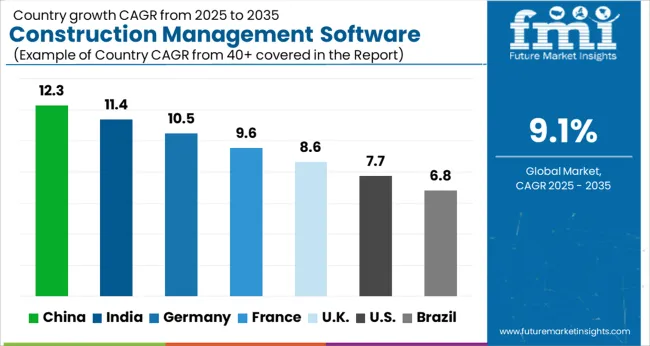
The global construction management software market is projected to grow at 9.1% from 2026 to 2036. China leads at 12.3%, followed by India 11.4% and Germany 10.5%; the United Kingdom 8.6% and United States 7.7% follow. Growth is being pulled by site-to-office coordination, cost and schedule control, and standardized closeout. Mobile field capture, photo mark-ups, RFIs, submittals, and change orders are being consolidated into cloud workflows with BIM/CDE and ERP links. E-signatures, audit trails, and role-based approvals are being favored to reduce disputes. Asia is expected to outpace on volume deployments and localized interfaces; Germany is set to emphasize compliance and documentation rigor; the UK is projected to expand through framework contracts; the US is likely to advance via steady upgrades across established general contractors and specialty trades. This report includes insights on 40+ countries; the top markets are shown here for reference.
Sales Outlook for Construction Management Software Market in China
The construction management software market in China is expected to expand at 12.3%. Adoption is being driven by public works, mixed-use megaprojects, and prefab programs where punch lists, RFIs, and submittals must be processed at speed. Cloud tenancy within national regions is being specified, and Chinese-language templates for codes and acceptance criteria are being mandated by owners. Mobile apps with offline sync, QR-tagged rooms and equipment, batch assignment, and e-stamps are being used to compress handover. GPS anchoring and dashboard KPIs are being applied to rank subcontractor performance. In our assessment, leadership is likely to be retained as procurement is standardized, defect workflows are codified, and trade coordination is enforced through role-based approvals and documented audit trails across tier-1 and tier-2 cities.
- Data-residency requirements are being written into tenders for platform selection.
- WeChat mini-access is being enabled to accelerate acknowledgments by subcontractors.
- Photo-to-item tagging is being piloted to reduce manual entry on dense sites.
Demand Analysis for Construction Management Software Market in India
The construction management software market in India is projected to grow at 11.4%. Transport corridors, airports, metros, data centers, and high-density housing are generating structured snagging, RFI routing, and milestone-based payment checks. Multilingual interfaces, WhatsApp share links, and GPS-anchored issues are being requested for dispersed teams. Cloud subscriptions with flexible seats are being adopted by EPCs, while owners insist on timestamped evidence and standardized defect taxonomies to support certification. ERP and e-invoicing connectors aligned to GST are being preferred to avoid reconciliation delays. In our view, consistent gains will be recorded as checklists, geo-fencing, and audit trails become routine, and as contractor training raises on-site usage across tier-1 metros and fast-growing tier-2 clusters.
- Geo-fenced zones are being used to trigger location-aware checklists on arrival.
- Payment holdbacks are being linked to unresolved punch items inside client portals.
- Dealer-led workshops are being run to lift proficiency in field capture and care routines.
Growth Outlook for Construction Management Software Market in Germany
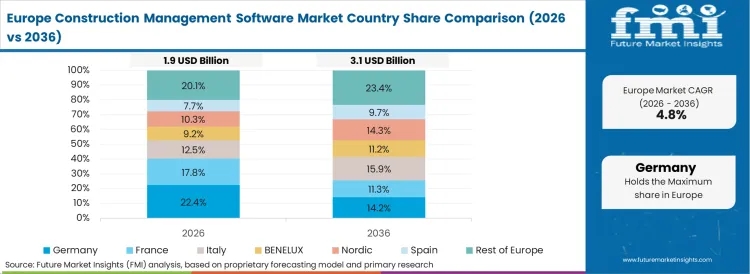
The construction management software market in Germany is forecast to increase at 10.5%. Uptake is being guided by DIN/VOB requirements, defect-liability periods, and precise trade interfaces on industrial and public buildings. BIM coordination models are being connected to issue logs so clashes and field defects share identifiers, improving traceability. EU-region hosting, immutable audit trails, and template libraries aligned to DIN are being favored. Photo evidence with measurement overlays and controlled distribution lists is being applied to protect warranty positions. It is judged that Germany will sustain premium growth as acceptance protocols, commissioning checklists, and archive exports (PDF/A, IFC refs, CSV) are enforced to preserve records across long service lives.
- Weighted defect scoring is being applied to prioritize critical-path rectification.
- On-site calibration checks are being logged to satisfy handover audits.
- Framework agreements are being used to lock standards across multi-year programs.
Future Analysis for Construction Management Software Market in the United Kingdom
The construction management software market in the UK is anticipated to rise at 8.6%. Refurb programs, education estates, healthcare builds, and build-to-rent schemes are requiring consistent snag capture and transparent closeout. CDE alignment with ISO 19650 naming and status mapping is being requested, and resident-care portals are being linked for post-handover triage. Mobile snagging with offline modes for basements and tunnels is being standardized, while e-signatures and role-based approvals are being used to support NEC-style contracts. In our view, steady adoption will be underpinned by framework procurement, clear audit trails, and repeatable template packs by trade (M&E, façades, interiors) that reduce dispute risk and compress practical completion timelines.
- Barcode scans on door sets and fixtures are being tied to serial-number histories.
- Issue-aging SLAs are being embedded to prevent end-of-project surges.
- Resident portals are being deployed to route post-completion defects to trades.
Opportunity Analysis for Construction Management Software Market in the United States
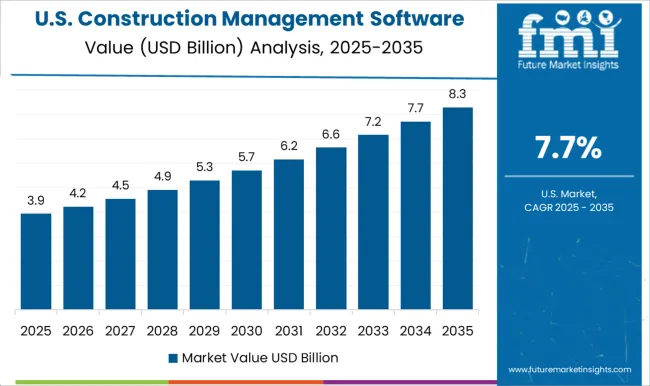
The construction management software market in the United States is expected to grow at 7.7%. Healthcare, life-science labs, logistics hubs, and corporate interiors are sustaining demand where closeout documentation and safety compliance are closely audited. Mobile field tools for photo mark-ups, voice-to-item capture, and batch assignments are being standardized by GC/CM firms. API connectors to scheduling, estimating, and ERP are being valued to link change orders with cost exposure and earned-value metrics. Owner dashboards are being used to surface aging defects and trade performance. It is assessed that steady upgrades will continue as certified payroll, lien waivers, and e-signatures are embedded, raising transparency and shortening pay-app cycles across multi-trade programs.
- Certified-payroll and lien-waiver modules are being tied to progress billing.
- Digital twins are being referenced to compare as-built records with model intent.
- Pro loyalty programs are steering repeat purchases toward unified tool ecosystems.
Competitive Landscape of Construction Management Software Market
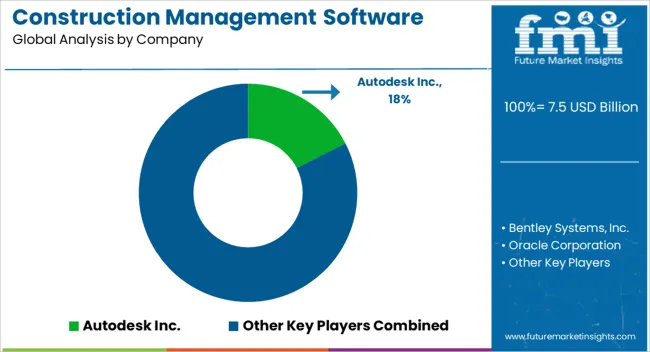
Competition in construction management software has been organized around breadth of workflows, mobile depth, and how clearly brochures turn complexity into step by step control. Autodesk and Procore are positioned as end to end platforms, with brochures emphasizing RFIs, submittals, change orders, drawings, and cost in one environment. Oracle frames Aconex and Primavera as enterprise grade coordination with structured correspondence and schedule governance. Trimble presents Viewpoint as a field to back office spine that ties payroll, equipment, and job cost to site activity. Bentley Systems highlights design model fidelity, 4D planning, and digital delivery for infrastructure programs. E Builder is presented as owner side program management with capital planning and closeout tracking. Across these brands, brochure tables make comparison simple. Mobile capture, offline resilience, markup clarity, revision control, and permission rules are listed explicitly. Claims center on fewer rework loops, faster closeout, and auditable decisions.
Strategy has been executed through documentation that mirrors project life. Sage Group, CMiC, and Jonas Construction Software position ERP strength and job cost accuracy, then connect to field tools through published integrations. Brochures display role based workflows, approval gates, transmittal logs, and photo evidence embedded in issues. Implementation pages show timelines, training formats, and data migration steps. API catalogs, connector lists, and data residency statements reduce IT risk. Pricing tiers are explained with user types and environment limits. Security posture is summarized with encryption, SSO, MFA, and audit trails.
Key Players in the Construction Management Software Market
- Autodesk Inc.
- Bentley Systems, Inc.
- Oracle Corporation
- Trimble, Inc
- Procore Technologies
- Sage Group plc
- Jonas Construction Software
- E-Builder, Inc.
- Cmic
Scope of the Report
| Metric | Value |
|---|---|
| Quantitative Units | USD 8.18 billion to USD 19.55 billion, at a CAGR of 9.1% |
| Market Definition | Construction management software covers cloud and on-premise platforms that manage project scheduling, cost accounting, field reporting, and safety documentation for construction firms. |
| Segmentation | Deployment: Cloud, On-premise; Building Type: Commercial Buildings, Residential Buildings; Application: Project Management & Scheduling, Safety & Reporting, Project Design, Field Service Management, Cost Accounting, Others |
| Regions Covered | North America, Latin America, Europe, East Asia, South Asia, Oceania, Middle East & Africa |
| Countries Covered | China, India, Germany, France, UK, USA, Brazil, and 40 plus countries |
| Key Companies Profiled | Autodesk Inc., Bentley Systems, Inc., Oracle Corporation, Trimble, Inc, Procore Technologies, Sage Group plc, Jonas Construction Software, E-Builder, Inc. |
| Forecast Period | 2026 to 2036 |
| Approach | Forecasting models apply a bottom-up methodology starting with regional construction activity and equipment procurement metrics, cross-validated against fleet operator capital expenditure records. |
Construction Management Software Market by Segments
Deployment:
- Cloud
- On-premise
Building Type:
- Commercial Buildings
- Residential Buildings
Application:
- Project Management & Scheduling
- Safety & Reporting
- Project Design
- Field Service Management
- Cost Accounting
- Others
End-Use:
- Builders & Contractors
- Construction Managers
- Engineers & Architects
Region:
- North America
- USA
- Canada
- Mexico
- Latin America
- Brazil
- Chile
- Rest of Latin America
- Western Europe
- Germany
- UK
- Italy
- Spain
- France
- Nordic
- BENELUX
- Rest of Western Europe
- Eastern Europe
- Russia
- Poland
- Hungary
- Balkan & Baltic
- Rest of Eastern Europe
- East Asia
- China
- Japan
- South Korea
- South Asia and Pacific
- India
- ASEAN
- Australia & New Zealand
- Rest of South Asia and Pacific
- Middle East & Africa
- Kingdom of Saudi Arabia
- Other GCC Countries
- Turkiye
- South Africa
- Other African Union
- Rest of Middle East & Africa
Bibliography
- 1. International Organization for Standardization. (2024). ISO 19650: Organization and Digitization of Information about Buildings and Civil Engineering Works. ISO.
- 2. European Commission. (2024). BIM Mandate Implementation Guidance for Public Infrastructure. European Commission.
- 3. Organisation for Economic Co-operation and Development. (2025). Digital Transformation in the Construction Sector. OECD.
- 4. World Bank Group. (2024). Digital Infrastructure for Development: Construction Sector. World Bank.
- 5. United Kingdom Government. (2025). Construction Playbook: Digital Requirements Update. UK Cabinet Office.
This bibliography is provided for reader reference. The full Future Market Insights report contains the complete reference list with primary research documentation.
Frequently Asked Questions
How large is the demand for Construction Management Software in the global market in 2026?
Demand for Construction Management Software in the global market is estimated to be valued at USD 8.18 billion in 2026.
What will be the market size of Construction Management Software in the global market by 2036?
Market size for Construction Management Software is projected to reach USD 19.55 billion by 2036.
What is the expected demand growth for Construction Management Software between 2026 and 2036?
Demand for Construction Management Software is expected to grow at a CAGR of 9.1% between 2026 and 2036.
Which Deployment is poised to lead global sales by 2026?
Cloud accounts for 61.3% share in 2026 based on FMI analysis.
How is the role of Commercial Buildings in driving Construction Management Software adoption in 2026?
Commercial Buildings represents 57.8% of segment share in 2026 as per FMI's construction management software market report.
What is the fastest-growing country market in this report?
China is projected to grow at a CAGR of 12.3% during 2026 to 2036.
What is Construction Management Software and what is it mainly used for?
Construction management software covers cloud and on-premise platforms that manage project scheduling, cost accounting, field reporting, and safety documentation for construction firms.
What is included in the scope of this Construction Management Software report?
The market covers cloud and on-premise construction management platforms covering scheduling, cost accounting, safety reporting, field service, and project design applications.
Preview the report firsthand - request a free sample
Get SampleGet the brochure for pricing and purchase details.
Get PDFTable of Content
- Executive Summary
- Global Market Outlook
- Demand-side Trends
- Supply-side Trends
- Technology Roadmap Analysis
- Analysis and Recommendations
- Market Overview
- Market Coverage / Taxonomy
- Market Definition / Scope / Limitations
- Research Methodology
- Chapter Orientation
- Analytical Lens and Working Hypotheses
- Market Structure, Signals, and Trend Drivers
- Benchmarking and Cross-market Comparability
- Market Sizing, Forecasting, and Opportunity Mapping
- Research Design and Evidence Framework
- Desk Research Programme (Secondary Evidence)
- Company Annual and Sustainability Reports
- Peer-reviewed Journals and Academic Literature
- Corporate Websites, Product Literature, and Technical Notes
- Earnings Decks and Investor Briefings
- Statutory Filings and Regulatory Disclosures
- Technical White Papers and Standards Notes
- Trade Journals, Industry Magazines, and Analyst Briefs
- Conference Proceedings, Webinars, and Seminar Materials
- Government Statistics Portals and Public Data Releases
- Press Releases and Reputable Media Coverage
- Specialist Newsletters and Curated Briefings
- Sector Databases and Reference Repositories
- FMI Internal Proprietary Databases and Historical Market Datasets
- Subscription Datasets and Paid Sources
- Social Channels, Communities, and Digital Listening Inputs
- Additional Desk Sources
- Expert Input and Fieldwork (Primary Evidence)
- Primary Modes
- Qualitative Interviews and Expert Elicitation
- Quantitative Surveys and Structured Data Capture
- Blended Approach
- Why Primary Evidence is Used
- Field Techniques
- Interviews
- Surveys
- Focus Groups
- Observational and In-context Research
- Social and Community Interactions
- Stakeholder Universe Engaged
- C-suite Leaders
- Board Members
- Presidents and Vice Presidents
- R&D and Innovation Heads
- Technical Specialists
- Domain Subject-matter Experts
- Scientists
- Physicians and Other Healthcare Professionals
- Governance, Ethics, and Data Stewardship
- Research Ethics
- Data Integrity and Handling
- Primary Modes
- Tooling, Models, and Reference Databases
- Desk Research Programme (Secondary Evidence)
- Data Engineering and Model Build
- Data Acquisition and Ingestion
- Cleaning, Normalisation, and Verification
- Synthesis, Triangulation, and Analysis
- Quality Assurance and Audit Trail
- Market Background
- Market Dynamics
- Drivers
- Restraints
- Opportunity
- Trends
- Scenario Forecast
- Demand in Optimistic Scenario
- Demand in Likely Scenario
- Demand in Conservative Scenario
- Opportunity Map Analysis
- Product Life Cycle Analysis
- Supply Chain Analysis
- Investment Feasibility Matrix
- Value Chain Analysis
- PESTLE and Porter’s Analysis
- Regulatory Landscape
- Regional Parent Market Outlook
- Production and Consumption Statistics
- Import and Export Statistics
- Market Dynamics
- Global Market Analysis 2021 to 2025 and Forecast, 2026 to 2036
- Historical Market Size Value (USD Million) Analysis, 2021 to 2025
- Current and Future Market Size Value (USD Million) Projections, 2026 to 2036
- Y-o-Y Growth Trend Analysis
- Absolute $ Opportunity Analysis
- Global Market Pricing Analysis 2021 to 2025 and Forecast 2026 to 2036
- Global Market Analysis 2021 to 2025 and Forecast 2026 to 2036, By Deployment
- Introduction / Key Findings
- Historical Market Size Value (USD Million) Analysis By Deployment , 2021 to 2025
- Current and Future Market Size Value (USD Million) Analysis and Forecast By Deployment , 2026 to 2036
- Cloud
- On-premise
- Cloud
- Y-o-Y Growth Trend Analysis By Deployment , 2021 to 2025
- Absolute $ Opportunity Analysis By Deployment , 2026 to 2036
- Global Market Analysis 2021 to 2025 and Forecast 2026 to 2036, By Building Type
- Introduction / Key Findings
- Historical Market Size Value (USD Million) Analysis By Building Type, 2021 to 2025
- Current and Future Market Size Value (USD Million) Analysis and Forecast By Building Type, 2026 to 2036
- Commercial Buildings
- Residential Buildings
- Commercial Buildings
- Y-o-Y Growth Trend Analysis By Building Type, 2021 to 2025
- Absolute $ Opportunity Analysis By Building Type, 2026 to 2036
- Global Market Analysis 2021 to 2025 and Forecast 2026 to 2036, By Application
- Introduction / Key Findings
- Historical Market Size Value (USD Million) Analysis By Application, 2021 to 2025
- Current and Future Market Size Value (USD Million) Analysis and Forecast By Application, 2026 to 2036
- Project Management & Scheduling
- Safety & Reporting
- Project Design
- Field Service Management
- Cost Accounting
- Others
- Project Management & Scheduling
- Y-o-Y Growth Trend Analysis By Application, 2021 to 2025
- Absolute $ Opportunity Analysis By Application, 2026 to 2036
- Global Market Analysis 2021 to 2025 and Forecast 2026 to 2036, By Region
- Introduction
- Historical Market Size Value (USD Million) Analysis By Region, 2021 to 2025
- Current Market Size Value (USD Million) Analysis and Forecast By Region, 2026 to 2036
- North America
- Latin America
- Western Europe
- Eastern Europe
- East Asia
- South Asia and Pacific
- Middle East & Africa
- Market Attractiveness Analysis By Region
- North America Market Analysis 2021 to 2025 and Forecast 2026 to 2036, By Country
- Historical Market Size Value (USD Million) Trend Analysis By Market Taxonomy, 2021 to 2025
- Market Size Value (USD Million) Forecast By Market Taxonomy, 2026 to 2036
- By Country
- USA
- Canada
- Mexico
- By Deployment
- By Building Type
- By Application
- By Country
- Market Attractiveness Analysis
- By Country
- By Deployment
- By Building Type
- By Application
- Key Takeaways
- Latin America Market Analysis 2021 to 2025 and Forecast 2026 to 2036, By Country
- Historical Market Size Value (USD Million) Trend Analysis By Market Taxonomy, 2021 to 2025
- Market Size Value (USD Million) Forecast By Market Taxonomy, 2026 to 2036
- By Country
- Brazil
- Chile
- Rest of Latin America
- By Deployment
- By Building Type
- By Application
- By Country
- Market Attractiveness Analysis
- By Country
- By Deployment
- By Building Type
- By Application
- Key Takeaways
- Western Europe Market Analysis 2021 to 2025 and Forecast 2026 to 2036, By Country
- Historical Market Size Value (USD Million) Trend Analysis By Market Taxonomy, 2021 to 2025
- Market Size Value (USD Million) Forecast By Market Taxonomy, 2026 to 2036
- By Country
- Germany
- UK
- Italy
- Spain
- France
- Nordic
- BENELUX
- Rest of Western Europe
- By Deployment
- By Building Type
- By Application
- By Country
- Market Attractiveness Analysis
- By Country
- By Deployment
- By Building Type
- By Application
- Key Takeaways
- Eastern Europe Market Analysis 2021 to 2025 and Forecast 2026 to 2036, By Country
- Historical Market Size Value (USD Million) Trend Analysis By Market Taxonomy, 2021 to 2025
- Market Size Value (USD Million) Forecast By Market Taxonomy, 2026 to 2036
- By Country
- Russia
- Poland
- Hungary
- Balkan & Baltic
- Rest of Eastern Europe
- By Deployment
- By Building Type
- By Application
- By Country
- Market Attractiveness Analysis
- By Country
- By Deployment
- By Building Type
- By Application
- Key Takeaways
- East Asia Market Analysis 2021 to 2025 and Forecast 2026 to 2036, By Country
- Historical Market Size Value (USD Million) Trend Analysis By Market Taxonomy, 2021 to 2025
- Market Size Value (USD Million) Forecast By Market Taxonomy, 2026 to 2036
- By Country
- China
- Japan
- South Korea
- By Deployment
- By Building Type
- By Application
- By Country
- Market Attractiveness Analysis
- By Country
- By Deployment
- By Building Type
- By Application
- Key Takeaways
- South Asia and Pacific Market Analysis 2021 to 2025 and Forecast 2026 to 2036, By Country
- Historical Market Size Value (USD Million) Trend Analysis By Market Taxonomy, 2021 to 2025
- Market Size Value (USD Million) Forecast By Market Taxonomy, 2026 to 2036
- By Country
- India
- ASEAN
- Australia & New Zealand
- Rest of South Asia and Pacific
- By Deployment
- By Building Type
- By Application
- By Country
- Market Attractiveness Analysis
- By Country
- By Deployment
- By Building Type
- By Application
- Key Takeaways
- Middle East & Africa Market Analysis 2021 to 2025 and Forecast 2026 to 2036, By Country
- Historical Market Size Value (USD Million) Trend Analysis By Market Taxonomy, 2021 to 2025
- Market Size Value (USD Million) Forecast By Market Taxonomy, 2026 to 2036
- By Country
- Kingdom of Saudi Arabia
- Other GCC Countries
- Turkiye
- South Africa
- Other African Union
- Rest of Middle East & Africa
- By Deployment
- By Building Type
- By Application
- By Country
- Market Attractiveness Analysis
- By Country
- By Deployment
- By Building Type
- By Application
- Key Takeaways
- Key Countries Market Analysis
- USA
- Pricing Analysis
- Market Share Analysis, 2025
- By Deployment
- By Building Type
- By Application
- Canada
- Pricing Analysis
- Market Share Analysis, 2025
- By Deployment
- By Building Type
- By Application
- Mexico
- Pricing Analysis
- Market Share Analysis, 2025
- By Deployment
- By Building Type
- By Application
- Brazil
- Pricing Analysis
- Market Share Analysis, 2025
- By Deployment
- By Building Type
- By Application
- Chile
- Pricing Analysis
- Market Share Analysis, 2025
- By Deployment
- By Building Type
- By Application
- Germany
- Pricing Analysis
- Market Share Analysis, 2025
- By Deployment
- By Building Type
- By Application
- UK
- Pricing Analysis
- Market Share Analysis, 2025
- By Deployment
- By Building Type
- By Application
- Italy
- Pricing Analysis
- Market Share Analysis, 2025
- By Deployment
- By Building Type
- By Application
- Spain
- Pricing Analysis
- Market Share Analysis, 2025
- By Deployment
- By Building Type
- By Application
- France
- Pricing Analysis
- Market Share Analysis, 2025
- By Deployment
- By Building Type
- By Application
- India
- Pricing Analysis
- Market Share Analysis, 2025
- By Deployment
- By Building Type
- By Application
- ASEAN
- Pricing Analysis
- Market Share Analysis, 2025
- By Deployment
- By Building Type
- By Application
- Australia & New Zealand
- Pricing Analysis
- Market Share Analysis, 2025
- By Deployment
- By Building Type
- By Application
- China
- Pricing Analysis
- Market Share Analysis, 2025
- By Deployment
- By Building Type
- By Application
- Japan
- Pricing Analysis
- Market Share Analysis, 2025
- By Deployment
- By Building Type
- By Application
- South Korea
- Pricing Analysis
- Market Share Analysis, 2025
- By Deployment
- By Building Type
- By Application
- Russia
- Pricing Analysis
- Market Share Analysis, 2025
- By Deployment
- By Building Type
- By Application
- Poland
- Pricing Analysis
- Market Share Analysis, 2025
- By Deployment
- By Building Type
- By Application
- Hungary
- Pricing Analysis
- Market Share Analysis, 2025
- By Deployment
- By Building Type
- By Application
- Kingdom of Saudi Arabia
- Pricing Analysis
- Market Share Analysis, 2025
- By Deployment
- By Building Type
- By Application
- Turkiye
- Pricing Analysis
- Market Share Analysis, 2025
- By Deployment
- By Building Type
- By Application
- South Africa
- Pricing Analysis
- Market Share Analysis, 2025
- By Deployment
- By Building Type
- By Application
- USA
- Market Structure Analysis
- Competition Dashboard
- Competition Benchmarking
- Market Share Analysis of Top Players
- By Regional
- By Deployment
- By Building Type
- By Application
- Competition Analysis
- Competition Deep Dive
- Autodesk Inc.
- Overview
- Product Portfolio
- Profitability by Market Segments (Product/Age /Sales Channel/Region)
- Sales Footprint
- Strategy Overview
- Marketing Strategy
- Product Strategy
- Channel Strategy
- Bentley Systems, Inc.
- Oracle Corporation
- Trimble, Inc
- Procore Technologies
- Sage Group plc
- Jonas Construction Software
- E-Builder, Inc.
- Cmic
- Autodesk Inc.
- Competition Deep Dive
- Assumptions & Acronyms Used


