


Construction Generator Sets Market : Global Industry Analysis 2016 - 2025 and Opportunity Assessment 2026 - 2036
This report covers the Construction Generator Sets market through analysis of market size, revenue forecast, competitive landscape, demand outlook, growth drivers, restraints, power rating trends, fuel trends, application analysis, supply chain developments, strategic growth opportunities.
Historical Data Covered: 2016 - 2025 | Base Year: 2025 | Estimated Year: 2026 | Forecast Period: 2026 - 2036
Construction Generator Sets Market Size, Market Forecast and Outlook By FMI
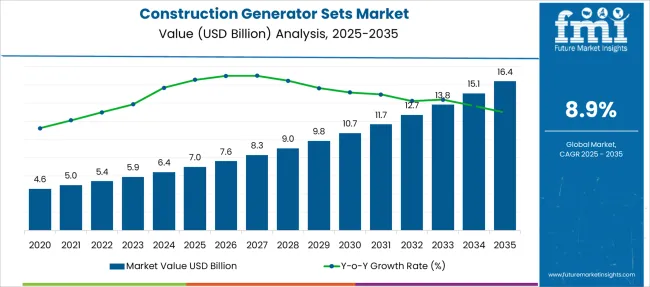
The construction generator sets market was valued at USD 7 billion in 2025, projected to reach USD 7.62 billion in 2026, and is forecast to expand to USD 17.88 billion by 2036 at a 8.9% CAGR. Demand is driven by the expanding volume of infrastructure and commercial construction projects that require continuous or standby power supply at sites without reliable grid connectivity. Diesel-fueled generator sets remain the primary power source for construction sites due to their load-carrying capacity, fuel availability, and compatibility with heavy equipment duty cycles. Tightening emissions standards from the European Union Stage V and USA EPA Tier 4 Final regulations are forcing procurement teams to upgrade or replace older units with compliant engines. The growing frequency of extreme weather events and grid instability in emerging markets is adding standby power demand alongside the primary construction application base.
Summary of Construction Generator Sets Market
- Market Overview
- The construction generator sets market is valued at USD 7 billion in 2025 and is projected to reach USD 17.88 billion by 2036.
- The industry is expected to grow at a 8.9% CAGR from 2026 to 2036, creating an incremental opportunity of USD 10.26 billion.
- The market is a capital equipment category where procurement decisions are tied to construction project power requirements, emissions compliance timelines, and fuel infrastructure availability at project sites.
- Demand and Growth Drivers
- Demand is driven by the expanding volume of infrastructure projects requiring continuous on-site power generation at locations without reliable grid connectivity.
- Emissions compliance mandates from EU Stage V and USA EPA Tier 4 Final regulations are forcing fleet-wide generator replacement and upgrade cycles.
- Growing grid instability and extreme weather frequency in emerging markets is adding standby and emergency power demand beyond primary construction use.
- Among key countries, China at 12%, India at 11.1%, Germany at 10.2%, France at 9.3%, UK at 8.5%, USA at 7.6%, Brazil at 6.7%.
- Product and Segment View
- The market covers diesel, gas, and alternative fuel generator sets across power ratings from under 50 kVA to above 750 kVA for construction site applications.
- These units serve prime/continuous, standby, and peak shaving power requirements across infrastructure, commercial, and residential construction projects.
- Diesel leads by Fuel with 61.7% share in 2026, driven by load capacity, fuel logistics, and compatibility with heavy construction equipment duty cycles.
- Prime/Continuous leads by Application with 43.8% share in 2026.
- The scope includes construction-specific generator sets across all power ratings and fuel types, excluding utility-scale power plants, residential backup generators under 5 kW, and marine or aviation power units.
- Geography and Competitive Outlook
- China and India are the fastest-growing markets due to large-scale infrastructure construction programs with limited grid access at remote project sites.
- Germany and USA sustain demand through emissions-compliant fleet replacement cycles and commercial construction standby power requirements.
- Competition is shaped by engine technology, emissions compliance certification, fuel efficiency, and dealer service network coverage, with key players including Cummins, Inc., Kirloskar, Kohler Co., Generac Power Systems, Inc., Yamaha Motor Co., Ltd., Powerica Limited, Sterling and Wilson Pvt. Ltd..
- Analyst Opinion at FMI
- Nikhil Kaitwade, Principal Consultant at Future Market Insights, opines: 'As per FMI analysis, the construction generator sets market is entering a phase where emissions compliance, fuel logistics, and site-specific power load requirements define procurement qualification thresholds. Operations teams that delay equipment specification decisions risk exclusion from major project contract cycles where pre-qualification requirements progressively tighten.'
- Strategic Implications / Executive Takeaways
- Equipment OEMs must accelerate emissions-compliant engine platform rollouts to meet EU Stage V and EPA Tier 4 Final procurement deadlines on upcoming infrastructure contracts.
- Project power planning teams should evaluate total fuel and maintenance cost projections across diesel, gas, and hybrid configurations before committing to fleet procurement specifications.
- Rental fleet operators must align generator inventory refresh cycles with emissions compliance cutoff dates to avoid stranded non-compliant assets.
Construction Generator Sets Market Key Takeaways
| Metric | Details |
|---|---|
| Industry Size (2026) | USD 7.62 billion |
| Industry Value (2036) | USD 17.88 billion |
| CAGR (2026-2036) | 8.9% |
Source: Future Market Insights, 2026
All major markets reflect construction activity-driven power demand cycles. China leads at 12% CAGR as massive infrastructure and real estate construction volumes require on-site power generation capacity at scale. India follows at 11.1% driven by highway, metro, and industrial corridor construction programs with limited grid access at remote sites. Germany maintains 10.2% growth anchored by emissions-compliant unit replacement demand and temporary power needs for urban construction projects. France at 9.3% and UK at 8.5% reflect steady replacement cycles driven by Stage V compliance mandates. USA sustains a 7.6% pace through commercial construction and disaster preparedness standby installations. Brazil at 6.7% is driven by infrastructure development in regions with unreliable grid connectivity.
Construction Generator Sets Market Definition
Construction Generator Sets Market encompasses engine-driven power generation units designed to supply prime, continuous, or standby electricity at construction project sites. These units range from compact sub-50 kVA sets for small residential projects to large above-750 kVA systems for heavy civil and industrial construction. Procurement is driven by project power load requirements, site grid connectivity, emissions compliance mandates, and fuel logistics availability.
Construction Generator Sets Market Inclusions
Market scope includes diesel, gas, and alternative fuel generator sets across all power ratings from under 50 kVA to above 750 kVA for prime, standby, and peak shaving construction applications. Coverage spans global and regional market sizes, the 2026 to 2036 forecast period, and segment breakdowns by power rating, fuel type, application, and region.
Construction Generator Sets Market Exclusions
The scope excludes utility-scale power generation plants, residential backup generators under 5 kW, marine and aviation power generation units, and uninterruptible power supply (UPS) systems. It also omits generator rental revenue, which is covered separately.
Construction Generator Sets Market Research Methodology
- Primary Research: Analysts conducted structured interviews with procurement directors, site engineers, and fleet managers to map decision gates and specification requirements in the construction generator sets market.
- Desk Research: Data collection aggregated regulatory filings, emissions standards updates, industry association reports, and publicly available corporate disclosures relevant to the construction generator sets sector.
- Market-Sizing and Forecasting: Baseline values derive from a bottom-up aggregation of equipment procurement and rental contract volumes, applying region-specific adoption curves to project future demand trajectories.
- Data Validation and Update Cycle: Projections are tested against publicly reported capital expenditure guidance and fleet procurement records from major construction and rental operators.
Why is the Construction Generator Sets Market Growing?
The construction generator sets market is expanding steadily, driven by increased infrastructure development and the need for reliable power supply at construction sites. Growing investments in large-scale projects have created demand for robust power solutions capable of supporting heavy equipment and continuous operations.
The market benefits from improvements in generator technology, enhancing fuel efficiency and emission controls, which align with stricter environmental regulations. Construction firms are prioritizing uninterrupted power availability to minimize project delays and reduce operational costs.
Emerging markets are witnessing rapid urbanization and industrialization, further fueling generator demand. The outlook remains positive as power reliability becomes critical for construction activities. Segment growth is expected to be led by generator sets with power ratings between >125 kVA and 200 kVA, diesel fuel-powered units, and prime/continuous power applications.
Segmental Analysis
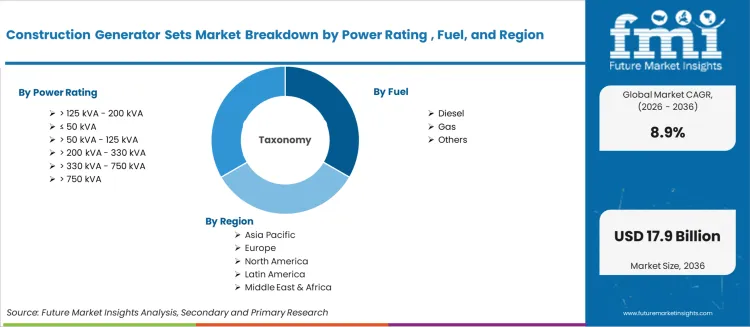
The construction generator sets market is segmented by power rating, fuel, application and geographic regions. The construction generator sets market is divided by power rating into > 125 kVA - 200 kVA, ≤ 50 kVA, > 50 kVA - 125 kVA, > 200 kVA - 330 kVA, > 330 kVA - 750 kVA, and > 750 kVA. In terms of fuel, the construction generator sets market is classified into Diesel, Gas, and Others.
Based on the application of the construction generator sets, the market is segmented into Prime/Continuous, Standby, and Peak Shaving. Regionally, the construction generator sets industry is classified into North America, Latin America, Western Europe, Eastern Europe, Balkan & Baltic Countries, Russia & Belarus, Central Asia, East Asia, South Asia & Pacific, and the Middle East & Africa.
Insights into the Power Rating Segment: >125 kVA - 200 kVA
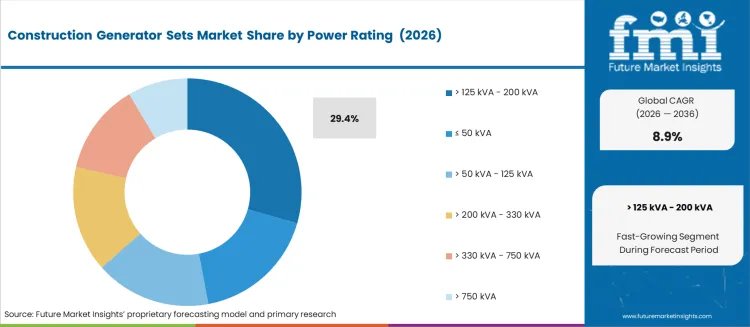
The >125 kVA - 200 kVA power rating segment is projected to hold 29.4% of the market revenue in 2026, maintaining its position as a leading category. This range provides a balanced solution for mid to large construction sites requiring substantial power output without excessive fuel consumption or size.
The segment’s popularity is due to its suitability for powering heavy machinery and multiple tools simultaneously. Contractors value these generators for their reliability and ease of transport.
The flexibility of this power rating to adapt to varying load requirements across projects supports consistent demand. As construction projects grow in scale and complexity, this power rating segment is expected to retain its dominance.
Insights into the Fuel Segment: Diesel
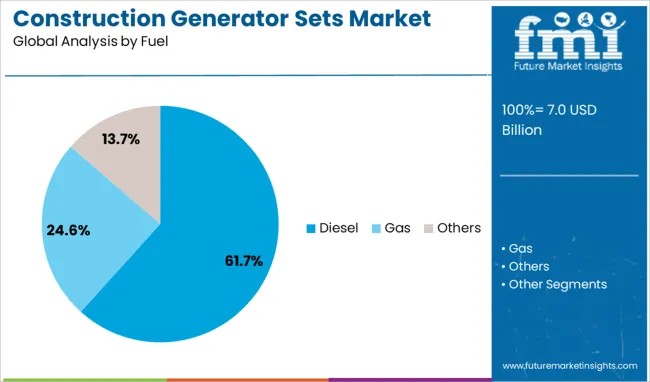
Diesel-powered generator sets are forecasted to account for 61.7% of the market revenue in 2026, remaining the preferred fuel type. Diesel engines are favored for their fuel efficiency, durability, and ability to handle heavy loads in demanding construction environments.
The wide availability of diesel fuel and established maintenance infrastructure contribute to the preference for diesel generators. These units are also recognized for their lower operational costs over time compared to alternatives.
Additionally, advancements in diesel engine technology have improved emissions performance, helping meet regulatory standards. Diesel fuel’s energy density and reliability make it the optimal choice for continuous and prime power supply in construction applications.
Insights into the Application Segment: Prime/Continuous
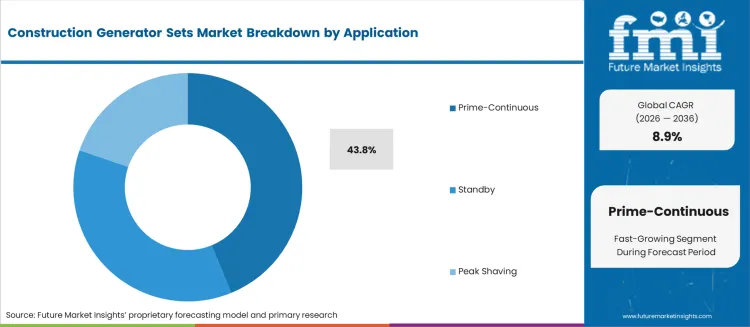
The Prime/Continuous application segment is projected to generate 43.8% of the market revenue in 2026, holding the largest share among application types. This segment’s growth is driven by the need for uninterrupted power to sustain ongoing construction activities and critical onsite operations.
Prime/continuous power generators are designed to run for extended periods under varying load conditions, making them essential for long-term projects. Their ability to provide stable power reduces downtime and improves equipment performance.
Construction companies increasingly rely on these generators to ensure operational efficiency and meet project deadlines. The segment is expected to continue leading as demand for reliable, long-duration power solutions grows in the construction sector.
What are the Drivers, Restraints, and Key Trends of the Construction Generator Sets Market?
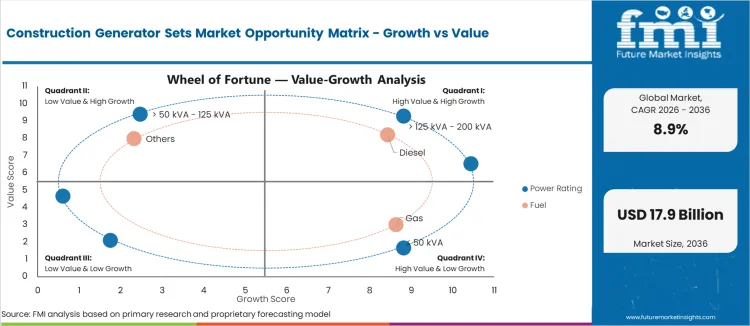
The construction generator sets market is expanding due to increasing global infrastructure development and remote site electrification requirements. These gensets provide portable or standby power for construction tools, lighting, and temporary facilities in areas lacking reliable grid access. Diesel remains the dominant fuel type, though natural gas and hybrid systems are gaining traction.
Key applications include high-rise construction, tunneling, data center builds, and large‑scale projects. Demand growth is strongest in Asia‑Pacific, North America, and Europe, driven by construction activity and temporary power needs.
Strict Emission Standards Limit Product Compatibility Expansion
Manufacturers of generator sets for construction face mounting pressure from emission regulations in major markets. New standards targeting nitrogen oxide, particulate matter, and sound output require use of advanced aftertreatment systems or alternative fuels for compliance.
Diesel gensets must include components such as catalytic converters or particulate filters to meet allowable emission limits, increasing system complexity. Regulatory variation by region means that manufacturers must develop multiple versions of the same product, each tailored to local rules. This fragmentation raises engineering cost and extends product development timelines.
Regional testing and certification processes are required, adding administrative layers that delay market entry. Smaller manufacturers frequently struggle to support multiple compliant variants. These demands limit engineers to proven, emission‑certified designs, slowing adoption of new genset lines. Cost increases associated with compliance may also restrict competitiveness in price‑sensitive projects or emerging regions where regulations are less stringent.
Infrastructure Expansion Drives Elevated Power Demand Opportunity
Rapid growth in infrastructure projects worldwide offers significant opportunity for generator set suppliers. Construction of highways, bridges, metro systems, airports, high-rise buildings, and data centers often occurs in areas with insufficient grid capacity. Portable generator sets provide necessary electricity for equipment, temporary lighting, and jobsite needs.
As governments and private developers invest heavily in large-scale construction and smart infrastructure, the demand for high‑capacity and reliable power grows. Data‑center construction also requires backup systems during critical installation phases. Suppliers that provide robust, modular genset systems capable of enduring harsh outdoor conditions and prolonged runtime are favored.
Installation services and rental models further support deployment. Partnerships with construction contractors and rental fleets provide ongoing demand. As project timelines tighten and downtime becomes costly, reliable gensets become indispensable. This creates a long‑term growth pipeline for providers focused on construction sector requirements.
Hybrid And Gas‑Fueled Models Shift Market Preference Trend
A notable trend in this market is rising adoption of generator sets powered by cleaner fuels such as natural gas or propane, as well as hybrid models combining gensets with solar or battery backup. These options allow operators to reduce fuel consumption, lower emissions, and comply with tightening regulations. Hybrid systems support quieter operation and better fuel efficiency, valued by urban construction sites.
Natural gas gensets are preferred in markets with available pipeline infrastructure. Manufacturers are introducing modular units that can switch between fuel types or engage battery support during low‑load periods. While diesel gensets remain powerful and reliable, hybrid configurations are increasingly preferred in environmentally sensitive or regulatory‑tight regions.
Supplier capabilities around multi‑fuel compatibility and integration of renewable energy components help win long‑term contracts. As construction firms emphasize cost optimization and environmental compliance simultaneously, hybrid and gas‑powered gensets gain market share relative to traditional diesel-only units.
Fuel Cost Volatility Elevates Operational Budget Risk
Fluctuations in diesel, gas, or propane prices significantly affect the total operating cost of generator set fleets deployed at construction sites. Construction firms often operate on thin margins and cannot easily absorb sudden fuel cost increases, even when the power supply is critical.
Global crude dynamics, local tax structures, or changes in gas pricing policies drive price swings. This unpredictability complicates budgeting for long-term projects, especially those planned months in advance. Facilities relying on backup gensets may shift usage to reduce hours during peak fuel prices.
Suppliers who offer fuel-efficient models or advisory support for fuel procurement help alleviate this risk. Rental companies may face pressure to raise rental fees or offer fuel-inclusive packages to maintain profitability. In regions with limited fuel subsidy or unstable fuel markets, fuel cost volatility remains a key constraint affecting adoption decisions and pricing negotiations.
Analysis of Construction Generator Sets Market By Key Countries
.webp "Top Country Growth Comparison Construction Generator Sets Market Cagr (2026 2036)")
| Country | CAGR |
|---|---|
| China | 12.0% |
| India | 11.1% |
| Germany | 10.2% |
| France | 9.3% |
| UK | 8.5% |
| USA | 7.6% |
| Brazil | 6.7% |
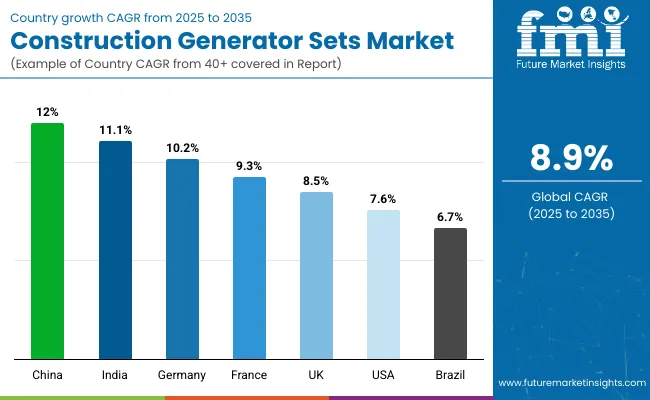
The global construction generator sets market is projected to grow at a CAGR of 8.9% through 2036, supported by expanding infrastructure development and off-grid power requirements. Among BRICS nations, China leads with 12.0% growth, fueled by widespread construction activity and the deployment of standby power units on large-scale sites. India follows at 11.1%, where temporary power demand has been driven by urban expansion and industrial estate development. In the OECD region, Germany records 10.2% growth, supported by stringent reliability standards and consistent demand in commercial construction.
The United Kingdom, at 8.5%, continues to apply generator sets for infrastructure upgrades and remote site deployment. The United States, at 7.6%, remains a steady market with procurement driven by equipment reliability and emissions compliance. Market trends have been shaped by fuel efficiency mandates, operating hour limits, and procurement model requirements. This report includes insights on 40+ countries; the top five markets are shown here for reference.
Sales Outlook for Construction Generator Sets Market in China
Growth of 12.0% CAGR has been registered in China, driven by widespread usage of generator sets at infrastructure and commercial construction sites. A noticeable rise in medium-capacity diesel and gas-powered units has been recorded across mixed-use developments and roadworks. Regulatory standards on emission limits have encouraged gradual integration of hybrid models in larger construction fleets.
High-altitude and remote zone operations have led to strong demand for heavy-duty sets with superior fuel efficiency. OEMs have expanded regional support networks to ensure on-site servicing and uptime assurance. Custom-built gensets with automatic load management systems have been adopted by tier-1 contractors.
- High-capacity units deployed across complex urban projects
- Remote operations driving heavy-duty genset demand
- OEM support expanded for uptime optimization
Demand Analysis for Construction Generator Sets Market in India
In India, market has expanded at 11.1% CAGR, supported by increased deployment in road, rail, and industrial park development. A surge in mid-size genset demand has been observed in semi-urban and Tier-2 cities. Infrastructure contractors have opted for sound-attenuated and mobile models for ease of relocation. Hybrid generators combining solar support have been introduced in select construction zones where grid access remains limited. Local manufacturers have ramped up production of gensets compliant with CPCB norms. Equipment rental services have gained traction due to short project cycles and cost sensitivity.
- Portable gensets widely adopted in Tier-2 cities
- Hybrid and solar-assisted units piloted in off-grid areas
- Rental segment expansion aligned with project variability
In-depth Analysis of Construction Generator Sets Market in Germany
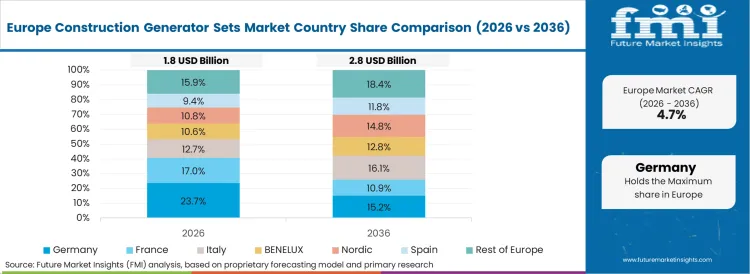
Germany has reported a 10.2% CAGR in this segment, largely attributed to the role of gensets in temporary grid-independent construction activities. Units fitted with remote monitoring and real-time diagnostics have been increasingly preferred by civil contractors. Modular gensets for phased infrastructure rollouts have found usage in commercial and public building sites. Fuel-efficient models equipped with automated load balancing have gained prominence, especially for renovation and utility tunneling work. Construction equipment distributors have offered bundled genset packages with energy usage forecasts and preventive maintenance plans.
- Remote diagnostics standard in new genset deployments
- Phased infrastructure works driving modular genset demand
- Efficiency-led models prioritized for civil construction
Opportunity Analysis for Construction Generator Sets Market in the United Kingdom
The United Kingdom has demonstrated an 8.5% CAGR, backed by steady usage of generator sets in residential, railway, and refurbishment projects. Construction contractors have preferred silent-operation models for inner-city applications. Compact gensets have been deployed for mobile site offices and temporary tool stations. Digital control panels enabling start-stop automation and fuel consumption reporting have supported wider adoption. Compliance with Stage V emissions legislation has led to upgrades in fleet specifications among equipment rental agencies. Select sites have trialed low-noise biofuel-powered sets for operations near schools and hospitals.
- Low-emission gensets favored in emission-regulated zones
- Digital monitoring driving precision load control
- Compact units used in site offices and refurbishments
Expansion of the Construction Generator Sets Market in United States
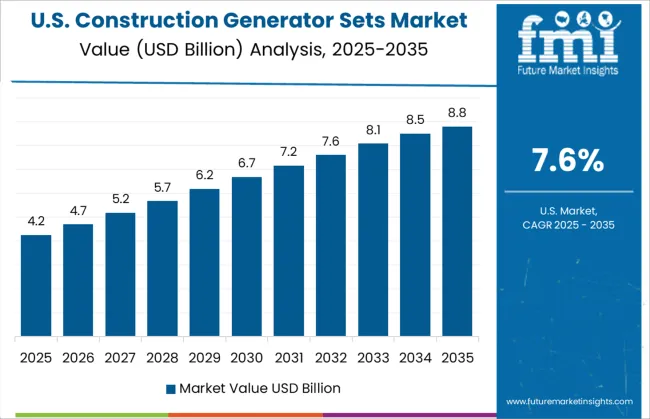
An 8.9% CAGR has been matched closely by the United States market, where demand has been shaped by backup needs at large commercial construction zones and highway expansion projects. Mobile gensets with trailer mounts have been deployed for asphalt and concrete batching applications. Equipment integrators have supported builders with telematics-enabled power solutions. Cost-efficient generators with multi-voltage output have seen usage in regional projects with fluctuating load demands. Infrastructure upgrades in hurricane-prone zones have pushed up requirements for weather-resistant sets with extended fuel autonomy.
- Multi-voltage gensets applied in regional infrastructure builds
- Mobile units used across batching and road projects
- Weather-resistant designs deployed in disaster-prone areas
Competitive Landscape of Construction Generator Sets Market
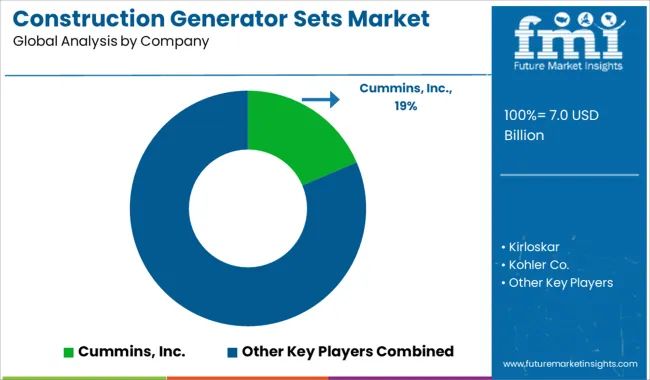
The construction generator sets market is dominated by a mix of globally established manufacturers and regional players offering diesel and gas-powered solutions for consistent energy supply across remote and urban project sites. Cummins, Inc. leads with a broad range of heavy-duty gensets that are deployed on large-scale construction sites requiring high reliability and fuel efficiency. Caterpillar remains a dominant force due to its robust lineup of industrial-grade gensets designed to withstand harsh operational conditions while offering scalable power output.
Generac Power Systems, Inc. and Kohler Co. are recognized for their portable and standby generator systems, particularly suited for mid-sized construction firms requiring flexible deployment. Kirloskar and Mahindra POWEROL are leading Indian suppliers, offering cost-effective generator solutions with strong regional support, especially in infrastructure and real estate development. Atlas Copco AB and HIMOINSA provide integrated power modules featuring sound-attenuated enclosures and modular deployment options, ideal for urban construction environments with noise restrictions.
Yamaha Motor Co., Ltd. and Honda India Power Products Ltd. serve the portable genset segment with compact, reliable units favored for light-duty and temporary construction applications. Emerging players like Powerica Limited and Rapid Power Generation Ltd. are gaining market share by offering custom-built gensets aligned with project-specific requirements. Companies like Aggreko focus on rental power, catering to short-term construction needs. Others, including J C Bamford Excavators Ltd., Ashok Leyland, and Greaves Cotton Limited, offer vertically integrated power solutions that complement their construction equipment lines, enhancing operational continuity on-site.
Scope of the Report
| Metric | Value |
|---|---|
| Quantitative Units | USD 7.62 billion to USD 17.88 billion, at a CAGR of 8.9% |
| Market Definition | Construction generator sets are engine-driven power generation units that supply prime, standby, or peak shaving electricity at construction project sites across diesel, gas, and alternative fuel configurations. |
| Segmentation | Power Rating: > 125 kVA to 200 kVA, Up to 50 kVA, > 50 kVA to 125 kVA, > 200 kVA to 330 kVA, > 330 kVA to 750 kVA, > 750 kVA; Fuel: Diesel, Gas, Others; Application: Prime/Continuous, Standby, Peak Shaving |
| Regions Covered | North America, Latin America, Europe, East Asia, South Asia, Oceania, Middle East & Africa |
| Countries Covered | China, India, Germany, France, UK, USA, Brazil, and 40 plus countries |
| Key Companies Profiled | Cummins, Inc., Kirloskar, Kohler Co., Generac Power Systems, Inc., Yamaha Motor Co., Ltd., Powerica Limited, Sterling and Wilson Pvt. Ltd., HIMOINSA |
| Forecast Period | 2026 to 2036 |
| Approach | Forecasting models apply a bottom-up methodology starting with regional construction activity and equipment procurement metrics, cross-validated against fleet operator capital expenditure records. |
Construction Generator Sets Market by Segments
Power Rating:
- > 125 kVA - 200 kVA
- ≤ 50 kVA
- > 50 kVA - 125 kVA
- > 200 kVA - 330 kVA
- > 330 kVA - 750 kVA
- > 750 kVA
Fuel:
- Diesel
- Gas
- Others
Application:
- Prime/Continuous
- Standby
- Peak Shaving
Region:
- North America
- USA
- Canada
- Mexico
- Latin America
- Brazil
- Chile
- Rest of Latin America
- Western Europe
- Germany
- UK
- Italy
- Spain
- France
- Nordic
- BENELUX
- Rest of Western Europe
- Eastern Europe
- Russia
- Poland
- Hungary
- Balkan & Baltic
- Rest of Eastern Europe
- East Asia
- China
- Japan
- South Korea
- South Asia and Pacific
- India
- ASEAN
- Australia & New Zealand
- Rest of South Asia and Pacific
- Middle East & Africa
- Kingdom of Saudi Arabia
- Other GCC Countries
- Turkiye
- South Africa
- Other African Union
- Rest of Middle East & Africa
Bibliography
- 1. International Organization for Standardization. (2024). ISO 8528: Reciprocating Internal Combustion Engine Driven Alternating Current Generating Sets. ISO.
- 2. European Commission. (2024). Regulation (EU) 2016/1628: Non-Road Mobile Machinery Emissions (Stage V Implementation Update). European Commission.
- 3. United States Environmental Protection Agency. (2025). Nonroad Compression-Ignition Engines: Tier 4 Final Standards Compliance Report. EPA.
- 4. International Energy Agency. (2025). World Energy Outlook: Distributed Generation and Construction Sector. IEA.
- 5. Organisation for Economic Co-operation and Development. (2024). Infrastructure Investment and Power Supply Gaps. OECD.
This bibliography is provided for reader reference. The full Future Market Insights report contains the complete reference list with primary research documentation.
Frequently Asked Questions
How large is the demand for Construction Generator Sets in the global market in 2026?
Demand for Construction Generator Sets in the global market is estimated to be valued at USD 7.62 billion in 2026.
What will be the market size of Construction Generator Sets in the global market by 2036?
Market size for Construction Generator Sets is projected to reach USD 17.88 billion by 2036.
What is the expected demand growth for Construction Generator Sets between 2026 and 2036?
Demand for Construction Generator Sets is expected to grow at a CAGR of 8.9% between 2026 and 2036.
Which Fuel is poised to lead global sales by 2026?
Diesel accounts for 61.7% share in 2026 based on FMI analysis.
How is the role of Prime/Continuous in driving Construction Generator Sets adoption in 2026?
Prime/Continuous represents 43.8% of segment share in 2026 as per FMI's construction generator sets market report.
What is the fastest-growing country market in this report?
China is projected to grow at a CAGR of 12% during 2026 to 2036.
What is Construction Generator Sets and what is it mainly used for?
Construction generator sets are engine-driven power generation units that supply prime, standby, or peak shaving electricity at construction project sites across diesel, gas, and alternative fuel configurations.
What is included in the scope of this Construction Generator Sets report?
The market covers diesel, gas, and alternative fuel generator sets across all power ratings for prime, standby, and peak shaving construction site applications.
Table of Content
- Executive Summary
- Global Market Outlook
- Demand-side Trends
- Supply-side Trends
- Technology Roadmap Analysis
- Analysis and Recommendations
- Market Overview
- Market Coverage / Taxonomy
- Market Definition / Scope / Limitations
- Research Methodology
- Chapter Orientation
- Analytical Lens and Working Hypotheses
- Market Structure, Signals, and Trend Drivers
- Benchmarking and Cross-market Comparability
- Market Sizing, Forecasting, and Opportunity Mapping
- Research Design and Evidence Framework
- Desk Research Programme (Secondary Evidence)
- Company Annual and Sustainability Reports
- Peer-reviewed Journals and Academic Literature
- Corporate Websites, Product Literature, and Technical Notes
- Earnings Decks and Investor Briefings
- Statutory Filings and Regulatory Disclosures
- Technical White Papers and Standards Notes
- Trade Journals, Industry Magazines, and Analyst Briefs
- Conference Proceedings, Webinars, and Seminar Materials
- Government Statistics Portals and Public Data Releases
- Press Releases and Reputable Media Coverage
- Specialist Newsletters and Curated Briefings
- Sector Databases and Reference Repositories
- FMI Internal Proprietary Databases and Historical Market Datasets
- Subscription Datasets and Paid Sources
- Social Channels, Communities, and Digital Listening Inputs
- Additional Desk Sources
- Expert Input and Fieldwork (Primary Evidence)
- Primary Modes
- Qualitative Interviews and Expert Elicitation
- Quantitative Surveys and Structured Data Capture
- Blended Approach
- Why Primary Evidence is Used
- Field Techniques
- Interviews
- Surveys
- Focus Groups
- Observational and In-context Research
- Social and Community Interactions
- Stakeholder Universe Engaged
- C-suite Leaders
- Board Members
- Presidents and Vice Presidents
- R&D and Innovation Heads
- Technical Specialists
- Domain Subject-matter Experts
- Scientists
- Physicians and Other Healthcare Professionals
- Governance, Ethics, and Data Stewardship
- Research Ethics
- Data Integrity and Handling
- Primary Modes
- Tooling, Models, and Reference Databases
- Desk Research Programme (Secondary Evidence)
- Data Engineering and Model Build
- Data Acquisition and Ingestion
- Cleaning, Normalisation, and Verification
- Synthesis, Triangulation, and Analysis
- Quality Assurance and Audit Trail
- Market Background
- Market Dynamics
- Drivers
- Restraints
- Opportunity
- Trends
- Scenario Forecast
- Demand in Optimistic Scenario
- Demand in Likely Scenario
- Demand in Conservative Scenario
- Opportunity Map Analysis
- Product Life Cycle Analysis
- Supply Chain Analysis
- Investment Feasibility Matrix
- Value Chain Analysis
- PESTLE and Porter’s Analysis
- Regulatory Landscape
- Regional Parent Market Outlook
- Production and Consumption Statistics
- Import and Export Statistics
- Market Dynamics
- Global Market Analysis 2021 to 2025 and Forecast, 2026 to 2036
- Historical Market Size Value (USD Million) Analysis, 2021 to 2025
- Current and Future Market Size Value (USD Million) Projections, 2026 to 2036
- Y-o-Y Growth Trend Analysis
- Absolute $ Opportunity Analysis
- Global Market Pricing Analysis 2021 to 2025 and Forecast 2026 to 2036
- Global Market Analysis 2021 to 2025 and Forecast 2026 to 2036, By Power Rating
- Introduction / Key Findings
- Historical Market Size Value (USD Million) Analysis By Power Rating , 2021 to 2025
- Current and Future Market Size Value (USD Million) Analysis and Forecast By Power Rating , 2026 to 2036
- > 125 kVA - 200 kVA
- ≤ 50 kVA
- > 50 kVA - 125 kVA
- > 200 kVA - 330 kVA
- > 330 kVA - 750 kVA
- > 750 kVA
- > 125 kVA - 200 kVA
- Y-o-Y Growth Trend Analysis By Power Rating , 2021 to 2025
- Absolute $ Opportunity Analysis By Power Rating , 2026 to 2036
- Global Market Analysis 2021 to 2025 and Forecast 2026 to 2036, By Fuel
- Introduction / Key Findings
- Historical Market Size Value (USD Million) Analysis By Fuel, 2021 to 2025
- Current and Future Market Size Value (USD Million) Analysis and Forecast By Fuel, 2026 to 2036
- Diesel
- Gas
- Others
- Diesel
- Y-o-Y Growth Trend Analysis By Fuel, 2021 to 2025
- Absolute $ Opportunity Analysis By Fuel, 2026 to 2036
- Global Market Analysis 2021 to 2025 and Forecast 2026 to 2036, By Application
- Introduction / Key Findings
- Historical Market Size Value (USD Million) Analysis By Application, 2021 to 2025
- Current and Future Market Size Value (USD Million) Analysis and Forecast By Application, 2026 to 2036
- Prime/Continuous
- Standby
- Peak Shaving
- Prime/Continuous
- Y-o-Y Growth Trend Analysis By Application, 2021 to 2025
- Absolute $ Opportunity Analysis By Application, 2026 to 2036
- Global Market Analysis 2021 to 2025 and Forecast 2026 to 2036, By Region
- Introduction
- Historical Market Size Value (USD Million) Analysis By Region, 2021 to 2025
- Current Market Size Value (USD Million) Analysis and Forecast By Region, 2026 to 2036
- North America
- Latin America
- Western Europe
- Eastern Europe
- East Asia
- South Asia and Pacific
- Middle East & Africa
- Market Attractiveness Analysis By Region
- North America Market Analysis 2021 to 2025 and Forecast 2026 to 2036, By Country
- Historical Market Size Value (USD Million) Trend Analysis By Market Taxonomy, 2021 to 2025
- Market Size Value (USD Million) Forecast By Market Taxonomy, 2026 to 2036
- By Country
- USA
- Canada
- Mexico
- By Power Rating
- By Fuel
- By Application
- By Country
- Market Attractiveness Analysis
- By Country
- By Power Rating
- By Fuel
- By Application
- Key Takeaways
- Latin America Market Analysis 2021 to 2025 and Forecast 2026 to 2036, By Country
- Historical Market Size Value (USD Million) Trend Analysis By Market Taxonomy, 2021 to 2025
- Market Size Value (USD Million) Forecast By Market Taxonomy, 2026 to 2036
- By Country
- Brazil
- Chile
- Rest of Latin America
- By Power Rating
- By Fuel
- By Application
- By Country
- Market Attractiveness Analysis
- By Country
- By Power Rating
- By Fuel
- By Application
- Key Takeaways
- Western Europe Market Analysis 2021 to 2025 and Forecast 2026 to 2036, By Country
- Historical Market Size Value (USD Million) Trend Analysis By Market Taxonomy, 2021 to 2025
- Market Size Value (USD Million) Forecast By Market Taxonomy, 2026 to 2036
- By Country
- Germany
- UK
- Italy
- Spain
- France
- Nordic
- BENELUX
- Rest of Western Europe
- By Power Rating
- By Fuel
- By Application
- By Country
- Market Attractiveness Analysis
- By Country
- By Power Rating
- By Fuel
- By Application
- Key Takeaways
- Eastern Europe Market Analysis 2021 to 2025 and Forecast 2026 to 2036, By Country
- Historical Market Size Value (USD Million) Trend Analysis By Market Taxonomy, 2021 to 2025
- Market Size Value (USD Million) Forecast By Market Taxonomy, 2026 to 2036
- By Country
- Russia
- Poland
- Hungary
- Balkan & Baltic
- Rest of Eastern Europe
- By Power Rating
- By Fuel
- By Application
- By Country
- Market Attractiveness Analysis
- By Country
- By Power Rating
- By Fuel
- By Application
- Key Takeaways
- East Asia Market Analysis 2021 to 2025 and Forecast 2026 to 2036, By Country
- Historical Market Size Value (USD Million) Trend Analysis By Market Taxonomy, 2021 to 2025
- Market Size Value (USD Million) Forecast By Market Taxonomy, 2026 to 2036
- By Country
- China
- Japan
- South Korea
- By Power Rating
- By Fuel
- By Application
- By Country
- Market Attractiveness Analysis
- By Country
- By Power Rating
- By Fuel
- By Application
- Key Takeaways
- South Asia and Pacific Market Analysis 2021 to 2025 and Forecast 2026 to 2036, By Country
- Historical Market Size Value (USD Million) Trend Analysis By Market Taxonomy, 2021 to 2025
- Market Size Value (USD Million) Forecast By Market Taxonomy, 2026 to 2036
- By Country
- India
- ASEAN
- Australia & New Zealand
- Rest of South Asia and Pacific
- By Power Rating
- By Fuel
- By Application
- By Country
- Market Attractiveness Analysis
- By Country
- By Power Rating
- By Fuel
- By Application
- Key Takeaways
- Middle East & Africa Market Analysis 2021 to 2025 and Forecast 2026 to 2036, By Country
- Historical Market Size Value (USD Million) Trend Analysis By Market Taxonomy, 2021 to 2025
- Market Size Value (USD Million) Forecast By Market Taxonomy, 2026 to 2036
- By Country
- Kingdom of Saudi Arabia
- Other GCC Countries
- Turkiye
- South Africa
- Other African Union
- Rest of Middle East & Africa
- By Power Rating
- By Fuel
- By Application
- By Country
- Market Attractiveness Analysis
- By Country
- By Power Rating
- By Fuel
- By Application
- Key Takeaways
- Key Countries Market Analysis
- USA
- Pricing Analysis
- Market Share Analysis, 2025
- By Power Rating
- By Fuel
- By Application
- Canada
- Pricing Analysis
- Market Share Analysis, 2025
- By Power Rating
- By Fuel
- By Application
- Mexico
- Pricing Analysis
- Market Share Analysis, 2025
- By Power Rating
- By Fuel
- By Application
- Brazil
- Pricing Analysis
- Market Share Analysis, 2025
- By Power Rating
- By Fuel
- By Application
- Chile
- Pricing Analysis
- Market Share Analysis, 2025
- By Power Rating
- By Fuel
- By Application
- Germany
- Pricing Analysis
- Market Share Analysis, 2025
- By Power Rating
- By Fuel
- By Application
- UK
- Pricing Analysis
- Market Share Analysis, 2025
- By Power Rating
- By Fuel
- By Application
- Italy
- Pricing Analysis
- Market Share Analysis, 2025
- By Power Rating
- By Fuel
- By Application
- Spain
- Pricing Analysis
- Market Share Analysis, 2025
- By Power Rating
- By Fuel
- By Application
- France
- Pricing Analysis
- Market Share Analysis, 2025
- By Power Rating
- By Fuel
- By Application
- India
- Pricing Analysis
- Market Share Analysis, 2025
- By Power Rating
- By Fuel
- By Application
- ASEAN
- Pricing Analysis
- Market Share Analysis, 2025
- By Power Rating
- By Fuel
- By Application
- Australia & New Zealand
- Pricing Analysis
- Market Share Analysis, 2025
- By Power Rating
- By Fuel
- By Application
- China
- Pricing Analysis
- Market Share Analysis, 2025
- By Power Rating
- By Fuel
- By Application
- Japan
- Pricing Analysis
- Market Share Analysis, 2025
- By Power Rating
- By Fuel
- By Application
- South Korea
- Pricing Analysis
- Market Share Analysis, 2025
- By Power Rating
- By Fuel
- By Application
- Russia
- Pricing Analysis
- Market Share Analysis, 2025
- By Power Rating
- By Fuel
- By Application
- Poland
- Pricing Analysis
- Market Share Analysis, 2025
- By Power Rating
- By Fuel
- By Application
- Hungary
- Pricing Analysis
- Market Share Analysis, 2025
- By Power Rating
- By Fuel
- By Application
- Kingdom of Saudi Arabia
- Pricing Analysis
- Market Share Analysis, 2025
- By Power Rating
- By Fuel
- By Application
- Turkiye
- Pricing Analysis
- Market Share Analysis, 2025
- By Power Rating
- By Fuel
- By Application
- South Africa
- Pricing Analysis
- Market Share Analysis, 2025
- By Power Rating
- By Fuel
- By Application
- USA
- Market Structure Analysis
- Competition Dashboard
- Competition Benchmarking
- Market Share Analysis of Top Players
- By Regional
- By Power Rating
- By Fuel
- By Application
- Competition Analysis
- Competition Deep Dive
- Cummins, Inc.
- Overview
- Product Portfolio
- Profitability by Market Segments (Product/Age /Sales Channel/Region)
- Sales Footprint
- Strategy Overview
- Marketing Strategy
- Product Strategy
- Channel Strategy
- Kirloskar
- Kohler Co.
- Generac Power Systems, Inc.
- Yamaha Motor Co., Ltd.
- Powerica Limited
- Sterling and Wilson Pvt. Ltd.
- HIMOINSA
- Caterpillar
- Atlas Copco AB
- J C Bamford Excavators Ltd.
- Mahindra POWEROL
- Deere & Company
- Ashok Leyland
- Greaves Cotton Limited
- Mitsubishi Heavy Industries, Ltd.
- Wartsila
- Rapid Power Generation Ltd.
- Honda India Power Products Ltd.
- FG Wilson
- Cummins, Inc.
- Competition Deep Dive
- Assumptions & Acronyms Used
List of Tables
- Table 1: Global Market Value (USD Million) Forecast by Region, 2021 to 2036
- Table 2: Global Market Value (USD Million) Forecast by Power Rating , 2021 to 2036
- Table 3: Global Market Value (USD Million) Forecast by Fuel, 2021 to 2036
- Table 4: Global Market Value (USD Million) Forecast by Application, 2021 to 2036
- Table 5: North America Market Value (USD Million) Forecast by Country, 2021 to 2036
- Table 6: North America Market Value (USD Million) Forecast by Power Rating , 2021 to 2036
- Table 7: North America Market Value (USD Million) Forecast by Fuel, 2021 to 2036
- Table 8: North America Market Value (USD Million) Forecast by Application, 2021 to 2036
- Table 9: Latin America Market Value (USD Million) Forecast by Country, 2021 to 2036
- Table 10: Latin America Market Value (USD Million) Forecast by Power Rating , 2021 to 2036
- Table 11: Latin America Market Value (USD Million) Forecast by Fuel, 2021 to 2036
- Table 12: Latin America Market Value (USD Million) Forecast by Application, 2021 to 2036
- Table 13: Western Europe Market Value (USD Million) Forecast by Country, 2021 to 2036
- Table 14: Western Europe Market Value (USD Million) Forecast by Power Rating , 2021 to 2036
- Table 15: Western Europe Market Value (USD Million) Forecast by Fuel, 2021 to 2036
- Table 16: Western Europe Market Value (USD Million) Forecast by Application, 2021 to 2036
- Table 17: Eastern Europe Market Value (USD Million) Forecast by Country, 2021 to 2036
- Table 18: Eastern Europe Market Value (USD Million) Forecast by Power Rating , 2021 to 2036
- Table 19: Eastern Europe Market Value (USD Million) Forecast by Fuel, 2021 to 2036
- Table 20: Eastern Europe Market Value (USD Million) Forecast by Application, 2021 to 2036
- Table 21: East Asia Market Value (USD Million) Forecast by Country, 2021 to 2036
- Table 22: East Asia Market Value (USD Million) Forecast by Power Rating , 2021 to 2036
- Table 23: East Asia Market Value (USD Million) Forecast by Fuel, 2021 to 2036
- Table 24: East Asia Market Value (USD Million) Forecast by Application, 2021 to 2036
- Table 25: South Asia and Pacific Market Value (USD Million) Forecast by Country, 2021 to 2036
- Table 26: South Asia and Pacific Market Value (USD Million) Forecast by Power Rating , 2021 to 2036
- Table 27: South Asia and Pacific Market Value (USD Million) Forecast by Fuel, 2021 to 2036
- Table 28: South Asia and Pacific Market Value (USD Million) Forecast by Application, 2021 to 2036
- Table 29: Middle East & Africa Market Value (USD Million) Forecast by Country, 2021 to 2036
- Table 30: Middle East & Africa Market Value (USD Million) Forecast by Power Rating , 2021 to 2036
- Table 31: Middle East & Africa Market Value (USD Million) Forecast by Fuel, 2021 to 2036
- Table 32: Middle East & Africa Market Value (USD Million) Forecast by Application, 2021 to 2036
List of Figures
- Figure 1: Global Market Pricing Analysis
- Figure 2: Global Market Value (USD Million) Forecast 2021-2036
- Figure 3: Global Market Value Share and BPS Analysis by Power Rating , 2026 and 2036
- Figure 4: Global Market Y-o-Y Growth Comparison by Power Rating , 2026-2036
- Figure 5: Global Market Attractiveness Analysis by Power Rating
- Figure 6: Global Market Value Share and BPS Analysis by Fuel, 2026 and 2036
- Figure 7: Global Market Y-o-Y Growth Comparison by Fuel, 2026-2036
- Figure 8: Global Market Attractiveness Analysis by Fuel
- Figure 9: Global Market Value Share and BPS Analysis by Application, 2026 and 2036
- Figure 10: Global Market Y-o-Y Growth Comparison by Application, 2026-2036
- Figure 11: Global Market Attractiveness Analysis by Application
- Figure 12: Global Market Value (USD Million) Share and BPS Analysis by Region, 2026 and 2036
- Figure 13: Global Market Y-o-Y Growth Comparison by Region, 2026-2036
- Figure 14: Global Market Attractiveness Analysis by Region
- Figure 15: North America Market Incremental Dollar Opportunity, 2026-2036
- Figure 16: Latin America Market Incremental Dollar Opportunity, 2026-2036
- Figure 17: Western Europe Market Incremental Dollar Opportunity, 2026-2036
- Figure 18: Eastern Europe Market Incremental Dollar Opportunity, 2026-2036
- Figure 19: East Asia Market Incremental Dollar Opportunity, 2026-2036
- Figure 20: South Asia and Pacific Market Incremental Dollar Opportunity, 2026-2036
- Figure 21: Middle East & Africa Market Incremental Dollar Opportunity, 2026-2036
- Figure 22: North America Market Value Share and BPS Analysis by Country, 2026 and 2036
- Figure 23: North America Market Value Share and BPS Analysis by Power Rating , 2026 and 2036
- Figure 24: North America Market Y-o-Y Growth Comparison by Power Rating , 2026-2036
- Figure 25: North America Market Attractiveness Analysis by Power Rating
- Figure 26: North America Market Value Share and BPS Analysis by Fuel, 2026 and 2036
- Figure 27: North America Market Y-o-Y Growth Comparison by Fuel, 2026-2036
- Figure 28: North America Market Attractiveness Analysis by Fuel
- Figure 29: North America Market Value Share and BPS Analysis by Application, 2026 and 2036
- Figure 30: North America Market Y-o-Y Growth Comparison by Application, 2026-2036
- Figure 31: North America Market Attractiveness Analysis by Application
- Figure 32: Latin America Market Value Share and BPS Analysis by Country, 2026 and 2036
- Figure 33: Latin America Market Value Share and BPS Analysis by Power Rating , 2026 and 2036
- Figure 34: Latin America Market Y-o-Y Growth Comparison by Power Rating , 2026-2036
- Figure 35: Latin America Market Attractiveness Analysis by Power Rating
- Figure 36: Latin America Market Value Share and BPS Analysis by Fuel, 2026 and 2036
- Figure 37: Latin America Market Y-o-Y Growth Comparison by Fuel, 2026-2036
- Figure 38: Latin America Market Attractiveness Analysis by Fuel
- Figure 39: Latin America Market Value Share and BPS Analysis by Application, 2026 and 2036
- Figure 40: Latin America Market Y-o-Y Growth Comparison by Application, 2026-2036
- Figure 41: Latin America Market Attractiveness Analysis by Application
- Figure 42: Western Europe Market Value Share and BPS Analysis by Country, 2026 and 2036
- Figure 43: Western Europe Market Value Share and BPS Analysis by Power Rating , 2026 and 2036
- Figure 44: Western Europe Market Y-o-Y Growth Comparison by Power Rating , 2026-2036
- Figure 45: Western Europe Market Attractiveness Analysis by Power Rating
- Figure 46: Western Europe Market Value Share and BPS Analysis by Fuel, 2026 and 2036
- Figure 47: Western Europe Market Y-o-Y Growth Comparison by Fuel, 2026-2036
- Figure 48: Western Europe Market Attractiveness Analysis by Fuel
- Figure 49: Western Europe Market Value Share and BPS Analysis by Application, 2026 and 2036
- Figure 50: Western Europe Market Y-o-Y Growth Comparison by Application, 2026-2036
- Figure 51: Western Europe Market Attractiveness Analysis by Application
- Figure 52: Eastern Europe Market Value Share and BPS Analysis by Country, 2026 and 2036
- Figure 53: Eastern Europe Market Value Share and BPS Analysis by Power Rating , 2026 and 2036
- Figure 54: Eastern Europe Market Y-o-Y Growth Comparison by Power Rating , 2026-2036
- Figure 55: Eastern Europe Market Attractiveness Analysis by Power Rating
- Figure 56: Eastern Europe Market Value Share and BPS Analysis by Fuel, 2026 and 2036
- Figure 57: Eastern Europe Market Y-o-Y Growth Comparison by Fuel, 2026-2036
- Figure 58: Eastern Europe Market Attractiveness Analysis by Fuel
- Figure 59: Eastern Europe Market Value Share and BPS Analysis by Application, 2026 and 2036
- Figure 60: Eastern Europe Market Y-o-Y Growth Comparison by Application, 2026-2036
- Figure 61: Eastern Europe Market Attractiveness Analysis by Application
- Figure 62: East Asia Market Value Share and BPS Analysis by Country, 2026 and 2036
- Figure 63: East Asia Market Value Share and BPS Analysis by Power Rating , 2026 and 2036
- Figure 64: East Asia Market Y-o-Y Growth Comparison by Power Rating , 2026-2036
- Figure 65: East Asia Market Attractiveness Analysis by Power Rating
- Figure 66: East Asia Market Value Share and BPS Analysis by Fuel, 2026 and 2036
- Figure 67: East Asia Market Y-o-Y Growth Comparison by Fuel, 2026-2036
- Figure 68: East Asia Market Attractiveness Analysis by Fuel
- Figure 69: East Asia Market Value Share and BPS Analysis by Application, 2026 and 2036
- Figure 70: East Asia Market Y-o-Y Growth Comparison by Application, 2026-2036
- Figure 71: East Asia Market Attractiveness Analysis by Application
- Figure 72: South Asia and Pacific Market Value Share and BPS Analysis by Country, 2026 and 2036
- Figure 73: South Asia and Pacific Market Value Share and BPS Analysis by Power Rating , 2026 and 2036
- Figure 74: South Asia and Pacific Market Y-o-Y Growth Comparison by Power Rating , 2026-2036
- Figure 75: South Asia and Pacific Market Attractiveness Analysis by Power Rating
- Figure 76: South Asia and Pacific Market Value Share and BPS Analysis by Fuel, 2026 and 2036
- Figure 77: South Asia and Pacific Market Y-o-Y Growth Comparison by Fuel, 2026-2036
- Figure 78: South Asia and Pacific Market Attractiveness Analysis by Fuel
- Figure 79: South Asia and Pacific Market Value Share and BPS Analysis by Application, 2026 and 2036
- Figure 80: South Asia and Pacific Market Y-o-Y Growth Comparison by Application, 2026-2036
- Figure 81: South Asia and Pacific Market Attractiveness Analysis by Application
- Figure 82: Middle East & Africa Market Value Share and BPS Analysis by Country, 2026 and 2036
- Figure 83: Middle East & Africa Market Value Share and BPS Analysis by Power Rating , 2026 and 2036
- Figure 84: Middle East & Africa Market Y-o-Y Growth Comparison by Power Rating , 2026-2036
- Figure 85: Middle East & Africa Market Attractiveness Analysis by Power Rating
- Figure 86: Middle East & Africa Market Value Share and BPS Analysis by Fuel, 2026 and 2036
- Figure 87: Middle East & Africa Market Y-o-Y Growth Comparison by Fuel, 2026-2036
- Figure 88: Middle East & Africa Market Attractiveness Analysis by Fuel
- Figure 89: Middle East & Africa Market Value Share and BPS Analysis by Application, 2026 and 2036
- Figure 90: Middle East & Africa Market Y-o-Y Growth Comparison by Application, 2026-2036
- Figure 91: Middle East & Africa Market Attractiveness Analysis by Application
- Figure 92: Global Market - Tier Structure Analysis
- Figure 93: Global Market - Company Share Analysis


