

- Industry Size (2026)
- USD 5.99 Bn
- Forecast (2036)
- USD 24.66 Bn
- CAGR (2026 to 2036)
- 15.2%
Construction Equipment Fleet Management Software Market Size, Market Forecast and Outlook By FMI
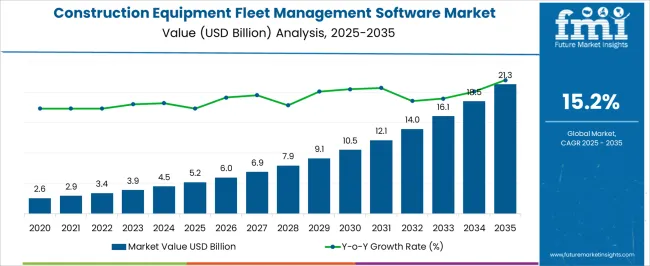
The construction equipment fleet management software market was valued at USD 5.2 billion in 2025, projected to reach USD 5.99 billion in 2026, and is forecast to expand to USD 24.66 billion by 2036 at a 15.2% CAGR. Demand is accelerating as construction fleet operators face rising fuel costs and tighter equipment utilization targets across multi-site projects. Telematics integration mandates from large general contractors are forcing subcontractors to adopt real-time GPS tracking and engine diagnostics platforms as a condition of project participation. Cloud-based deployment is displacing legacy on-premise installations as construction firms operating across multiple jurisdictions require centralized fleet visibility without dedicated server infrastructure at each site. The convergence of equipment OEM proprietary data feeds with third-party fleet management platforms is creating integration complexity that favors vendors with pre-certified API connections to major machinery brands.
Summary of Construction Equipment Fleet Management Software Market
- Market Overview
- The construction equipment fleet management software market is valued at USD 5.2 billion in 2025 and is projected to reach USD 24.66 billion by 2036.
- The industry is expected to grow at a 15.2% CAGR from 2026 to 2036, creating an incremental opportunity of USD 18.67 billion.
- The market is a high-growth enterprise software category where procurement decisions are tied to fleet size thresholds, OEM telematics compatibility requirements, and multi-site project visibility mandates.
- Demand and Growth Drivers
- Demand is rising as construction fleet operators face rising fuel and maintenance costs that require real-time utilization tracking to meet project budget targets.
- Telematics integration mandates from general contractors are forcing subcontractors to adopt fleet management platforms as a condition of project participation.
- Cloud-based deployment is displacing legacy on-premise installations as firms operating across multiple jurisdictions require centralized fleet visibility.
- Among key countries, China at 20.5%, India at 19%, Germany at 17.5%, France at 16%, UK at 14.4%, USA at 12.9%, Brazil at 11.4%.
- Product and Segment View
- The market covers telematics, GPS tracking, engine diagnostics, and maintenance scheduling software platforms designed for construction equipment fleets.
- These platforms serve fleet managers, project directors, and equipment rental operators across construction, mining, and infrastructure sectors.
- Cloud-based leads by Deployment Model with 53.6% share in 2026, driven by multi-site project requirements for centralized fleet data access.
- Software leads by Software Component with 36.9% share in 2026.
- The scope includes fleet tracking, utilization monitoring, and maintenance management software, excluding standalone GPS navigation units and general enterprise asset management platforms.
- Geography and Competitive Outlook
- China and India are the fastest-growing markets due to rapid fleet expansion across greenfield infrastructure projects and government digitization mandates.
- Germany and USA sustain demand through fleet electrification monitoring and heavy civil optimization requirements.
- Competition is shaped by OEM telematics integration depth, multi-brand fleet compatibility, and cloud platform scalability, with key players including Caterpillar, John Deere, Komatsu, Trimble, Hitachi Construction Machinery, Volvo Construction Equipment, Samsara.
- Analyst Opinion at FMI
- Sudip saha, Principal Consultant at Future Market Insights, opines: 'As per FMI analysis, the construction equipment fleet management software market is entering a phase where procurement standardization and compliance-driven specification requirements define supplier qualification thresholds. Operations teams that delay platform and product selection decisions risk exclusion from major contract cycles where pre-qualification requirements tighten progressively.'
- Strategic Implications / Executive Takeaways
- Software providers must secure pre-certified API integrations with major equipment OEM telematics platforms to qualify for enterprise fleet contracts.
- Fleet operations directors should standardize fleet management platform requirements across all project sites to eliminate data fragmentation from incompatible systems.
- IT procurement teams must evaluate total cost of ownership across cloud, on-premise, and hybrid deployment models against projected fleet growth and multi-site expansion plans.
Construction Equipment Fleet Management Software Market Key Takeaways
| Metric | Details |
|---|---|
| Industry Size (2026) | USD 5.99 billion |
| Industry Value (2036) | USD 24.66 billion |
| CAGR (2026-2036) | 15.2% |
Source: Future Market Insights, 2026
All major markets reflect accelerated software deployment parameters. China leads the pace with a 20.5% CAGR as rapid construction fleet expansion across greenfield infrastructure projects creates concentrated demand for centralized tracking platforms. India follows at 19% driven by government-mandated equipment utilization reporting on public works contracts. Germany registers 17.5% growth anchored by fleet electrification monitoring requirements. USA maintains a 12.9% trajectory supported by heavy civil construction fleet optimization mandates. UK tracks at 14.4% and Brazil at 11.4% as fleet operators in both markets adopt telematics to manage dispersed equipment across expanding project portfolios.
Construction Equipment Fleet Management Software Market Definition
Construction Equipment Fleet Management Software Market encompasses telematics-enabled software platforms designed to track, monitor, and optimize construction equipment fleets across distributed project sites. These platforms aggregate GPS location data, engine diagnostic feeds, fuel consumption metrics, and maintenance scheduling parameters into centralized dashboards used by fleet managers and project directors. Procurement is tied to fleet size thresholds, OEM compatibility requirements, and contractor compliance mandates imposed by general contractors on multi-site projects.
Construction Equipment Fleet Management Software Market Inclusions
Market scope includes cloud-based, on-premise, and hybrid fleet management software platforms covering GPS tracking, telematics integration, engine diagnostics, maintenance scheduling, and utilization analytics for construction equipment. Coverage spans global and regional market sizes, the 2026 to 2036 forecast period, and segment breakdowns by deployment model, software component, and region.
Construction Equipment Fleet Management Software Market Exclusions
The scope excludes standalone GPS navigation devices, general enterprise asset management platforms not configured for construction equipment, and consumer vehicle fleet tracking systems. It also omits hardware-only telematics units sold without accompanying software subscriptions.
Construction Equipment Fleet Management Software Market Research Methodology
- Primary Research: Analysts conducted structured interviews with procurement directors, system integrators, and end-use operators to map decision gates and specification requirements in the construction equipment fleet management software market.
- Desk Research: Data collection aggregated regulatory filings, industry standards updates, trade association reports, and publicly available corporate disclosures relevant to the construction equipment fleet management software sector.
- Market-Sizing and Forecasting: Baseline values derive from a bottom-up aggregation of procurement volumes and contract values, applying region-specific adoption curves to project future demand trajectories.
- Data Validation and Update Cycle: Projections are tested against publicly reported capital expenditure guidance and procurement records from major end-use operators.
Why is the Construction Equipment Fleet Management Software Market Growing?
The construction equipment fleet management software market is experiencing steady growth due to the increasing need for operational efficiency, cost control, and predictive maintenance across large-scale construction operations. Rising labor costs, tight project timelines, and the growing complexity of equipment logistics are pushing contractors and construction firms to adopt advanced digital fleet management solutions. These platforms enable real-time tracking, remote diagnostics, and data-driven decision-making, thereby reducing downtime and improving asset utilization.
The growing trend of digitization in construction, coupled with the integration of telematics and IoT-based systems, is expanding the scope and capabilities of fleet management platforms. Regulatory requirements related to emissions, safety compliance, and asset tracking are further contributing to market expansion.
As construction companies continue to scale operations across multiple geographies, centralized software tools are gaining favor for streamlining logistics, reducing fuel consumption, and improving workforce coordination. With rapid infrastructure development in emerging economies and increasing investment in automation, the demand for intelligent, software-driven fleet management tools is expected to remain strong in the years ahead.
Segmental Analysis
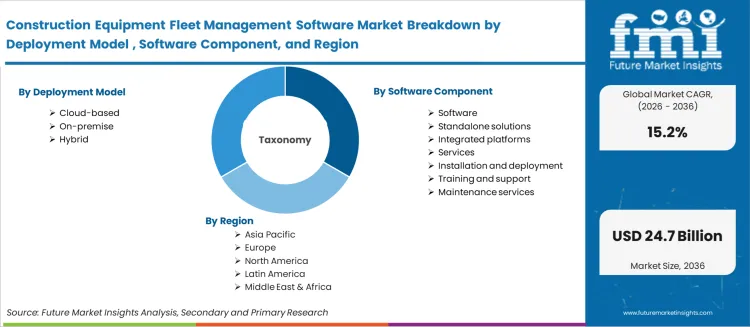
The construction equipment fleet management software market is segmented by component, deployment model, functionality, end user, and geographic regions. By component, construction equipment fleet management software market is divided into Software, Standalone solutions, Integrated platforms, Services, Installation and deployment, Training and support, and Maintenance services. In terms of deployment model, construction equipment fleet management software market is classified into Cloud-based, On-premise, and Hybrid. Based on functionality, construction equipment fleet management software market is segmented into Equipment tracking and monitoring, Maintenance and repair management, Fuel management, Compliance management, and Performance analysis and reporting. By functionality, construction equipment fleet management software market is segmented into Equipment tracking and monitoring, Maintenance and repair management, Fuel management, Compliance management, and Performance analysis and reporting. By end user, construction equipment fleet management software market is segmented into Construction contractors, Equipment rental companies, and Infrastructure development firms. Regionally, the construction equipment fleet management software industry is classified into North America, Latin America, Western Europe, Eastern Europe, Balkan & Baltic Countries, Russia & Belarus, Central Asia, East Asia, South Asia & Pacific, and the Middle East & Africa.
Insights into the Software Component Segment
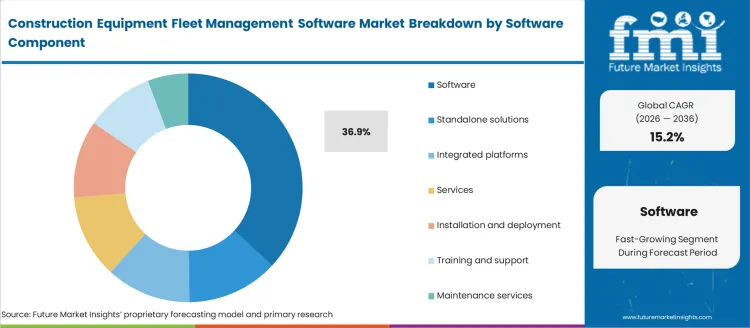
The software component segment is projected to hold 36.9% of the construction equipment fleet management software market revenue share in 2025, making it the leading component. This dominance is being driven by the central role software plays in enabling core functionalities such as real-time tracking, asset performance analysis, predictive maintenance scheduling, and compliance reporting. Construction firms are increasingly investing in digital solutions to manage growing equipment inventories and optimize fleet operations across diverse project sites.
Software platforms offer configurable dashboards, automated alerts, and integration with GPS, fuel sensors, and engine diagnostics, which enhance operational visibility and control. The ability to generate actionable insights from historical and real-time data enables faster decision-making and minimizes equipment downtime.
Vendors are also offering modular platforms that allow construction firms to scale capabilities as operational needs evolve. As the industry moves toward digital-first operations, the reliance on software as the backbone of fleet intelligence is expected to intensify, reinforcing the segment’s leadership in the market.
Insights into the Cloud-based Deployment Model Segment
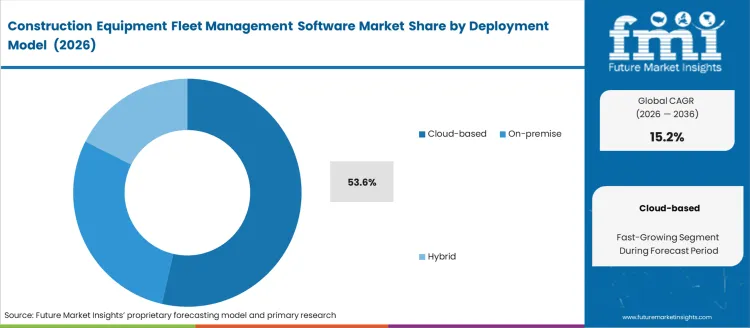
The cloud-based deployment model segment is expected to account for 53.6% of the construction equipment fleet management software market revenue share in 2025, establishing it as the leading deployment model. This dominance is attributed to the flexibility, scalability, and cost-efficiency offered by cloud-based platforms, which are increasingly preferred by both large and mid-sized construction firms. These solutions eliminate the need for on-premise infrastructure, allowing for faster implementation and easier access across geographically dispersed job sites.
Cloud-based platforms enable real-time data synchronization, mobile accessibility, and remote updates, supporting seamless coordination across operations. Additionally, enhanced data security protocols, automated backups, and vendor-managed updates are reducing IT overhead and improving reliability.
Construction companies are recognizing the value of cloud systems in managing multi-location fleets and responding quickly to field conditions. As demand grows for always-connected, scalable, and collaborative software environments, the cloud-based model is expected to maintain its lead, driven by widespread adoption and continuous vendor innovation.
Insights into the Equipment Tracking and Monitoring Functionality Segment
The equipment tracking and monitoring functionality segment is anticipated to capture 29.6% of the construction equipment fleet management software market revenue share in 2025, positioning it as the leading functionality. Its dominance is being driven by the critical need to monitor equipment usage, location, engine hours, and performance metrics in real time to improve productivity and reduce losses from theft or misuse. This functionality is essential for maintaining control over costly assets, especially in large-scale or multi-site construction operations.
The ability to receive live updates on idle time, fuel consumption, maintenance needs, and geofence breaches enhances both operational efficiency and cost savings. Construction firms are increasingly deploying GPS-based solutions and IoT-enabled sensors that transmit data to centralized software platforms for actionable insights.
As competitive pressure mounts to reduce project delays and operating expenses, the value of real-time equipment visibility and control is becoming a core component of modern fleet management strategies. The continued focus on data-driven operations and return on investment is expected to keep this functionality at the forefront of market demand.
What are the Drivers, Restraints, and Key Trends of the Construction Equipment Fleet Management Software Market?
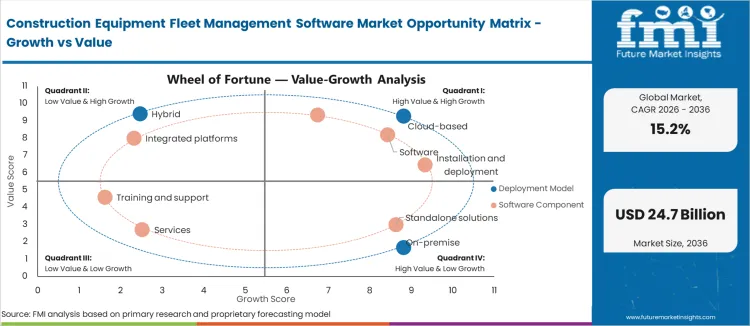
The market is driven by the increasing demand for real-time monitoring and digitalization in heavy equipment operations. Contractors and rental companies are prioritizing cost efficiency, asset utilization, and operational transparency, which enhances reliance on advanced fleet management platforms. These solutions offer data-driven insights to optimize equipment scheduling, fuel consumption, predictive maintenance, and regulatory compliance. Integration with telematics and IoT devices has further strengthened functionality, enabling accurate tracking and automated reporting. Market growth is reinforced by rising infrastructure investments worldwide, which generate the need for effective equipment allocation and downtime reduction.
Role of Telematics and Data Analytics Integration
Telematics integration is a major driver for fleet management software in construction equipment operations. Through GPS tracking, sensor monitoring, and telematics units, real-time information is gathered on equipment performance, fuel usage, and location data. This data is analyzed using advanced software platforms to improve operational efficiency and extend equipment life cycles. Predictive maintenance powered by analytics helps reduce unexpected breakdowns, lowering repair costs and downtime. Contractors gain visibility into fleet operations, ensuring that resources are utilized effectively across different projects. Data-driven decision-making, supported by telematics-enabled software, has become a standard requirement for companies seeking to stay competitive. The emphasis on analytics-driven fleet optimization continues to push adoption globally, particularly in large-scale infrastructure projects.
Importance of Cost Control and Maintenance Optimization
Construction companies increasingly focus on reducing ownership and operational costs for heavy machinery, making fleet management software crucial for long-term profitability. Preventive and predictive maintenance functions enable proactive scheduling, reducing repair expenses and extending equipment service life. Fuel management tools integrated into software platforms help monitor consumption patterns and detect inefficiencies, allowing savings in large fleets. Cost control is further supported by detailed reporting and insights into idle time, operator efficiency, and asset allocation. By reducing unnecessary downtime and unplanned repairs, businesses achieve consistent productivity gains. The shift toward software-based fleet optimization is reinforced by contractors seeking to protect margins in competitive infrastructure and construction markets, making maintenance-focused digital solutions essential.
Cloud Platforms and Mobile Application Expansion
The adoption of cloud-based fleet management software solutions has grown as construction companies require scalability, remote access, and integration with existing IT systems. Mobile applications provide field operators and managers with instant access to fleet data, enabling real-time decision-making at project sites. Cloud platforms lower upfront investment costs, making them accessible to small and mid-sized businesses in the construction industry. Updates and security features are seamlessly deployed, ensuring compliance with data protection standards. Mobile-based functionalities such as instant alerts, digital logs, and operator scheduling enhance productivity on construction sites. The ease of cloud and mobile deployment supports broader adoption globally, as businesses seek flexible and cost-effective solutions tailored to their operational needs.
Regional Dynamics and Competitive Landscape
Regional growth patterns reflect differences in construction activity and digital adoption rates. North America and Europe lead with early adoption of advanced telematics-enabled fleet solutions, driven by regulatory standards and emphasis on cost efficiency. Asia Pacific shows rapid expansion due to ongoing urban infrastructure projects and increasing awareness of fleet digitalization benefits. Market competition is characterized by technology partnerships, software customization, and integration with OEM systems. Companies are investing in artificial intelligence and machine learning to enhance predictive capabilities. Customer support and aftersales services also play a critical role in vendor differentiation. With continuous infrastructure development and rising pressure on equipment productivity, the market is expected to evolve with stronger regional adoption and technological innovation.
Analysis of Construction Equipment Fleet Management Software Market By Key Countries
.webp "Top Country Growth Comparison Construction Equipment Fleet Management Software Market Cagr (2026 2036)")
| Country | CAGR |
|---|---|
| China | 20.5% |
| India | 19.0% |
| Germany | 17.5% |
| France | 16.0% |
| UK | 14.4% |
| USA | 12.9% |
| Brazil | 11.4% |
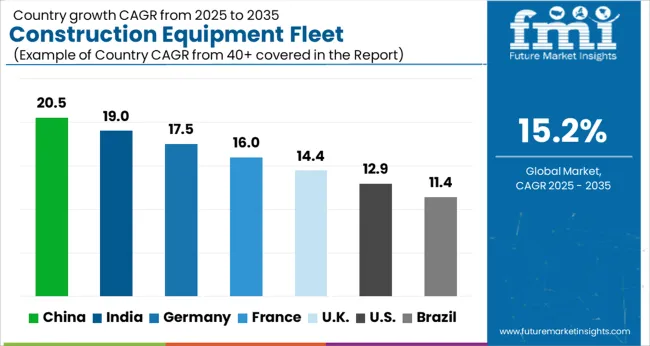
The market is forecast to register a CAGR of 15.2% from 2025 to 2035. India stood at 19.0%, supported by the adoption of digital fleet optimization tools and telematics in large-scale infrastructure projects. China led the market at 20.5%, driven by rapid construction activities and demand for predictive maintenance systems. Germany recorded 17.5%, where integration of IoT solutions has strengthened fleet tracking and utilization. The United Kingdom posted 14.4%, reflecting increased investment in cloud-based platforms for construction equipment monitoring. The United States accounted for 12.9%, where enhanced safety compliance and productivity tracking have reinforced adoption. These markets are advancing through deployment, scaling, and innovation in fleet management technologies. This report includes insights on 40+ countries; the top markets are shown here for reference.
Market Expansion of Construction Equipment Fleet Management Software in China
China is anticipated to grow at a CAGR of 20.5%, supported by rapid digitalization of construction operations and integration of telematics in heavy machinery. Government-backed infrastructure projects, smart city initiatives, and large-scale road and rail developments are driving software adoption. Domestic software providers are focusing on analytics-driven solutions, while international players are partnering with equipment manufacturers to enhance fleet performance. The push for reducing downtime and improving machine utilization has accelerated demand across public and private construction firms.
- Over 60% of major contractors in China adopted fleet management platforms in 2023.
- Infrastructure accounted for nearly 50% of the software demand within the market.
- Local providers expanded offerings in predictive maintenance and real-time asset tracking modules.
Growth Outlook of Construction Equipment Fleet Management Software in India
India is expected to record a CAGR of 19.0%, driven by ongoing infrastructure expansion, metro rail projects, and increasing mechanization in construction. Contractors and equipment rental companies are shifting toward centralized fleet monitoring to reduce operational costs. Cloud-based solutions are gaining prominence, enabling small and mid-sized enterprises to access advanced features at affordable rates. Compliance requirements on emissions and safety standards also strengthen the role of fleet monitoring software in project efficiency.
- Nearly 40% of fleet owners in India shifted to telematics-enabled solutions in 2023.
- Rental companies contributed to more than 30% of demand for software-driven asset tracking.
- Government highway and metro projects were among the top adopters of digital fleet systems.
Adoption Trends of Construction Equipment Fleet Management Software in Germany
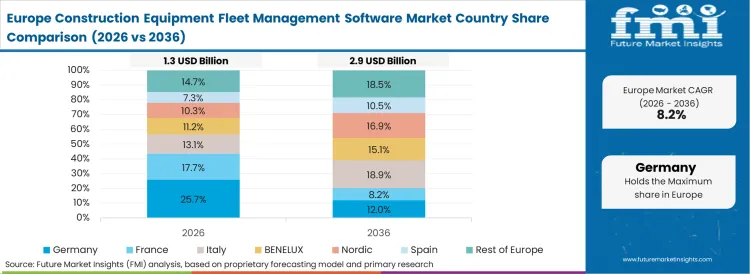
Germany, projected to grow at a CAGR of 17.5%, showcases strong adoption due to emphasis on precision, efficiency, and regulatory compliance in construction projects. German contractors prioritize advanced analytics, automated reporting, and integration with enterprise resource planning systems. Sustainability-driven regulations are encouraging digital solutions that reduce idle time and fuel usage. Established technology players are collaborating with machinery manufacturers to create highly customized fleet solutions.
- More than 55% of leading construction firms in Germany used advanced fleet software by 2023.
- Integration with ERP systems represented a major trend in fleet management adoption.
- Public infrastructure and renewable energy projects accounted for a large share of demand.
Future Prospects of Construction Equipment Fleet Management Software in the United Kingdom
The United Kingdom is forecast to expand at a CAGR of 14.4%, influenced by urban redevelopment, housing projects, and government-funded infrastructure upgrades. Adoption is shaped by rising emphasis on cost control, compliance, and sustainability. Fleet management platforms are being used to track equipment health, improve scheduling, and ensure compliance with evolving environmental standards. Cloud-driven solutions and mobile accessibility are becoming increasingly vital for mid-tier construction firms.
- The UK reported adoption of fleet software in over 35% of medium-to-large contractors in 2023.
- Mobile-driven monitoring systems accounted for nearly 40% of new deployments.
- Public infrastructure investment programs accelerated software penetration across projects.
Market Growth of Construction Equipment Fleet Management Software in the United States
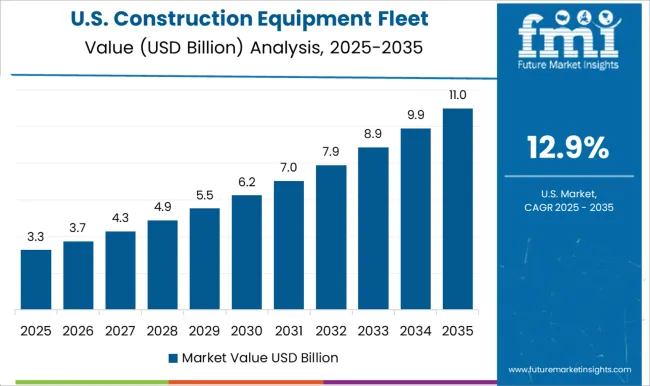
The United States, growing at a CAGR of 12.9%, benefits from strong demand in large-scale infrastructure, mining, and commercial projects. Rising focus on predictive maintenance, compliance reporting, and downtime reduction has enhanced the role of fleet software. Contractors emphasize real-time monitoring to optimize utilization of expensive machinery. Domestic software vendors are prioritizing integration with telematics hardware and cloud solutions, while partnerships with OEMs ensure seamless adoption across equipment categories.
- More than 50% of large contractors in the US deployed fleet monitoring software by 2023.
- Mining and road construction projects represented nearly 45% of new installations.
- Vendors focused on predictive analytics modules to support proactive maintenance strategies.
Competitive Landscape of Construction Equipment Fleet Management Software Market
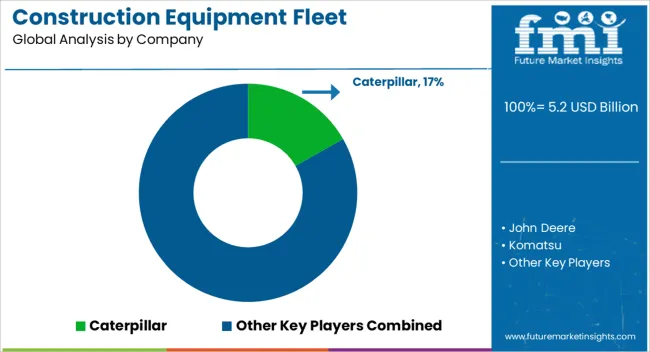
The market is highly competitive, dominated by a blend of global construction equipment manufacturers and specialized software providers, each focusing on operational efficiency, safety, and connectivity. Caterpillar, John Deere, Komatsu, Hitachi Construction Machinery, and Volvo Construction Equipment leverage their heavy equipment expertise and telematics integration capabilities, offering proprietary fleet management solutions tightly coupled with their machinery. These OEM-linked platforms benefit from seamless hardware-software interoperability, predictive maintenance features, and real-time performance analytics, making them preferred choices for large-scale construction operations. Software-focused companies such as Trimble, Topcon Positioning Systems, Teletrac Navman, Samsara, and Zebra Technologies emphasize versatility, cloud-based monitoring, and cross-brand fleet compatibility. These providers differentiate themselves through advanced analytics, GPS tracking, fuel consumption optimization, and IoT-enabled reporting systems, enabling construction firms to manage heterogeneous fleets efficiently.
Trimble and Topcon also integrate positioning and geospatial technologies, enhancing project planning and asset utilization insights. Competitive strategies across the market focus on automation, predictive maintenance, and cost reduction. OEMs aim to strengthen customer loyalty through equipment-software ecosystems, while independent providers prioritize interoperability and advanced data analytics. Increasing adoption of telematics, AI-driven decision-making, and regulatory compliance solutions is expected to drive differentiation, encouraging vendors to continuously enhance platform capabilities to capture market share in an increasingly digital construction landscape.
Key Players in the Construction Equipment Fleet Management Software Market
- Caterpillar
- John Deere
- Komatsu
- Trimble
- Hitachi Construction Machinery
- Volvo Construction Equipment
- Samsara
- Topcon Positioning Systems
- Teletrac Navman
- Zebra Technologies
Scope of the Report
| Metric | Value |
|---|---|
| Quantitative Units | USD 5.99 billion to USD 24.66 billion, at a CAGR of 15.2% |
| Market Definition | Construction equipment fleet management software covers telematics-enabled platforms that track, monitor, and optimize construction machinery across project sites through GPS tracking, engine diagnostics, and maintenance scheduling. |
| Segmentation | Deployment Model: Cloud-based, On-premise, Hybrid; Software Component: Software, Standalone solutions, Integrated platforms, Services, Installation and deployment, Training and support, Maintenance services |
| Regions Covered | North America, Latin America, Europe, East Asia, South Asia, Oceania, Middle East & Africa |
| Countries Covered | China, India, Germany, France, UK, USA, Brazil, and 40 plus countries |
| Key Companies Profiled | Caterpillar, John Deere, Komatsu, Trimble, Hitachi Construction Machinery, Volvo Construction Equipment, Samsara, Topcon Positioning Systems |
| Forecast Period | 2026 to 2036 |
| Approach | Forecasting models apply a bottom-up methodology starting with global installed base metrics and cross-validate projections against quarterly procurement and capital expenditure records. |
Construction Equipment Fleet Management Software Market by Segments
Component:
- Software
- Standalone solutions
- Integrated platforms
- Services
- Installation and deployment
- Training and support
- Maintenance services
Deployment Model:
- Cloud-based
- On-premise
- Hybrid
Functionality:
- Equipment tracking and monitoring
- Maintenance and repair management
- Fuel management
- Compliance management
- Performance analysis and reporting
Functionality:
- Equipment tracking and monitoring
- Maintenance and repair management
- Fuel management
- Compliance management
- Performance analysis and reporting
End User:
- Construction contractors
- Equipment rental companies
- Infrastructure development firms
Region:
- North America
- USA
- Canada
- Mexico
- Latin America
- Brazil
- Chile
- Rest of Latin America
- Western Europe
- Germany
- UK
- Italy
- Spain
- France
- Nordic
- BENELUX
- Rest of Western Europe
- Eastern Europe
- Russia
- Poland
- Hungary
- Balkan & Baltic
- Rest of Eastern Europe
- East Asia
- China
- Japan
- South Korea
- South Asia and Pacific
- India
- ASEAN
- Australia & New Zealand
- Rest of South Asia and Pacific
- Middle East & Africa
- Kingdom of Saudi Arabia
- Other GCC Countries
- Turkiye
- South Africa
- Other African Union
- Rest of Middle East & Africa
Bibliography
- 1. International Organization for Standardization. (2024). ISO 15143-3: Earthmoving Machinery, Worksite Data Exchange. ISO.
- 2. Organisation for Economic Co-operation and Development. (2025). Infrastructure Investment and Digital Construction. OECD.
- 3. European Commission. (2024). EU Construction Equipment Type-Approval Framework Update. European Commission.
- 4. World Bank Group. (2024). Digital Infrastructure for Development: Construction Sector Assessment. World Bank.
- 5. United States Department of Transportation. (2025). Connected Equipment Standards for Highway Construction Projects. USDOT.
This bibliography is provided for reader reference. The full Future Market Insights report contains the complete reference list with primary research documentation.
Frequently Asked Questions
How large is the demand for Construction Equipment Fleet Management Software in the global market in 2026?
Demand for Construction Equipment Fleet Management Software in the global market is estimated to be valued at USD 5.99 billion in 2026.
What will be the market size of Construction Equipment Fleet Management Software in the global market by 2036?
Market size for Construction Equipment Fleet Management Software is projected to reach USD 24.66 billion by 2036.
What is the expected demand growth for Construction Equipment Fleet Management Software in the global market between 2026 and 2036?
Demand for Construction Equipment Fleet Management Software is expected to grow at a CAGR of 15.2% between 2026 and 2036.
Which Deployment Model is poised to lead global sales by 2026?
Cloud-based accounts for 53.6% share in 2026 based on FMI analysis.
How is the role of Software in driving Construction Equipment Fleet Management Software adoption in 2026?
Software represents 36.9% of segment share in 2026 as per FMI's construction equipment fleet management software market report.
What is the fastest-growing country market in this report?
China is projected to grow at a CAGR of 20.5% during 2026 to 2036.
What is Construction Equipment Fleet Management Software and what is it mainly used for?
Construction equipment fleet management software covers telematics-enabled platforms that track, monitor, and optimize construction machinery across project sites through GPS tracking, engine diagnostics, and maintenance scheduling.
What is included in the scope of this Construction Equipment Fleet Management Software report?
The market covers cloud-based, on-premise, and hybrid fleet management platforms with GPS tracking, telematics, and maintenance scheduling modules.
Preview the report firsthand - request a free sample
Get SampleGet the brochure for pricing and purchase details.
Get PDFTable of Content
- Executive Summary
- Global Market Outlook
- Demand-side Trends
- Supply-side Trends
- Technology Roadmap Analysis
- Analysis and Recommendations
- Market Overview
- Market Coverage / Taxonomy
- Market Definition / Scope / Limitations
- Research Methodology
- Chapter Orientation
- Analytical Lens and Working Hypotheses
- Market Structure, Signals, and Trend Drivers
- Company Annual and Sustainability Reports
- Peer-reviewed Journals and Academic Literature
- Corporate Websites, Product Literature, and Technical Notes
- Earnings Decks and Investor Briefings
- Statutory Filings and Regulatory Disclosures
- Technical White Papers and Standards Notes
- Trade Journals, Industry Magazines, and Analyst Briefs
- Conference Proceedings, Webinars, and Seminar Materials
- Government Statistics Portals and Public Data Releases
- Press Releases and Reputable Media Coverage
- Specialist Newsletters and Curated Briefings
- Sector Databases and Reference Repositories
- FMI Internal Proprietary Databases and Historical Market Datasets
- Subscription Datasets and Paid Sources
- Social Channels, Communities, and Digital Listening Inputs
- Additional Desk Sources
- Expert Input and Fieldwork (Primary Evidence)
- Primary Modes
- Qualitative Interviews and Expert Elicitation
- Quantitative Surveys and Structured Data Capture
- Blended Approach
- Why Primary Evidence is Used
- Field Techniques
- Interviews
- Surveys
- Focus Groups
- Observational and In-context Research
- Social and Community Interactions
- Stakeholder Universe Engaged
- C-suite Leaders
- Board Members
- Presidents and Vice Presidents
- R&D and Innovation Heads
- Technical Specialists
- Domain Subject-matter Experts
- Scientists
- Physicians and Other Healthcare Professionals
- Governance, Ethics, and Data Stewardship
- Research Ethics
- Data Integrity and Handling
- Primary Modes
- Tooling, Models, and Reference Databases
- Data Engineering and Model Build
- Data Acquisition and Ingestion
- Cleaning, Normalisation, and Verification
- Synthesis, Triangulation, and Analysis
- Quality Assurance and Audit Trail
- Market Background
- Market Dynamics
- Drivers
- Restraints
- Opportunity
- Trends
- Scenario Forecast
- Demand in Optimistic Scenario
- Demand in Likely Scenario
- Demand in Conservative Scenario
- Opportunity Map Analysis
- Product Life Cycle Analysis
- Supply Chain Analysis
- Investment Feasibility Matrix
- Value Chain Analysis
- PESTLE and Porter’s Analysis
- Regulatory Landscape
- Regional Parent Market Outlook
- Production and Consumption Statistics
- Import and Export Statistics
- Market Dynamics
- Global Market Analysis 2021 to 2025 and Forecast, 2026 to 2036
- Historical Market Size Value (USD Million) Analysis, 2021 to 2025
- Current and Future Market Size Value (USD Million) Projections, 2026 to 2036
- Y-o-Y Growth Trend Analysis
- Absolute $ Opportunity Analysis
- Global Market Pricing Analysis 2021 to 2025 and Forecast 2026 to 2036
- Global Market Analysis 2021 to 2025 and Forecast 2026 to 2036, By Deployment Model
- Introduction / Key Findings
- Historical Market Size Value (USD Million) Analysis By Deployment Model , 2021 to 2025
- Current and Future Market Size Value (USD Million) Analysis and Forecast By Deployment Model , 2026 to 2036
- Cloud-based
- On-premise
- Hybrid
- Cloud-based
- Y-o-Y Growth Trend Analysis By Deployment Model , 2021 to 2025
- Absolute $ Opportunity Analysis By Deployment Model , 2026 to 2036
- Global Market Analysis 2021 to 2025 and Forecast 2026 to 2036, By Software Component
- Introduction / Key Findings
- Historical Market Size Value (USD Million) Analysis By Software Component, 2021 to 2025
- Current and Future Market Size Value (USD Million) Analysis and Forecast By Software Component, 2026 to 2036
- Software
- Standalone solutions
- Integrated platforms
- Services
- Installation and deployment
- Training and support
- Maintenance services
- Software
- Y-o-Y Growth Trend Analysis By Software Component, 2021 to 2025
- Absolute $ Opportunity Analysis By Software Component, 2026 to 2036
- Global Market Analysis 2021 to 2025 and Forecast 2026 to 2036, By Region
- Introduction
- Historical Market Size Value (USD Million) Analysis By Region, 2021 to 2025
- Current Market Size Value (USD Million) Analysis and Forecast By Region, 2026 to 2036
- North America
- Latin America
- Western Europe
- Eastern Europe
- East Asia
- South Asia and Pacific
- Middle East & Africa
- Market Attractiveness Analysis By Region
- North America Market Analysis 2021 to 2025 and Forecast 2026 to 2036, By Country
- Historical Market Size Value (USD Million) Trend Analysis By Market Taxonomy, 2021 to 2025
- Market Size Value (USD Million) Forecast By Market Taxonomy, 2026 to 2036
- By Country
- USA
- Canada
- Mexico
- By Deployment Model
- By Software Component
- By Country
- Market Attractiveness Analysis
- By Country
- By Deployment Model
- By Software Component
- Key Takeaways
- Latin America Market Analysis 2021 to 2025 and Forecast 2026 to 2036, By Country
- Historical Market Size Value (USD Million) Trend Analysis By Market Taxonomy, 2021 to 2025
- Market Size Value (USD Million) Forecast By Market Taxonomy, 2026 to 2036
- By Country
- Brazil
- Chile
- Rest of Latin America
- By Deployment Model
- By Software Component
- By Country
- Market Attractiveness Analysis
- By Country
- By Deployment Model
- By Software Component
- Key Takeaways
- Western Europe Market Analysis 2021 to 2025 and Forecast 2026 to 2036, By Country
- Historical Market Size Value (USD Million) Trend Analysis By Market Taxonomy, 2021 to 2025
- Market Size Value (USD Million) Forecast By Market Taxonomy, 2026 to 2036
- By Country
- Germany
- UK
- Italy
- Spain
- France
- Nordic
- BENELUX
- Rest of Western Europe
- By Deployment Model
- By Software Component
- By Country
- Market Attractiveness Analysis
- By Country
- By Deployment Model
- By Software Component
- Key Takeaways
- Eastern Europe Market Analysis 2021 to 2025 and Forecast 2026 to 2036, By Country
- Historical Market Size Value (USD Million) Trend Analysis By Market Taxonomy, 2021 to 2025
- Market Size Value (USD Million) Forecast By Market Taxonomy, 2026 to 2036
- By Country
- Russia
- Poland
- Hungary
- Balkan & Baltic
- Rest of Eastern Europe
- By Deployment Model
- By Software Component
- By Country
- Market Attractiveness Analysis
- By Country
- By Deployment Model
- By Software Component
- Key Takeaways
- East Asia Market Analysis 2021 to 2025 and Forecast 2026 to 2036, By Country
- Historical Market Size Value (USD Million) Trend Analysis By Market Taxonomy, 2021 to 2025
- Market Size Value (USD Million) Forecast By Market Taxonomy, 2026 to 2036
- By Country
- China
- Japan
- South Korea
- By Deployment Model
- By Software Component
- By Country
- Market Attractiveness Analysis
- By Country
- By Deployment Model
- By Software Component
- Key Takeaways
- South Asia and Pacific Market Analysis 2021 to 2025 and Forecast 2026 to 2036, By Country
- Historical Market Size Value (USD Million) Trend Analysis By Market Taxonomy, 2021 to 2025
- Market Size Value (USD Million) Forecast By Market Taxonomy, 2026 to 2036
- By Country
- India
- ASEAN
- Australia & New Zealand
- Rest of South Asia and Pacific
- By Deployment Model
- By Software Component
- By Country
- Market Attractiveness Analysis
- By Country
- By Deployment Model
- By Software Component
- Key Takeaways
- Middle East & Africa Market Analysis 2021 to 2025 and Forecast 2026 to 2036, By Country
- Historical Market Size Value (USD Million) Trend Analysis By Market Taxonomy, 2021 to 2025
- Market Size Value (USD Million) Forecast By Market Taxonomy, 2026 to 2036
- By Country
- Kingdom of Saudi Arabia
- Other GCC Countries
- Turkiye
- South Africa
- Other African Union
- Rest of Middle East & Africa
- By Deployment Model
- By Software Component
- By Country
- Market Attractiveness Analysis
- By Country
- By Deployment Model
- By Software Component
- Key Takeaways
- Key Countries Market Analysis
- USA
- Pricing Analysis
- Market Share Analysis, 2025
- By Deployment Model
- By Software Component
- Canada
- Pricing Analysis
- Market Share Analysis, 2025
- By Deployment Model
- By Software Component
- Mexico
- Pricing Analysis
- Market Share Analysis, 2025
- By Deployment Model
- By Software Component
- Brazil
- Pricing Analysis
- Market Share Analysis, 2025
- By Deployment Model
- By Software Component
- Chile
- Pricing Analysis
- Market Share Analysis, 2025
- By Deployment Model
- By Software Component
- Germany
- Pricing Analysis
- Market Share Analysis, 2025
- By Deployment Model
- By Software Component
- UK
- Pricing Analysis
- Market Share Analysis, 2025
- By Deployment Model
- By Software Component
- Italy
- Pricing Analysis
- Market Share Analysis, 2025
- By Deployment Model
- By Software Component
- Spain
- Pricing Analysis
- Market Share Analysis, 2025
- By Deployment Model
- By Software Component
- France
- Pricing Analysis
- Market Share Analysis, 2025
- By Deployment Model
- By Software Component
- India
- Pricing Analysis
- Market Share Analysis, 2025
- By Deployment Model
- By Software Component
- ASEAN
- Pricing Analysis
- Market Share Analysis, 2025
- By Deployment Model
- By Software Component
- Australia & New Zealand
- Pricing Analysis
- Market Share Analysis, 2025
- By Deployment Model
- By Software Component
- China
- Pricing Analysis
- Market Share Analysis, 2025
- By Deployment Model
- By Software Component
- Japan
- Pricing Analysis
- Market Share Analysis, 2025
- By Deployment Model
- By Software Component
- South Korea
- Pricing Analysis
- Market Share Analysis, 2025
- By Deployment Model
- By Software Component
- Russia
- Pricing Analysis
- Market Share Analysis, 2025
- By Deployment Model
- By Software Component
- Poland
- Pricing Analysis
- Market Share Analysis, 2025
- By Deployment Model
- By Software Component
- Hungary
- Pricing Analysis
- Market Share Analysis, 2025
- By Deployment Model
- By Software Component
- Kingdom of Saudi Arabia
- Pricing Analysis
- Market Share Analysis, 2025
- By Deployment Model
- By Software Component
- Turkiye
- Pricing Analysis
- Market Share Analysis, 2025
- By Deployment Model
- By Software Component
- South Africa
- Pricing Analysis
- Market Share Analysis, 2025
- By Deployment Model
- By Software Component
- USA
- Market Structure Analysis
- Competition Dashboard
- Competition Benchmarking
- Market Share Analysis of Top Players
- By Regional
- By Deployment Model
- By Software Component
- Competition Analysis
- Competition Deep Dive
- Caterpillar
- Overview
- Product Portfolio
- Profitability by Market Segments (Product/Age /Sales Channel/Region)
- Sales Footprint
- Strategy Overview
- Marketing Strategy
- Product Strategy
- Channel Strategy
- John Deere
- Komatsu
- Trimble
- Hitachi Construction Machinery
- Volvo Construction Equipment
- Samsara
- Topcon Positioning Systems
- Teletrac Navman
- Zebra Technologies
- Caterpillar
- Competition Deep Dive
- Assumptions & Acronyms Used


