


Computerized Maintenance Management Systems (CMMS) Market : Global Industry Analysis 2016 - 2025 and Opportunity Assessment 2026 - 2036
Computerized Maintenance Management Systems (CMMS) Market Size and Share Forecast Outlook 2026 to 2036
Historical Data Covered: 2016 - 2025 | Base Year: 2025 | Estimated Year: 2026 | Forecast Period: 2026 - 2036
Computerized Maintenance Management Systems Market Forecast and Outlook 2026 to 2036
The computerized maintenance management systems market is projected to reach USD 2.4 billion by 2026 and expand to USD 5.9 billion by 2036, reflecting a 9.3% CAGR. Growth formation is increasingly tied to whether enterprises can convert asset maintenance from a reactive cost center into a governed operational discipline. Demand is clustering around organizations that require traceable work orders, auditable maintenance histories, and predictable uptime across distributed asset bases.
Summary of Computerized Maintenance Management Systems (CMMS) Market
- Market Overview
- The computerized maintenance management systems market is valued at USD 2.4 billion in 2026.
- The computerized maintenance management systems market is projected to reach USD 5.9 billion by 2036.
- The market is expanding at a CAGR of 9.3% during 2026 to 2036.
- Demand and Growth Drivers
- Enterprises are adopting CMMS to shift maintenance from reactive processes to governed and auditable workflows.
- Increasing regulatory and compliance requirements are driving demand for traceable maintenance histories.
- Integration with ERP and asset management systems is expanding CMMS usage across procurement and operations.
- Product and Segment View
- Software accounts for 56.0% of the solution segment due to its role in scheduling, reporting, and asset tracking.
- Small and medium enterprises hold 69.0% share driven by replacement of manual maintenance systems.
- The finance industry contributes 44.0% share supported by demand from data centers and critical infrastructure.
- Geography and Competitive Outlook
- India leads growth with a CAGR of 14.4% followed by China at 13.3% and the United States at 12.1%.
- Japan and Germany grow at 11.5% and 10.5% respectively driven by manufacturing and Industry 4.0 adoption.
- Key companies include IBM Maximo, SAP, Oracle, Infor, eMaint, Fiix, Limble CMMS, UpKeep, MPulse Software, and DIMO.
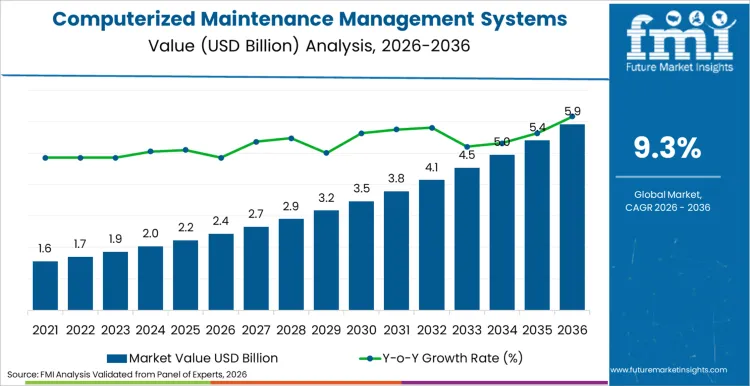
FMI opines that value creation is now driven by operational adoption depth rather than license volume alone. Buyers are prioritizing platforms that embed preventive scheduling, parts availability, technician accountability, and performance reporting into daily execution. Where CMMS is integrated into production, facilities, and infrastructure governance, recurring usage expands faster than new logo acquisition.
Key Industry Insights
| Technology and Operating Development | How it is reshaping CMMS conversion and scale |
|---|---|
| Sensor enabled asset monitoring integrated into maintenance workflows | Shifts maintenance from calendar driven to condition driven, increasing preventive task density and raising CMMS utilization per asset class. |
| ERP and maintenance system convergence in large enterprises | Expands CMMS footprint beyond engineering into finance and procurement, increasing module attach and contract values. |
| Mobile first technician execution platforms | Improves work order closure rates and data capture quality, strengthening system dependence in field heavy industries. |
| Public infrastructure digitization programs | Pull CMMS adoption into utilities and transport agencies where compliance reporting and auditability are mandatory. |
Source: Future Market Insights (FMI) analysis, based on proprietary forecasting model and primary research
Computerized Maintenance Management Systems Market Key Takeaways
| Metric | Value |
|---|---|
| Industry Size (2026) | USD 2.4 Billion |
| Industry Value (2036) | USD 5.9 Billion |
| CAGR (2026-2036) | 9.3% |
Source: Future Market Insights’ proprietary forecasting model and primary research
Why is the Computerized Maintenance Management Systems Market Expanding?
Expansion is reinforced by asset intensive enterprises seeking tighter control over uptime, compliance, and maintenance cost leakage. As asset bases scale and regulatory scrutiny increases, manual tracking and spreadsheet based maintenance planning are becoming operationally insufficient.
This shifts demand toward systems that can document every intervention and convert maintenance history into actionable performance metrics. Execution is often aligned with decision structures associated with enterprise asset management, particularly where maintenance governance must integrate with procurement, inventory, and capital planning.
Portfolio planning is frequently evaluated alongside frameworks associated with industrial automation, especially where machine utilization and production stability determine throughput economics. Renovation cycles are also being coordinated with digital operations strategies linked to manufacturing execution systems, particularly where maintenance discipline directly influences yield and scrap rates.
How is the Computerized Maintenance Management Systems Market Segmented?
The computerized maintenance management systems market is segmented by solution, enterprise size, and industry. Solution includes software and services. Enterprise size includes small and medium enterprises and large enterprises. Industry includes finance, manufacturing, distribution services, services, public sector, and infrastructure.
Why does Software Lead Solution Share?
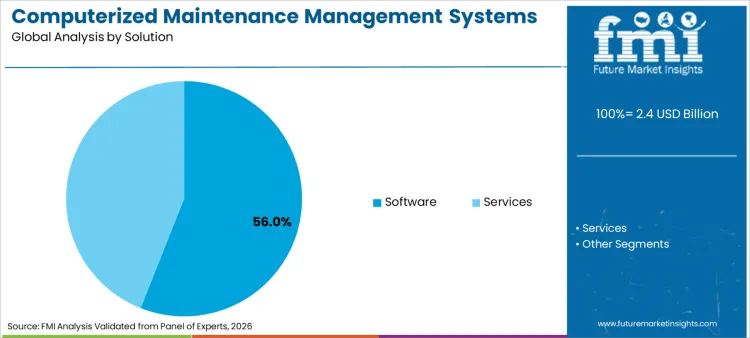
Software holds a 56.0% share because CMMS value is realized primarily through scheduling logic, asset hierarchies, reporting engines, and integration interfaces. This leadership strengthens where deployment planning is aligned with technology stacks associated with cloud computing, particularly where scalability and remote access drive adoption across multi site operations.
Why do Small and Medium Enterprises Dominate Enterprise Size Share?
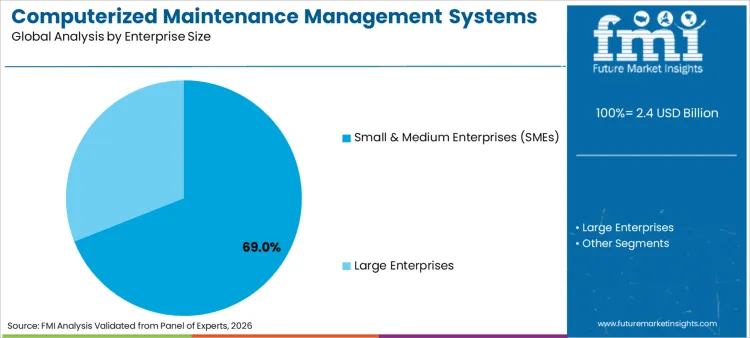
Small and medium enterprises account for 69.0% share because digital maintenance systems are replacing informal and paper based tracking in mid scale plants and facilities. This preference is reinforced where adoption is coordinated with operating models associated with cloud services, particularly where subscription pricing lowers entry barriers and accelerates time to value.
Why does Finance Lead Industry Share?
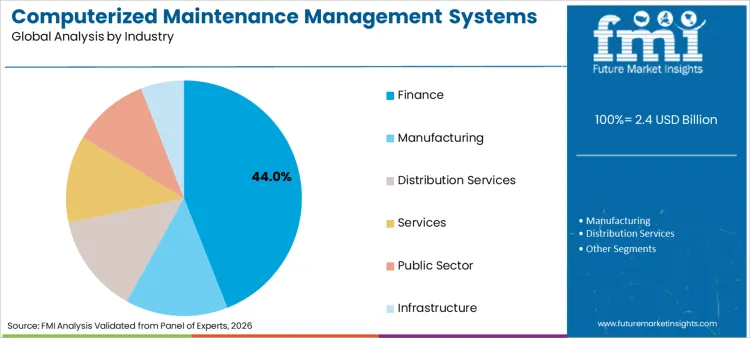
Finance holds 44.0% share as maintenance governance is increasingly critical in data centers, banking infrastructure, and mission critical facilities where downtime directly translates into revenue and compliance risk.
This pattern strengthens where uptime assurance is linked to risk management frameworks associated with data center infrastructure management, particularly where auditability and service continuity are regulated.
Which Dynamics will Influence the CMMS Market’s Trajectory in the Coming Decade?
A primary driver is the transition from reactive to predictive maintenance. As sensor data becomes more available, enterprises increasingly expect CMMS platforms to trigger work orders based on condition thresholds rather than time intervals. This raises the strategic value of analytics modules, integration connectors, and rule based automation inside maintenance platforms.
A second driver is the institutionalization of compliance reporting. Regulated industries are tightening documentation requirements around inspections, safety interventions, and equipment certification. CMMS systems that can produce audit ready maintenance histories gain preference in utilities, infrastructure, and public sector deployments.
Multi-site asset portfolios create demand for centralized governance. Enterprises with hundreds of facilities require standardized taxonomies, harmonized KPIs, and global visibility into maintenance performance. This opens space for enterprise grade CMMS platforms that combine configurability with governance control.
Key DROTs Table
| Attribute | Impact |
|---|---|
| Driver | Condition based workflows increase preventive task density and platform stickiness. |
| Audit and compliance reporting requirements raise the value of standardized maintenance histories. | |
| Restraint | Low digital maturity in smaller facilities delays full workflow adoption and data completeness. |
| Poor asset master data limits analytics accuracy and perceived ROI. | |
| Opportunity | Multi site governance creates demand for centralized maintenance control and KPI harmonization. |
| Mobile technician enablement expands daily transaction volume and improves closure discipline. | |
| Trend | Integration with ERP and production systems becomes a purchase criterion rather than an add on. |
Source: FMI analysis based on primary research and proprietary forecasting model
Interlink alignment is often evaluated alongside execution models associated with predictive maintenance, particularly where sensor signals must convert into governed work orders with clear accountability.
What is the Country Profile for the Computerized Maintenance Management Systems Landscape?
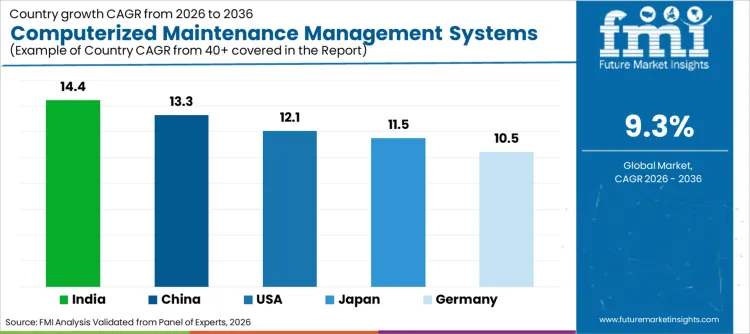
| Country | CAGR (2026-2036) |
|---|---|
| India | 14.4% |
| China | 13.3% |
| USA | 12.1% |
| Japan | 11.5% |
| Germany | 10.5% |
Source: Future Market Insights analysis, supported by a proprietary forecasting model and primary research
How are Industrial Digitization Programs and Brownfield Automation shaping India’s Trajectory?
India is projected to expand at a 14.4% CAGR, supported by digitization across manufacturing clusters and infrastructure operators. One trend is modernization of brownfield plants where CMMS replaces manual logbooks and spreadsheet tracking, which raises preventive compliance and reduces repeat breakdown cycles. Another trend is multi site rollouts in utilities and transport systems, where mobile execution improves closure discipline and makes performance reporting visible to central operations teams.
A second India specific shift is the growing preference for integrated stacks rather than stand alone tooling, especially in asset heavy groups that want maintenance data to influence procurement, spares policies, and contractor management. This pattern strengthens where operating blueprints are aligned with workflows associated with smart factory deployments that treat uptime as a measurable output KPI.
How do Smart Manufacturing Programs and State-led Infrastructure Upgrades define China’s growth?
China is expected to grow at a 13.3% CAGR, driven by factory digitalization and large scale infrastructure upgrades. One trend is tighter integration of maintenance platforms with production monitoring, which increases the value of standardized asset hierarchies and work order automation. Another trend is policy led digitization in public utilities, which elevates auditability and structured reporting as procurement requirements.
A second China trend is data driven uptime governance in large enterprise groups where maintenance becomes part of operational control. This intensifies demand for connected equipment data and harmonized KPIs, strengthening adoption patterns aligned with industrial IoT systems that feed condition signals into maintenance decision making.
How are asset heavy services and compliance discipline shaping the United States expansion path?
USA is projected to expand at a 12.1% CAGR, supported by asset heavy service sectors and compliance expectations in regulated facility operations. One trend is formalization of maintenance governance in finance, healthcare, and data center operations where downtime has direct revenue and risk implications. Another trend is the shift toward contract structures that tie services, training, and configuration to measurable uptime outcomes, which raises total contract value.
A second USA specific driver is enterprise convergence, where maintenance data is expected to flow into procurement and finance. This increases preference for platforms that integrate maintenance with broader business control systems aligned with enterprise resource planning software adoption programs.
How are Precision Manufacturing and Workforce Constraints influencing Japan’s Adoption Curve?
Japan is expected to grow at an 11.5% CAGR, shaped by precision manufacturing environments and an aging technical workforce. One trend is the use of CMMS to preserve institutional knowledge through standardized procedures, failure code libraries, and repeatable preventive routines. Another trend is higher emphasis on parts governance and planned downtime windows, which improves asset utilization stability.
A second Japan trend is decision automation, where work order triggers and escalation rules reduce dependence on scarce expert technicians. This reinforces demand for systems that can use equipment data to drive intervention logic and standardize responses.
How are Industry 4.0 Investments and Engineering Governance shaping Germany’s Pace?
Germany is projected to expand at a 10.5% CAGR, driven by Industry 4.0 investments and strong engineering governance. One trend is integration of maintenance planning with production scheduling to protect equipment utilization and throughput stability. Another trend is KPI standardization across multi plant networks, which favors configurable platforms that can enforce shared taxonomies and reporting.
A second Germany specific pattern is the emphasis on interoperability and integration readiness, where CMMS must connect to automation, MES, and enterprise systems without heavy custom work. This increases preference for vendors with mature connectors and disciplined master data frameworks.
What is the Competitive Outlook for the Computerized Maintenance Management Systems Market?
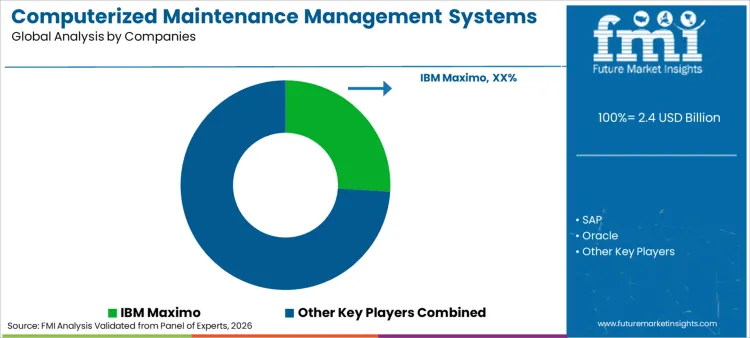
Competition is increasingly defined by who can embed maintenance into enterprise operations rather than who sells the most licenses. Three competitive levers are becoming decisive.
First, platform convergence is gaining weight. IBM Maximo, SAP, and Oracle win in environments where maintenance must connect with procurement, finance, and asset governance, which increases switching costs and deepens workflow dependence.
Second, mid market adoption is accelerating through simplified onboarding. Vendors such as Fiix, UpKeep, and Limble reduce implementation friction through mobile first execution, quick asset onboarding, and prescriptive workflow templates that raise time to value for SMEs.
Third, analytics driven differentiation is expanding. Infor and other suites are pushing performance modules that shift CMMS from record keeping to decision support, especially where leaders measure uptime impact by site, line, and asset class.
Execution is increasingly aligned with commercialization models associated with connected equipment ecosystems, particularly those tied to industrial IoT adoption where machine signals raise the value of condition based maintenance governance.
Key Players in Computerized Maintenance Management Systems Market
- IBM Maximo
- SAP
- Oracle
- Infor
- eMaint
- Fiix
- Limble CMMS
- UpKeep
- MPulse Software
- DIMO
Scope of Report
| Items | Values |
|---|---|
| Quantitative Units | USD Billion |
| Solution | Software; Services |
| Enterprise Size | Small & Medium Enterprises; Large Enterprises |
| Industry | Finance; Manufacturing; Distribution Services; Services; Public Sector; Infrastructure |
| Regions | North America, Latin America, Western Europe, Eastern Europe, East Asia, South Asia & Pacific, Middle East & Africa |
Computerized Maintenance Management Systems Market by Segments
Solution
- Software
- Services
Enterprise Size
- Small & Medium Enterprises
- Large Enterprises
Industry
- Finance
- Manufacturing
- Distribution Services
- Services
- Public Sector
- Infrastructure
Region
- North America
- Latin America
- Western Europe
- Eastern Europe
- East Asia
- South Asia & Pacific
- Middle East & Africa
Bibliography
- International Organization for Standardization. (2018). ISO 55000: Asset management-Overview, principles and terminology.
- International Organization for Standardization. (2014). ISO 55001: Asset management-Management systems-Requirements.
- International Organization for Standardization. (2019). ISO 14224: Petroleum, petrochemical and natural gas industries-Collection and exchange of reliability and maintenance data for equipment.
- International Electrotechnical Commission. (2020). IEC 62264: Enterprise control system integration.
- Organisation for Economic Co-operation and Development. (2020). Digital security risk management for economic and social prosperity.
- World Economic Forum. (2019). Unlocking business value through predictive maintenance.
- International Labour Organization. (2022). Safety and health management systems in industrial workplaces.
Frequently Asked Questions
What is the outlook for the Computerized Maintenance Management Systems (CMMS) Market in 2026?
The CMMS market is projected to total USD 2.4 billion in 2026.
What is the forecast for the CMMS Market in 2036?
By 2036, the market for CMMS is expected to reach USD 5.9 billion.
By Solution, Which Segment leads in the CMMS Market in 2026?
CMMS software is expected to lead with a 56.0% share in 2026.
Which Enterprise Category will account for the Dominant Share of CMMS?
Small and medium enterprises are expected to lead with a 69.0% share.
Which Industry Vertical leads in the CMMS Market?
By industry, the finance sector is expected to lead in the CMMS market with a 44.0% share.
Table of Content
- Executive Summary
- Global Market Outlook
- Demand-side Trends
- Supply-side Trends
- Technology Roadmap Analysis
- Analysis and Recommendations
- Market Overview
- Market Coverage / Taxonomy
- Market Definition / Scope / Limitations
- Market Background
- Market Dynamics
- Drivers
- Restraints
- Opportunity
- Trends
- Scenario Forecast
- Demand in Optimistic Scenario
- Demand in Likely Scenario
- Demand in Conservative Scenario
- Opportunity Map Analysis
- Product Life Cycle Analysis
- Supply Chain Analysis
- Investment Feasibility Matrix
- Value Chain Analysis
- PESTLE and Porter’s Analysis
- Regulatory Landscape
- Regional Parent Market Outlook
- Production and Consumption Statistics
- Import and Export Statistics
- Market Dynamics
- Global Market Analysis 2021 to 2025 and Forecast, 2026 to 2036
- Historical Market Size Value (USD Million) Analysis, 2021 to 2025
- Current and Future Market Size Value (USD Million) Projections, 2026 to 2036
- Y-o-Y Growth Trend Analysis
- Absolute $ Opportunity Analysis
- Global Market Pricing Analysis 2021 to 2025 and Forecast 2026 to 2036
- Global Market Analysis 2021 to 2025 and Forecast 2026 to 2036, By Solution
- Introduction / Key Findings
- Historical Market Size Value (USD Million) Analysis By Solution , 2021 to 2025
- Current and Future Market Size Value (USD Million) Analysis and Forecast By Solution , 2026 to 2036
- Software
- Services
- Software
- Y-o-Y Growth Trend Analysis By Solution , 2021 to 2025
- Absolute $ Opportunity Analysis By Solution , 2026 to 2036
- Global Market Analysis 2021 to 2025 and Forecast 2026 to 2036, By Enterprise Size
- Introduction / Key Findings
- Historical Market Size Value (USD Million) Analysis By Enterprise Size, 2021 to 2025
- Current and Future Market Size Value (USD Million) Analysis and Forecast By Enterprise Size, 2026 to 2036
- Small & Medium Enterprises (SMEs)
- Large Enterprises
- Small & Medium Enterprises (SMEs)
- Y-o-Y Growth Trend Analysis By Enterprise Size, 2021 to 2025
- Absolute $ Opportunity Analysis By Enterprise Size, 2026 to 2036
- Global Market Analysis 2021 to 2025 and Forecast 2026 to 2036, By Industry
- Introduction / Key Findings
- Historical Market Size Value (USD Million) Analysis By Industry, 2021 to 2025
- Current and Future Market Size Value (USD Million) Analysis and Forecast By Industry, 2026 to 2036
- Finance
- Manufacturing
- Distribution Services
- Services
- Public Sector
- Infrastructure
- Finance
- Y-o-Y Growth Trend Analysis By Industry, 2021 to 2025
- Absolute $ Opportunity Analysis By Industry, 2026 to 2036
- Global Market Analysis 2021 to 2025 and Forecast 2026 to 2036, By Region
- Introduction
- Historical Market Size Value (USD Million) Analysis By Region, 2021 to 2025
- Current Market Size Value (USD Million) Analysis and Forecast By Region, 2026 to 2036
- North America
- Latin America
- Western Europe
- Eastern Europe
- East Asia
- South Asia and Pacific
- Middle East & Africa
- Market Attractiveness Analysis By Region
- North America Market Analysis 2021 to 2025 and Forecast 2026 to 2036, By Country
- Historical Market Size Value (USD Million) Trend Analysis By Market Taxonomy, 2021 to 2025
- Market Size Value (USD Million) Forecast By Market Taxonomy, 2026 to 2036
- By Country
- USA
- Canada
- Mexico
- By Solution
- By Enterprise Size
- By Industry
- By Country
- Market Attractiveness Analysis
- By Country
- By Solution
- By Enterprise Size
- By Industry
- Key Takeaways
- Latin America Market Analysis 2021 to 2025 and Forecast 2026 to 2036, By Country
- Historical Market Size Value (USD Million) Trend Analysis By Market Taxonomy, 2021 to 2025
- Market Size Value (USD Million) Forecast By Market Taxonomy, 2026 to 2036
- By Country
- Brazil
- Chile
- Rest of Latin America
- By Solution
- By Enterprise Size
- By Industry
- By Country
- Market Attractiveness Analysis
- By Country
- By Solution
- By Enterprise Size
- By Industry
- Key Takeaways
- Western Europe Market Analysis 2021 to 2025 and Forecast 2026 to 2036, By Country
- Historical Market Size Value (USD Million) Trend Analysis By Market Taxonomy, 2021 to 2025
- Market Size Value (USD Million) Forecast By Market Taxonomy, 2026 to 2036
- By Country
- Germany
- UK
- Italy
- Spain
- France
- Nordic
- BENELUX
- Rest of Western Europe
- By Solution
- By Enterprise Size
- By Industry
- By Country
- Market Attractiveness Analysis
- By Country
- By Solution
- By Enterprise Size
- By Industry
- Key Takeaways
- Eastern Europe Market Analysis 2021 to 2025 and Forecast 2026 to 2036, By Country
- Historical Market Size Value (USD Million) Trend Analysis By Market Taxonomy, 2021 to 2025
- Market Size Value (USD Million) Forecast By Market Taxonomy, 2026 to 2036
- By Country
- Russia
- Poland
- Hungary
- Balkan & Baltic
- Rest of Eastern Europe
- By Solution
- By Enterprise Size
- By Industry
- By Country
- Market Attractiveness Analysis
- By Country
- By Solution
- By Enterprise Size
- By Industry
- Key Takeaways
- East Asia Market Analysis 2021 to 2025 and Forecast 2026 to 2036, By Country
- Historical Market Size Value (USD Million) Trend Analysis By Market Taxonomy, 2021 to 2025
- Market Size Value (USD Million) Forecast By Market Taxonomy, 2026 to 2036
- By Country
- China
- Japan
- South Korea
- By Solution
- By Enterprise Size
- By Industry
- By Country
- Market Attractiveness Analysis
- By Country
- By Solution
- By Enterprise Size
- By Industry
- Key Takeaways
- South Asia and Pacific Market Analysis 2021 to 2025 and Forecast 2026 to 2036, By Country
- Historical Market Size Value (USD Million) Trend Analysis By Market Taxonomy, 2021 to 2025
- Market Size Value (USD Million) Forecast By Market Taxonomy, 2026 to 2036
- By Country
- India
- ASEAN
- Australia & New Zealand
- Rest of South Asia and Pacific
- By Solution
- By Enterprise Size
- By Industry
- By Country
- Market Attractiveness Analysis
- By Country
- By Solution
- By Enterprise Size
- By Industry
- Key Takeaways
- Middle East & Africa Market Analysis 2021 to 2025 and Forecast 2026 to 2036, By Country
- Historical Market Size Value (USD Million) Trend Analysis By Market Taxonomy, 2021 to 2025
- Market Size Value (USD Million) Forecast By Market Taxonomy, 2026 to 2036
- By Country
- Kingdom of Saudi Arabia
- Other GCC Countries
- Turkiye
- South Africa
- Other African Union
- Rest of Middle East & Africa
- By Solution
- By Enterprise Size
- By Industry
- By Country
- Market Attractiveness Analysis
- By Country
- By Solution
- By Enterprise Size
- By Industry
- Key Takeaways
- Key Countries Market Analysis
- USA
- Pricing Analysis
- Market Share Analysis, 2025
- By Solution
- By Enterprise Size
- By Industry
- Canada
- Pricing Analysis
- Market Share Analysis, 2025
- By Solution
- By Enterprise Size
- By Industry
- Mexico
- Pricing Analysis
- Market Share Analysis, 2025
- By Solution
- By Enterprise Size
- By Industry
- Brazil
- Pricing Analysis
- Market Share Analysis, 2025
- By Solution
- By Enterprise Size
- By Industry
- Chile
- Pricing Analysis
- Market Share Analysis, 2025
- By Solution
- By Enterprise Size
- By Industry
- Germany
- Pricing Analysis
- Market Share Analysis, 2025
- By Solution
- By Enterprise Size
- By Industry
- UK
- Pricing Analysis
- Market Share Analysis, 2025
- By Solution
- By Enterprise Size
- By Industry
- Italy
- Pricing Analysis
- Market Share Analysis, 2025
- By Solution
- By Enterprise Size
- By Industry
- Spain
- Pricing Analysis
- Market Share Analysis, 2025
- By Solution
- By Enterprise Size
- By Industry
- France
- Pricing Analysis
- Market Share Analysis, 2025
- By Solution
- By Enterprise Size
- By Industry
- India
- Pricing Analysis
- Market Share Analysis, 2025
- By Solution
- By Enterprise Size
- By Industry
- ASEAN
- Pricing Analysis
- Market Share Analysis, 2025
- By Solution
- By Enterprise Size
- By Industry
- Australia & New Zealand
- Pricing Analysis
- Market Share Analysis, 2025
- By Solution
- By Enterprise Size
- By Industry
- China
- Pricing Analysis
- Market Share Analysis, 2025
- By Solution
- By Enterprise Size
- By Industry
- Japan
- Pricing Analysis
- Market Share Analysis, 2025
- By Solution
- By Enterprise Size
- By Industry
- South Korea
- Pricing Analysis
- Market Share Analysis, 2025
- By Solution
- By Enterprise Size
- By Industry
- Russia
- Pricing Analysis
- Market Share Analysis, 2025
- By Solution
- By Enterprise Size
- By Industry
- Poland
- Pricing Analysis
- Market Share Analysis, 2025
- By Solution
- By Enterprise Size
- By Industry
- Hungary
- Pricing Analysis
- Market Share Analysis, 2025
- By Solution
- By Enterprise Size
- By Industry
- Kingdom of Saudi Arabia
- Pricing Analysis
- Market Share Analysis, 2025
- By Solution
- By Enterprise Size
- By Industry
- Turkiye
- Pricing Analysis
- Market Share Analysis, 2025
- By Solution
- By Enterprise Size
- By Industry
- South Africa
- Pricing Analysis
- Market Share Analysis, 2025
- By Solution
- By Enterprise Size
- By Industry
- USA
- Market Structure Analysis
- Competition Dashboard
- Competition Benchmarking
- Market Share Analysis of Top Players
- By Regional
- By Solution
- By Enterprise Size
- By Industry
- Competition Analysis
- Competition Deep Dive
- IBM Maximo
- Overview
- Product Portfolio
- Profitability by Market Segments (Product/Age /Sales Channel/Region)
- Sales Footprint
- Strategy Overview
- Marketing Strategy
- Product Strategy
- Channel Strategy
- SAP
- Oracle
- Infor
- eMaint
- Fiix
- Limble CMMS
- UpKeep
- MPulse Software
- DIMO
- IBM Maximo
- Competition Deep Dive
- Assumptions & Acronyms Used
- Research Methodology
List of Tables
- Table 1: Global Market Value (USD Million) Forecast by Region, 2021 to 2036
- Table 2: Global Market Value (USD Million) Forecast by Solution , 2021 to 2036
- Table 3: Global Market Value (USD Million) Forecast by Enterprise Size, 2021 to 2036
- Table 4: Global Market Value (USD Million) Forecast by Industry, 2021 to 2036
- Table 5: North America Market Value (USD Million) Forecast by Country, 2021 to 2036
- Table 6: North America Market Value (USD Million) Forecast by Solution , 2021 to 2036
- Table 7: North America Market Value (USD Million) Forecast by Enterprise Size, 2021 to 2036
- Table 8: North America Market Value (USD Million) Forecast by Industry, 2021 to 2036
- Table 9: Latin America Market Value (USD Million) Forecast by Country, 2021 to 2036
- Table 10: Latin America Market Value (USD Million) Forecast by Solution , 2021 to 2036
- Table 11: Latin America Market Value (USD Million) Forecast by Enterprise Size, 2021 to 2036
- Table 12: Latin America Market Value (USD Million) Forecast by Industry, 2021 to 2036
- Table 13: Western Europe Market Value (USD Million) Forecast by Country, 2021 to 2036
- Table 14: Western Europe Market Value (USD Million) Forecast by Solution , 2021 to 2036
- Table 15: Western Europe Market Value (USD Million) Forecast by Enterprise Size, 2021 to 2036
- Table 16: Western Europe Market Value (USD Million) Forecast by Industry, 2021 to 2036
- Table 17: Eastern Europe Market Value (USD Million) Forecast by Country, 2021 to 2036
- Table 18: Eastern Europe Market Value (USD Million) Forecast by Solution , 2021 to 2036
- Table 19: Eastern Europe Market Value (USD Million) Forecast by Enterprise Size, 2021 to 2036
- Table 20: Eastern Europe Market Value (USD Million) Forecast by Industry, 2021 to 2036
- Table 21: East Asia Market Value (USD Million) Forecast by Country, 2021 to 2036
- Table 22: East Asia Market Value (USD Million) Forecast by Solution , 2021 to 2036
- Table 23: East Asia Market Value (USD Million) Forecast by Enterprise Size, 2021 to 2036
- Table 24: East Asia Market Value (USD Million) Forecast by Industry, 2021 to 2036
- Table 25: South Asia and Pacific Market Value (USD Million) Forecast by Country, 2021 to 2036
- Table 26: South Asia and Pacific Market Value (USD Million) Forecast by Solution , 2021 to 2036
- Table 27: South Asia and Pacific Market Value (USD Million) Forecast by Enterprise Size, 2021 to 2036
- Table 28: South Asia and Pacific Market Value (USD Million) Forecast by Industry, 2021 to 2036
- Table 29: Middle East & Africa Market Value (USD Million) Forecast by Country, 2021 to 2036
- Table 30: Middle East & Africa Market Value (USD Million) Forecast by Solution , 2021 to 2036
- Table 31: Middle East & Africa Market Value (USD Million) Forecast by Enterprise Size, 2021 to 2036
- Table 32: Middle East & Africa Market Value (USD Million) Forecast by Industry, 2021 to 2036
List of Figures
- Figure 1: Global Market Pricing Analysis
- Figure 2: Global Market Value (USD Million) Forecast 2021 to 2036
- Figure 3: Global Market Value Share and BPS Analysis by Solution , 2026 and 2036
- Figure 4: Global Market Y-o-Y Growth Comparison by Solution , 2026 to 2036
- Figure 5: Global Market Attractiveness Analysis by Solution
- Figure 6: Global Market Value Share and BPS Analysis by Enterprise Size, 2026 and 2036
- Figure 7: Global Market Y-o-Y Growth Comparison by Enterprise Size, 2026 to 2036
- Figure 8: Global Market Attractiveness Analysis by Enterprise Size
- Figure 9: Global Market Value Share and BPS Analysis by Industry, 2026 and 2036
- Figure 10: Global Market Y-o-Y Growth Comparison by Industry, 2026 to 2036
- Figure 11: Global Market Attractiveness Analysis by Industry
- Figure 12: Global Market Value (USD Million) Share and BPS Analysis by Region, 2026 and 2036
- Figure 13: Global Market Y-o-Y Growth Comparison by Region, 2026 to 2036
- Figure 14: Global Market Attractiveness Analysis by Region
- Figure 15: North America Market Incremental Dollar Opportunity, 2026 to 2036
- Figure 16: Latin America Market Incremental Dollar Opportunity, 2026 to 2036
- Figure 17: Western Europe Market Incremental Dollar Opportunity, 2026 to 2036
- Figure 18: Eastern Europe Market Incremental Dollar Opportunity, 2026 to 2036
- Figure 19: East Asia Market Incremental Dollar Opportunity, 2026 to 2036
- Figure 20: South Asia and Pacific Market Incremental Dollar Opportunity, 2026 to 2036
- Figure 21: Middle East & Africa Market Incremental Dollar Opportunity, 2026 to 2036
- Figure 22: North America Market Value Share and BPS Analysis by Country, 2026 and 2036
- Figure 23: North America Market Value Share and BPS Analysis by Solution , 2026 and 2036
- Figure 24: North America Market Y-o-Y Growth Comparison by Solution , 2026 to 2036
- Figure 25: North America Market Attractiveness Analysis by Solution
- Figure 26: North America Market Value Share and BPS Analysis by Enterprise Size, 2026 and 2036
- Figure 27: North America Market Y-o-Y Growth Comparison by Enterprise Size, 2026 to 2036
- Figure 28: North America Market Attractiveness Analysis by Enterprise Size
- Figure 29: North America Market Value Share and BPS Analysis by Industry, 2026 and 2036
- Figure 30: North America Market Y-o-Y Growth Comparison by Industry, 2026 to 2036
- Figure 31: North America Market Attractiveness Analysis by Industry
- Figure 32: Latin America Market Value Share and BPS Analysis by Country, 2026 and 2036
- Figure 33: Latin America Market Value Share and BPS Analysis by Solution , 2026 and 2036
- Figure 34: Latin America Market Y-o-Y Growth Comparison by Solution , 2026 to 2036
- Figure 35: Latin America Market Attractiveness Analysis by Solution
- Figure 36: Latin America Market Value Share and BPS Analysis by Enterprise Size, 2026 and 2036
- Figure 37: Latin America Market Y-o-Y Growth Comparison by Enterprise Size, 2026 to 2036
- Figure 38: Latin America Market Attractiveness Analysis by Enterprise Size
- Figure 39: Latin America Market Value Share and BPS Analysis by Industry, 2026 and 2036
- Figure 40: Latin America Market Y-o-Y Growth Comparison by Industry, 2026 to 2036
- Figure 41: Latin America Market Attractiveness Analysis by Industry
- Figure 42: Western Europe Market Value Share and BPS Analysis by Country, 2026 and 2036
- Figure 43: Western Europe Market Value Share and BPS Analysis by Solution , 2026 and 2036
- Figure 44: Western Europe Market Y-o-Y Growth Comparison by Solution , 2026 to 2036
- Figure 45: Western Europe Market Attractiveness Analysis by Solution
- Figure 46: Western Europe Market Value Share and BPS Analysis by Enterprise Size, 2026 and 2036
- Figure 47: Western Europe Market Y-o-Y Growth Comparison by Enterprise Size, 2026 to 2036
- Figure 48: Western Europe Market Attractiveness Analysis by Enterprise Size
- Figure 49: Western Europe Market Value Share and BPS Analysis by Industry, 2026 and 2036
- Figure 50: Western Europe Market Y-o-Y Growth Comparison by Industry, 2026 to 2036
- Figure 51: Western Europe Market Attractiveness Analysis by Industry
- Figure 52: Eastern Europe Market Value Share and BPS Analysis by Country, 2026 and 2036
- Figure 53: Eastern Europe Market Value Share and BPS Analysis by Solution , 2026 and 2036
- Figure 54: Eastern Europe Market Y-o-Y Growth Comparison by Solution , 2026 to 2036
- Figure 55: Eastern Europe Market Attractiveness Analysis by Solution
- Figure 56: Eastern Europe Market Value Share and BPS Analysis by Enterprise Size, 2026 and 2036
- Figure 57: Eastern Europe Market Y-o-Y Growth Comparison by Enterprise Size, 2026 to 2036
- Figure 58: Eastern Europe Market Attractiveness Analysis by Enterprise Size
- Figure 59: Eastern Europe Market Value Share and BPS Analysis by Industry, 2026 and 2036
- Figure 60: Eastern Europe Market Y-o-Y Growth Comparison by Industry, 2026 to 2036
- Figure 61: Eastern Europe Market Attractiveness Analysis by Industry
- Figure 62: East Asia Market Value Share and BPS Analysis by Country, 2026 and 2036
- Figure 63: East Asia Market Value Share and BPS Analysis by Solution , 2026 and 2036
- Figure 64: East Asia Market Y-o-Y Growth Comparison by Solution , 2026 to 2036
- Figure 65: East Asia Market Attractiveness Analysis by Solution
- Figure 66: East Asia Market Value Share and BPS Analysis by Enterprise Size, 2026 and 2036
- Figure 67: East Asia Market Y-o-Y Growth Comparison by Enterprise Size, 2026 to 2036
- Figure 68: East Asia Market Attractiveness Analysis by Enterprise Size
- Figure 69: East Asia Market Value Share and BPS Analysis by Industry, 2026 and 2036
- Figure 70: East Asia Market Y-o-Y Growth Comparison by Industry, 2026 to 2036
- Figure 71: East Asia Market Attractiveness Analysis by Industry
- Figure 72: South Asia and Pacific Market Value Share and BPS Analysis by Country, 2026 and 2036
- Figure 73: South Asia and Pacific Market Value Share and BPS Analysis by Solution , 2026 and 2036
- Figure 74: South Asia and Pacific Market Y-o-Y Growth Comparison by Solution , 2026 to 2036
- Figure 75: South Asia and Pacific Market Attractiveness Analysis by Solution
- Figure 76: South Asia and Pacific Market Value Share and BPS Analysis by Enterprise Size, 2026 and 2036
- Figure 77: South Asia and Pacific Market Y-o-Y Growth Comparison by Enterprise Size, 2026 to 2036
- Figure 78: South Asia and Pacific Market Attractiveness Analysis by Enterprise Size
- Figure 79: South Asia and Pacific Market Value Share and BPS Analysis by Industry, 2026 and 2036
- Figure 80: South Asia and Pacific Market Y-o-Y Growth Comparison by Industry, 2026 to 2036
- Figure 81: South Asia and Pacific Market Attractiveness Analysis by Industry
- Figure 82: Middle East & Africa Market Value Share and BPS Analysis by Country, 2026 and 2036
- Figure 83: Middle East & Africa Market Value Share and BPS Analysis by Solution , 2026 and 2036
- Figure 84: Middle East & Africa Market Y-o-Y Growth Comparison by Solution , 2026 to 2036
- Figure 85: Middle East & Africa Market Attractiveness Analysis by Solution
- Figure 86: Middle East & Africa Market Value Share and BPS Analysis by Enterprise Size, 2026 and 2036
- Figure 87: Middle East & Africa Market Y-o-Y Growth Comparison by Enterprise Size, 2026 to 2036
- Figure 88: Middle East & Africa Market Attractiveness Analysis by Enterprise Size
- Figure 89: Middle East & Africa Market Value Share and BPS Analysis by Industry, 2026 and 2036
- Figure 90: Middle East & Africa Market Y-o-Y Growth Comparison by Industry, 2026 to 2036
- Figure 91: Middle East & Africa Market Attractiveness Analysis by Industry
- Figure 92: Global Market - Tier Structure Analysis
- Figure 93: Global Market - Company Share Analysis


