

- Market Size (2026)
- USD 2.1 Bn
- Forecast (2036)
- USD 3.6 Bn
- CAGR (2026 to 2036)
- 5.4%
How big is Collagen Casings Market in 2026?
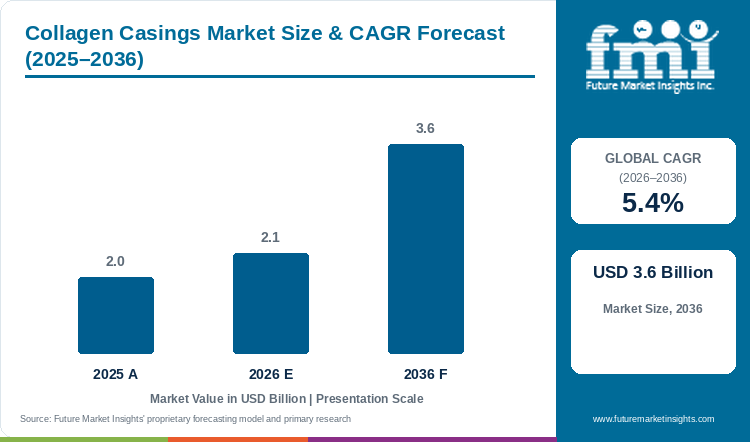
Sales of collagen casings are estimated to rise at 5.4% CAGR through 2036. Market value is USD 2.0 billion in 2025 and is estimated at USD 2.1 billion in 2026. The market is forecast to reach USD 3.6 billion by 2036.
The collagen casings market is valued at USD 2.1 billion in 2026 and is projected to reach USD 3.6 billion by 2036, growing at a 5.4% CAGR. Collagen casings are made from processed collagen and are supplied in uniform tubular form for fresh, cooked and dry sausage production. These casings reduce soaking and sorting work and allow processors to maintain similar diameter on automated filling lines. Brazil slaughtered 60.69 million hogs and pigs in 2025, increasing 4.3% over 2024[2]. Higher pork movement gives sausage processors more production runs, due to which demand for ready-to-stuff sausage casings is expected to rise. FMI notes that edible and non-edible collagen casings are gaining use where consistent size, lower breakage and faster line preparation are required. Source records, labeling and plant-line testing will remain the final requirement before a processor changes an approved casing.
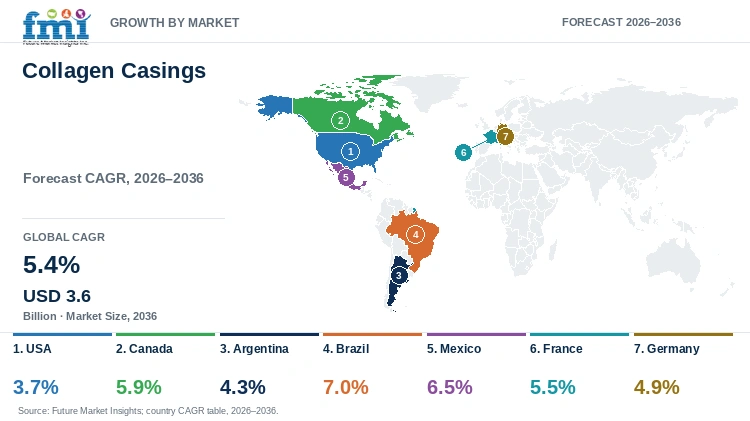
Brazil and Mexico are projected to expand at 7.0% and 6.5% CAGR, respectively, during 2026 to 2036. Brazil has a larger pork-processing base, whereas Mexico requires varied casing sizes for sausages, chorizo, longaniza and mortadella. Mexico produced more than 1.920 million tonnes of pork in 2025[5]. The increasing pork output supports more filling runs and creates demand for edible and non-edible collagen casings across different calibers. Brazil offers larger commercial trials because of its high slaughter volume, while Mexican processors place more importance on local stock and size availability. Expansion of the processed meat industry in both countries is anticipated to support market revenue growth. However, repeat purchasing remains dependent on casing bite, diameter stability, breakage and supply of the approved format.
Key Takeaways of Collagen Casings Market
- Ready-to-stuff collagen supports demand where processors need stable dimensions and less preparation before automated sausage filling.
- Future Market Insights projects non-edible collagen casings to hold 56.2% of product type demand in 2026.
- Small is projected to hold 51.5% of caliber demand in 2026 as linked sausages require stable diameter during filling.
- Fresh sausages are expected at 41.2% of application demand in 2026 because frequent runs make setup and portion drift measurable.
- FMI analysis suggests Brazil at 7.0% CAGR and Mexico at 6.5% CAGR, with pork throughput supporting Brazil and format variety shaping Mexico.
- Notable companies in the collagen casings market include Viscofan S.A., VH Devro (SARIA Group), Shenguan Holdings (Group) Limited, Nippi, Incorporated, FIBRAN, S.A., FABIOS S.A., and Belkozin.
Analyst Perspective
“Pork processing and automated filling will keep collagen casing demand firm. Ready-to-stuff formats will give approved suppliers the strongest repeat opportunity.”
- Nandini Roy Choudhury, Principal Consultant, Future Market Insights
How is the Collagen Casings Market segmented?
Collagen Casings Market is segmented by four primary commercial axes and region: product type, caliber, application, end-use, and region. In 2026, non-edible is estimated at 56.2%, small at 51.5%, fresh sausages at 41.2%, and foodservice at 42.0%.
The collagen casings market uses four segment axes with region as the geographic split.
Product type covers non-edible and edible.
Caliber covers small and large.
Application covers fresh sausages, meat-based snacks, cooked sausages, dry-cured sausages, and others.
End use covers foodservice, industrial food processing, private label, butcheries and meat processors, and others.
What supports small as a preferred choice in the caliber category?
By caliber, small is estimated to hold 51.5% in 2026, owing to stable diameter on high-volume linked sausage lines.
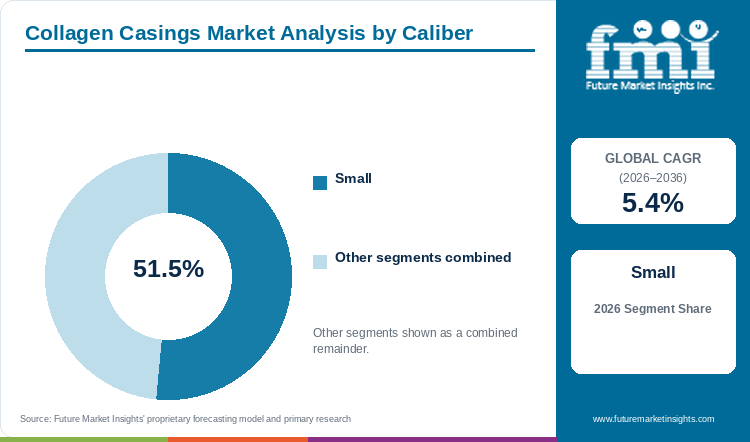
Small collagen casings are used for linked sausages where diameter controls piece count, filler setting and portion weight. Stable small calibers allow automatic meat processing equipment to run for a longer period without repeated fill and clip adjustment. Shenguan reported continued intelligent-production upgrades for collagen casing products in its 2025 annual report[13]. These improvements support uniform formats for high-volume sausage production. However, processors continue to test breakage and finished-product appearance before routine use, as a minor diameter change affects every piece packed from the line.
- Small is expected to hold 51.5% of caliber demand in 2026 because linked products depend on stable diameter during filling.
- Stable stick length reduces setup changes during long runs, but plants still test breakage before routine use.
Why does non-edible account for a notable share of product type demand?
Non-edible is projected to account for 56.2% of product type in 2026, supported by processing strength and clean peeling.
Non-edible collagen casings are designed to hold sausage meat during stuffing, cooking and drying, and these casings are removed before sale or serving. Non-edible formats provide higher processing strength and clean peeling, due to which they are increasingly used for cooked and dry sausages. Viscofan documents collagen casings for fresh sausage and meat-snack applications[11]. Wider use of collagen products across food processing is also supporting material availability. Processors prefer non-edible collagen casings when the finished sausage requires uniform diameter but casing bite is not part of the product. Clean removal without surface damage remains important, which in turn is anticipated to support repeat demand.
- Non-edible is estimated to hold 56.2% of product type in 2026 as controlled removal supports cooked and dry sausage processes.
- Plants reject a change if peeling leaves residue or damages the sausage during cooling and final handling.
How are fresh sausages gaining use across the application category?
Fresh sausages are forecast to represent 41.2% of application demand in 2026, enabled by ready-to-stuff handling on frequent runs.
Fresh sausages are commonly filled in edible collagen casings as the casing remains with the finished product and gives uniform shape. Ready-to-stuff handling reduces preparation before filling, while consistent diameter supports linking and portion control. FIBRAN presented edible and non-edible collagen casing formats for several sausage applications at IFFA 2025[12]. Increasing production of fresh sausages and meat snacks is therefore creating demand for separate casing specifications. Fresh lines also expose breakage, bite and diameter problems immediately, due to which processors can check the casing before moving it into large production runs.
- Reflecting consistent diameter requirements and the frequency of filling runs, fresh sausages are projected to hold 41.2% of application demand in 2026.
- A failed bite or diameter test appears quickly on fresh lines, so processors can stop a casing change before scale-up.
What supports foodservice demand within the end-use category in 2026?
In 2026, foodservice is expected to hold 42.0% of end-use demand, reinforced by repeatable portions in recurring service programs.
Foodservice operators require sausages with similar size, cooking behavior and appearance at every outlet. Collagen casings support this requirement by maintaining uniform diameter during repeated filling runs. VH Devro combined natural casings, collagen casings and gels under one customer-facing brand in June 2025[9]. The combined product range can support processors supplying restaurants and quick-service chains through recurring programs. In addition, repeatable portions reduce variation when sausages move into foodservice packaging and distribution. Growing number of chain outlets is anticipated to support demand for approved collagen casing sizes.
- Foodservice is estimated at 42.0% of end-use demand in 2026 because chain programs depend on repeatable portions and cooking behavior.
- Chain-account contracts can repeat every week, so casing consistency protects portion size and cooking performance over many production runs.
What are the drivers, restraints and opportunities in the Collagen Casings Market?
In the collagen casings market, the key driver is stuffing consistency, the key restraint is qualification, and the key opportunity is local technical support.
- Driver: Ready-to-stuff formats support adoption because stable diameter reduces setup changes on approved high-speed sausage lines.
- Restraint: Source records and plant qualification delay switching if labeling requirements or line behavior remain unresolved.
- Opportunity: Regional service can shorten trials and replenishment once processors approve a casing for routine production.
High-Speed Stuffing Supports Collagen Demand
Collagen casings reduce preparation time because processors can load ready-to-stuff formats without soaking and sorting natural gut. Nippi states that a standard collagen strand can reach 15 metres, compared with about 5 to 10 metres for sheep casings[10]. Longer strands require fewer reloads and allow sausage fillers to continue for a longer production run. This is supporting adoption on high-speed lines where repeated stops reduce output and disturb portion control. Increasing automation in meat packaging and processing plants is therefore expected to drive the collagen casings market growth.
Source Records Can Slow Casing Changes
Collagen source and label review can delay adoption even when a casing performs well during filling. USDA FSIS stated in September 2026 that collagen need not be declared when its known source is the same species as the sausage, whereas declaration is required when the source differs or remains unknown[8]. Processors must therefore obtain source records before a new edible casing moves into regular production. These requirements increase approval time and may restrict ordinary suppliers that cannot provide consistent documentation. High cost of testing, label correction and repeated plant trials may hamper the growth of collagen casings market.
Local Support Can Shorten Qualification
Local technical support can shorten the movement from a plant trial to regular purchasing. Viscofan reported that its 2025 projects added collagen-casing capacity across Europe, Asia and the Americas[14]. New production capacity gives processors more access to approved sizes and technical support during filling trials. Apart from that, nearby converted stock helps plants obtain the required caliber without long replenishment schedules. Expansion of regional food packaging and casing support is expected to create new avenues for collagen casing manufacturers.
Which country CAGRs are profiled in the Collagen Casings Market?
| Country | CAGR |
|---|---|
| USA | 3.7% |
| Canada | 5.9% |
| Argentina | 4.3% |
| Brazil | 7.0% |
| Mexico | 6.5% |
| France | 5.5% |
| Germany | 4.9% |
How do country-level CAGRs compare in the Collagen Casings Market?
Country growth differs according to pork production, product variety and availability of approved casing sizes. Brazil and Mexico are projected to record faster growth as expanding pork output gives processors more commercial filling runs. France and Germany have mature sausage industries and automated lines, whereas casing changes are accepted only when bite, appearance and machine settings remain similar. The USA and Canada retain large recurring processing bases, while Argentina is gaining from higher pork slaughter and consumption. These differences are expected to keep demand connected with local production volume and supplier support.
- USA processors run large hog-slaughter networks, that means casing trials must prove repeatable performance before a specification changes.
- Canadian processors value dependable stock because concentrated pork production makes missed deliveries costly during booked plant schedules.
- Argentina's expanding pork output gives processors more production runs for casing trials once local documentation is cleared.
- Brazilian pork plants run frequent schedules, so preparation time and breakage can be measured during normal commercial output.
- Mexican processors produce sausages, chorizo, longaniza and mortadella, which raises the value of nearby stock and line-level conversion support.
- French charcuterie plants protect product style, so casing changes must preserve bite and appearance before preparation savings matter.
- German processors use mature automated lines, meaning a new casing must match validated machine settings before a specification changes.
Full report country CAGRs cover: North America; Latin America; Western Europe; Eastern Europe; East Asia; South Asia and Pacific; Middle East and Africa.
Country-wise Analysis
- USA is projected to expand at 3.7% CAGR during 2026 to 2036. USDA NASS reported that 128 million hogs were slaughtered in 2025 and the 15 largest plants handled 65% of federally inspected hogs[1]. The presence of large slaughter plants creates recurring sausage runs and gives an approved casing access to high production volume. Increasing replacement of natural gut preparation on automated lines is expected to support collagen casing demand, though diameter, bite and breakage must remain consistent.
- Canada collagen casings market is anticipated to grow at 5.9% CAGR during the forecast period. Statistics Canada reported 13.9 million hogs on farms on January 1, 2026, while slaughter increased 1.8% to 10.9 million head during the second half of 2025[3]. Higher slaughter supports regular sausage production even when the opening inventory is lower. Reliable local stock of approved sizes remains important, due to which regional supply is anticipated to support market growth.
- Argentina is estimated to record 4.3% CAGR over 2026 to 2036. The national agriculture authority reported 8.52 million hogs slaughtered in 2025, increasing 2.5% from 2024, while pork production reached 812,272 tonnes[4]. Increasing production gives fresh and processed sausage plants more opportunities to use collagen casings. Reduced preparation and uniform diameter is expected to support demand once local documentation and finished-product appearance are accepted.
- Brazil collagen casings market is projected to rise at 7.0% CAGR through 2036. Brazil opened a national consultation in February 2026 for updated sanitary inspection rules covering pork and pork products[15]. The review keeps source records and processing controls important for casing suppliers serving pork plants. Higher commercial sausage production gives suppliers regular opportunities to prove preparation savings, and approved formats are expected to witness increasing demand.
- Mexico is forecast to expand at 6.5% CAGR during the assessment period. INEGI tracks sausages, chorizo, longaniza and mortadella as separate manufactured meat products in its national statistics[16]. These products require different casing sizes, due to which nearby stock and line-level support gains importance. Wider processed-meat varieties are anticipated to support collagen casings market revenue growth.
- France collagen casings market is estimated to grow at 5.5% CAGR through 2036. Agreste reported in February 2026 that January pig slaughter declined 1.0% year over year, whereas December 2025 pork consumption increased 3.2%[6]. This difference places more attention on processing yield and product consistency. Charcuterie producers are likely to adopt collagen casings where bite, appearance and cooking behavior remains unchanged while preparation work is reduced.
- Germany is projected to record 4.9% CAGR from 2026 to 2036. Destatis reported that pig slaughter remained almost unchanged at 22.1 million head during the first half of 2026[7]. The large recurring pork base supports sausage production even as total meat output declined. Uniform diameter and easy handling is expected to increase collagen casing use, provided the casing matches validated filling, cooking and peeling settings.
Who are the notable companies in the Collagen Casings Market?
Notable companies serving the collagen casings market include Viscofan S.A., VH Devro (SARIA Group), Shenguan Holdings (Group) Limited, Nippi, Incorporated, FIBRAN, S.A., FABIOS S.A., and Belkozin.
Collagen casings market includes integrated manufacturers, specialist casing producers and regional converting companies. Viscofan S.A., VH Devro, Shenguan Holdings and Nippi operate collagen-casing production and supply products across several countries. FIBRAN, FABIOS and Belkozin provide edible and non-edible formats for defined sausage applications. Some of the key players are focusing on wider caliber ranges, production expansion and technical service in order to cater the growing demand. Consistent supply remains important after a casing is approved, which is likely to support manufacturers having production and sales networks across major meat-processing regions.
- Integrated global manufacturers combine owned collagen-casing production with international sales: Viscofan S.A., VH Devro (SARIA Group), Shenguan Holdings (Group) Limited, and Nippi, Incorporated.
- Specialist collagen-casing manufacturers supply edible and non-edible formats for defined sausage processes: FIBRAN, S.A., FABIOS S.A., and Belkozin.
Competitive Benchmarking: Collagen Casings Market
| Company | Product Breadth | Production / Converting Control | Qualification Evidence | Geographic Reach |
|---|---|---|---|---|
| Viscofan S.A. | High | High | High | High |
| VH Devro (SARIA Group) | High | High | High | High |
| Shenguan Holdings (Group) Limited | Medium | High | High | High |
| Nippi, Incorporated | Medium | High | High | High |
| FIBRAN, S.A. | High | High | Medium | Medium |
| FABIOS S.A. | High | High | Medium | High |
| Belkozin | Medium | High | Medium | Medium |
Key Developments in the Collagen Casings Market
- In February 2026, Viscofan S.A. reported that its 2025 projects added collagen-casing capacity in Europe, Asia and the Americas.
- In May 2025, FIBRAN, S.A. presented collagen-casing products at IFFA 2025 covering edible and non-edible sausage formats.
Key Players in the Collagen Casings Market
Integrated Global Collagen-casing Manufacturers
- Viscofan S.A.
- VH Devro (SARIA Group)
- Shenguan Holdings (Group) Limited
- Nippi, Incorporated
Specialist Collagen-casing Manufacturers
- FIBRAN, S.A.
- FABIOS S.A.
- Belkozin
Collagen Casings Market - Report Scope
| Coverage field | Report scope |
|---|---|
| Market breakdown | Product Type, Caliber, Application, End-use, and Region. |
| Quantitative Units | USD billion. |
| Market Definition | Commercial collagen sausage casings sold as tubular edible or non-edible formats within the stated segmentation boundary. Natural gut, cellulose, fibrous, plastic casings, and collagen products not sold as casings are excluded. |
| Regions Covered | North America; Latin America; Western Europe; Eastern Europe; East Asia; South Asia and Pacific; Middle East and Africa. |
| Countries Covered | USA, Canada, Argentina, Brazil, Mexico, France, Germany, and 20+ countries included in the full report. |
| Key Companies Profiled | Viscofan S.A.; VH Devro (SARIA Group); Shenguan Holdings (Group) Limited; Nippi, Incorporated; FIBRAN, S.A.; FABIOS S.A.; Belkozin; |
| Forecast Period | 2026 to 2036. |
| Approach | Primary and secondary research with market triangulation. |
Collagen Casings Market - Research Methodology
| Method | Approach |
|---|---|
| Primary Research | FMI analysts gathered inputs from collagen casing manufacturers, converters, distributors, sausage processors and industry experts. Interviews covered product use, pricing, caliber preference, plant trials, adoption barriers and expected demand during the forecast period. |
| Desk Research | Desk research covered government statistics, regulatory publications, trade data, company filings, product pages and official announcements. Sources were checked for publication date, relevance and connection with the defined collagen casings market. |
| Market Sizing and Forecasting | Market sizing combined the base value with historical demand, segment shares, collagen casing prices, sausage production, company participation and country-level conditions. Segment and regional estimates were reconciled with the total market before the forecast was finalized. |
| Data Validation | Market estimates were checked against public data, company activity, trade movement and primary interviews. Natural gut, cellulose, fibrous and plastic casings were excluded in order to avoid overlap with the defined collagen casings market. |
Collagen Casings Market by Segments
Collagen Casings Market segmented by Product Type:
- Non-edible
- Edible
Collagen Casings Market segmented by Caliber:
- Small
- Large
Collagen Casings Market segmented by Application:
- Fresh Sausages
- Meat-based Snacks
- Cooked Sausages
- Others (Pork Loin, etc.)
- Dry-Cured Sausages
Collagen Casings Market segmented by End-use:
- Foodservice
- Industrial Food Processing
- Private Label
- Others
- Butcheries and Meat Processors
Collagen Casings Market by Region:
- North America
- United States
- Canada
- Latin America
- Brazil
- Mexico
- Argentina
- Chile
- Western Europe
- Germany
- France
- United Kingdom
- Italy
- Spain
- Benelux
- Nordics
- Eastern Europe
- Poland
- Czech Republic
- Romania
- Hungary
- East Asia
- China
- Japan
- South Korea
- South Asia and Pacific
- India
- ASEAN
- Australia and New Zealand
- Middle East and Africa
- GCC Countries
- South Africa
- Türkiye
- Israel
Research Sources and Bibliography
- [1] U.S. Department of Agriculture, National Agricultural Statistics Service. (2026, April 22). Livestock slaughter 2025 summary.
- [2] Brazilian Institute of Geography and Statistics. (2026, March 18). Produção pecuária atinge recordes históricos em 2025.
- [3] Statistics Canada. (2026, February 27). Livestock estimates, January 1, 2026.
- [4] Secretaría de Agricultura, Ganadería y Pesca, Argentina. (2026, February 3). El sector porcino cerró el 2025 con récord de faena y consumo.
- [5] Secretaría de Agricultura y Desarrollo Rural, Mexico. (2026, May 28). Del taco al mundo: El legado y sabor de la porcicultura en México.
- [6] Agreste. (2026, February 27). Porcins: En janvier, baisse des abattages de porcs.
- [7] Statistisches Bundesamt. (2026, August 7). Fleischproduktion im 1. Halbjahr 2026 um 0,7 % gesunken.
- [8] U.S. Department of Agriculture, Food Safety and Inspection Service. (2026, September 4). askFSIS public Q&A: Collagen declaration on sausage labels.
- [9] VH Devro. (2025, June). Introducing VH Devro: Linking together two trusted brands in sausage casing.
- [10] Nippi, Incorporated. (2026, January 26). Manufacturing collagen casings.
- [11] Viscofan S.A. (2026). Collagen artificial casing for meat snacks and fresh sausage.
- [12] Messe Frankfurt. (2025, May). FIBRAN, S.A., exhibitor profile, IFFA 2025.
- [13] Shenguan Holdings (Group) Limited. (2026, April 29). Annual report 2025.
- [14] Viscofan S.A. (2026). Annual report 2025.
- [15] Ministério da Agricultura e Pecuária, Brazil. (2026, February 20). Consulta pública on sanitary inspection of pork and pork products.
- [16] Instituto Nacional de Estadística y Geografía. (2026). Products by activity class, 2023 version.
This bibliography lists official statistics, regulatory material and company sources used in the report.
This Report Answers
- How large is the Collagen Casings Market in 2026 and 2036?
- What CAGR is forecast for the Collagen Casings Market through 2036?
- Which segments hold notable 2026 shares in the Collagen Casings Market?
- Which countries show notable expansion in the Collagen Casings Market?
- Which companies are active in the Collagen Casings Market today?
- What products and geographies define the Collagen Casings Market scope?
Frequently Asked Questions
How big is the Collagen Casings Market in 2026?
The collagen casings market is valued at USD 2.1 billion in 2026 and is forecast to reach USD 3.6 billion by 2036. Growth is driven by increasing adoption of ready-to-stuff collagen casings on automated sausage filling lines, where uniform diameter and reduced preparation time support recurring demand from fresh, cooked and dry sausage processors.
What is the CAGR of the Collagen Casings Market from 2026 to 2036?
The collagen casings market grows at a CAGR of 5.4% between 2026 and 2036, supported by rising use of ready-to-stuff collagen casings in automated sausage production where consistent diameter and faster line preparation replace natural gut handling on high-speed filling lines across fresh, cooked and dry sausage applications.
Which product type leads the Collagen Casings Market?
Non-edible collagen casings account for 56.2% of the collagen casings market by product type in 2026, driven by higher processing strength and clean peeling performance that support cooked and dry sausage applications where uniform diameter and controlled casing removal without surface damage remain essential to processors.
How much will the Collagen Casings Market add between 2026 and 2036?
The collagen casings market is set to add USD 1.5 billion between 2026 and 2036, growing from USD 2.1 billion to USD 3.6 billion as ready-to-stuff collagen casings enter routine production across a wider base of sausage processors running automated fresh, cooked and dry sausage filling programs.
Who are the leading companies in the Collagen Casings Market?
Eight companies serve the collagen casings market, including Viscofan S.A., VH Devro (SARIA Group), Shenguan Holdings (Group) Limited, Nippi, Incorporated, FIBRAN, S.A., FABIOS S.A., Belkozin, and Nicolaisen Casing & Packaging GmbH, competing through integrated production, specialist edible and non-edible formats, and regional converting and technical support.
Preview the report firsthand - request a free sample
Get SampleGet the brochure for pricing and purchase details.
Get PDFTable of Content
- Key Takeaways
- Market Size and CAGR
- Top Growth Driver
- Fastest Growing Segment
- Leading Region
- Key Companies
- Emerging Opportunities
- Executive Summary
- Global Market Outlook
- Demand-side Trends
- Supply-side Trends
- Technology Roadmap Analysis
- Analysis and Recommendations
- Analyst Perspective (What is happening? Why now? What should investors know?)
- Key Questions Answered
- How large is the market?
- What is the CAGR?
- What are key trends?
- Which region dominates?
- Who are the leaders?
- Market Overview
- Market Coverage / Taxonomy
- Market Definition / Scope / Limitations
- Research Methodology
- Chapter Orientation
- Analytical Lens and Working Hypotheses
- Market Structure, Signals, and Trend Drivers
- Benchmarking and Cross-market Comparability
- Market Sizing, Forecasting, and Opportunity Mapping
- Research Design and Evidence Framework
- Desk Research Programme (Secondary Evidence)
- Expert Input and Fieldwork (Primary Evidence)
- Tooling, Models, and Reference Databases
- Data Engineering and Model Build
- Quality Assurance and Audit Trail
- Market Background
- Market Dynamics (Drivers, Restraints, Opportunity, Trends)
- Scenario Forecast (Optimistic, Likely, Conservative)
- Impact Analysis
- AI Impact
- Sustainability Impact
- Regulatory Impact
- Technology Impact
- Consumer / Buyer Analysis
- Purchase Drivers
- Adoption Barriers
- Buyer Journey
- Opportunity Map Analysis
- Product Life Cycle Analysis
- Supply Chain Analysis
- Investment Feasibility Matrix
- Value Chain Analysis
- PESTLE and Porter's Analysis
- Regulatory Landscape
- Regional Parent Market Outlook
- Production and Consumption Statistics
- Import and Export Statistics
- Global Market Analysis and Forecast, 2021 to 2036
- Historical Market Size Value (USD Billion) Analysis, 2021 to 2025
- Current and Future Market Size Value (USD Billion) Projections, 2026 to 2036
- Y-o-Y Growth Trend Analysis
- Absolute $ Opportunity Analysis
- Global Market Pricing Analysis, 2021 to 2036
- Global Market Analysis and Forecast, By Product Type, 2021 to 2036
- Introduction / Key Findings
- Historical Market Size Value (USD Billion) Analysis By Product Type, 2021 to 2025
- Current and Future Market Size Value (USD Billion) Analysis and Forecast By Product Type, 2026 to 2036
- Non-edible
- Edible
- Y-o-Y Growth Trend Analysis By Product Type, 2021 to 2025
- Absolute $ Opportunity Analysis By Product Type, 2026 to 2036
- Global Market Analysis and Forecast, By Caliber, 2021 to 2036
- Introduction / Key Findings
- Historical Market Size Value (USD Billion) Analysis By Caliber, 2021 to 2025
- Current and Future Market Size Value (USD Billion) Analysis and Forecast By Caliber, 2026 to 2036
- Small
- Large
- Y-o-Y Growth Trend Analysis By Caliber, 2021 to 2025
- Absolute $ Opportunity Analysis By Caliber, 2026 to 2036
- Global Market Analysis and Forecast, By Application, 2021 to 2036
- Introduction / Key Findings
- Historical Market Size Value (USD Billion) Analysis By Application, 2021 to 2025
- Current and Future Market Size Value (USD Billion) Analysis and Forecast By Application, 2026 to 2036
- Fresh Sausages
- Meat-based Snacks
- Cooked Sausages
- Others (Pork Loin, etc.)
- Dry-Cured Sausages
- Y-o-Y Growth Trend Analysis By Application, 2021 to 2025
- Absolute $ Opportunity Analysis By Application, 2026 to 2036
- Global Market Analysis and Forecast, By End-use, 2021 to 2036
- Introduction / Key Findings
- Historical Market Size Value (USD Billion) Analysis By End-use, 2021 to 2025
- Current and Future Market Size Value (USD Billion) Analysis and Forecast By End-use, 2026 to 2036
- Foodservice
- Industrial Food Processing
- Private Label
- Others
- Butcheries and Meat Processors
- Y-o-Y Growth Trend Analysis By End-use, 2021 to 2025
- Absolute $ Opportunity Analysis By End-use, 2026 to 2036
- Global Market Analysis and Forecast, By Region, 2021 to 2036
- Introduction
- Historical Market Size Value (USD Billion) Analysis By Region, 2021 to 2025
- Current Market Size Value (USD Billion) Analysis and Forecast By Region, 2026 to 2036
- North America
- Latin America
- Western Europe
- Eastern Europe
- East Asia
- South Asia and Pacific
- Middle East and Africa
- Market Attractiveness Analysis By Region
- North America Market Analysis and Forecast, By Country, 2021 to 2036
- Historical Market Size Value (USD Billion) Trend Analysis By Market Taxonomy, 2021 to 2025
- Market Size Value (USD Billion) Forecast By Market Taxonomy, 2026 to 2036
- By Country
- United States
- Canada
- By Product Type
- By Caliber
- By Application
- By End-use
- By Country
- Market Attractiveness Analysis
- By Country
- By Product Type
- By Caliber
- By Application
- By End-use
- Key Takeaways
- Latin America Market Analysis and Forecast, By Country
- Historical Market Size Value (USD Billion) Trend Analysis By Market Taxonomy, 2021 to 2025
- Market Size Value (USD Billion) Forecast By Market Taxonomy, 2026 to 2036
- By Country
- Brazil
- Mexico
- Argentina
- Chile
- By Product Type
- By Caliber
- By Application
- By End-use
- By Country
- Market Attractiveness Analysis
- By Country
- By Product Type
- By Caliber
- By Application
- By End-use
- Key Takeaways
- Western Europe Market Analysis and Forecast, By Country
- Historical Market Size Value (USD Billion) Trend Analysis By Market Taxonomy, 2021 to 2025
- Market Size Value (USD Billion) Forecast By Market Taxonomy, 2026 to 2036
- By Country
- Germany
- France
- United Kingdom
- Italy
- Spain
- Benelux
- Nordics
- By Product Type
- By Caliber
- By Application
- By End-use
- By Country
- Market Attractiveness Analysis
- By Country
- By Product Type
- By Caliber
- By Application
- By End-use
- Key Takeaways
- Eastern Europe Market Analysis and Forecast, By Country
- Historical Market Size Value (USD Billion) Trend Analysis By Market Taxonomy, 2021 to 2025
- Market Size Value (USD Billion) Forecast By Market Taxonomy, 2026 to 2036
- By Country
- Poland
- Czech Republic
- Romania
- Hungary
- By Product Type
- By Caliber
- By Application
- By End-use
- By Country
- Market Attractiveness Analysis
- By Country
- By Product Type
- By Caliber
- By Application
- By End-use
- Key Takeaways
- East Asia Market Analysis and Forecast, By Country
- Historical Market Size Value (USD Billion) Trend Analysis By Market Taxonomy, 2021 to 2025
- Market Size Value (USD Billion) Forecast By Market Taxonomy, 2026 to 2036
- By Country
- China
- Japan
- South Korea
- By Product Type
- By Caliber
- By Application
- By End-use
- By Country
- Market Attractiveness Analysis
- By Country
- By Product Type
- By Caliber
- By Application
- By End-use
- Key Takeaways
- South Asia and Pacific Market Analysis and Forecast, By Country
- Historical Market Size Value (USD Billion) Trend Analysis By Market Taxonomy, 2021 to 2025
- Market Size Value (USD Billion) Forecast By Market Taxonomy, 2026 to 2036
- By Country
- India
- ASEAN
- Australia and New Zealand
- By Product Type
- By Caliber
- By Application
- By End-use
- By Country
- Market Attractiveness Analysis
- By Country
- By Product Type
- By Caliber
- By Application
- By End-use
- Key Takeaways
- Middle East and Africa Market Analysis and Forecast, By Country
- Historical Market Size Value (USD Billion) Trend Analysis By Market Taxonomy, 2021 to 2025
- Market Size Value (USD Billion) Forecast By Market Taxonomy, 2026 to 2036
- By Country
- GCC Countries
- South Africa
- Türkiye
- Israel
- By Product Type
- By Caliber
- By Application
- By End-use
- By Country
- Market Attractiveness Analysis
- By Country
- By Product Type
- By Caliber
- By Application
- By End-use
- Key Takeaways
- Key Countries Market Analysis
- United States
- Pricing Analysis
- Market Share Analysis, 2025
- By Product Type
- By Caliber
- By Application
- By End-use
- Canada
- Pricing Analysis
- Market Share Analysis, 2025
- By Product Type
- By Caliber
- By Application
- By End-use
- Mexico
- Pricing Analysis
- Market Share Analysis, 2025
- By Product Type
- By Caliber
- By Application
- By End-use
- Brazil
- Pricing Analysis
- Market Share Analysis, 2025
- By Product Type
- By Caliber
- By Application
- By End-use
- Chile
- Pricing Analysis
- Market Share Analysis, 2025
- By Product Type
- By Caliber
- By Application
- By End-use
- Germany
- Pricing Analysis
- Market Share Analysis, 2025
- By Product Type
- By Caliber
- By Application
- By End-use
- United Kingdom
- Pricing Analysis
- Market Share Analysis, 2025
- By Product Type
- By Caliber
- By Application
- By End-use
- Italy
- Pricing Analysis
- Market Share Analysis, 2025
- By Product Type
- By Caliber
- By Application
- By End-use
- Spain
- Pricing Analysis
- Market Share Analysis, 2025
- By Product Type
- By Caliber
- By Application
- By End-use
- France
- Pricing Analysis
- Market Share Analysis, 2025
- By Product Type
- By Caliber
- By Application
- By End-use
- India
- Pricing Analysis
- Market Share Analysis, 2025
- By Product Type
- By Caliber
- By Application
- By End-use
- ASEAN
- Pricing Analysis
- Market Share Analysis, 2025
- By Product Type
- By Caliber
- By Application
- By End-use
- Australia and New Zealand
- Pricing Analysis
- Market Share Analysis, 2025
- By Product Type
- By Caliber
- By Application
- By End-use
- China
- Pricing Analysis
- Market Share Analysis, 2025
- By Product Type
- By Caliber
- By Application
- By End-use
- Japan
- Pricing Analysis
- Market Share Analysis, 2025
- By Product Type
- By Caliber
- By Application
- By End-use
- South Korea
- Pricing Analysis
- Market Share Analysis, 2025
- By Product Type
- By Caliber
- By Application
- By End-use
- Poland
- Pricing Analysis
- Market Share Analysis, 2025
- By Product Type
- By Caliber
- By Application
- By End-use
- Hungary
- Pricing Analysis
- Market Share Analysis, 2025
- By Product Type
- By Caliber
- By Application
- By End-use
- Türkiye
- Pricing Analysis
- Market Share Analysis, 2025
- By Product Type
- By Caliber
- By Application
- By End-use
- South Africa
- Pricing Analysis
- Market Share Analysis, 2025
- By Product Type
- By Caliber
- By Application
- By End-use
- Argentina
- Pricing Analysis
- Market Share Analysis, 2025
- By Product Type
- By Caliber
- By Application
- By End-use
- United States
- Market Structure Analysis
- Competition Dashboard
- Competition Benchmarking
- Market Share Analysis of Top Players
- By Regional
- By Product Type
- By Caliber
- By Application
- By End-use
- Emerging Startups
- Innovation Benchmarking
- Competition Analysis
- Competition Deep Dive
- Viscofan S.A.
- Overview
- Product Portfolio
- Profitability by Market Segments
- Sales Footprint
- Strategy Overview
- Marketing Strategy
- Product Strategy
- Channel Strategy
- VH Devro (SARIA Group)
- Shenguan Holdings (Group) Limited
- Nippi, Incorporated
- FIBRAN, S.A.
- FABIOS S.A.
- Belkozin
- Viscofan S.A.
- Case Studies
- Success Stories
- Recent Developments
- Competition Deep Dive
- Assumptions & Acronyms Used


