

- Market Size (2026)
- USD 11.4 Bn
- Forecast (2036)
- USD 22.2 Bn
- CAGR (2026 to 2036)
- 6.9%
How big is the boutique hotel market in 2026?
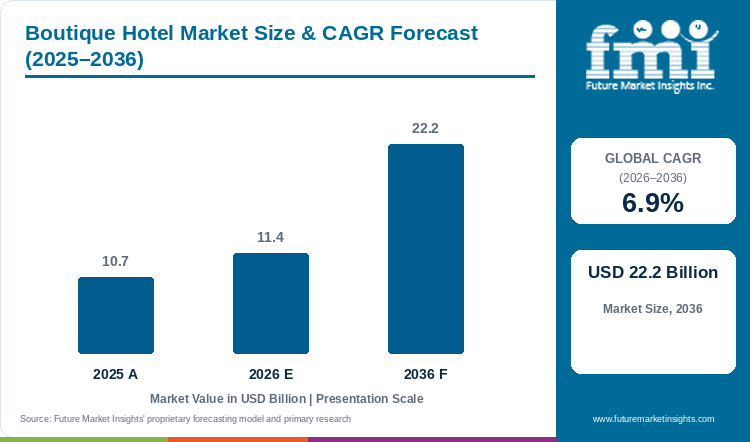
The Boutique Hotel Market is projected to expand at a CAGR of 6.9% between 2026 and 2036. Market value rises from USD 10.7 billion in 2025 to USD 11.4 billion in 2026 and USD 22.2 billion by 2036. [1]
Boutique hotels compete through the character of a property and the experience available during the stay. A city hotel can use its location, restaurant and public spaces to attract business and leisure guests. A rural retreat may centre the visit on the landscape and local activities. Independent hotels and branded collections both participate, with the latter adding booking and loyalty channels while allowing individual properties to retain a distinct identity. Marriott describes Tribute Portfolio as a family of independent boutique hotels. [2]
Commercial decisions begin at property level: the rooms available, the services included and the guests a location can serve. A boutique label alone does not establish a fixed room count or price band. The Hazelton in Toronto combines rooms and suites with dining, a spa and meeting spaces, while YOTEL offers compact design-led stays across city and airport locations. These examples illustrate different uses of accommodation, rather than a single building size or operating model. [3, 4, 5]
Key Market Trends & Insights
- Growth is forecast at 6.9% CAGR over 2026 to 2036. [1]
- Business Hotels, Suite Hotels, Airport Hotels, Resorts Hotels and Others form the hotel-type segmentation. [1]
- Online, phone and in-person reservations describe the booking channel. [1]
- Collection membership adds booking and loyalty access to an individual property’s offer. [2, 6]
Regional Highlights
- The United States and Canada profiles include distinctive city properties and collection-based distribution. [3, 4, 6]
- Spain and China profiles illustrate distinctive properties within wider boutique-hotel collections. [2, 9, 10]
- India’s profile connects distinctive accommodation with regional settings, heritage and outdoor activities. [9, 10]
Market Size & Forecast
Table 1: Market Size and Forecast for the Boutique Hotel Market (USD billion and percentage), 2025 to 2036
| Metric | Value |
|---|---|
| 2025 Market Size | USD 10.7 billion |
| Estimated Market Size in 2026 | USD 11.4 billion |
| Projected Market Size by 2036 | USD 22.2 billion |
| CAGR, 2026 to 2036 | 6.9% |
| Added Revenue, 2026 to 2036 | USD 10.8 billion |
| Market Expansion Multiple | 1.9x |
The market is forecast to expand at 6.9% CAGR over 2026 to 2036. [1] Boutique hotels compete through the character of a property and the experience available during the stay. A city hotel can use its location, restaurant and public spaces to attract business and leisure guests. A rural retreat may centre the visit on the landscape and local activities. Independent hotels and branded collections both participate, with the latter adding booking and loyalty channels while allowing individual properties to retain a distinct identity. Marriott describes Tribute Portfolio as a family of independent boutique hotels. [2]
Boutique Hotel Market Industry and Operating Indicators
Published product, supplier and service developments describe the operating choices within this market.
Table 2: Industry Indicators for the Boutique Hotel Market, 2025 to 2026
| Indicator | Data Point | Why It Matters | Source |
|---|---|---|---|
| Collection membership and reservations | On May 27, 2026, Hilton announced that The Berkeley Richmond had joined Outset Collection following renovation and was accepting reservations. The hotel connects a historic Richmond location with Hilton’s booking and loyalty network. | Connects a renovated independent property with a wider booking and loyalty network. | [6] |
| Announced island hotel opening | In September 2026, Accor announced the September opening of Nírema Hotel & Spa Samos within MGallery Collection. The announcement linked the property’s accommodation and planned spa and dining offer with the island’s landscape and wine heritage. | Links an announced accommodation opening with planned spa and dining services. | [11] |
| Independent hotel collection additions | SLH’s July 14, 2026 collection update featured boutique stays across city, mountain, wine-estate and coastal destinations, including Shanghai Muh Shoou Zhujing Hotel and Terrah Hills Resort. The update illustrated the range of settings available within an independent collection. | Adds varied city, estate, mountain and coastal properties to a collection’s visitor offer. | [10] |
Analyst Perspective
“A boutique hotel has to make its individuality useful to the guest. Distinctive interiors attract attention, but the reservation also needs to explain the room, arrival arrangements and services available. For an owner, joining a collection can widen distribution while introducing brand requirements and commercial commitments. The stronger proposition connects a recognisable property with reliable delivery and a booking route suited to the guests it serves.”
– Nandini Roy Choudhury, Principal Consultant, Future Market Insights
How is the boutique hotel market segmented?
The market covers Boutique Hotel Type, Booking Channel, Tourist Type, Tour Type and Age Group, with regional and country analysis. [1]
By Boutique Hotel Type: Business Hotels, Suite Hotels, Airport Hotels, Resorts Hotels, Others.
By Booking Channel: Online Booking, Phone Booking, In Person Booking.
By Tourist Type: Domestic, International.
By Tour Type: Independent Traveller, Package Traveller, Tour Group.
By Age Group: 15 to 25 Years, 26 to 35 Years, 36 to 45 Years, 46 to 55 Years, 66 to 75 Years.
By Region: North America, Latin America, Western Europe, Eastern Europe, East Asia, South Asia and Pacific, Middle East and Africa.
Hotel type describes the accommodation format. Booking channel identifies how the reservation is made, while tourist type distinguishes domestic and international visitors. Tour type separates independent travellers, package travellers and tour groups. Age group provides another view of the buyer. A domestic business guest booking online can appear in several of these classifications at once; each axis examines a different feature of the same purchase. [1]
Why are business hotels important?
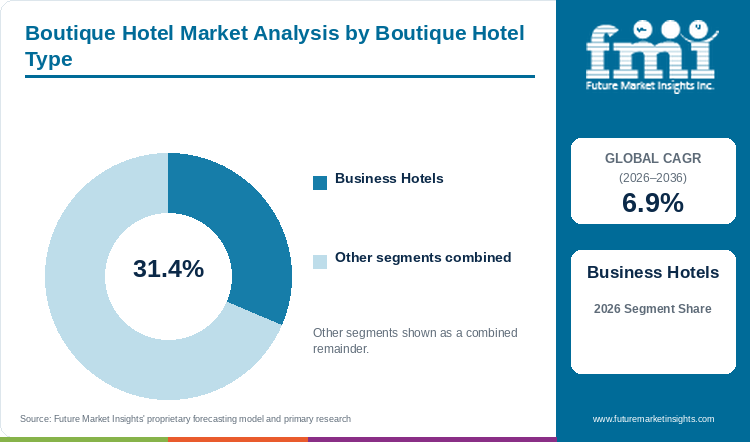
Business Hotels are projected to account for 31.4% of hotel-type demand in 2026.
Table 3: Boutique Hotel Type Focus and Market Growth for the Boutique Hotel Market, 2026 to 2036
| Metric | Value |
|---|---|
| Global CAGR (2026 to 2036) | 6.9% |
| Business Hotels Share (2026) | 31.4% |
A business stay needs a convenient location and practical services alongside a distinctive atmosphere. Meeting space, dining arrangements and workable arrival times influence the choice. The Hazelton offers several meeting and event spaces with catering from ONE Restaurant, giving an example of how a boutique property can accommodate a business occasion. Hotel buyers can assess those facilities against the group attending and the work planned, rather than assuming that every small hotel has the same conference capacity. [4]
- Business Hotels lead the hotel-type category with a projected 31.4% share in 2026. [1]
- Location, meeting facilities and service arrangements determine suitability for a business visit. [4]
How does online booking affect the offer?
Online Booking is projected to account for 42.6% of booking-channel demand in 2026
An online listing gives a hotel a way to present its rooms, public spaces and setting before a guest arrives. A direct website also allows the property to explain packages and reservation terms in its own words. Collection membership can add another route: Marriott Bonvoy lets members earn and redeem points at Tribute Portfolio hotels, while Hilton connects independent properties with its reservation and loyalty network. The operator must keep room descriptions, inclusions and availability consistent across the channels used. [2, 6]
- Online Booking is projected to account for 42.6% of booking-channel demand in 2026. [1]
- Direct websites and collection reservation systems can serve different routes to the same property. [2, 6]
What distinguishes resort, suite and airport formats?
A resort stay gives the hotel more opportunity to organize the guest’s time around food, recreation and the surrounding landscape. Suite accommodation can offer a different room arrangement for a longer visit or a party travelling together. Airport hotels meet the timing requirements of a stopover: YOTELAIR positions its properties inside airports and offers bookings in blocks of hours. These formats require different arrival, housekeeping and service schedules. The boutique experience needs to fit the reason for the stay. [5]
How do domestic demand and tour arrangements interact?
Domestic visitors can purchase short city stays or travel within their own country for a resort break. International visitors need to coordinate accommodation with a broader journey and may rely on a package or travel adviser. A tour group creates a room-block requirement that differs from an independent reservation. Hotels selling through several routes need to match room inventory with meal times, transfers and any activities included, so a promised experience remains available when the group arrives. [1]
What are the drivers, restraints and opportunities in boutique hotels?
Distinctive accommodation and destination experiences support demand; property costs and service capacity constrain delivery; collection membership and local partnerships create opportunities.
- Driver: Travellers can choose a hotel for its individual design, setting and connection with the destination.
- Restraint: Room inventory, staffing and property upkeep limit the services available during a stay.
- Opportunity: Independent hotels can reach wider booking networks while retaining a distinctive property identity.
Driver. Cultural travel gives a property reasons to connect accommodation with the neighbourhood beyond its doors. A hotel can orient guests to nearby heritage sites, local food and craft traditions, or arrange access through independent guides. The commercial benefit depends on practical delivery: the activity needs an available provider and a schedule the guest can use. A compelling account of the place is more useful when the visitor can act on it during the stay.
Restraint. Individual buildings can be expensive to maintain and difficult to adapt. A historic property may have room layouts, access routes and service areas that differ from a purpose-built hotel. Seasonal destinations also need enough business to support staffing and upkeep outside peak weeks. Owners must connect the facilities they advertise with the capacity available on the guest’s dates. That includes dining reservations, accessible rooms and spaces used for private events.
Opportunity. Sustainable tourism creates a commercial opening for locally rooted hotels to explain specific operating choices, including purchasing and the activities offered to guests. A smaller footprint alone does not establish environmental performance. Operators can make their offer clearer by describing actual measures at the property and identifying the local partners involved. Such detail can support the accommodation choice without making a broad claim about every hotel in a collection.
Wellness tourism can extend the reasons for a boutique stay through spa access, movement sessions or time in a quiet setting. These facilities also need a workable booking process. A guest purchasing a room may still need a separate treatment appointment, while a retreat package can include a scheduled programme. Showing that difference before purchase helps the hotel manage capacity and gives the visitor a better basis for comparing the available stays.
How do country markets differ?
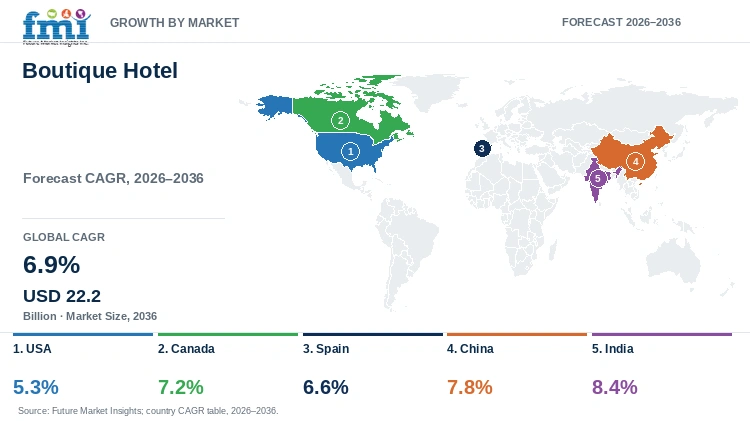
| Country | CAGR (2026–2036) |
|---|---|
| USA | 5.3% |
| Canada | 7.2% |
| Spain | 6.6% |
| China | 7.8% |
| India | 8.4% |
Country-wise Analysis
USA
The boutique hotel market in the United States is projected to expand at a CAGR of 5.3% from 2026 to 2036, supported by distinctive urban properties and access to established reservation networks. The United States offers boutique formats built around city neighbourhoods, restored properties and destination access. Hilton’s May 2026 announcement that The Berkeley Richmond had joined Outset Collection shows how a renovated independent hotel can connect its local identity with a larger reservation network. For owners, that route adds a distribution relationship to the decisions already made about rooms, dining and service. It also gives guests a familiar booking programme through which to discover an individual property. [6]
Seattle’s Kimpton Palladian illustrates another urban model. Its location connects the stay with Belltown and nearby city attractions, while its amenity offer includes a restaurant, fitness facilities and a social hour. The operating task is to make those services available alongside the room booking. Business visitors and weekend travellers may use the same hotel differently, making arrival arrangements, opening times and clear package information commercially useful. [7, 8]
Canada
The boutique hotel market in Canada is projected to expand at a CAGR of 7.2% from 2026 to 2036, supported by boutique accommodation combined with dining, wellness and business-event services. Canada’s urban boutique offer can bring together room revenue and occasions for dining or events. The Hazelton in Toronto identifies itself as a family-owned boutique hotel and combines accommodation with ONE Restaurant and Spa by Valmont. Its Yorkville location provides the setting, while the facilities create reasons to spend time at the property. A buyer comparing this format needs to understand the services included with the room and those reserved separately. [3]
Business occasions offer a further purchasing route. The Hazelton’s meeting portfolio includes a boardroom, event rooms and a private screening space. That combination allows a hotel to serve a small conference, corporate dinner or presentation as well as overnight guests. Room blocks and venue bookings require coordination, particularly where public dining spaces also serve local customers. Capacity is determined by the chosen space and occasion rather than the boutique category alone. [4]
Spain
The boutique hotel market in Spain is projected to expand at a CAGR of 6.6% from 2026 to 2036, supported by heritage-city stays and distinctive coastal accommodation. Spanish boutique stays can anchor a visit in a historic city or a coastal setting. SLH’s July 2026 selection included La Casa del Presidente in Ávila, a restored residence linked with the city’s heritage surroundings. Marriott’s Tribute Portfolio features Hotel Riomar in Santa Eulalia, Ibiza, with a beach setting. These examples present different reasons to travel and different daily rhythms, so the hotel’s positioning needs to reflect the itinerary it can support. [2, 9]
Hotels can make a local experience easier to purchase by connecting accommodation with restaurant information, transport and access to nearby attractions. An independent guest may assemble these elements separately, while a package traveller expects the organiser to specify them together. For the operator, the booking route affects how guest requirements arrive at the property. Accurate descriptions and a clear contact point matter when a stay involves several service providers.
China
The boutique hotel market in China is projected to expand at a CAGR of 7.8% from 2026 to 2036, supported by regional architecture and destination settings that differentiate individual properties. China’s boutique offer can draw on regional architecture and landscapes while remaining connected with a large city. SLH’s July 2026 collection update featured Shanghai Muh Shoou Zhujing Hotel, describing Jiangnan-inspired buildings, gardens and access to nearby waterways and Fengjing Ancient Town. This gives a property a different proposition from a conventional central-city stay. The surroundings become part of the accommodation choice, with transport and activity arrangements shaping the visitor’s usable time. [10]
For a hotel using this approach, the practical offer begins with the stay itself and extends to what the guest can do nearby. Domestic visitors may already understand the destination, while an international guest may need more information about access and local arrangements. Photos and an architectural account can attract interest, but room selection, directions and clear service information are needed to turn that interest into a workable reservation.
India
The boutique hotel market in India is projected to expand at a CAGR of 8.4% from 2026 to 2036, supported by heritage retreats, regional culture and accommodation linked with local experiences. India offers boutique experiences tied to restored buildings, mountain settings and regional culture. SLH’s July 2026 collection update featured Terrah Hills Resort in Himachal Pradesh, describing a restored Himalayan chalet and nearby heritage and outdoor activities. A separate July selection included Dolkhar in Ladakh, where local materials and craft inform the accommodation. These formats make the destination part of the stay rather than treating the hotel as a room isolated from its setting. [9, 10]
A destination-led property needs to account for the time and arrangements involved in reaching it. Guests may want a quiet visit, guided activities or a wider regional itinerary. The hotel can make those choices clearer through the services it includes and the local providers it recommends. Group bookings require particular attention to room availability and transport schedules, while independent travellers may value flexibility in how they spend their days.
Who participates in the boutique hotel market?
Representative participants include independent properties, hotel collections and operators of design-led city and leisure accommodation.
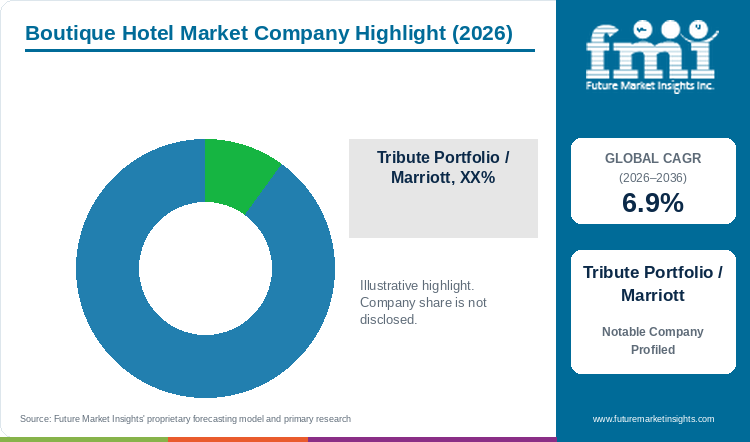
Competition takes place at property level and through the booking networks that help travellers discover the property. Marriott’s Tribute Portfolio, Accor’s MGallery and Hilton’s Outset Collection provide different collection models. SLH curates independent properties, while Kimpton participates through IHG. Individual hotels such as The Hazelton compete through their location, rooms and services. Owners evaluating luxury travel demand need to connect the guest experience with the operating and distribution commitments of the chosen model. [2, 3, 6, 11]
Competitive Benchmarking: Boutique Hotel Market
| Participant | Position | Offer | Route to Guest | Commercial Focus |
|---|---|---|---|---|
| Tribute Portfolio / Marriott | Independent hotel collection | Distinctive individual hotels [2] | Marriott Bonvoy and property channels | Identity with network distribution |
| MGallery / Accor | Hotel collection | Story-led destination properties [11] | Accor and property channels | Design, destination and hospitality |
| Outset Collection / Hilton | Independent hotel collection | Local character and renovated properties [6] | Hilton reservation and loyalty network | Independent identity with broader access |
| Small Luxury Hotels of the World | Independent hotel collection | Selected city and destination stays [9, 10] | Collection and property channels | Discovery across varied destinations |
| Kimpton / IHG | Boutique hotel brand | Urban accommodation and guest services [7, 8] | IHG and hotel websites | Neighbourhood setting and service |
| The Hazelton | Independent hotel | Rooms, dining, spa and events [3, 4] | Direct property reservations | Urban hospitality and business occasions |
| YOTEL | Design-led hotel operator | City, airport and longer-stay formats [5] | Direct and travel distribution | Compact space and travel convenience |
Key Developments in the Boutique Hotel Market
- On May 27, 2026, Hilton announced that The Berkeley Richmond had joined Outset Collection following renovation and was accepting reservations. The hotel connects a historic Richmond location with Hilton’s booking and loyalty network. [6]
- In September 2026, Accor announced the September opening of Nírema Hotel & Spa Samos within MGallery Collection. The announcement linked the property’s accommodation and planned spa and dining offer with the island’s landscape and wine heritage. [11]
- SLH’s July 14, 2026 collection update featured boutique stays across city, mountain, wine-estate and coastal destinations, including Shanghai Muh Shoou Zhujing Hotel and Terrah Hills Resort. The update illustrated the range of settings available within an independent collection. [10]
Key Participants in the Boutique Hotel Market
- Marriott International / Tribute Portfolio
- Accor / MGallery Collection
- Hilton / Outset Collection
- Small Luxury Hotels of the World
- IHG / Kimpton Hotels & Restaurants
- The Hazelton Hotel
- YOTEL
Boutique Hotel Market - Report Scope
| Coverage Field | Report Scope |
|---|---|
| Market Breakdown | Boutique Hotel Type; Booking Channel; Tourist Type; Tour Type; Age Group |
| Quantitative Units | Hotel accommodation and related guest-service revenue in USD billion |
| Market Definition | Distinctive hotel accommodation with an individual property identity and personalised hospitality. Includes relevant independent and collection-affiliated city, suite, airport and resort properties. |
| Regions Covered | North America; Latin America; Western Europe; Eastern Europe; East Asia; South Asia and Pacific; Middle East and Africa |
| Countries Profiled | USA; Canada; Spain; China; India |
| Participants Analyzed | Tribute Portfolio; MGallery; Outset Collection; SLH; Kimpton; The Hazelton; YOTEL |
| 2025 Market Value | USD 10.7 billion |
| 2026 Market Value | USD 11.4 billion |
| 2036 Forecast Value | USD 22.2 billion |
| CAGR | 6.9% |
| Forecast Period | 2026 to 2036 |
Boutique Hotel Market - Research Methodology
| Research Area | Coverage |
|---|---|
| Market Coverage | Boutique accommodation and relevant services delivered during the stay. |
| Industry Evidence | Market outlooks, hotel offers, collection descriptions and company announcements. |
| Segment Analysis | Hotel format, booking route, visitor origin, trip arrangement and age group. |
| Country Analysis | Property examples, destination setting and operating requirements. |
| Participant Analysis | Property operation, collection membership and reservation networks. |
Boutique Hotel Market by Segments
Current and Future Market Size Value (USD Billion) Analysis and Forecast By Boutique Hotel Type, 2026 to 2036
- Business Hotels
- Suite Hotels
- Airport Hotels
- Resorts Hotels
- Others
Current and Future Market Size Value (USD Billion) Analysis and Forecast By Booking Channel, 2026 to 2036
- Online Booking
- Phone Booking
- In Person Booking
Current and Future Market Size Value (USD Billion) Analysis and Forecast By Tourist Type, 2026 to 2036
- Domestic
- International
Current and Future Market Size Value (USD Billion) Analysis and Forecast By Tour Type, 2026 to 2036
- Independent Traveller
- Package Traveller
- Tour Group
Current and Future Market Size Value (USD Billion) Analysis and Forecast By Age Group, 2026 to 2036
- 15 to 25 Years
- 26 to 35 Years
- 36 to 45 Years
- 46 to 55 Years
- 66 to 75 Years
Boutique Hotel Market by Region
- North America
- USA
- Canada
- Mexico
- Latin America
- Brazil
- Chile
- Rest of Latin America
- Western Europe
- Germany
- UK
- Italy
- Spain
- France
- Nordic
- BENELUX
- Rest of Western Europe
- Eastern Europe
- Russia
- Poland
- Hungary
- Balkan and Baltic
- Rest of Eastern Europe
- East Asia
- China
- Japan
- South Korea
- South Asia and Pacific
- India
- ASEAN
- Australia and New Zealand
- Rest of South Asia and Pacific
- Middle East and Africa
- Kingdom of Saudi Arabia
- Other GCC Countries
- Turkiye
- South Africa
- Other African Union
- Rest of Middle East and Africa
Research Sources and Bibliography
- [1] Future Market Insights. Boutique Hotel Market.
- [2] Marriott International. Tribute Portfolio: A Family of Independent Hotels.
- [3] The Hazelton Hotel. Toronto Boutique Accommodation and Guest Services.
- [4] The Hazelton Hotel. Meetings and Events.
- [5] YOTEL. Hotel Locations and Accommodation Formats.
- [6] Hilton (2026, May 27). The Berkeley Richmond Joins Outset Collection.
- Kimpton Palladian Hotel. Downtown Seattle Boutique Hotel.
- IHG. Kimpton Palladian Hotel Amenities.
- Small Luxury Hotels of the World (2026, June 29; updated July 6). Designed to Experience: New Boutique Hotels for July.
- [10] Small Luxury Hotels of the World (2026, July 14). New Boutique Hotels for City, Safari and Countryside Escapes.
- [11] Accor (2026, September). MGallery Collection Unveils Nirema Hotel & Spa Samos.
This Report Answers
- What was the boutique hotel market value in 2025?
- What are the 2026 estimate and 2036 forecast?
- Which hotel types and booking channels are covered?
- How do visitor origin and tour arrangements affect demand?
- How do country settings shape boutique accommodation?
- Which properties and collections participate?
- What do current collection additions and property announcements show?
Frequently Asked Questions
How big is the boutique hotel market in 2026?
The market is estimated at USD 11.4 billion in 2026, following USD 10.7 billion in 2025. [1]
What is forecast for 2036?
The market is forecast at USD 22.2 billion by 2036, expanding at 6.9% CAGR over 2026 to 2036. [1]
Which hotel type is prominent?
Business Hotels are prominent in the hotel-type outlook. [1]
Which booking routes are covered?
Online Booking, Phone Booking and In Person Booking form the booking-channel segmentation. [1]
Do boutique hotels have to be independent?
Independent properties and hotels affiliated with collections both participate. Collection models can combine individual property identity with a larger booking network. [2, 6]
Does boutique mean one fixed room count?
The market spans different property formats. The individual hotel’s rooms, services and identity determine its offer. [3, 5]
Preview the report firsthand - request a free sample
Get SampleGet the brochure for pricing and purchase details.
Get PDFTable of Content
- Key Takeaways
- Market Size and CAGR
- Top Growth Driver
- Fastest Growing Segment
- Leading Region
- Key Companies
- Emerging Opportunities
- Executive Summary
- Global Market Outlook
- Demand-side Trends
- Supply-side Trends
- Technology Roadmap Analysis
- Analysis and Recommendations
- Analyst Perspective (What is happening? Why now? What should investors know?)
- Key Questions Answered
- How large is the market?
- What is the CAGR?
- What are key trends?
- Which region dominates?
- Who are the leaders?
- Market Overview
- Market Coverage / Taxonomy
- Market Definition / Scope / Limitations
- Research Methodology
- Chapter Orientation
- Analytical Lens and Working Hypotheses
- Market Structure, Signals, and Trend Drivers
- Benchmarking and Cross-market Comparability
- Market Sizing, Forecasting, and Opportunity Mapping
- Research Design and Evidence Framework
- Desk Research Programme (Secondary Evidence)
- Expert Input and Fieldwork (Primary Evidence)
- Tooling, Models, and Reference Databases
- Data Engineering and Model Build
- Quality Assurance and Audit Trail
- Market Background
- Market Dynamics (Drivers, Restraints, Opportunity, Trends)
- Scenario Forecast (Optimistic, Likely, Conservative)
- Impact Analysis
- AI Impact
- Sustainability Impact
- Regulatory Impact
- Technology Impact
- Consumer / Buyer Analysis
- Purchase Drivers
- Adoption Barriers
- Buyer Journey
- Opportunity Map Analysis
- Product Life Cycle Analysis
- Supply Chain Analysis
- Investment Feasibility Matrix
- Value Chain Analysis
- PESTLE and Porter's Analysis
- Regulatory Landscape
- Regional Parent Market Outlook
- Production and Consumption Statistics
- Import and Export Statistics
- Global Market Analysis and Forecast, 2021 to 2036
- Historical Market Size Value (USD Billion) Analysis, 2021 to 2025
- Current and Future Market Size Value (USD Billion) Projections, 2026 to 2036
- Y-o-Y Growth Trend Analysis
- Absolute $ Opportunity Analysis
- Global Market Pricing Analysis, 2021 to 2036
- Global Market Analysis and Forecast, By Boutique Hotel Type, 2021 to 2036
- Introduction / Key Findings
- Historical Market Size Value (USD Billion) Analysis By Boutique Hotel Type, 2021 to 2025
- Current and Future Market Size Value (USD Billion) Analysis and Forecast By Boutique Hotel Type, 2026 to 2036
- Business Hotels
- Suite Hotels
- Airport Hotels
- Resorts Hotels
- Others
- Y-o-Y Growth Trend Analysis By Boutique Hotel Type, 2021 to 2025
- Absolute $ Opportunity Analysis By Boutique Hotel Type, 2026 to 2036
- Global Market Analysis and Forecast, By Booking Channel, 2021 to 2036
- Introduction / Key Findings
- Historical Market Size Value (USD Billion) Analysis By Booking Channel, 2021 to 2025
- Current and Future Market Size Value (USD Billion) Analysis and Forecast By Booking Channel, 2026 to 2036
- Online Booking
- Phone Booking
- In Person Booking
- Y-o-Y Growth Trend Analysis By Booking Channel, 2021 to 2025
- Absolute $ Opportunity Analysis By Booking Channel, 2026 to 2036
- Global Market Analysis and Forecast, By Tourist Type, 2021 to 2036
- Introduction / Key Findings
- Historical Market Size Value (USD Billion) Analysis By Tourist Type, 2021 to 2025
- Current and Future Market Size Value (USD Billion) Analysis and Forecast By Tourist Type, 2026 to 2036
- Domestic
- International
- Y-o-Y Growth Trend Analysis By Tourist Type, 2021 to 2025
- Absolute $ Opportunity Analysis By Tourist Type, 2026 to 2036
- Global Market Analysis and Forecast, By Tour Type, 2021 to 2036
- Introduction / Key Findings
- Historical Market Size Value (USD Billion) Analysis By Tour Type, 2021 to 2025
- Current and Future Market Size Value (USD Billion) Analysis and Forecast By Tour Type, 2026 to 2036
- Independent Traveller
- Package Traveller
- Tour Group
- Y-o-Y Growth Trend Analysis By Tour Type, 2021 to 2025
- Absolute $ Opportunity Analysis By Tour Type, 2026 to 2036
- Global Market Analysis and Forecast, By Age Group, 2021 to 2036
- Introduction / Key Findings
- Historical Market Size Value (USD Billion) Analysis By Age Group, 2021 to 2025
- Current and Future Market Size Value (USD Billion) Analysis and Forecast By Age Group, 2026 to 2036
- 15 to 25 Years
- 26 to 35 Years
- 36 to 45 Years
- 46 to 55 Years
- 66 to 75 Years
- Y-o-Y Growth Trend Analysis By Age Group, 2021 to 2025
- Absolute $ Opportunity Analysis By Age Group, 2026 to 2036
- Global Market Analysis and Forecast, By Region, 2021 to 2036
- Introduction
- Historical Market Size Value (USD Billion) Analysis By Region, 2021 to 2025
- Current Market Size Value (USD Billion) Analysis and Forecast By Region, 2026 to 2036
- North America
- Latin America
- Western Europe
- Eastern Europe
- East Asia
- South Asia and Pacific
- Middle East and Africa
- Market Attractiveness Analysis By Region
- North America Market Analysis and Forecast, By Country, 2021 to 2036
- Historical Market Size Value (USD Billion) Trend Analysis By Market Taxonomy, 2021 to 2025
- Market Size Value (USD Billion) Forecast By Market Taxonomy, 2026 to 2036
- By Country
- USA
- Canada
- Mexico
- By Boutique Hotel Type
- By Booking Channel
- By Tourist Type
- By Tour Type
- By Age Group
- By Country
- Market Attractiveness Analysis
- By Country
- By Boutique Hotel Type
- By Booking Channel
- By Tourist Type
- By Tour Type
- By Age Group
- Key Takeaways
- Latin America Market Analysis and Forecast, By Country
- Historical Market Size Value (USD Billion) Trend Analysis By Market Taxonomy, 2021 to 2025
- Market Size Value (USD Billion) Forecast By Market Taxonomy, 2026 to 2036
- By Country
- Brazil
- Chile
- Rest of Latin America
- By Boutique Hotel Type
- By Booking Channel
- By Tourist Type
- By Tour Type
- By Age Group
- By Country
- Market Attractiveness Analysis
- By Country
- By Boutique Hotel Type
- By Booking Channel
- By Tourist Type
- By Tour Type
- By Age Group
- Key Takeaways
- Western Europe Market Analysis and Forecast, By Country
- Historical Market Size Value (USD Billion) Trend Analysis By Market Taxonomy, 2021 to 2025
- Market Size Value (USD Billion) Forecast By Market Taxonomy, 2026 to 2036
- By Country
- Germany
- UK
- Italy
- Spain
- France
- Nordic
- BENELUX
- Rest of Western Europe
- By Boutique Hotel Type
- By Booking Channel
- By Tourist Type
- By Tour Type
- By Age Group
- By Country
- Market Attractiveness Analysis
- By Country
- By Boutique Hotel Type
- By Booking Channel
- By Tourist Type
- By Tour Type
- By Age Group
- Key Takeaways
- Eastern Europe Market Analysis and Forecast, By Country
- Historical Market Size Value (USD Billion) Trend Analysis By Market Taxonomy, 2021 to 2025
- Market Size Value (USD Billion) Forecast By Market Taxonomy, 2026 to 2036
- By Country
- Russia
- Poland
- Hungary
- Balkan and Baltic
- Rest of Eastern Europe
- By Boutique Hotel Type
- By Booking Channel
- By Tourist Type
- By Tour Type
- By Age Group
- By Country
- Market Attractiveness Analysis
- By Country
- By Boutique Hotel Type
- By Booking Channel
- By Tourist Type
- By Tour Type
- By Age Group
- Key Takeaways
- East Asia Market Analysis and Forecast, By Country
- Historical Market Size Value (USD Billion) Trend Analysis By Market Taxonomy, 2021 to 2025
- Market Size Value (USD Billion) Forecast By Market Taxonomy, 2026 to 2036
- By Country
- China
- Japan
- South Korea
- By Boutique Hotel Type
- By Booking Channel
- By Tourist Type
- By Tour Type
- By Age Group
- By Country
- Market Attractiveness Analysis
- By Country
- By Boutique Hotel Type
- By Booking Channel
- By Tourist Type
- By Tour Type
- By Age Group
- Key Takeaways
- South Asia and Pacific Market Analysis and Forecast, By Country
- Historical Market Size Value (USD Billion) Trend Analysis By Market Taxonomy, 2021 to 2025
- Market Size Value (USD Billion) Forecast By Market Taxonomy, 2026 to 2036
- By Country
- India
- ASEAN
- Australia and New Zealand
- Rest of South Asia and Pacific
- By Boutique Hotel Type
- By Booking Channel
- By Tourist Type
- By Tour Type
- By Age Group
- By Country
- Market Attractiveness Analysis
- By Country
- By Boutique Hotel Type
- By Booking Channel
- By Tourist Type
- By Tour Type
- By Age Group
- Key Takeaways
- Middle East and Africa Market Analysis and Forecast, By Country
- Historical Market Size Value (USD Billion) Trend Analysis By Market Taxonomy, 2021 to 2025
- Market Size Value (USD Billion) Forecast By Market Taxonomy, 2026 to 2036
- By Country
- Kingdom of Saudi Arabia
- Other GCC Countries
- Turkiye
- South Africa
- Other African Union
- Rest of Middle East and Africa
- By Boutique Hotel Type
- By Booking Channel
- By Tourist Type
- By Tour Type
- By Age Group
- By Country
- Market Attractiveness Analysis
- By Country
- By Boutique Hotel Type
- By Booking Channel
- By Tourist Type
- By Tour Type
- By Age Group
- Key Takeaways
- Key Countries Market Analysis
- USA
- Pricing Analysis
- Market Share Analysis, 2025
- By Boutique Hotel Type
- By Booking Channel
- By Tourist Type
- By Tour Type
- By Age Group
- Canada
- Pricing Analysis
- Market Share Analysis, 2025
- By Boutique Hotel Type
- By Booking Channel
- By Tourist Type
- By Tour Type
- By Age Group
- Mexico
- Pricing Analysis
- Market Share Analysis, 2025
- By Boutique Hotel Type
- By Booking Channel
- By Tourist Type
- By Tour Type
- By Age Group
- Brazil
- Pricing Analysis
- Market Share Analysis, 2025
- By Boutique Hotel Type
- By Booking Channel
- By Tourist Type
- By Tour Type
- By Age Group
- Chile
- Pricing Analysis
- Market Share Analysis, 2025
- By Boutique Hotel Type
- By Booking Channel
- By Tourist Type
- By Tour Type
- By Age Group
- Germany
- Pricing Analysis
- Market Share Analysis, 2025
- By Boutique Hotel Type
- By Booking Channel
- By Tourist Type
- By Tour Type
- By Age Group
- UK
- Pricing Analysis
- Market Share Analysis, 2025
- By Boutique Hotel Type
- By Booking Channel
- By Tourist Type
- By Tour Type
- By Age Group
- Italy
- Pricing Analysis
- Market Share Analysis, 2025
- By Boutique Hotel Type
- By Booking Channel
- By Tourist Type
- By Tour Type
- By Age Group
- Spain
- Pricing Analysis
- Market Share Analysis, 2025
- By Boutique Hotel Type
- By Booking Channel
- By Tourist Type
- By Tour Type
- By Age Group
- France
- Pricing Analysis
- Market Share Analysis, 2025
- By Boutique Hotel Type
- By Booking Channel
- By Tourist Type
- By Tour Type
- By Age Group
- India
- Pricing Analysis
- Market Share Analysis, 2025
- By Boutique Hotel Type
- By Booking Channel
- By Tourist Type
- By Tour Type
- By Age Group
- ASEAN
- Pricing Analysis
- Market Share Analysis, 2025
- By Boutique Hotel Type
- By Booking Channel
- By Tourist Type
- By Tour Type
- By Age Group
- Australia and New Zealand
- Pricing Analysis
- Market Share Analysis, 2025
- By Boutique Hotel Type
- By Booking Channel
- By Tourist Type
- By Tour Type
- By Age Group
- China
- Pricing Analysis
- Market Share Analysis, 2025
- By Boutique Hotel Type
- By Booking Channel
- By Tourist Type
- By Tour Type
- By Age Group
- Japan
- Pricing Analysis
- Market Share Analysis, 2025
- By Boutique Hotel Type
- By Booking Channel
- By Tourist Type
- By Tour Type
- By Age Group
- South Korea
- Pricing Analysis
- Market Share Analysis, 2025
- By Boutique Hotel Type
- By Booking Channel
- By Tourist Type
- By Tour Type
- By Age Group
- Russia
- Pricing Analysis
- Market Share Analysis, 2025
- By Boutique Hotel Type
- By Booking Channel
- By Tourist Type
- By Tour Type
- By Age Group
- Poland
- Pricing Analysis
- Market Share Analysis, 2025
- By Boutique Hotel Type
- By Booking Channel
- By Tourist Type
- By Tour Type
- By Age Group
- Hungary
- Pricing Analysis
- Market Share Analysis, 2025
- By Boutique Hotel Type
- By Booking Channel
- By Tourist Type
- By Tour Type
- By Age Group
- Kingdom of Saudi Arabia
- Pricing Analysis
- Market Share Analysis, 2025
- By Boutique Hotel Type
- By Booking Channel
- By Tourist Type
- By Tour Type
- By Age Group
- South Africa
- Pricing Analysis
- Market Share Analysis, 2025
- By Boutique Hotel Type
- By Booking Channel
- By Tourist Type
- By Tour Type
- By Age Group
- USA
- Market Structure Analysis
- Competition Dashboard
- Competition Benchmarking
- Market Share Analysis of Top Players
- By Regional
- By Boutique Hotel Type
- By Booking Channel
- By Tourist Type
- By Tour Type
- By Age Group
- Emerging Startups
- Innovation Benchmarking
- Competition Analysis
- Competition Deep Dive
- Tribute Portfolio / Marriott
- Overview
- Product Portfolio
- Profitability by Market Segments
- Sales Footprint
- Strategy Overview
- Marketing Strategy
- Product Strategy
- Channel Strategy
- MGallery / Accor
- Outset Collection / Hilton
- Small Luxury Hotels of the World
- Kimpton / IHG
- The Hazelton
- YOTEL
- Marriott International / Tribute Portfolio
- Accor / MGallery Collection
- Hilton / Outset Collection
- IHG / Kimpton Hotels & Restaurants
- The Hazelton Hotel
- Tribute Portfolio / Marriott
- Case Studies
- Success Stories
- Recent Developments
- Competition Deep Dive
- Assumptions & Acronyms Used


