

- Industry Size (2026)
- USD 8.17 Bn
- Forecast (2036)
- USD 33.03 Bn
- CAGR (2026 to 2036)
- 15.00%
Bike And Scooter Rental Market Size, Market Forecast and Outlook By FMI
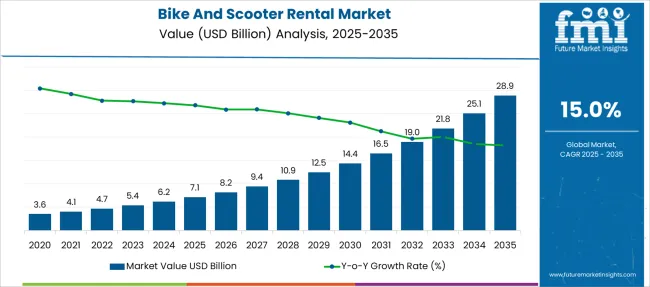
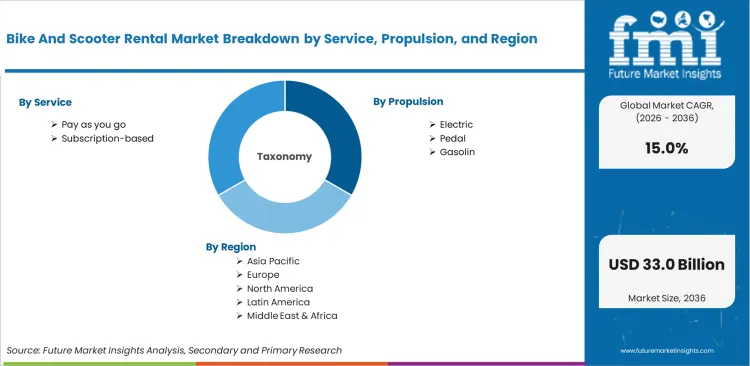
The bike and scooter rental market was valued at USD 7.10 billion in 2025, projected to reach USD 8.17 billion in 2026, and is forecast to expand to USD 33.03 billion by 2036 at a 15.00% CAGR. Structural shifts in end-use procurement cycles and tightening performance specifications across downstream sectors are accelerating capital allocation toward bike and scooter rental categories. Procurement teams operating across global supply chains now require standardized compliance certifications, compressing qualification timelines and elevating minimum specification thresholds for approved supplier lists.
Summary of Bike And Scooter Rental Market
- Market Snapshot
- The bike and scooter rental market is valued at USD 7.10 billion in 2025 and is projected to reach USD 33.03 billion by 2036.
- The industry is expected to grow at a 15.00% CAGR from 2026 to 2036, creating an incremental opportunity of USD 24.87 billion.
- The market operates as a specification-driven procurement category where compliance certifications, material performance standards, and supply chain integration define competitive positioning.
- Demand and Growth Drivers
- Demand is rising as downstream industries face tightening performance specifications and mandatory compliance requirements across procurement cycles.
- Technology upgrades and process automation are accelerating adoption of higher-specification bike and scooter rental products across manufacturing operations.
- Infrastructure expansion programs in emerging economies are creating greenfield demand that bypasses legacy supplier constraints.
- Among key countries, China at 20.30%, India at 18.80%, Germany at 17.30%, France at 15.80%, UK at 14.30%, USA at 12.80%, Brazil at 11.30%.
- Product and Segment View
- The market includes bike and scooter rental products segmented across service, propulsion, operation model, vehicle, rental duration categories serving diverse industrial and commercial applications.
- Pay as you go leads by service with 68.0% share in 2026.
- Electric leads by propulsion with 72.0% share in 2026.
- The scope covers Pay as you go, Subscription-based, Electric, Pedal configurations among other formats, while excluding unrelated commodity categories and non-specialized alternatives.
- Geography and Competitive Outlook
- China and India are the fastest-growing markets due to infrastructure expansion and rising industrial demand, while North America and Europe remain high-value mature demand bases.
- Competition is shaped by vertical integration capabilities, specification compliance certifications, and established procurement channel relationships, with key players including Lime, Bird, Spin (Ford), TIER Mobility, Vogo, Bounce, Yulu.
- Market consolidation trends are evident as leading suppliers acquire complementary capabilities to meet broadening customer specification requirements.
- Analyst Opinion at FMI
- Ronak Shah, Principal Consultant, opines: 'As per FMI analysis, the bike and scooter rental market is transitioning from a volume-driven procurement model to a specification-led qualification framework. Buyers who delay integration of higher-performance bike and scooter rental solutions into their supply chains face material cost escalation as compliance timelines compress. FMI analysts observe that suppliers lacking certified production capabilities will find themselves excluded from approved vendor lists as downstream operators enforce tighter material specifications.'
- Strategic Implications / Executive Takeaways
- Procurement directors must transition vendor qualification processes to prioritize lifecycle cost models and specification compliance certifications over lowest unit price evaluations.
- Capital project teams should mandate compatibility with next-generation performance standards in all new equipment procurement specifications entering the 2027 tender cycle.
- Supply chain architects must develop multi-source qualification programs to mitigate concentration risk across critical bike and scooter rental supply categories.
Bike And Scooter Rental Market Key Takeaways
| Metric | Details |
|---|---|
| Industry Size (2026) | USD 8.17 billion |
| Industry Value (2036) | USD 33.03 billion |
| CAGR (2026-2036) | 15.00% |
Source: Future Market Insights, 2026
Capital expenditure planning cycles across verticals consuming bike and scooter rental products have shifted from discretionary upgrades to mandated replacements. Regulatory frameworks governing material performance, safety testing, and environmental compliance are tightening across all major consumption regions. Buyers evaluating supplier contracts increasingly weight lifecycle cost models over upfront unit pricing, favoring suppliers with vertically integrated operations and certified testing capabilities.
Regional deployment parameters reflect differentiated adoption velocities. China sets the pace with a 20.30% CAGR, followed by India at 18.80% as infrastructure expansion programs bypass legacy procurement constraints. Germany operations advance at a 17.30% rate, supported by regulatory compliance mandates. France tracks at 15.80%. UK networks maintain a 14.30% expansion trajectory. USA registers a 12.80% pace. Brazil expands at a 11.30% trajectory.
Bike And Scooter Rental Market Definition
Bike And Scooter Rental constitutes the material, product, or technology category defined by its primary industrial function within downstream manufacturing and end-use sectors. The scope encompasses standardized and specialty configurations compliant with global performance and safety specifications. Core inclusions govern products meeting defined procurement parameters across industrial, commercial, and institutional buyer categories.
Bike And Scooter Rental Market Inclusions
Market scope includes Pay as you go, Subscription-based, Electric, Pedal, Gasolin configurations and related product variants. Global and regional market sizes, forecast period 2026 to 2036, and segment breakdowns by service, propulsion, operation model, vehicle, rental duration are fully incorporated within the analytical boundary.
Bike And Scooter Rental Market Exclusions
Standard commodity alternatives lacking specialized performance certifications are excluded. Downstream finished goods, standalone accessory components, and non-standardized custom fabrications fall outside the analytical parameters. Legacy product formats without current industry specification compliance are explicitly omitted from the valuation.
Bike And Scooter Rental Market Research Methodology
- Primary Research: Analysts engaged with procurement specification leads, technical managers, and supply chain directors across key consumption sectors to map decision gates triggering product upgrades and supplier requalification.
- Desk Research: Data collection phases aggregated regulatory compliance frameworks, industry standards ratification schedules, and published procurement guidelines from major institutional buyers.
- Market-Sizing and Forecasting: Baseline values derive from a bottom-up aggregation of product volumes and contract values, applying region-specific adoption curves to project future demand velocity.
- Data Validation and Update Cycle: Projections are tested against publicly reported expenditure guidance from leading industrial consumers and trade association production statistics.
Why is the Bike and Scooter Rental Market Growing?
The Bike and Scooter Rental market is undergoing significant transformation as urban mobility solutions continue to evolve in response to rising traffic congestion, increasing fuel costs, and heightened environmental awareness. This growth is being sustained by a shift in consumer preferences toward shared, affordable, and sustainable transportation modes that can seamlessly integrate with public transit. Advancements in mobile app-based booking, real-time GPS tracking, and digital payment systems have further enabled widespread adoption of rental services across metropolitan regions.
Policymakers and municipal authorities are actively encouraging micromobility initiatives to reduce urban emissions and promote last-mile connectivity. The presence of a large base of environmentally conscious consumers, especially in densely populated cities, is creating fertile ground for expansion.
Continuous investments from private operators, infrastructure development, and regulatory support are all contributing to long-term market stability. As consumer behavior increasingly aligns with on-demand transportation and shared mobility, the bike and scooter rental industry is expected to witness sustained growth through technology-driven innovation and operational scalability..
Segmental Analysis
The market is segmented by Service, Propulsion, Operation Model, Vehicle, and Rental Duration and region. By Service, the market is divided into Pay as you go and Subscription-based. In terms of Propulsion, the market is classified into Electric, Pedal, and Gasolin.
Based on Operation Model, the market is segmented into Dockless and Station-based. By Vehicle, the market is divided into Scooter and Bike. By Rental Duration, the market is segmented into Short term, Pedal, Electric, Gasoline, Long term, Pedal, Electric, and Gasoline. Regionally, the market is classified into North America, Latin America, Western Europe, Eastern Europe, Balkan & Baltic Countries, Russia & Belarus, Central Asia, East Asia, South Asia & Pacific, and the Middle East & Africa.
Insights into the Pay as you go Service Segment
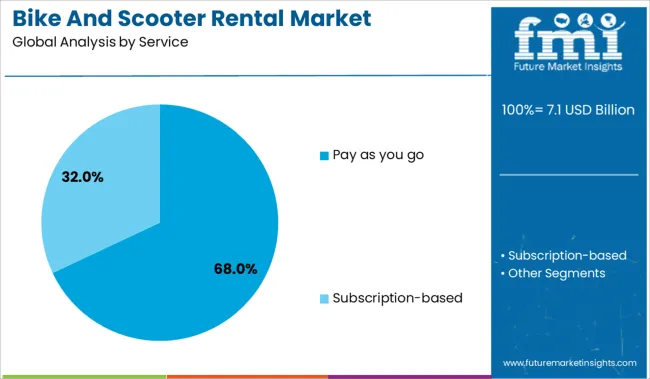
The pay as you go service segment is projected to account for 68% of the Bike and Scooter Rental market revenue share in 2026, making it the dominant service model. The segment’s popularity has been driven by its flexible pricing structure, which allows users to rent vehicles on a per-minute or per-trip basis without long-term commitment. This approach has appealed especially to casual riders, tourists, and commuters seeking affordable and short-duration travel solutions.
Ease of access through smartphone applications and the absence of subscription fees have contributed to greater adoption. Operators have favored this model due to its low customer acquisition cost and high user turnover, leading to improved fleet utilization rates.
Pay as you go services have also enabled service providers to penetrate new markets without deploying complex pricing infrastructures. As consumers continue to prioritize convenience, transparency, and cost efficiency, the pay as you go service format has remained the preferred choice across both mature and emerging urban centers..
Insights into the Electric Propulsion Segment
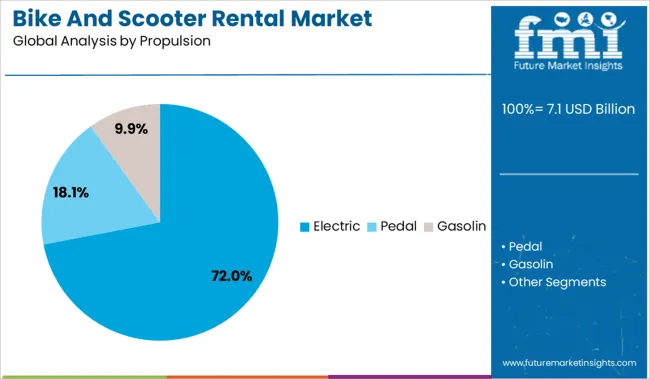
The electric propulsion segment is expected to command 72% of the Bike and Scooter Rental market revenue share in 2026, establishing it as the leading propulsion type. Growth in this segment has been influenced by increasing demand for zero-emission transportation and rising fuel prices, which have accelerated the shift toward electric alternatives. Electric bikes and scooters offer a quiet, efficient, and low-maintenance alternative to traditional combustion-powered vehicles.
Supportive government policies, including incentives, subsidies, and relaxed regulations for electric mobility, have encouraged both service providers and consumers to transition to electric fleets. Additionally, advancements in battery technology have extended travel ranges and reduced charging times, enhancing the user experience and operational efficiency.
The environmental sustainability of electric vehicles has also aligned with the growing commitment of cities to reduce air pollution and carbon emissions. The combination of environmental, economic, and policy-driven factors has ensured the continued dominance of electric propulsion in the micromobility ecosystem..
Insights into the Dockless Operation Model Segment
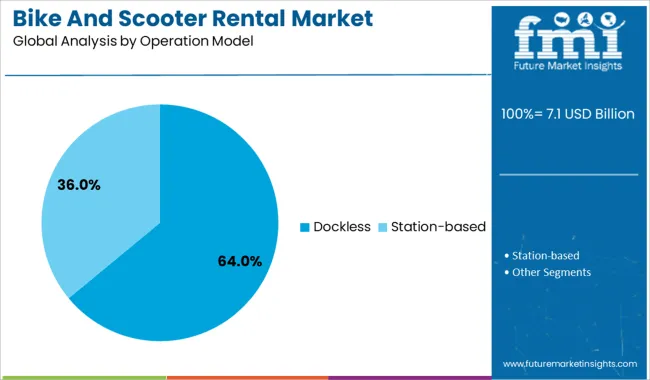
The dockless operation model segment is forecasted to capture 64% of the Bike and Scooter Rental market revenue share in 2026, positioning it as the leading operational framework. This model has been adopted widely due to its unmatched convenience, allowing users to pick up and drop off vehicles at any legal public location without requiring fixed docking stations. The ease of access provided by GPS-enabled mobile applications has enhanced user flexibility and led to greater trip volumes per vehicle.
From an operator’s perspective, the dockless model has enabled faster scaling and reduced infrastructure investment compared to station-based systems. Urban planners and transport authorities have supported this model due to its minimal space requirements and adaptability across different city layouts.
While the model has required careful management of fleet distribution and parking compliance, advances in geofencing and real-time fleet monitoring have mitigated these challenges. The dockless approach continues to gain traction as cities and consumers alike prioritize agile and user-centric mobility solutions..
What are the Drivers, Restraints, and Key Trends of the Bike and Scooter Rental Market?
The bike and scooter rental market has revealed strong opportunities through tourism integration and institutional partnerships. From 2023 to 2026, services were embedded into travel packages, hotel bookings, and campus transit systems, allowing rentals to move beyond commuter use. These models enabled providers to capture predictable, high-frequency demand across leisure and organizational segments. As shared mobility becomes embedded in travel and corporate routines, rental operators are positioned to scale through targeted, contract-based deployment strategies.
Increasing urban mobility demand accelerates rentals adoption
Rapid expansion of bike and scooter sharing systems was observed in 2023, with a notable rise in ride volumes that highlighted sustained reliance on micromobility options. In 2026, dockless electric scooters and e-bikes were more widely integrated into public transport corridors, improving access to first- and last-mile connectivity across cities. By 2026, extensions of government-supported rental trials were introduced in several countries to develop regulatory blueprints and scale up shared mobility operations. These developments have shown that rising commuter volume, paired with structured municipal involvement, has fueled market expansion. The shift toward flexible, short-distance mobility is no longer experimental-it has become a recurring demand, reinforced by transit system gaps.
Tourism sector integration unlocks shared mobility opportunities
The infusion of bike and scooter rental services into tourism offerings was leveraged in 2023 when guided micromobility tours were introduced in major European and Asian destinations. In 2026, partnerships with hotels and travel agencies were being formalized to provide rental fleets directly at booking touchpoints. By early 2026, integrated booking platforms were facilitating on-demand access via vacation packages, boosting usage among international travelers. These initiatives have shown that micromobility can evolve from general urban transport into curated sightseeing experiences. Providers positioned within the travel ecosystem are thus poised to capture value by offering convenient, accessible mobility bundles tailored to visitor preferences and trip itineraries.
Analysis of Bike And Scooter Rental Market By Key Countries
.webp "Top Country Growth Comparison Bike And Scooter Rental Market Cagr (2026 2036)")
| Country | CAGR |
|---|---|
| China | 20.3% |
| India | 18.8% |
| Germany | 17.3% |
| France | 15.8% |
| UK | 14.3% |
| USA | 12.8% |
| Brazil | 11.3% |
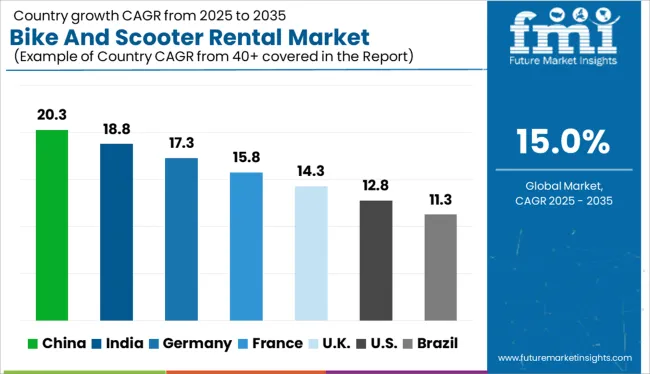
The RF smart electric meter market is projected to expand globally at a CAGR of 10% from 2026 to 2036. China leads the growth with a 13.4% CAGR, followed by India at 12.4% and Germany at 11.4%. France records a steady 10.4%, while the United Kingdom trails slightly at 9.4%. China and India are accelerating rollout through nationwide grid modernization and wireless AMI programs. Germany's emphasis on energy data privacy and interoperability standards supports strong expansion. France invests in meter digitalization via utilities-backed programs, while the UK reflects a more phased approach influenced by consumer pushback and infrastructure constraints.
Sales Outlook for Bike and Scooter Rental Platforms in China
China is projected to lead the global bike and scooter rental market with a 20.3% CAGR, supported by aggressive government backing and the dominance of app-integrated platforms. Operators like Meituan and HelloBike continue to expand fleets with AI-enabled demand tracking and smart lock features. High ridership in Tier-1 and Tier-2 cities stems from congestion avoidance and flexible fare systems. Integration with local transit apps drives higher consumer retention.
- GPS-optimized fleet redistribution improves vehicle availability.
- In-app loyalty programs drive high-frequency ridership in metros.
- Low-cost manufacturing base allows faster fleet refresh cycles.
Demand Analysis for Bike and Scooter Rentals in India
India is expected to grow at an 18.8% CAGR in the bike and scooter rental segment, driven by dense city networks and demand for low-cost urban mobility. Startups and EV-first platforms are deploying battery-swappable scooters across tech parks, metro stations, and university zones. State incentives for electric mobility expansion further support rental infrastructure. Companies are offering micro-leasing options for college students and gig workers.
- EV subsidies promote transition from petrol to e-scooter rental models.
- QR-based unlocking systems reduce onboarding friction.
- Regional fleet operators partner with last-mile delivery startups.
In-depth Analysis of Bike and Scooter Rental Services in Germany
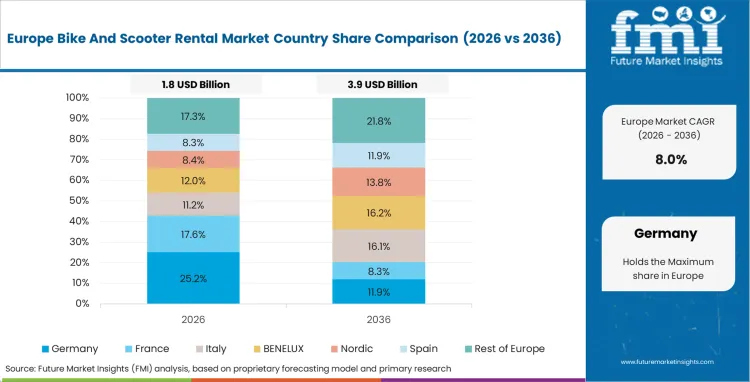
Germany’s bike and scooter rental market is forecast to grow at a 17.3% CAGR, supported by green transport policies and digital infrastructure integration. Municipal partnerships in Berlin, Hamburg, and Munich enable fleet co-management with urban planners. Shared mobility providers integrate with Deutsche Bahn apps to offer seamless first- and last-mile options. Subscription-based access models are rising in usage, particularly for scooters in younger urban populations.
- Local governments offer regulatory backing for e-scooter trial zones.
- Smart city initiatives support vehicle tracking and fleet zoning.
- Co-branded platforms introduce corporate mobility packages.
Opportunity Analysis for Bike and Scooter Rental Operators in France
France is projected to expand its bike and scooter rental market at a 15.8% CAGR, backed by public funding for shared mobility and eco-transportation targets. Cities like Paris and Lyon have adopted large-scale scooter regulation frameworks while promoting public-private stationless bike deployments. Multimodal fare cards now include bike access through regional transit passes. Domestic firms and international entrants compete on pricing and vehicle durability.
- Public transit authorities link passes with shared vehicle access.
- EU urban air quality mandates encourage rental fleet expansion.
- Compact cities promote stationless rentals for high turnover.
Growth and Expansion Outlook for Bike and Scooter Rental Market in the United Kingdom
The United Kingdom is forecast to grow its bike and scooter rental market at a 14.3% CAGR, with adoption rising through campus mobility pilots, tourism hubs, and business districts. Providers like Lime, Voi, and Tier operate under trial zones with strict compliance requirements. Helmet accessibility, geo-fencing, and speed restrictions remain core focus areas. Rental use is especially strong during events and in travel corridors underserved by public transit.
- Tiered fare models offer affordability for short-term urban users.
- Policy hesitancy limits rollout to controlled pilot areas.
- Strong uptake in university towns and intermodal transit gaps.
Competitive Landscape of Bike And Scooter Rental Market
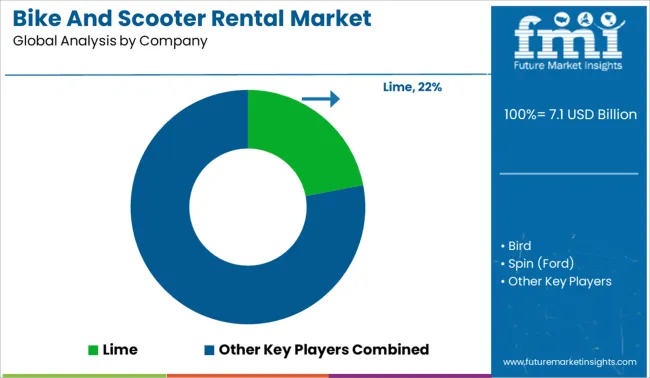
The bike and scooter rental market is moderately consolidated, led by Lime. The company holds a dominant position through its global fleet of electric scooters and bikes, strong app-based ecosystem, and extensive municipal partnerships across North America, Europe, and Asia. Dominant player status is held exclusively by Lime. Key players include Bird, Spin (Ford), TIER Mobility, and Lyft - each offering app-integrated shared mobility services with a focus on fleet optimization, multimodal integration, and urban mobility contracts. Emerging players such as Vogo, Bounce, and Yulu focus on regional markets through dockless systems, cost-sensitive two-wheeler fleets, and collaborations with smart city initiatives. Market demand is driven by rising need for last-mile connectivity, shifting commuter preferences, and supportive policies favoring micro-mobility adoption.
Key Developments in Bike And Scooter Rental Market
- In July 2025, Bolt announced plans to roll out thousands of AI-managed e-bikes across London by August. The deployment intensifies competition with operators like Lime and Voi, sparking regulatory conversations around fleet limits and pedestrian space management.
- In June 2025, Lime extended its multi-year global partnership with Uber, offering integrated access to micromobility services. Uber One members now receive 10% cashback on Lime rides, reinforcing efforts to promote shared, low-emission transportation across key international urban markets.
Scope of the Report
| Metric | Value |
|---|---|
| Quantitative Units | USD 8.17 billion to USD 33.03 billion, at a CAGR of 15.00% |
| Market Definition | Bike And Scooter Rental encompasses the material, product, or technology category serving downstream industrial, commercial, and institutional end-use sectors under defined performance and safety specifications. |
| Service Segmentation | Pay as you go, Subscription-based |
| Propulsion Segmentation | Electric, Pedal, Gasolin |
| Operation Model Segmentation | Dockless, Station-based |
| Vehicle Segmentation | Scooter, Bike |
| Rental Duration Segmentation | Short term, Pedal, Electric, Gasoline, Long term, Pedal, Electric, Gasoline |
| Regions Covered | North America, Latin America, Europe, East Asia, South Asia, Oceania, Middle East & Africa |
| Countries Covered | China, India, Germany, France, UK, USA, Brazil, and 40 plus countries |
| Key Companies Profiled | Lime, Bird, Spin (Ford), TIER Mobility, Vogo, Bounce, Yulu, Lyft |
| Forecast Period | 2026 to 2036 |
| Approach | Forecasting models apply a bottom-up methodology starting with global installed base metrics and projecting conversion rates to higher-specification product categories. |
Bike And Scooter Rental Market by Segments
Service:
- Pay as you go
- Subscription-based
Propulsion:
- Electric
- Pedal
- Gasolin
Operation Model:
- Dockless
- Station-based
Vehicle:
- Scooter
- Bike
Rental Duration:
- Short term
- Pedal
- Electric
- Gasoline
- Long term
- Pedal
- Electric
- Gasoline
Region:
- North America
- USA
- Canada
- Mexico
- Latin America
- Brazil
- Chile
- Rest of Latin America
- Western Europe
- Germany
- UK
- Italy
- Spain
- France
- Nordic
- BENELUX
- Rest of Western Europe
- Eastern Europe
- Russia
- Poland
- Hungary
- Balkan & Baltic
- Rest of Eastern Europe
- East Asia
- China
- Japan
- South Korea
- South Asia and Pacific
- India
- ASEAN
- Australia & New Zealand
- Rest of South Asia and Pacific
- Middle East & Africa
- Kingdom of Saudi Arabia
- Other GCC Countries
- Turkiye
- South Africa
- Other African Union
- Rest of Middle East & Africa
Bibliography
- 1. Organisation for Economic Co-operation and Development. (2025, June). Industrial performance and competitiveness indicators. OECD.
- 2. World Bank Group. (2025). Global economic prospects: Industrial supply chains and trade facilitation. World Bank.
- 3. United Nations Industrial Development Organization. (2025). Industrial development report: Manufacturing and global value chains. UNIDO.
- 4. International Organization for Standardization. (2025). ISO standards catalogue: Materials testing and quality management. ISO.
- 5. European Commission, Directorate-General for Internal Market, Industry, Entrepreneurship and SMEs. (2025). Single market for goods: Industrial product compliance. European Commission.
- 6. USA Bureau of Labor Statistics. (2025). Producer price indexes for intermediate demand. USA Department of Labor.
This bibliography is provided for reader reference. The full Future Market Insights report contains the complete reference list with primary research documentation.
Frequently Asked Questions
How large is the demand for Bike And Scooter Rental in the global market in 2026?
Demand for Bike And Scooter Rental in the global market is estimated to be valued at USD 8.17 billion in 2026.
What will be the market size of Bike And Scooter Rental in the global market by 2036?
Market size for Bike And Scooter Rental is projected to reach USD 33.03 billion by 2036.
What is the expected demand growth for Bike And Scooter Rental in the global market between 2026 and 2036?
Demand for Bike And Scooter Rental is expected to grow at a CAGR of 15.00% between 2026 and 2036.
Which Service is poised to lead global sales by 2026?
Pay as you go accounts for 68.0% in 2026, driven by established procurement specifications and downstream integration requirements.
What is driving demand in China?
China leads with a 20.30% CAGR as greenfield industrial facilities deploying modern procurement frameworks create scaled demand for specification-compliant bike and scooter rental products.
What is the India growth outlook in this report?
India is projected to grow at a CAGR of 18.80% during 2026 to 2036.
What is Bike And Scooter Rental and what is it mainly used for?
Bike And Scooter Rental constitutes the specialized material, product, or technology category designed for defined industrial, commercial, and institutional applications. End-use sectors primarily deploy it to meet performance, safety, and regulatory compliance requirements.
How does FMI build and validate the Bike And Scooter Rental forecast?
Forecasting models apply a bottom-up methodology starting with global installed base metrics and cross-validate projections against quarterly industry production and trade volumes.
Preview the report firsthand - request a free sample
Get SampleGet the brochure for pricing and purchase details.
Get PDFTable of Content
- Executive Summary
- Global Market Outlook
- Demand-side Trends
- Supply-side Trends
- Technology Roadmap Analysis
- Analysis and Recommendations
- Market Overview
- Market Coverage / Taxonomy
- Market Definition / Scope / Limitations
- Research Methodology
- Chapter Orientation
- Analytical Lens and Working Hypotheses
- Market Structure, Signals, and Trend Drivers
- Benchmarking and Cross-market Comparability
- Market Sizing, Forecasting, and Opportunity Mapping
- Research Design and Evidence Framework
- Desk Research Programme (Secondary Evidence)
- Company Annual and Sustainability Reports
- Peer-reviewed Journals and Academic Literature
- Corporate Websites, Product Literature, and Technical Notes
- Earnings Decks and Investor Briefings
- Statutory Filings and Regulatory Disclosures
- Technical White Papers and Standards Notes
- Trade Journals, Industry Magazines, and Analyst Briefs
- Conference Proceedings, Webinars, and Seminar Materials
- Government Statistics Portals and Public Data Releases
- Press Releases and Reputable Media Coverage
- Specialist Newsletters and Curated Briefings
- Sector Databases and Reference Repositories
- FMI Internal Proprietary Databases and Historical Market Datasets
- Subscription Datasets and Paid Sources
- Social Channels, Communities, and Digital Listening Inputs
- Additional Desk Sources
- Expert Input and Fieldwork (Primary Evidence)
- Primary Modes
- Qualitative Interviews and Expert Elicitation
- Quantitative Surveys and Structured Data Capture
- Blended Approach
- Why Primary Evidence is Used
- Field Techniques
- Interviews
- Surveys
- Focus Groups
- Observational and In-context Research
- Social and Community Interactions
- Stakeholder Universe Engaged
- C-suite Leaders
- Board Members
- Presidents and Vice Presidents
- R&D and Innovation Heads
- Technical Specialists
- Domain Subject-matter Experts
- Scientists
- Physicians and Other Healthcare Professionals
- Governance, Ethics, and Data Stewardship
- Research Ethics
- Data Integrity and Handling
- Primary Modes
- Tooling, Models, and Reference Databases
- Desk Research Programme (Secondary Evidence)
- Data Engineering and Model Build
- Data Acquisition and Ingestion
- Cleaning, Normalisation, and Verification
- Synthesis, Triangulation, and Analysis
- Quality Assurance and Audit Trail
- Market Background
- Market Dynamics
- Drivers
- Restraints
- Opportunity
- Trends
- Scenario Forecast
- Demand in Optimistic Scenario
- Demand in Likely Scenario
- Demand in Conservative Scenario
- Opportunity Map Analysis
- Product Life Cycle Analysis
- Supply Chain Analysis
- Investment Feasibility Matrix
- Value Chain Analysis
- PESTLE and Porter’s Analysis
- Regulatory Landscape
- Regional Parent Market Outlook
- Production and Consumption Statistics
- Import and Export Statistics
- Market Dynamics
- Global Market Analysis 2021 to 2025 and Forecast, 2026 to 2036
- Historical Market Size Value (USD Million) Analysis, 2021 to 2025
- Current and Future Market Size Value (USD Million) Projections, 2026 to 2036
- Y-o-Y Growth Trend Analysis
- Absolute $ Opportunity Analysis
- Global Market Pricing Analysis 2021 to 2025 and Forecast 2026 to 2036
- Global Market Analysis 2021 to 2025 and Forecast 2026 to 2036, By Service
- Introduction / Key Findings
- Historical Market Size Value (USD Million) Analysis By Service , 2021 to 2025
- Current and Future Market Size Value (USD Million) Analysis and Forecast By Service , 2026 to 2036
- Pay as you go
- Subscription-based
- Pay as you go
- Y-o-Y Growth Trend Analysis By Service , 2021 to 2025
- Absolute $ Opportunity Analysis By Service , 2026 to 2036
- Global Market Analysis 2021 to 2025 and Forecast 2026 to 2036, By Propulsion
- Introduction / Key Findings
- Historical Market Size Value (USD Million) Analysis By Propulsion, 2021 to 2025
- Current and Future Market Size Value (USD Million) Analysis and Forecast By Propulsion, 2026 to 2036
- Electric
- Pedal
- Gasolin
- Electric
- Y-o-Y Growth Trend Analysis By Propulsion, 2021 to 2025
- Absolute $ Opportunity Analysis By Propulsion, 2026 to 2036
- Global Market Analysis 2021 to 2025 and Forecast 2026 to 2036, By Operation Model
- Introduction / Key Findings
- Historical Market Size Value (USD Million) Analysis By Operation Model, 2021 to 2025
- Current and Future Market Size Value (USD Million) Analysis and Forecast By Operation Model, 2026 to 2036
- Dockless
- Station-based
- Dockless
- Y-o-Y Growth Trend Analysis By Operation Model, 2021 to 2025
- Absolute $ Opportunity Analysis By Operation Model, 2026 to 2036
- Global Market Analysis 2021 to 2025 and Forecast 2026 to 2036, By Vehicle
- Introduction / Key Findings
- Historical Market Size Value (USD Million) Analysis By Vehicle, 2021 to 2025
- Current and Future Market Size Value (USD Million) Analysis and Forecast By Vehicle, 2026 to 2036
- Scooter
- Bike
- Scooter
- Y-o-Y Growth Trend Analysis By Vehicle, 2021 to 2025
- Absolute $ Opportunity Analysis By Vehicle, 2026 to 2036
- Global Market Analysis 2021 to 2025 and Forecast 2026 to 2036, By Rental Duration
- Introduction / Key Findings
- Historical Market Size Value (USD Million) Analysis By Rental Duration, 2021 to 2025
- Current and Future Market Size Value (USD Million) Analysis and Forecast By Rental Duration, 2026 to 2036
- Short term
- Pedal
- Electric
- Gasoline
- Long term
- Pedal
- Electric
- Gasoline
- Short term
- Y-o-Y Growth Trend Analysis By Rental Duration, 2021 to 2025
- Absolute $ Opportunity Analysis By Rental Duration, 2026 to 2036
- Global Market Analysis 2021 to 2025 and Forecast 2026 to 2036, By Region
- Introduction
- Historical Market Size Value (USD Million) Analysis By Region, 2021 to 2025
- Current Market Size Value (USD Million) Analysis and Forecast By Region, 2026 to 2036
- North America
- Latin America
- Western Europe
- Eastern Europe
- East Asia
- South Asia and Pacific
- Middle East & Africa
- Market Attractiveness Analysis By Region
- North America Market Analysis 2021 to 2025 and Forecast 2026 to 2036, By Country
- Historical Market Size Value (USD Million) Trend Analysis By Market Taxonomy, 2021 to 2025
- Market Size Value (USD Million) Forecast By Market Taxonomy, 2026 to 2036
- By Country
- USA
- Canada
- Mexico
- By Service
- By Propulsion
- By Operation Model
- By Vehicle
- By Rental Duration
- By Country
- Market Attractiveness Analysis
- By Country
- By Service
- By Propulsion
- By Operation Model
- By Vehicle
- By Rental Duration
- Key Takeaways
- Latin America Market Analysis 2021 to 2025 and Forecast 2026 to 2036, By Country
- Historical Market Size Value (USD Million) Trend Analysis By Market Taxonomy, 2021 to 2025
- Market Size Value (USD Million) Forecast By Market Taxonomy, 2026 to 2036
- By Country
- Brazil
- Chile
- Rest of Latin America
- By Service
- By Propulsion
- By Operation Model
- By Vehicle
- By Rental Duration
- By Country
- Market Attractiveness Analysis
- By Country
- By Service
- By Propulsion
- By Operation Model
- By Vehicle
- By Rental Duration
- Key Takeaways
- Western Europe Market Analysis 2021 to 2025 and Forecast 2026 to 2036, By Country
- Historical Market Size Value (USD Million) Trend Analysis By Market Taxonomy, 2021 to 2025
- Market Size Value (USD Million) Forecast By Market Taxonomy, 2026 to 2036
- By Country
- Germany
- UK
- Italy
- Spain
- France
- Nordic
- BENELUX
- Rest of Western Europe
- By Service
- By Propulsion
- By Operation Model
- By Vehicle
- By Rental Duration
- By Country
- Market Attractiveness Analysis
- By Country
- By Service
- By Propulsion
- By Operation Model
- By Vehicle
- By Rental Duration
- Key Takeaways
- Eastern Europe Market Analysis 2021 to 2025 and Forecast 2026 to 2036, By Country
- Historical Market Size Value (USD Million) Trend Analysis By Market Taxonomy, 2021 to 2025
- Market Size Value (USD Million) Forecast By Market Taxonomy, 2026 to 2036
- By Country
- Russia
- Poland
- Hungary
- Balkan & Baltic
- Rest of Eastern Europe
- By Service
- By Propulsion
- By Operation Model
- By Vehicle
- By Rental Duration
- By Country
- Market Attractiveness Analysis
- By Country
- By Service
- By Propulsion
- By Operation Model
- By Vehicle
- By Rental Duration
- Key Takeaways
- East Asia Market Analysis 2021 to 2025 and Forecast 2026 to 2036, By Country
- Historical Market Size Value (USD Million) Trend Analysis By Market Taxonomy, 2021 to 2025
- Market Size Value (USD Million) Forecast By Market Taxonomy, 2026 to 2036
- By Country
- China
- Japan
- South Korea
- By Service
- By Propulsion
- By Operation Model
- By Vehicle
- By Rental Duration
- By Country
- Market Attractiveness Analysis
- By Country
- By Service
- By Propulsion
- By Operation Model
- By Vehicle
- By Rental Duration
- Key Takeaways
- South Asia and Pacific Market Analysis 2021 to 2025 and Forecast 2026 to 2036, By Country
- Historical Market Size Value (USD Million) Trend Analysis By Market Taxonomy, 2021 to 2025
- Market Size Value (USD Million) Forecast By Market Taxonomy, 2026 to 2036
- By Country
- India
- ASEAN
- Australia & New Zealand
- Rest of South Asia and Pacific
- By Service
- By Propulsion
- By Operation Model
- By Vehicle
- By Rental Duration
- By Country
- Market Attractiveness Analysis
- By Country
- By Service
- By Propulsion
- By Operation Model
- By Vehicle
- By Rental Duration
- Key Takeaways
- Middle East & Africa Market Analysis 2021 to 2025 and Forecast 2026 to 2036, By Country
- Historical Market Size Value (USD Million) Trend Analysis By Market Taxonomy, 2021 to 2025
- Market Size Value (USD Million) Forecast By Market Taxonomy, 2026 to 2036
- By Country
- Kingdom of Saudi Arabia
- Other GCC Countries
- Turkiye
- South Africa
- Other African Union
- Rest of Middle East & Africa
- By Service
- By Propulsion
- By Operation Model
- By Vehicle
- By Rental Duration
- By Country
- Market Attractiveness Analysis
- By Country
- By Service
- By Propulsion
- By Operation Model
- By Vehicle
- By Rental Duration
- Key Takeaways
- Key Countries Market Analysis
- USA
- Pricing Analysis
- Market Share Analysis, 2025
- By Service
- By Propulsion
- By Operation Model
- By Vehicle
- By Rental Duration
- Canada
- Pricing Analysis
- Market Share Analysis, 2025
- By Service
- By Propulsion
- By Operation Model
- By Vehicle
- By Rental Duration
- Mexico
- Pricing Analysis
- Market Share Analysis, 2025
- By Service
- By Propulsion
- By Operation Model
- By Vehicle
- By Rental Duration
- Brazil
- Pricing Analysis
- Market Share Analysis, 2025
- By Service
- By Propulsion
- By Operation Model
- By Vehicle
- By Rental Duration
- Chile
- Pricing Analysis
- Market Share Analysis, 2025
- By Service
- By Propulsion
- By Operation Model
- By Vehicle
- By Rental Duration
- Germany
- Pricing Analysis
- Market Share Analysis, 2025
- By Service
- By Propulsion
- By Operation Model
- By Vehicle
- By Rental Duration
- UK
- Pricing Analysis
- Market Share Analysis, 2025
- By Service
- By Propulsion
- By Operation Model
- By Vehicle
- By Rental Duration
- Italy
- Pricing Analysis
- Market Share Analysis, 2025
- By Service
- By Propulsion
- By Operation Model
- By Vehicle
- By Rental Duration
- Spain
- Pricing Analysis
- Market Share Analysis, 2025
- By Service
- By Propulsion
- By Operation Model
- By Vehicle
- By Rental Duration
- France
- Pricing Analysis
- Market Share Analysis, 2025
- By Service
- By Propulsion
- By Operation Model
- By Vehicle
- By Rental Duration
- India
- Pricing Analysis
- Market Share Analysis, 2025
- By Service
- By Propulsion
- By Operation Model
- By Vehicle
- By Rental Duration
- ASEAN
- Pricing Analysis
- Market Share Analysis, 2025
- By Service
- By Propulsion
- By Operation Model
- By Vehicle
- By Rental Duration
- Australia & New Zealand
- Pricing Analysis
- Market Share Analysis, 2025
- By Service
- By Propulsion
- By Operation Model
- By Vehicle
- By Rental Duration
- China
- Pricing Analysis
- Market Share Analysis, 2025
- By Service
- By Propulsion
- By Operation Model
- By Vehicle
- By Rental Duration
- Japan
- Pricing Analysis
- Market Share Analysis, 2025
- By Service
- By Propulsion
- By Operation Model
- By Vehicle
- By Rental Duration
- South Korea
- Pricing Analysis
- Market Share Analysis, 2025
- By Service
- By Propulsion
- By Operation Model
- By Vehicle
- By Rental Duration
- Russia
- Pricing Analysis
- Market Share Analysis, 2025
- By Service
- By Propulsion
- By Operation Model
- By Vehicle
- By Rental Duration
- Poland
- Pricing Analysis
- Market Share Analysis, 2025
- By Service
- By Propulsion
- By Operation Model
- By Vehicle
- By Rental Duration
- Hungary
- Pricing Analysis
- Market Share Analysis, 2025
- By Service
- By Propulsion
- By Operation Model
- By Vehicle
- By Rental Duration
- Kingdom of Saudi Arabia
- Pricing Analysis
- Market Share Analysis, 2025
- By Service
- By Propulsion
- By Operation Model
- By Vehicle
- By Rental Duration
- Turkiye
- Pricing Analysis
- Market Share Analysis, 2025
- By Service
- By Propulsion
- By Operation Model
- By Vehicle
- By Rental Duration
- South Africa
- Pricing Analysis
- Market Share Analysis, 2025
- By Service
- By Propulsion
- By Operation Model
- By Vehicle
- By Rental Duration
- USA
- Market Structure Analysis
- Competition Dashboard
- Competition Benchmarking
- Market Share Analysis of Top Players
- By Region
- By Service
- By Propulsion
- By Operation Model
- By Vehicle
- By Rental Duration
- Competition Analysis
- Competition Deep Dive
- Lime
- Overview
- Product Portfolio
- Profitability by Market Segments (Product/Age /Sales Channel/Region)
- Sales Footprint
- Strategy Overview
- Marketing Strategy
- Product Strategy
- Channel Strategy
- Bird
- Spin (Ford)
- TIER Mobility
- Vogo
- Bounce
- Yulu
- Lyft
- Lime
- Competition Deep Dive
- Assumptions & Acronyms Used


