

- Market Size (2026)
- USD 75.98 Bn
- Forecast (2036)
- USD 92.16 Bn
- CAGR (2026 to 2036)
- 19.0%
AI Document Generator Market Size, Market Forecast and Outlook By FMI
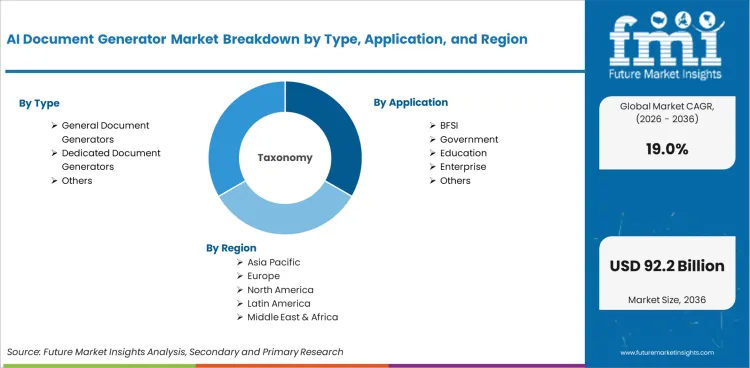
The AI document generator market was valued at USD 13.6 billion in 2025. The market is set to reach USD 16.2 billion by 2026-end and grow at a CAGR of 19.0% between 2026–2036 to reach USD 92.2 billion by 2036. General Document Generators will dominate with a 67.4% share, while BFSI will lead with a 42.8%% share.
Summary of the AI Document Generator Market Size, Market Forecast and Outlook By FMI
- Demand and Growth Drivers
- Demand is shaped by enterprise automation requirements as organizations seek to reduce manual document creation time across legal, financial, and compliance functions.
- Growth reflects increasing integration of AI document tools with existing enterprise workflows, reducing output turnaround from days to minutes for standard business documents.
- Adoption is increasing due to regulatory compliance complexity, where AI-generated documents ensure consistency and reduce human error in repetitive documentation tasks.
- Product and Segment View
- General document generators hold 67.4% of the type segment in 2026, supported by their applicability across multiple enterprise functions including contracts, reports, and correspondence.
- BFSI accounts for 42.8% of the application segment, reflecting high document volumes in banking, insurance, and financial compliance operations.
- Technology companies represent 38.6% of the end-use industry segment, reflecting early adoption of AI document tools in software development documentation and technical writing.
- Geography and Competitive Outlook
- India leads country-level growth at 23.7% CAGR, supported by large-scale IT outsourcing operations that generate significant document automation demand.
- North America maintains the largest revenue base with the USA growing at 18.0% CAGR, reflecting enterprise-grade AI document platform adoption across financial services and technology sectors.
- Companies that combine document generation accuracy with enterprise security compliance and multi-format output capability are capturing the largest share of procurement contracts.
- Analyst Opinion
- The AI document generator market is transitioning from a productivity tool category to a core enterprise infrastructure requirement. As organizations face increasing regulatory documentation burdens and competitive pressure to reduce operational overhead, AI-generated document quality has reached a threshold where automated output matches or exceeds manually produced alternatives for standardized formats. Companies that can deliver reliable, auditable document generation with direct integration into enterprise compliance and records management systems are likely to secure the largest share of institutional procurement during the forecast period.
- Adoption is accelerating as enterprise buyers recognize the cost reduction potential of automating high-volume, repetitive document creation across departments.
- Integration with enterprise content management and compliance systems is becoming a primary vendor selection criterion.
- Emerging demand from government agencies and educational institutions is expanding the addressable market beyond core BFSI and technology sectors.

Key Takeaways, Market Size, and Forecast
- The AI Document Generator Market was valued at USD 13.60 billion in 2025.
- By 2036, the AI Document Generator Market is expected to be worth USD 92.16 billion.
- From 2026 to 2036, the market is projected to expand at a CAGR of 19.0%.
- The market is projected to create an incremental opportunity of USD 75.98 billion between 2026 and 2036.
- In 2026, general document generators are expected to account for 67.4% of the type segment, driven by demand for versatile automation across enterprise document workflows.
- India (23.7%) and Germany (21.8%) are two of the fastest growing markets in the world.
AI Document Generator Market Definition
The AI document generator market includes software platforms that use artificial intelligence and natural language processing to automate the creation, formatting, and management of business documents across enterprise, government, and institutional applications.
AI Document Generator Market Inclusions
Market scope covers all commercially available AI document generation platforms categorized by type (general document generators, dedicated document generators, others), application (BFSI, government, education, enterprise, others), and end-use industry (technology companies, financial institutions, government agencies, educational institutions, healthcare facilities, legal firms). The revenue range extends from 2026 to 2036.
AI Document Generator Market Exclusions
The scope does not include basic word processing software without AI capabilities, manual document creation services, or generic text editors that do not incorporate machine learning for document generation and formatting.
AI Document Generator Market Research Methodology
- Primary Research: FMI analysts conducted interviews with enterprise IT leaders, document management specialists, and AI software vendors across key markets.
- Desk Research: Integrated data from enterprise software industry reports, digital transformation surveys, and vendor financial disclosures.
- Market Sizing and Forecasting: Bottom-up aggregation across document generator types, application segments, and regional adoption curves with cross-validation against enterprise software spending data.
- Data Validation: Cross-checked quarterly against enterprise technology budgets, vendor revenue disclosures, and digital transformation adoption surveys.
Why is the AI Document Generator Market Growing?
- Enterprise document volumes are expanding at approximately 25% annually across compliance, legal, and financial functions, creating unsustainable manual production workloads.
- AI document generation quality has reached parity with human-produced output for standardized business formats, eliminating the primary adoption barrier of output quality concerns.
- Cost reduction pressure across enterprise back-office operations is converting document automation from a discretionary technology investment to a operational necessity.
Growth in AI document generation reflects a structural shift in enterprise content production. Organizations across BFSI, government, and technology sectors produce millions of standardized documents annually, including contracts, reports, compliance filings, and customer communications. The labor cost of manual document creation represents a significant and growing portion of operational overhead.
AI document generators address this cost pressure by automating the creation of standardized document types while maintaining consistency, compliance, and quality. Modern platforms integrate with enterprise data sources to populate documents with accurate, current information, reducing both production time and error rates compared to manual processes.
The market is also benefiting from improvements in natural language processing that enable AI systems to generate documents in multiple languages and formats simultaneously, supporting multinational enterprise operations without proportional increases in document production staff.
Market Segmentation Analysis
- General document generators hold 67.4% of the type segment, reflecting demand for flexible platforms that serve multiple document creation use cases within a single enterprise deployment.
- BFSI accounts for 42.8% of the application segment, where high document volumes in loan processing, compliance reporting, and customer communications create strong automation demand.
- Technology companies represent 38.6% of end-use industry demand, driven by documentation requirements for software development, API documentation, and technical specifications.
The AI document generator market is segmented by type (general document generators, dedicated document generators, others), application (BFSI, government, education, enterprise, others), and end-use industry (technology companies, financial institutions, government agencies, educational institutions, healthcare facilities, legal firms).
Insights into the General Document Generator Segment

General document generators command 67.4% of the type segment in 2026. These platforms support creation of multiple document formats including contracts, reports, correspondence, and compliance filings from a single interface. Enterprise buyers prefer general-purpose platforms that reduce vendor complexity and provide consistent AI document quality across departments.
Adoption reflects the practical advantage of platform consolidation, where a single AI document tool replaces multiple specialized solutions. Integration with enterprise content management systems enables automated filing, version control, and compliance tracking for all generated documents.
Insights into the BFSI Application Segment

BFSI accounts for 42.8% of the application segment in 2026, reflecting the financial sector's high document production volumes across loan origination, regulatory compliance, and customer communications. Banks and insurance companies process millions of standardized documents annually, creating a strong cost reduction case for AI automation.
Regulatory requirements for document consistency and auditability favor AI generation over manual processes, as automated systems produce compliant output with embedded metadata for regulatory tracking and records management.
AI Document Generator Market Drivers, Restraints, and Opportunities
- Enterprise document volume growth is the primary structural driver, with compliance and regulatory filing requirements expanding faster than organizations can scale manual document production capacity.
- Data security and intellectual property concerns constrain adoption in sectors where document content includes sensitive client information or proprietary business data.
- Government digitization programs present growth opportunities as public sector agencies automate citizen-facing document creation and internal administrative processes.
The AI document generator market is shaped by the intersection of enterprise efficiency requirements and advancing natural language processing capabilities. Document production represents a measurable and growing cost center for most large organizations.
Document Volume Growth as a Structural Driver
Regulatory complexity is expanding the volume of compliance documentation that enterprises must produce, file, and maintain. AI document generators reduce per-document production costs while improving consistency and reducing error rates that create compliance risk.
Data Security and IP Concerns
Enterprise adoption faces friction from concerns about document content security, particularly in legal, financial, and healthcare applications where generated documents contain sensitive data. Vendors that offer on-premises deployment or verified data isolation in cloud environments address this constraint.
Government Digitization Opportunities
Public sector agencies are adopting AI document tools to automate citizen-facing communications, permit processing, and internal administrative documentation. Government procurement cycles are longer than private sector, but contract values tend to be larger and multi-year.
Analysis of AI Document Generator Market by Key Countries
.webp "Top Country Growth Comparison Ai Document Generator Market Cagr (2026 2036)")
| Country | CAGR |
|---|---|
| India | 23.7% |
| Germany | 21.8% |
| Brazil | 19.9% |
| USA | 18.0% |
| UK | 16.1% |
| Japan | 14.2% |
| China | 13.4% |
- India leads at 23.7% CAGR through 2036, supported by IT outsourcing demand and enterprise digitization programs across financial services and government sectors.
- Germany at 21.8% CAGR reflects strong demand from automotive, manufacturing, and financial compliance documentation requirements.
- Brazil at 19.9% CAGR benefits from banking sector digitization and government document automation initiatives.
- The USA at 18.0% CAGR maintains the largest revenue base with enterprise adoption concentrated in BFSI, technology, and legal sectors.
The AI document generator market is projected to expand at 19.0% CAGR globally from 2026 to 2036. The analysis covers more than 30 countries, with the leading markets detailed below.

Demand Outlook for AI Document Generator Market in India
India is growing at 23.7% CAGR through 2036, reflecting the country's position as a global IT services hub with significant demand for document automation across outsourcing operations. Enterprise digitization programs in banking, insurance, and government are creating large-scale procurement for AI document platforms.
- IT outsourcing operations create concentrated demand for automated document production across client-facing deliverables.
- Banking sector digitization is automating loan documentation, compliance filings, and customer correspondence.
- Government e-governance initiatives are procuring AI document tools for citizen service and administrative automation.
Future Outlook for AI Document Generator Market in Germany
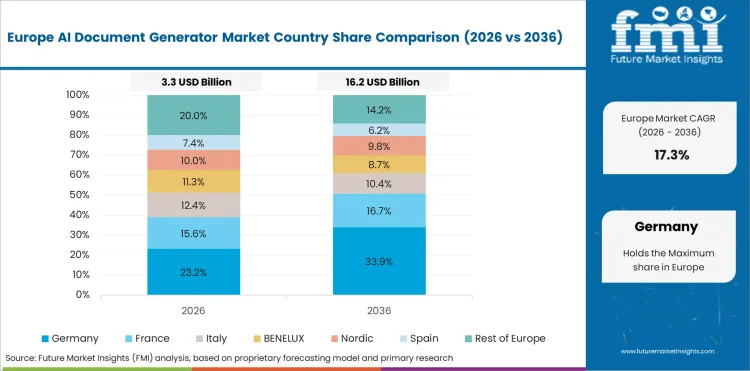
Germany is expanding at 21.8% CAGR through 2036, supported by demand from automotive and manufacturing sectors for automated technical documentation and compliance reporting. German enterprises prioritize AI document solutions with strong data governance and privacy compliance features.
- Automotive and manufacturing documentation requirements drive adoption for technical specifications and compliance reporting.
- GDPR compliance requirements influence vendor selection toward privacy-compliant AI document platforms.
- Financial services demand centers on regulatory filing automation and customer communication standardization.
Opportunity Analysis of AI Document Generator Market in the USA

The USA is growing at 18.0% CAGR through 2036, maintaining the largest revenue base globally. Enterprise adoption is concentrated in BFSI, technology, and legal sectors where high document volumes and compliance requirements create strong automation demand.
- BFSI sector drives large-scale enterprise procurement for loan documentation and regulatory filing automation.
- Legal sector adoption is accelerating for contract generation, discovery document processing, and compliance filings.
- Technology companies adopt AI document tools for API documentation, release notes, and technical writing automation.
In-depth Analysis of AI Document Generator Market in Brazil
Brazil is expanding at 19.9% CAGR through 2036, supported by banking sector digitization and government modernization programs. The country's complex regulatory environment creates significant demand for standardized document automation in financial compliance.
- Banking digitization programs are automating customer-facing documentation and regulatory compliance filings.
- Government modernization initiatives are procuring AI document tools for public administration.
- SME adoption is accelerating through cloud-based, Portuguese-language AI document platforms.
Sales Analysis of AI Document Generator Market in the UK
The UK is growing at 16.1% CAGR through 2036, with demand concentrated in financial services, legal, and government sectors. London's position as a global financial center creates concentrated demand for compliance and regulatory document automation.
- Financial services compliance documentation creates sustained demand for AI document generation platforms.
- Legal sector adoption is growing for contract automation and regulatory filing preparation.
- Government digital services programs are integrating AI document tools for citizen communication automation.
Competitive Landscape and Strategic Positioning

- Microsoft leads through integration of AI document capabilities within its Office 365 and Azure ecosystem, leveraging its established enterprise customer base.
- Google and Adobe compete through cloud-native AI document platforms that emphasize collaboration, accessibility, and cross-platform compatibility.
- Specialized vendors including Templafy, DocuSign, and UiPath differentiate through enterprise workflow integration and compliance-focused document generation.
The competitive landscape is characterized by the convergence of major technology platforms expanding AI document capabilities and specialized vendors focusing on enterprise workflow integration. Microsoft holds the leading position through its Office 365 ecosystem, where AI document generation is integrated directly into tools already deployed across millions of enterprises.
Google competes through its Workspace platform, offering cloud-native AI document generation that emphasizes real-time collaboration and accessibility. Adobe leverages its established position in document management and PDF workflows to offer AI-enhanced creation tools.
Specialized vendors including Templafy, Jotform, and Accusoft compete through deep enterprise workflow integration, offering document generation solutions tailored to specific industry compliance and formatting requirements. These companies often serve as complementary tools within larger enterprise technology stacks.
Key Companies in the AI Document Generator Market
Key global companies leading the AI Document Generator Market include:
- Microsoft (USA), Google (USA), and IBM (USA) lead through integrated AI document capabilities within their established enterprise platforms, leveraging broad customer bases and comprehensive cloud infrastructure.
- Adobe (USA), Salesforce (USA), and DocuSign (USA) compete through specialized document management ecosystems that integrate AI generation with electronic signatures, CRM data, and compliance workflows.
- Visme (USA), Piktochart (Malaysia), Jotform (USA), Accusoft Corporation (USA), Templafy (Denmark), and UiPath (USA) represent specialized and emerging competitors focused on specific document types, visual document generation, and enterprise workflow automation.
Competitive Benchmarking: AI Document Generator Market
| Company | Enterprise Integration | AI Capability | Document Format Range | Security Compliance |
|---|---|---|---|---|
| Microsoft | Strong | High | Wide | High |
| Strong | High | Wide | High | |
| IBM | Strong | High | Medium | High |
| Adobe | Strong | Medium | Wide | High |
| Salesforce | Strong | Medium | Medium | High |
| DocuSign | Medium | Medium | Narrow | High |
| Templafy | Medium | Medium | Wide | Medium |
| UiPath | Medium | Medium | Medium | Medium |
| Visme | Low | Medium | Wide | Medium |
| Jotform | Low | Medium | Medium | Medium |
Source: Future Market Insights competitive analysis, 2026.
Key Players in the AI Document Generator Market
Major Global Players
- Microsoft
- IBM
- Adobe
- Salesforce
- DocuSign
Emerging Players/Startups
- Visme
- Piktochart
- Jotform
- Accusoft Corporation
- Templafy
- UiPath
- Writesonic
- Jasper AI
- Copy.ai
- Notion AI
Report Scope and Coverage
| Parameter | Details |
|---|---|
| Quantitative Units | USD 16.18 billion to USD 92.16 billion, at a CAGR of 19.0% |
| Market Definition | The AI document generator market includes AI-powered software platforms for automated creation, formatting, and management of business documents across enterprise, government, and institutional applications. |
| Regions Covered | North America, Latin America, Europe, East Asia, South Asia and Pacific, Middle East and Africa |
| Countries Covered | USA, UK, Germany, France, Japan, China, India, Brazil, and 30 plus countries |
| Key Companies Profiled | Microsoft, Google, IBM, Adobe, Salesforce, DocuSign, Visme, Piktochart, Jotform, Templafy, UiPath |
| Forecast Period | 2026 to 2036 |
| Approach | Hybrid bottom-up and top-down methodology starting with verified enterprise software spending data, projecting adoption velocity across document types, applications, and regional markets. |
Market Segmentation Analysis
AI Document Generator Market Segmented by Type:
- General Document Generators
- Dedicated Document Generators
- Others
AI Document Generator Market Segmented by Application:
- BFSI
- Government
- Education
- Enterprise
- Others
AI Document Generator Market Segmented by End-Use Industry:
- Technology Companies
- Financial Institutions
- Government Agencies
- Educational Institutions
- Healthcare Facilities
- Legal Firms
AI Document Generator Market by Region:
- North America
- USA
- Canada
- Mexico
- Latin America
- Brazil
- Chile
- Rest of Latin America
- Western Europe
- Germany
- UK
- Italy
- Spain
- France
- Nordic
- BENELUX
- Rest of Western Europe
- Eastern Europe
- Russia
- Poland
- Hungary
- Balkan & Baltic
- Rest of Eastern Europe
- East Asia
- China
- Japan
- South Korea
- South Asia and Pacific
- India
- ASEAN
- Australia & New Zealand
- Rest of South Asia and Pacific
- Middle East & Africa
- Kingdom of Saudi Arabia
- Other GCC Countries
- Turkiye
- South Africa
- Other African Union
- Rest of Middle East & Africa
Research Sources and Bibliography
- 1. International Data Corporation. (2025). IDC Worldwide Enterprise Content Management Software Market Forecast. IDC.
- 2. European Commission. (2025). EU Digital Government Strategy: Document Automation Adoption. EC.
- 3. World Bank. (2025). Digital Government Readiness Assessment: Document Management Infrastructure. World Bank.
- 4. National Institute of Standards and Technology. (2024). NIST AI Risk Management Framework for Document Generation Systems. NIST.
- 5. Organisation for Economic Co-operation and Development. (2025). OECD Digital Economy Outlook: Enterprise AI Adoption. OECD.
This bibliography is provided for reader reference. The full Future Market Insights report contains the complete reference list with publication dates, URLs, and supporting data for all cited works.
This Report Answers
- Estimating the size of the AI document generator market and revenue projections from 2026 to 2036.
- Segmentation by type, application, and end-use industry.
- Regional insights across more than 30 markets globally.
- Analysis of AI and NLP technology advancement in document generation.
- Assessment of the competitive landscape including platform vendors and specialized providers.
- Identification of investment opportunities across BFSI, government, and technology verticals.
- Enterprise workflow integration and compliance technology assessment.
- Data delivery in PDF and Excel formats.
Frequently Asked Questions
What is the global market demand for AI Document Generator in 2026?
In 2026, the global AI Document Generator Market is expected to be worth USD 16.18 billion.
How big will the AI Document Generator Market be in 2036?
By 2036, the AI Document Generator Market is expected to be worth USD 92.16 billion.
How much is demand for AI document generators expected to grow between 2026 and 2036?
Between 2026 and 2036, the demand for AI document generators is expected to grow at a CAGR of 19.0%.
Which type segment is expected to lead globally in 2026?
General document generators are expected to hold 67.4% of the type segment in 2026, reflecting enterprise demand for versatile platforms that support multiple document formats within a single deployment.
What is driving demand growth in India?
India is growing at 23.7% CAGR through 2036, supported by IT outsourcing demand, banking digitization, and government e-governance programs.
What is driving demand growth in Germany?
Germany is expanding at 21.8% CAGR through 2036, driven by automotive and manufacturing documentation requirements and financial compliance automation.
What does this report mean by AI Document Generator Market definition?
The AI document generator market includes AI-powered platforms for automated creation, formatting, and management of business documents across enterprise, government, and institutional applications.
How does FMI make the AI Document Generator forecast and validate it?
Forecasting models use a hybrid bottom-up and top-down approach, starting with verified enterprise software spending data and cross-checking against vendor revenue disclosures and digital transformation adoption surveys.
Preview the report firsthand - request a free sample
Get SampleGet the brochure for pricing and purchase details.
Get PDFTable of Content
- Executive Summary
- Global Market Outlook
- Demand-side Trends
- Supply-side Trends
- Technology Roadmap Analysis
- Analysis and Recommendations
- Market Overview
- Market Coverage / Taxonomy
- Market Definition / Scope / Limitations
- Research Methodology
- Chapter Orientation
- Analytical Lens and Working Hypotheses
- Market Structure, Signals, and Trend Drivers
- Benchmarking and Cross-market Comparability
- Market Sizing, Forecasting, and Opportunity Mapping
- Research Design and Evidence Framework
- Desk Research Programme (Secondary Evidence)
- Company Annual and Sustainability Reports
- Peer-reviewed Journals and Academic Literature
- Corporate Websites, Product Literature, and Technical Notes
- Earnings Decks and Investor Briefings
- Statutory Filings and Regulatory Disclosures
- Technical White Papers and Standards Notes
- Trade Journals, Industry Magazines, and Analyst Briefs
- Conference Proceedings, Webinars, and Seminar Materials
- Government Statistics Portals and Public Data Releases
- Press Releases and Reputable Media Coverage
- Specialist Newsletters and Curated Briefings
- Sector Databases and Reference Repositories
- FMI Internal Proprietary Databases and Historical Market Datasets
- Subscription Datasets and Paid Sources
- Social Channels, Communities, and Digital Listening Inputs
- Additional Desk Sources
- Expert Input and Fieldwork (Primary Evidence)
- Primary Modes
- Qualitative Interviews and Expert Elicitation
- C-suite Leaders
- Board Members
- Presidents and Vice Presidents
- R&D and Innovation Heads
- Technical Specialists
- Domain Subject-matter Experts
- Scientists
- Physicians and Other Healthcare Professionals
- Governance, Ethics, and Data Stewardship
- Research Ethics
- Data Integrity and Handling
- Primary Modes
- Tooling, Models, and Reference Databases
- Desk Research Programme (Secondary Evidence)
- Data Engineering and Model Build
- Data Acquisition and Ingestion
- Cleaning, Normalisation, and Verification
- Synthesis, Triangulation, and Analysis
- Quality Assurance and Audit Trail
- Market Background
- Market Dynamics
- Drivers
- Restraints
- Opportunity
- Trends
- Scenario Forecast
- Demand in Optimistic Scenario
- Demand in Likely Scenario
- Demand in Conservative Scenario
- Opportunity Map Analysis
- Product Life Cycle Analysis
- Supply Chain Analysis
- Investment Feasibility Matrix
- Value Chain Analysis
- PESTLE and Porter’s Analysis
- Regulatory Landscape
- Regional Parent Market Outlook
- Production and Consumption Statistics
- Import and Export Statistics
- Market Dynamics
- Global Market Analysis 2021 to 2025 and Forecast, 2026 to 2036
- Historical Market Size Value (USD Million) Analysis, 2021 to 2025
- Current and Future Market Size Value (USD Million) Projections, 2026 to 2036
- Y-o-Y Growth Trend Analysis
- Absolute $ Opportunity Analysis
- Global Market Pricing Analysis 2021 to 2025 and Forecast 2026 to 2036
- Global Market Analysis 2021 to 2025 and Forecast 2026 to 2036, By Type
- Introduction / Key Findings
- Historical Market Size Value (USD Million) Analysis By Type , 2021 to 2025
- Current and Future Market Size Value (USD Million) Analysis and Forecast By Type , 2026 to 2036
- General Document Generators
- Dedicated Document Generators
- Others
- General Document Generators
- Y-o-Y Growth Trend Analysis By Type , 2021 to 2025
- Absolute $ Opportunity Analysis By Type , 2026 to 2036
- Global Market Analysis 2021 to 2025 and Forecast 2026 to 2036, By Application
- Introduction / Key Findings
- Historical Market Size Value (USD Million) Analysis By Application, 2021 to 2025
- Current and Future Market Size Value (USD Million) Analysis and Forecast By Application, 2026 to 2036
- BFSI
- Government
- Education
- Enterprise
- Others
- BFSI
- Y-o-Y Growth Trend Analysis By Application, 2021 to 2025
- Absolute $ Opportunity Analysis By Application, 2026 to 2036
- Global Market Analysis 2021 to 2025 and Forecast 2026 to 2036, By End-Use Industry
- Introduction / Key Findings
- Historical Market Size Value (USD Million) Analysis By End-Use Industry, 2021 to 2025
- Current and Future Market Size Value (USD Million) Analysis and Forecast By End-Use Industry, 2026 to 2036
- Technology Companies
- Financial Institutions
- Government Agencies
- Educational Institutions
- Healthcare Facilities
- Legal Firms
- Technology Companies
- Y-o-Y Growth Trend Analysis By End-Use Industry, 2021 to 2025
- Absolute $ Opportunity Analysis By End-Use Industry, 2026 to 2036
- Global Market Analysis 2021 to 2025 and Forecast 2026 to 2036, By Region
- Introduction
- Historical Market Size Value (USD Million) Analysis By Region, 2021 to 2025
- Current Market Size Value (USD Million) Analysis and Forecast By Region, 2026 to 2036
- North America
- Latin America
- Western Europe
- Eastern Europe
- East Asia
- South Asia and Pacific
- Middle East & Africa
- Market Attractiveness Analysis By Region
- North America Market Analysis 2021 to 2025 and Forecast 2026 to 2036, By Country
- Historical Market Size Value (USD Million) Trend Analysis By Market Taxonomy, 2021 to 2025
- Market Size Value (USD Million) Forecast By Market Taxonomy, 2026 to 2036
- By Country
- USA
- Canada
- Mexico
- By Type
- By Application
- By End-Use Industry
- By Country
- Market Attractiveness Analysis
- By Country
- By Type
- By Application
- By End-Use Industry
- Key Takeaways
- Latin America Market Analysis 2021 to 2025 and Forecast 2026 to 2036, By Country
- Historical Market Size Value (USD Million) Trend Analysis By Market Taxonomy, 2021 to 2025
- Market Size Value (USD Million) Forecast By Market Taxonomy, 2026 to 2036
- By Country
- Brazil
- Chile
- Rest of Latin America
- By Type
- By Application
- By End-Use Industry
- By Country
- Market Attractiveness Analysis
- By Country
- By Type
- By Application
- By End-Use Industry
- Key Takeaways
- Western Europe Market Analysis 2021 to 2025 and Forecast 2026 to 2036, By Country
- Historical Market Size Value (USD Million) Trend Analysis By Market Taxonomy, 2021 to 2025
- Market Size Value (USD Million) Forecast By Market Taxonomy, 2026 to 2036
- By Country
- Germany
- UK
- Italy
- Spain
- France
- Nordic
- BENELUX
- Rest of Western Europe
- By Type
- By Application
- By End-Use Industry
- By Country
- Market Attractiveness Analysis
- By Country
- By Type
- By Application
- By End-Use Industry
- Key Takeaways
- Eastern Europe Market Analysis 2021 to 2025 and Forecast 2026 to 2036, By Country
- Historical Market Size Value (USD Million) Trend Analysis By Market Taxonomy, 2021 to 2025
- Market Size Value (USD Million) Forecast By Market Taxonomy, 2026 to 2036
- By Country
- Russia
- Poland
- Hungary
- Balkan & Baltic
- Rest of Eastern Europe
- By Type
- By Application
- By End-Use Industry
- By Country
- Market Attractiveness Analysis
- By Country
- By Type
- By Application
- By End-Use Industry
- Key Takeaways
- East Asia Market Analysis 2021 to 2025 and Forecast 2026 to 2036, By Country
- Historical Market Size Value (USD Million) Trend Analysis By Market Taxonomy, 2021 to 2025
- Market Size Value (USD Million) Forecast By Market Taxonomy, 2026 to 2036
- By Country
- China
- Japan
- South Korea
- By Type
- By Application
- By End-Use Industry
- By Country
- Market Attractiveness Analysis
- By Country
- By Type
- By Application
- By End-Use Industry
- Key Takeaways
- South Asia and Pacific Market Analysis 2021 to 2025 and Forecast 2026 to 2036, By Country
- Historical Market Size Value (USD Million) Trend Analysis By Market Taxonomy, 2021 to 2025
- Market Size Value (USD Million) Forecast By Market Taxonomy, 2026 to 2036
- By Country
- India
- ASEAN
- Australia & New Zealand
- Rest of South Asia and Pacific
- By Type
- By Application
- By End-Use Industry
- By Country
- Market Attractiveness Analysis
- By Country
- By Type
- By Application
- By End-Use Industry
- Key Takeaways
- Middle East & Africa Market Analysis 2021 to 2025 and Forecast 2026 to 2036, By Country
- Historical Market Size Value (USD Million) Trend Analysis By Market Taxonomy, 2021 to 2025
- Market Size Value (USD Million) Forecast By Market Taxonomy, 2026 to 2036
- By Country
- Kingdom of Saudi Arabia
- Other GCC Countries
- Turkiye
- South Africa
- Other African Union
- Rest of Middle East & Africa
- By Type
- By Application
- By End-Use Industry
- By Country
- Market Attractiveness Analysis
- By Country
- By Type
- By Application
- By End-Use Industry
- Key Takeaways
- Key Countries Market Analysis
- USA
- Pricing Analysis
- Market Share Analysis, 2025
- By Type
- By Application
- By End-Use Industry
- Canada
- Pricing Analysis
- Market Share Analysis, 2025
- By Type
- By Application
- By End-Use Industry
- Mexico
- Pricing Analysis
- Market Share Analysis, 2025
- By Type
- By Application
- By End-Use Industry
- Brazil
- Pricing Analysis
- Market Share Analysis, 2025
- By Type
- By Application
- By End-Use Industry
- Chile
- Pricing Analysis
- Market Share Analysis, 2025
- By Type
- By Application
- By End-Use Industry
- Germany
- Pricing Analysis
- Market Share Analysis, 2025
- By Type
- By Application
- By End-Use Industry
- UK
- Pricing Analysis
- Market Share Analysis, 2025
- By Type
- By Application
- By End-Use Industry
- Italy
- Pricing Analysis
- Market Share Analysis, 2025
- By Type
- By Application
- By End-Use Industry
- Spain
- Pricing Analysis
- Market Share Analysis, 2025
- By Type
- By Application
- By End-Use Industry
- France
- Pricing Analysis
- Market Share Analysis, 2025
- By Type
- By Application
- By End-Use Industry
- India
- Pricing Analysis
- Market Share Analysis, 2025
- By Type
- By Application
- By End-Use Industry
- ASEAN
- Pricing Analysis
- Market Share Analysis, 2025
- By Type
- By Application
- By End-Use Industry
- Australia & New Zealand
- Pricing Analysis
- Market Share Analysis, 2025
- By Type
- By Application
- By End-Use Industry
- China
- Pricing Analysis
- Market Share Analysis, 2025
- By Type
- By Application
- By End-Use Industry
- Japan
- Pricing Analysis
- Market Share Analysis, 2025
- By Type
- By Application
- By End-Use Industry
- South Korea
- Pricing Analysis
- Market Share Analysis, 2025
- By Type
- By Application
- By End-Use Industry
- Russia
- Pricing Analysis
- Market Share Analysis, 2025
- By Type
- By Application
- By End-Use Industry
- Poland
- Pricing Analysis
- Market Share Analysis, 2025
- By Type
- By Application
- By End-Use Industry
- Hungary
- Pricing Analysis
- Market Share Analysis, 2025
- By Type
- By Application
- By End-Use Industry
- Kingdom of Saudi Arabia
- Pricing Analysis
- Market Share Analysis, 2025
- By Type
- By Application
- By End-Use Industry
- Turkiye
- Pricing Analysis
- Market Share Analysis, 2025
- By Type
- By Application
- By End-Use Industry
- South Africa
- Pricing Analysis
- Market Share Analysis, 2025
- By Type
- By Application
- By End-Use Industry
- USA
- Market Structure Analysis
- Competition Dashboard
- Competition Benchmarking
- Market Share Analysis of Top Players
- By Regional
- By Type
- By Application
- By End-Use Industry
- Competition Analysis
- Competition Deep Dive
- Microsoft
- Overview
- Product Portfolio
- Profitability by Market Segments (Product/Age /Sales Channel/Region)
- Sales Footprint
- Strategy Overview
- Marketing Strategy
- Product Strategy
- Channel Strategy
- IBM
- Visme
- Piktochart
- Jotform
- Accusoft Corporation
- Templafy
- Adobe
- Salesforce
- DocuSign
- UiPath
- Microsoft
- Competition Deep Dive
- Assumptions & Acronyms Used


