

- Industry Size (2026)
- USD 88.37 Bn
- Forecast (2036)
- USD 218.99 Bn
- CAGR (2026 to 2036)
- 9.5%
Advance Battery Technologies Market Size, Market Forecast and Outlook By FMI
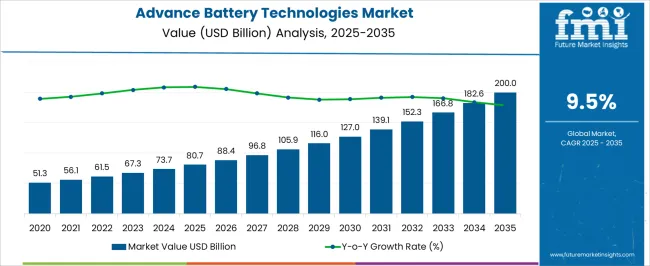
The advance battery technologies market was valued at USD 80.70 billion in 2025, projected to reach USD 88.37 billion in 2026, and is forecast to expand to USD 218.99 billion by 2036 at a 9.5% CAGR. FMI opines that the accelerating global transition to electric mobility and the parallel build-out of grid-scale energy storage infrastructure are the twin structural forces driving battery technology investment at an unprecedented scale. Lithium-ion chemistry maintains its position as the dominant platform, but procurement specifications are diversifying as automotive OEMs and grid operators evaluate emerging chemistries for cost, safety, and supply chain resilience advantages.
Summary of Advance Battery Technologies Market
- The market is on track to reach USD 218.99 billion by 2036.
- Growth is pegged at a 9.5% CAGR over the 2026 to 2036 forecast window.
- As of 2025, the market was valued at USD 80.70 billion.
- Cumulative incremental value across the forecast stands at USD 130.63 billion.
- Lithium-Ion Batteries lead by Battery Type with 29.6% share in 2026, maintaining dominance across automotive and stationary storage applications.
- Automotive leads by Application with 38.7% share in 2026.
- Demand is driven by the accelerating global transition to electric mobility and the parallel build-out of grid-scale energy storage infrastructure.
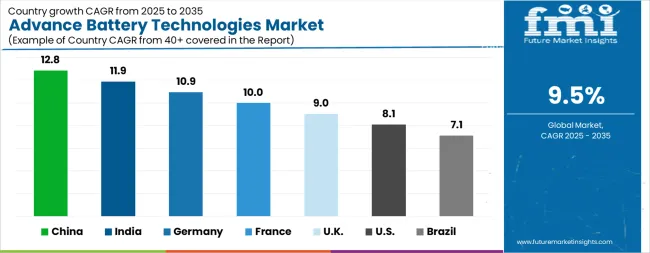
- Among key countries, China leads at 12.8% CAGR, followed by India at 11.9%, Germany at 10.9%, France at 10.0%, the UK at 9.0%, the USA at 8.1%, and Brazil at 7.1%.
Based on FMI's analysis, the competitive landscape is being reshaped by gigafactory capacity expansion in China, Europe, and North America, creating scale-driven cost compression that accelerates electric vehicle price parity with internal combustion alternatives. Battery technology development is focused on solid-state architectures, silicon-anode formulations, and sodium-ion chemistries that promise higher energy density or lower critical mineral dependency. Residential energy storage is emerging as a high-growth application segment as solar-plus-storage economics improve in markets with time-of-use electricity tariff structures.
China leads with a 12.8% CAGR, driven by dominant electric vehicle production volumes and massive cell manufacturing capacity expansion. India follows at 11.9%, supported by national electric mobility incentive programmes and localized battery manufacturing investment. Germany advances at 10.9%, anchored by automotive OEM electrification commitments and EU Battery Regulation compliance requirements. France records a 10.0% pace. The United Kingdom grows at 9.0%, while the United States maintains an 8.1% trajectory, reflecting Inflation Reduction Act manufacturing incentives and domestic gigafactory construction. Brazil records a 7.1% rate, with electric bus procurement and grid storage pilot projects sustaining demand.
Advance Battery Technologies Market Key Takeaways
| Metric | Details |
|---|---|
| Industry Size (2026) | USD 88.37 billion |
| Industry Value (2036) | USD 218.99 billion |
| CAGR (2026 to 2036) | 9.5% |
Source: Future Market Insights, 2026
Advance Battery Technologies Market Definition
Advanced battery technologies encompass next-generation electrochemical energy storage systems, including lithium-ion, lithium-polymer, metal-air, nickel-zinc, and specialty secondary battery chemistries, engineered for high energy density, extended cycle life, and fast charging capability across automotive, aerospace, consumer electronics, and stationary energy storage applications. These technologies move beyond conventional lead-acid and nickel-cadmium architectures to deliver superior gravimetric and volumetric energy performance required by electric vehicle powertrains, grid-scale storage, and portable electronic devices.
Advance Battery Technologies Market Inclusions
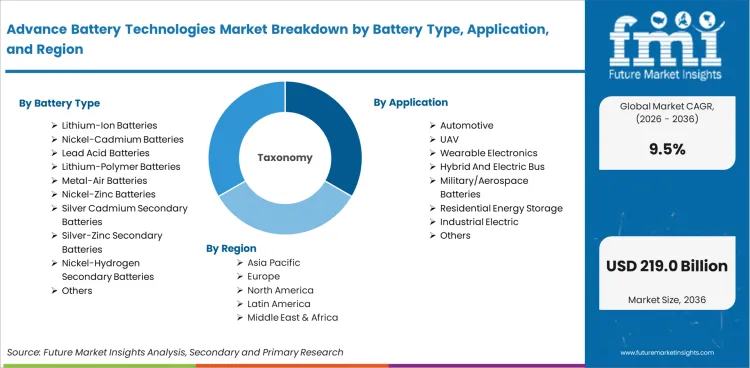
Market scope covers lithium-ion, nickel-cadmium, lead acid, lithium-polymer, metal-air, nickel-zinc, silver cadmium, silver-zinc, and nickel-hydrogen secondary battery technologies. The scope encompasses battery cells, modules, and pack-level systems used across automotive, UAV, wearable electronics, hybrid and electric bus, military and aerospace, residential energy storage, and industrial electric applications.
Advance Battery Technologies Market Exclusions
Primary (non-rechargeable) batteries are excluded. The scope omits fuel cell systems, supercapacitors and ultracapacitors marketed as standalone energy storage devices, and battery management system software sold independently of battery hardware.
Advance Battery Technologies Market Research Methodology
- Primary Research: Analysts engaged with procurement directors, operations managers, and technical specialists to identify decision-making triggers and specification requirements shaping purchasing cycles.
- Desk Research: Data collection aggregated regulatory documentation, industry standards publications, institutional procurement records, and publicly filed corporate disclosures.
- Market-Sizing and Forecasting: Baseline values derive from a bottom-up aggregation of product-level revenues, applying region-specific adoption curves and regulatory timeline adjustments to project future demand trajectories.
- Data Validation and Update Cycle: Projections are tested against publicly reported expenditure guidance from leading institutions and verified through cross-referencing primary interview outputs with secondary data sources.
Why is the Advance Battery Technologies Market Growing?
The Advance Battery Technologies market is experiencing robust growth, driven by the increasing demand for high-performance, efficient, and sustainable energy storage solutions across multiple sectors. Adoption is being fueled by the rapid growth of electric vehicles, renewable energy integration, and portable electronics, all of which require reliable and long-lasting batteries. Technological advancements in energy density, charging speed, and lifecycle performance are enhancing the appeal of advanced batteries.
Governments and private enterprises are investing heavily in battery research and development to achieve sustainability targets and reduce carbon emissions. Growing focus on environmental regulations, energy efficiency, and energy security is further accelerating the market.
Innovations in battery chemistry, thermal management, and recycling solutions are improving overall safety and performance while reducing operational costs As energy storage demands continue to rise globally, advanced battery technologies are expected to play a central role in electrification, grid stability, and portable energy solutions, ensuring sustained market expansion over the next decade.
Segmental Analysis
The advance battery technologies market is segmented by battery type, application, and geographic regions. By battery type, advance battery technologies market is divided into Lithium-Ion Batteries, Nickel-Cadmium Batteries, Lead Acid Batteries, Lithium-Polymer Batteries, Metal-Air Batteries, Nickel-Zinc Batteries, Silver Cadmium Secondary Batteries, Silver-Zinc Secondary Batteries, Nickel-Hydrogen Secondary Batteries, and Others. In terms of application, advance battery technologies market is classified into Automotive, UAV, Wearable Electronics, Hybrid And Electric Bus, Military/Aerospace Batteries, Residential Energy Storage, Industrial Electric, and Others. Regionally, the advance battery technologies industry is classified into North America, Latin America, Western Europe, Eastern Europe, Balkan & Baltic Countries, Russia & Belarus, Central Asia, East Asia, South Asia & Pacific, and the Middle East & Africa.
Insights into the Lithium-Ion Batteries Battery Type Segment
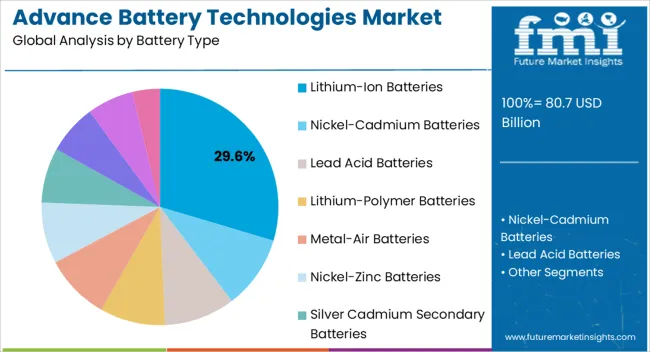
The lithium-ion batteries segment is projected to hold 29.6% of the market revenue in 2026, establishing it as the leading battery type. Growth in this segment is being driven by superior energy density, high charge-discharge efficiency, and long cycle life, which make lithium-ion batteries ideal for automotive, industrial, and consumer applications. The segment is further supported by ongoing innovations in electrode materials, electrolytes, and battery management systems that enhance safety and performance.
Lithium-ion batteries provide rapid charging capabilities and are easily scalable, which has strengthened adoption in electric vehicles and renewable energy storage systems. Their compatibility with smart energy solutions and integration into advanced power management systems further enhances operational efficiency.
Regulatory incentives for electric mobility, rising consumer demand for portable electronics, and the global push toward low-emission transportation are reinforcing growth As research continues to improve performance and cost-effectiveness, lithium-ion batteries are expected to maintain their leading position within the advanced battery technologies market.
Insights into the Automotive Application Segment
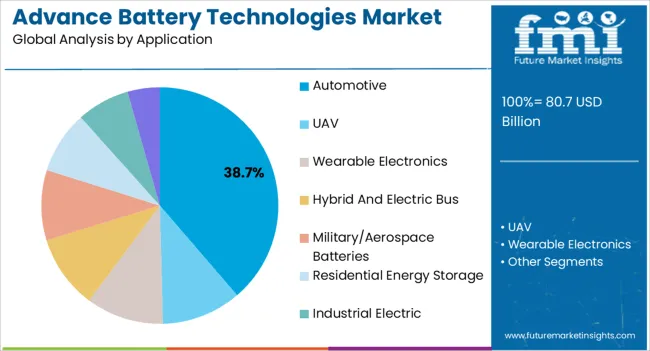
The automotive application segment is expected to account for 38.7% of the market revenue in 2026, making it the leading application area. Growth is being driven by the rapid adoption of electric and hybrid vehicles, which require high-capacity, efficient, and reliable battery solutions. Advanced battery technologies, particularly lithium-ion systems, are being leveraged to deliver longer driving ranges, faster charging, and enhanced safety, meeting consumer and regulatory expectations.
Investments in electric vehicle infrastructure, including charging networks and battery swapping stations, are further supporting market expansion. Automotive manufacturers are increasingly focusing on integrating advanced battery systems with vehicle management technologies to optimize performance and energy efficiency.
Environmental regulations and emission reduction mandates are accelerating the transition from conventional internal combustion engines to electrified mobility solutions As a result, the automotive segment is expected to continue driving demand for advanced battery technologies, with ongoing innovation in battery chemistry, thermal management, and recyclability reinforcing its dominant market position and ensuring sustained growth over the coming years.
Market Overview
Advance Battery Technologies Market Overview
Energy storage is a key factor leading towards technological advancements primarily in energy and power sector. Thus, demand for batteries, which are efficient, low cost and safe is anticipated to record significant growth in the coming years. This is further supported by investments by public as well as private sector for projects on energy storage.
Advance battery technologies are majorly used in power-intensive applications. Conventionally, batteries were used in used either in consumer products or automobiles. Technological advancements have led towards development of advance batteries including metal hydride, lithium-ion and zinc-air designs.
Advance battery technologies are expected to witness upsurge in wind-power energy storage, utility-load leveling systems and plug-in vehicles. Advance battery technologies are anticipated to have a significant transformation in the transportation industry as well as energy markets globally.
In addition, development of combination batteries equipped with renewable sources of energy might lead towards a shift from non-renewable sources such as coal, gas and oil. Thus, leading towards attainment of energy efficiency across the globe. Battery manufacturers are focused towards development of high performance products, which cater to the demand for high energy storage, better speed and energy optimaisation.
Geographically, the advance battery technologies market is segmented into seven regions namely North America, Western Europe, Japan, Asia Pacific Excluding Japan, Middle East and Africa and Latin America.
Analysis of Advance Battery Technologies Market By Key Countries
.webp "Top Country Growth Comparison Advance Battery Technologies Market Cagr (2026 2036)")
| Country | CAGR |
|---|---|
| China | 12.8% |
| India | 11.9% |
| Germany | 10.9% |
| France | 10.0% |
| UK | 9.0% |
| USA | 8.1% |
| Brazil | 7.1% |
Source: FMI analysis based on primary research and proprietary forecasting model
Country-wise Analysis
The Advance Battery Technologies Market is expected to register a CAGR of 9.5% during the forecast period, exhibiting varied country level momentum. China leads with the highest CAGR of 12.8%, followed by India at 11.9%. Developed markets such as Germany, France, and the UK continue to expand steadily, while the USA is likely to grow at consistent rates. Brazil posts the lowest CAGR at 7.1%, yet still underscores a broadly positive trajectory for the global Advance Battery Technologies Market. In 2024, Germany held a dominant revenue in the Western Europe market and is expected to grow with a CAGR of 10.9%. The USA Advance Battery Technologies Market is estimated to be valued at USD 27.6 billion in 2026 and is anticipated to reach a valuation of USD 59.9 billion by 2036. Sales are projected to rise at a CAGR of 8.1% over the forecast period between 2026 and 2036. While Japan and South Korea markets are estimated to be valued at USD 3.8 billion and USD 2.6 billion respectively in 2026.
Key Players in the Advance Battery Technologies Market
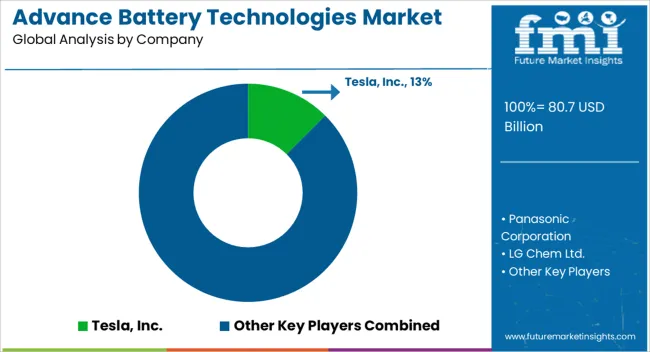
- Tesla, Inc.
- Panasonic Corporation
- LG Chem Ltd.
- Samsung SDI Co., Ltd.
- BYD Company Limited
- Contemporary Amperex Technology Co. Limited (CATL)
- Johnson Controls International plc
- GS Yuasa Corporation
- A123 Systems LLC
- Saft Groupe S.A.
- Enersys
- Toshiba Corporation
- Hitachi Chemical Co., Ltd.
- SK Innovation Co., Ltd.
- Northvolt AB
- Energizer Holdings, Inc.
- Duracell Inc.
Scope of the Report
| Metric | Value |
|---|---|
| Quantitative Units | USD 88.37 billion to USD 218.99 billion, at a CAGR of 9.5% |
| Market Definition | Advanced battery technologies encompass next-generation electrochemical energy storage systems, including lithium-ion, lithium-polymer, metal-air, nickel-zinc, and specialty secondary battery chemistries, engineered for high energy density, extended cycle life, and fast charging capability across automotive, aerospace, consumer electronics, and stationary energy storage applications. These technologies move beyond conventional lead-acid and nickel-cadmium architectures to deliver superior gravimetric and volumetric energy performance required by electric vehicle powertrains, grid-scale storage, and portable electronic devices. |
| Segmentation | Battery Type: Lithium-Ion Batteries, Nickel-Cadmium Batteries, Lead Acid Batteries, Lithium-Polymer Batteries, Metal-Air Batteries, Nickel-Zinc Batteries, Silver Cadmium Secondary Batteries, Silver-Zinc Secondary Batteries, Nickel-Hydrogen Secondary Batteries, Others; Application: Automotive, UAV, Wearable Electronics, Hybrid and Electric Bus, Military/Aerospace Batteries, Residential Energy Storage, Industrial Electric, Others |
| Regions Covered | North America, Latin America, Europe, East Asia, South Asia, Oceania, Middle East & Africa |
| Countries Covered | China, India, Germany, France, UK, USA, Brazil, and 40 plus countries |
| Key Companies Profiled | Tesla, Inc., Panasonic Corporation, LG Chem Ltd., Samsung SDI Co., Ltd., BYD Company Limited, Contemporary Amperex Technology Co. Limited (CATL), Johnson Controls International plc, GS Yuasa Corporation, A123 Systems LLC, Saft Groupe S.A., Enersys, Toshiba Corporation, Hitachi Chemical Co., Ltd., SK Innovation Co., Ltd., Northvolt AB, Energizer Holdings, Inc., Duracell Inc. |
| Forecast Period | 2026 to 2036 |
| Approach | Forecasting models apply a bottom-up methodology starting with installed base metrics and project conversion rates, cross-validated against institutional expenditure guidance. |
Advance Battery Technologies Market by Segments
Battery Type:
- Lithium-Ion Batteries
- Nickel-Cadmium Batteries
- Lead Acid Batteries
- Lithium-Polymer Batteries
- Metal-Air Batteries
- Nickel-Zinc Batteries
- Silver Cadmium Secondary Batteries
- Silver-Zinc Secondary Batteries
- Nickel-Hydrogen Secondary Batteries
- Others
Application:
- Automotive
- UAV
- Wearable Electronics
- Hybrid And Electric Bus
- Military/Aerospace Batteries
- Residential Energy Storage
- Industrial Electric
- Others
Region:
- North America
- USA
- Canada
- Mexico
- Latin America
- Brazil
- Chile
- Rest of Latin America
- Western Europe
- Germany
- UK
- Italy
- Spain
- France
- Nordic
- BENELUX
- Rest of Western Europe
- Eastern Europe
- Russia
- Poland
- Hungary
- Balkan & Baltic
- Rest of Eastern Europe
- East Asia
- China
- Japan
- South Korea
- South Asia and Pacific
- India
- ASEAN
- Australia & New Zealand
- Rest of South Asia and Pacific
- Middle East & Africa
- Kingdom of Saudi Arabia
- Other GCC Countries
- Turkiye
- South Africa
- Other African Union
- Rest of Middle East & Africa
Bibliography
- International Energy Agency. (2024). Global EV outlook 2024: scaling up electric vehicle deployment. IEA.
- USA Department of Energy. (2024). National blueprint for lithium batteries 2021 to 2030: progress report. DOE.
- European Commission. (2024). Battery Regulation (EU) 2023/1542: implementation guidance. European Commission.
- International Renewable Energy Agency. (2024). Electricity storage valuation framework: updated guidelines. IRENA.
- Organisation for Economic Co-operation and Development. (2024). Critical minerals for the energy transition: supply chain analysis. OECD.
- World Bank. (2024). Minerals for climate action: the mineral intensity of the clean energy transition. World Bank.
This bibliography is provided for reader reference. The full Future Market Insights report contains the complete reference list with primary research documentation.
Frequently Asked Questions
How large is the demand for Advance Battery Technologies in the global market in 2026?
Demand for Advance Battery Technologies in the global market is estimated to be valued at USD 88.37 billion in 2026.
What will be the market size of Advance Battery Technologies by 2036?
Market size for Advance Battery Technologies is projected to reach USD 218.99 billion by 2036.
What is the expected demand growth between 2026 and 2036?
Demand for Advance Battery Technologies is expected to grow at a CAGR of 9.5% between 2026 and 2036.
Which Battery Type is poised to lead global sales by 2026?
Lithium-Ion Batteries account for 29.6% share in 2026, maintaining platform dominance across automotive and stationary energy storage applications.
Which Application leads the market in 2026?
Automotive represents 38.7% of application share as global electric vehicle production volumes continue to scale.
What is driving demand in China?
Dominant electric vehicle production volumes and massive cell manufacturing capacity expansion are fueling demand in China at a 12.8% CAGR.
What is India's growth outlook?
India is projected to grow at a CAGR of 11.9% during 2026 to 2036.
What is included in the scope?
The market covers lithium-ion, lithium-polymer, metal-air, nickel-zinc, and specialty secondary battery cells, modules, and packs for automotive, UAV, wearable, aerospace, residential energy storage, and industrial applications.
Preview the report firsthand - request a free sample
Get SampleGet the brochure for pricing and purchase details.
Get PDFTable of Content
- Executive Summary
- Global Market Outlook
- Demand-side Trends
- Supply-side Trends
- Technology Roadmap Analysis
- Analysis and Recommendations
- Market Overview
- Market Coverage / Taxonomy
- Market Definition / Scope / Limitations
- Research Methodology
- Chapter Orientation
- Analytical Lens and Working Hypotheses
- Market Structure, Signals, and Trend Drivers
- Benchmarking and Cross-market Comparability
- Market Sizing, Forecasting, and Opportunity Mapping
- Research Design and Evidence Framework
- Desk Research Programme (Secondary Evidence)
- Company Annual and Sustainability Reports
- Peer-reviewed Journals and Academic Literature
- Corporate Websites, Product Literature, and Technical Notes
- Earnings Decks and Investor Briefings
- Statutory Filings and Regulatory Disclosures
- Technical White Papers and Standards Notes
- Trade Journals, Industry Magazines, and Analyst Briefs
- Conference Proceedings, Webinars, and Seminar Materials
- Government Statistics Portals and Public Data Releases
- Press Releases and Reputable Media Coverage
- Specialist Newsletters and Curated Briefings
- Sector Databases and Reference Repositories
- FMI Internal Proprietary Databases and Historical Market Datasets
- Subscription Datasets and Paid Sources
- Social Channels, Communities, and Digital Listening Inputs
- Additional Desk Sources
- Expert Input and Fieldwork (Primary Evidence)
- Primary Modes
- Qualitative Interviews and Expert Elicitation
- Quantitative Surveys and Structured Data Capture
- Blended Approach
- Why Primary Evidence is Used
- Field Techniques
- Interviews
- Surveys
- Focus Groups
- Observational and In-context Research
- Social and Community Interactions
- Stakeholder Universe Engaged
- C-suite Leaders
- Board Members
- Presidents and Vice Presidents
- R&D and Innovation Heads
- Technical Specialists
- Domain Subject-matter Experts
- Scientists
- Physicians and Other Healthcare Professionals
- Governance, Ethics, and Data Stewardship
- Research Ethics
- Data Integrity and Handling
- Primary Modes
- Tooling, Models, and Reference Databases
- Desk Research Programme (Secondary Evidence)
- Data Engineering and Model Build
- Data Acquisition and Ingestion
- Cleaning, Normalisation, and Verification
- Synthesis, Triangulation, and Analysis
- Quality Assurance and Audit Trail
- Market Background
- Market Dynamics
- Drivers
- Restraints
- Opportunity
- Trends
- Scenario Forecast
- Demand in Optimistic Scenario
- Demand in Likely Scenario
- Demand in Conservative Scenario
- Opportunity Map Analysis
- Product Life Cycle Analysis
- Supply Chain Analysis
- Investment Feasibility Matrix
- Value Chain Analysis
- PESTLE and Porter’s Analysis
- Regulatory Landscape
- Regional Parent Market Outlook
- Production and Consumption Statistics
- Import and Export Statistics
- Market Dynamics
- Global Market Analysis 2021 to 2025 and Forecast, 2026 to 2036
- Historical Market Size Value (USD Million) Analysis, 2021 to 2025
- Current and Future Market Size Value (USD Million) Projections, 2026 to 2036
- Y-o-Y Growth Trend Analysis
- Absolute $ Opportunity Analysis
- Global Market Pricing Analysis 2021 to 2025 and Forecast 2026 to 2036
- Global Market Analysis 2021 to 2025 and Forecast 2026 to 2036, By Battery Type
- Introduction / Key Findings
- Historical Market Size Value (USD Million) Analysis By Battery Type , 2021 to 2025
- Current and Future Market Size Value (USD Million) Analysis and Forecast By Battery Type , 2026 to 2036
- Lithium-Ion Batteries
- Nickel-Cadmium Batteries
- Lead Acid Batteries
- Lithium-Polymer Batteries
- Metal-Air Batteries
- Nickel-Zinc Batteries
- Silver Cadmium Secondary Batteries
- Silver-Zinc Secondary Batteries
- Nickel-Hydrogen Secondary Batteries
- Others
- Lithium-Ion Batteries
- Y-o-Y Growth Trend Analysis By Battery Type , 2021 to 2025
- Absolute $ Opportunity Analysis By Battery Type , 2026 to 2036
- Global Market Analysis 2021 to 2025 and Forecast 2026 to 2036, By Application
- Introduction / Key Findings
- Historical Market Size Value (USD Million) Analysis By Application, 2021 to 2025
- Current and Future Market Size Value (USD Million) Analysis and Forecast By Application, 2026 to 2036
- Automotive
- UAV
- Wearable Electronics
- Hybrid And Electric Bus
- Military/Aerospace Batteries
- Residential Energy Storage
- Industrial Electric
- Others
- Automotive
- Y-o-Y Growth Trend Analysis By Application, 2021 to 2025
- Absolute $ Opportunity Analysis By Application, 2026 to 2036
- Global Market Analysis 2021 to 2025 and Forecast 2026 to 2036, By Region
- Introduction
- Historical Market Size Value (USD Million) Analysis By Region, 2021 to 2025
- Current Market Size Value (USD Million) Analysis and Forecast By Region, 2026 to 2036
- North America
- Latin America
- Western Europe
- Eastern Europe
- East Asia
- South Asia and Pacific
- Middle East & Africa
- Market Attractiveness Analysis By Region
- North America Market Analysis 2021 to 2025 and Forecast 2026 to 2036, By Country
- Historical Market Size Value (USD Million) Trend Analysis By Market Taxonomy, 2021 to 2025
- Market Size Value (USD Million) Forecast By Market Taxonomy, 2026 to 2036
- By Country
- USA
- Canada
- Mexico
- By Battery Type
- By Application
- By Country
- Market Attractiveness Analysis
- By Country
- By Battery Type
- By Application
- Key Takeaways
- Latin America Market Analysis 2021 to 2025 and Forecast 2026 to 2036, By Country
- Historical Market Size Value (USD Million) Trend Analysis By Market Taxonomy, 2021 to 2025
- Market Size Value (USD Million) Forecast By Market Taxonomy, 2026 to 2036
- By Country
- Brazil
- Chile
- Rest of Latin America
- By Battery Type
- By Application
- By Country
- Market Attractiveness Analysis
- By Country
- By Battery Type
- By Application
- Key Takeaways
- Western Europe Market Analysis 2021 to 2025 and Forecast 2026 to 2036, By Country
- Historical Market Size Value (USD Million) Trend Analysis By Market Taxonomy, 2021 to 2025
- Market Size Value (USD Million) Forecast By Market Taxonomy, 2026 to 2036
- By Country
- Germany
- UK
- Italy
- Spain
- France
- Nordic
- BENELUX
- Rest of Western Europe
- By Battery Type
- By Application
- By Country
- Market Attractiveness Analysis
- By Country
- By Battery Type
- By Application
- Key Takeaways
- Eastern Europe Market Analysis 2021 to 2025 and Forecast 2026 to 2036, By Country
- Historical Market Size Value (USD Million) Trend Analysis By Market Taxonomy, 2021 to 2025
- Market Size Value (USD Million) Forecast By Market Taxonomy, 2026 to 2036
- By Country
- Russia
- Poland
- Hungary
- Balkan & Baltic
- Rest of Eastern Europe
- By Battery Type
- By Application
- By Country
- Market Attractiveness Analysis
- By Country
- By Battery Type
- By Application
- Key Takeaways
- East Asia Market Analysis 2021 to 2025 and Forecast 2026 to 2036, By Country
- Historical Market Size Value (USD Million) Trend Analysis By Market Taxonomy, 2021 to 2025
- Market Size Value (USD Million) Forecast By Market Taxonomy, 2026 to 2036
- By Country
- China
- Japan
- South Korea
- By Battery Type
- By Application
- By Country
- Market Attractiveness Analysis
- By Country
- By Battery Type
- By Application
- Key Takeaways
- South Asia and Pacific Market Analysis 2021 to 2025 and Forecast 2026 to 2036, By Country
- Historical Market Size Value (USD Million) Trend Analysis By Market Taxonomy, 2021 to 2025
- Market Size Value (USD Million) Forecast By Market Taxonomy, 2026 to 2036
- By Country
- India
- ASEAN
- Australia & New Zealand
- Rest of South Asia and Pacific
- By Battery Type
- By Application
- By Country
- Market Attractiveness Analysis
- By Country
- By Battery Type
- By Application
- Key Takeaways
- Middle East & Africa Market Analysis 2021 to 2025 and Forecast 2026 to 2036, By Country
- Historical Market Size Value (USD Million) Trend Analysis By Market Taxonomy, 2021 to 2025
- Market Size Value (USD Million) Forecast By Market Taxonomy, 2026 to 2036
- By Country
- Kingdom of Saudi Arabia
- Other GCC Countries
- Turkiye
- South Africa
- Other African Union
- Rest of Middle East & Africa
- By Battery Type
- By Application
- By Country
- Market Attractiveness Analysis
- By Country
- By Battery Type
- By Application
- Key Takeaways
- Key Countries Market Analysis
- USA
- Pricing Analysis
- Market Share Analysis, 2025
- By Battery Type
- By Application
- Canada
- Pricing Analysis
- Market Share Analysis, 2025
- By Battery Type
- By Application
- Mexico
- Pricing Analysis
- Market Share Analysis, 2025
- By Battery Type
- By Application
- Brazil
- Pricing Analysis
- Market Share Analysis, 2025
- By Battery Type
- By Application
- Chile
- Pricing Analysis
- Market Share Analysis, 2025
- By Battery Type
- By Application
- Germany
- Pricing Analysis
- Market Share Analysis, 2025
- By Battery Type
- By Application
- UK
- Pricing Analysis
- Market Share Analysis, 2025
- By Battery Type
- By Application
- Italy
- Pricing Analysis
- Market Share Analysis, 2025
- By Battery Type
- By Application
- Spain
- Pricing Analysis
- Market Share Analysis, 2025
- By Battery Type
- By Application
- France
- Pricing Analysis
- Market Share Analysis, 2025
- By Battery Type
- By Application
- India
- Pricing Analysis
- Market Share Analysis, 2025
- By Battery Type
- By Application
- ASEAN
- Pricing Analysis
- Market Share Analysis, 2025
- By Battery Type
- By Application
- Australia & New Zealand
- Pricing Analysis
- Market Share Analysis, 2025
- By Battery Type
- By Application
- China
- Pricing Analysis
- Market Share Analysis, 2025
- By Battery Type
- By Application
- Japan
- Pricing Analysis
- Market Share Analysis, 2025
- By Battery Type
- By Application
- South Korea
- Pricing Analysis
- Market Share Analysis, 2025
- By Battery Type
- By Application
- Russia
- Pricing Analysis
- Market Share Analysis, 2025
- By Battery Type
- By Application
- Poland
- Pricing Analysis
- Market Share Analysis, 2025
- By Battery Type
- By Application
- Hungary
- Pricing Analysis
- Market Share Analysis, 2025
- By Battery Type
- By Application
- Kingdom of Saudi Arabia
- Pricing Analysis
- Market Share Analysis, 2025
- By Battery Type
- By Application
- Turkiye
- Pricing Analysis
- Market Share Analysis, 2025
- By Battery Type
- By Application
- South Africa
- Pricing Analysis
- Market Share Analysis, 2025
- By Battery Type
- By Application
- USA
- Market Structure Analysis
- Competition Dashboard
- Competition Benchmarking
- Market Share Analysis of Top Players
- By Regional
- By Battery Type
- By Application
- Competition Analysis
- Competition Deep Dive
- Tesla, Inc.
- Overview
- Product Portfolio
- Profitability by Market Segments (Product/Age /Sales Channel/Region)
- Sales Footprint
- Strategy Overview
- Marketing Strategy
- Product Strategy
- Channel Strategy
- Panasonic Corporation
- LG Chem Ltd.
- Samsung SDI Co., Ltd.
- BYD Company Limited
- Contemporary Amperex Technology Co. Limited (CATL)
- Johnson Controls International plc
- GS Yuasa Corporation
- A123 Systems LLC
- Saft Groupe S.A.
- Enersys
- Toshiba Corporation
- Hitachi Chemical Co., Ltd.
- SK Innovation Co., Ltd.
- Northvolt AB
- Energizer Holdings, Inc.
- Duracell Inc.
- Tesla, Inc.
- Competition Deep Dive
- Assumptions & Acronyms Used


