

- Industry Size (2026)
- USD 1.9 Bn
- Forecast (2036)
- USD 3.8 Bn
- CAGR (2026 to 2036)
- 7.6%
Acai Berry Market Size, Market Forecast and Outlook By FMI
Acai berry market was valued at USD 1.8 billion in 2025 and is expected to reach USD 1.9 billion in 2026. Demand is forecast to reach USD 3.8 billion by 2036 at 7.6% CAGR during the forecast period. Conventional products are expected to lead product claim demand with 52.8% share. Households are forecast to account for 42.0% of end use demand in 2026.
Summary of the Acai Berry Market
- Demand and Growth Drivers
- Foodservice demand is rising as cafes use frozen acai pulp for smoothie bowls and breakfast menus.
- Wellness brands are using acai powder in supplements as consumers look for fruit-based antioxidant products.
- Retail demand is expanding as frozen packs and shelf-stable powders make acai easier to use at home.
- Product and Segment View
- Conventional acai leads as mass retail and foodservice users need price access with steady supply.
- Pulp form gains demand as frozen bowl preparation needs thick texture and consistent fruit taste.
- Online retail supports repeat buying because specialty acai packs suit subscription and direct orders.
- Geography and Competitive Outlook
- Brazil is important as harvest areas and pulp processors shape the supply side of the market.
- India and Germany are expected to expand faster as urban wellness retail and premium foods gain wider access.
- Suppliers with traceable sourcing and cold storage control will have an advantage in premium retail accounts.
- Analyst Opinion
- Nandini Roy Choudhury, Principal Consultant at FMI says, “Acai berry demand is becoming a product format decision for food and wellness brands. Cafes need frozen pulp with stable color and texture. Supplement brands need powder with clean handling records. Suppliers that prove Amazon sourcing and cold control will be preferred across premium foodservice and retail channels.”
- Acai Berry Market Value Analysis
- Acai berry market is moving from a niche superfruit space into a more defined fruit ingredient industry.
- Market value is supported by wider use of frozen pulp in smoothie bowls and cafe menus.
- Powder formats are gaining value as supplement brands use acai in daily wellness products.
- Retail growth is supported by ready packs and online sales that make acai easier for households to buy and use.
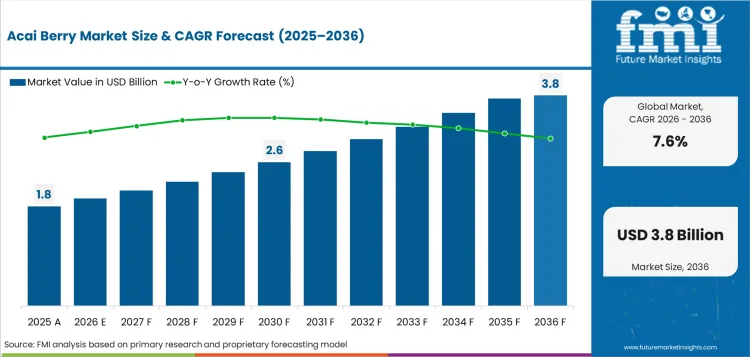
Key Takeaways, Market Size, and Forecast
| Metric | Value |
|---|---|
| Market Size (2025) | USD 1.8 Billion |
| Market Size (2036) | USD 3.8 Billion |
| CAGR (Forecast Period) | 7.6% |
| Incremental Opportunity (2026–2036) | USD 2.0 Billion |
| Leading Product Claim (2026) | Conventional Acai (52.8%) |
| Leading End Use (2026) | Households (42.0%) |
| Fastest-Growing Countries | India (9.7% CAGR), Germany (8.7% CAGR) |
Acai processing is becoming a lucrative opportunity driven by the need for fast harvest speed and local freezing access. In March 2026, USDA FAS said high-quality acai must be processed within 12 hours after harvest. It also said fruit quality declines if harvest is delayed beyond 48 hours. That makes harvest-zone pulping a core requirement for puree and frozen bowl programs. Brazil remains the main sourcing base for acai pulp and puree. Brand owners need deeper supplier mapping because Amazon sourcing can face seasonal pressure and cold-chain limits. Embrapa’s BRS Pai d’Égua acai cultivar gives growers a practical season-smoothing option. Embrapa stated that BRS Pai d’Égua produces 46% in the January to June off-season. Growers and processors using certified seedlings can improve plant utilization before peak harvest pressure builds.
Acai Berry Market Definition
The acai berry market covers acai berries sold as raw fruit, frozen pulp, puree, powder, juice and extract. These products are used in food and beverages, nutraceuticals, personal care and herbal products.
Acai Berry Market Inclusions
Scope covers raw-whole, processed, frozen, freeze-dried, powder, juice, pulp, and puree acai. Claims include conventional and organic. Applications cover food and beverages, nutraceuticals, cosmetics, pharmaceutical and herbal use, and animal nutrition with acai as a named ingredient. Key stakeholders include growers, processors, ingredient suppliers, food brands, nutraceutical formulators, cosmetic companies, distributors, and retailers.
Acai Berry Market Exclusions
Scope excludes unrelated berry crops and generic superfruit blends without acai as a named ingredient. Farm tools and cold storage equipment are excluded. Generic fruit logistics revenue is excluded. Restaurant revenue is excluded unless tied to acai ingredient purchases. Finished beauty products are excluded unless acai is sold as a defined active ingredient.
Acai Berry Market Research Methodology
- Primary Research: FMI analysts reviewed acai processors and ingredient suppliers. Foodservice accounts and specialty retailers were checked across major demand countries.
- Desk Research: Public data from government and trade bodies was reviewed. Company releases were used only for verified supplier activity.
- Market Sizing and Forecasting: Market value was checked using supplied anchors and CAGR math. Pulp demand and powder use were used for format-level checks.
- Data Validation: Forecast checks compared Brazil supply, export movement and retail wellness demand. Country analysis reviewed channel depth and import readiness.
Why is the Acai Berry Market Growing?
- Smoothie bowls are raising demand for frozen pulp as cafes need color, thickness and steady fruit taste.
- Supplement use supports powder demand because brands use acai in capsules and daily wellness drinks.
- Retail access is improving as frozen packs and shelf-stable formats make acai easier for households.
Acai demand is rising as Brazil’s production base expands. USDA FAS estimates Brazil’s acai production at 2.0 million metric tons in 2026, up 11.0% from the 1.8 million metric tons estimated for 2025. Domestic consumption of Brazilian acai is growing by about 15.0% annually, which supports both pulp processing and branded bowl formats.
Export demand gives the market another growth base. Brazilian acai exports reached 55,798 metric tons in 2025, showing that frozen and processed acai products are moving through global foodservice and retail channels.
Market Segmentation Analysis
- Raw-whole acai is forecast to account for 40.0% share in 2026.
- Conventional products are anticipated to represent 52.8% share in 2026.
- In 2026, pharmaceutical and herbal use is forecast at 38.0% share.
- Household demand is expected to account for 42.0% share in 2026.
- Pulp form is anticipated to hold 42.0% share during 2026.
- Online retail is forecast to represent 42.0% share during the same period.
The acai berry market is divided into groups based on product type, product claim, application, end use, form, distribution channel, and region. Product type includes raw-whole acai and processed acai. It also includes frozen acai and freeze-dried acai. Powder and juice are included in the same scope. Pulp and purees complete the product type scope. Product claim covers conventional and organic acai. By application, the market covers food and beverages and nutraceuticals. Cosmetics and personal care are included. Pharmaceutical and herbal use and animal nutrition complete the application scope. By end use, the market covers households and foodservice sector. Nutraceutical companies and cosmetic brands are included. Functional food brands and regional brands complete the end use scope. Form covers pulp form and powder form. Liquid form and capsule and tablet form are included. By distribution channel, the market covers supermarkets and hypermarkets. Convenience stores and online retail are included. Specialty stores complete the distribution channel scope.
Insights into Acai Berry Market by Product Type
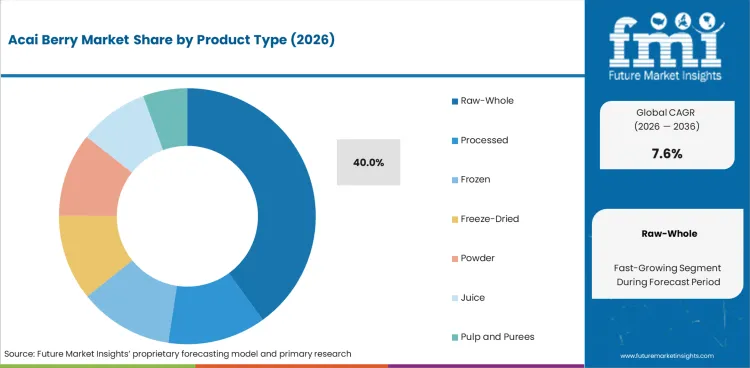
- Raw-whole acai is expected to hold 40.0% share in 2026. Whole-fruit identity supports premium sourcing claims and processing authenticity.
- Frozen acai supports bowl menus and freezer retail packs. Freeze-dried products support longer shelf life and travel-friendly formats.
Insights into Acai Berry Market by Product Claim
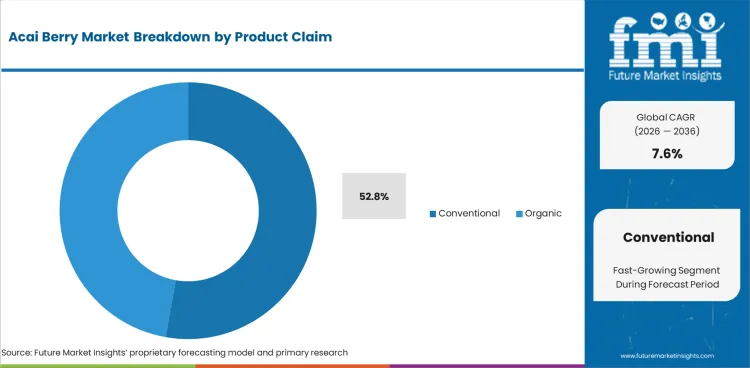
- Conventional acai is forecast to account for 52.8% share in 2026 as retail users need stable price points and regular availability.
- Organic acai serves premium health stores and wellness brands. Certified sourcing helps suppliers defend better margins in specialty channels.
Insights into Acai Berry Market by Application
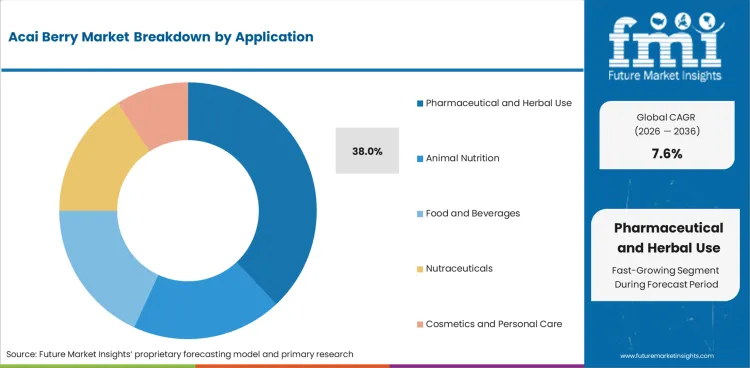
- Pharmaceutical and herbal use is anticipated at 38.0% share in 2026. Extract makers use acai in capsules and antioxidant products.
- Food and beverage use expands through bowls, juices and functional drinks. Acai gives products strong color and clear fruit identity.
Insights into Acai Berry Market by End Use
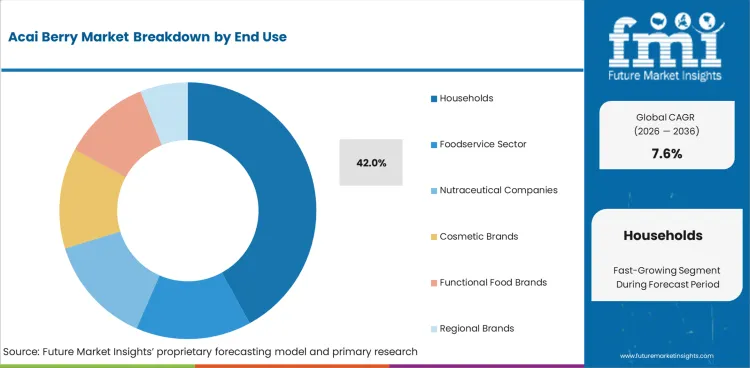
- Households are expected to represent 42.0% share in 2026 as consumers use frozen packs and powders for home smoothies.
- Foodservice operators need pulp that blends quickly during busy service periods. Cafes benefit from stable texture and portion control.
Insights into Acai Berry Market by Form
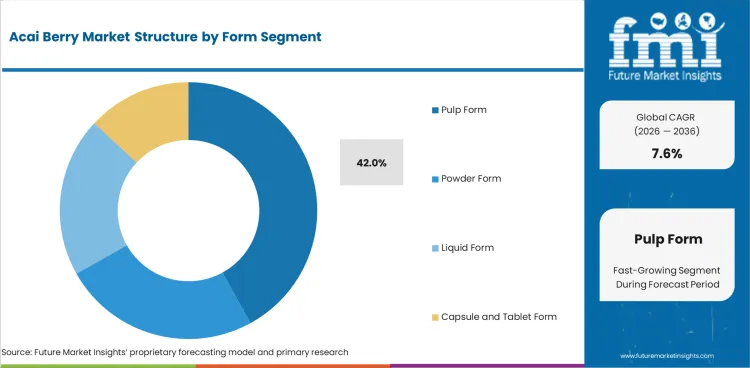
- Pulp form is forecast to capture 42.0% share in 2026 as frozen bowl preparation needs thick texture after blending.
- Powder form supports supplement and instant drink use. Shelf-stable formats reduce cold storage needs for online sellers.
Insights into Acai Berry Market by Distribution Channel
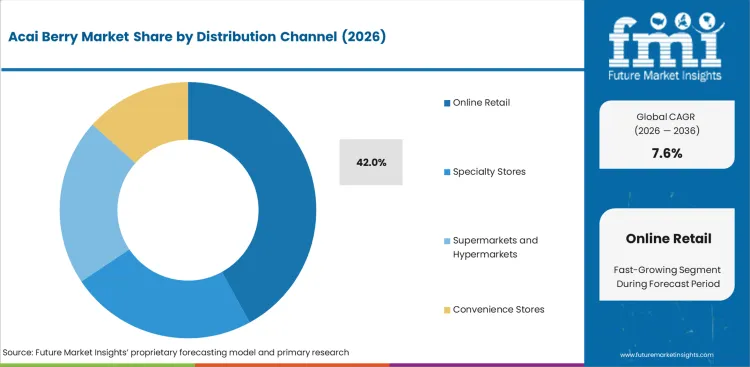
- Online retail is anticipated to account for 42.0% share in 2026 as direct ordering supports repeat purchases.
- Supermarkets and hypermarkets expand household access through freezer cases and health food sections.
Acai Berry Market Drivers, Restraints, and Opportunities
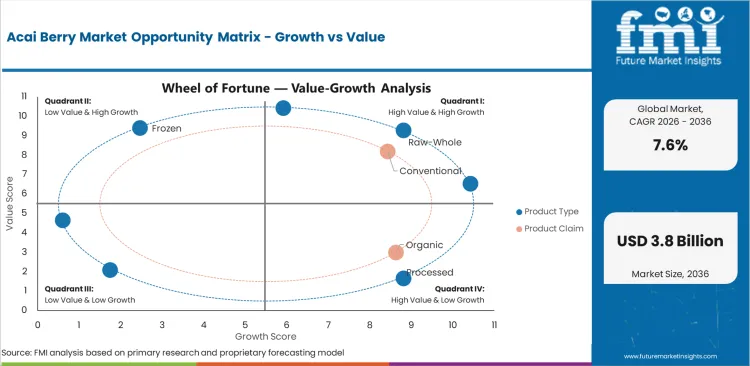
- Frozen bowl menus are increasing demand for pulp formats with stable taste and color.
- Short harvest timing can limit premium supply and raise pressure on local processors.
- Traceable sourcing creates opportunity for suppliers able to prove Amazon origin and handling time.
Frozen Pulp Demand Is Raising Processing Needs
Frozen acai pulp is becoming the main service format for bowl shops and cafes. Pulp works well because it blends quickly and keeps a thick texture. Acai must be processed within 12 hours of harvest for the best quality. Fruit quality can decline if harvest handling crosses 48 hours.
Harvest Timing Can Limit Premium Supply
Harvest pressure is high because 90.0% of acai harvest occurs during the 100-day season. The commercial harvest usually starts in August or September and lasts until November or December. Exporters need strong freezing and pulp capacity during that short window.
Powder and Extracts Create Higher-value Uses
Powder and extracts create a wider route beyond frozen bowls. Supplement brands use acai for antioxidant claims and daily wellness products. Embrapa’s BRS Pai d’Égua variety gives 46.0% of its output during the off-season and 54.0% during the main harvest. Such varieties can help processors reduce supply gaps across the year.
Analysis of Acai Berry Market by Key Countries
.webp "Top Country Growth Comparison Acai Berry Market Cagr (2026 2036)")
| Country | CAGR |
|---|---|
| India | 9.7% |
| Germany | 8.7% |
| Brazil | 8.4% |
| China | 8.2% |
| United Kingdom | 7.5% |
| United States | 6.2% |
| Japan | 5.7% |
Source: Future Market Insights, 2026.
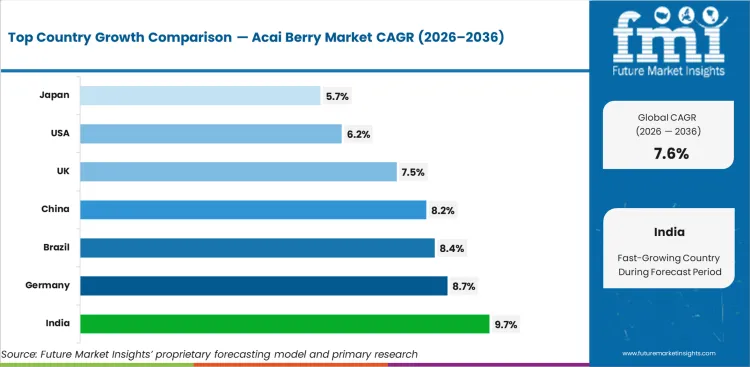
Acai Berry Market CAGR Analysis by Country
- India is expected to record 9.7% CAGR by 2036 as urban wellness retail supports premium fruit formats.
- Germany is forecast to advance at 8.7% CAGR during the forecast period as organic food channels deepen.
- As domestic processing capacity strengthens, Brazil is anticipated to move ahead at 8.4% CAGR by 2036.
- China is expected to expand at 8.2% CAGR over the ten-year period as beverage chains increase acai use.
- United Kingdom demand is forecast at 7.5% CAGR by 2036 as freezer-based smoothie packs gain retail space.
- During the forecast period as bowl chains support steady use, United States acai demand is anticipated to grow at 6.2% CAGR.
- Japan is expected to advance at 5.7% CAGR by 2036 as functional drink makers use acai selectively.
Demand Outlook for Acai Berry Market in India
India is expected to record 9.7% CAGR by 2036 as urban wellness retail and premium cafes support imported acai products. Frozen pulp can serve smoothie shops in large cities. Powder formats suit supplement brands that need small packs and clear fruit India is expected to record 9.7% CAGR by 2036 as urban wellness retail and premium cafes support imported acai products. India’s agricultural food imports stood at USD 32.0 billion in fiscal year 2023 to 2024, with processed food products forming 17.0% of that value. Frozen pulp can serve smoothie shops in large cities. Powder formats suit supplement brands that need small packs and clear fruit positioning.
- Suppliers will need price discipline because mainstream retail buyers compare acai with other imported berries.
- Mumbai distributors can support frozen pulp movement into cafes and health food stores.
- Bengaluru wellness brands may use powder formats for smoothies and supplement blends.
- Delhi specialty retailers need compliant labels and stable product availability.
Sales Analysis of Acai Berry Market in Germany
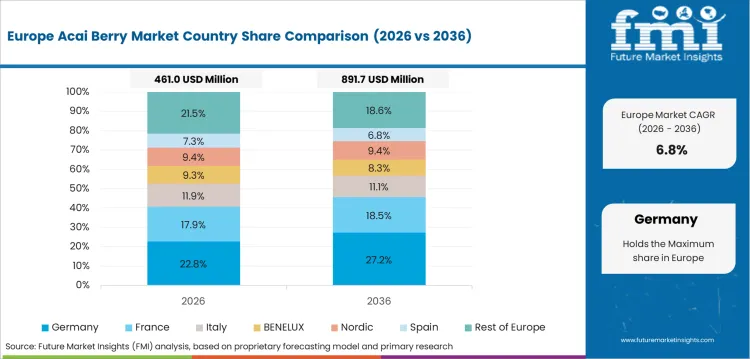
Germany has a developed organic retail channel and strong consumer interest in natural products. Demand in Germany is forecast to advance at 8.7% CAGR during the forecast period. Nearby Dutch import flow supports European acai distribution, as Brazil exported 8,718 metric tons of acai to the Netherlands in 2025 after a 93.0% increase from 2020. Certified organic acai can gain space in health stores and premium freezer sections.
- Hamburg importers can support frozen pulp movement into German distribution channels.
- Berlin organic stores create space for premium acai powder and smoothie packs.
- North Rhine-Westphalia beverage processors can use puree and concentrate formats.
Demand Outlook for Acai Berry Market in Brazil
Acai demand in Brazil is anticipated to move ahead at 8.4% CAGR by 2036. Brazil is the supply center for acai berry products and has direct access to Amazon harvest areas. IBGE states that Amazonian acai harvesting reached 247,500 tonnes in 2024, up 3.6% from the prior year. The North Region held 92.9% of harvesting, which confirms the supply depth of Amazon states.
- Para supports the strongest supply depth for wild-harvested acai.
- Amapa adds sourcing value for specialty and organic acai packs.
- Belem processors support frozen pulp movement into domestic and export channels.
Sales Analysis of Acai Berry Market in China
China creates demand through urban cafes and premium beverage channels. Imported acai can work in smoothie bars and wellness retail shelves. The market in China is expected to expand at 8.2% CAGR over the ten-year period. China had more than 100,000 registered food processing companies in 2025, with food and agricultural processing revenue estimated above USD 2.5 trillion. Acai suppliers need local label compliance and cold logistics partners before serving larger retail chains.
- Shanghai importers can support premium frozen fruit movement into retail channels.
- Guangzhou beverage processors create demand for puree and concentrate inputs.
- Beijing specialty retailers can help premium superfruit packs reach high-income consumers.
Future Outlook for Acai Berry Market in the United Kingdom
United Kingdom retailers are adding more natural and organic food products across chilled and frozen sections. Acai can benefit from smoothie packs and premium powders sold through health stores. Industry outlook in the United Kingdom points to 7.5% CAGR by 2036. In 2025, online purchases accounted for 13.0% of UK grocery sales, with 59.0% of consumers doing some grocery shopping online. That supports repeat ordering for frozen packs and powder formats.
- London retailers support frozen bowl packs and powdered acai products.
- Bristol cafes give acai bowl brands urban menu access.
- Online grocery platforms can support repeat purchases for frozen packs.
Demand Outlook for Acai Berry Market in the United States
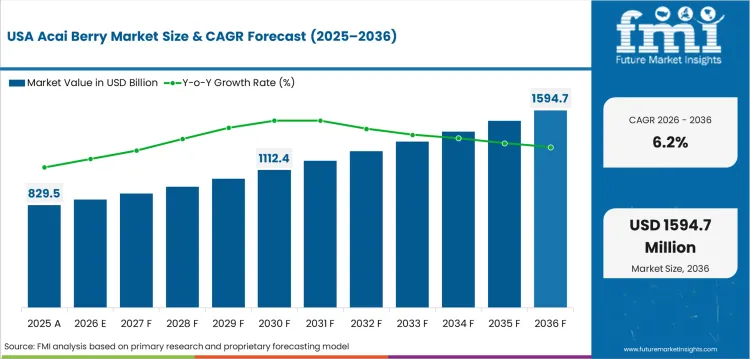
Acai demand in the United States is expected to move ahead at 6.2% CAGR during the forecast period. United States demand is supported by acai bowl chains and wellness retailers. USDA ERS states that USA organic food sales reached USD 65.4 billion in 2024, with produce forming 33.0% of organic food sales. Organic acai suppliers can use that channel strength to support premium retail placement.
- California bowl chains support high-volume frozen pulp demand.
- Florida importers help move Brazilian puree into retail and foodservice accounts.
- Natural grocery retailers support powder and ready-to-drink acai products.
Future Outlook for Acai Berry Market in Japan
Japan uses acai in selective premium formats tied to health drinks and small food packs. Powder formats can serve functional beverages and dessert mixes. Adoption in Japan is anticipated to advance at 5.7% CAGR by 2036. Brazil exported 6,244 metric tons of acai to Japan in 2025, a 712.0% increase from 2020. Smaller pack sizes can help brands test acai in premium retail channels.
- Tokyo retailers support premium acai packs for health-conscious consumers.
- Osaka beverage firms can use powder formats for cafe drinks and dessert mixes.
- Nagoya distributors need stable frozen supply for specialty retail placement.
Competitive Landscape and Strategic Positioning
- Competition is moving toward sourcing proof because acai quality depends on harvest origin and cold handling after pulp processing.
- Foodservice brands gain an edge when frozen pulp blends quickly and gives the same bowl texture across outlets.
- Ingredient suppliers can stand out with powder formats because supplement brands need shelf-stable acai for capsules and drink mixes.
- New entrants face pressure from cold storage needs and organic certification records.
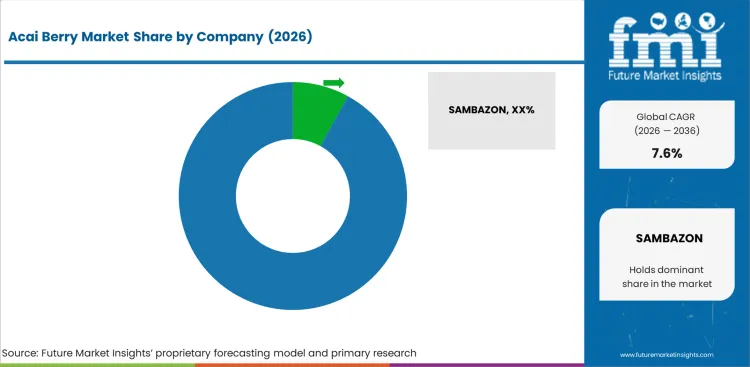
Competitive position in the acai berry market is increasingly driven by sourcing proof and channel access. Companies that can demonstrate traceable Amazon sourcing and maintain strict cold-chain control are better placed to secure premium retail and foodservice accounts. SAMBAZON maintains a competitive edge through acai sourcing and fair trade positioning. The company says its plants hold an AA+ BRCGS food safety rating, which supports premium supply claims. Acai Roots and Nossa! Fruits support frozen pulp and retail ingredient needs.
Scale in foodservice distribution has emerged as a critical competitive differentiator. Brands with direct consumer access through large outlet networks gain stronger visibility and demand control. In this context, OAKBERRY states that the brand has more than 600 stores across more than 35 countries. This gives the company a wide direct route for acai bowls and smoothies.
Key Companies in the Acai Berry Market
- Source-integrated brands: SAMBAZON and Nativo Acai hold strong positions through Amazon sourcing and fruit identity.
- Frozen pulp suppliers: Acai Roots and Nossa! Fruits compete through pulp packs and retail ingredient formats.
- Beverage and retail brands: The Berry Company and Açaí Berry Foods support juice products and consumer packs.
- Foodservice specialists: AcaiExotic and OAKBERRY support bowl formats and direct consumer demand.
Competitive Benchmarking: Acai Berry Market
| Company | Sourcing Control | Frozen Pulp Capability | Retail Access | Geographic Footprint |
|---|---|---|---|---|
| SAMBAZON | High | High | High | United States and export retail |
| Acai Roots | Medium | High | Medium | United States centered |
| Nossa! Fruits SAS | Medium | High | Medium | Europe centered |
| The Berry Company Limited | Medium | Medium | High | United Kingdom centered |
| Nativo Acai | High | Medium | Medium | Brazil and export channels |
| AcaiExotic | Medium | High | Medium | United States specialty channels |
| Açaí Berry Foods | Medium | Medium | Medium | Regional retail and foodservice |
| OAKBERRY | Medium | High | High | Global foodservice network |
Source: Future Market Insights competitive analysis, 2026.
Key Developments in Acai Berry Market
- In July 2024, SAMBAZON expanded its Açaí Bowls presence across USA airport locations and highlighted the launch of its Açaí Bowls franchising program. This supports wider foodservice access for ready-to-eat acai bowls.
- In April 2026, Jamba promoted National Acai Day with a USD 5 regular acai bowl and USD 3 Super-Antioxidant Acai Smoothie at participating locations. The campaign supported acai bowl and acai smoothie trial through a limited-time in-store offer.
Key Players in the Acai Berry Market
Major Global Players
- SAMBAZON, Inc.
- Acai Roots, Inc.
- Nossa! Fruits SAS
- The Berry Company Limited
- OAKBERRY
Specialist and Regional Players
- Nativo Acai
- AcaiExotic
- Açaí Berry Foods
- Amazon Forest Trading
Report Scope and Coverage
| Parameter | Details |
|---|---|
| Quantitative Units | USD 1.8 billion to USD 3.8 billion at 7.6% CAGR |
| Market Definition | Acai fruit products used in food, beverages, supplements, personal care and herbal products |
| Regions Covered | North America, Latin America, Western Europe, Eastern Europe, East Asia, South Asia and Pacific, Middle East and Africa |
| Countries Covered | India, Germany, Brazil, China, United Kingdom, United States, Japan and more than thirty countries |
| Key Companies Profiled | SAMBAZON, Acai Roots, Nossa! Fruits, The Berry Company, Nativo Acai, AcaiExotic, Açaí Berry Foods and OAKBERRY |
| Forecast Period | 2026 to 2036 |
| Approach | Hybrid bottom-up and top-down methodology using supplied values, Brazil supply data, product format demand and supplier activity |
Source: Future Market Insights, 2026.
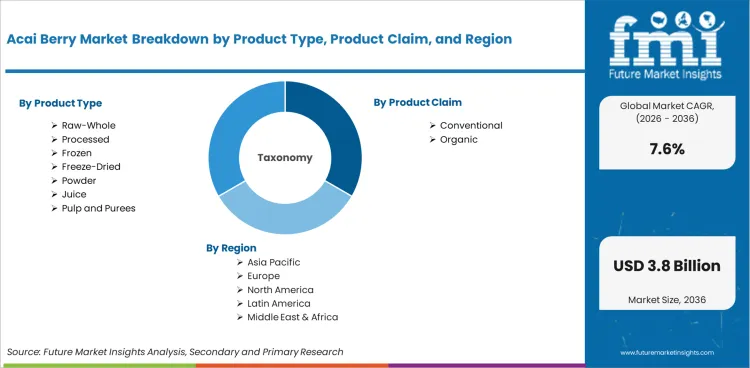
Acai Berry Market Breakdown by Product Type, Product Claim, Application, End Use, Form, Distribution Channel, and Region
Acai Berry Market Segmented by Product Type
- Raw-Whole
- Processed
- Frozen
- Freeze-Dried
- Powder
- Juice
- Pulp and Purees
Acai Berry Market Segmented by Product Claim
- Conventional
- Organic
Acai Berry Market Segmented by Application
- Food and Beverages
- Nutraceuticals
- Cosmetics and Personal Care
- Pharmaceutical and Herbal Use
- Animal Nutrition
Acai Berry Market Segmented by End Use
- Households
- Foodservice Sector
- Nutraceutical Companies
- Cosmetic Brands
- Functional Food Brands
- Regional Brands
Acai Berry Market Segmented by Form
- Pulp Form
- Powder Form
- Liquid Form
- Capsule and Tablet Form
Acai Berry Market Segmented by Distribution Channel
- Supermarkets and Hypermarkets
- Convenience Stores
- Online Retail
- Specialty Stores
Acai Berry Market by Region
- North America
- Latin America
- Europe
- East Asia
- South Asia and Pacific
- Middle East and Africa
Research Sources and Bibliography
- USA Department of Agriculture, Foreign Agricultural Service. (2026, March 13). The global acai report (Report No. BR2026-0013). USDA FAS.
- Empresa Brasileira de Pesquisa Agropecuária. (n.d.). BRS Pai d’Égua: Cultivated açaí tree irrigated on land. Embrapa.
- USA Department of Agriculture, Foreign Agricultural Service. (2025, April 1). Food processing ingredients annual: India (Report No. IN2025-0022). USDA FAS.
- USA Department of Agriculture, Foreign Agricultural Service. (2026, April 1). Food processing ingredients annual: China - People’s Republic of (Report No. CH2026-0042). USDA FAS.
- USA Department of Agriculture, Foreign Agricultural Service. (2026, March 24). Food processing ingredients annual: United Kingdom (Report No. UK2026-0008). USDA FAS.
- USA Department of Agriculture, Economic Research Service. (2026, January 27). Organic agriculture. USDA ERS.
- Jamba. (2026, April 6). Celebrate Acai Day with us on Monday, April 6, 2026. Jamba Newsroom.
This bibliography is provided for reader reference and is not exhaustive. The full report contains the complete reference list and detailed citations.
This Report Answers
- What is the current and future size of the acai berry market?
- How fast will the acai berry market expand during the forecast period?
- Which product claim is forecast to lead acai berry demand by 2026?
- Which end use creates the main demand for acai berry products?
- How do frozen pulp and powder formats affect product demand?
- Which countries are forecast to record faster expansion during the forecast period?
- How does Brazil influence acai berry supply?
- How does online retail affect acai berry sales?
- Who are the main companies active in the acai berry market?
- How does FMI estimate and validate the acai berry forecast?
Frequently Asked Questions
What is the global market demand for Acai Berry in 2026?
In 2026, the global acai berry market is forecast at USD 1.9 billion as pulp and powder formats widen.
How big will the Acai Berry Market be in 2036?
By 2036, the acai berry market is forecast to reach USD 3.8 billion as retail and foodservice use expands.
How much will Acai Berry demand grow during the forecast period?
Acai berry demand is forecast to expand at 7.6% CAGR during the forecast period.
Which product claim is forecast to lead the Acai Berry Market in 2026?
Conventional acai is forecast to lead with 52.8% share in 2026 due to price access and regular supply.
Which end use is forecast to lead Acai Berry demand?
Households are forecast to lead with 42.0% share in 2026 as frozen packs and powders support home smoothies.
Which country will expand fastest in the Acai Berry Market?
India is forecast to record 9.7% CAGR by 2036 as urban wellness retail supports premium imported fruit formats.
What does the Acai Berry Market include?
The market includes raw-whole acai, frozen pulp, puree, powder, juice and extracts used in food and wellness products.
How does FMI estimate the Acai Berry Market forecast?
FMI uses supplied values, Brazil supply data, product format demand, channel checks and supplier activity to validate the forecast.
Why is frozen pulp important in acai berry demand?
Frozen pulp supports smoothie bowls because it blends quickly and keeps a thick fruit texture during service.
Are acai berry products used in supplements?
Yes. Supplement brands use acai powder and extracts in capsules, drink mixes and antioxidant products.
Preview the report firsthand - request a free sample
Get SampleGet the brochure for pricing and purchase details.
Get PDFTable of Content
- Executive Summary
- Global Market Outlook
- Demand-side Trends
- Supply-side Trends
- Technology Roadmap Analysis
- Analysis and Recommendations
- Market Overview
- Market Coverage / Taxonomy
- Market Definition / Scope / Limitations
- Research Methodology
- Chapter Orientation
- Analytical Lens and Working Hypotheses
- Market Structure, Signals, and Trend Drivers
- Benchmarking and Cross-market Comparability
- Market Sizing, Forecasting, and Opportunity Mapping
- Research Design and Evidence Framework
- Desk Research Programme (Secondary Evidence)
- Company Annual and Sustainability Reports
- Peer-reviewed Journals and Academic Literature
- Corporate Websites, Product Literature, and Technical Notes
- Earnings Decks and Investor Briefings
- Statutory Filings and Regulatory Disclosures
- Technical White Papers and Standards Notes
- Trade Journals, Industry Magazines, and Analyst Briefs
- Conference Proceedings, Webinars, and Seminar Materials
- Government Statistics Portals and Public Data Releases
- Press Releases and Reputable Media Coverage
- Specialist Newsletters and Curated Briefings
- Sector Databases and Reference Repositories
- FMI Internal Proprietary Databases and Historical Market Datasets
- Subscription Datasets and Paid Sources
- Social Channels, Communities, and Digital Listening Inputs
- Additional Desk Sources
- Expert Input and Fieldwork (Primary Evidence)
- Primary Modes
- Qualitative Interviews and Expert Elicitation
- Quantitative Surveys and Structured Data Capture
- Blended Approach
- Why Primary Evidence is Used
- Field Techniques
- Interviews
- Surveys
- Focus Groups
- Observational and In-context Research
- Social and Community Interactions
- Stakeholder Universe Engaged
- C-suite Leaders
- Board Members
- Presidents and Vice Presidents
- R&D and Innovation Heads
- Technical Specialists
- Domain Subject-matter Experts
- Scientists
- Physicians and Other Healthcare Professionals
- Governance, Ethics, and Data Stewardship
- Research Ethics
- Data Integrity and Handling
- Primary Modes
- Tooling, Models, and Reference Databases
- Desk Research Programme (Secondary Evidence)
- Data Engineering and Model Build
- Data Acquisition and Ingestion
- Cleaning, Normalisation, and Verification
- Synthesis, Triangulation, and Analysis
- Quality Assurance and Audit Trail
- Market Background
- Market Dynamics
- Drivers
- Restraints
- Opportunity
- Trends
- Scenario Forecast
- Demand in Optimistic Scenario
- Demand in Likely Scenario
- Demand in Conservative Scenario
- Opportunity Map Analysis
- Product Life Cycle Analysis
- Supply Chain Analysis
- Investment Feasibility Matrix
- Value Chain Analysis
- PESTLE and Porter’s Analysis
- Regulatory Landscape
- Regional Parent Market Outlook
- Production and Consumption Statistics
- Import and Export Statistics
- Market Dynamics
- Global Market Analysis 2021 to 2025 and Forecast, 2026 to 2036
- Historical Market Size Value (USD Million) Analysis, 2021 to 2025
- Current and Future Market Size Value (USD Million) Projections, 2026 to 2036
- Y-o-Y Growth Trend Analysis
- Absolute $ Opportunity Analysis
- Global Market Pricing Analysis 2021 to 2025 and Forecast 2026 to 2036
- Global Market Analysis 2021 to 2025 and Forecast 2026 to 2036, By Product Type
- Introduction / Key Findings
- Historical Market Size Value (USD Million) Analysis By Product Type , 2021 to 2025
- Current and Future Market Size Value (USD Million) Analysis and Forecast By Product Type , 2026 to 2036
- Raw-Whole
- Processed
- Frozen
- Freeze-Dried
- Powder
- Juice
- Pulp and Purees
- Raw-Whole
- Y-o-Y Growth Trend Analysis By Product Type , 2021 to 2025
- Absolute $ Opportunity Analysis By Product Type , 2026 to 2036
- Global Market Analysis 2021 to 2025 and Forecast 2026 to 2036, By Product Claim
- Introduction / Key Findings
- Historical Market Size Value (USD Million) Analysis By Product Claim, 2021 to 2025
- Current and Future Market Size Value (USD Million) Analysis and Forecast By Product Claim, 2026 to 2036
- Conventional
- Organic
- Conventional
- Y-o-Y Growth Trend Analysis By Product Claim, 2021 to 2025
- Absolute $ Opportunity Analysis By Product Claim, 2026 to 2036
- Global Market Analysis 2021 to 2025 and Forecast 2026 to 2036, By Application
- Introduction / Key Findings
- Historical Market Size Value (USD Million) Analysis By Application, 2021 to 2025
- Current and Future Market Size Value (USD Million) Analysis and Forecast By Application, 2026 to 2036
- Pharmaceutical and Herbal Use
- Animal Nutrition
- Food and Beverages
- Nutraceuticals
- Cosmetics and Personal Care
- Pharmaceutical and Herbal Use
- Y-o-Y Growth Trend Analysis By Application, 2021 to 2025
- Absolute $ Opportunity Analysis By Application, 2026 to 2036
- Global Market Analysis 2021 to 2025 and Forecast 2026 to 2036, By End Use
- Introduction / Key Findings
- Historical Market Size Value (USD Million) Analysis By End Use, 2021 to 2025
- Current and Future Market Size Value (USD Million) Analysis and Forecast By End Use, 2026 to 2036
- Households
- Foodservice Sector
- Nutraceutical Companies
- Cosmetic Brands
- Functional Food Brands
- Regional Brands
- Households
- Y-o-Y Growth Trend Analysis By End Use, 2021 to 2025
- Absolute $ Opportunity Analysis By End Use, 2026 to 2036
- Global Market Analysis 2021 to 2025 and Forecast 2026 to 2036, By Form
- Introduction / Key Findings
- Historical Market Size Value (USD Million) Analysis By Form, 2021 to 2025
- Current and Future Market Size Value (USD Million) Analysis and Forecast By Form, 2026 to 2036
- Pulp Form
- Powder Form
- Liquid Form
- Capsule and Tablet Form
- Pulp Form
- Y-o-Y Growth Trend Analysis By Form, 2021 to 2025
- Absolute $ Opportunity Analysis By Form, 2026 to 2036
- Global Market Analysis 2021 to 2025 and Forecast 2026 to 2036, By Distribution Channel
- Introduction / Key Findings
- Historical Market Size Value (USD Million) Analysis By Distribution Channel, 2021 to 2025
- Current and Future Market Size Value (USD Million) Analysis and Forecast By Distribution Channel, 2026 to 2036
- Online Retail
- Specialty Stores
- Supermarkets and Hypermarkets
- Convenience Stores
- Online Retail
- Y-o-Y Growth Trend Analysis By Distribution Channel, 2021 to 2025
- Absolute $ Opportunity Analysis By Distribution Channel, 2026 to 2036
- Global Market Analysis 2021 to 2025 and Forecast 2026 to 2036, By Region
- Introduction
- Historical Market Size Value (USD Million) Analysis By Region, 2021 to 2025
- Current Market Size Value (USD Million) Analysis and Forecast By Region, 2026 to 2036
- North America
- Latin America
- Western Europe
- Eastern Europe
- East Asia
- South Asia and Pacific
- Middle East & Africa
- Market Attractiveness Analysis By Region
- North America Market Analysis 2021 to 2025 and Forecast 2026 to 2036, By Country
- Historical Market Size Value (USD Million) Trend Analysis By Market Taxonomy, 2021 to 2025
- Market Size Value (USD Million) Forecast By Market Taxonomy, 2026 to 2036
- By Country
- USA
- Canada
- Mexico
- By Product Type
- By Product Claim
- By Application
- By End Use
- By Form
- By Distribution Channel
- By Country
- Market Attractiveness Analysis
- By Country
- By Product Type
- By Product Claim
- By Application
- By End Use
- By Form
- By Distribution Channel
- Key Takeaways
- Latin America Market Analysis 2021 to 2025 and Forecast 2026 to 2036, By Country
- Historical Market Size Value (USD Million) Trend Analysis By Market Taxonomy, 2021 to 2025
- Market Size Value (USD Million) Forecast By Market Taxonomy, 2026 to 2036
- By Country
- Brazil
- Chile
- Rest of Latin America
- By Product Type
- By Product Claim
- By Application
- By End Use
- By Form
- By Distribution Channel
- By Country
- Market Attractiveness Analysis
- By Country
- By Product Type
- By Product Claim
- By Application
- By End Use
- By Form
- By Distribution Channel
- Key Takeaways
- Western Europe Market Analysis 2021 to 2025 and Forecast 2026 to 2036, By Country
- Historical Market Size Value (USD Million) Trend Analysis By Market Taxonomy, 2021 to 2025
- Market Size Value (USD Million) Forecast By Market Taxonomy, 2026 to 2036
- By Country
- Germany
- UK
- Italy
- Spain
- France
- Nordic
- BENELUX
- Rest of Western Europe
- By Product Type
- By Product Claim
- By Application
- By End Use
- By Form
- By Distribution Channel
- By Country
- Market Attractiveness Analysis
- By Country
- By Product Type
- By Product Claim
- By Application
- By End Use
- By Form
- By Distribution Channel
- Key Takeaways
- Eastern Europe Market Analysis 2021 to 2025 and Forecast 2026 to 2036, By Country
- Historical Market Size Value (USD Million) Trend Analysis By Market Taxonomy, 2021 to 2025
- Market Size Value (USD Million) Forecast By Market Taxonomy, 2026 to 2036
- By Country
- Russia
- Poland
- Hungary
- Balkan & Baltic
- Rest of Eastern Europe
- By Product Type
- By Product Claim
- By Application
- By End Use
- By Form
- By Distribution Channel
- By Country
- Market Attractiveness Analysis
- By Country
- By Product Type
- By Product Claim
- By Application
- By End Use
- By Form
- By Distribution Channel
- Key Takeaways
- East Asia Market Analysis 2021 to 2025 and Forecast 2026 to 2036, By Country
- Historical Market Size Value (USD Million) Trend Analysis By Market Taxonomy, 2021 to 2025
- Market Size Value (USD Million) Forecast By Market Taxonomy, 2026 to 2036
- By Country
- China
- Japan
- South Korea
- By Product Type
- By Product Claim
- By Application
- By End Use
- By Form
- By Distribution Channel
- By Country
- Market Attractiveness Analysis
- By Country
- By Product Type
- By Product Claim
- By Application
- By End Use
- By Form
- By Distribution Channel
- Key Takeaways
- South Asia and Pacific Market Analysis 2021 to 2025 and Forecast 2026 to 2036, By Country
- Historical Market Size Value (USD Million) Trend Analysis By Market Taxonomy, 2021 to 2025
- Market Size Value (USD Million) Forecast By Market Taxonomy, 2026 to 2036
- By Country
- India
- ASEAN
- Australia & New Zealand
- Rest of South Asia and Pacific
- By Product Type
- By Product Claim
- By Application
- By End Use
- By Form
- By Distribution Channel
- By Country
- Market Attractiveness Analysis
- By Country
- By Product Type
- By Product Claim
- By Application
- By End Use
- By Form
- By Distribution Channel
- Key Takeaways
- Middle East & Africa Market Analysis 2021 to 2025 and Forecast 2026 to 2036, By Country
- Historical Market Size Value (USD Million) Trend Analysis By Market Taxonomy, 2021 to 2025
- Market Size Value (USD Million) Forecast By Market Taxonomy, 2026 to 2036
- By Country
- Kingdom of Saudi Arabia
- Other GCC Countries
- Turkiye
- South Africa
- Other African Union
- Rest of Middle East & Africa
- By Product Type
- By Product Claim
- By Application
- By End Use
- By Form
- By Distribution Channel
- By Country
- Market Attractiveness Analysis
- By Country
- By Product Type
- By Product Claim
- By Application
- By End Use
- By Form
- By Distribution Channel
- Key Takeaways
- Key Countries Market Analysis
- USA
- Pricing Analysis
- Market Share Analysis, 2025
- By Product Type
- By Product Claim
- By Application
- By End Use
- By Form
- By Distribution Channel
- Canada
- Pricing Analysis
- Market Share Analysis, 2025
- By Product Type
- By Product Claim
- By Application
- By End Use
- By Form
- By Distribution Channel
- Mexico
- Pricing Analysis
- Market Share Analysis, 2025
- By Product Type
- By Product Claim
- By Application
- By End Use
- By Form
- By Distribution Channel
- Brazil
- Pricing Analysis
- Market Share Analysis, 2025
- By Product Type
- By Product Claim
- By Application
- By End Use
- By Form
- By Distribution Channel
- Chile
- Pricing Analysis
- Market Share Analysis, 2025
- By Product Type
- By Product Claim
- By Application
- By End Use
- By Form
- By Distribution Channel
- Germany
- Pricing Analysis
- Market Share Analysis, 2025
- By Product Type
- By Product Claim
- By Application
- By End Use
- By Form
- By Distribution Channel
- UK
- Pricing Analysis
- Market Share Analysis, 2025
- By Product Type
- By Product Claim
- By Application
- By End Use
- By Form
- By Distribution Channel
- Italy
- Pricing Analysis
- Market Share Analysis, 2025
- By Product Type
- By Product Claim
- By Application
- By End Use
- By Form
- By Distribution Channel
- Spain
- Pricing Analysis
- Market Share Analysis, 2025
- By Product Type
- By Product Claim
- By Application
- By End Use
- By Form
- By Distribution Channel
- France
- Pricing Analysis
- Market Share Analysis, 2025
- By Product Type
- By Product Claim
- By Application
- By End Use
- By Form
- By Distribution Channel
- India
- Pricing Analysis
- Market Share Analysis, 2025
- By Product Type
- By Product Claim
- By Application
- By End Use
- By Form
- By Distribution Channel
- ASEAN
- Pricing Analysis
- Market Share Analysis, 2025
- By Product Type
- By Product Claim
- By Application
- By End Use
- By Form
- By Distribution Channel
- Australia & New Zealand
- Pricing Analysis
- Market Share Analysis, 2025
- By Product Type
- By Product Claim
- By Application
- By End Use
- By Form
- By Distribution Channel
- China
- Pricing Analysis
- Market Share Analysis, 2025
- By Product Type
- By Product Claim
- By Application
- By End Use
- By Form
- By Distribution Channel
- Japan
- Pricing Analysis
- Market Share Analysis, 2025
- By Product Type
- By Product Claim
- By Application
- By End Use
- By Form
- By Distribution Channel
- South Korea
- Pricing Analysis
- Market Share Analysis, 2025
- By Product Type
- By Product Claim
- By Application
- By End Use
- By Form
- By Distribution Channel
- Russia
- Pricing Analysis
- Market Share Analysis, 2025
- By Product Type
- By Product Claim
- By Application
- By End Use
- By Form
- By Distribution Channel
- Poland
- Pricing Analysis
- Market Share Analysis, 2025
- By Product Type
- By Product Claim
- By Application
- By End Use
- By Form
- By Distribution Channel
- Hungary
- Pricing Analysis
- Market Share Analysis, 2025
- By Product Type
- By Product Claim
- By Application
- By End Use
- By Form
- By Distribution Channel
- Kingdom of Saudi Arabia
- Pricing Analysis
- Market Share Analysis, 2025
- By Product Type
- By Product Claim
- By Application
- By End Use
- By Form
- By Distribution Channel
- Turkiye
- Pricing Analysis
- Market Share Analysis, 2025
- By Product Type
- By Product Claim
- By Application
- By End Use
- By Form
- By Distribution Channel
- South Africa
- Pricing Analysis
- Market Share Analysis, 2025
- By Product Type
- By Product Claim
- By Application
- By End Use
- By Form
- By Distribution Channel
- USA
- Market Structure Analysis
- Competition Dashboard
- Competition Benchmarking
- Market Share Analysis of Top Players
- By Regional
- By Product Type
- By Product Claim
- By Application
- By End Use
- By Form
- By Distribution Channel
- Competition Analysis
- Competition Deep Dive
- SAMBAZON
- Overview
- Product Portfolio
- Profitability by Market Segments (Product/Age /Sales Channel/Region)
- Sales Footprint
- Strategy Overview
- Marketing Strategy
- Product Strategy
- Channel Strategy
- Acai Roots
- Nossa! Fruits SAS
- The Berry Company Limited
- Nativo Acai
- AcaiExotic
- Açaí Berry Foods
- OAKBERRY
- SAMBAZON
- Competition Deep Dive
- Assumptions & Acronyms Used


