

- Market Size (2026)
- USD 3.3 Bn
- Forecast (2036)
- USD 5.3 Bn
- CAGR (2026 to 2036)
- 4.8%
Vegan Butter Market Size, Market Forecast and Outlook By FMI
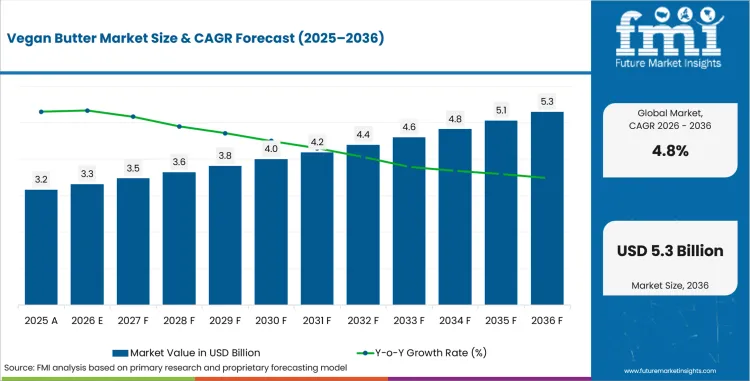
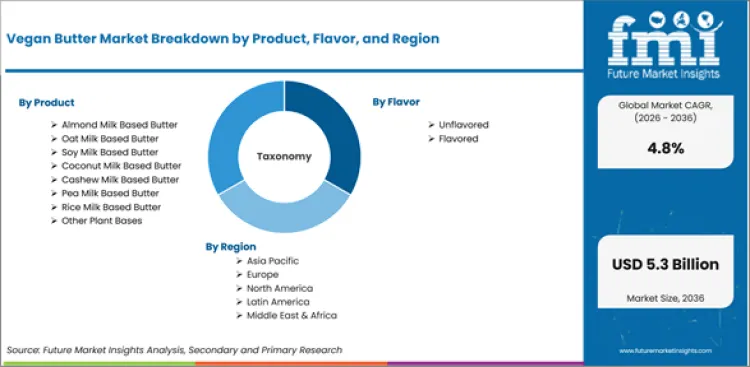
The vegan butter market was valued at USD 3.2 billion in 2025. The market is set to reach USD 3.3 billion by 2026-end and grow at a CAGR of 4.8% between 2026-2036 to reach USD 5.3 billion by 2036. Almond Milk Based Butter will dominate with a 34.0% share, while Unflavored will lead with a 71.0% share.
Key Takeaways, Market Size, and Forecast
- 2026 Market Size: USD 3.3 billion
- 2036 Market Size: USD 5.3 billion
- Compound Annual Growth Rate (CAGR): 4.8% from 2026 to 2036
- Absolute $ Opportunity: USD 2 billion between 2026 and 2036
- Leading Product Segment: Almond Milk Based Butter
- Almond Milk Based Butter Share in 2026: 34%
- Fastest-growing Country: Japan
- Japan CAGR: 5.2% through 2036
| Parameter | Details |
|---|---|
| Market Size in 2026 (Value) | USD 3.3 billion |
| Market Forecast in 2036 (Value) | USD 5.3 billion |
| CAGR (2026 to 2036) | 4.8% |
| Years Considered | 2021 to 2036 |
| Base Year | 2025 |
| Forecast Period | 2026 to 2036 |
| Units Considered | Value (USD Bn) |
| Leading Sub-Region | Japan |
Summary of the Vegan Butter Market
- Demand and Growth Drivers
- Demand for vegan butter is expanding as plant-based dairy alternatives gain mainstream retail shelf presence, driven by consumer interest in lactose-free, cholesterol-free, and environmentally conscious food products.
- Bakery industry procurement of plant-based butter for commercial bread, pastry, and confectionery production is increasing due to growing demand for vegan-certified and allergen-free baked goods across retail and foodservice channels.
- Retail distribution expansion through supermarkets, online grocery platforms, and specialty health stores is broadening the consumer base beyond dedicated vegan buyers to include flexitarian and health-conscious households.
- Product and Segment View
- Almond milk based butter accounts for 34.0% of the product segment in 2026, led by creamy and salted variants that offer taste profiles closest to conventional dairy butter for household and bakery use.
- Bakery industry holds 38.0% of the application segment, reflecting concentrated demand from commercial bakeries, artisan operations, and industrial baking units that require plant-based butter for vegan-certified product lines.
- Spreadable tubs hold 52.0% of the form segment, representing the dominant packaging format for household retail consumption where convenience and portion control drive purchase decisions.
- Geography and Competitive Outlook
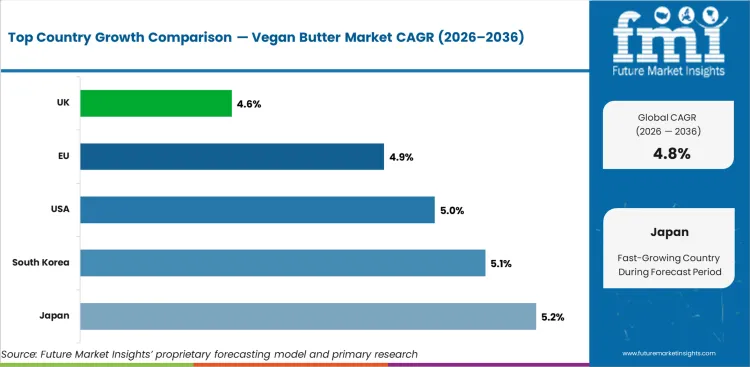
- Japan leads at 5.2% CAGR, supported by growing consumer interest in plant-based dairy alternatives, expanding health-food retail channels, and increasing bakery industry adoption of vegan-certified ingredients.
- The USA at 5.0% reflects strong demand from flexitarian consumer growth, retailer sustainability commitments, and expanding online grocery distribution of plant-based dairy alternatives.
- Upfield (Flora, Country Crock) holds the leading competitive position with established retail distribution, broad product range across plant bases, and strong brand recognition in the plant-based spreads category.
- Analyst Opinion
- Nandini Roy Choudhury, Principal Consultant at FMI says, 'Companies that can match conventional dairy butter in taste, baking performance, and price competitiveness while maintaining clean-label plant-based credentials are positioned to capture the growing share of flexitarian and health-conscious consumers through 2036.'
- The vegan butter market is shifting from a niche health-food category to a mainstream grocery segment as major retailers allocate dedicated shelf space for plant-based dairy alternatives alongside conventional products.
- Adoption of oat and pea milk based butter formulations is increasing due to allergen-free positioning that addresses consumer concerns about tree nut and soy allergies in the plant-based category.
- Demand is further supported by the growth of vegan-certified bakery and confectionery products in retail and foodservice, which requires commercial-grade plant-based butter with consistent baking performance.
The vegan butter market encompasses plant-based butter alternatives manufactured from almond, oat, soy, coconut, cashew, pea, rice, and other plant milk bases in solid block, spreadable tub, and spray formats. These products serve as dairy butter replacements in household consumption, bakery production, confectionery, foodservice, and dietary supplement applications.
Vegan Butter Market Inclusions
Market scope covers all commercially traded vegan butter products categorized by product, flavor, sales channel, application, distribution channel, form. Revenue is tracked from 2026 to 2036. Products include almond milk based, oat milk based, soy milk based, coconut milk based, cashew milk based, pea milk based, rice milk based, and other plant-based butter alternatives sold through supermarkets, online retail, specialty stores, convenience stores, and B2B foodservice channels.
Vegan Butter Market Exclusions
The scope does not include conventional dairy butter, margarine manufactured primarily from refined vegetable oils without plant milk bases, cooking oil sprays not marketed as butter alternatives, or plant-based cheese products.
Vegan Butter Market Research Methodology
- Primary Research: FMI analysts conducted interviews with plant-based food manufacturers, retail buyers, bakery ingredient suppliers, and foodservice distributors in key markets.
- Desk Research: Combined data from food industry trade associations, retail scanner databases, and plant-based food certification organizations.
- Market Sizing and Forecasting: Bottom-up aggregation from retail scanner data, B2B bakery ingredient sales, foodservice procurement, and online grocery platform transaction volumes with regional adoption curves.
- Data Validation: Cross-checked quarterly against retail distribution data, plant-based food production statistics, and manufacturer shipment records.
Why is the Vegan Butter Market Growing?
- Mainstream retail shelf space allocation for plant-based dairy alternatives is a primary growth factor as major grocery chains position vegan butter alongside conventional dairy products rather than in specialty health-food sections.
- Japan leads growth at 5.2% CAGR, supported by growing consumer interest in plant-based products, health-food retail expansion, and increasing bakery industry adoption of vegan-certified ingredients.
The vegan butter market is growing at 4.8% CAGR from 2026 to 2036, reflecting the steady mainstreaming of plant-based dairy alternatives across retail, bakery, and foodservice channels. The market is moving beyond its original vegan consumer base to capture demand from flexitarian, lactose-intolerant, and health-conscious consumers who seek dairy-free options without compromising on taste or culinary performance.
Almond milk based butter leads the product segment at 34.0%, followed by oat, soy, and coconut variants. Product development is focused on improving taste similarity to conventional dairy butter, enhancing baking performance for commercial applications, and achieving clean-label formulations that minimize processed ingredients. B2C retail accounts for 68.0% of the sales channel, with supermarkets and hypermarkets dominating distribution at 41.0%.
The bakery industry is the largest application segment at 38.0%, reflecting substantial B2B procurement by commercial bakeries, artisan operations, and industrial baking units that require plant-based butter for vegan-certified bread, pastry, and confectionery product lines. Household pantry use and hotel, restaurant, and retail chain foodservice represent additional demand channels.
Market Segmentation Analysis
- Almond milk based butter holds 34.0% of the product segment, with creamy and salted variants leading retail and bakery demand due to taste profiles similar to conventional dairy butter.
- Unflavored variants hold 71.0% of the flavor segment, reflecting consumer preference for neutral-taste plant-based butter suitable for cooking, baking, and general-purpose spreading.
- B2C retail channels account for 68.0% of sales, with supermarkets and hypermarkets holding 41.0% of distribution channel share as plant-based products gain mainstream grocery shelf allocation.
The vegan butter market segments by product type (plant milk base), flavor, sales channel, application, distribution channel, and form. Almond, oat, and soy milk based variants lead product demand, while unflavored products dominate the flavor segment. B2C retail is the primary sales channel, with supermarkets and hypermarkets leading distribution. Solid blocks and spreadable tubs serve different consumption occasions.
Insights into the Almond Milk Based Butter Segment
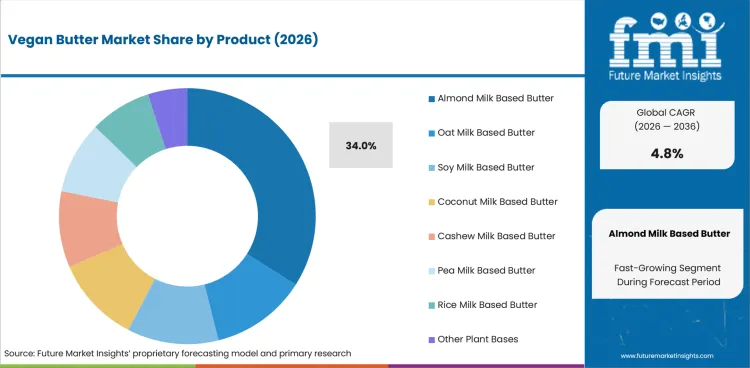
Almond milk based butter holds 34.0% of the product segment in 2026. Creamy and salted variants lead retail demand as consumers recognize almond-based formulations for their taste similarity to conventional dairy butter. Unsalted variants serve bakery and confectionery applications where neutral flavor profiles are essential for recipe consistency.
Almond milk based butter is the most established plant-based butter category in Western markets, with strong brand recognition and retail distribution. Oat milk based butter is the fastest-growing challenger, gaining share through allergen-free positioning that addresses tree nut allergy concerns in the plant-based category.
Insights into the Bakery Industry Application Segment
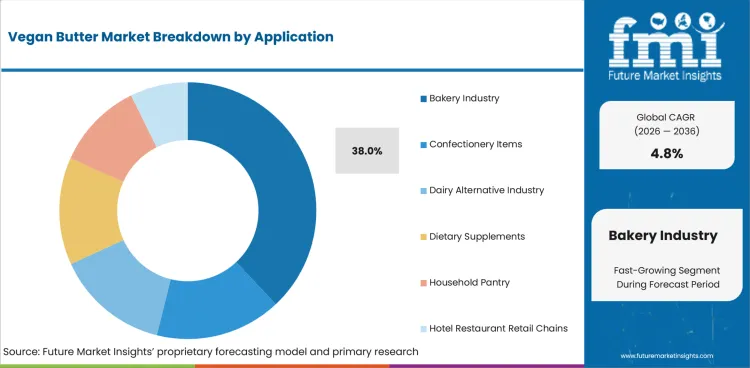
The bakery industry holds 38.0% of the application segment in 2026. Commercial bread production, artisan bakeries, and industrial baking operations represent the largest procurement volumes for plant-based butter. Vegan-certified bakery products are expanding in retail and foodservice channels, creating structured B2B demand for plant-based butter with consistent baking performance.
Confectionery items including dairy-free chocolates, vegan desserts, and plant-based cakes account for the second-largest bakery sub-segment. The household pantry application is growing as daily consumption occasions expand from spreading to cooking butter replacement.
Vegan Butter Market Drivers, Restraints, and Opportunities
- Mainstream retail distribution expansion is creating growth as major grocery chains allocate dedicated shelf space for plant-based butter alongside conventional dairy products.
- Price premium over conventional dairy butter constrains volume growth in price-sensitive consumer segments and limits penetration in commercial bakery operations where ingredient cost per unit directly affects margins.
- Sustainability positioning and retailer packaging requirements are creating demand for plant-based butter brands that can demonstrate environmental benefits and compliance with retailer-specific sustainability standards.
The vegan butter market is shaped by consumer dietary preference shifts, retail distribution dynamics, and bakery industry ingredient reformulation. Growth is constrained by price premiums over conventional dairy butter, while opportunities exist in allergen-free formulations, B2B bakery procurement, and emerging market retail expansion.
Mainstream Retail Shelf Expansion
Demand is shaped by the shift of plant-based butter from specialty health-food sections to mainstream dairy aisles in major grocery chains. This shelf placement change significantly increases consumer exposure and trial, converting occasional buyers into repeat purchasers. Retailers are allocating increased shelf space to plant-based alternatives as category growth outpaces conventional dairy spreads.
Price Premium Constraints
Growth is constrained by the persistent price gap between vegan butter and conventional dairy butter. Plant-based formulations using almond, cashew, and oat bases carry higher ingredient costs that translate to retail prices 30 to 60 percent above dairy butter equivalents. This limits adoption in price-sensitive households and cost-focused commercial bakery operations.
Allergen-Free Product Development
Adoption is increasing due to the development of allergen-free plant-based butter formulations using oat, pea, and rice milk bases that avoid the eight major food allergens. These products address a growing consumer segment that needs dairy alternatives without exposure to tree nuts, soy, or other common allergens, expanding the addressable market.
Analysis of Vegan Butter Market By Key Countries
.webp "Top Country Growth Comparison Vegan Butter Market Cagr (2026 2036)")
| Country | CAGR |
|---|---|
| USA | 5% |
| UK | 4.6% |
| EU | 4.9% |
| Japan | 5.2% |
| South Korea | 5.1% |
- Japan leads at 5.2% CAGR, driven by growing plant-based food interest, health-food retail expansion, and bakery industry adoption of vegan-certified ingredients.
- The USA at 5.0% reflects flexitarian consumer growth, retailer sustainability commitments, and online grocery distribution of plant-based dairy alternatives.
- South Korea at 5.1% shows growth from health-conscious consumer trends, modern retail expansion, and increasing awareness of plant-based dietary options.
The global vegan butter market is projected to grow at 4.8% CAGR from 2026 to 2036. The study covers more than 30 countries, and the main markets are listed below.
Demand Outlook for Vegan Butter Market in the United States
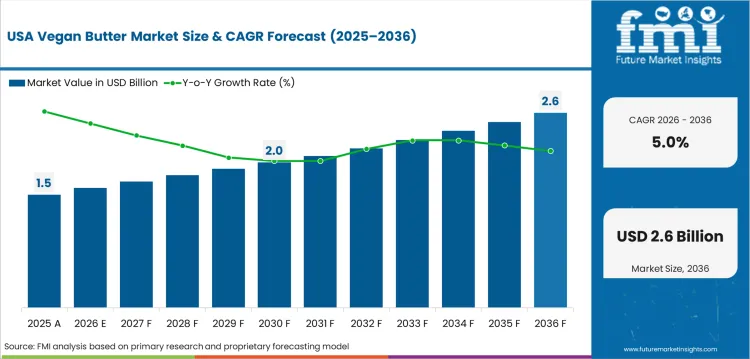
The US market is projected to grow at 5.0% CAGR through 2036. Flexitarian consumer growth, retailer sustainability commitments, and expanding online grocery distribution are broadening the buyer base for plant-based butter. Major retailers are allocating dedicated shelf space and private label offerings in the plant-based dairy alternatives category.
- Retailer sustainability mandates are creating procurement preference for plant-based ingredients with verified environmental benefit claims.
- Online grocery platform expansion is enabling direct-to-consumer sales channels for plant-based butter brands that lack traditional retail distribution.
- Bakery industry reformulation for vegan-certified product lines is generating B2B procurement volume for commercial-grade plant-based butter.
Future Outlook for Vegan Butter Market in the United Kingdom
The UK market is projected to grow at 4.6% CAGR through 2036. UK Plastics Tax and post-Brexit packaging regulations are influencing packaging design for plant-based food products. Retailer sustainability targets from major UK grocery chains create preference for plant-based alternatives across dairy categories.
- UK Plastics Tax is driving packaging reformulation for plant-based butter products toward recyclable and reduced-plastic formats.
- Major UK grocery retailer sustainability targets support expanded shelf allocation for plant-based dairy alternatives.
- Growing vegan and flexitarian consumer segments in urban centers sustain retail demand for premium plant-based spreads.
Opportunity Analysis of Vegan Butter Market in the EU
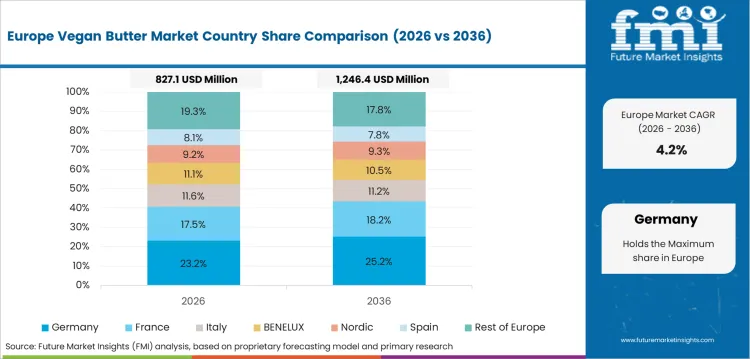
The EU market is projected to grow at 4.9% CAGR through 2036. EU packaging regulations, extended producer responsibility programs, and retailer sustainability commitments are shaping the competitive environment. German and French markets lead EU demand, with strong organic food retail channels supporting premium plant-based butter distribution.
- Extended producer responsibility programs in the EU are influencing packaging material choices for plant-based food products.
- German organic food retail channels provide premium distribution for plant-based butter brands with organic and clean-label credentials.
- Retailer consolidation in EU grocery markets creates procurement leverage for established plant-based brands with proven supply reliability.
In-depth Analysis of Vegan Butter Market in Japan
Japan leads at 5.2% CAGR through 2036. Growing consumer interest in plant-based foods, health-food retail expansion, and increasing bakery industry adoption of vegan-certified ingredients are supporting demand. Japanese consumers prioritize product quality and taste, creating opportunities for premium plant-based butter formulations.
- Health-food retail channel expansion in urban centers is creating distribution access for plant-based butter in a market traditionally dominated by dairy.
- Japanese bakery industry interest in vegan-certified products is generating B2B ingredient procurement for plant-based butter alternatives.
- High product quality expectations among Japanese consumers favor premium almond and cashew milk based formulations with superior taste profiles.
Sales Analysis of Vegan Butter Market in South Korea
South Korea is projected to grow at 5.1% CAGR through 2036. Health-conscious consumer trends, modern retail expansion, and increasing awareness of plant-based dietary options are supporting demand growth. Korean convenience store and modern trade channels are expanding plant-based product offerings.
- Health-conscious consumer trends among younger demographics support trial and repeat purchase of plant-based butter alternatives.
- Modern trade retail expansion and convenience store channel development create broader distribution access for vegan butter products.
- Growing café and bakery culture in Korean urban centers is generating foodservice demand for plant-based butter ingredients.
Competitive Landscape and Strategic Positioning
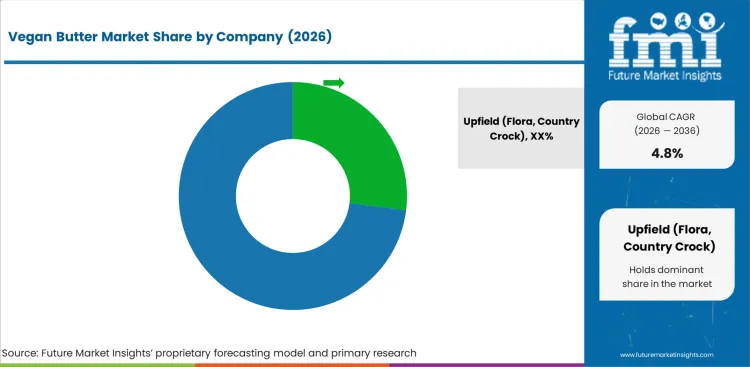
- Upfield (Flora, Country Crock) leads with established retail distribution, broad product range across plant bases, and strong brand recognition in plant-based spreads across North America and Europe.
- Miyoko's Creamery and Conagra Brands (Earth Balance) maintain strong positions in premium and mass-market plant-based butter segments respectively.
- Califia Farms and emerging plant-based food companies are gaining traction through online retail distribution and innovation in allergen-free and functional formulations.
The competitive landscape spans multinational food companies with plant-based portfolios and dedicated plant-based dairy alternative brands. Upfield holds the leading position with Flora, Country Crock, and other regional brands that offer broad plant-based spread portfolios in retail and foodservice. Miyoko's Creamery competes in the premium artisanal segment with cashew-based formulations.
Conagra Brands competes through Earth Balance with mass-market distribution and competitive pricing. Califia Farms offers plant-based butter alongside a broader plant-based dairy portfolio. Competition centers on taste performance, price competitiveness, retail distribution breadth, and ingredient sourcing transparency.
Entry barriers include retail shelf space access, brand awareness in a crowded plant-based category, manufacturing scale for cost-competitive pricing, and the technical challenge of matching conventional dairy butter in taste and culinary performance. Companies with bakery-grade product lines and B2B distribution capabilities hold advantages in the commercial ingredient segment.
Key Companies in the Vegan Butter Market
Key global companies leading the vegan butter market include:
- Upfield (Netherlands) and Conagra Brands (USA) lead globally with established retail distribution networks, broad plant-based butter product ranges, and strong brand recognition in plant-based spreads.
- Miyoko's Creamery (USA) and Califia Farms (USA) hold strong positions in premium and innovation-led plant-based butter segments with direct-to-consumer and specialty retail distribution.
- Naturli Foods (Denmark), Violife parent Upfield, and regional organic brands are gaining traction in European and Asian markets through health-food retail channels and organic certification positioning.
Competitive Benchmarking: Vegan Butter Market
| Company | Product Range | Retail Distribution | B2B Bakery | Brand Recognition |
|---|---|---|---|---|
| Upfield (Flora, Country Crock) | High | Global | Medium | High |
| Miyoko's Creamery | Medium | North America | Low | High |
| Conagra Brands (Earth Balance) | Medium | North America | Medium | High |
| Califia Farms | Low | North America | Low | Medium |
| Naturli Foods | Medium | Europe | Medium | Medium |
| Kite Hill | Low | North America | Low | Medium |
| Melt Organic | Low | North America | Low | Low |
| Forager Project | Low | North America | Low | Low |
Source: Future Market Insights competitive analysis, 2026.
Key Developments in Vegan Butter Market
- In 2025, Upfield expanded its plant-based butter portfolio with an oat milk based formulation designed for commercial bakery applications in European and North American markets.
- In 2025, Miyoko's Creamery introduced an allergen-free pea protein based butter targeting consumers with tree nut and soy allergies.
Key Players in the Vegan Butter Market
Major Global Players
- Upfield (Flora, Country Crock)
- Miyoko's Creamery
- Conagra Brands (Earth Balance)
- Califia Farms
- Naturli Foods
Emerging Players/Startups
- Savor
- Miyoko’s Creamery
- Fora Foods
Report Scope and Coverage
| Parameter | Details |
|---|---|
| Market size by 2036 | USD 5.3 billion |
| Growth rate | 4.8% CAGR (2026 to 2036) |
| Forecast period | 2026 to 2036 |
| Base year value (2025) | USD 3.2 billion |
| Key Segment Covered | Product, Flavor, Sales Channel, Application, Distribution Channel, Form |
| Regions covered | North America, Latin America, Western Europe, Eastern Europe, East Asia, South Asia and Pacific, Middle East and Africa |
| Countries covered | USA, South Korea, UK, Japan, Germany, 30 plus countries |
| Key companies profiled | Upfield (Flora, Country Crock), Miyoko's Creamery, Conagra Brands (Earth Balance), Califia Farms, Naturli Foods, Kite Hill, Melt Organic, Forager Project |
| Approach | Hybrid bottom-up and top-down methodology starting with verified transaction data, projecting adoption velocity across segments and regions. |
Market Segmentation Analysis
Vegan Butter Market Segmented by Product:
- Almond Milk Based Butter
- Almond Cream Butter
- Salted Variant
- Unsalted Variant
- Almond Cream Butter
- Oat Milk Based Butter
- Creamy Oat Butter
- Organic Oat Butter
- Spreadable Form
- Creamy Oat Butter
- Soy Milk Based Butter
- Soy Cream Butter
- High Protein Variant
- Low Fat Variant
- Soy Cream Butter
- Coconut Milk Based Butter
- Coconut Cream Butter
- Refined Coconut Blend
- Virgin Coconut Blend
- Coconut Cream Butter
- Cashew Milk Based Butter
- Cashew Cream Butter
- Premium Spread
- Artisanal Blend
- Cashew Cream Butter
- Pea Milk Based Butter
- Plant Protein Butter
- Functional Nutrition Butter
- Plant Protein Butter
- Rice Milk Based Butter
- Light Texture Butter
- Allergen Free Formulation
- Light Texture Butter
- Other Plant Bases
- Mixed Plant Blends
- Hybrid Nut-Oat Mix
- Functional Blends
- Mixed Plant Blends
Vegan Butter Market Segmented by Flavor:
- Unflavored
- Classic Butter Taste
- Natural Cream Profile
- Neutral Spread
- Classic Butter Taste
- Flavored
- Savory Flavors
- Garlic Herb
- Salted Butter
- Sweet Flavors
- Vanilla Infused
- Honey Style Vegan
- Savory Flavors
Vegan Butter Market Segmented by Sales Channel:
- B2C
- Retail Consumers
- Supermarkets
- Online Grocery
- Health Stores
- Organic Stores
- Retail Consumers
- B2B
- Food Manufacturers
- Bakery Supply
- Industrial Food Processing
- HoReCa Supply
- Hotels And Restaurants
- Cafes And Bakeries
- Food Manufacturers
Vegan Butter Market Segmented by Application:
- Bakery Industry
- Bread Production
- Artisan Bakeries
- Industrial Bakeries
- Bread Production
- Confectionery Items
- Chocolates
- Dairy Free Chocolates
- Cakes And Pastries
- Vegan Desserts
- Chocolates
- Dairy Alternative Industry
- Vegan Dairy Products
- Cheese Substitutes
- Cream Substitutes
- Vegan Dairy Products
- Dietary Supplements
- Functional Nutrition
- Plant Fat Supplements
- Functional Nutrition
- Household Pantry
- Daily Spread Use
- Cooking Butter Replacement
- Breakfast Use
- Daily Spread Use
- Hotel Restaurant Retail Chains
- Foodservice Usage
- QSR Chains
- Fine Dining Kitchens
- Foodservice Usage
Vegan Butter Market Segmented by Distribution Channel:
- Supermarkets And Hypermarkets
- Modern Trade Retail
- Large Chains
- Private Labels
- Modern Trade Retail
- Online Retail
- E Commerce Platforms
- Direct To Consumer
- Subscription Models
- E Commerce Platforms
- Specialty Stores
- Organic Stores
- Health Food Stores
- Organic Stores
- Convenience Stores
- Quick Purchase Retail
- Urban Stores
- Quick Purchase Retail
Vegan Butter Market Segmented by Form:
- Solid Blocks
- Block Butter
- Packaged Sticks
- Bulk Blocks
- Block Butter
- Spreadable Tubs
- Cream Texture
- Whipped Form
- Soft Spread
- Cream Texture
- Spray Forms
- Cooking Sprays
- Low Calorie Sprays
- Functional Sprays
- Cooking Sprays
Vegan Butter Market by Region:
- North America
- USA
- Canada
- Mexico
- Latin America
- Brazil
- Chile
- Rest of Latin America
- Western Europe
- Germany
- UK
- Italy
- Spain
- France
- Nordic
- BENELUX
- Rest of Western Europe
- Eastern Europe
- Russia
- Poland
- Hungary
- Balkan & Baltic
- Rest of Eastern Europe
- East Asia
- China
- Japan
- South Korea
- South Asia and Pacific
- India
- ASEAN
- Australia & New Zealand
- Rest of South Asia and Pacific
- Middle East & Africa
- Kingdom of Saudi Arabia
- Other GCC Countries
- Türkiye
- South Africa
- Other African Union
- Rest of Middle East & Africa
Research Sources and Bibliography
- 1. Food and Agriculture Organization. (2025). FAO Global Plant-Based Food Production and Trade Report. FAO.
- 2. European Commission. (2025). EU Packaging and Packaging Waste Regulation: Updated Requirements. EC.
- 3. USA Food and Drug Administration. (2025). FDA Labeling Requirements for Plant-Based Dairy Alternatives. FDA.
- 4. Good Food Institute. (2025). GFI Plant-Based Market Overview: Global Sales and Distribution Trends. GFI.
- 5. Upfield. (2025). Annual Sustainability Report: Plant-Based Product Portfolio and Environmental Impact. Upfield.
This bibliography is provided for reader reference.
This Report Answers
- Estimating the size of the market and how much revenue it is projected to generate from 2026 to 2036.
- Segmentation by product, flavor, sales channel, application, distribution channel, form.
- Insights about more than 30 markets in the region.
- Analysis of product types including almond, oat, soy, coconut, cashew, pea, and rice milk based butter formulations.
- Assessment of the competitive landscape.
- Finding investment opportunities in bakery, confectionery, dairy alternatives, household, and foodservice applications.
- Keeping track of the supply chain.
- Delivery of data in PDF and Excel formats.
Frequently Asked Questions
How big is the vegan butter market in 2026?
The global vegan butter market is estimated to be valued at USD 3.3 billion in 2026.
What will be the size of the vegan butter market in 2036?
The market size for the vegan butter market is projected to reach USD 5.3 billion by 2036.
How much will the vegan butter market growth be between 2026 and 2036?
The vegan butter market is expected to grow at a 4.8% CAGR between 2026 and 2036.
What are the key products in the vegan butter market?
The key products in the vegan butter market are Almond Milk Based Butter, Oat Milk Based Butter, Soy Milk Based Butter, Coconut Milk Based Butter, Cashew Milk Based Butter, Pea Milk Based Butter, Rice Milk Based Butter and Other Plant Bases.
Which flavor segment is expected to contribute a significant share in the vegan butter market in 2026?
In terms of flavor, the unflavored segment is expected to command 71.0% share in the vegan butter market in 2026.
Preview the report firsthand - request a free sample
Get SampleGet the brochure for pricing and purchase details.
Get PDFTable of Content
- Key Takeaways
- Market Size and CAGR
- Top Growth Driver
- Fastest Growing Segment
- Leading Region
- Key Companies
- Emerging Opportunities
- Executive Summary
- Global Market Outlook
- Demand-side Trends
- Supply-side Trends
- Technology Roadmap Analysis
- Analysis and Recommendations
- Analyst Perspective (What is happening? Why now? What should investors know?)
- Key Questions Answered
- How large is the market?
- What is the CAGR?
- What are key trends?
- Which region dominates?
- Who are the leaders?
- Market Overview
- Market Coverage / Taxonomy
- Market Definition / Scope / Limitations
- Research Methodology
- Chapter Orientation
- Analytical Lens and Working Hypotheses
- Market Structure, Signals, and Trend Drivers
- Benchmarking and Cross-market Comparability
- Market Sizing, Forecasting, and Opportunity Mapping
- Research Design and Evidence Framework
- Desk Research Programme (Secondary Evidence)
- Expert Input and Fieldwork (Primary Evidence)
- Tooling, Models, and Reference Databases
- Data Engineering and Model Build
- Quality Assurance and Audit Trail
- Market Background
- Market Dynamics (Drivers, Restraints, Opportunity, Trends)
- Scenario Forecast (Optimistic, Likely, Conservative)
- Impact Analysis
- AI Impact
- Sustainability Impact
- Regulatory Impact
- Technology Impact
- Consumer / Buyer Analysis
- Purchase Drivers
- Adoption Barriers
- Buyer Journey
- Opportunity Map Analysis
- Product Life Cycle Analysis
- Supply Chain Analysis
- Investment Feasibility Matrix
- Value Chain Analysis
- PESTLE and Porter's Analysis
- Regulatory Landscape
- Regional Parent Market Outlook
- Production and Consumption Statistics
- Import and Export Statistics
- Global Market Analysis and Forecast, 2021 to 2036
- Historical Market Size Value (USD Million) Analysis, 2021 to 2025
- Current and Future Market Size Value (USD Million) Projections, 2026 to 2036
- Y-o-Y Growth Trend Analysis
- Absolute $ Opportunity Analysis
- Global Market Pricing Analysis, 2021 to 2036
- Global Market Analysis and Forecast, By Product, 2021 to 2036
- Introduction / Key Findings
- Historical Market Size Value (USD Million) Analysis By Product, 2021 to 2025
- Current and Future Market Size Value (USD Million) Analysis and Forecast By Product, 2026 to 2036
- Almond Milk Based Butter
- Almond Cream Butter
- Oat Milk Based Butter
- Creamy Oat Butter
- Soy Milk Based Butter
- Soy Cream Butter
- Coconut Milk Based Butter
- Coconut Cream Butter
- Cashew Milk Based Butter
- Cashew Cream Butter
- Pea Milk Based Butter
- Plant Protein Butter
- Rice Milk Based Butter
- Light Texture Butter
- Other Plant Bases
- Mixed Plant Blends
- Almond Milk Based Butter
- Y-o-Y Growth Trend Analysis By Product, 2021 to 2025
- Absolute $ Opportunity Analysis By Product, 2026 to 2036
- Global Market Analysis and Forecast, By Flavor, 2021 to 2036
- Introduction / Key Findings
- Historical Market Size Value (USD Million) Analysis By Flavor, 2021 to 2025
- Current and Future Market Size Value (USD Million) Analysis and Forecast By Flavor, 2026 to 2036
- Unflavored
- Classic Butter Taste
- Flavored
- Savory Flavors
- Sweet Flavors
- Unflavored
- Y-o-Y Growth Trend Analysis By Flavor, 2021 to 2025
- Absolute $ Opportunity Analysis By Flavor, 2026 to 2036
- Global Market Analysis and Forecast, By Sales Channel, 2021 to 2036
- Introduction / Key Findings
- Historical Market Size Value (USD Million) Analysis By Sales Channel, 2021 to 2025
- Current and Future Market Size Value (USD Million) Analysis and Forecast By Sales Channel, 2026 to 2036
- B2C
- Retail Consumers
- Health Stores
- B2B
- Food Manufacturers
- HoReCa Supply
- B2C
- Y-o-Y Growth Trend Analysis By Sales Channel, 2021 to 2025
- Absolute $ Opportunity Analysis By Sales Channel, 2026 to 2036
- Global Market Analysis and Forecast, By Application, 2021 to 2036
- Introduction / Key Findings
- Historical Market Size Value (USD Million) Analysis By Application, 2021 to 2025
- Current and Future Market Size Value (USD Million) Analysis and Forecast By Application, 2026 to 2036
- Bakery Industry
- Bread Production
- Confectionery Items
- Chocolates
- Cakes And Pastries
- Dairy Alternative Industry
- Vegan Dairy Products
- Dietary Supplements
- Functional Nutrition
- Household Pantry
- Daily Spread Use
- Hotel Restaurant Retail Chains
- Foodservice Usage
- Bakery Industry
- Y-o-Y Growth Trend Analysis By Application, 2021 to 2025
- Absolute $ Opportunity Analysis By Application, 2026 to 2036
- Global Market Analysis and Forecast, By Distribution Channel, 2021 to 2036
- Introduction / Key Findings
- Historical Market Size Value (USD Million) Analysis By Distribution Channel, 2021 to 2025
- Current and Future Market Size Value (USD Million) Analysis and Forecast By Distribution Channel, 2026 to 2036
- Supermarkets And Hypermarkets
- Modern Trade Retail
- Online Retail
- E Commerce Platforms
- Specialty Stores
- Organic Stores
- Convenience Stores
- Quick Purchase Retail
- Supermarkets And Hypermarkets
- Y-o-Y Growth Trend Analysis By Distribution Channel, 2021 to 2025
- Absolute $ Opportunity Analysis By Distribution Channel, 2026 to 2036
- Global Market Analysis and Forecast, By Form
- Introduction / Key Findings
- Historical Market Size Value (USD Million) Analysis By Form, 2021 to 2025
- Current and Future Market Size Value (USD Million) Analysis and Forecast By Form, 2026 to 2036
- Solid Blocks
- Block Butter
- Spreadable Tubs
- Cream Texture
- Spray Forms
- Cooking Sprays
- Solid Blocks
- Y-o-Y Growth Trend Analysis By Form, 2021 to 2025
- Absolute $ Opportunity Analysis By Form, 2026 to 2036
- Global Market Analysis and Forecast, By Region, 2021 to 2036
- Introduction
- Historical Market Size Value (USD Million) Analysis By Region, 2021 to 2025
- Current Market Size Value (USD Million) Analysis and Forecast By Region, 2026 to 2036
- North America
- Latin America
- Western Europe
- Eastern Europe
- East Asia
- South Asia and Pacific
- Middle East & Africa
- Market Attractiveness Analysis By Region
- North America Market Analysis and Forecast, By Country, 2021 to 2036
- Historical Market Size Value (USD Million) Trend Analysis By Market Taxonomy, 2021 to 2025
- Market Size Value (USD Million) Forecast By Market Taxonomy, 2026 to 2036
- By Country
- USA
- Canada
- Mexico
- By Product
- By Flavor
- By Sales Channel
- By Application
- By Distribution Channel
- By Form
- By Country
- Market Attractiveness Analysis
- By Country
- By Product
- By Flavor
- By Sales Channel
- By Application
- By Distribution Channel
- By Form
- Key Takeaways
- Latin America Market Analysis and Forecast, By Country
- Historical Market Size Value (USD Million) Trend Analysis By Market Taxonomy, 2021 to 2025
- Market Size Value (USD Million) Forecast By Market Taxonomy, 2026 to 2036
- By Country
- Brazil
- Chile
- Rest of Latin America
- By Product
- By Flavor
- By Sales Channel
- By Application
- By Distribution Channel
- By Form
- By Country
- Market Attractiveness Analysis
- By Country
- By Product
- By Flavor
- By Sales Channel
- By Application
- By Distribution Channel
- By Form
- Key Takeaways
- Western Europe Market Analysis and Forecast, By Country
- Historical Market Size Value (USD Million) Trend Analysis By Market Taxonomy, 2021 to 2025
- Market Size Value (USD Million) Forecast By Market Taxonomy, 2026 to 2036
- By Country
- Germany
- UK
- Italy
- Spain
- France
- Nordic
- BENELUX
- Rest of Western Europe
- By Product
- By Flavor
- By Sales Channel
- By Application
- By Distribution Channel
- By Form
- By Country
- Market Attractiveness Analysis
- By Country
- By Product
- By Flavor
- By Sales Channel
- By Application
- By Distribution Channel
- By Form
- Key Takeaways
- Eastern Europe Market Analysis and Forecast, By Country
- Historical Market Size Value (USD Million) Trend Analysis By Market Taxonomy, 2021 to 2025
- Market Size Value (USD Million) Forecast By Market Taxonomy, 2026 to 2036
- By Country
- Russia
- Poland
- Hungary
- Balkan & Baltic
- Rest of Eastern Europe
- By Product
- By Flavor
- By Sales Channel
- By Application
- By Distribution Channel
- By Form
- By Country
- Market Attractiveness Analysis
- By Country
- By Product
- By Flavor
- By Sales Channel
- By Application
- By Distribution Channel
- By Form
- Key Takeaways
- East Asia Market Analysis and Forecast, By Country
- Historical Market Size Value (USD Million) Trend Analysis By Market Taxonomy, 2021 to 2025
- Market Size Value (USD Million) Forecast By Market Taxonomy, 2026 to 2036
- By Country
- China
- Japan
- South Korea
- By Product
- By Flavor
- By Sales Channel
- By Application
- By Distribution Channel
- By Form
- By Country
- Market Attractiveness Analysis
- By Country
- By Product
- By Flavor
- By Sales Channel
- By Application
- By Distribution Channel
- By Form
- Key Takeaways
- South Asia and Pacific Market Analysis and Forecast, By Country
- Historical Market Size Value (USD Million) Trend Analysis By Market Taxonomy, 2021 to 2025
- Market Size Value (USD Million) Forecast By Market Taxonomy, 2026 to 2036
- By Country
- India
- ASEAN
- Australia & New Zealand
- Rest of South Asia and Pacific
- By Product
- By Flavor
- By Sales Channel
- By Application
- By Distribution Channel
- By Form
- By Country
- Market Attractiveness Analysis
- By Country
- By Product
- By Flavor
- By Sales Channel
- By Application
- By Distribution Channel
- By Form
- Key Takeaways
- Middle East & Africa Market Analysis and Forecast, By Country
- Historical Market Size Value (USD Million) Trend Analysis By Market Taxonomy, 2021 to 2025
- Market Size Value (USD Million) Forecast By Market Taxonomy, 2026 to 2036
- By Country
- Kingdom of Saudi Arabia
- Other GCC Countries
- Türkiye
- South Africa
- Other African Union
- Rest of Middle East & Africa
- By Product
- By Flavor
- By Sales Channel
- By Application
- By Distribution Channel
- By Form
- By Country
- Market Attractiveness Analysis
- By Country
- By Product
- By Flavor
- By Sales Channel
- By Application
- By Distribution Channel
- By Form
- Key Takeaways
- Key Countries Market Analysis
- USA
- Pricing Analysis
- Market Share Analysis, 2025
- By Product
- By Flavor
- By Sales Channel
- By Application
- By Distribution Channel
- By Form
- Canada
- Pricing Analysis
- Market Share Analysis, 2025
- By Product
- By Flavor
- By Sales Channel
- By Application
- By Distribution Channel
- By Form
- Mexico
- Pricing Analysis
- Market Share Analysis, 2025
- By Product
- By Flavor
- By Sales Channel
- By Application
- By Distribution Channel
- By Form
- Brazil
- Pricing Analysis
- Market Share Analysis, 2025
- By Product
- By Flavor
- By Sales Channel
- By Application
- By Distribution Channel
- By Form
- Chile
- Pricing Analysis
- Market Share Analysis, 2025
- By Product
- By Flavor
- By Sales Channel
- By Application
- By Distribution Channel
- By Form
- Germany
- Pricing Analysis
- Market Share Analysis, 2025
- By Product
- By Flavor
- By Sales Channel
- By Application
- By Distribution Channel
- By Form
- UK
- Pricing Analysis
- Market Share Analysis, 2025
- By Product
- By Flavor
- By Sales Channel
- By Application
- By Distribution Channel
- By Form
- Italy
- Pricing Analysis
- Market Share Analysis, 2025
- By Product
- By Flavor
- By Sales Channel
- By Application
- By Distribution Channel
- By Form
- Spain
- Pricing Analysis
- Market Share Analysis, 2025
- By Product
- By Flavor
- By Sales Channel
- By Application
- By Distribution Channel
- By Form
- France
- Pricing Analysis
- Market Share Analysis, 2025
- By Product
- By Flavor
- By Sales Channel
- By Application
- By Distribution Channel
- By Form
- India
- Pricing Analysis
- Market Share Analysis, 2025
- By Product
- By Flavor
- By Sales Channel
- By Application
- By Distribution Channel
- By Form
- ASEAN
- Pricing Analysis
- Market Share Analysis, 2025
- By Product
- By Flavor
- By Sales Channel
- By Application
- By Distribution Channel
- By Form
- Australia & New Zealand
- Pricing Analysis
- Market Share Analysis, 2025
- By Product
- By Flavor
- By Sales Channel
- By Application
- By Distribution Channel
- By Form
- China
- Pricing Analysis
- Market Share Analysis, 2025
- By Product
- By Flavor
- By Sales Channel
- By Application
- By Distribution Channel
- By Form
- Japan
- Pricing Analysis
- Market Share Analysis, 2025
- By Product
- By Flavor
- By Sales Channel
- By Application
- By Distribution Channel
- By Form
- South Korea
- Pricing Analysis
- Market Share Analysis, 2025
- By Product
- By Flavor
- By Sales Channel
- By Application
- By Distribution Channel
- By Form
- Russia
- Pricing Analysis
- Market Share Analysis, 2025
- By Product
- By Flavor
- By Sales Channel
- By Application
- By Distribution Channel
- By Form
- Poland
- Pricing Analysis
- Market Share Analysis, 2025
- By Product
- By Flavor
- By Sales Channel
- By Application
- By Distribution Channel
- By Form
- Hungary
- Pricing Analysis
- Market Share Analysis, 2025
- By Product
- By Flavor
- By Sales Channel
- By Application
- By Distribution Channel
- By Form
- Kingdom of Saudi Arabia
- Pricing Analysis
- Market Share Analysis, 2025
- By Product
- By Flavor
- By Sales Channel
- By Application
- By Distribution Channel
- By Form
- Türkiye
- Pricing Analysis
- Market Share Analysis, 2025
- By Product
- By Flavor
- By Sales Channel
- By Application
- By Distribution Channel
- By Form
- South Africa
- Pricing Analysis
- Market Share Analysis, 2025
- By Product
- By Flavor
- By Sales Channel
- By Application
- By Distribution Channel
- By Form
- USA
- Market Structure Analysis
- Competition Dashboard
- Competition Benchmarking
- Market Share Analysis of Top Players
- By Regional
- By Product
- By Flavor
- By Sales Channel
- By Application
- By Distribution Channel
- By Form
- Emerging Startups
- Innovation Benchmarking
- Competition Analysis
- Competition Deep Dive
- Upfield (Flora, Country Crock)
- Overview
- Product Portfolio
- Profitability by Market Segments (Product/Region/Sales Channel)
- Sales Footprint
- Strategy Overview
- Marketing Strategy
- Product Strategy
- Channel Strategy
- Miyoko’s Creamery
- Conagra Brands (Earth Balance)
- Califia Farms
- Other Companies (combined)
- Upfield (Flora, Country Crock)
- Case Studies
- Success Stories
- Recent Developments
- Competition Deep Dive
- Assumptions & Acronyms Used


