

- Market Size (2026)
- USD 32.0 Bn
- Forecast (2036)
- USD 52.6 Bn
- CAGR (2026 to 2036)
- 5.1%
How big is Protective Packaging Market in 2026?
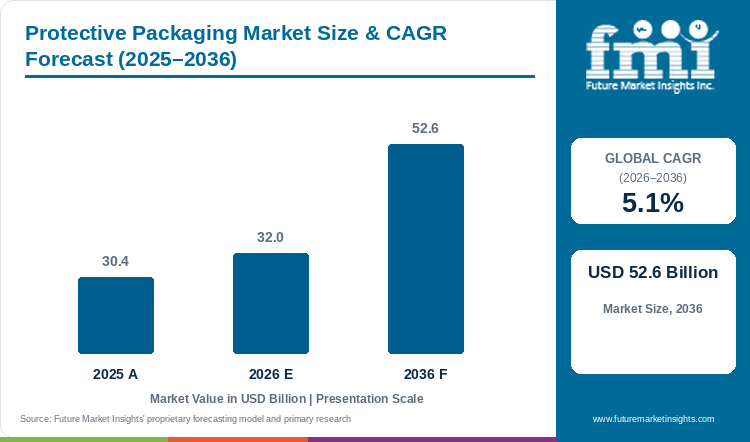
Sales in the protective packaging market are projected to grow at 5.1% CAGR, with the market size rising from USD 30.4 billion in 2025 to USD 32.0 billion in 2026 and reaching USD 52.6 billion by 2036.
Stemming from frequent parcel drop damage inside automated e-commerce sorting hubs and rising carrier surcharges on excess box volume, warehouse operators are replacing loose plastic foam with engineered protective packaging. According to FMI, global protective packaging market valuation rises from USD 30.4 billion in 2025 to USD 32.0 billion in 2026 and is projected to reach USD 52.6 billion by 2036, expanding at a 5.1% CAGR from 2026 to 2036 and generating USD 20.6 billion in added revenue. In March 2025, the International Safe Transit Association updated its 3A and 3L e-commerce fulfillment test protocols, documenting that multi-drop conveyor sorting subjects individual parcels to peak deceleration shocks exceeding 40 G-forces [1]. Rigid Containers & Bottles hold 46.4% of packaging format demand in 2026 because molded protective cases and structural shipping crates prevent vertical crush damage. However, issues such as volatile recycled containerboard pulp prices and capital retooling costs for molded fiber presses continue to restrain converter profit margins.
Key Market Trends & Insights
- By packaging format: Rigid Containers & Bottles led with 46.4% share in 2026, supported by high compressive stacking strength, precision-molded interior cavities, and automated denesting on high-speed packing lines.
- By material substrate: Recycled Paperboard accounted for 36.5% in 2026, reflecting retail and industrial conversion from expanded plastic foams to honeycomb paperboard buffers, corrugated corner guards, and molded pulp trays.
- By end-use sector: Food & Beverage held 42.9% of revenue in 2026, underpinned by surging direct-to-consumer meal delivery, bottled wine shipping, and insulated cold-chain grocery fulfillment.
Regional Highlights
- Fastest-growing evaluated country: Australia, at 6.2% CAGR from 2026 to 2036.
- By country: Japan at 5.7%, Mexico at 5.3%, and the USA at 4.9% follow, while Chile records the lowest evaluated CAGR at 4.1%.
Market Size & Forecast
Table 1: Market Size and Forecast for the Protective Packaging Market (USD billion and CAGR percentage), 2025 to 2036
| Metric | Value |
|---|---|
| 2025 Market Size | USD 30.4 billion |
| Estimated Market Size in 2026 | USD 32.0 billion |
| Projected Market Size by 2036 | USD 52.6 billion |
| CAGR, 2026 to 2036 | 5.1% |
| Added Revenue, 2026 to 2036 | USD 20.6 billion |
Adoption develops differently across countries because municipal extended producer responsibility fees, curbside recycling rules, and parcel delivery distances vary widely between regional markets. FMI research indicates that omnichannel fulfillment centers are replacing pre-expanded foam peanuts with on-demand crinkle paper dispensers and high-barrier flexible protective packaging rolls that inflate directly at the packing bench. In February 2025, the European Union enacted Regulation (EU) 2025/40 on packaging and packaging waste, introducing binding empty-space limits of 50% for grouped and e-commerce transport packs alongside strict recyclability mandates taking effect in August 2026 [2]. Warehouse operators are consequently downsizing outer cartons and installing right-sized cushioning machines that eliminate excess void volume.
Cushioning Material Density and Dynamic Drop Deceleration Sizing
Table 2: Cushioning Material Metrics and Shock Deceleration Parameters for the Protective Packaging Market (USD billion and operational metrics), mixed historical and forecast years from 2025 to 2036
| Operating Parameter | 2025 | 2026 | 2036 |
|---|---|---|---|
| Baseline Global Market Valuation (USD billion) | 30.4 | 32.0 | 52.6 |
| Global Protective Packaging Volume (Million Metric Tons) | 16.5 | 17.4 | 27.8 |
| Inflatable Air-Cushion Machine Linear Speed (m/min) | 26.0 | 28.5 | 42.0 |
| Molded Fiber & Paper Cushioning Market Share (%) | 34.0% | 37.5% | 68.5% |
Calculation basis: Cushioning volume and machine throughput indicators reconcile converter resin and recycled paperboard consumption against parcel fulfillment station deployments.
Parcel Fulfillment Economics & Warehouse Storage Sizing
Protective cushioning systems have gained broad adoption across retail fulfillment and industrial manufacturing because a single damaged shipment costs several times the price of the packaging material in reverse logistics and replacement freight. Managing warehouse packing stations requires balancing unit cushioning cost against inbound storage footprint and operator pack time. Replacing pre-formed foam blocks with uninflated air-pillow film rolls or flat engineered dunnage packaging frees up dock floor space while allowing automated dispensers to feed exact cushion lengths per order.
Table 3: Production Economics and Logistics Material Cost Metrics for the Protective Packaging Market (USD and percentages), mixed historical and forecast years from 2025 to 2036
| Economic Metric | 2025 | 2026 | 2036 |
|---|---|---|---|
| Average Cushioning Material Cost per Parcel Packed (USD) | 0.38 | 0.36 | 0.25 |
| Void-Fill Material Share of Total Parcel Packaging Cost (%) | 24.5% | 23.0% | 14.5% |
| Inbound Warehouse Space Savings from On-Demand Pillows (%) | 88.0% | 89.5% | 94.5% |
| Molded Pulp Cushioning Price Parity to Expanded Foam (%) | 114.0% | 108.5% | 91.0% |
Table 4: Converting Facility Shock Absorption and Segment Revenue Indicators for the Protective Packaging Market (USD billion, units, and percentages), mixed reporting years from 2024 to 2026
| Metric | Value | Basis |
|---|---|---|
| Market size, 2026 | USD 32.0 billion | Report value |
| On-demand cushioning dispensers deployed | 55,000 units | 2026 industry estimate |
| Rigid Containers & Bottles revenue, 2026 | USD 14.8 billion | 46.4% share |
| Food & Beverage end-use revenue, 2026 | USD 13.7 billion | 42.9% share |
Analyst Perspective
"Dry-molded cellulose inserts and high-PCR inflatable polyolefin films give fulfillment operators curb-recyclable shock protection without slowing automated packing lines. High aluminum tooling costs for custom molded pulp geometries still challenge converters serving short-run industrial SKUs."
- Nandini Roy Choudhury, Principal Consultant, Future Market Insights.
How is the protective packaging market segmented?
The protective packaging market is segmented by packaging format, material substrate, end-use sector, and region. In 2026, Rigid Containers & Bottles is projected at 46.4%, recycled paperboard at 36.5%, and food & beverage at 42.9%.
By packaging format: Rigid containers & bottles, flexible wraps & bags, and secondary bulk packaging.
By material substrate: Recycled paperboard, thermoplastic polymers, sustainable plant fibers, and specialty alloys.
By end-use sector: Food & beverage, pharmaceuticals & healthcare, personal care & homecare, and industrial manufacturing.
Why do Rigid Containers & Bottles lead the packaging format category?
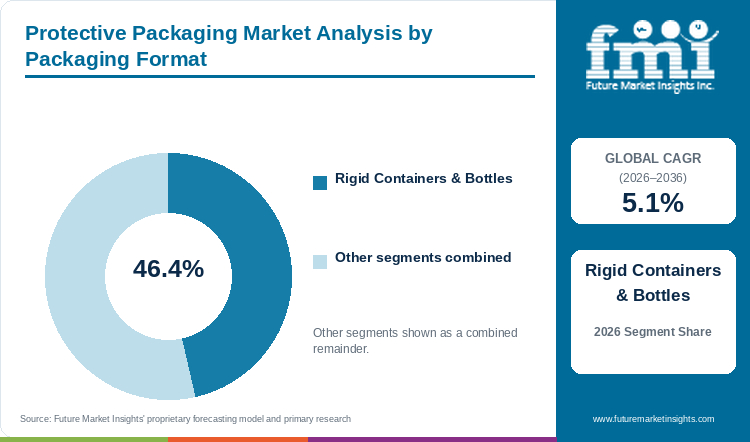
With an estimated 46.4% share in 2026, Rigid Containers & Bottles lead packaging format, underpinned by superior crush resistance.
Table 5: Packaging Format Share for the Protective Packaging Market (percentage share), 2026
| Packaging Format | Share (2026) |
|---|---|
| Rigid Containers & Bottles | 46.4% |
| Other Segments Combined | 53.6%* |
| Total | 100.0% |
*Calculated as the balance remaining after deducting the leading segment's reported share from 100.0%.
Table 6: Packaging Format Leadership and Market Growth for the Protective Packaging Market (segment and CAGR percentage), 2026 to 2036
| Metric | Value |
|---|---|
| Global CAGR (2026 to 2036) | 5.1% |
| Leading Segment | Rigid Containers & Bottles |
Manufacturers of precision electronics, medical diagnostic instruments, automotive sensors, and fragile glass bottles rely on rigid protective containers because flexible wraps alone cannot stop heavy top-load crushing inside stacked LTL freight trailers. Molded high-density polyethylene cases, rigid thermoformed clamshells, and reinforced corrugated crates distribute vertical stacking forces around the product perimeter so that internal components experience zero static deflection. Brand owners also pair rigid outer packs with molded fiber pulp packaging and custom molded fiber protective inserts that immobilize delicate items without expanded polystyrene foam. Quality engineers run dynamic compression and vibration table tests before qualifying a rigid container design.
- Rigid Containers & Bottles are projected to account for 46.4% of packaging format demand in 2026, underpinned by high top-load stacking strength and automated tray denesting.
- In May 2025, ASTM International updated its D1596 test procedure for evaluating dynamic shock cushioning curves in rigid and molded protective enclosures [3].
What makes Recycled Paperboard central to the material substrate category?
Recycled paperboard is anticipated to contribute 36.5% of material substrate sales in 2026, owing to curbside repulpability and stiffness.
Retailers and industrial shippers are replacing expanded plastic foams with recycled paperboard because household customers and receiving docks can place used paperboard cushioning directly into standard paper recycling bins without material separation. Multi-ply kraft linerboard and recycled boxboard are converted into hexagonal honeycomb blocks, fluted mailers, and L-profile corner boards that absorb impact energy while resisting pallet strapping tension. Logistics operations increasingly combine paper edge protectors with heavy-duty honeycomb transit packaging to stabilize stacked appliances and furniture during cross-border road and rail transport. However, high relative humidity in tropical transit lanes can soften untreated paper fibers, prompting converters to apply water-dispersible barrier sizings.
- Recycled paperboard is estimated to hold 36.5% of material substrate demand in 2026, supported by corporate plastic elimination targets and 100% curbside repulpability.
- In June 2025, the European Committee for Standardization issued updated EN ISO 8318 random vibration testing benchmarks for filled paperboard transport packages [4].
How does Food & Beverage anchor the end-use sector category?
Food & beverage is set to command 42.9% of end-use sector revenue in 2026, reinforced by cold-chain grocery shipping.
Direct-to-consumer meal kits, online grocery fulfillment, and specialty wine and spirits e-commerce generate massive recurring demand for thermal and impact-absorbent protective packaging. Unlike dry apparel parcels that tolerate rough handling and ambient warehouse heat, chilled meat, dairy, and glass-bottled beverages require insulated box liners combined with shock-absorbing dividers to survive forty-eight-hour parcel carrier delivery. While e-commerce shippers use inflatable bubble wrap cushioning and engineered packaging foam for high-fragility glassware, food brands increasingly specify pulp bottle cradles and cellulose thermal liners that prevent condensation damage. Cold-chain packagers must validate 48-hour thermal hold profiles before summer shipping seasons.
- Food & beverage is projected to capture 42.9% of end-use sector demand in 2026, driven by fragile glass bottle transit and insulated doorstep meal delivery.
- In August 2025, the Journal of Applied Packaging Research demonstrated that high-density molded pulp bottle dividers reduced glass breakage by 31% under simulated parcel drop testing [5].
What are the drivers, restraints, and opportunities in the protective packaging market?
Omnichannel parcel shipping volume and statutory expanded polystyrene bans propel fiber and PCR film demand, whereas recycled pulp price volatility and dimensional weight surcharges pressure margins, and dry-molded fiber tooling unlocks premium electronics and cold-chain contracts.
- Driver:Rising cross-border parcel fulfillment and statutory phase-outs of expanded polystyrene foam compel brands to adopt recyclable paper and PCR air-pillow cushioning.
- Restraint:Converters face volatile old corrugated container (OCC) fiber prices and carrier dimensional-weight billing rules that penalize bulky void-fill formats.
- Opportunity:Deploying high-speed dry-molded cellulose thermoforming and automated table-top paper wrapper dispensers captures high-margin electronics and beauty contracts.
Growth Analysis and Future Potential: Qualitative Demand Catalysts
E-commerce retailers and industrial parts distributors are redesigning secondary transit packs as single-item parcel shipping replaces palletized store replenishment. Every individual parcel travels through automated belt diverters, chutes, and delivery vans where unbraced items suffer corner impact damage. At the same time, national plastic taxes and corporate sustainability pledges are pushing fulfillment managers to replace loose-fill plastic foam with curbside-recyclable padded mailers and automated protective paper wrap systems. In July 2025, the Material Handling Industry (MHI) annual supply chain report noted that 64% of surveyed fulfillment warehouses increased investment in automated right-sized protective packing stations [6]. Suppliers must guarantee jam-free dispensing at speeds above 30 meters per minute before large fulfillment centers convert.
Risk Assessment of the Protective Packaging Market: Operational and Formulation Friction
Raw material cost swings in recycled containerboard and food-grade post-consumer recycled (PCR) polyolefin resins create persistent margin compression for protective packaging converters. Because old corrugated containers (OCC) and virgin kraft pulp account for roughly half of paper cushioning production costs, seasonal spikes in mill linerboard prices quickly erode converter profitability on fixed-price retail supply contracts. Furthermore, major parcel carriers apply strict dimensional-weight pricing formulas that charge shippers by exterior box volume rather than scale weight. In September 2025, the European Paper Packaging Alliance reported that energy and recovered fiber cost fluctuations raised European paper converting expenses by 11% [7]. Shippers consequently reject thick cushioning pads that force an upgrade to a larger outer carton.
Commercial Opportunity Analysis: Formulation Differentiation and Value-Add Formats
Packaging manufacturers are unlocking higher gross margins by commercializing dry-molded fiber thermoforming and smart shock-monitoring labels for high-value electronics, cosmetics, and clinical biologics. Traditional wet-molded pulp requires long drying ovens and leaves rough exterior surfaces that shed dust onto polished smartphone screens or luxury glass flacons. New dry-forming cellulose presses cure smooth, tight-tolerance protective trays in seconds using 80% less water. In October 2025, the Waste and Resources Action Programme (WRAP) published technical guidance confirming that precision-molded fiber cradles achieved full drop-shock parity with expanded polyethylene foam across consumer electronics transit trials [8]. Converters that offer rapid CAD prototyping and modular aluminum tooling win multi-year OEM design-ins.
Protective Packaging Market by Country (2026 to 2036)
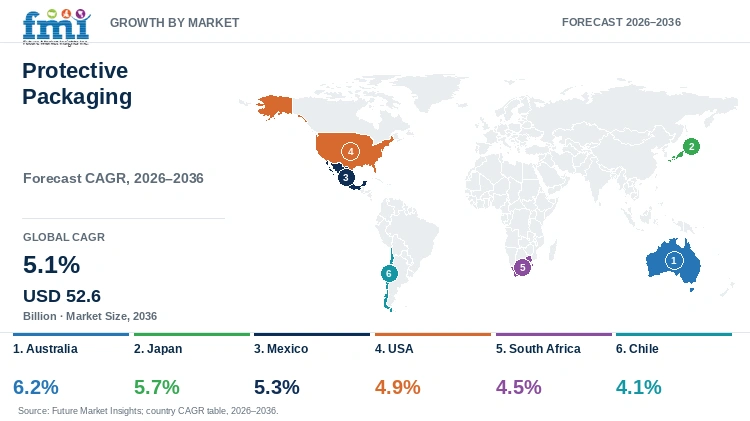
As per FMI, Australia represents the fastest-growing protective packaging market among the six evaluated countries at a 6.2% CAGR from 2026 to 2036, while Chile records the slowest expansion at 4.1% CAGR. Across all evaluated economies, commercial uptake is shaped by how rapidly converters replace banned expanded polystyrene foams, adapt cushioning thickness to carrier dimensional-weight tariffs, and automate packing benches.
Table 7: Country CAGR and Primary Growth Levers for the Protective Packaging Market (CAGR percentage and operational drivers), 2026 to 2036
| Country | CAGR (2026 to 2036) | Primary Growth Lever |
|---|---|---|
| Australia | 6.2% | Statutory phase-out of expanded polystyrene and long-distance interstate e-commerce parcel shipping |
| Japan | 5.7% | Strict zero-defect cosmetic box standards, semiconductor component cushioning, and robotic fulfillment |
| Mexico | 5.3% | Nearshoring automotive and electronics assembly exports requiring cross-border shock and corrosion protection |
| USA | 4.9% | High-volume omnichannel parcel fulfillment, state EPR laws, and curbside-recyclable paper mailer adoption |
| South Africa | 4.5% | Rapid urban grocery and parcel delivery expansion and molded fiber export fruit tray demand |
| Chile | 4.1% | Counter-seasonal fresh cherry, blueberry, and bottled wine exports requiring long-haul ocean cushioning |
Source: Future Market Insights analysis
Australia Protective Packaging Market Outlook (2026 to 2036)
Long interstate road and air freight distances between coastal cities and strict state-level bans on loose-fill and molded expanded polystyrene set Australia apart, driving a projected 6.2% CAGR from 2026 to 2036. In December 2025, the Australian Packaging Covenant Organisation (APCO) reported in its national consumption and recovery audit that brand owners accelerated conversion from EPS foam to recyclable fiber and mono-material PE cushioning to meet national packaging reform mandates [9]. Because parcels shipped from Sydney or Melbourne fulfillment hubs to Perth and rural Queensland endure multi-day highway vibration and high summer heat, fragile wine and electronics shippers face elevated breakage rates. Local converters address this friction by supplying heavy-flute honeycomb paper sleeves and Australasian Recycling Label (ARL) certified padded mailers.
Key takeaway:In Australia, binding EPS foam phase-out regulations and long continental transit corridors propel rapid adoption of molded pulp and honeycomb paper cushioning.
Japan Protective Packaging Market Outlook (2026 to 2036)
Uncompromising retail buyer intolerance for even minor exterior carton scuffing and a dense precision electronics manufacturing base support Japan at a projected 5.7% CAGR through 2036. In January 2026, the Japan Packaging Institute documented that domestic fulfillment centers and semiconductor equipment shippers increased deployment of automated 3D box-sizing and electrostatic-dissipative (ESD) cushioning systems by 15% to offset warehouse labor shortages [10]. Unlike Western bulk warehouses with ample floor space, Japanese urban logistics centers operate in multi-story facilities where bulky pre-formed foam inventory is cost-prohibitive. Domestic converters succeed by engineering ultra-thin micro-flute corrugated inserts, anti-static polyolefin air pillows, and precision-molded pulp trays for camera optics and gift produce.
Key takeaway:In Japan, strict zero-defect presentation standards and warehouse labor automation drive demand for compact on-demand dispensers and ESD-safe precision cushioning.
Mexico Protective Packaging Market Outlook (2026 to 2036)
Cross-border industrial component shipping from northern and Bajio assembly plants into United States automotive and appliance factories anchors Mexico at a projected 5.3% CAGR between 2026 and 2036. Tier-one suppliers in Monterrey, Saltillo, Queretaro, and Tijuana ship millions of instrument clusters, wire harnesses, and glass displays that must survive highway vibration and border transloading without scratch or shock damage. In February 2026, the Mexican Packaging Association (AMEE) reported a 14% annual increase in industrial returnable dunnage, paperboard edge protectors, and die-cut foam inserts across export maquiladoras [11]. Because U.S. OEM buyers enforce strict recyclable packaging specifications and reject non-compliant foam, Mexican converters are expanding multi-wall honeycomb paperboard and PCR polyethylene foam converting lines.
Key takeaway:In Mexico, export-oriented automotive and electronics nearshoring plants sustain strong B2B demand for engineered die-cut inserts, edge protectors, and returnable dunnage.
USA Protective Packaging Market Outlook (2026 to 2036)
The United States represents the largest single-country revenue base, projected to expand at a 4.9% CAGR from 2026 to 2036 as major omnichannel retailers overhaul fulfillment center packing lines. In March 2026, the Packaging Machinery Manufacturers Institute (PMMI) reported that North American e-commerce distribution centers replaced plastic air pillows across hundreds of automated pack stations with high-speed paper void-fill and curbside-recyclable paper mailers [12]. While massive parcel volumes and biopharmaceutical cold-chain shipments create steady baseline demand, converters must navigate fragmented state-level extended producer responsibility (EPR) laws in California, Oregon, Colorado, and Maine. Packaging suppliers win national accounts by offering How2Recycle-verified paper cushions and 50%+ PCR polyolefin bubble films.
Key takeaway:In the USA, large-scale e-commerce retailer transitions from plastic air pillows to curbside-recyclable paper void-fill and state EPR laws drive converter machine placements.
South Africa Protective Packaging Market Outlook (2026 to 2036)
Rapid growth in on-demand urban grocery delivery across Johannesburg, Cape Town, and Durban alongside export citrus and pome fruit logistics supports South Africa at a 4.5% CAGR through 2036. In April 2026, Packaging SA noted that mandatory extended producer responsibility recovery targets under the Department of Forestry, Fisheries and the Environment prompted domestic converters to increase recycled paperboard andPCR low-density polyethylene content across transit wraps and cushioning trays [13]. However, uneven rural road surfaces and municipal electricity load-shedding expose both domestic parcel freight and cold-chain fruit packs to prolonged vibration and temperature spikes. Local packaging producers address these operating hurdles by manufacturing high-crush corrugated corner posts, ventilated molded pulp fruit trays, and insulated foil-lined thermal pouches.
Key takeaway:In South Africa, mandatory EPR recycling quotas, urban e-commerce delivery growth, and export fruit protection drive demand for molded fiber trays and reinforced paperboard dunnage.
Chile Protective Packaging Market Outlook (2026 to 2036)
Chile is projected to grow at a 4.1% CAGR from 2026 to 2036, shaped by its position as a premier Southern Hemisphere exporter of fresh cherries, blueberries, table grapes, salmon, and bottled wine. Because Chilean agricultural and viticulture cargoes must endure three-to-four-week ocean reefer voyages to China, the United States, and Europe, exporters require moisture-resistant cushioning that prevents bruising and glass bottle fracture under high container humidity. In January 2026, sustainable materials assessments under Chile Ley REP (Extended Producer Responsibility Law) highlighted rising adoption of recyclable molded cellulose bottle dividers and water-resistant honeycomb pads across export packing houses [14]. High imported virgin resin costs further encourage domestic converters to utilize local forestry pulp and recovered paperboard.
Key takeaway:In Chile, long-distance maritime fruit and wine exports combined with Ley REP recycling mandates support steady adoption of moisture-resistant molded pulp and corrugated cushioning.
Full report country CAGRs cover: North America; Latin America; Western Europe; Eastern Europe; East Asia; South Asia and Pacific; Middle East and Africa.
Who are the notable companies in the protective packaging market?
Sealed Air Corporation, Pregis LLC, Smurfit WestRock, Storopack Hans Reichenecker GmbH, Ranpak Holdings Corp., Sonoco Products Company, Cascades Inc., and Macfarlane Group PLC are the significant market players in this market.
FMI data suggests that the competitive environment divides between integrated multi-material protective packaging corporations and automated on-demand paper cushioning machinery specialists. Global converters such as Sealed Air Corporation, Pregis LLC, and Smurfit WestRock supply inflatable air-pillow films, engineered foam plank, padded mailers, and corrugated dunnage alongside proprietary packing-station dispensers. Meanwhile, paper-focused innovators including Ranpak Holdings Corp. and Storopack Hans Reichenecker GmbH place high-speed paper crinkling and pad-forming machines at fulfillment benches under consumable paper supply agreements. Buyers select vendors based on dispenser reliability, ISTA drop-test certification, and verified post-consumer recycled content.
- Global Multi-Material Protective Packaging Leaders: Sealed Air Corporation, Pregis LLC, and Smurfit WestRock deliver inflatable cushioning films, padded mailers, foam inserts, and corrugated protective packs.
- On-Demand Paper Cushioning & Void-Fill Specialists: Ranpak Holdings Corp. and Storopack Hans Reichenecker GmbH engineer automated tabletop and floor-standing paper pad and void-fill dispensing systems.
- Sustainable Fiber & Molded Pulp Innovators: Sonoco Products Company, Cascades Inc., and Macfarlane Group PLC supply recycled paperboard edge protectors, honeycomb panels, and custom molded pulp cradles.
Competitive Benchmarking: Protective Packaging Market
Table 8: Competitive Benchmarking for the Protective Packaging Market (qualitative capability ratings), 2026
| Company | On-Demand Dispenser Network | PCR & Recyclable Material Scope | Molded Fiber & Paper Engineering | Geographic Reach |
|---|---|---|---|---|
| Sealed Air Corporation | High | High | High | High |
| Pregis LLC | High | High | Medium | Medium |
| Smurfit WestRock | Medium | High | High | High |
| Storopack Hans Reichenecker GmbH | High | High | Medium | High |
| Ranpak Holdings Corp. | High | High | High | High |
| Sonoco Products Company | Medium | High | High | High |
| Cascades Inc. | Medium | High | High | Medium |
| Macfarlane Group PLC | Medium | Medium | Medium | Medium |
Scoring basis: On-Demand Dispenser Network is High when public disclosures confirm over 20,000 installed air-inflation or paper-pad machines in customer warehouses. PCR & Recyclable Material Scope is High when product lines routinely incorporate 50%+ post-consumer recycled polymer or 100% repulpable fiber. Molded Fiber & Paper Engineering is High when custom drop-tested cellulose tooling is core. Geographic Reach reflects multi-regional converting plants.
Key Developments in the Protective Packaging Market
- In February 2025, Sealed Air Corporation expanded its BUBBLE WRAP brand inflatable air-pillow film portfolio formulated with at least 50% post-consumer recycled polyolefins for high-speed e-commerce fulfillment [15].
- In June 2025, Ranpak Holdings Corp. launched the PadPak Guardian automated high-speed paper cushioning dispenser engineered for heavy industrial and automotive parts packing stations [16].
- In October 2025, Pregis LLC commissioned an expanded ISTA-certified transit simulation and parcel optimization laboratory to engineer custom fiber and film cushioning for enterprise retailers [17].
- In January 2026, Smurfit WestRock commercialized a full range of 100% curbside-recyclable fluted paper padded mailers to replace polyethylene bubble envelopes across apparel and electronics e-commerce [18].
Key Players in the Protective Packaging Market
Global Multi-Material Protective Packaging Leaders
- Sealed Air Corporation
- Pregis LLC
- Smurfit WestRock
On-Demand Paper Cushioning & Void-Fill Specialists
- Ranpak Holdings Corp.
- Storopack Hans Reichenecker GmbH
Sustainable Fiber & Molded Pulp Innovators
- Sonoco Products Company
- Cascades Inc.
- Macfarlane Group PLC
Protective Packaging Market - Report Scope
Table 9: Report Scope for the Protective Packaging Market (coverage fields and definitions), 2026 to 2036
| Coverage field | Report scope |
|---|---|
| Market breakdown | Packaging Format; Material Substrate; End-Use Sector; Region |
| Quantitative Units | USD Billion |
| Market Definition | Includes converter and system supplier revenue from rigid protective containers, flexible cushioning wraps, air pillows, dunnage bags, molded fiber inserts, paper void-fill, and insulated protective mailers. Excludes standard unlined corrugated shipping cartons and stretch pallet film. |
| Regions Covered | North America; Latin America; Western Europe; Eastern Europe; East Asia; South Asia and Pacific; Middle East and Africa |
| Countries Covered | Australia, Japan, Mexico, USA, South Africa, Chile, and additional countries in the full report |
| Key Companies Covered | Sealed Air Corporation, Pregis LLC, Smurfit WestRock, Storopack Hans Reichenecker GmbH, Ranpak Holdings Corp., Sonoco Products Company, Cascades Inc., Macfarlane Group PLC |
| Forecast Period | 2026 to 2036 |
| Approach | Primary and secondary research with rigorous market triangulation. |
Protective Packaging Market - Research Methodology
Table 10: Research Methodology for the Protective Packaging Market (research methods and approach), 2026 edition
| Method | Approach |
|---|---|
| Primary Research | Primary interviews were conducted with protective packaging converters, fulfillment center operations directors, ISTA transit testing engineers, and industrial logistics managers to validate cushioning material selection, dispenser placement, and damage-rate benchmarks. |
| Secondary Research | Secondary research included corporate annual filings, investor presentations, extended producer responsibility regulations, ISTA and ASTM transit testing standards, packaging trade journals, and publicly available material recovery databases. |
| Market Sizing and Forecasting | Market sizing and forecasting for the 2026 to 2036 assessment period were developed using top-down and bottom-up approaches to evaluate protective material tonnage, on-demand dispenser installations, and unit parcel packaging expenditure. |
| Data Triangulation and Validation | Data is validated against e-commerce parcel shipment volumes, industrial manufacturing output, recovered paperboard pricing, and historical converter revenues to ensure high accuracy without double counting standard outer cartons. |
Protective Packaging Market by Segments
Protective Packaging Market segmented by Packaging Format:
- Rigid Containers & Bottles
- Flexible Wraps & Bags
- Secondary Bulk Packaging
Protective Packaging Market segmented by Material Substrate:
- Recycled Paperboard
- Thermoplastic Polymers
- Sustainable Plant Fibers
- Specialty Alloys
Protective Packaging Market segmented by End-Use Sector:
- Food & Beverage
- Pharmaceuticals & Healthcare
- Personal Care & Homecare
- Industrial Manufacturing
Protective Packaging Market by Region
- North America
- United States
- Canada
- Latin America
- Brazil
- Mexico
- Argentina
- Chile
- Western Europe
- Germany
- France
- United Kingdom
- Italy
- Spain
- Benelux
- Nordics
- Eastern Europe
- Poland
- Czech Republic
- Romania
- Hungary
- East Asia
- China
- Japan
- South Korea
- South Asia and Pacific
- India
- ASEAN
- Australia and New Zealand
- Middle East and Africa
- GCC Countries
- South Africa
- Türkiye
- Israel
Research Sources and Bibliography
- [1] International Safe Transit Association (ISTA). (2025, March 18). ISTA 3L and 3A Transit Testing Guidelines: Generalized E-Commerce Retailer Fulfillment and Parcel Delivery System Shipment. ISTA Official Standards.
- [2] European Commission Directorate-General for Environment. (2025, February 11). Regulation (EU) 2025/40 on Packaging and Packaging Waste (PPWR): Binding Void-Space and Recyclability Targets. Official European Union Environment Publications.
- [3] American Society for Testing and Materials (ASTM). (2025, May 26). Standard test method for dynamic shock cushioning characteristics of packaging materials. ASTM Standards, D1596-25.
- [4] European Committee for Standardization (CEN). (2025, June 20). Packaging: Complete, filled transport packages and unit loads: Random vibration test methods. CEN Standards, EN ISO 8318:2025.
- [5] Journal of Applied Packaging Research. (2025, August 28). Compressive creep and drop-shock deceleration performance of recycled molded pulp bottle dividers. JAPR Academic Papers, 17(2), 78-94.
- [6] Material Handling Industry (MHI). (2025, July 24). Annual industry report: Warehouse fulfillment automation and right-sized protective packaging adoption. MHI Technical Studies, 2025 Edition.
- [7] European Paper Packaging Alliance (EPPA). (2025, September 22). Life cycle and converting cost assessment of paperboard cushioning versus plastic void-fill. EPPA Circularity Bulletins, 2025-09.
- [8] Waste and Resources Action Programme (WRAP). (2025, October 24). Elimination of problematic plastics: Technical performance of dry-molded fiber electronics inserts. WRAP Sector Briefings, 2025-10.
- [9] Australian Packaging Covenant Organisation (APCO). (2025, December 01). Australian Packaging Consumption and Recovery Data Report: National Packaging Targets Progress. APCO Official Publications.
- [10] Japan Packaging Institute (JPI). (2026, January 18). Protective cushioning design standards and automated 3D box-sizing robotics in Japanese logistics. JPI Technical Reports, 2026-01.
- [11] Mexican Packaging Association (AMEE). (2026, February 20). Industrial returnable dunnage and export automotive cushioning trends across Mexican maquiladoras. AMEE Informes Anuales, 2026-02.
- [12] Packaging Machinery Manufacturers Institute (PMMI). (2026, March 22). Automated paper void-fill and curbside-recyclable mailer erecting machinery outlook in North America. PMMI Industry Studies, 2026-03.
- [13] Packaging Association of South Africa (Packaging SA). (2026, April 18). Extended producer responsibility compliance and agricultural export cushioning review. Packaging SA Bulletins, 2026-04.
- [14] Australian Packaging Covenant Organisation (APCO). (2026, January 13). National Packaging Reform: Securing Plastic and Fiber Packaging Recycling Infrastructure. APCO Regulatory Briefings.
- [15] Sealed Air Corporation. (2025, February 24). Commercial expansion of BUBBLE WRAP brand inflatable air-pillow films with 50% post-consumer recycled polyolefins. Sealed Air Media Releases.
- [16] Ranpak Holdings Corp. (2025, June 18). Introduction of PadPak Guardian high-speed paper cushioning dispenser for industrial packing lines. Ranpak Corporate Announcements.
- [17] Pregis LLC. (2025, October 22). Commissioning of expanded ISTA-certified parcel testing and custom cushioning design laboratory. Pregis Press Releases.
- [18] Smurfit WestRock. (2026, January 20). Commercial rollout of 100% curbside-recyclable fluted paper padded mailers for omnichannel retail. Smurfit WestRock Technical Briefings.
- [19] Sonoco Products Company. (2026, March 16). Modernization of precision thermoformed molded fiber cushioning insert plants in North America. Sonoco Investor Disclosures.
- [20] Storopack Hans Reichenecker GmbH. (2026, April 12). Launch of PAPERplus compact tabletop recycled paper void-fill dispenser series. Storopack Product News.
- [21] Cascades Inc. (2025, August 14). Expansion of 100% recycled honeycomb paperboard and thermal protective liner converting capacity. Cascades Corporate Reports.
This bibliography is provided for reader reference and is not exhaustive. The full report contains the complete reference list and detailed citations.
This Report Answers
- How large is the protective packaging market in 2026 and what is forecast for 2036?
- Which e-commerce parcel and plastic-ban pressures support demand for protective packaging?
- Why do Rigid Containers & Bottles lead the packaging format category?
- Why does recycled paperboard capture a major share in the material substrate category?
- How do growth rates prominently differ across Australia, Japan, Mexico, and the USA?
- Which leading companies supply protective cushioning materials and automated dispensers today?
- What limits adoption or converter margin expansion in the protective packaging market?
- What should buyers evaluate deeply before selecting a protective packaging system?
Frequently Asked Questions
How big is the protective packaging market in 2026, and what is forecast for 2036?
The global protective packaging market is projected to reach USD 32.0 billion in 2026. Industry revenue is forecast to reach USD 52.6 billion by 2036, driven by omnichannel parcel shipping and fragile electronics distribution.
What is the CAGR for the protective packaging market from 2026 to 2036?
As per FMI, the protective packaging market is projected to grow at a 5.1% CAGR from 2026 to 2036. Expansion is supported by automated warehouse packing stations and statutory phase-outs of expanded polystyrene foam.
Which packaging format segment leads the protective packaging market?
Rigid Containers & Bottles hold 46.4% share of packaging format demand in 2026. The segment leads because molded protective cases, thermoformed clamshells, and reinforced shipping crates prevent vertical crush damage during stacked freight transit.
Which material substrate segment holds a major share in the protective packaging market?
Recycled paperboard accounts for 36.5% of material substrate demand in 2026. Demand is underpinned by 100% curbside repulpability, high honeycomb compressive stiffness, and corporate commitments to eliminate single-use plastic foam.
Which country has a notable growth outlook during the assessment period?
FMI finds that Australia is projected to register a 6.2% CAGR from 2026 to 2036. High growth is supported by long interstate parcel shipping distances and national regulatory phase-outs of expanded polystyrene packaging.
Who are the key players in the market?
Key market participants include Sealed Air Corporation, Pregis LLC, Smurfit WestRock, Storopack Hans Reichenecker GmbH, Ranpak Holdings Corp., Sonoco Products Company, Cascades Inc., and Macfarlane Group PLC. These suppliers focus on on-demand paper and air-pillow dispensers, dry-molded pulp inserts, and high-PCR polymer formulations.
Preview the report firsthand - request a free sample
Get SampleGet the brochure for pricing and purchase details.
Get PDFTable of Content
- Key Takeaways
- Market Size and CAGR
- Top Growth Driver
- Fastest Growing Segment
- Leading Region
- Key Companies
- Emerging Opportunities
- Executive Summary
- Global Market Outlook
- Demand-side Trends
- Supply-side Trends
- Technology Roadmap Analysis
- Analysis and Recommendations
- Analyst Perspective (What is happening? Why now? What should investors know?)
- Key Questions Answered
- How large is the market?
- What is the CAGR?
- What are key trends?
- Which region dominates?
- Who are the leaders?
- Market Overview
- Market Coverage / Taxonomy
- Market Definition / Scope / Limitations
- Research Methodology
- Chapter Orientation
- Analytical Lens and Working Hypotheses
- Market Structure, Signals, and Trend Drivers
- Benchmarking and Cross-market Comparability
- Market Sizing, Forecasting, and Opportunity Mapping
- Research Design and Evidence Framework
- Desk Research Programme (Secondary Evidence)
- Expert Input and Fieldwork (Primary Evidence)
- Tooling, Models, and Reference Databases
- Data Engineering and Model Build
- Quality Assurance and Audit Trail
- Market Background
- Market Dynamics (Drivers, Restraints, Opportunity, Trends)
- Scenario Forecast (Optimistic, Likely, Conservative)
- Impact Analysis
- AI Impact
- Sustainability Impact
- Regulatory Impact
- Technology Impact
- Consumer / Buyer Analysis
- Purchase Drivers
- Adoption Barriers
- Buyer Journey
- Opportunity Map Analysis
- Product Life Cycle Analysis
- Supply Chain Analysis
- Investment Feasibility Matrix
- Value Chain Analysis
- PESTLE and Porter's Analysis
- Regulatory Landscape
- Regional Parent Market Outlook
- Production and Consumption Statistics
- Import and Export Statistics
- Global Market Analysis and Forecast, 2021 to 2036
- Historical Market Size Value (USD Billion) Analysis, 2021 to 2025
- Current and Future Market Size Value (USD Billion) Projections, 2026 to 2036
- Y-o-Y Growth Trend Analysis
- Absolute $ Opportunity Analysis
- Global Market Pricing Analysis, 2021 to 2036
- Global Market Analysis and Forecast, By Packaging Format, 2021 to 2036
- Introduction / Key Findings
- Historical Market Size Value (USD Billion) Analysis By Packaging Format, 2021 to 2025
- Current and Future Market Size Value (USD Billion) Analysis and Forecast By Packaging Format, 2026 to 2036
- Rigid Containers & Bottles
- Flexible Wraps & Bags
- Secondary Bulk Packaging
- Y-o-Y Growth Trend Analysis By Packaging Format, 2021 to 2025
- Absolute $ Opportunity Analysis By Packaging Format, 2026 to 2036
- Global Market Analysis and Forecast, By Material Substrate, 2021 to 2036
- Introduction / Key Findings
- Historical Market Size Value (USD Billion) Analysis By Material Substrate, 2021 to 2025
- Current and Future Market Size Value (USD Billion) Analysis and Forecast By Material Substrate, 2026 to 2036
- Recycled Paperboard
- Thermoplastic Polymers
- Sustainable Plant Fibers
- Specialty Alloys
- Y-o-Y Growth Trend Analysis By Material Substrate, 2021 to 2025
- Absolute $ Opportunity Analysis By Material Substrate, 2026 to 2036
- Global Market Analysis and Forecast, By End-Use Sector, 2021 to 2036
- Introduction / Key Findings
- Historical Market Size Value (USD Billion) Analysis By End-Use Sector, 2021 to 2025
- Current and Future Market Size Value (USD Billion) Analysis and Forecast By End-Use Sector, 2026 to 2036
- Food & Beverage
- Pharmaceuticals & Healthcare
- Personal Care & Homecare
- Industrial Manufacturing
- Y-o-Y Growth Trend Analysis By End-Use Sector, 2021 to 2025
- Absolute $ Opportunity Analysis By End-Use Sector, 2026 to 2036
- Global Market Analysis and Forecast, By Region, 2021 to 2036
- Introduction
- Historical Market Size Value (USD Billion) Analysis By Region, 2021 to 2025
- Current Market Size Value (USD Billion) Analysis and Forecast By Region, 2026 to 2036
- North America
- Latin America
- Western Europe
- Eastern Europe
- East Asia
- South Asia and Pacific
- Middle East and Africa
- Market Attractiveness Analysis By Region
- North America Market Analysis and Forecast, By Country, 2021 to 2036
- Historical Market Size Value (USD Billion) Trend Analysis By Market Taxonomy, 2021 to 2025
- Market Size Value (USD Billion) Forecast By Market Taxonomy, 2026 to 2036
- By Country
- United States
- Canada
- By Packaging Format
- By Material Substrate
- By End-Use Sector
- By Country
- Market Attractiveness Analysis
- By Country
- By Packaging Format
- By Material Substrate
- By End-Use Sector
- Key Takeaways
- Latin America Market Analysis and Forecast, By Country
- Historical Market Size Value (USD Billion) Trend Analysis By Market Taxonomy, 2021 to 2025
- Market Size Value (USD Billion) Forecast By Market Taxonomy, 2026 to 2036
- By Country
- Brazil
- Mexico
- Argentina
- Chile
- By Packaging Format
- By Material Substrate
- By End-Use Sector
- By Country
- Market Attractiveness Analysis
- By Country
- By Packaging Format
- By Material Substrate
- By End-Use Sector
- Key Takeaways
- Western Europe Market Analysis and Forecast, By Country
- Historical Market Size Value (USD Billion) Trend Analysis By Market Taxonomy, 2021 to 2025
- Market Size Value (USD Billion) Forecast By Market Taxonomy, 2026 to 2036
- By Country
- Germany
- France
- United Kingdom
- Italy
- Spain
- Benelux
- Nordics
- By Packaging Format
- By Material Substrate
- By End-Use Sector
- By Country
- Market Attractiveness Analysis
- By Country
- By Packaging Format
- By Material Substrate
- By End-Use Sector
- Key Takeaways
- Eastern Europe Market Analysis and Forecast, By Country
- Historical Market Size Value (USD Billion) Trend Analysis By Market Taxonomy, 2021 to 2025
- Market Size Value (USD Billion) Forecast By Market Taxonomy, 2026 to 2036
- By Country
- Poland
- Czech Republic
- Romania
- Hungary
- By Packaging Format
- By Material Substrate
- By End-Use Sector
- By Country
- Market Attractiveness Analysis
- By Country
- By Packaging Format
- By Material Substrate
- By End-Use Sector
- Key Takeaways
- East Asia Market Analysis and Forecast, By Country
- Historical Market Size Value (USD Billion) Trend Analysis By Market Taxonomy, 2021 to 2025
- Market Size Value (USD Billion) Forecast By Market Taxonomy, 2026 to 2036
- By Country
- China
- Japan
- South Korea
- By Packaging Format
- By Material Substrate
- By End-Use Sector
- By Country
- Market Attractiveness Analysis
- By Country
- By Packaging Format
- By Material Substrate
- By End-Use Sector
- Key Takeaways
- South Asia and Pacific Market Analysis and Forecast, By Country
- Historical Market Size Value (USD Billion) Trend Analysis By Market Taxonomy, 2021 to 2025
- Market Size Value (USD Billion) Forecast By Market Taxonomy, 2026 to 2036
- By Country
- India
- ASEAN
- Australia and New Zealand
- By Packaging Format
- By Material Substrate
- By End-Use Sector
- By Country
- Market Attractiveness Analysis
- By Country
- By Packaging Format
- By Material Substrate
- By End-Use Sector
- Key Takeaways
- Middle East and Africa Market Analysis and Forecast, By Country
- Historical Market Size Value (USD Billion) Trend Analysis By Market Taxonomy, 2021 to 2025
- Market Size Value (USD Billion) Forecast By Market Taxonomy, 2026 to 2036
- By Country
- GCC Countries
- South Africa
- Türkiye
- Israel
- By Packaging Format
- By Material Substrate
- By End-Use Sector
- By Country
- Market Attractiveness Analysis
- By Country
- By Packaging Format
- By Material Substrate
- By End-Use Sector
- Key Takeaways
- Key Countries Market Analysis
- United States
- Pricing Analysis
- Market Share Analysis, 2025
- By Packaging Format
- By Material Substrate
- By End-Use Sector
- Canada
- Pricing Analysis
- Market Share Analysis, 2025
- By Packaging Format
- By Material Substrate
- By End-Use Sector
- Mexico
- Pricing Analysis
- Market Share Analysis, 2025
- By Packaging Format
- By Material Substrate
- By End-Use Sector
- Brazil
- Pricing Analysis
- Market Share Analysis, 2025
- By Packaging Format
- By Material Substrate
- By End-Use Sector
- Chile
- Pricing Analysis
- Market Share Analysis, 2025
- By Packaging Format
- By Material Substrate
- By End-Use Sector
- Germany
- Pricing Analysis
- Market Share Analysis, 2025
- By Packaging Format
- By Material Substrate
- By End-Use Sector
- United Kingdom
- Pricing Analysis
- Market Share Analysis, 2025
- By Packaging Format
- By Material Substrate
- By End-Use Sector
- Italy
- Pricing Analysis
- Market Share Analysis, 2025
- By Packaging Format
- By Material Substrate
- By End-Use Sector
- Spain
- Pricing Analysis
- Market Share Analysis, 2025
- By Packaging Format
- By Material Substrate
- By End-Use Sector
- France
- Pricing Analysis
- Market Share Analysis, 2025
- By Packaging Format
- By Material Substrate
- By End-Use Sector
- India
- Pricing Analysis
- Market Share Analysis, 2025
- By Packaging Format
- By Material Substrate
- By End-Use Sector
- ASEAN
- Pricing Analysis
- Market Share Analysis, 2025
- By Packaging Format
- By Material Substrate
- By End-Use Sector
- Australia and New Zealand
- Pricing Analysis
- Market Share Analysis, 2025
- By Packaging Format
- By Material Substrate
- By End-Use Sector
- China
- Pricing Analysis
- Market Share Analysis, 2025
- By Packaging Format
- By Material Substrate
- By End-Use Sector
- Japan
- Pricing Analysis
- Market Share Analysis, 2025
- By Packaging Format
- By Material Substrate
- By End-Use Sector
- South Korea
- Pricing Analysis
- Market Share Analysis, 2025
- By Packaging Format
- By Material Substrate
- By End-Use Sector
- Poland
- Pricing Analysis
- Market Share Analysis, 2025
- By Packaging Format
- By Material Substrate
- By End-Use Sector
- Hungary
- Pricing Analysis
- Market Share Analysis, 2025
- By Packaging Format
- By Material Substrate
- By End-Use Sector
- Türkiye
- Pricing Analysis
- Market Share Analysis, 2025
- By Packaging Format
- By Material Substrate
- By End-Use Sector
- South Africa
- Pricing Analysis
- Market Share Analysis, 2025
- By Packaging Format
- By Material Substrate
- By End-Use Sector
- Australia
- Pricing Analysis
- Market Share Analysis, 2025
- By Packaging Format
- By Material Substrate
- By End-Use Sector
- United States
- Market Structure Analysis
- Competition Dashboard
- Competition Benchmarking
- Market Share Analysis of Top Players
- By Regional
- By Packaging Format
- By Material Substrate
- By End-Use Sector
- Emerging Startups
- Innovation Benchmarking
- Competition Analysis
- Competition Deep Dive
- Sealed Air Corporation
- Overview
- Product Portfolio
- Profitability by Market Segments
- Sales Footprint
- Strategy Overview
- Marketing Strategy
- Product Strategy
- Channel Strategy
- Pregis LLC
- Smurfit WestRock
- Storopack Hans Reichenecker GmbH
- Ranpak Holdings Corp.
- Sonoco Products Company
- Cascades Inc.
- Macfarlane Group PLC
- Sealed Air Corporation
- Case Studies
- Success Stories
- Recent Developments
- Competition Deep Dive
- Assumptions & Acronyms Used


