

- Market Size (2026)
- USD 37.9 Bn
- Forecast (2036)
- USD 55.6 Bn
- CAGR (2026 to 2036)
- 3.9%
Milk Powder Market Size, Market Forecast and Outlook By FMI
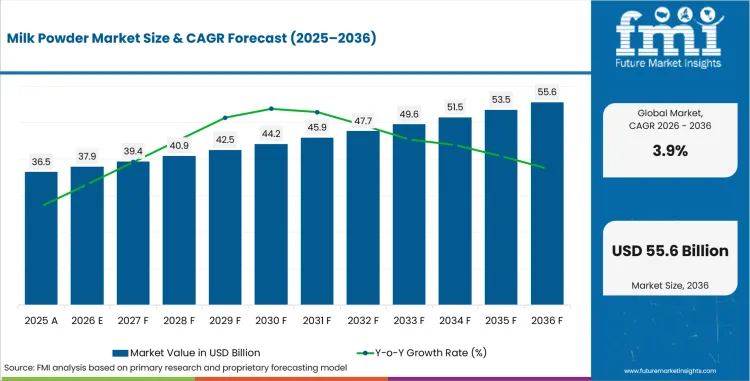
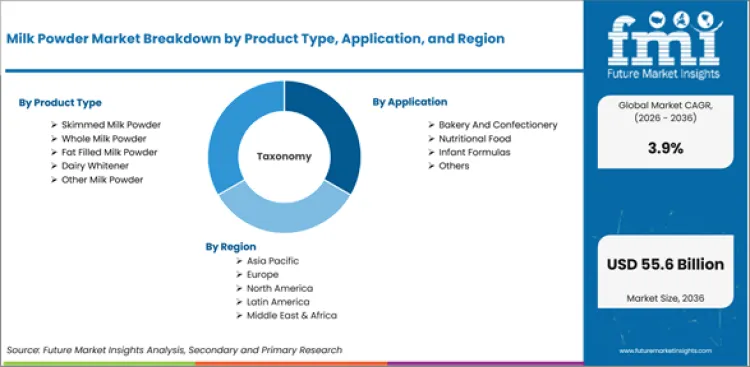
The milk powder market was valued at USD 36.5 billion in 2025. The market is set to reach USD 37.9 billion by 2026-end and grow at a CAGR of 3.9% between 2026-2036 to reach USD 55.6 billion by 2036. Skimmed Milk Powder will dominate with a 34.0% share, while Bakery And Confectionery will lead with a 36.0% share.
Key Takeaways, Market Size, and Forecast
- 2026 Market Size: USD 37.9 billion
- 2036 Market Size: USD 55.6 billion
- Compound Annual Growth Rate (CAGR): 3.9% from 2026 to 2036
- Absolute $ Opportunity: USD 17.6 billion between 2026 and 2036
- Leading Product Type Segment: Skimmed Milk Powder
- Skimmed Milk Powder Share in 2026: 34.0%
- Fastest-growing Country: China
- China CAGR: 5.26% through 2036
| Parameter | Details |
|---|---|
| Market Size in 2026 (Value) | USD 37.9 billion |
| Market Forecast in 2036 (Value) | USD 55.6 billion |
| Compound Annual Growth Rate (CAGR) | 3.9% from 2026 to 2036 |
| Years Considered | 2021 to 2036 |
| Base Year | 2025 |
| Forecast Period | 2026 to 2036 |
| Units Considered | Value (USD Bn) |
| Leading Sub-Region | China |
Summary of the Milk Powder Market
- Demand and Growth Drivers
- Growing dairy consumption in emerging markets and expanding food manufacturing applications are expected to sustain demand for milk powder as a shelf-stable, cost-effective dairy ingredient through 2036.
- Infant nutrition, bakery, and confectionery manufacturing are likely to remain the primary industrial demand channels for specification-grade milk powder during the forecast period.
- Urbanization and modern retail expansion in Asia-Pacific and Latin America are anticipated to increase household milk powder consumption for daily nutrition and reconstituted milk preparation.
- Product and Segment View
- Skimmed milk powder is likely to account for 34.0% of product type demand in 2026, supported by its role as a cost-effective protein and mineral source in food manufacturing and infant nutrition formulations.
- Bakery and confectionery accounts for 36.0% of application demand, with bread, biscuits, chocolate, and ice cream manufacturing as the primary procurement channels.
- Flexible packaging holds 52.0% of packaging type demand, reflecting manufacturer preference for sachets, pouches, and stand-up packs for retail and food service distribution.
- Geography and Competitive Outlook
- China is projected to lead with a 5.26% CAGR through 2036, driven by infant formula demand, food manufacturing expansion, and growing household dairy consumption in urban and rural markets.
- India at 4.88% reflects expanding dairy processing capacity, increasing packaged food manufacturing, and growing consumer demand for affordable dairy nutrition.
- Companies with integrated dairy sourcing, spray drying capacity, and distribution networks across retail and industrial channels are likely to consolidate supply positions during the forecast period.
- Analyst Opinion
- Nandini Roy Choudhury, Principal Consultant at FMI says, 'Dairy companies that can deliver consistent quality milk powder with documented nutritional profiles and competitive pricing across infant nutrition, bakery, and household consumption channels are likely to strengthen their multi-market supply positions through 2036.'
- The milk powder market is maturing from a commodity dairy trade into a segmented supply chain with distinct quality tiers for infant nutrition, food manufacturing, and household reconstitution.
- Adoption in emerging markets is increasing due to urbanization, modern retail expansion, and the shelf stability advantage of milk powder in regions with limited cold chain infrastructure.
- Skimmed milk powder at 34.0% reflects its versatility as a protein source in food manufacturing where fat content control is a formulation requirement.
- Hypermarkets and supermarkets at 32.0% of distribution channel reflect the role of modern retail in household milk powder sales across urban consumer markets.
Milk Powder Market Definition
The milk powder market encompasses commercially produced dried milk products, including skimmed milk powder, whole milk powder, buttermilk powder, and specialty milk powders. These products serve infant nutrition, bakery, confectionery, dairy reconstitution, food service, and household consumption applications.
Milk Powder Market Inclusions
Market scope covers all commercially traded milk powder products categorized by product type (skimmed milk powder, whole milk powder, buttermilk powder, specialty milk powders), application (bakery and confectionery, infant nutrition, dairy products, food service, household consumption), distribution channel (hypermarkets and supermarkets, convenience stores, online, specialty stores, B2B), packaging type (flexible packaging, rigid packaging, bulk packaging), and end user (food and beverage industry, infant nutrition companies, food service operators, household consumers). Revenue coverage spans 2026 to 2036.
Milk Powder Market Exclusions
The scope does not include liquid milk, UHT milk, flavored milk drinks, or milk protein concentrates and isolates marketed as specialty ingredients rather than milk powder.
Milk Powder Market Research Methodology
- Primary Research: FMI analysts conducted interviews with dairy processors, milk powder traders, infant formula manufacturers, bakery companies, and retail category managers in key markets.
- Desk Research: Combined data from dairy trade databases, FAO dairy production statistics, and retail scanner data on milk powder sales.
- Market Sizing and Forecasting: Bottom-up aggregation from infant nutrition, bakery, confectionery, food service, and household application volumes across regional dairy consumption and trade data.
- Data Validation: Cross-checked quarterly against dairy production statistics, international dairy trade data, and manufacturer procurement reports.
Why is the Milk Powder Market Growing?
- Emerging market dairy consumption and food manufacturing expansion are driving growth, with the milk powder market projected to reach USD 55.60 billion by 2036.
- China leads at 5.3% CAGR, driven by infant formula demand, food manufacturing growth, and expanding household dairy consumption.
- Skimmed milk powder at 34.0% of product type reflects its versatility as a cost-effective protein ingredient in food manufacturing and infant nutrition.
The milk powder market is estimated at USD 37.9 billion in 2026 and is projected to reach USD 55.6 billion by 2036, expanding at a CAGR of 3.9%. Demand is shaped by the structural role of milk powder as a shelf-stable dairy ingredient in food manufacturing, infant nutrition, and household consumption across markets with varying cold chain infrastructure.
Skimmed milk powder accounts for 34.0% of product type. Bakery and confectionery represent 36.0% of application. Hypermarkets and supermarkets hold 32.0% of distribution. Flexible packaging accounts for 52.0% of packaging type. Food and beverage industry represents 40.0% of end-user demand.
Growth reflects the convergence of emerging market urbanization, food manufacturing expansion, and the sustained role of milk powder in infant nutrition supply chains where shelf stability and transport logistics favor powder over liquid dairy formats.
Market Segmentation Analysis
- Skimmed milk powder holds 34.0% of product type in 2026, serving food manufacturing, infant nutrition, and reconstituted dairy applications.
- Bakery and confectionery accounts for 36.0% of application demand, with bread, biscuit, chocolate, and ice cream manufacturing as the primary procurement channels.
- Flexible packaging holds 52.0% of packaging type, reflecting consumer and manufacturer preference for sachets and pouches across retail and food service channels.
The milk powder market is segmented by product type (skimmed milk powder, whole milk powder, buttermilk powder, specialty milk powders), application (bakery and confectionery, infant nutrition, dairy products, food service, household consumption), distribution channel (hypermarkets and supermarkets, convenience stores, online, specialty stores, B2B), packaging type (flexible packaging, rigid packaging, bulk packaging), and end user (food and beverage industry, infant nutrition companies, food service operators, household consumers).
Insights into the Skimmed Milk Powder Product Type Segment
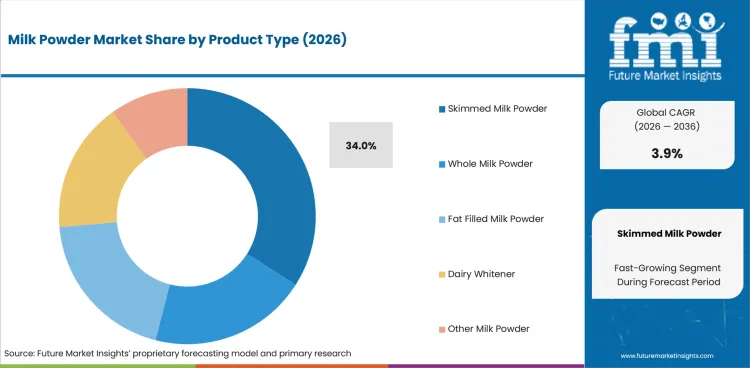
In 2026, skimmed milk powder accounts for 34.0% of product type demand. Low-heat, medium-heat, and high-heat grades serve different food manufacturing requirements: low-heat for cheese making and infant formula, medium-heat for bakery and confectionery, and high-heat for recombined dairy products.
Whole milk powder serves household reconstitution and beverage manufacturing where full-fat dairy taste is required. Buttermilk powder serves bakery applications where its acidity and emulsification properties improve product quality. Specialty powders include fortified and value-added variants.
Insights into the Bakery and Confectionery Application Segment
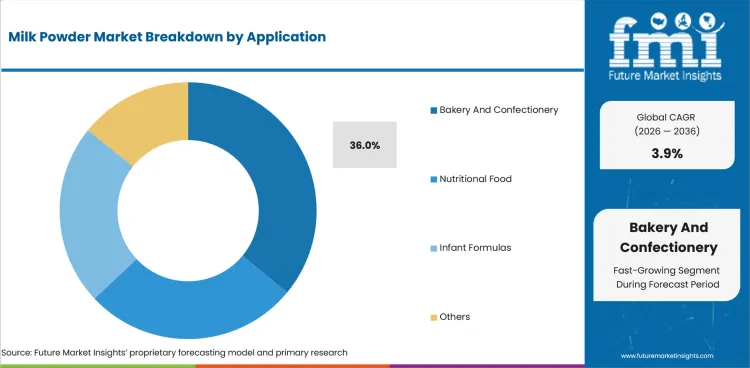
Bakery and confectionery accounts for 36.0% of application demand in 2026. Bread manufacturing uses milk powder for crust color, crumb structure, and shelf life improvement. Biscuit and cookie manufacturing uses milk powder for flavor and texture. Chocolate and ice cream manufacturing use milk powder as a primary dairy ingredient.
Infant nutrition represents the second-largest application, with specification-grade skimmed and whole milk powder serving formula manufacturing. Household consumption provides stable retail demand, particularly in emerging markets where reconstituted milk is a daily nutrition source.
Milk Powder Market Drivers, Restraints, and Opportunities
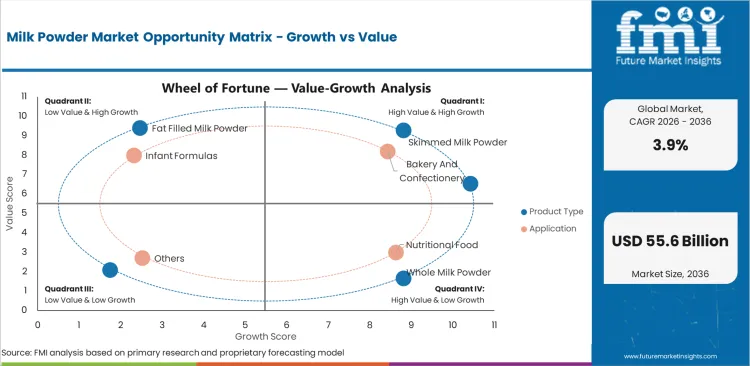
- Emerging market dairy consumption growth and food manufacturing expansion are creating consistent volume demand for milk powder across industrial and household channels.
- Dairy commodity price volatility driven by production variability in New Zealand, the EU, and the USA affects procurement costs and margin management for milk powder buyers.
- Infant nutrition specification requirements and food safety standards are creating differentiated quality tiers that support premium pricing for certified milk powder grades.
The milk powder market expands on the basis of global dairy consumption, food manufacturing demand, and emerging market urbanization. Constraints include dairy commodity price volatility, trade policy impacts on international dairy flows, and competition from liquid dairy in markets with developed cold chain infrastructure.
Emerging Market Dairy Consumption Growth
Demand is shaped by urbanization and rising household income in China, India, Southeast Asia, and Africa that increase per-capita dairy consumption. Milk powder serves as the primary dairy format in regions where cold chain limitations make liquid milk distribution uneconomical outside urban centers.
Dairy Commodity Price Volatility
Adoption dynamics are influenced by dairy commodity price cycles driven by production variability in major exporting regions. New Zealand drought, EU quota management, and US dairy policy affect global milk powder pricing and procurement planning for food manufacturers and traders.
Infant Nutrition Quality Differentiation
Growth is supported by the differentiation of milk powder quality tiers, with infant-nutrition-grade products commanding premium pricing due to strict compositional specifications, food safety documentation, and traceability requirements that distinguish them from commodity-grade industrial and household milk powder.
Analysis of Milk Powder Market By Key Countries
.webp "Top Country Growth Comparison Milk Powder Market Cagr (2026 2036)")
| Country | CAGR |
|---|---|
| China | 5.3% |
| India | 4.9% |
| Germany | 4.5% |
| Brazil | 4.1% |
| USA | 3.7% |
| UK | 3.3% |
| Japan | 2.9% |
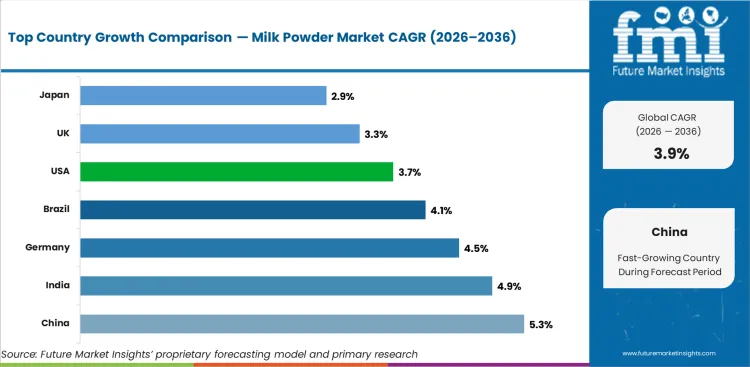
- China at 5.26% leads growth, driven by infant formula demand, food manufacturing expansion, and household dairy consumption growth.
- India at 4.88% reflects expanding dairy processing, packaged food manufacturing, and consumer demand for affordable dairy nutrition.
- Germany (4.49%) and Brazil (4.09%) sustain demand through established food manufacturing and expanding household consumption respectively.
- The USA (3.71%) and UK (3.31%) maintain demand through bakery, confectionery, and food service channel procurement.
The global milk powder market is projected to expand at a CAGR of 3.9% from 2026 to 2036. The study covers more than 30 countries, and the primary markets are analyzed below.
Demand Outlook for Milk Powder Market in China
China is projected to lead with a 5.3% CAGR through 2036. Infant formula demand, food manufacturing expansion, and growing household dairy consumption across urban and rural markets drive milk powder procurement.
- Infant formula manufacturers in China maintain large-volume procurement of specification-grade milk powder from New Zealand, EU, and Australian dairy origins.
- Food manufacturing expansion in bakery, confectionery, and dairy reconstitution generates industrial demand for skimmed and whole milk powder.
- E-commerce and modern retail channels expand household access to branded milk powder products in tier-2 and tier-3 Chinese cities.
Future Outlook for Milk Powder Market in India
India is expected to grow at 4.8% through 2036. Expanding dairy cooperative processing, packaged food manufacturing, and urban consumer demand for dairy nutrition support milk powder market growth.
- Indian dairy cooperatives including Amul expand spray drying capacity to convert surplus milk production into powder for domestic and export markets.
- Bakery and confectionery manufacturing growth in India generates industrial demand for milk powder as a cost-effective dairy ingredient.
- Household consumption of milk powder in sachets and small packs serves daily nutrition needs in regions with limited cold chain access.
Opportunity Analysis of Milk Powder Market in Germany
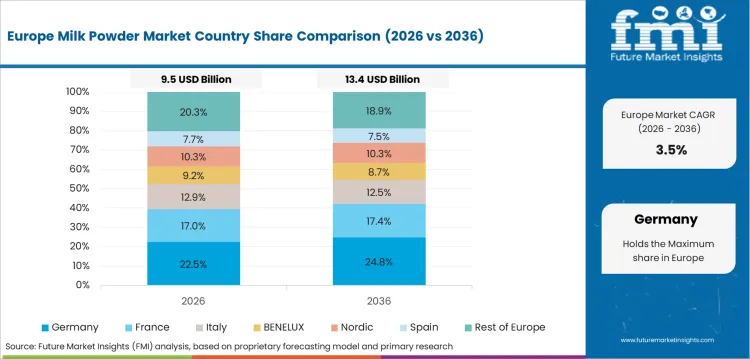
Germany is projected to expand at 4.5% through 2036. Established dairy processing, bakery manufacturing scale, and intra-EU dairy trade support consistent milk powder demand.
- German dairy processors produce skimmed and whole milk powder for domestic bakery, confectionery, and food manufacturing applications.
- Intra-EU dairy trade positions Germany as both a producer and consumer of milk powder within the European single market.
- Infant nutrition companies sourcing from German dairy operations maintain specification-grade milk powder procurement for formula production.
In-depth Analysis of Milk Powder Market in Brazil
Brazil is projected to grow at 4.1% through 2036. Household dairy consumption, bakery manufacturing, and dairy reconstitution demand sustain milk powder market growth.
- Brazilian household consumers purchase whole milk powder for daily reconstitution, particularly in northern and northeastern regions with limited cold chain infrastructure.
- Bakery and confectionery manufacturing in Brazil generates industrial demand for skimmed milk powder in bread, biscuit, and chocolate production.
- Domestic dairy processing capacity expansion and import supply from Argentina and Uruguay serve growing Brazilian milk powder demand.
Sales Analysis of Milk Powder Market in the United States
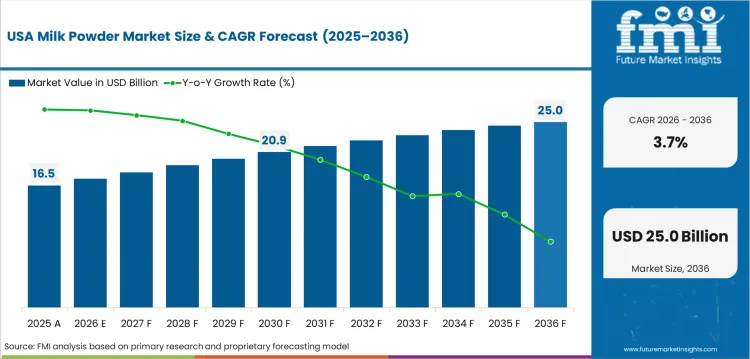
The USA is projected to grow at 3.7% through 2036. Food manufacturing, food service, and dairy export operations sustain milk powder production and procurement.
- US dairy processors produce skimmed and whole milk powder for domestic food manufacturing and international dairy trade through USDEC-facilitated export programs.
- Bakery, confectionery, and food service operations in the USA procure milk powder as a cost-effective, shelf-stable dairy ingredient for commercial food preparation.
- Nonfat dry milk exports from the USA serve infant formula and food manufacturing demand in Latin American, Asian, and Middle Eastern markets.
Competitive Landscape and Strategic Positioning
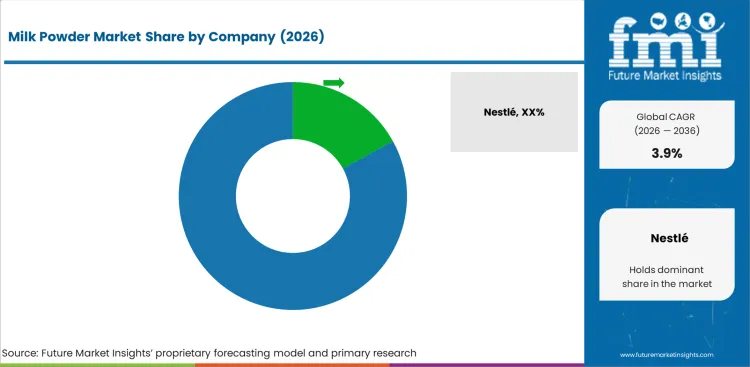
- Nestle and Danone lead with global dairy brand portfolios, infant nutrition product lines, and extensive retail and food service distribution networks.
- Groupe Lactalis and Fonterra maintain positions through dairy processing scale and international milk powder trading operations.
- Royal FrieslandCampina and Arla Foods compete through European dairy cooperative processing and diversified milk powder product portfolios.
Nestle holds a leading position through its global infant nutrition and dairy brand portfolio, including Nido, Nespray, and infant formula brands. Danone competes through its infant nutrition division and dairy product portfolio across European and Asian markets.
Groupe Lactalis and Fonterra maintain positions through dairy processing scale and international trading. FrieslandCampina and Arla Foods provide European cooperative dairy supply.
Barriers include dairy sourcing scale, spray drying infrastructure, and brand building investment. Strategic priorities center on infant nutrition quality, emerging market distribution, and cost-competitive production.
Key Companies in the Milk Powder Market
Key global companies leading the milk powder market include:
- Nestle (Switzerland), Danone (France), and Groupe Lactalis (France) maintain global dairy brand portfolios with integrated infant nutrition, retail, and food manufacturing distribution networks.
- Fonterra (New Zealand), Royal FrieslandCampina N.V. (Netherlands), and Arla Foods (Denmark) hold positions through dairy cooperative processing scale and international milk powder trading operations.
- Regional dairy processors and private-label manufacturers serve local markets with competitively priced milk powder for household and food manufacturing use.
Competitive Benchmarking: Milk Powder Market
| Company | Brand Portfolio | Dairy Processing Scale | Retail Distribution | Geographic Footprint |
|---|---|---|---|---|
| Nestle | High | High | Strong | Global |
| Danone | High | High | Strong | Global |
| Groupe Lactalis | High | High | Strong | Europe, Global |
| Fonterra | High | High | Strong | Asia-Pacific, Global |
| FrieslandCampina | High | High | Strong | Europe, Global |
| Arla Foods | High | High | Strong | Europe, Global |
Source: Future Market Insights competitive analysis, 2026.
Key Developments in Milk Powder Market
- In 2025, Nestle expanded its milk powder product range in Southeast Asian markets with new fortified variants targeting household nutrition and early childhood feeding.
- In 2025, Fonterra launched a new specification-grade skimmed milk powder for infant formula manufacturing in Chinese and Southeast Asian markets.
Key Players in the Milk Powder Market
Major Global Players
- Nestle
- Danone
- Groupe Lactalis
- Fonterra
- Royal FrieslandCampina N.V.
- Arla Foods
Emerging Players/Startups
- Regional dairy processors
- Private-label milk powder manufacturers
- Specialty milk powder producers
Report Scope and Coverage
| Parameter | Details |
|---|---|
| Market size by 2036 | USD 55.6 billion |
| Growth rate | 3.9% CAGR (2026 to 2036) |
| Forecast period | 2026 to 2036 |
| Base year value (2025) | USD 36.5 billion |
| Key Segment Covered | Product Type, Application, Distribution Channel, Packaging Type, End User |
| Regions covered | North America, Latin America, Europe, East Asia, South Asia and Pacific, Middle East and Africa |
| Countries covered | China, India, Germany, Brazil, USA, UK, Japan, 30 plus countries |
| Key companies profiled | Nestle, Danone, Groupe Lactalis, Fonterra, FrieslandCampina, Arla Foods |
| Approach | Hybrid bottom-up and top-down methodology starting with verified dairy production and trade data, projecting adoption velocity across product types, applications, and regions. |
Market Segmentation Analysis
Milk Powder Market Segmented by Product Type:
- Skimmed Milk Powder
- Low Fat Dairy Ingredients
- Bakery And Beverage Applications
- Nutritional Food Products
- Instant Skimmed Milk Powder
- Rapid Solubility Benefits
- Industrial Food Processing
- Low Fat Dairy Ingredients
- Whole Milk Powder
- Full Cream Milk Powder
- Rich Dairy Flavor Applications
- Infant Nutrition Products
- Regular Whole Milk Powder
- Confectionery And Bakery Uses
- Dairy Beverage Formulations
- Full Cream Milk Powder
- Fat Filled Milk Powder
- Vegetable Fat Blended Powders
- Cost Effective Dairy Alternatives
- Foodservice Applications
- Instant Fat Filled Powders
- Beverage Whitening Solutions
- Industrial Dairy Processing
- Vegetable Fat Blended Powders
- Dairy Whitener
- Tea And Coffee Whiteners
- Foodservice Beverage Applications
- Convenience Consumption Products
- Instant Dairy Whitener Blends
- Creamy Texture Enhancement
- Retail Beverage Solutions
- Tea And Coffee Whiteners
- Other Milk Powder
- Buttermilk Powder
- Bakery Texture Applications
- Flavor Enhancement Solutions
- Goat And Specialty Milk Powders
- Premium Nutritional Products
- Digestive Friendly Formulations
- Buttermilk Powder
Milk Powder Market Segmented by Application:
- Bakery And Confectionery
- Bakery Ingredient Applications
- Texture And Moisture Enhancement
- Shelf Life Improvement
- Chocolate And Confectionery Uses
- Creaminess And Flavor Development
- Milk Solids Enrichment
- Bakery Ingredient Applications
- Nutritional Food
- Functional Nutrition Products
- Protein And Calcium Enrichment
- Healthy Lifestyle Applications
- Clinical And Wellness Nutrition
- Balanced Dietary Support
- Meal Replacement Formulations
- Functional Nutrition Products
- Infant Formulas
- Infant Nutrition Ingredients
- Balanced Growth Nutrition
- High Purity Dairy Solutions
- Follow On Formula Applications
- Digestive Health Support
- Essential Nutrient Enrichment
- Infant Nutrition Ingredients
- Others
- Dairy Beverage Applications
- Milk Based Drink Formulations
- Instant Beverage Solutions
- Foodservice And Culinary Uses
- Sauce And Soup Applications
- Industrial Food Manufacturing
- Dairy Beverage Applications
Milk Powder Market Segmented by Distribution Channel:
- Hypermarkets Supermarkets
- Large Retail Chains
- Mass Market Product Availability
- Family Pack Sales
- Organized Grocery Stores
- Convenient Consumer Access
- Promotional Product Displays
- Large Retail Chains
- B2B
- Industrial Ingredient Supply
- Bulk Dairy Procurement
- Food Manufacturing Contracts
- Foodservice Distribution Networks
- Commercial Kitchen Supply
- Hospitality Sector Applications
- Industrial Ingredient Supply
- B2C
- Direct Consumer Sales
- Retail Dairy Nutrition Products
- Household Consumption Solutions
- Brand Owned Sales Channels
- Subscription Dairy Services
- Consumer Wellness Products
- Direct Consumer Sales
- Convenience Stores
- Local Retail Outlets
- Single Serve Milk Powder Packs
- Quick Purchase Convenience
- Urban Convenience Retail
- Daily Dairy Consumption Products
- Compact Packaging Formats
- Local Retail Outlets
- Specialty Stores
- Health And Nutrition Stores
- Premium Dairy Nutrition Products
- Infant Formula Distribution
- Dairy Specialty Retailers
- Imported Milk Powder Products
- Functional Dairy Solutions
- Health And Nutrition Stores
- Retail Stores
- Traditional Grocery Retail
- Regional Product Distribution
- Affordable Dairy Products
- Independent Retail Shops
- Community Based Consumer Reach
- Daily Essentials Availability
- Traditional Grocery Retail
- Online Retail
- E Commerce Grocery Platforms
- Home Delivery Convenience
- Subscription Nutrition Services
- Brand Owned Online Stores
- Digital Consumer Engagement
- Wide Product Selection
- E Commerce Grocery Platforms
Milk Powder Market Segmented by Packaging Type:
- Flexible Packaging
- Pouches And Sachets
- Lightweight Storage Solutions
- Convenient Consumer Usage
- Bulk Flexible Bags
- Industrial Dairy Distribution
- Cost Effective Transportation
- Pouches And Sachets
- Rigid Packaging
- Cans And Tins
- Extended Shelf Life Protection
- Premium Product Positioning
- Plastic Containers
- Moisture Resistant Packaging
- Household Storage Convenience
- Cans And Tins
- Bulk Packaging
- Industrial Bulk Drums
- Large Scale Food Manufacturing
- Efficient Supply Chain Handling
- Bulk Export Packaging
- International Dairy Trade
- Commercial Ingredient Applications
- Industrial Bulk Drums
Milk Powder Market Segmented by End User:
- Food And Beverage Industry
- Bakery And Confectionery Manufacturers
- Industrial Ingredient Utilization
- Texture And Flavor Enhancement
- Beverage Processing Companies
- Milk Based Drink Production
- Nutritional Product Formulation
- Bakery And Confectionery Manufacturers
- Household Consumers
- Family Nutrition Applications
- Daily Beverage Consumption
- Convenient Dairy Storage
- Home Baking And Cooking
- Dessert And Recipe Applications
- Pantry Essential Products
- Family Nutrition Applications
- Infant Nutrition Industry
- Infant Formula Manufacturers
- Balanced Pediatric Nutrition
- Specialized Dairy Ingredients
- Baby Food Producers
- Growth And Development Support
- Premium Nutrition Solutions
- Infant Formula Manufacturers
- Foodservice Industry
- Hotels And Restaurants
- Tea And Coffee Whitening Applications
- Culinary Ingredient Usage
- Cafes And Catering Services
- Dessert And Beverage Preparation
- Commercial Kitchen Efficiency
- Hotels And Restaurants
Milk Powder Market by Region:
- North America
- USA
- Canada
- Mexico
- Latin America
- Brazil
- Chile
- Rest of Latin America
- Western Europe
- Germany
- UK
- Italy
- Spain
- France
- Nordic
- BENELUX
- Rest of Western Europe
- Eastern Europe
- Russia
- Poland
- Hungary
- Balkan & Baltic
- Rest of Eastern Europe
- East Asia
- China
- Japan
- South Korea
- South Asia and Pacific
- India
- ASEAN
- Australia & New Zealand
- Rest of South Asia and Pacific
- Middle East & Africa
- Kingdom of Saudi Arabia
- Other GCC Countries
- Türkiye
- South Africa
- Other African Union
- Rest of Middle East & Africa
Research Sources and Bibliography
- 1. Food and Agriculture Organization. (2025). FAO Dairy Market Review: Global Milk Powder Production and Trade Statistics. FAO.
- 2. International Dairy Federation. (2025). IDF World Dairy Situation Report: Milk Powder Market Trends. IDF.
- 3. USA Department of Agriculture. (2025). USDA Dairy Market News: Nonfat Dry Milk and Whole Milk Powder Trade Data. USDA.
- 4. European Commission. (2025). EU Milk Market Observatory: Powder Production and Export Statistics. EC.
- 5. Codex Alimentarius Commission. (2025). Codex Standard for Milk Powders and Cream Powder: Quality and Labeling Specifications. WHO/FAO.
This bibliography is provided for reader reference.
This Report Answers
- Estimating the size of the milk powder market and projected revenue from 2026 to 2036.
- Segmenting by product type, application, distribution channel, packaging type, and end user.
- Regional and country-level insights across more than 30 markets.
- Analysis of skimmed, whole, buttermilk, and specialty milk powder categories.
- Assessment of the competitive landscape and company benchmarking.
- Identifying investment opportunities in infant nutrition, bakery manufacturing, and emerging market distribution.
- Tracking supply chain dynamics from dairy processing to milk powder distribution.
- Delivery of data in PDF and Excel formats.
Frequently Asked Questions
How big is the milk powder market in 2026?
The global milk powder market is estimated to be valued at USD 37.9 billion in 2026.
What will be the size of milk powder market in 2036?
The market size for the milk powder market is projected to reach USD 55.6 billion by 2036.
How much will be the milk powder market growth between 2026 and 2036?
The milk powder market is expected to grow at a 3.9% CAGR between 2026 and 2036.
What are the key product types in the milk powder market?
The key product types in the milk powder market are Skimmed Milk Powder, Whole Milk Powder, Fat Filled Milk Powder, Dairy Whitener and Other Milk Powder.
Which application segment is expected to contribute significant share in the milk powder market in 2026?
In terms of application, bakery and confectionery segment is expected to command 36.0% share in the milk powder market in 2026.
Preview the report firsthand - request a free sample
Get SampleGet the brochure for pricing and purchase details.
Get PDFTable of Content
- Key Takeaways
- Market Size and CAGR
- Top Growth Driver
- Fastest Growing Segment
- Leading Region
- Key Companies
- Emerging Opportunities
- Executive Summary
- Global Market Outlook
- Demand-side Trends
- Supply-side Trends
- Technology Roadmap Analysis
- Analysis and Recommendations
- Analyst Perspective (What is happening? Why now? What should investors know?)
- Key Questions Answered
- How large is the market?
- What is the CAGR?
- What are key trends?
- Which region dominates?
- Who are the leaders?
- Market Overview
- Market Coverage / Taxonomy
- Market Definition / Scope / Limitations
- Research Methodology
- Chapter Orientation
- Analytical Lens and Working Hypotheses
- Market Structure, Signals, and Trend Drivers
- Benchmarking and Cross-market Comparability
- Market Sizing, Forecasting, and Opportunity Mapping
- Research Design and Evidence Framework
- Desk Research Programme (Secondary Evidence)
- Expert Input and Fieldwork (Primary Evidence)
- Tooling, Models, and Reference Databases
- Data Engineering and Model Build
- Quality Assurance and Audit Trail
- Market Background
- Market Dynamics (Drivers, Restraints, Opportunity, Trends)
- Scenario Forecast (Optimistic, Likely, Conservative)
- Impact Analysis
- AI Impact
- Sustainability Impact
- Regulatory Impact
- Technology Impact
- Consumer / Buyer Analysis
- Purchase Drivers
- Adoption Barriers
- Buyer Journey
- Opportunity Map Analysis
- Product Life Cycle Analysis
- Supply Chain Analysis
- Investment Feasibility Matrix
- Value Chain Analysis
- PESTLE and Porter's Analysis
- Regulatory Landscape
- Regional Parent Market Outlook
- Production and Consumption Statistics
- Import and Export Statistics
- Global Market Analysis and Forecast, 2021 to 2036
- Historical Market Size Value (USD Billion) Analysis, 2021 to 2025
- Current and Future Market Size Value (USD Billion) Projections, 2026 to 2036
- Y-o-Y Growth Trend Analysis
- Absolute $ Opportunity Analysis
- Global Market Pricing Analysis, 2021 to 2036
- Global Market Analysis and Forecast, By Product Type, 2021 to 2036
- Introduction / Key Findings
- Historical Market Size Value (USD Billion) Analysis By Product Type, 2021 to 2025
- Current and Future Market Size Value (USD Billion) Analysis and Forecast By Product Type, 2026 to 2036
- Skimmed Milk Powder
- Low Fat Dairy Ingredients
- Instant Skimmed Milk Powder
- Whole Milk Powder
- Full Cream Milk Powder
- Regular Whole Milk Powder
- Fat Filled Milk Powder
- Vegetable Fat Blended Powders
- Instant Fat Filled Powders
- Dairy Whitener
- Tea And Coffee Whiteners
- Instant Dairy Whitener Blends
- Other Milk Powder
- Buttermilk Powder
- Goat And Specialty Milk Powders
- Skimmed Milk Powder
- Y-o-Y Growth Trend Analysis By Product Type, 2021 to 2025
- Absolute $ Opportunity Analysis By Product Type, 2026 to 2036
- Global Market Analysis and Forecast, By Application, 2021 to 2036
- Introduction / Key Findings
- Historical Market Size Value (USD Billion) Analysis By Application, 2021 to 2025
- Current and Future Market Size Value (USD Billion) Analysis and Forecast By Application, 2026 to 2036
- Bakery And Confectionery
- Bakery Ingredient Applications
- Chocolate And Confectionery Uses
- Nutritional Food
- Functional Nutrition Products
- Clinical And Wellness Nutrition
- Infant Formulas
- Infant Nutrition Ingredients
- Follow On Formula Applications
- Others
- Dairy Beverage Applications
- Foodservice And Culinary Uses
- Bakery And Confectionery
- Y-o-Y Growth Trend Analysis By Application, 2021 to 2025
- Absolute $ Opportunity Analysis By Application, 2026 to 2036
- Global Market Analysis and Forecast, By Distribution Channel, 2021 to 2036
- Introduction / Key Findings
- Historical Market Size Value (USD Billion) Analysis By Distribution Channel, 2021 to 2025
- Current and Future Market Size Value (USD Billion) Analysis and Forecast By Distribution Channel, 2026 to 2036
- Hypermarkets Supermarkets
- Large Retail Chains
- Organized Grocery Stores
- B2B
- Industrial Ingredient Supply
- Foodservice Distribution Networks
- B2C
- Direct Consumer Sales
- Brand Owned Sales Channels
- Convenience Stores
- Local Retail Outlets
- Urban Convenience Retail
- Specialty Stores
- Health And Nutrition Stores
- Dairy Specialty Retailers
- Retail Stores
- Traditional Grocery Retail
- Independent Retail Shops
- Online Retail
- E Commerce Grocery Platforms
- Brand Owned Online Stores
- Hypermarkets Supermarkets
- Y-o-Y Growth Trend Analysis By Distribution Channel, 2021 to 2025
- Absolute $ Opportunity Analysis By Distribution Channel, 2026 to 2036
- Global Market Analysis and Forecast, By Packaging Type, 2021 to 2036
- Introduction / Key Findings
- Historical Market Size Value (USD Billion) Analysis By Packaging Type, 2021 to 2025
- Current and Future Market Size Value (USD Billion) Analysis and Forecast By Packaging Type, 2026 to 2036
- Flexible Packaging
- Pouches And Sachets
- Bulk Flexible Bags
- Rigid Packaging
- Cans And Tins
- Plastic Containers
- Bulk Packaging
- Industrial Bulk Drums
- Bulk Export Packaging
- Flexible Packaging
- Y-o-Y Growth Trend Analysis By Packaging Type, 2021 to 2025
- Absolute $ Opportunity Analysis By Packaging Type, 2026 to 2036
- Global Market Analysis and Forecast, By End User, 2021 to 2036
- Introduction / Key Findings
- Historical Market Size Value (USD Billion) Analysis By End User, 2021 to 2025
- Current and Future Market Size Value (USD Billion) Analysis and Forecast By End User, 2026 to 2036
- Food And Beverage Industry
- Bakery And Confectionery Manufacturers
- Beverage Processing Companies
- Household Consumers
- Family Nutrition Applications
- Home Baking And Cooking
- Infant Nutrition Industry
- Infant Formula Manufacturers
- Baby Food Producers
- Foodservice Industry
- Hotels And Restaurants
- Cafes And Catering Services
- Food And Beverage Industry
- Y-o-Y Growth Trend Analysis By End User, 2021 to 2025
- Absolute $ Opportunity Analysis By End User, 2026 to 2036
- Global Market Analysis and Forecast, By Region, 2021 to 2036
- Introduction
- Historical Market Size Value (USD Billion) Analysis By Region, 2021 to 2025
- Current Market Size Value (USD Billion) Analysis and Forecast By Region, 2026 to 2036
- North America
- Latin America
- Western Europe
- Eastern Europe
- East Asia
- South Asia and Pacific
- Middle East & Africa
- Market Attractiveness Analysis By Region
- North America Market Analysis and Forecast, By Country, 2021 to 2036
- Historical Market Size Value (USD Billion) Trend Analysis By Market Taxonomy, 2021 to 2025
- Market Size Value (USD Billion) Forecast By Market Taxonomy, 2026 to 2036
- By Country
- USA
- Canada
- Mexico
- By Product Type
- By Application
- By Distribution Channel
- By Packaging Type
- By End User
- By Country
- Market Attractiveness Analysis
- By Country
- By Product Type
- By Application
- By Distribution Channel
- By Packaging Type
- By End User
- Key Takeaways
- Latin America Market Analysis and Forecast, By Country
- Historical Market Size Value (USD Billion) Trend Analysis By Market Taxonomy, 2021 to 2025
- Market Size Value (USD Billion) Forecast By Market Taxonomy, 2026 to 2036
- By Country
- Brazil
- Chile
- Rest of Latin America
- By Product Type
- By Application
- By Distribution Channel
- By Packaging Type
- By End User
- By Country
- Market Attractiveness Analysis
- By Country
- By Product Type
- By Application
- By Distribution Channel
- By Packaging Type
- By End User
- Key Takeaways
- Western Europe Market Analysis and Forecast, By Country
- Historical Market Size Value (USD Billion) Trend Analysis By Market Taxonomy, 2021 to 2025
- Market Size Value (USD Billion) Forecast By Market Taxonomy, 2026 to 2036
- By Country
- Germany
- UK
- Italy
- Spain
- France
- Nordic
- BENELUX
- Rest of Western Europe
- By Product Type
- By Application
- By Distribution Channel
- By Packaging Type
- By End User
- By Country
- Market Attractiveness Analysis
- By Country
- By Product Type
- By Application
- By Distribution Channel
- By Packaging Type
- By End User
- Key Takeaways
- Eastern Europe Market Analysis and Forecast, By Country
- Historical Market Size Value (USD Billion) Trend Analysis By Market Taxonomy, 2021 to 2025
- Market Size Value (USD Billion) Forecast By Market Taxonomy, 2026 to 2036
- By Country
- Russia
- Poland
- Hungary
- Balkan & Baltic
- Rest of Eastern Europe
- By Product Type
- By Application
- By Distribution Channel
- By Packaging Type
- By End User
- By Country
- Market Attractiveness Analysis
- By Country
- By Product Type
- By Application
- By Distribution Channel
- By Packaging Type
- By End User
- Key Takeaways
- East Asia Market Analysis and Forecast, By Country
- Historical Market Size Value (USD Billion) Trend Analysis By Market Taxonomy, 2021 to 2025
- Market Size Value (USD Billion) Forecast By Market Taxonomy, 2026 to 2036
- By Country
- China
- Japan
- South Korea
- By Product Type
- By Application
- By Distribution Channel
- By Packaging Type
- By End User
- By Country
- Market Attractiveness Analysis
- By Country
- By Product Type
- By Application
- By Distribution Channel
- By Packaging Type
- By End User
- Key Takeaways
- South Asia and Pacific Market Analysis and Forecast, By Country
- Historical Market Size Value (USD Billion) Trend Analysis By Market Taxonomy, 2021 to 2025
- Market Size Value (USD Billion) Forecast By Market Taxonomy, 2026 to 2036
- By Country
- India
- ASEAN
- Australia & New Zealand
- Rest of South Asia and Pacific
- By Product Type
- By Application
- By Distribution Channel
- By Packaging Type
- By End User
- By Country
- Market Attractiveness Analysis
- By Country
- By Product Type
- By Application
- By Distribution Channel
- By Packaging Type
- By End User
- Key Takeaways
- Middle East & Africa Market Analysis and Forecast, By Country
- Historical Market Size Value (USD Billion) Trend Analysis By Market Taxonomy, 2021 to 2025
- Market Size Value (USD Billion) Forecast By Market Taxonomy, 2026 to 2036
- By Country
- Kingdom of Saudi Arabia
- Other GCC Countries
- Türkiye
- South Africa
- Other African Union
- Rest of Middle East & Africa
- By Product Type
- By Application
- By Distribution Channel
- By Packaging Type
- By End User
- By Country
- Market Attractiveness Analysis
- By Country
- By Product Type
- By Application
- By Distribution Channel
- By Packaging Type
- By End User
- Key Takeaways
- Key Countries Market Analysis
- USA
- Pricing Analysis
- Market Share Analysis, 2025
- By Product Type
- By Application
- By Distribution Channel
- By Packaging Type
- By End User
- Canada
- Pricing Analysis
- Market Share Analysis, 2025
- By Product Type
- By Application
- By Distribution Channel
- By Packaging Type
- By End User
- Mexico
- Pricing Analysis
- Market Share Analysis, 2025
- By Product Type
- By Application
- By Distribution Channel
- By Packaging Type
- By End User
- Brazil
- Pricing Analysis
- Market Share Analysis, 2025
- By Product Type
- By Application
- By Distribution Channel
- By Packaging Type
- By End User
- Chile
- Pricing Analysis
- Market Share Analysis, 2025
- By Product Type
- By Application
- By Distribution Channel
- By Packaging Type
- By End User
- Germany
- Pricing Analysis
- Market Share Analysis, 2025
- By Product Type
- By Application
- By Distribution Channel
- By Packaging Type
- By End User
- UK
- Pricing Analysis
- Market Share Analysis, 2025
- By Product Type
- By Application
- By Distribution Channel
- By Packaging Type
- By End User
- Italy
- Pricing Analysis
- Market Share Analysis, 2025
- By Product Type
- By Application
- By Distribution Channel
- By Packaging Type
- By End User
- Spain
- Pricing Analysis
- Market Share Analysis, 2025
- By Product Type
- By Application
- By Distribution Channel
- By Packaging Type
- By End User
- France
- Pricing Analysis
- Market Share Analysis, 2025
- By Product Type
- By Application
- By Distribution Channel
- By Packaging Type
- By End User
- India
- Pricing Analysis
- Market Share Analysis, 2025
- By Product Type
- By Application
- By Distribution Channel
- By Packaging Type
- By End User
- ASEAN
- Pricing Analysis
- Market Share Analysis, 2025
- By Product Type
- By Application
- By Distribution Channel
- By Packaging Type
- By End User
- Australia & New Zealand
- Pricing Analysis
- Market Share Analysis, 2025
- By Product Type
- By Application
- By Distribution Channel
- By Packaging Type
- By End User
- China
- Pricing Analysis
- Market Share Analysis, 2025
- By Product Type
- By Application
- By Distribution Channel
- By Packaging Type
- By End User
- Japan
- Pricing Analysis
- Market Share Analysis, 2025
- By Product Type
- By Application
- By Distribution Channel
- By Packaging Type
- By End User
- South Korea
- Pricing Analysis
- Market Share Analysis, 2025
- By Product Type
- By Application
- By Distribution Channel
- By Packaging Type
- By End User
- Russia
- Pricing Analysis
- Market Share Analysis, 2025
- By Product Type
- By Application
- By Distribution Channel
- By Packaging Type
- By End User
- Poland
- Pricing Analysis
- Market Share Analysis, 2025
- By Product Type
- By Application
- By Distribution Channel
- By Packaging Type
- By End User
- Hungary
- Pricing Analysis
- Market Share Analysis, 2025
- By Product Type
- By Application
- By Distribution Channel
- By Packaging Type
- By End User
- Kingdom of Saudi Arabia
- Pricing Analysis
- Market Share Analysis, 2025
- By Product Type
- By Application
- By Distribution Channel
- By Packaging Type
- By End User
- Türkiye
- Pricing Analysis
- Market Share Analysis, 2025
- By Product Type
- By Application
- By Distribution Channel
- By Packaging Type
- By End User
- South Africa
- Pricing Analysis
- Market Share Analysis, 2025
- By Product Type
- By Application
- By Distribution Channel
- By Packaging Type
- By End User
- USA
- Market Structure Analysis
- Competition Dashboard
- Competition Benchmarking
- Market Share Analysis of Top Players
- By Regional
- By Product Type
- By Application
- By Distribution Channel
- By Packaging Type
- By End User
- Emerging Startups
- Innovation Benchmarking
- Competition Analysis
- Competition Deep Dive
- Nestlé
- Overview
- Product Portfolio
- Profitability by Market Segments (Product/Region/Sales Channel)
- Sales Footprint
- Strategy Overview
- Marketing Strategy
- Product Strategy
- Channel Strategy
- Danone
- Groupe Lactalis
- Fonterra
- Royal FrieslandCampina N.V.
- Arla Foods
- Dairy Farmers of America
- Saputo
- The Kraft Heinz Company
- Parmalat
- Kraft Foods
- Dean Foods
- Others
- Nestlé
- Case Studies
- Success Stories
- Recent Developments
- Competition Deep Dive
- Assumptions & Acronyms Used


