


Industrial Counterweight Market
Industrial Counterweight Market Size and Share Forecast Outlook 2025 to 2035
Historical Data Covered: 2015 to 2023 | Base Year: 2024 | Estimated Year: 2025 | Forecast Period: 2026 to 2035
Industrial Counterweight Market Size and Share Forecast Outlook From 2025 to 2035
The Industrial Counterweight Market is estimated to be valued at USD 8.2 billion in 2025 and is projected to reach USD 13.8 billion by 2035, registering a compound annual growth rate (CAGR) of 5.3% over the forecast period.
The industrial counterweight market is experiencing steady expansion due to rising demand across construction, material handling, and manufacturing sectors. Growth is being driven by the widespread adoption of heavy machinery, cranes, and lifting equipment that rely on counterbalance systems for operational stability and safety. Current market dynamics reflect a focus on performance efficiency, load optimization, and cost-effective materials.
Manufacturers are emphasizing precision-engineered designs that improve equipment balance and extend service life. Increasing infrastructure investments and industrial automation trends are further supporting market expansion. The future outlook remains positive as industries continue to modernize equipment fleets and integrate safety-enhancing technologies.
Continuous innovation in material composition and fabrication processes is expected to reduce overall weight while maintaining strength and durability These advancements, coupled with the proliferation of heavy-duty applications in logistics and energy sectors, are projected to reinforce steady growth momentum and broaden adoption across global industrial markets.
Quick Stats for Industrial Counterweight Market
- Industrial Counterweight Market Industry Value (2025): USD 8.2 billion
- Industrial Counterweight Market Forecast Value (2035): USD 13.8 billion
- Industrial Counterweight Market Forecast CAGR: 5.3%
- Leading Segment in Industrial Counterweight Market in 2025: Fixed Counterweights (57.4%)
- Key Growth Region in Industrial Counterweight Market: North America, Asia-Pacific, Europe
- Top Key Players in Industrial Counterweight Market: Toyota Material Handling, Bharat Engineering Works, Bruckert Beton GmbH, Crescent Foundry Pvt Ltd., EdgeTech Industries LLC, FARINIA S.A., Frans Pateer B.V., GALLIZO S.L., LKAB Minerals Limited, Mars Metal Company, Shanxi Huaxiang Group Co., Ultraray, So.me.fer. S.r.l., Tenwinkel GmbH & Co.KG
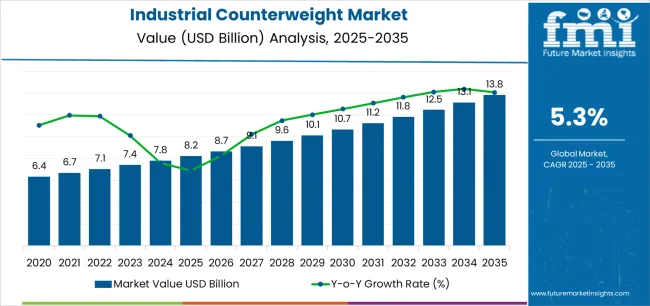
| Metric | Value |
|---|---|
| Industrial Counterweight Market Estimated Value in (2025 E) | USD 8.2 billion |
| Industrial Counterweight Market Forecast Value in (2035 F) | USD 13.8 billion |
| Forecast CAGR (2025 to 2035) | 5.3% |
Segmental Analysis
The market is segmented by Type, Material, Application, and End User and region. By Type, the market is divided into Fixed Counterweights and Swinging Counterweights. In terms of Material, the market is classified into Iron & Steel and Concrete. Based on Application, the market is segmented into Cranes, Elevators, Excavators, Forklifts, Grinding Wheels, and Lifts. By End User, the market is divided into Construction, Agriculture, Industrial Manufacturing, Logistics, Marine, Mining, and Renewables. Regionally, the market is classified into North America, Latin America, Western Europe, Eastern Europe, Balkan & Baltic Countries, Russia & Belarus, Central Asia, East Asia, South Asia & Pacific, and the Middle East & Africa.
Insights into the Type Segment
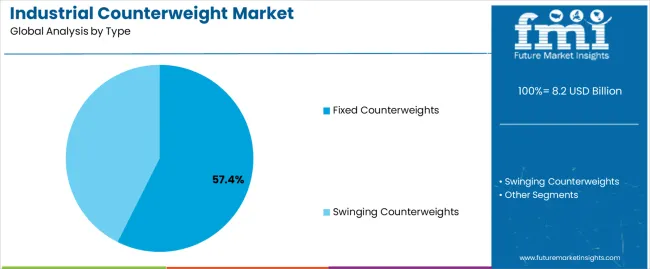
The fixed counterweights segment, holding 57.40% of the type category, has maintained its dominant position due to its structural simplicity, stability, and widespread use in stationary equipment. Its adoption has been supported by low maintenance requirements and proven reliability in maintaining machine equilibrium during high-load operations.
Fixed counterweights are extensively utilized in cranes, elevators, and construction machinery, where consistent balancing is essential for safety and performance. The segment’s growth is reinforced by its cost-effectiveness and ease of integration into various industrial applications.
Manufacturers are optimizing production through modular designs and advanced casting techniques, improving both strength and operational efficiency The reliability of fixed counterweights in heavy-duty applications continues to ensure their leading market share and strong preference across industries that prioritize stability and safety in mechanical operations.
Insights into the Material Segment
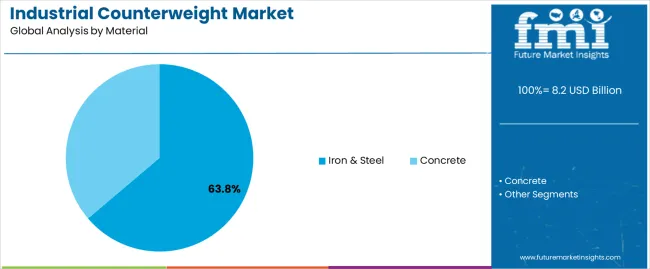
The iron and steel segment, accounting for 63.80% of the material category, leads the market owing to its superior strength, durability, and affordability. Its dominance is driven by consistent mechanical performance and adaptability to different manufacturing processes, including casting and forging. Iron and steel counterweights offer high density and corrosion resistance, making them suitable for demanding environments such as construction and mining.
The material’s availability and recyclability further enhance its cost efficiency and sustainability profile. Continuous improvements in metallurgical techniques are contributing to better weight-to-strength ratios and extended service life.
Manufacturers are also leveraging alloy advancements to reduce brittleness and enhance performance under stress conditions These factors collectively support the continued prominence of iron and steel materials in counterweight production and ensure their ongoing relevance in high-performance industrial applications.
Insights into the Application Segment
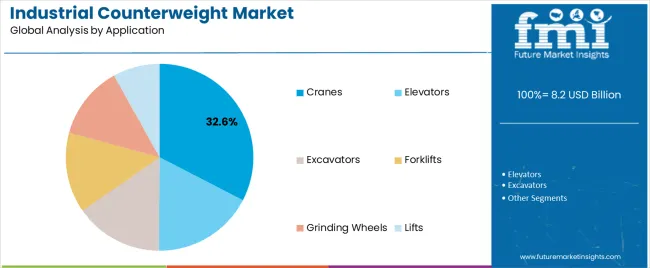
The cranes segment, representing 32.60% of the application category, remains the leading application area due to the critical role of counterweights in ensuring load stability and operational safety. Increasing deployment of mobile, tower, and overhead cranes in infrastructure and industrial projects has been a major growth driver.
Demand is further supported by expanding construction activity and the modernization of lifting equipment across global markets. Technological innovations such as smart load monitoring systems and adjustable counterweight mechanisms are improving performance efficiency and safety compliance.
Manufacturers are focusing on design standardization and modular installation to meet diverse lifting capacities and project requirements With continuous investments in heavy equipment and large-scale construction initiatives, the cranes segment is expected to retain its leadership, driving sustained demand for reliable and efficient industrial counterweight solutions.
Top Industrial Counterweight Market Dynamics and Industry Trends
- As industries demand customized counterweight solutions, they are increasing their demand.
- The construction, aerospace, and agriculture sectors seek bespoke solutions to address their particular needs.
- Sustainability practices, such as recycling and using eco-friendly materials, are gaining traction.
- A growing demand for sustainable solutions is causing counterweight manufacturers to explore ways to reduce their environmental impact.
- The production of counterweights is being explored using 3D printing or additive manufacturing. This technology can make Manufacturing processes more efficient and cost-effective, allowing for intricate designs and customization.
Comparison of Historical vs Future Outlook for the Industrial Counterweight Market (2020 to 2024 vs 2025 to 2035)
The industrial counterweights market was worth 6.8% CAGR from 2020 to 2025. Industrial equipment can now be monitored in real-time and data-driven decisions can be made based on Internet of Things (IoT) technologies.
With the help of smart sensors, weight counters can provide valuable information regarding usage, maintenance requirements, and performance enhancement. Investing in upgraded equipment and retrofitting older machines with modern counterweights can be profitable.
Industry after industry is looking for ways to make their existing assets perform and stay safe. Counterweight manufacturers can seamlessly integrate their solutions into new machinery by collaborating with original equipment manufacturers (OEMs). Increased market penetration can be achieved by establishing partnerships with OEMs. A 5.6% CAGR is forecast between 2025 and 2035.
| Historical CAGR from 2020 to 2025 | 7.3% |
|---|---|
| Forecast CAGR from 2025 to 2035 | 5.6% |
Key Drivers of Growth in the Industrial Counterweight Market
- A global expansion of construction projects requires heavy gear equipped with industrial counterweights to ensure safety and stability.
- The purpose of industrial counterweights is to maintain stability, balance heavy loads, and increase safety in various industries.
- Safety regulations must be followed when operating machinery when using industrial counterweights.
- The purpose of counterweights is to eliminate vibrations and balance loads to improve the performance of machines, minimize downtime, and maximize output.
- Due to material and design innovations, industrial counterweights customized for specific purposes are more efficient, durable, and compact.
- With technology advancements, complex and efficient machinery is becoming more sophisticated and efficient, resulting in the need for more specialized counterweight solutions, which drives innovation within the industry.
Key Challenges in the Industrial Counterweight Market
- The space for counterweight installations may be limited in some industrial environments. A confined space can pose challenges when it comes to designing effective counterweights.
- Counterweights work effectively if the weight distribution is correct. Complex machinery makes it difficult to distribute weight evenly and correctly.
- Vibrations and shocks may occur during the operation of machinery and structures. This type of force must be considered when designing counterweights, as well as preventing damage and instability from occurring.
- A counterweight installation can be complicated, especially in an existing structure or machinery. Keeping counterweights aligned, attached, and secure is vital for safety and efficiency.
- Maintaining and inspecting counterweights is like maintaining any other component. To ensure safe maintenance procedures, counterweight locations must be accessible.
Analysis of Top Countries Producing, Formulating, Packaging, Distributing, and Using Industrial Counterweights
In accordance with the table provided, South Korea generates the largest amount of revenue. Among the sectors that are expected to contribute to growth are the automotive, aerospace, and defense industries.
Counterweights help balance rotating components and improve efficiency in these sectors. Due to the expansion of these industries, industrial counterweights will also become more in demand
In the future, development projects in the field of infrastructure, including those related to transportation, energy, and renewable energy, will increase the demand for industrial counterweights. Developing countries will increase their investment in infrastructure, increasing the demand for counterweights in machinery and equipment for construction.
| Countries | Forecast CAGRs from 2025 to 2035 |
|---|---|
| The United States | 5.8% |
| China | 6.5% |
| Japan | 7.1% |
| South Korea | 7.2% |
| The United Kingdom | 6.7% |
Regulatory Reforms in the United States are Likely to Boost Industrial Counterweight Demand
Increasing oil and gas production in the United States drives the need for industrial counterweights. Industrial counterweights are needed in the United States to install and maintain renewable energy infrastructure with the expansion of renewable energy. Between 2025 and 2035, the United States is expected to expand at a CAGR of 5.8%.
Increasing construction industries and rising projects in the United States are expected to drive demand in the market. The United States government sets engineering standards and regulations to ensure the safe use of industrial equipment, including counterweights, including OSHA (Occupational Safety and Health Administration).
Construction Industry in China will Drive Demand for Industrial Counterweight Market
The industrial counterweight market in China is growing due to ongoing industrialization and infrastructure development. Growing water and wastewater treatment facilities also drive the demand for the industrial counterweights market. The growth rate between 2025 and 2035 is expected to be 6.5%.
As China's infrastructure projects progress, including the construction of buildings, bridges, and transit networks, industrial counterweights become essential to maintain stability and safety. With China's fast urbanization and skyscraper construction in major cities, industrial counterweights are needed in tall cranes and equipment for stabilizing and protecting vertical construction projects.
Industrialization in Japan will Drive Demand for Industrial Counterweights in the Market
A 7.1% CAGR is forecast for Japan from 2025 to 2035. Due to Japan's advanced manufacturing sector's reliance on large machinery and equipment, industrial counterweights are required for stability and precision. This includes the electronics, robotics, and automotive industries.
As a result of Japan's aging infrastructure, where significant renovations and maintenance are needed, industrial counterweights have increased in infrastructure projects. Several factors contribute to Japan's growth in the industrial counterweight market, including its focus on industrial manufacturing. Human labor is reduced, and efficiency is improved with counterweights in automotive applications
Advancement in Manufacturing Sectors in South Korea to Fuel Market
Due to technological advancements, industrial machinery using counterweights might become more efficient, effective, and safe due to performance, efficiency, and safety improvements. A market of USD 13.8 million is expected in 2035. According to the forecast, the market is expected to expand by 7.9% between 2025 and 2035.
During manufacturing operations, the shipbuilding and aerospace industries in South Korea use heavy machinery and equipment that rely on industrial counterweights for stability and balance. Heavy equipment and industrial counterweights are required to construct South Korea's nuclear power plants so that reactors and other vital parts can be installed safely.
Growth of Renewable Energy Sources in the United Kingdom to Drive the Market
The United Kingdom projects involving infrastructure upgrades, including transit improvements and renewable energy programs, require heavy machinery equipped with industrial counterweights. A CAGR of 6.7% is projected for the United Kingdom between 2025 and 2035.
Due to its involvement in international trade, the United Kingdom may encounter a demand for industrial machinery and equipment counterweights. Ports and harbors in the United Kingdom are expanding and developing, causing this demand.
Regulations regarding health and safety are crucial to the industrial sector. A counterweight contributes to the safety of industrial operations, especially in applications requiring balance and stability.
Industrial Counterweight Industry Analysis by Top Investment Segments
This section illustrates the market's leading segment. the fixed counterweight segment is projected to register a CAGR of 5.4% by 2035. The concrete segment is expected to expand at a CAGR of 5.1% by 2035. Construction equipment, cranes, elevators, and other industrial equipment requiring balance and stability usually feature fixed counterweights.
| Category | CAGR from 2025 to 2035 |
|---|---|
| Fixed Counterweight | 5.4% |
| Concrete | 5.1% |
Rising Safety Issues to Drive Demand for Fixed Counterweight in the Market
Fixed counterweights are essential features of many industries because they allow machinery and equipment to function safely and efficiently by counterbalancing the weight of moving parts and loads. Fixed counterweights are expected to increase at a CAGR of 5.4% by 2035.
For permanent counterweights to be safe and effective, they must be installed and maintained correctly. A fixed counterweight's design and implementation must consider weight distribution, fastening, and space availability. Providing stability and balancing loads are the primary purposes of fixed counterweights. The safety and efficiency of equipment is vital to various industrial processes.
Concrete is expected to hold a Significant Share in the Market
Construction projects involving buildings, roads, bridges, dams, and infrastructure rely extensively on concrete's strength, adaptability, and durability. The concrete market is expected to expand at a CAGR of 5.1% by 2035. Combined with its affordability and availability of raw materials, its versatility makes it an attractive option for structural and aesthetic applications.
Concrete technology is advancing in response to environmental concerns and contemporary construction methods. Concrete is becoming stronger, easier to work with, and more durable due to adding admixtures and additives. Resilient and sustainable, concrete is a great building material. All these factors are expected to drive demand for the industrial counterweight market.
Competitive Landscape of the Industrial Counterweight Market
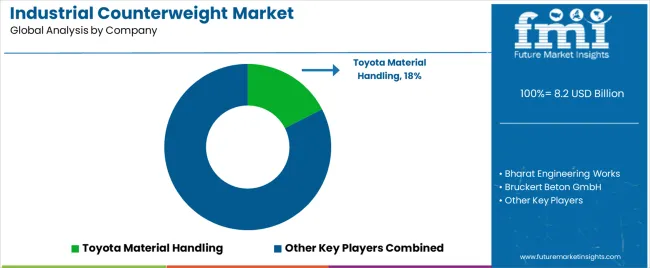
Industry, mining, and construction sectors need reliable counterweight machines, helping leaders in the global industrial counterweight market capitalize on this demand.
Other key players are conducting research and development activities to launch innovative products. Their global presence is also strengthened through mergers and acquisitions.
Key Market Developments
- In June 2025, Kalmar, part of Cargotec, launched its eco-efficient electric reach stacker with new sustainable options at TOC Europe in Rotterdam. The Kalmar electric reach stacker will be the world's most sustainable reach stacker with the new options available today. Additionally, Kalmar has introduced a new counterweight that reduces emissions from cast iron by using unprocessed natural heavy materials.
Key Coverage in the Industrial Counterweight Market Report
- Study on Industrial Counterweight, Performance Analysis of Industrial Counterweight Market
- Opportunity Analysis of the Industrial Counterweight
- Industrial Counterweight Market Scenario
- South Korea Industrial Counterweight in the Market
- Competitive Analysis of Top Industrial Counterweight and Support Companies
Scope and Coverage of the Industrial Counterweight Market Report
| Attributes | Details |
|---|---|
| Estimated Market Size in 2025 | USD 7.8 billion |
| Projected Market Valuation in 2035 | USD 13.5 billion |
| Value-based CAGR 2025 to 2035 | 5.6% |
| Forecast Period | 2025 to 2035 |
| Historical Data Available for | 2020 to 2025 |
| Market Analysis | Value in USD billion |
| Key Regions Covered | North America; Latin America; Western Europe; Eastern Europe; South Asia and Pacific; East Asia; The Middle East and Africa |
| Key Market Segments Covered | Type, Material, Application, End User, Region |
| Key Countries Profiled | The United States; Canada; Brazil; Mexico; Germany; The United Kingdom; France; Spain; Italy; Poland; Russia; Czech Republic; Romania; India; Bangladesh; Australia; New Zealand; China; Japan; South Korea; GCC countries; South Africa; Israel |
| Key Companies Profiled | Bharat Engineering Works; Bruckert Beton GmbH; Crescent Foundry Pvt Ltd.; EdgeTech Industries LLC; FARINIA S.A.; Frans Pateer B.V.; GALLIZO S.L.; LKAB Minerals Limited; Mars Metal Company; Shanxi Huaxiang Group Co.; Ultraray; So.me.fer. S.r.l.; Tenwinkel GmbH & Co.KG; Toyota Material Handling |
Top Segments Studied in the Industrial Counterweight Market
By Type:
- Fixed Counterweights
- Swinging Counterweights
By Material:
- Concrete
- Iron & Steel
By Application:
- Cranes
- Elevators
- Excavators
- Forklifts
- Grinding Wheels
- Lifts
By End User:
- Agriculture
- Construction
- Industrial Manufacturing
- Logistics
- Marine
- Mining
- Renewables
By Region:
- North America
- Latin America
- Western Europe
- Eastern Europe
- South Asia and Pacific
- East Asia
- The Middle East and Africa
Frequently Asked Questions
How big is the industrial counterweight market in 2025?
The global industrial counterweight market is estimated to be valued at USD 8.2 billion in 2025.
What will be the size of industrial counterweight market in 2035?
The market size for the industrial counterweight market is projected to reach USD 13.8 billion by 2035.
How much will be the industrial counterweight market growth between 2025 and 2035?
The industrial counterweight market is expected to grow at a 5.3% CAGR between 2025 and 2035.
What are the key product types in the industrial counterweight market?
The key product types in industrial counterweight market are fixed counterweights and swinging counterweights.
Which material segment to contribute significant share in the industrial counterweight market in 2025?
In terms of material, iron & steel segment to command 63.8% share in the industrial counterweight market in 2025.
Table of Content
- Executive Summary
- Global Market Outlook
- Demand-side Trends
- Supply-side Trends
- Technology Roadmap Analysis
- Analysis and Recommendations
- Market Overview
- Market Coverage / Taxonomy
- Market Definition / Scope / Limitations
- Market Background
- Market Dynamics
- Drivers
- Restraints
- Opportunity
- Trends
- Scenario Forecast
- Demand in Optimistic Scenario
- Demand in Likely Scenario
- Demand in Conservative Scenario
- Opportunity Map Analysis
- Product Life Cycle Analysis
- Supply Chain Analysis
- Investment Feasibility Matrix
- Value Chain Analysis
- PESTLE and Porter’s Analysis
- Regulatory Landscape
- Regional Parent Market Outlook
- Production and Consumption Statistics
- Import and Export Statistics
- Market Dynamics
- Global Industrial Counterweight Market Analysis 2020-2024 and Forecast, 2025-2035
- Historical Market Size Value (USD Mn) Analysis, 2020-2024
- Current and Future Market Size Value (USD Mn) Projections, 2025-2035
- Y-o-Y Growth Trend Analysis
- Absolute $ Opportunity Analysis
- Global Industrial Counterweight Market Pricing Analysis 2020-2024 and Forecast 2025-2035
- Global Industrial Counterweight Market Analysis 2020-2024 and Forecast 2025-2035, By Type
- Introduction / Key Findings
- Historical Market Size Value (USD Mn) Analysis By Type , 2020-2024
- Current and Future Market Size Value (USD Mn) Analysis and Forecast By Type , 2025-2035
- Fixed Counterweights
- Swinging Counterweights
- Y-o-Y Growth Trend Analysis By Type , 2020-2024
- Absolute $ Opportunity Analysis By Type , 2025-2035
- Global Industrial Counterweight Market Analysis 2020-2024 and Forecast 2025-2035, By Material
- Introduction / Key Findings
- Historical Market Size Value (USD Mn) Analysis By Material, 2020-2024
- Current and Future Market Size Value (USD Mn) Analysis and Forecast By Material, 2025-2035
- Iron & Steel
- Concrete
- Y-o-Y Growth Trend Analysis By Material, 2020-2024
- Absolute $ Opportunity Analysis By Material, 2025-2035
- Global Industrial Counterweight Market Analysis 2020-2024 and Forecast 2025-2035, By Application
- Introduction / Key Findings
- Historical Market Size Value (USD Mn) Analysis By Application, 2020-2024
- Current and Future Market Size Value (USD Mn) Analysis and Forecast By Application, 2025-2035
- Cranes
- Elevators
- Excavators
- Forklifts
- Grinding Wheels
- Lifts
- Y-o-Y Growth Trend Analysis By Application, 2020-2024
- Absolute $ Opportunity Analysis By Application, 2025-2035
- Global Industrial Counterweight Market Analysis 2020-2024 and Forecast 2025-2035, By End User
- Introduction / Key Findings
- Historical Market Size Value (USD Mn) Analysis By End User, 2020-2024
- Current and Future Market Size Value (USD Mn) Analysis and Forecast By End User, 2025-2035
- Construction
- Agriculture
- Industrial Manufacturing
- Logistics
- Marine
- Mining
- Renewables
- Y-o-Y Growth Trend Analysis By End User, 2020-2024
- Absolute $ Opportunity Analysis By End User, 2025-2035
- Global Industrial Counterweight Market Analysis 2020-2024 and Forecast 2025-2035, By Region
- Introduction
- Historical Market Size Value (USD Mn) Analysis By Region, 2020-2024
- Current Market Size Value (USD Mn) Analysis and Forecast By Region, 2025-2035
- North America
- Latin America
- Western Europe
- Eastern Europe
- East Asia
- South Asia and Pacific
- Middle East & Africa
- Market Attractiveness Analysis By Region
- North America Industrial Counterweight Market Analysis 2020-2024 and Forecast 2025-2035, By Country
- Historical Market Size Value (USD Mn) Trend Analysis By Market Taxonomy, 2020-2024
- Market Size Value (USD Mn) Forecast By Market Taxonomy, 2025-2035
- By Country
- USA
- Canada
- Mexico
- By Type
- By Material
- By Application
- By End User
- By Country
- Market Attractiveness Analysis
- By Country
- By Type
- By Material
- By Application
- By End User
- Key Takeaways
- Latin America Industrial Counterweight Market Analysis 2020-2024 and Forecast 2025-2035, By Country
- Historical Market Size Value (USD Mn) Trend Analysis By Market Taxonomy, 2020-2024
- Market Size Value (USD Mn) Forecast By Market Taxonomy, 2025-2035
- By Country
- Brazil
- Chile
- Rest of Latin America
- By Type
- By Material
- By Application
- By End User
- By Country
- Market Attractiveness Analysis
- By Country
- By Type
- By Material
- By Application
- By End User
- Key Takeaways
- Western Europe Industrial Counterweight Market Analysis 2020-2024 and Forecast 2025-2035, By Country
- Historical Market Size Value (USD Mn) Trend Analysis By Market Taxonomy, 2020-2024
- Market Size Value (USD Mn) Forecast By Market Taxonomy, 2025-2035
- By Country
- Germany
- UK
- Italy
- Spain
- France
- Nordic
- BENELUX
- Rest of Western Europe
- By Type
- By Material
- By Application
- By End User
- By Country
- Market Attractiveness Analysis
- By Country
- By Type
- By Material
- By Application
- By End User
- Key Takeaways
- Eastern Europe Industrial Counterweight Market Analysis 2020-2024 and Forecast 2025-2035, By Country
- Historical Market Size Value (USD Mn) Trend Analysis By Market Taxonomy, 2020-2024
- Market Size Value (USD Mn) Forecast By Market Taxonomy, 2025-2035
- By Country
- Russia
- Poland
- Hungary
- Balkan & Baltic
- Rest of Eastern Europe
- By Type
- By Material
- By Application
- By End User
- By Country
- Market Attractiveness Analysis
- By Country
- By Type
- By Material
- By Application
- By End User
- Key Takeaways
- East Asia Industrial Counterweight Market Analysis 2020-2024 and Forecast 2025-2035, By Country
- Historical Market Size Value (USD Mn) Trend Analysis By Market Taxonomy, 2020-2024
- Market Size Value (USD Mn) Forecast By Market Taxonomy, 2025-2035
- By Country
- China
- Japan
- South Korea
- By Type
- By Material
- By Application
- By End User
- By Country
- Market Attractiveness Analysis
- By Country
- By Type
- By Material
- By Application
- By End User
- Key Takeaways
- South Asia and Pacific Industrial Counterweight Market Analysis 2020-2024 and Forecast 2025-2035, By Country
- Historical Market Size Value (USD Mn) Trend Analysis By Market Taxonomy, 2020-2024
- Market Size Value (USD Mn) Forecast By Market Taxonomy, 2025-2035
- By Country
- India
- ASEAN
- Australia & New Zealand
- Rest of South Asia and Pacific
- By Type
- By Material
- By Application
- By End User
- By Country
- Market Attractiveness Analysis
- By Country
- By Type
- By Material
- By Application
- By End User
- Key Takeaways
- Middle East & Africa Industrial Counterweight Market Analysis 2020-2024 and Forecast 2025-2035, By Country
- Historical Market Size Value (USD Mn) Trend Analysis By Market Taxonomy, 2020-2024
- Market Size Value (USD Mn) Forecast By Market Taxonomy, 2025-2035
- By Country
- Kingdom of Saudi Arabia
- Other GCC Countries
- Turkiye
- South Africa
- Other African Union
- Rest of Middle East & Africa
- By Type
- By Material
- By Application
- By End User
- By Country
- Market Attractiveness Analysis
- By Country
- By Type
- By Material
- By Application
- By End User
- Key Takeaways
- Key Countries Industrial Counterweight Market Analysis
- USA
- Pricing Analysis
- Market Share Analysis, 2024
- By Type
- By Material
- By Application
- By End User
- Canada
- Pricing Analysis
- Market Share Analysis, 2024
- By Type
- By Material
- By Application
- By End User
- Mexico
- Pricing Analysis
- Market Share Analysis, 2024
- By Type
- By Material
- By Application
- By End User
- Brazil
- Pricing Analysis
- Market Share Analysis, 2024
- By Type
- By Material
- By Application
- By End User
- Chile
- Pricing Analysis
- Market Share Analysis, 2024
- By Type
- By Material
- By Application
- By End User
- Germany
- Pricing Analysis
- Market Share Analysis, 2024
- By Type
- By Material
- By Application
- By End User
- UK
- Pricing Analysis
- Market Share Analysis, 2024
- By Type
- By Material
- By Application
- By End User
- Italy
- Pricing Analysis
- Market Share Analysis, 2024
- By Type
- By Material
- By Application
- By End User
- Spain
- Pricing Analysis
- Market Share Analysis, 2024
- By Type
- By Material
- By Application
- By End User
- France
- Pricing Analysis
- Market Share Analysis, 2024
- By Type
- By Material
- By Application
- By End User
- India
- Pricing Analysis
- Market Share Analysis, 2024
- By Type
- By Material
- By Application
- By End User
- ASEAN
- Pricing Analysis
- Market Share Analysis, 2024
- By Type
- By Material
- By Application
- By End User
- Australia & New Zealand
- Pricing Analysis
- Market Share Analysis, 2024
- By Type
- By Material
- By Application
- By End User
- China
- Pricing Analysis
- Market Share Analysis, 2024
- By Type
- By Material
- By Application
- By End User
- Japan
- Pricing Analysis
- Market Share Analysis, 2024
- By Type
- By Material
- By Application
- By End User
- South Korea
- Pricing Analysis
- Market Share Analysis, 2024
- By Type
- By Material
- By Application
- By End User
- Russia
- Pricing Analysis
- Market Share Analysis, 2024
- By Type
- By Material
- By Application
- By End User
- Poland
- Pricing Analysis
- Market Share Analysis, 2024
- By Type
- By Material
- By Application
- By End User
- Hungary
- Pricing Analysis
- Market Share Analysis, 2024
- By Type
- By Material
- By Application
- By End User
- Kingdom of Saudi Arabia
- Pricing Analysis
- Market Share Analysis, 2024
- By Type
- By Material
- By Application
- By End User
- Turkiye
- Pricing Analysis
- Market Share Analysis, 2024
- By Type
- By Material
- By Application
- By End User
- South Africa
- Pricing Analysis
- Market Share Analysis, 2024
- By Type
- By Material
- By Application
- By End User
- USA
- Market Structure Analysis
- Competition Dashboard
- Competition Benchmarking
- Market Share Analysis of Top Players
- By Regional
- By Type
- By Material
- By Application
- By End User
- Competition Analysis
- Competition Deep Dive
- Toyota Material Handling
- Overview
- Product Portfolio
- Profitability by Market Segments (Product/Age /Sales Channel/Region)
- Sales Footprint
- Strategy Overview
- Marketing Strategy
- Product Strategy
- Channel Strategy
- Bharat Engineering Works
- Bruckert Beton GmbH
- Crescent Foundry Pvt Ltd.
- EdgeTech Industries LLC
- FARINIA S.A.
- Frans Pateer B.V.
- GALLIZO S.L.
- LKAB Minerals Limited
- Mars Metal Company
- Shanxi Huaxiang Group Co.
- Ultraray
- So.me.fer. S.r.l.
- Tenwinkel GmbH & Co.KG
- Toyota Material Handling
- Competition Deep Dive
- Assumptions & Acronyms Used
- Research Methodology
List of Tables
- Table 1: Global Industrial Counterweight Market Value (USD Mn) Forecast by Region, 2020-2035
- Table 2: Global Industrial Counterweight Market Value (USD Mn) Forecast by Type , 2020-2035
- Table 3: Global Industrial Counterweight Market Value (USD Mn) Forecast by Material, 2020-2035
- Table 4: Global Industrial Counterweight Market Value (USD Mn) Forecast by Application, 2020-2035
- Table 5: Global Industrial Counterweight Market Value (USD Mn) Forecast by End User, 2020-2035
- Table 6: North America Industrial Counterweight Market Value (USD Mn) Forecast by Country, 2020-2035
- Table 7: North America Industrial Counterweight Market Value (USD Mn) Forecast by Type , 2020-2035
- Table 8: North America Industrial Counterweight Market Value (USD Mn) Forecast by Material, 2020-2035
- Table 9: North America Industrial Counterweight Market Value (USD Mn) Forecast by Application, 2020-2035
- Table 10: North America Industrial Counterweight Market Value (USD Mn) Forecast by End User, 2020-2035
- Table 11: Latin America Industrial Counterweight Market Value (USD Mn) Forecast by Country, 2020-2035
- Table 12: Latin America Industrial Counterweight Market Value (USD Mn) Forecast by Type , 2020-2035
- Table 13: Latin America Industrial Counterweight Market Value (USD Mn) Forecast by Material, 2020-2035
- Table 14: Latin America Industrial Counterweight Market Value (USD Mn) Forecast by Application, 2020-2035
- Table 15: Latin America Industrial Counterweight Market Value (USD Mn) Forecast by End User, 2020-2035
- Table 16: Western Europe Industrial Counterweight Market Value (USD Mn) Forecast by Country, 2020-2035
- Table 17: Western Europe Industrial Counterweight Market Value (USD Mn) Forecast by Type , 2020-2035
- Table 18: Western Europe Industrial Counterweight Market Value (USD Mn) Forecast by Material, 2020-2035
- Table 19: Western Europe Industrial Counterweight Market Value (USD Mn) Forecast by Application, 2020-2035
- Table 20: Western Europe Industrial Counterweight Market Value (USD Mn) Forecast by End User, 2020-2035
- Table 21: Eastern Europe Industrial Counterweight Market Value (USD Mn) Forecast by Country, 2020-2035
- Table 22: Eastern Europe Industrial Counterweight Market Value (USD Mn) Forecast by Type , 2020-2035
- Table 23: Eastern Europe Industrial Counterweight Market Value (USD Mn) Forecast by Material, 2020-2035
- Table 24: Eastern Europe Industrial Counterweight Market Value (USD Mn) Forecast by Application, 2020-2035
- Table 25: Eastern Europe Industrial Counterweight Market Value (USD Mn) Forecast by End User, 2020-2035
- Table 26: East Asia Industrial Counterweight Market Value (USD Mn) Forecast by Country, 2020-2035
- Table 27: East Asia Industrial Counterweight Market Value (USD Mn) Forecast by Type , 2020-2035
- Table 28: East Asia Industrial Counterweight Market Value (USD Mn) Forecast by Material, 2020-2035
- Table 29: East Asia Industrial Counterweight Market Value (USD Mn) Forecast by Application, 2020-2035
- Table 30: East Asia Industrial Counterweight Market Value (USD Mn) Forecast by End User, 2020-2035
- Table 31: South Asia and Pacific Industrial Counterweight Market Value (USD Mn) Forecast by Country, 2020-2035
- Table 32: South Asia and Pacific Industrial Counterweight Market Value (USD Mn) Forecast by Type , 2020-2035
- Table 33: South Asia and Pacific Industrial Counterweight Market Value (USD Mn) Forecast by Material, 2020-2035
- Table 34: South Asia and Pacific Industrial Counterweight Market Value (USD Mn) Forecast by Application, 2020-2035
- Table 35: South Asia and Pacific Industrial Counterweight Market Value (USD Mn) Forecast by End User, 2020-2035
- Table 36: Middle East & Africa Industrial Counterweight Market Value (USD Mn) Forecast by Country, 2020-2035
- Table 37: Middle East & Africa Industrial Counterweight Market Value (USD Mn) Forecast by Type , 2020-2035
- Table 38: Middle East & Africa Industrial Counterweight Market Value (USD Mn) Forecast by Material, 2020-2035
- Table 39: Middle East & Africa Industrial Counterweight Market Value (USD Mn) Forecast by Application, 2020-2035
- Table 40: Middle East & Africa Industrial Counterweight Market Value (USD Mn) Forecast by End User, 2020-2035
List of Figures
- Figure 1: Global Industrial Counterweight Market Pricing Analysis
- Figure 2: Global Industrial Counterweight Market Value (USD Mn) Forecast 2020–2035
- Figure 3: Global Industrial Counterweight Market Value Share and BPS Analysis by Type , 2025 and 2035
- Figure 4: Global Industrial Counterweight Market Y-o-Y Growth Comparison by Type , 2025–2035
- Figure 5: Global Industrial Counterweight Market Attractiveness Analysis by Type
- Figure 6: Global Industrial Counterweight Market Value Share and BPS Analysis by Material, 2025 and 2035
- Figure 7: Global Industrial Counterweight Market Y-o-Y Growth Comparison by Material, 2025–2035
- Figure 8: Global Industrial Counterweight Market Attractiveness Analysis by Material
- Figure 9: Global Industrial Counterweight Market Value Share and BPS Analysis by Application, 2025 and 2035
- Figure 10: Global Industrial Counterweight Market Y-o-Y Growth Comparison by Application, 2025–2035
- Figure 11: Global Industrial Counterweight Market Attractiveness Analysis by Application
- Figure 12: Global Industrial Counterweight Market Value Share and BPS Analysis by End User, 2025 and 2035
- Figure 13: Global Industrial Counterweight Market Y-o-Y Growth Comparison by End User, 2025–2035
- Figure 14: Global Industrial Counterweight Market Attractiveness Analysis by End User
- Figure 15: Global Industrial Counterweight Market Value (USD Mn) Share and BPS Analysis by Region, 2025 and 2035
- Figure 16: Global Industrial Counterweight Market Y-o-Y Growth Comparison by Region, 2025–2035
- Figure 17: Global Industrial Counterweight Market Attractiveness Analysis by Region
- Figure 18: North America Industrial Counterweight Market Incremental Dollar Opportunity, 2025–2035
- Figure 19: Latin America Industrial Counterweight Market Incremental Dollar Opportunity, 2025–2035
- Figure 20: Western Europe Industrial Counterweight Market Incremental Dollar Opportunity, 2025–2035
- Figure 21: Eastern Europe Industrial Counterweight Market Incremental Dollar Opportunity, 2025–2035
- Figure 22: East Asia Industrial Counterweight Market Incremental Dollar Opportunity, 2025–2035
- Figure 23: South Asia and Pacific Industrial Counterweight Market Incremental Dollar Opportunity, 2025–2035
- Figure 24: Middle East & Africa Industrial Counterweight Market Incremental Dollar Opportunity, 2025–2035
- Figure 25: North America Industrial Counterweight Market Value Share and BPS Analysis by Country, 2025 and 2035
- Figure 26: North America Industrial Counterweight Market Value Share and BPS Analysis by Type , 2025 and 2035
- Figure 27: North America Industrial Counterweight Market Y-o-Y Growth Comparison by Type , 2025–2035
- Figure 28: North America Industrial Counterweight Market Attractiveness Analysis by Type
- Figure 29: North America Industrial Counterweight Market Value Share and BPS Analysis by Material, 2025 and 2035
- Figure 30: North America Industrial Counterweight Market Y-o-Y Growth Comparison by Material, 2025–2035
- Figure 31: North America Industrial Counterweight Market Attractiveness Analysis by Material
- Figure 32: North America Industrial Counterweight Market Value Share and BPS Analysis by Application, 2025 and 2035
- Figure 33: North America Industrial Counterweight Market Y-o-Y Growth Comparison by Application, 2025–2035
- Figure 34: North America Industrial Counterweight Market Attractiveness Analysis by Application
- Figure 35: North America Industrial Counterweight Market Value Share and BPS Analysis by End User, 2025 and 2035
- Figure 36: North America Industrial Counterweight Market Y-o-Y Growth Comparison by End User, 2025–2035
- Figure 37: North America Industrial Counterweight Market Attractiveness Analysis by End User
- Figure 38: Latin America Industrial Counterweight Market Value Share and BPS Analysis by Country, 2025 and 2035
- Figure 39: Latin America Industrial Counterweight Market Value Share and BPS Analysis by Type , 2025 and 2035
- Figure 40: Latin America Industrial Counterweight Market Y-o-Y Growth Comparison by Type , 2025–2035
- Figure 41: Latin America Industrial Counterweight Market Attractiveness Analysis by Type
- Figure 42: Latin America Industrial Counterweight Market Value Share and BPS Analysis by Material, 2025 and 2035
- Figure 43: Latin America Industrial Counterweight Market Y-o-Y Growth Comparison by Material, 2025–2035
- Figure 44: Latin America Industrial Counterweight Market Attractiveness Analysis by Material
- Figure 45: Latin America Industrial Counterweight Market Value Share and BPS Analysis by Application, 2025 and 2035
- Figure 46: Latin America Industrial Counterweight Market Y-o-Y Growth Comparison by Application, 2025–2035
- Figure 47: Latin America Industrial Counterweight Market Attractiveness Analysis by Application
- Figure 48: Latin America Industrial Counterweight Market Value Share and BPS Analysis by End User, 2025 and 2035
- Figure 49: Latin America Industrial Counterweight Market Y-o-Y Growth Comparison by End User, 2025–2035
- Figure 50: Latin America Industrial Counterweight Market Attractiveness Analysis by End User
- Figure 51: Western Europe Industrial Counterweight Market Value Share and BPS Analysis by Country, 2025 and 2035
- Figure 52: Western Europe Industrial Counterweight Market Value Share and BPS Analysis by Type , 2025 and 2035
- Figure 53: Western Europe Industrial Counterweight Market Y-o-Y Growth Comparison by Type , 2025–2035
- Figure 54: Western Europe Industrial Counterweight Market Attractiveness Analysis by Type
- Figure 55: Western Europe Industrial Counterweight Market Value Share and BPS Analysis by Material, 2025 and 2035
- Figure 56: Western Europe Industrial Counterweight Market Y-o-Y Growth Comparison by Material, 2025–2035
- Figure 57: Western Europe Industrial Counterweight Market Attractiveness Analysis by Material
- Figure 58: Western Europe Industrial Counterweight Market Value Share and BPS Analysis by Application, 2025 and 2035
- Figure 59: Western Europe Industrial Counterweight Market Y-o-Y Growth Comparison by Application, 2025–2035
- Figure 60: Western Europe Industrial Counterweight Market Attractiveness Analysis by Application
- Figure 61: Western Europe Industrial Counterweight Market Value Share and BPS Analysis by End User, 2025 and 2035
- Figure 62: Western Europe Industrial Counterweight Market Y-o-Y Growth Comparison by End User, 2025–2035
- Figure 63: Western Europe Industrial Counterweight Market Attractiveness Analysis by End User
- Figure 64: Eastern Europe Industrial Counterweight Market Value Share and BPS Analysis by Country, 2025 and 2035
- Figure 65: Eastern Europe Industrial Counterweight Market Value Share and BPS Analysis by Type , 2025 and 2035
- Figure 66: Eastern Europe Industrial Counterweight Market Y-o-Y Growth Comparison by Type , 2025–2035
- Figure 67: Eastern Europe Industrial Counterweight Market Attractiveness Analysis by Type
- Figure 68: Eastern Europe Industrial Counterweight Market Value Share and BPS Analysis by Material, 2025 and 2035
- Figure 69: Eastern Europe Industrial Counterweight Market Y-o-Y Growth Comparison by Material, 2025–2035
- Figure 70: Eastern Europe Industrial Counterweight Market Attractiveness Analysis by Material
- Figure 71: Eastern Europe Industrial Counterweight Market Value Share and BPS Analysis by Application, 2025 and 2035
- Figure 72: Eastern Europe Industrial Counterweight Market Y-o-Y Growth Comparison by Application, 2025–2035
- Figure 73: Eastern Europe Industrial Counterweight Market Attractiveness Analysis by Application
- Figure 74: Eastern Europe Industrial Counterweight Market Value Share and BPS Analysis by End User, 2025 and 2035
- Figure 75: Eastern Europe Industrial Counterweight Market Y-o-Y Growth Comparison by End User, 2025–2035
- Figure 76: Eastern Europe Industrial Counterweight Market Attractiveness Analysis by End User
- Figure 77: East Asia Industrial Counterweight Market Value Share and BPS Analysis by Country, 2025 and 2035
- Figure 78: East Asia Industrial Counterweight Market Value Share and BPS Analysis by Type , 2025 and 2035
- Figure 79: East Asia Industrial Counterweight Market Y-o-Y Growth Comparison by Type , 2025–2035
- Figure 80: East Asia Industrial Counterweight Market Attractiveness Analysis by Type
- Figure 81: East Asia Industrial Counterweight Market Value Share and BPS Analysis by Material, 2025 and 2035
- Figure 82: East Asia Industrial Counterweight Market Y-o-Y Growth Comparison by Material, 2025–2035
- Figure 83: East Asia Industrial Counterweight Market Attractiveness Analysis by Material
- Figure 84: East Asia Industrial Counterweight Market Value Share and BPS Analysis by Application, 2025 and 2035
- Figure 85: East Asia Industrial Counterweight Market Y-o-Y Growth Comparison by Application, 2025–2035
- Figure 86: East Asia Industrial Counterweight Market Attractiveness Analysis by Application
- Figure 87: East Asia Industrial Counterweight Market Value Share and BPS Analysis by End User, 2025 and 2035
- Figure 88: East Asia Industrial Counterweight Market Y-o-Y Growth Comparison by End User, 2025–2035
- Figure 89: East Asia Industrial Counterweight Market Attractiveness Analysis by End User
- Figure 90: South Asia and Pacific Industrial Counterweight Market Value Share and BPS Analysis by Country, 2025 and 2035
- Figure 91: South Asia and Pacific Industrial Counterweight Market Value Share and BPS Analysis by Type , 2025 and 2035
- Figure 92: South Asia and Pacific Industrial Counterweight Market Y-o-Y Growth Comparison by Type , 2025–2035
- Figure 93: South Asia and Pacific Industrial Counterweight Market Attractiveness Analysis by Type
- Figure 94: South Asia and Pacific Industrial Counterweight Market Value Share and BPS Analysis by Material, 2025 and 2035
- Figure 95: South Asia and Pacific Industrial Counterweight Market Y-o-Y Growth Comparison by Material, 2025–2035
- Figure 96: South Asia and Pacific Industrial Counterweight Market Attractiveness Analysis by Material
- Figure 97: South Asia and Pacific Industrial Counterweight Market Value Share and BPS Analysis by Application, 2025 and 2035
- Figure 98: South Asia and Pacific Industrial Counterweight Market Y-o-Y Growth Comparison by Application, 2025–2035
- Figure 99: South Asia and Pacific Industrial Counterweight Market Attractiveness Analysis by Application
- Figure 100: South Asia and Pacific Industrial Counterweight Market Value Share and BPS Analysis by End User, 2025 and 2035
- Figure 101: South Asia and Pacific Industrial Counterweight Market Y-o-Y Growth Comparison by End User, 2025–2035
- Figure 102: South Asia and Pacific Industrial Counterweight Market Attractiveness Analysis by End User
- Figure 103: Middle East & Africa Industrial Counterweight Market Value Share and BPS Analysis by Country, 2025 and 2035
- Figure 104: Middle East & Africa Industrial Counterweight Market Value Share and BPS Analysis by Type , 2025 and 2035
- Figure 105: Middle East & Africa Industrial Counterweight Market Y-o-Y Growth Comparison by Type , 2025–2035
- Figure 106: Middle East & Africa Industrial Counterweight Market Attractiveness Analysis by Type
- Figure 107: Middle East & Africa Industrial Counterweight Market Value Share and BPS Analysis by Material, 2025 and 2035
- Figure 108: Middle East & Africa Industrial Counterweight Market Y-o-Y Growth Comparison by Material, 2025–2035
- Figure 109: Middle East & Africa Industrial Counterweight Market Attractiveness Analysis by Material
- Figure 110: Middle East & Africa Industrial Counterweight Market Value Share and BPS Analysis by Application, 2025 and 2035
- Figure 111: Middle East & Africa Industrial Counterweight Market Y-o-Y Growth Comparison by Application, 2025–2035
- Figure 112: Middle East & Africa Industrial Counterweight Market Attractiveness Analysis by Application
- Figure 113: Middle East & Africa Industrial Counterweight Market Value Share and BPS Analysis by End User, 2025 and 2035
- Figure 114: Middle East & Africa Industrial Counterweight Market Y-o-Y Growth Comparison by End User, 2025–2035
- Figure 115: Middle East & Africa Industrial Counterweight Market Attractiveness Analysis by End User
- Figure 116: Global Industrial Counterweight Market – Tier Structure Analysis
- Figure 117: Global Industrial Counterweight Market – Company Share Analysis


