

- Industry Size (2026)
- USD 10.28 Bn
- Forecast (2036)
- USD 15.52 Bn
- CAGR (2026 to 2036)
- 4.2%
Demand for Dietary Supplements in EU Size, Market Forecast and Outlook By FMI
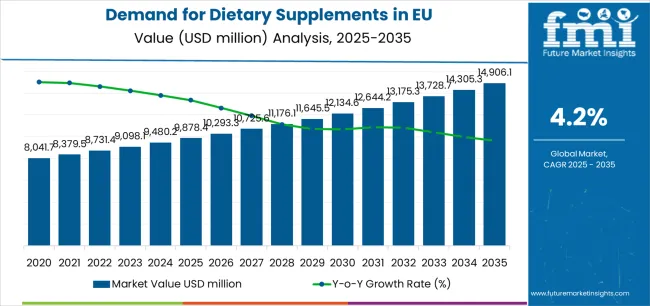
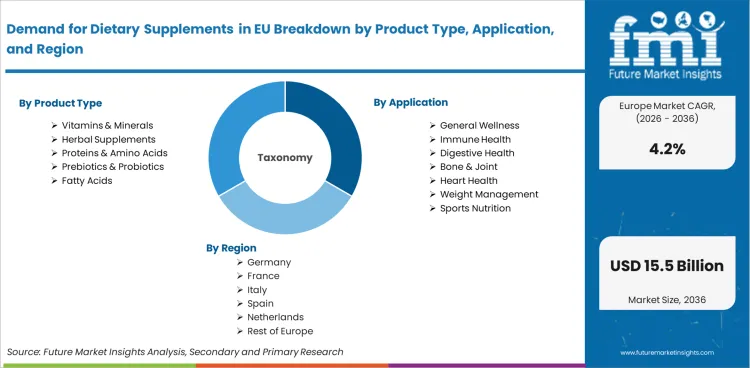
The Demand for Dietary Supplements in EU was valued at USD 9.87 billion in 2025, projected to reach USD 10.28 billion in 2026, and is forecast to expand to USD 15.52 billion by 2036 at a 4.2% CAGR. Consumer health awareness across the EU, reinforced by post-pandemic wellness spending patterns, is sustaining demand for dietary supplement products across pharmacy, retail, and online channels. Regulatory harmonization under the EU Food Supplements Directive 2002/46/EC provides a stable market entry framework, while national-level notification requirements create compliance differentiation between markets.
Summary of Demand for Dietary Supplements in EU
- Market Snapshot
- The market is valued at USD 9.87 billion in 2025 and is projected to reach USD 15.52 billion by 2036.
- The industry is expected to grow at a 4.2% CAGR from 2026 to 2036, creating an incremental opportunity of USD 5.23 billion.
- The market is a regulation-intensive, brand-trust-driven category where EFSA-authorized health claims, distribution reach, and formulation innovation define competitive positioning.
- Demand and Growth Drivers
- Consumer wellness spending sustained by post-pandemic health awareness is the primary demand driver across EU supplement categories.
- Aging population demographics in Germany, Italy, and France are expanding the addressable market for bone health, joint support, and cognitive function supplements.
- Online and direct-to-consumer distribution channels are creating new volume pathways outside traditional pharmacy-dominated supply chains.
- Among key countries, Netherlands is at 4.3% CAGR, Germany is at 4.2% CAGR, France is at 4.1% CAGR, Italy is at 4% CAGR, Spain is at 3.9% CAGR.
- Product and Segment View
- The market covers vitamins, minerals, herbal extracts, amino acids, probiotics, omega fatty acids, and specialty nutrient formulations in tablet, capsule, powder, and liquid formats.
- Applications span general wellness, bone and joint health, digestive health, cognitive support, sports nutrition, and immune function.
- Vitamins & Minerals leads the Product Type segment with 33% share in 2026.
- General Wellness leads the Application segment with 35% share in 2026.
- Pharmacies/Drug Stores leads the Distribution Channel segment with 40% share in 2026.
- Conventional leads the Nature segment with 82% share in 2026.
- Geography and Competitive Outlook
- Netherlands leads growth at 4.3% CAGR, while Spain tracks at 3.9% reflecting a more mature demand base.
- The Netherlands and Germany lead in per-capita supplement expenditure, while Southern European markets show higher growth rates from a lower base.
- Competition is shaped by Amway Corporation, Bayer AG, Abbott, Glanbia plc, Nestlé Health Science, Herbalife Nutrition Ltd., GNC Holdings, Inc..
Demand for Dietary Supplements in EU Key Takeaways
| Metric | Details |
|---|---|
| Industry Size (2026) | USD 10.28 billion |
| Industry Value (2036) | USD 15.52 billion |
| CAGR (2026 to 2036) | 4.2% |
Source: Future Market Insights, 2026
The EU Demand for Dietary Supplements in EU is governed by Directive 2002/46/EC, which establishes permitted vitamin and mineral sources and maximum intake levels. Health claims regulation under Regulation (EC) No 1924/2006 restricts marketing language, requiring EFSA-authorized health claims for all consumer-facing communications. FMI analysts observe that the structural shift from pharmacy-exclusive distribution toward omnichannel retail and direct-to-consumer e-commerce is the primary channel dynamic reshaping competitive positioning in this market. Organic and plant-based supplement formulations are gaining shelf space as consumer preference shifts toward clean-label and sustainability-certified products.
All major markets reflect differentiated growth trajectories through 2036. Netherlands is projected at a 4.3% CAGR, Germany is projected at a 4.2% CAGR, France is projected at a 4.1% CAGR, Italy is projected at a 4% CAGR, Spain is projected at a 3.9% CAGR. The Netherlands leads at 4.3% CAGR, supported by a mature health-conscious consumer base and high online supplement purchasing rates. Spain grows at a 3.9% pace, reflecting expanding pharmacy distribution and rising awareness of preventive health supplementation.
Demand for Dietary Supplements in EU Definition
The Demand for Dietary Supplements in EU encompasses concentrated sources of vitamins, minerals, herbal extracts, amino acids, probiotics, and specialty nutrients in dosage forms including tablets, capsules, powders, and liquids. These products are marketed for general wellness, targeted health support, and nutritional gap supplementation across pharmacy, retail, and online distribution channels in the EU.
Demand for Dietary Supplements in EU Inclusions
Market scope includes vitamins and minerals, herbal supplements, amino acids, probiotics, omega fatty acids, and specialty formulations distributed through pharmacies, hypermarkets, specialty stores, and online retail. Coverage extends to conventional and organic product lines with EU-level and country-level sizing for 2026 to 2036.
Demand for Dietary Supplements in EU Exclusions
The scope excludes pharmaceutical-grade prescription supplements, medical nutrition products requiring clinical supervision, and fortified food/beverage products where the supplement is not the primary product category.
Demand for Dietary Supplements in EU Research Methodology
- Primary Research: Analysts engaged with procurement directors, production managers, and supply chain leads across relevant manufacturing and distribution companies to map purchasing specifications and volume trends.
- Desk Research: Data collection aggregated regulatory filings, trade association publications, statistical agency databases, and company annual reports to establish baseline market parameters.
- Market-Sizing and Forecasting: Baseline values derive from a bottom-up aggregation of production volumes and trade flow data, applying country-specific consumption curves to project adoption velocity through 2036.
- Data Validation and Update Cycle: Projections are tested against publicly reported industry data and verified through cross-referencing with official statistical databases. Models are updated on a quarterly cycle.
Why is the Demand for Dietary Supplements in the EU Growing?
Industry expansion is being supported by the rapid demographic aging across European countries and the corresponding demand for age-related health management solutions with proven efficacy in maintaining wellness and preventing chronic conditions. Modern consumers rely on dietary supplements as essential components of daily health routines for immune system fortification, bone health maintenance, cardiovascular support, and cognitive function preservation, driving demand for products that deliver scientifically validated benefits, including targeted nutrient delivery, optimal absorption rates, and comprehensive health support. Even minor wellness considerations, such as seasonal immunity concerns, energy level management, or dietary nutrient gaps, can drive comprehensive adoption of dietary supplements to maintain optimal health and support quality of life.
The growing awareness of preventive healthcare and increasing recognition of dietary supplements' role in wellness management are driving demand for supplement products from certified manufacturers with appropriate quality credentials and transparent sourcing practices. Regulatory authorities are increasingly establishing stringent guidelines for dietary supplement manufacturing, labeling accuracy, and safety requirements to maintain consumer protection and ensure product quality. Scientific research studies and clinical trials are providing robust evidence supporting dietary supplements' health benefits and functional advantages, requiring specialized manufacturing processes and standardized quality protocols for ingredient purity verification, optimal potency maintenance, and appropriate safety profiles, including third-party testing and quality certifications.
Segmental Analysis
Sales are segmented by product type (ingredients), application, distribution channel, nature, and country. By product type, demand is divided into vitamins & minerals, herbal supplements, proteins & amino acids, prebiotics & probiotics, and fatty acids. Based on application, sales are categorized into general wellness, immune health, digestive health, bone & joint, heart health, weight management, and sports nutrition. In terms of distribution channel, demand is segmented into pharmacies/drug stores, online (e-commerce/D2C), supermarkets/hypermarkets, specialty stores, and others. By nature, sales are classified into conventional and organic. Regionally, demand is focused on Germany, France, Italy, Spain, the Netherlands, and the Rest of Europe.
By Product Type, Vitamins & Minerals Segment Accounts for 33% Share
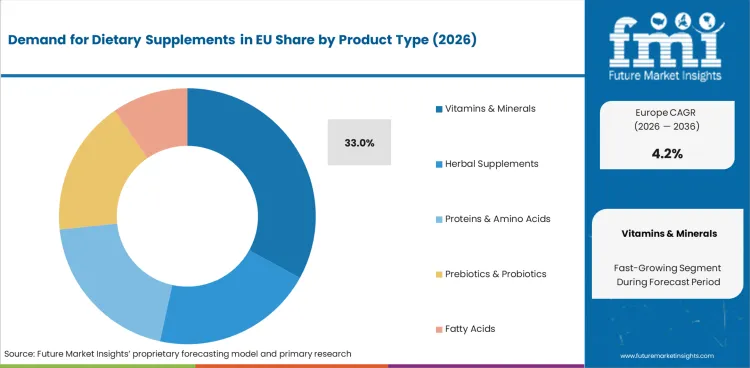
The vitamins & minerals segment is projected to account for 33% of EU dietary supplement sales in 2026, declining slightly to 31% by 2036, establishing itself as the foundational category across European consumers seeking essential nutrient supplementation. This commanding position is fundamentally supported by vitamins & minerals' universal health importance, comprehensive scientific validation supporting deficiency prevention, and broad demographic appeal spanning all age groups from children to elderly populations. The vitamins & minerals format delivers exceptional mainstream accessibility, providing retailers with a product category that facilitates household penetration, supports preventive health positioning, and maintains consumer trust essential for category credibility.
This segment benefits from extensive clinical research, well-established pharmaceutical-grade manufacturing, and comprehensive variety from multiple brands who maintain rigorous quality standards and continuous formulation innovation. Vitamins & minerals supplements offer versatility across various health objectives, including immune system support, bone health maintenance, energy metabolism, and cognitive function, supported by decades of nutritional science validating essential nutrient roles in human physiology.
The vitamins & minerals segment is expected to maintain strong positioning at 31% share through 2036, demonstrating stable demand as specialized segments like herbal supplements and prebiotics/probiotics gain modest share through targeted health positioning throughout the forecast period.
Key advantages:
- Universal health relevance supporting broad demographic appeal and consistent demand
- Scientific validation providing consumer confidence and healthcare professional endorsement
- Established safety profiles enabling mainstream adoption without specialized medical guidance
By Application, General Wellness Segment Accounts for 35% Share
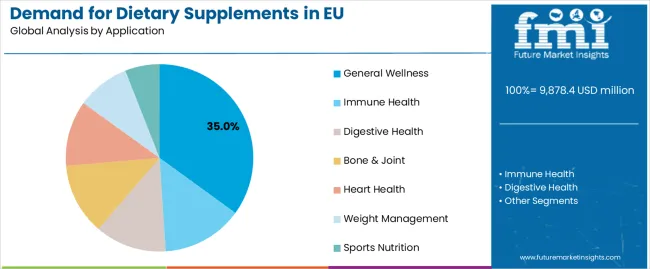
General wellness applications are positioned to represent 35% of total dietary supplement demand across European operations in 2026, declining slightly to 33% by 2036, reflecting the segment's dominance as the primary consumption driver within the overall category. This substantial share directly demonstrates that preventive health maintenance represents the core motivation, with consumers purchasing multivitamins, antioxidants, and broad-spectrum supplements for overall health optimization requiring comprehensive nutritional support.
Modern consumers increasingly view general wellness supplements as foundational daily health insurance, driving demand for products optimized for comprehensive nutrient coverage, appropriate dosing for daily maintenance, and balanced formulations that resonate across health-conscious populations seeking preventive approaches. The segment benefits from versatile positioning supporting multiple health objectives, established consumption routines integrated into daily wellness practices, and broad appeal transcending specific health conditions.
The segment's slight share decline reflects faster expansion in targeted applications like sports nutrition and digestive health, which accelerate as consumers increasingly seek specialized solutions beyond basic wellness support throughout the forecast period.
Key drivers:
- Preventive healthcare mindset supporting daily supplementation habits
- Comprehensive nutrient coverage addressing multiple wellness objectives simultaneously
- Mainstream appeal enabling adoption across diverse demographic segments
By Distribution Channel, Pharmacies/Drug Stores Segment Accounts for 40% Share
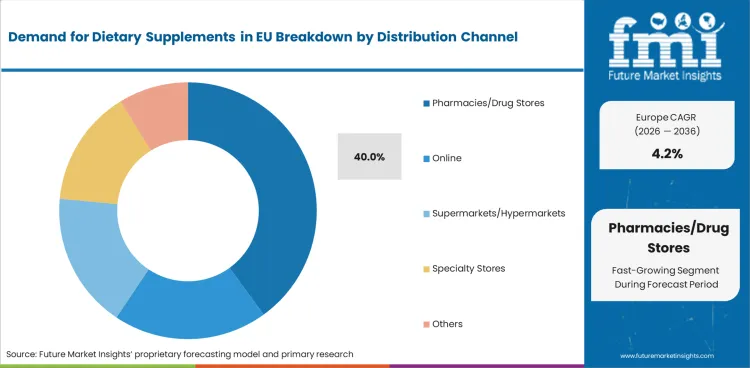
Pharmacies and drug stores are strategically estimated to control 40% of total European dietary supplement sales in 2026, declining to 36% by 2036, reflecting traditional healthcare channels' established position while facing growing competition from digital platforms. European pharmacy operators consistently demonstrate strong credibility for dietary supplements that deliver professional guidance, quality assurance, and trusted recommendations across licensed healthcare environments.
The segment provides essential trust-building touchpoints through pharmacist consultations, professional product selection assistance, and healthcare-oriented merchandising strategies that optimize consumer confidence and informed purchasing. Major European pharmacy chains, including Boots, DocMorris, Lloyds Pharmacy, and independent pharmacies, systematically maintain comprehensive dietary supplement selections, often featuring pharmaceutical-grade brands and clinically validated products that normalize supplement usage as legitimate health interventions.
The segment's declining share reflects accelerating e-commerce adoption, with pharmacies maintaining absolute growth while online channels expand more rapidly throughout the forecast period.
Success factors:
- Healthcare professional credibility providing consumer confidence and expert guidance
- Quality perception positioning pharmacy channels as trusted supplement sources
- Consultation services enabling informed product selection and appropriate usage recommendations
By Nature, Conventional Segment Accounts for 82% Share
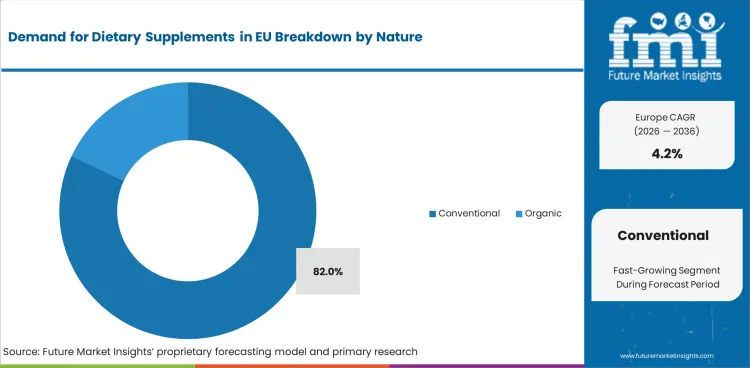
Conventional dietary supplement products are strategically positioned to contribute 82% of total European sales in 2026, declining to 76% by 2036, representing products produced through standard manufacturing without organic certification requirements. These conventional products successfully deliver accessible pricing and consistent quality while ensuring broad commercial availability across all distribution channels that prioritize volume scalability and cost competitiveness over organic certification.
Conventional production serves price-conscious consumers, mainstream wellness applications, and value-oriented buyers that require affordable nutritional supplementation at competitive price points. The segment derives significant competitive advantages from established ingredient supply chains, economies of scale in manufacturing, and the ability to meet substantial volume requirements from major retailers without organic certification constraints limiting ingredient sourcing options.
The segment's declining share through 2036 reflects the category's evolution toward premium organic products, which grow from 18% in 2026 to 24% in 2036, as health-conscious consumers increasingly prioritize organic certification and natural sourcing practices.
Competitive advantages:
- Price accessibility enabling mass market adoption and mainstream penetration
- Volume scalability supporting large-scale distribution requirements across multiple channels
- Manufacturing flexibility allowing rapid capacity expansion and ingredient optimization
What are the Drivers, Restraints, and Key Trends?
EU dietary supplement sales are advancing steadily due to increasing aging population seeking preventive healthcare, growing health consciousness accelerated by wellness trends, and rising consumer awareness of nutritional deficiencies. However, the industry faces challenges, including regulatory complexity across different European markets, skepticism regarding efficacy claims for certain product categories, and competitive pressure from fortified functional foods addressing similar health objectives. Continued innovation in bioavailability enhancement and clinical validation remains central to industry development.
Expansion of Personalized Nutrition and Targeted Formulations
The rapidly accelerating development of personalized nutrition technologies is fundamentally transforming dietary supplements from one-size-fits-all products to targeted solutions, enabling customized formulations addressing individual health profiles, genetic predispositions, and specific wellness objectives previously unavailable through standard multivitamin approaches. Advanced personalization platforms featuring DNA testing, blood biomarker analysis, and lifestyle assessment algorithms allow manufacturers to recommend dietary supplements with precise nutrient combinations, individualized dosing, and condition-specific targeting comparable to pharmaceutical precision. These personalization innovations prove particularly transformative for health-conscious consumers, including biohackers, longevity enthusiasts, and chronic condition management seekers, where customized formulations prove essential for optimal health outcomes.
Major dietary supplement brands invest heavily in digital health partnerships, personalization technology development, and direct-to-consumer platforms supporting customized recommendations, recognizing that personalized nutrition represents breakthrough solutions for generic positioning challenges limiting premium segment expansion. Manufacturers collaborate with testing laboratories, health technology companies, and medical professionals to develop scalable personalization systems that deliver individualized supplement regimens while maintaining manufacturing feasibility supporting commercial viability.
Integration of Advanced Delivery Systems and Bioavailability Enhancement
Modern dietary supplement producers systematically incorporate advanced delivery technologies, including liposomal encapsulation, microencapsulation, and nano-emulsion systems that deliver superior nutrient absorption, enhanced bioavailability, and optimized therapeutic effectiveness comparable to pharmaceutical delivery mechanisms. Strategic integration of bioavailability technologies optimized for nutrient delivery enables manufacturers to position dietary supplements as clinically effective products where absorption efficiency directly determines health-conscious consumer purchasing behavior. These technological improvements prove essential for premium positioning, as efficacy-focused consumers demand bioavailability verification, clinical evidence supporting enhanced absorption, and measurable health benefits.
Companies implement extensive bioavailability research programs, delivery technology partnerships with pharmaceutical ingredient suppliers, and clinical testing validating absorption enhancement, including pharmacokinetic studies, comparative bioavailability trials, and efficacy validation throughout product development. Manufacturers leverage advanced delivery positioning in marketing communications, on-pack claims featuring bioavailability advantages, and premium pricing justification, positioning technologically enhanced supplements as superior alternatives delivering measurable benefits.
Growing Emphasis on Sports Nutrition and Active Lifestyle Positioning
European consumers and fitness enthusiasts increasingly prioritize sports nutrition supplements featuring protein powders, amino acid complexes, and performance-enhancing formulations that differentiate athletic products through recovery support and performance optimization. This sports nutrition trend enables manufacturers to drive premium pricing through specialized positioning, performance benefit communication, and brand differentiation resonating with active consumers seeking competitive advantages. Sports nutrition innovation proves particularly important for younger demographics where fitness culture drives supplement adoption and social influence.
The development of sophisticated sports nutrition formulations, including plant-based proteins, pre-workout complexes, and recovery optimization blends expands manufacturers' abilities to create performance-focused products delivering athletic benefits without pharmaceutical interventions. Brands collaborate with sports scientists, professional athletes, and fitness influencers to develop formulations balancing efficacy with safety, supporting premium pricing and brand loyalty while maintaining clean-label credentials across health-conscious athletic segments.
Demand Analysis by Key Countries
.webp "Top Country Growth Comparison Demand For Dietary Supplements In Eu Cagr (2026 2036)")
| Country | CAGR % (2026-2036) |
|---|---|
| Netherlands | 4.3% |
| Germany | 4.2% |
| France | 4.1% |
| Italy | 4% |
| Spain | 3.9% |
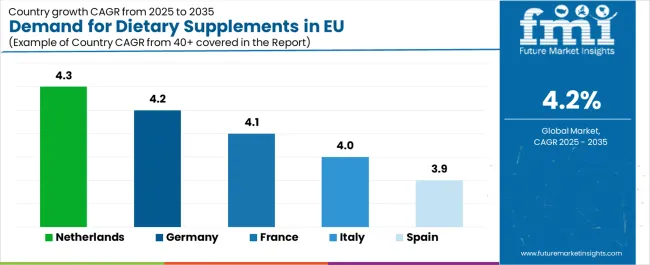
EU dietary supplement sales are projected to grow steadily from 2026 to 2036, with Rest of Europe leading expansion at 12.1% CAGR, supported by developing markets and rising wellness adoption. The Netherlands follows at 4.3% CAGR, reflecting strong health consciousness and receptivity to innovation. Among the larger economies, Germany (4.2%), France (4.1%), Italy (4%), and Spain (3.9%) demonstrate consistent mid-range growth, underpinned by established healthcare cultures, aging demographics, and sustained consumer demand for preventive health solutions. Overall, the region reflects robust and diversified growth momentum across both mature and emerging markets.
Germany Leads European Sales with Established Health Culture
Revenue from dietary supplements in Germany is projected to exhibit steady growth with a CAGR of 4.2% through 2036, driven by exceptionally large population base, well-developed health consciousness, and strong cultural emphasis on preventive wellness throughout the country. Germany's sophisticated healthcare system and internationally recognized leadership in pharmaceutical quality standards are creating substantial demand for diverse dietary supplement varieties across all consumer segments.
Major pharmacy chains, including DocMorris, Zur Rose, and independent apotheken, systematically maintain extensive dietary supplement selections, often dedicating substantial retail space to vitamins, minerals, and specialized wellness products to serve health-conscious consumers. German demand benefits from high trust in pharmacy-grade supplements, substantial healthcare spending supporting premium products, and cultural preference for quality-certified supplements that naturally supports premium positioning across mainstream consumers beyond budget-focused purchasing.
Growth drivers:
- Large population providing substantial market scale and established consumption base
- Strong pharmacy infrastructure ensuring quality products and professional guidance
- Health-conscious culture prioritizing preventive wellness and quality supplements
France Demonstrates Solid Growth with Pharmacy-Centric Distribution
Revenue from dietary supplements in France is expanding at a CAGR of 4.1%, supported by strong pharmacy tradition, growing wellness awareness, and increasing consumer acceptance of nutritional supplementation. France's sophisticated healthcare system and pharmacy-centric distribution model are driving demand for quality dietary supplements across therapeutic and wellness applications.
Major pharmacy chains, including Pharmacie Lafayette, Pharmacie Monge, and parapharmacy retailers, systematically expand dietary supplement offerings to address growing wellness demand. French sales particularly benefit from healthcare professional recommendations, creating natural adoption through trusted guidance, combined with increasing awareness of nutritional deficiencies contributing to expansion through preventive health positioning.
Success factors:
- Pharmacy tradition providing trusted distribution and professional recommendations
- Healthcare system integration supporting supplement adoption through medical guidance
- Growing wellness awareness driving preventive health supplement usage
Italy Maintains Solid Growth with Mediterranean Health Focus
Revenue from dietary supplements in Italy is growing at a steady CAGR of 4%, fundamentally driven by aging population, growing health consciousness, and Mediterranean wellness culture increasingly incorporating targeted supplementation. Italy's traditional focus on health and longevity is supporting dietary supplement adoption as complementary approaches to healthy lifestyle practices.
Major pharmacy chains and health retailers, including farmacia networks, parapharmacies, and specialized wellness stores, strategically invest in dietary supplement category expansion addressing growing health awareness. Italian sales particularly benefit from aging demographics requiring bone health, cardiovascular support, and cognitive function maintenance, creating natural adoption among senior populations.
Development factors:
- Aging population driving age-related health supplement demand
- Wellness culture supporting preventive health approaches and supplementation
- Pharmacy accessibility ensuring convenient purchasing and professional guidance
Spain Shows Steady Growth with Expanding Wellness Awareness
Demand for dietary supplements in Spain is projected to grow at a CAGR of 3.9%, supported by growing health consciousness, expanding pharmacy infrastructure, and increasing consumer awareness of nutritional supplementation benefits. Spanish consumer interest in wellness and active aging positions dietary supplements as aligned with health optimization objectives.
Major pharmacy chains and retailers, including Farmacias del Ahorro, Cruz Verde, and supermarket pharmacy sections, systematically expand dietary supplement offerings to serve growing demand. Spain's developing wellness culture supports supplement trial among health-conscious consumers seeking proactive health management solutions.
Growth enablers:
- Health awareness growth driving supplement adoption across demographics
- Pharmacy expansion supporting accessibility and mainstream availability
- Active aging trend facilitating preventive health supplement usage
Netherlands Emphasizes Innovation and Premium Quality
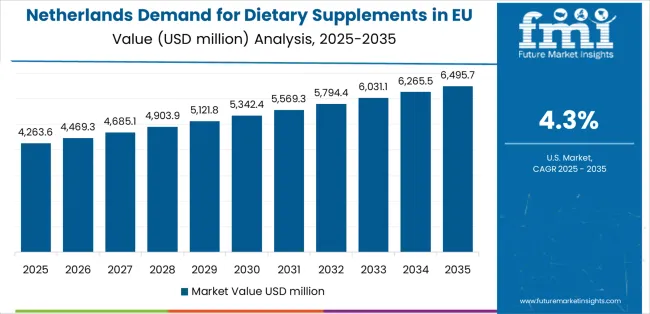
Demand for dietary supplements in the Netherlands is expanding at a leading CAGR of 4.3%, fundamentally driven by exceptionally strong health consciousness, progressive wellness culture, and comprehensive retail support for premium supplements across Dutch channels. Dutch consumers demonstrate particularly high receptivity to innovative supplement solutions and willingness to invest in quality products.
Netherlands sales significantly benefit from sophisticated retail infrastructure, including Kruidvat's extensive supplement sections, Etos' wellness focus, and innovative direct-to-consumer brands testing new products in a receptive Dutch environment. The country's progressive health culture positions Netherlands as innovation testing ground for European supplement categories.
Innovation drivers:
- Health consciousness supporting premium supplement adoption and quality focus
- Innovation receptivity enabling new product testing and format experimentation
- Retail sophistication facilitating diverse product offerings and channel innovation
Europe Market Split by Country
EU dietary supplement sales are projected to grow from USD 9,878.4 million in 2026 to USD 14,873.3 million by 2036, registering a CAGR of 4.2% over the forecast period. Rest of Europe is expected to demonstrate the strongest growth trajectory with a 12.1% CAGR, supported by developing wellness cultures, increasing healthcare infrastructure, and rising disposable incomes. Netherlands follows with 4.3% CAGR, attributed to progressive health consciousness and advanced retail sophistication.
Germany maintains the largest share at 34.3% in 2026, driven by established health awareness, strong pharmacy infrastructure, and quality-focused consumer base, while growing at 4.2% CAGR. France, Italy, and Spain all demonstrate 4.2% CAGR, reflecting consistent market development across major European economies.
Competitive Landscape
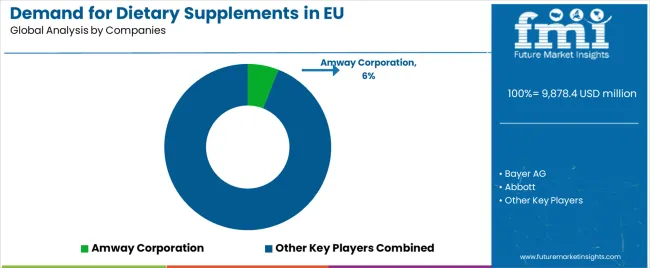
EU dietary supplement sales are defined by competition among direct selling companies, pharmaceutical corporations, specialized nutraceutical brands, and emerging wellness startups. Companies are investing in clinical validation studies, personalized nutrition platforms, bioavailability enhancement technologies, and clean-label formulation development to deliver high-quality, scientifically validated, and consumer-trusted dietary supplement solutions. Strategic partnerships with healthcare professionals, digital health technology integration, and marketing campaigns emphasizing clinical evidence and quality certifications are central to strengthening competitive position.
Major participants include Amway Corporation with an estimated 6% share, leveraging its direct selling expertise, comprehensive product portfolio, and established European presence through independent distributor networks. Amway benefits from personal relationship selling, multi-level marketing capabilities, and ability to provide personalized recommendations through direct contact, supporting premium positioning and brand loyalty.
Bayer AG holds approximately 5% share, emphasizing pharmaceutical quality standards, clinical validation expertise, and consumer trust earned through healthcare heritage. Bayer's success in applying pharmaceutical-grade manufacturing to dietary supplements creates strong quality positioning and professional endorsement, supported by scientific credibility and established brand reputation.
Abbott accounts for roughly 4% share through its position as healthcare nutrition leader with clinical expertise, providing medically positioned dietary supplements through evidence-based formulation. The company benefits from healthcare professional relationships, clinical nutrition specialization, and comprehensive quality assurance supporting therapeutic positioning and medical channel distribution.
Glanbia plc represents approximately 3% share, supporting growth through sports nutrition leadership, protein specialization, and performance-oriented product development. Glanbia leverages athletic positioning for sports supplement market dominance, innovation capabilities, and brand building expertise, attracting fitness enthusiasts seeking performance optimization.
Other companies collectively hold 82% share, reflecting highly fragmented competitive dynamics within European dietary supplement sales, where numerous specialized brands, private-label suppliers for major retailers, regional manufacturers, and emerging direct-to-consumer startups serve specific health conditions, demographic segments, and niche applications. This competitive environment provides opportunities for differentiation through specialized formulations (vegan, allergen-free), innovative delivery systems (gummies, effervescent), unique ingredient sourcing, and premium positioning resonating with health-conscious consumers seeking targeted wellness solutions.
Key Players
- Amway Corporation
- Bayer AG
- Abbott
- Glanbia plc
- Nestlé Health Science
- Herbalife Nutrition Ltd.
- GNC Holdings, Inc.
- Nature's Bounty Co.
- Pfizer Inc.
- DSM-Firmenich AG
- Others
Scope of the Report
| Metric | Value |
|---|---|
| Quantitative Units | USD 10.28 billion to USD 15.52 billion, at a CAGR of 4.2% |
| Market Definition | The Demand for Dietary Supplements in EU encompasses concentrated sources of vitamins, minerals, herbal extracts, amino acids, probiotics, and specialty nutrients in dosage forms including tablets, capsules, po... |
| Segmentation | Product Type: Vitamins & Minerals, Herbal Supplements, Proteins & Amino Acids, Prebiotics & Probiotics, Fatty Acids; Application: General Wellness, Immune Health, Digestive Health, Bone & Joint, Heart Health, Weight Management, Sports Nutrition; Distribution Channel: Pharmacies/Drug Stores, Online, Supermarkets/Hypermarkets, Specialty Stores, Others; Nature: Conventional, Organic |
| Regions Covered | EU (Western Europe, Southern Europe, Central Europe) |
| Countries Covered | Netherlands, Germany, France, Italy, Spain |
| Key Companies Profiled | Amway Corporation, Bayer AG, Abbott, Glanbia plc, Nestlé Health Science, Herbalife Nutrition Ltd., GNC Holdings, Inc., Nature's Bounty Co. |
| Forecast Period | 2026 to 2036 |
| Approach | Hybrid bottom-up modeling using production volume data, trade flow analysis, and primary research validation |
Key Segments
Product Type (Ingredients)
- Vitamins & Minerals
- Herbal Supplements
- Proteins & Amino Acids
- Prebiotics & Probiotics
- Fatty Acids
Application
- General Wellness
- Immune Health
- Digestive Health
- Bone & Joint
- Heart Health
- Weight Management
- Sports Nutrition
Distribution Channel
- Pharmacies/Drug Stores
- Online (E-commerce/D2C)
- Supermarkets/Hypermarkets
- Specialty Stores
- Others
Nature
- Conventional
- Organic
Countries
- Germany
- France
- Italy
- Spain
- Netherlands
- Rest of Europe
Bibliography
- 1. European Commission. (2024). Directive 2002/46/EC on food supplements, consolidated text. EUR-Lex.
- 2. European Commission. (2024). Regulation (EC) No 1924/2006 on nutrition and health claims, consolidated text. EUR-Lex.
- 3. European Food Safety Authority. (2025). Register of nutrition and health claims made on foods. EFSA.
- 4. Eurostat. (2025). Health supplement retail sales statistics, EU-27. European Commission Statistical Office.
- 5. World Health Organization. (2024). Micronutrient supplementation guidelines, European Region. WHO Regional Office for Europe.
This bibliography is provided for reader reference. The full Future Market Insights report contains the complete reference list with primary research documentation.
Frequently Asked Questions
How large is the demand for Dietary Supplements in the market in 2026?
Demand for dietary supplements is estimated to be valued at USD 10.28 billion in 2026.
What will be the market size of Dietary Supplements by 2036?
Market size for dietary supplements is projected to reach USD 15.52 billion by 2036.
What is the expected demand growth for Dietary Supplements between 2026 and 2036?
Demand for dietary supplements is expected to grow at a CAGR of 4.2% between 2026 and 2036.
Which Product Type is poised to lead sales by 2026?
Vitamins & Minerals accounts for 33% share in 2026, making it the leading sub-segment within the Product Type category.
How is the role of General Wellness in driving dietary supplements adoption in 2026?
General Wellness holds 35% of the Application segment share in 2026.
Which country is the fastest-growing market for dietary supplements?
Netherlands is projected to grow at a CAGR of 4.3% during 2026 to 2036, the fastest rate among markets covered.
What is Dietary Supplements and what is it mainly used for?
The Demand for Dietary Supplements in EU encompasses concentrated sources of vitamins, minerals, herbal extracts, amino acids, probiotics, and specialty nutrients in dosage forms including tablets, capsules, powders, and liquids. These products are marketed for general wellness, targeted health support, and nutritional gap supplementation across pharmacy, retail, and online distribution channels in the EU.
How does FMI build and validate the dietary supplements forecast?
Forecasting models apply a bottom-up methodology starting with production volume data and cross-validate projections against publicly reported industry statistics and primary research inputs.
Preview the report firsthand - request a free sample
Get SampleGet the brochure for pricing and purchase details.
Get PDFTable of Content
- Executive Summary
- Global Market Outlook
- Demand-side Trends
- Supply-side Trends
- Technology Roadmap Analysis
- Analysis and Recommendations
- Market Overview
- Market Coverage / Taxonomy
- Market Definition / Scope / Limitations
- Research Methodology
- Chapter Orientation
- Analytical Lens and Working Hypotheses
- Market Structure, Signals, and Trend Drivers
- Benchmarking and Cross-market Comparability
- Market Sizing, Forecasting, and Opportunity Mapping
- Research Design and Evidence Framework
- Desk Research Programme (Secondary Evidence)
- Company Annual and Sustainability Reports
- Peer-reviewed Journals and Academic Literature
- Corporate Websites, Product Literature, and Technical Notes
- Earnings Decks and Investor Briefings
- Statutory Filings and Regulatory Disclosures
- Technical White Papers and Standards Notes
- Trade Journals, Industry Magazines, and Analyst Briefs
- Conference Proceedings, Webinars, and Seminar Materials
- Government Statistics Portals and Public Data Releases
- Press Releases and Reputable Media Coverage
- Specialist Newsletters and Curated Briefings
- Sector Databases and Reference Repositories
- FMI Internal Proprietary Databases and Historical Market Datasets
- Subscription Datasets and Paid Sources
- Social Channels, Communities, and Digital Listening Inputs
- Additional Desk Sources
- Expert Input and Fieldwork (Primary Evidence)
- Primary Modes
- Qualitative Interviews and Expert Elicitation
- Quantitative Surveys and Structured Data Capture
- Blended Approach
- Why Primary Evidence is Used
- Field Techniques
- Interviews
- Surveys
- Focus Groups
- Observational and In-context Research
- Social and Community Interactions
- Stakeholder Universe Engaged
- C-suite Leaders
- Board Members
- Presidents and Vice Presidents
- R&D and Innovation Heads
- Technical Specialists
- Domain Subject-matter Experts
- Scientists
- Physicians and Other Healthcare Professionals
- Governance, Ethics, and Data Stewardship
- Research Ethics
- Data Integrity and Handling
- Primary Modes
- Tooling, Models, and Reference Databases
- Desk Research Programme (Secondary Evidence)
- Data Engineering and Model Build
- Data Acquisition and Ingestion
- Cleaning, Normalisation, and Verification
- Synthesis, Triangulation, and Analysis
- Quality Assurance and Audit Trail
- Market Background
- Market Dynamics
- Drivers
- Restraints
- Opportunity
- Trends
- Scenario Forecast
- Demand in Optimistic Scenario
- Demand in Likely Scenario
- Demand in Conservative Scenario
- Opportunity Map Analysis
- Product Life Cycle Analysis
- Supply Chain Analysis
- Investment Feasibility Matrix
- Value Chain Analysis
- PESTLE and Porter’s Analysis
- Regulatory Landscape
- Regional Parent Market Outlook
- Production and Consumption Statistics
- Import and Export Statistics
- Market Dynamics
- Global Market Analysis 2021 to 2025 and Forecast, 2026 to 2036
- Historical Market Size Value (USD Million) Analysis, 2021 to 2025
- Current and Future Market Size Value (USD Million) Projections, 2026 to 2036
- Y-o-Y Growth Trend Analysis
- Absolute $ Opportunity Analysis
- Global Market Pricing Analysis 2021 to 2025 and Forecast 2026 to 2036
- Global Market Analysis 2021 to 2025 and Forecast 2026 to 2036, By Product Type
- Introduction / Key Findings
- Historical Market Size Value (USD Million) Analysis By Product Type , 2021 to 2025
- Current and Future Market Size Value (USD Million) Analysis and Forecast By Product Type , 2026 to 2036
- Vitamins & Minerals
- Herbal Supplements
- Proteins & Amino Acids
- Prebiotics & Probiotics
- Fatty Acids
- Vitamins & Minerals
- Y-o-Y Growth Trend Analysis By Product Type , 2021 to 2025
- Absolute $ Opportunity Analysis By Product Type , 2026 to 2036
- Global Market Analysis 2021 to 2025 and Forecast 2026 to 2036, By Application
- Introduction / Key Findings
- Historical Market Size Value (USD Million) Analysis By Application, 2021 to 2025
- Current and Future Market Size Value (USD Million) Analysis and Forecast By Application, 2026 to 2036
- General Wellness
- Immune Health
- Digestive Health
- Bone & Joint
- Heart Health
- Weight Management
- Sports Nutrition
- General Wellness
- Y-o-Y Growth Trend Analysis By Application, 2021 to 2025
- Absolute $ Opportunity Analysis By Application, 2026 to 2036
- Global Market Analysis 2021 to 2025 and Forecast 2026 to 2036, By Distribution Channel
- Introduction / Key Findings
- Historical Market Size Value (USD Million) Analysis By Distribution Channel, 2021 to 2025
- Current and Future Market Size Value (USD Million) Analysis and Forecast By Distribution Channel, 2026 to 2036
- Pharmacies/Drug Stores
- Online
- Supermarkets/Hypermarkets
- Specialty Stores
- Others
- Pharmacies/Drug Stores
- Y-o-Y Growth Trend Analysis By Distribution Channel, 2021 to 2025
- Absolute $ Opportunity Analysis By Distribution Channel, 2026 to 2036
- Global Market Analysis 2021 to 2025 and Forecast 2026 to 2036, By Nature
- Introduction / Key Findings
- Historical Market Size Value (USD Million) Analysis By Nature, 2021 to 2025
- Current and Future Market Size Value (USD Million) Analysis and Forecast By Nature, 2026 to 2036
- Conventional
- Organic
- Conventional
- Y-o-Y Growth Trend Analysis By Nature, 2021 to 2025
- Absolute $ Opportunity Analysis By Nature, 2026 to 2036
- Global Market Analysis 2021 to 2025 and Forecast 2026 to 2036, By Region
- Introduction
- Historical Market Size Value (USD Million) Analysis By Region, 2021 to 2025
- Current Market Size Value (USD Million) Analysis and Forecast By Region, 2026 to 2036
- North America
- Latin America
- Western Europe
- Eastern Europe
- East Asia
- South Asia and Pacific
- Middle East & Africa
- Market Attractiveness Analysis By Region
- North America Market Analysis 2021 to 2025 and Forecast 2026 to 2036, By Country
- Historical Market Size Value (USD Million) Trend Analysis By Market Taxonomy, 2021 to 2025
- Market Size Value (USD Million) Forecast By Market Taxonomy, 2026 to 2036
- By Country
- USA
- Canada
- Mexico
- By Product Type
- By Application
- By Distribution Channel
- By Nature
- By Country
- Market Attractiveness Analysis
- By Country
- By Product Type
- By Application
- By Distribution Channel
- By Nature
- Key Takeaways
- Latin America Market Analysis 2021 to 2025 and Forecast 2026 to 2036, By Country
- Historical Market Size Value (USD Million) Trend Analysis By Market Taxonomy, 2021 to 2025
- Market Size Value (USD Million) Forecast By Market Taxonomy, 2026 to 2036
- By Country
- Brazil
- Chile
- Rest of Latin America
- By Product Type
- By Application
- By Distribution Channel
- By Nature
- By Country
- Market Attractiveness Analysis
- By Country
- By Product Type
- By Application
- By Distribution Channel
- By Nature
- Key Takeaways
- Western Europe Market Analysis 2021 to 2025 and Forecast 2026 to 2036, By Country
- Historical Market Size Value (USD Million) Trend Analysis By Market Taxonomy, 2021 to 2025
- Market Size Value (USD Million) Forecast By Market Taxonomy, 2026 to 2036
- By Country
- Germany
- UK
- Italy
- Spain
- France
- Nordic
- BENELUX
- Rest of Western Europe
- By Product Type
- By Application
- By Distribution Channel
- By Nature
- By Country
- Market Attractiveness Analysis
- By Country
- By Product Type
- By Application
- By Distribution Channel
- By Nature
- Key Takeaways
- Eastern Europe Market Analysis 2021 to 2025 and Forecast 2026 to 2036, By Country
- Historical Market Size Value (USD Million) Trend Analysis By Market Taxonomy, 2021 to 2025
- Market Size Value (USD Million) Forecast By Market Taxonomy, 2026 to 2036
- By Country
- Russia
- Poland
- Hungary
- Balkan & Baltic
- Rest of Eastern Europe
- By Product Type
- By Application
- By Distribution Channel
- By Nature
- By Country
- Market Attractiveness Analysis
- By Country
- By Product Type
- By Application
- By Distribution Channel
- By Nature
- Key Takeaways
- East Asia Market Analysis 2021 to 2025 and Forecast 2026 to 2036, By Country
- Historical Market Size Value (USD Million) Trend Analysis By Market Taxonomy, 2021 to 2025
- Market Size Value (USD Million) Forecast By Market Taxonomy, 2026 to 2036
- By Country
- China
- Japan
- South Korea
- By Product Type
- By Application
- By Distribution Channel
- By Nature
- By Country
- Market Attractiveness Analysis
- By Country
- By Product Type
- By Application
- By Distribution Channel
- By Nature
- Key Takeaways
- South Asia and Pacific Market Analysis 2021 to 2025 and Forecast 2026 to 2036, By Country
- Historical Market Size Value (USD Million) Trend Analysis By Market Taxonomy, 2021 to 2025
- Market Size Value (USD Million) Forecast By Market Taxonomy, 2026 to 2036
- By Country
- India
- ASEAN
- Australia & New Zealand
- Rest of South Asia and Pacific
- By Product Type
- By Application
- By Distribution Channel
- By Nature
- By Country
- Market Attractiveness Analysis
- By Country
- By Product Type
- By Application
- By Distribution Channel
- By Nature
- Key Takeaways
- Middle East & Africa Market Analysis 2021 to 2025 and Forecast 2026 to 2036, By Country
- Historical Market Size Value (USD Million) Trend Analysis By Market Taxonomy, 2021 to 2025
- Market Size Value (USD Million) Forecast By Market Taxonomy, 2026 to 2036
- By Country
- Kingdom of Saudi Arabia
- Other GCC Countries
- Turkiye
- South Africa
- Other African Union
- Rest of Middle East & Africa
- By Product Type
- By Application
- By Distribution Channel
- By Nature
- By Country
- Market Attractiveness Analysis
- By Country
- By Product Type
- By Application
- By Distribution Channel
- By Nature
- Key Takeaways
- Key Countries Market Analysis
- USA
- Pricing Analysis
- Market Share Analysis, 2025
- By Product Type
- By Application
- By Distribution Channel
- By Nature
- Canada
- Pricing Analysis
- Market Share Analysis, 2025
- By Product Type
- By Application
- By Distribution Channel
- By Nature
- Mexico
- Pricing Analysis
- Market Share Analysis, 2025
- By Product Type
- By Application
- By Distribution Channel
- By Nature
- Brazil
- Pricing Analysis
- Market Share Analysis, 2025
- By Product Type
- By Application
- By Distribution Channel
- By Nature
- Chile
- Pricing Analysis
- Market Share Analysis, 2025
- By Product Type
- By Application
- By Distribution Channel
- By Nature
- Germany
- Pricing Analysis
- Market Share Analysis, 2025
- By Product Type
- By Application
- By Distribution Channel
- By Nature
- UK
- Pricing Analysis
- Market Share Analysis, 2025
- By Product Type
- By Application
- By Distribution Channel
- By Nature
- Italy
- Pricing Analysis
- Market Share Analysis, 2025
- By Product Type
- By Application
- By Distribution Channel
- By Nature
- Spain
- Pricing Analysis
- Market Share Analysis, 2025
- By Product Type
- By Application
- By Distribution Channel
- By Nature
- France
- Pricing Analysis
- Market Share Analysis, 2025
- By Product Type
- By Application
- By Distribution Channel
- By Nature
- India
- Pricing Analysis
- Market Share Analysis, 2025
- By Product Type
- By Application
- By Distribution Channel
- By Nature
- ASEAN
- Pricing Analysis
- Market Share Analysis, 2025
- By Product Type
- By Application
- By Distribution Channel
- By Nature
- Australia & New Zealand
- Pricing Analysis
- Market Share Analysis, 2025
- By Product Type
- By Application
- By Distribution Channel
- By Nature
- China
- Pricing Analysis
- Market Share Analysis, 2025
- By Product Type
- By Application
- By Distribution Channel
- By Nature
- Japan
- Pricing Analysis
- Market Share Analysis, 2025
- By Product Type
- By Application
- By Distribution Channel
- By Nature
- South Korea
- Pricing Analysis
- Market Share Analysis, 2025
- By Product Type
- By Application
- By Distribution Channel
- By Nature
- Russia
- Pricing Analysis
- Market Share Analysis, 2025
- By Product Type
- By Application
- By Distribution Channel
- By Nature
- Poland
- Pricing Analysis
- Market Share Analysis, 2025
- By Product Type
- By Application
- By Distribution Channel
- By Nature
- Hungary
- Pricing Analysis
- Market Share Analysis, 2025
- By Product Type
- By Application
- By Distribution Channel
- By Nature
- Kingdom of Saudi Arabia
- Pricing Analysis
- Market Share Analysis, 2025
- By Product Type
- By Application
- By Distribution Channel
- By Nature
- Turkiye
- Pricing Analysis
- Market Share Analysis, 2025
- By Product Type
- By Application
- By Distribution Channel
- By Nature
- South Africa
- Pricing Analysis
- Market Share Analysis, 2025
- By Product Type
- By Application
- By Distribution Channel
- By Nature
- USA
- Market Structure Analysis
- Competition Dashboard
- Competition Benchmarking
- Market Share Analysis of Top Players
- By Regional
- By Product Type
- By Application
- By Distribution Channel
- By Nature
- Competition Analysis
- Competition Deep Dive
- Amway Corporation
- Overview
- Product Portfolio
- Profitability by Market Segments (Product/Age /Sales Channel/Region)
- Sales Footprint
- Strategy Overview
- Marketing Strategy
- Product Strategy
- Channel Strategy
- Bayer AG
- Abbott
- Glanbia plc
- Nestlé Health Science
- Herbalife Nutrition Ltd.
- GNC Holdings, Inc.
- Nature's Bounty Co.
- Pfizer Inc.
- DSM-Firmenich AG
- Others
- Amway Corporation
- Competition Deep Dive
- Assumptions & Acronyms Used


