


Conversation Intelligence Software Market : Global Industry Analysis and Opportunity Assessment, 2036
The Conversation Intelligence Software Market is segmented by Deployment Model (Cloud-based, On-Premise), End User (Large Enterprises, Small and Medium Enterprises), Use Case (Sales Coaching, Deal Intelligence, Customer Support, Marketing Attribution, Compliance Monitoring), Interaction Channel (Voice Calls, Video Meetings, Chat Messages, Email Threads, SMS), Industry Vertical (BFSI, Technology, Healthcare, Retail and E-commerce, Telecommunications, Education), and Component (Software Platforms, Managed Services, Integration Services, Training Services). Forecast for 2026 to 2036.
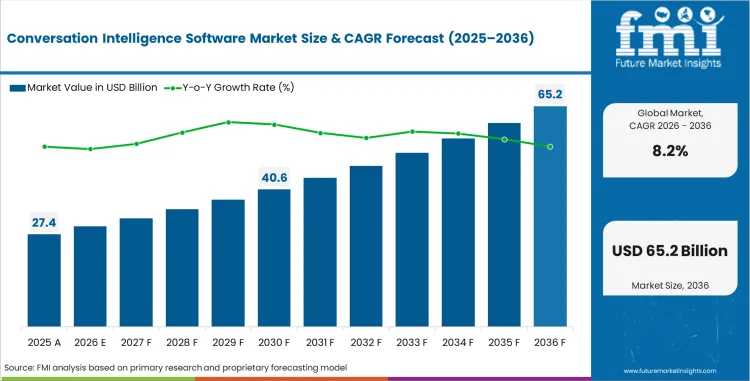
- Industry Size (2026): USD 27.4 Bn
- Forecast (2036): USD 60.3 Bn
- CAGR (2026 to 2036): 8.20%
Conversation Intelligence Software Market Size, Market Forecast and Outlook By FMI
The conversation intelligence software market was valued at USD 25.3 billion in 2025. Industry value is projected to cross USD 27.4 billion in 2026 and reach USD 60.3 billion by 2036 at 8.2% CAGR. Software platforms hold the largest component position with an estimated 73.0% share in 2026. Cloud-based deployment is expected to lead demand with 70.0% share in 2026.
Summary of the Conversation Intelligence Software Market
- Demand and Growth Drivers
- Rising use of AI-led sales coaching is lifting demand for conversation intelligence software through 2036.
- Call centers and revenue teams are using transcript analytics to improve agent training and customer follow-up.
- Cloud deployment leads adoption as distributed sales teams require faster access to call records and coaching insights.
- Product and Segment View
- Software platforms are projected to account for 73.0% share of component demand in 2026 since buyers want direct control of dashboards and workflow settings.
- Sales coaching is estimated to hold 34.0% share of use case demand in 2026 as managers use call libraries for rep training.
- Voice calls are anticipated to represent 42.0% share of interaction channel demand in 2026 due to phone conversations remaining central for service and sales reviews.
- Geography and Competitive Outlook
- India is projected to record 8.5% CAGR through 2036 led by cloud sales operations and large outsourced service delivery.
- China is expected to expand at 8.2% CAGR through 2036 as e-commerce service teams add AI call and chat analysis.
- Competitive strength is shaped by AI transcription quality and CRM connection depth and manager workflow design.
- Analyst Opinion
- Rahul Pandita, Principal Analyst for Technology at FMI, opines, “Conversation intelligence software increasingly functions as a workflow control layer across revenue and service operations. Sales leaders rely on these platforms to assess deal quality and deliver targeted coaching using evidence drawn from live customer calls, while service leaders apply conversation analytics to identify recurring complaint drivers and missed follow‑up actions.”
- Conversation Intelligence Software Market Value Analysis
- Cloud deployment remains the largest route to use since global sales teams depend on shared access to call notes and meeting records.
- Large enterprise demand increases influenced by high call volume creating more need for coaching queues and transcript search.
- Software platform spend shapes the largest value pool as buyers prefer configurable scoring and analytics screens.
- Privacy review costs create a restraint for vendors handling call recording and customer consent rules.
Conversation Intelligence Software Market Definition
Conversation intelligence software covers AI-enabled tools used to record, transcribe, summarize, score, and analyze business conversations across calls, meetings, chats, and messages. The scope includes software platforms and related services used by sales, marketing, support, compliance, and revenue operations teams. General CRM systems without conversation analytics are outside the counted value.
Conversation Intelligence Software Market Inclusions
The study includes deployment model, end user, use case, interaction channel, industry vertical, component, and geography across global demand.
Conversation Intelligence Software Market Exclusions
General video conferencing tools, basic call recording hardware, CRM databases without conversation analytics, manual sales training, and non-AI transcription services stay outside this study.
Conversation Intelligence Software Market Research Methodology
- Primary Research: FMI analysts reviewed software vendors and enterprise sales leaders across conversation analytics selection.
- Desk Research: Desk review used technology reports and company product releases covering sales automation and customer interaction analytics.
- Market Sizing and Forecasting: The forecast aligned supplied values with deployment mix and country-level cloud software readiness.
- Data Validation: Segment balance and country outlook were compared with company actions and public regulatory signals.
Why is the Conversation Intelligence Software Market Growing?
- Sales teams need call review records as deal cycles involve more digital meetings and longer approval chains.
- Contact centers need automated quality checks since supervisors cannot manually review every customer interaction.
- AI risk rules in Europe and the United States increase interest in audit trails for automated conversation review.
- CRM-linked analytics help managers connect conversation themes with pipeline movement and service tickets.
Demand for conversation intelligence software is expanding as sales processes become increasingly digital and data‑driven. Longer deal cycles and wider use of video meetings and remote selling are increasing the volume of recorded customer conversations, creating a structural need for searchable transcripts and AI‑generated insights. Revenue teams are shifting away from manual call playback toward intent detection and performance comparison across winning and stalled deals. This evolution is pushing conversation intelligence deeper into sales and lead intelligence workflows, where real‑time buyer signals extracted from calls and meetings help teams prioritize accounts, accelerate follow‑up, and improve forecast confidence.
Market Segmentation Analysis
- Cloud-based deployment is expected to account for 70.0% share in 2026 since teams need secure access across locations and CRM systems.
- Large enterprises are anticipated to contribute 55.6% share in 2026 as global revenue teams require common scoring rules.
- Sales coaching is likely to secure 34.0% share in 2026 influenced by managers using call examples for quicker representative feedback.
- Voice calls are expected to hold 42.0% share in 2026 led by phone conversations holding high-value service and sales detail.
Conversation intelligence software is segmented by deployment into cloud and on-premise. Cloud leads since sales teams need faster access to call recordings and coaching dashboards. Components include software and services. Software retains the largest position because of recurring use across call capture and transcript analysis. Enterprise size covers large enterprises and small and medium enterprises. Large enterprises stay ahead as multi-team sales operations need centralized review of customer conversations. Application includes sales coaching, call analytics, compliance monitoring, quality assurance and customer experience. Sales coaching leads since managers use recorded calls to improve rep training. End users include BFSI, healthcare, retail, IT and telecom and education.. Integration types include CRM integration, contact center integration and collaboration tool integration. CRM integration leads as revenue teams prefer conversation records linked directly to account activity.
Conversation Intelligence Software Market Analysis by Deployment Model
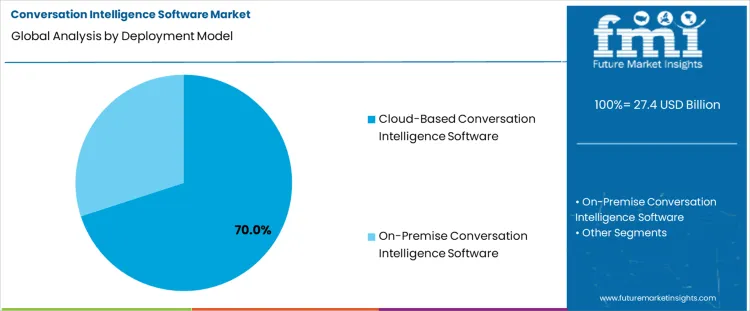
- Cloud-based deployment is expected to account for 70.0% share in 2026 led by shared transcripts and quick CRM connection contributing to distributed revenue teams.
- Cloud tools support faster user onboarding for teams using customer service software, while contact center as a service users benefits from lighter deployment work.
Insights into the On-Premise Segment
- On-premise demand remains aligned to regulated accounts needing tighter control of audio records and internal storage.
- Private deployments help firms align call review with internal data policies and regional privacy checks.
Conversation Intelligence Software Market Analysis by End User
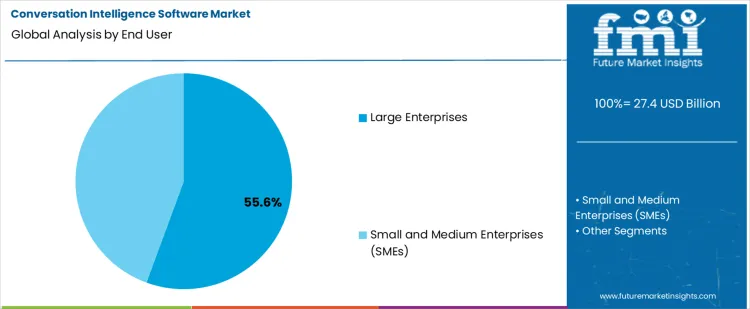
- Large enterprises are projected to represent 55.6% share in 2026 since large sales teams require common scorecards and deal review routines.
- Large accounts connect conversation data with sales intelligence to reduce manual review work. Customer journey analytics software can extend the same signal into customer path review.
Insights into the Small and Medium Enterprises Segment
- Small and medium enterprises adopt cloud tools as packaged call summaries reduce the need for dedicated sales operations staff.
- Lower setup burden supports adoption among teams using conversational marketing software. Digital marketing software users can connect campaign signals with call outcomes.
Conversation Intelligence Software Market Analysis by Use Case
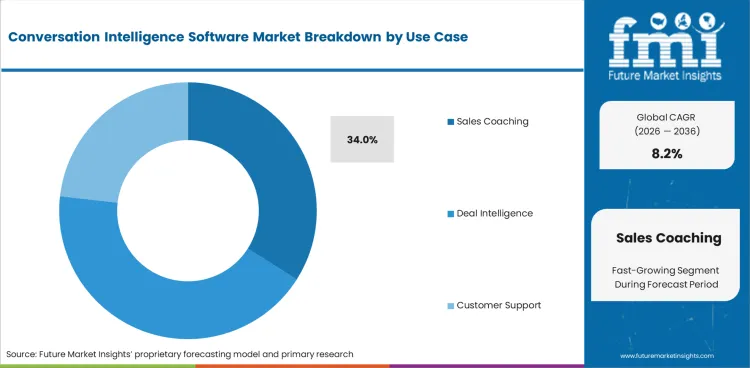
- Sales coaching is anticipated to represent 34.0% share in 2026 as managers use real conversation clips to improve rep behavior.
- Sales teams combine sales coaching software with call review to improve rep behavior. Predictive analytics can compare call quality against pipeline movement.
Insights into the Customer Support Segment
- Customer support use expands as contact centers replace sample-based review with wider scoring across calls and chats.
- Support teams connect conversation findings with enterprise feedback management to understand complaint themes faster. Customer experience platforms use similar feedback loops across digital service journeys.
Conversation Intelligence Software Market Analysis by Interaction Channel
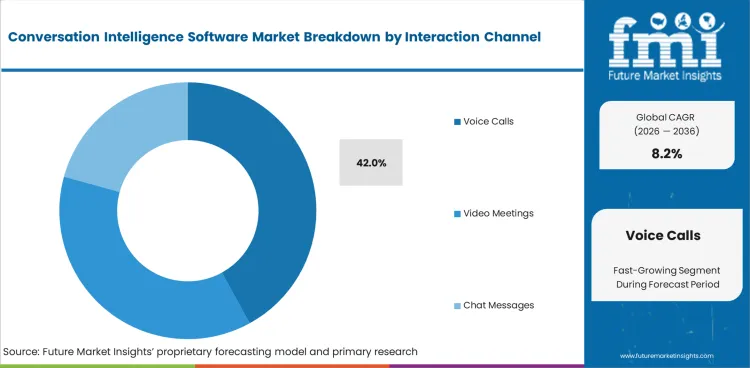
- Voice calls are projected to secure 42.0% share in 2026 because of phone conversations featuring direct objection handling and service recovery detail.
- Voice-led review links the industry with speech and voice analytics as call audio remains a large evidence source.
Insights into the Video Meetings Segment
- Video meetings gain from remote selling as buyer questions and demo objections appear in recorded meetings.
- Meeting summaries help sales managers reduce note gaps after complex product demos.
Conversation Intelligence Software Market Analysis by Industry Vertical
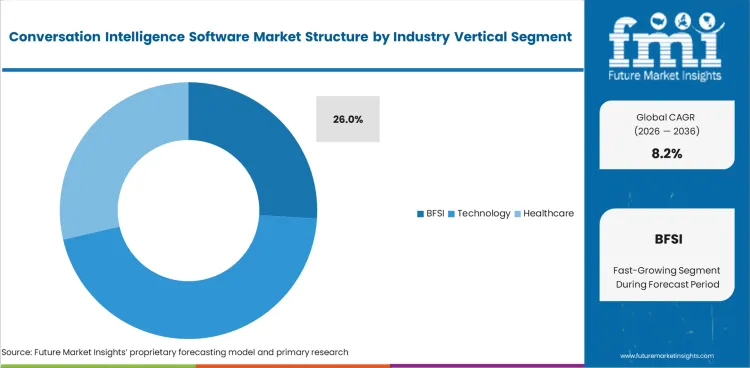
- BFSI is expected to make up 26.0% share in 2026 influenced by financial service teams depending on review trails for customer communication.
- Banks and insurers use conversation analytics to assess script adherence and complaint handling.
Insights into the Retail and E-commerce Segment
- Retail and e-commerce users connect calls with customer analytics in e-commerce programs. Conversational commerce teams use phone insight to improve digital sales journeys.
- Call attribution helps retail teams trace why customers complete purchases after speaking with agents. Marketing teams can pair audience analytics with call outcomes for cleaner campaign review.
Conversation Intelligence Software Market Analysis by Component
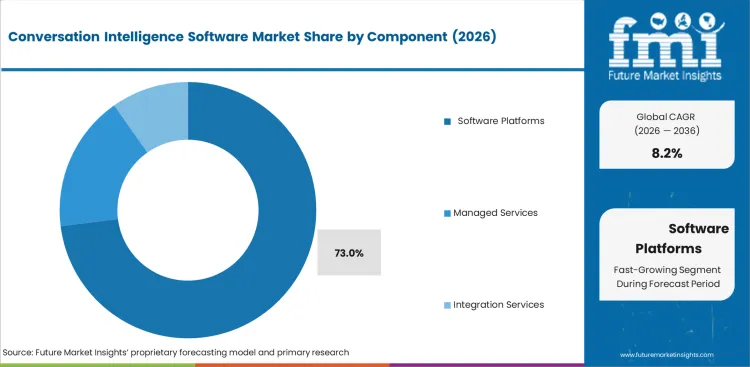
- Software platforms are likely to secure 73.0% share in 2026 due to buyers preferring direct analytics control and configurable user roles.
- Platform demand aligns with conversational AI as vendors improve summarization and intent detection. Natural language processing remains the core technology layer behind transcript analysis.
Insights into the Services Segment
- Services remain important during migration as buyers need CRM mapping and consent policy setup.
- Training support helps managers use call libraries without creating extra review burden.
Conversation Intelligence Software Market Drivers Restraints and Opportunities
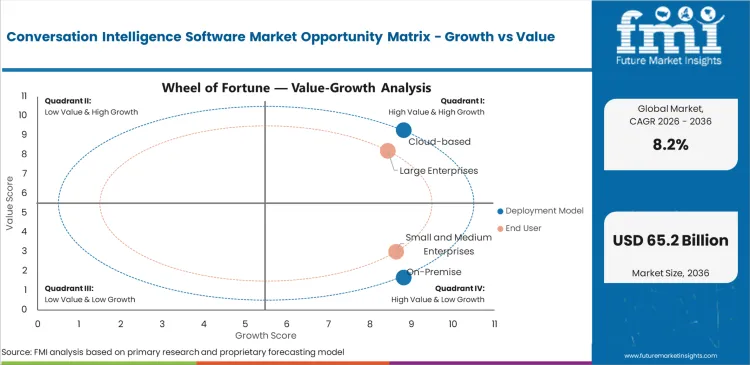
- AI call summaries are projected to support faster coaching as managers review short outputs instead of full recordings.
- Privacy and consent review may create purchase delays for buyers recording customer calls across countries.
- Integration with CRM and support software is forecast to create higher value for vendors with clean workflow design.
Conversation intelligence software demand is expected to rise through 2036, supported by wider use of AI-led sales coaching and call analytics across revenue teams. Supplier selection is shaped by transcript accuracy and CRM connectivity as managers need faster review of customer calls. Cloud deployment is expected to remain the preferred model due to distributed teams requiring shared access to recordings and coaching dashboards. Revenue growth will come from enterprise upgrades as buyers shift toward compliance monitoring and customer experience analysis. Integration with contact centers and CRM systems will support wider use across sales and service teams.
Call review integrates into sales workflow
Conversation intelligence software demand is expected to rise as call review moves deeper into sales workflows. Sales leaders are seeking call evidence without asking managers to replay every meeting. AI-led revenue tools from Gong and Salesforce point to a shift toward embedded review inside daily CRM work. Platforms linking transcripts with coaching cues and account actions should gain higher enterprise budget priority.
Privacy review slows deployment
Deployment will remain slower in regulated sectors due to AI call analysis using customer speech and employee performance data. NIST guidance and the EU AI Act are expected to push buyers toward strict consent controls and audit features. Vendors with clearer permission settings and easier review trails should shorten legal approval cycles before rollout.
Contact center automation expands use
Contact center use is expected to expand as service teams replace manual call sampling with AI review across larger interaction sets. Dialpad and CallMiner product rollout show supplier focus moving from analytics toward automated next actions. Demand should improve for software linking call insight with coaching and workflow follow-up.
Regional Analysis
.webp "Top Country Growth Comparison Conversation Intelligence Software Market Cagr (2026 2036)")
| Country | CAGR 2026 to 2036 |
|---|---|
| India | 8.5% |
| China | 8.2% |
| South Korea | 7.4% |
| United Kingdom | 6.9% |
| Japan | 6.7% |
| Germany | 6.4% |
| United States | 5.5% |
Source: Future Market Insights analysis based on country demand narratives and public source checks in 2026.
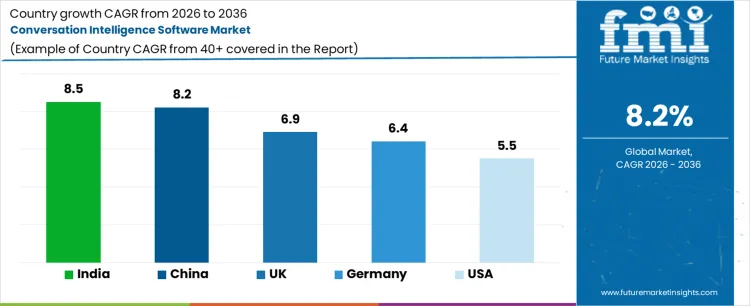
Analysis of Conversation Intelligence Software Market by Key Countries
- India is likely to post the fastest pace at 8.5% CAGR through 2036 since cloud software use and digital sales activity are expanding across service-led companies.
- China is expected to follow at 8.2% CAGR through 2036 because of online service platforms and customer support teams requiring stronger speech analytics.
- South Korea is projected to expand at 7.4% CAGR through 2036 led by high digital readiness supporting rapid adoption of AI tools in sales and service teams.
- United Kingdom demand is projected to rise at 6.9% CAGR through 2036 as financial services and customer support operations need better review of recorded conversations.
Country growth differs with cloud adoption speed and customer interaction volume. India leads as digital commerce and inside sales teams are expanding from a lower software base. China follows through large online service activity and AI-led customer support use. South Korea benefits from strong digital infrastructure and faster enterprise technology rollout. The United Kingdom and Japan show steady expansion through customer service quality programs. Germany advances through enterprise workflow automation. The United States expands more slowly because revenue teams already use mature sales technology stacks.
Demand Outlook for Conversation Intelligence Software Market in India
Demand for the industry in India is projected to record 8.5% CAGR through 2036 since digital commerce firms and inside sales teams need faster call review across rising customer interaction volumes. Cloud deployment remains the main adoption route as companies require lower setup cost and easier access across distributed teams. AI-led coaching use is expected to improve as sales managers seek clearer call evidence for rep training.
- Inside sales teams create steady demand for transcript analysis based on managers requiring coaching signals without replaying every recorded meeting.
- Cloud deployment improves adoption prospects influenced by growing companies preferring subscription tools with faster setup and easier CRM integration.
- Digital commerce firms support software adoption as customer support teams need faster review of calls and chats across high-volume service operations.
Sales Analysis of Conversation Intelligence Software Market in China
Industry sales in China are expected to expand at 8.2% CAGR through 2036 as online service platforms and intelligent customer support systems create larger use for speech analytics. Local companies are expected to use conversation intelligence tools to improve customer handling across e-commerce and digital service channels. Chatbot and virtual assistant use should raise demand for software capable of reviewing voice and text interactions.
- E-commerce platforms support wider software use because of customer interaction teams requiring automated review of voice calls and chat records at scale.
- Intelligent customer service systems create demand for analytics tools since service managers need clearer patterns from recorded interactions.
- AI adoption across online services supports conversation review software as companies link customer speech data with service quality improvement.
Opportunity Analysis of Conversation Intelligence Software Market in South Korea
Industry in South Korea is projected to rise at 7.4% CAGR through 2036 propelled by advanced digital infrastructure and enterprise cloud use supporting faster adoption of AI-led conversation tools. Sales and service teams are expected to adopt call review software to improve coaching and response quality. Strong technology readiness gives vendors an easier route for integration across CRM and contact center systems.
- Digitally mature enterprises support adoption as sales teams can connect call analytics with CRM systems at lower integration risk.
- Contact center teams create clearer use cases led by service quality review requiring faster analysis across recorded customer interactions.
- Technology-led companies favor AI coaching tools since managers need clearer call evidence for training and account follow-up.
Demand Outlook for Conversation Intelligence Software Market in the United Kingdom
United Kingdom demand for the industry is projected to expand at 6.9% CAGR through 2036 led by financial services and customer support teams affected by clearer conversation review. Sales and service teams are expected to use transcript analytics to improve call handling and follow-up quality. Remote customer engagement supports software use as managers need a shared view of customer calls across distributed teams.
- Sales managers use conversation intelligence tools since call evidence helps identify coaching needs without adding heavy manual review work.
- Financial service teams support adoption because of recorded customer conversations requiring clearer review trails and clearer service quality checks.
- Remote support teams create demand for Cloud-based review tools as managers need call records across different work locations.
Demand Outlook for Conversation Intelligence Software Market in Japan
The industry in Japan is expected to grow at 6.7% CAGR through 2036 influenced by mature enterprise users adding AI review tools to improve customer service quality. Large companies are expected to use conversation intelligence software for call monitoring and structured coaching across customer-facing teams. Adoption remains steady as enterprise software buying is disciplined and integration quality receives close review.
- Large enterprises create demand for structured coaching tools as managers depend on clearer signals from sales and support conversations.
- Customer service teams support software adoption because of high service expectations influenced by consistent review of call handling and response quality.
- CRM-linked deployments gain attention led by Japanese companies often preferring software tools connected with existing enterprise systems.
Demand Outlook for Conversation Intelligence Software Market in Germany
Industry expansion in Germany is expected to reach 6.4% CAGR through 2036 influenced by industrial sales teams and service groups adopting workflow-linked conversation review. Enterprise automation programs are expected to connect call analysis with CRM workflows and service dashboards. Privacy review may slow rollout as customer speech data needs careful control during storage and analysis.
- Industrial service teams support software adoption due to account managers depending on clearer customer call records for follow-up and issue resolution.
- Enterprise automation programs increase adoption prospects as companies connect call review with CRM workflows and service dashboards.
- Privacy review shapes vendor selection since buyers prefer clearer consent settings and stronger audit trails for recorded interactions.
Demand Outlook for Conversation Intelligence Software Market in the United States
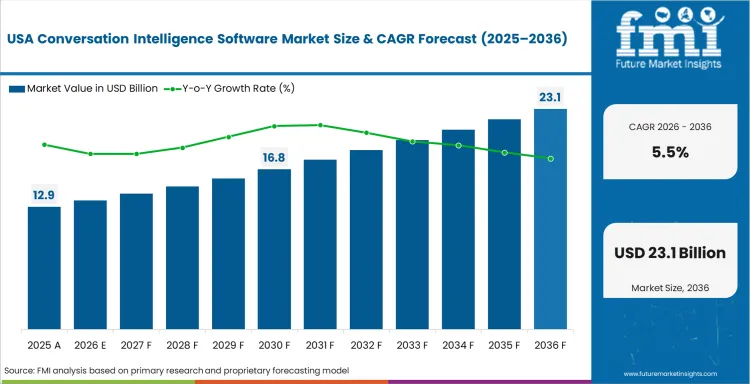
Demand in the United States is projected to record 5.5% CAGR through 2036 since mature sales technology stacks shift spending toward upgrades and integration depth. Large enterprises use conversation intelligence software to connect call records with CRM activity and coaching workflows. Contact centers support software demand as service leaders replace manual call sampling with AI review across larger interaction sets.
- Mature CRM use supports upgrade demand as sales teams prefer conversation records linked directly with account activity and deal follow-up.
- Contact center teams create steady demand for AI review led by managers depending on quality checks across larger call volumes.
- Enterprise buyers favor integrated platforms influenced by coaching insights and service review tools needing to work inside existing sales systems.
Competitive Structure and Strategic Positioning
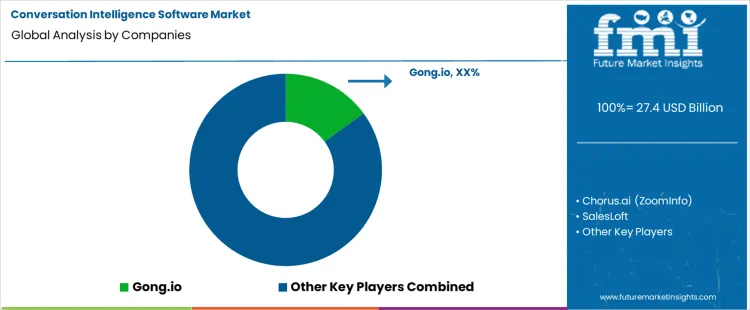
- Conversation intelligence software competition is led by revenue AI platforms and CRM vendors and contact center analytics specialists serving different sales and service teams.
- Large suppliers compete through transcript quality and workflow depth as buyers prefer tools connected with CRM records and coaching tasks.
- CRM-linked vendors gain attention led by sales teams requiring call evidence inside account activity instead of separate review screens.
- Entry barriers rise as buyers expect stricter consent controls and audit trails before approving AI review of customer calls.
Competition in conversation intelligence software industry is influenced by how well call review connects with daily sales work. Gong positions its Revenue AI OS around customer insights and AI agents and workflow automation for go-to-market teams. Salesforce announced Agentforce 360 general availability in October 2025, supporting the shift toward AI agents integrated in CRM work. Product signals show why conversation review is progressing from standalone call recording into sales execution.
Contact center suppliers compete through automation depth and service workflow coverage. Dialpad launched its Agentic AI Platform in October 2025 for autonomous voice and text agents connected with existing systems. CallMiner advanced its agentic AI structure in October 2025 to connect customer experience analytics with intelligent automation. These moves show that suppliers are extending conversation analysis into next-action workflows for service teams.
Key Companies in the Conversation Intelligence Software Market
- Competition spans revenue intelligence platforms, CRM AI providers and contact center analytics companies with different strengths.
- Revenue intelligence platforms: Gong, Salesloft, Clari and ZoomInfo Chorus compete through call capture, transcript review and coaching workflows. Gong announced new AI-driven revenue products in October 2025 under its Revenue AI Operating System. Salesloft positions Conversations around automatic capture and analysis of customer interactions for sales teams.
- CRM AI providers: Salesforce competes through CRM-native AI agents and customer workflow integration. Salesforce made Agentforce 360 generally available in October 2025, which strengthens its position in enterprise AI workflows linked with customer records.
- Contact center analytics providers: Dialpad and CallMiner compete through voice analytics, agentic AI and service workflow automation. Dialpad launched its Agentic AI Platform in October 2025 for autonomous voice and text agents. CallMiner advanced its agentic AI structure in October 2025 to connect customer experience analytics with automation workflows.
Competitive Benchmarking: Conversation Intelligence Software Market
| Company | AI Call Analysis | CRM Integration | Coaching Workflow | Footprint |
|---|---|---|---|---|
| Gong.io | High | Large | Large | Global |
| ZoomInfo Chorus | High | Large | Large | North America and Europe |
| Salesloft | Large | Large | High | Global |
| Dialpad | Large | Moderate | Moderate | Global |
| CallMiner | High | Moderate | Large | North America and Europe |
| Invoca | Large | Large | Moderate | North America |
| Salesforce | Moderate | High | Moderate | Global |
Source: Future Market Insights competitive analysis based on official company updates and covered country narratives in 2026.
Key Developments in Conversation Intelligence Software Market
- In September 2025, CallMiner advanced its agentic AI structure to connect analytics and automation workflows across its platform.
- In October 2025, Gong launched Gong Orchestrate and new AI-driven revenue capabilities under its Revenue AI Operating System.
Key Players in the Conversation Intelligence Software Market
Major Global Players
- Gong.io
- ZoomInfo Chorus
- Salesloft
- Dialpad
Specialist and Platform Participants
- CallMiner
- Invoca
- Salesforce
Report Scope and Coverage
| Item | Value |
|---|---|
| Market value in 2025 | USD 25.3 billion |
| Market value in 2026 | USD 27.4 billion |
| Market value in 2036 | USD 60.3 billion |
| CAGR from 2026 to 2036 | 8.2% |
| Quantitative units | USD billion |
| Market definition | AI-enabled software used to record, transcribe, summarize, score, and analyze business conversations |
| By deployment model | Cloud-based, On-Premise |
| By end user | Large enterprises, small and medium enterprises |
| By use case | Sales coaching, deal intelligence, customer support, marketing attribution, compliance monitoring |
| By interaction channel | Voice calls, video meetings, chat messages, email threads, SMS |
| By industry vertical | BFSI, technology, healthcare, retail and E-commerce, telecommunications, education |
| By component | Software platforms, managed services, integration services, training services |
| Regions covered | North America, Latin America, Europe, East Asia, South Asia and Pacific, Middle East and Africa |
| Countries covered | United States, Canada, Mexico, Brazil, Chile, Germany, United Kingdom, France, Italy, Spain, China, Japan, South Korea, India, ASEAN, Australia and New Zealand, Saudi Arabia, Other GCC Countries, South Africa |
| Key companies profiled | Gong.io, ZoomInfo Chorus, Salesloft, Dialpad, CallMiner, Invoca, Salesforce |
| Forecast period | 2026 to 2036 |
| Approach | FMI public demand model aligned with deployment mix, user scale, company updates, and country narratives |
Source: Future Market Insights analysis, 2026.
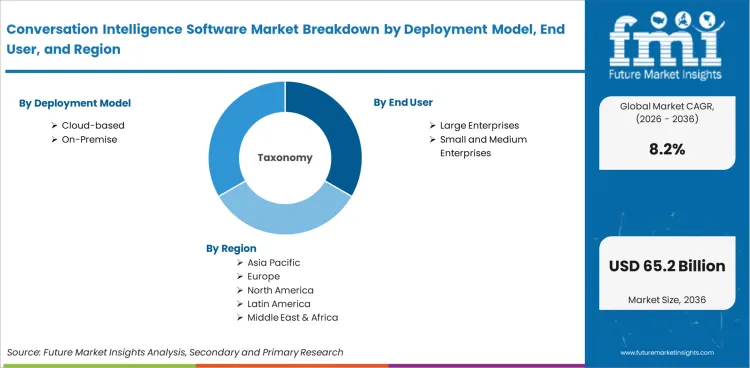
Conversation Intelligence Software Market Breakdown by Deployment Model and End User and Use Case and Interaction Channel and Industry Vertical and Component and Region
Conversation Intelligence Software Market Segmented by Deployment Model:
- Cloud-based
- On-Premise
Conversation Intelligence Software Market Segmented by End User:
- Large Enterprises
- Small and Medium Enterprises
Conversation Intelligence Software Market Segmented by Use Case:
- Sales Coaching
- Deal Intelligence
- Customer Support
- Marketing Attribution
- Compliance Monitoring
Conversation Intelligence Software Market Segmented by Interaction Channel:
- Voice Calls
- Video Meetings
- Chat Messages
- Email Threads
- SMS
Conversation Intelligence Software Market Segmented by Industry Vertical:
- BFSI
- Technology
- Healthcare
- Retail and E-commerce
- Telecommunications
- Education
Conversation Intelligence Software Market Segmented by Component:
- Software Platforms
- Managed Services
- Integration Services
- Training Services
Conversation Intelligence Software Market by Region:
- North America
- Latin America
- Europe
- East Asia
- South Asia and Pacific
- Middle East and Africa
Research Sources and Bibliography
- Gong. (2025, October 21). Gong unveils new AI innovations to help revenue teams drive growth at scale. Gong.
- Dialpad. (2025, October 9). Dialpad launches its agentic AI platform, ending the era of broken bots and IVRs. Dialpad.
- CallMiner. (2025, October 7). CallMiner advances agentic AI framework to transform CX with intelligent automation. CallMiner.
- USA Census Bureau. (2024, March 28). Census Bureau releases BTOS data with artificial intelligence supplement.
- European Commission. (2024, August 1). AI Act enters into force.
- National Institute of Standards and Technology. (2024). Artificial intelligence risk management framework: Generative artificial intelligence profile (NIST AI 600-1). U.S. Department of Commerce.
- Salesforce. (2025, October 13). Salesforce announces the Agentic Enterprise.
- Invoca. (2025, November 13). Invoca leverages Databricks to power AI messaging innovation.
- Federal Trade Commission. (2024, September 25). FTC announces crackdown on deceptive AI claims and schemes.
- Microsoft. (2026, April 23). Overview of Dynamics 365 Sales 2025 release wave 1. Microsoft Learn.
- ZoomInfo. (2025, June 17). 2025 ZoomInfo Sales release notes [PDF].
- Gong. (2026, February 25). Gong launches Mission Andromeda, expanding its Revenue AI OS to enablement and account management.
- Salesloft. (2025, November 12). Salesloft unveils AI “Closing Power” Suite at Saleslove On Tour London event.
The bibliography is provided for reader reference and direct source checking.
This Report Answers
- How large the conversation intelligence software sector is in 2026 and how far it can rise by 2036?
- Which deployment model and end user and component hold the largest projected share positions in 2026?
- Why Cloud-Based deployment and Software Platforms hold the clearest lead in current software demand?
- Which countries are projected to record the fastest CAGR through 2036?
- Which companies compete through AI call analysis and CRM workflow depth?
Frequently Asked Questions
What is the global conversation intelligence software market value in 2026?
The global conversation intelligence software market is expected to reach USD 27.4 billion in 2026.
What is the projected conversation intelligence software market value by 2036?
The conversation intelligence software market is projected to reach USD 60.3 billion by 2036 as AI call review expands.
What CAGR is expected for the conversation intelligence software market through 2036?
The conversation intelligence software market is expected to advance at 8.2% CAGR from 2026 to 2036.
Which deployment model leads the conversation intelligence software market in 2026?
Cloud-based deployment leads the conversation intelligence software market with 70.0% share in 2026 due to remote access needs.
Which country records the fastest CAGR in the conversation intelligence software market?
India records the fastest conversation intelligence software market pace at a projected 8.5% CAGR through 2036 as cloud sales operations expand.
Table of Content
- Executive Summary
- Global Market Outlook
- Demand-side Trends
- Supply-side Trends
- Technology Roadmap Analysis
- Analysis and Recommendations
- Market Overview
- Market Coverage / Taxonomy
- Market Definition / Scope / Limitations
- Research Methodology
- Chapter Orientation
- Analytical Lens and Working Hypotheses
- Market Structure, Signals, and Trend Drivers
- Benchmarking and Cross-market Comparability
- Market Sizing, Forecasting, and Opportunity Mapping
- Research Design and Evidence Framework
- Desk Research Programme (Secondary Evidence)
- Company Annual and Sustainability Reports
- Peer-reviewed Journals and Academic Literature
- Corporate Websites, Product Literature, and Technical Notes
- Earnings Decks and Investor Briefings
- Statutory Filings and Regulatory Disclosures
- Technical White Papers and Standards Notes
- Trade Journals, Industry Magazines, and Analyst Briefs
- Conference Proceedings, Webinars, and Seminar Materials
- Government Statistics Portals and Public Data Releases
- Press Releases and Reputable Media Coverage
- Specialist Newsletters and Curated Briefings
- Sector Databases and Reference Repositories
- FMI Internal Proprietary Databases and Historical Market Datasets
- Subscription Datasets and Paid Sources
- Social Channels, Communities, and Digital Listening Inputs
- Additional Desk Sources
- Expert Input and Fieldwork (Primary Evidence)
- Primary Modes
- Qualitative Interviews and Expert Elicitation
- Quantitative Surveys and Structured Data Capture
- Blended Approach
- Why Primary Evidence is Used
- Field Techniques
- Interviews
- Surveys
- Focus Groups
- Observational and In-context Research
- Social and Community Interactions
- Stakeholder Universe Engaged
- C-suite Leaders
- Board Members
- Presidents and Vice Presidents
- R&D and Innovation Heads
- Technical Specialists
- Domain Subject-matter Experts
- Scientists
- Physicians and Other Healthcare Professionals
- Governance, Ethics, and Data Stewardship
- Research Ethics
- Data Integrity and Handling
- Primary Modes
- Tooling, Models, and Reference Databases
- Desk Research Programme (Secondary Evidence)
- Data Engineering and Model Build
- Data Acquisition and Ingestion
- Cleaning, Normalisation, and Verification
- Synthesis, Triangulation, and Analysis
- Quality Assurance and Audit Trail
- Market Background
- Market Dynamics
- Drivers
- Restraints
- Opportunity
- Trends
- Scenario Forecast
- Demand in Optimistic Scenario
- Demand in Likely Scenario
- Demand in Conservative Scenario
- Opportunity Map Analysis
- Product Life Cycle Analysis
- Supply Chain Analysis
- Investment Feasibility Matrix
- Value Chain Analysis
- PESTLE and Porter’s Analysis
- Regulatory Landscape
- Regional Parent Market Outlook
- Production and Consumption Statistics
- Import and Export Statistics
- Market Dynamics
- Global Market Analysis 2021 to 2025 and Forecast, 2026 to 2036
- Historical Market Size Value (USD Million) Analysis, 2021 to 2025
- Current and Future Market Size Value (USD Million) Projections, 2026 to 2036
- Y-o-Y Growth Trend Analysis
- Absolute $ Opportunity Analysis
- Global Market Pricing Analysis 2021 to 2025 and Forecast 2026 to 2036
- Global Market Analysis 2021 to 2025 and Forecast 2026 to 2036, By Deployment Model
- Introduction / Key Findings
- Historical Market Size Value (USD Million) Analysis By Deployment Model , 2021 to 2025
- Current and Future Market Size Value (USD Million) Analysis and Forecast By Deployment Model , 2026 to 2036
- Cloud-based
- On-Premise
- Cloud-based
- Y-o-Y Growth Trend Analysis By Deployment Model , 2021 to 2025
- Absolute $ Opportunity Analysis By Deployment Model , 2026 to 2036
- Global Market Analysis 2021 to 2025 and Forecast 2026 to 2036, By End User
- Introduction / Key Findings
- Historical Market Size Value (USD Million) Analysis By End User, 2021 to 2025
- Current and Future Market Size Value (USD Million) Analysis and Forecast By End User, 2026 to 2036
- Large Enterprises
- Small and Medium Enterprises
- Large Enterprises
- Y-o-Y Growth Trend Analysis By End User, 2021 to 2025
- Absolute $ Opportunity Analysis By End User, 2026 to 2036
- Global Market Analysis 2021 to 2025 and Forecast 2026 to 2036, By Use Case
- Introduction / Key Findings
- Historical Market Size Value (USD Million) Analysis By Use Case, 2021 to 2025
- Current and Future Market Size Value (USD Million) Analysis and Forecast By Use Case, 2026 to 2036
- Sales Coaching
- Deal Intelligence
- Customer Support
- Sales Coaching
- Y-o-Y Growth Trend Analysis By Use Case, 2021 to 2025
- Absolute $ Opportunity Analysis By Use Case, 2026 to 2036
- Global Market Analysis 2021 to 2025 and Forecast 2026 to 2036, By Interaction Channel
- Introduction / Key Findings
- Historical Market Size Value (USD Million) Analysis By Interaction Channel, 2021 to 2025
- Current and Future Market Size Value (USD Million) Analysis and Forecast By Interaction Channel, 2026 to 2036
- Voice Calls
- Video Meetings
- Chat Messages
- Voice Calls
- Y-o-Y Growth Trend Analysis By Interaction Channel, 2021 to 2025
- Absolute $ Opportunity Analysis By Interaction Channel, 2026 to 2036
- Global Market Analysis 2021 to 2025 and Forecast 2026 to 2036, By Industry Vertical
- Introduction / Key Findings
- Historical Market Size Value (USD Million) Analysis By Industry Vertical, 2021 to 2025
- Current and Future Market Size Value (USD Million) Analysis and Forecast By Industry Vertical, 2026 to 2036
- BFSI
- Technology
- Healthcare
- BFSI
- Y-o-Y Growth Trend Analysis By Industry Vertical, 2021 to 2025
- Absolute $ Opportunity Analysis By Industry Vertical, 2026 to 2036
- Global Market Analysis 2021 to 2025 and Forecast 2026 to 2036, By Component
- Introduction / Key Findings
- Historical Market Size Value (USD Million) Analysis By Component, 2021 to 2025
- Current and Future Market Size Value (USD Million) Analysis and Forecast By Component, 2026 to 2036
- Software Platforms
- Managed Services
- Integration Services
- Software Platforms
- Y-o-Y Growth Trend Analysis By Component, 2021 to 2025
- Absolute $ Opportunity Analysis By Component, 2026 to 2036
- Global Market Analysis 2021 to 2025 and Forecast 2026 to 2036, By Region
- Introduction
- Historical Market Size Value (USD Million) Analysis By Region, 2021 to 2025
- Current Market Size Value (USD Million) Analysis and Forecast By Region, 2026 to 2036
- North America
- Latin America
- Western Europe
- Eastern Europe
- East Asia
- South Asia and Pacific
- Middle East & Africa
- Market Attractiveness Analysis By Region
- North America Market Analysis 2021 to 2025 and Forecast 2026 to 2036, By Country
- Historical Market Size Value (USD Million) Trend Analysis By Market Taxonomy, 2021 to 2025
- Market Size Value (USD Million) Forecast By Market Taxonomy, 2026 to 2036
- By Country
- USA
- Canada
- Mexico
- By Deployment Model
- By End User
- By Use Case
- By Interaction Channel
- By Industry Vertical
- By Component
- By Country
- Market Attractiveness Analysis
- By Country
- By Deployment Model
- By End User
- By Use Case
- By Interaction Channel
- By Industry Vertical
- By Component
- Key Takeaways
- Latin America Market Analysis 2021 to 2025 and Forecast 2026 to 2036, By Country
- Historical Market Size Value (USD Million) Trend Analysis By Market Taxonomy, 2021 to 2025
- Market Size Value (USD Million) Forecast By Market Taxonomy, 2026 to 2036
- By Country
- Brazil
- Chile
- Rest of Latin America
- By Deployment Model
- By End User
- By Use Case
- By Interaction Channel
- By Industry Vertical
- By Component
- By Country
- Market Attractiveness Analysis
- By Country
- By Deployment Model
- By End User
- By Use Case
- By Interaction Channel
- By Industry Vertical
- By Component
- Key Takeaways
- Western Europe Market Analysis 2021 to 2025 and Forecast 2026 to 2036, By Country
- Historical Market Size Value (USD Million) Trend Analysis By Market Taxonomy, 2021 to 2025
- Market Size Value (USD Million) Forecast By Market Taxonomy, 2026 to 2036
- By Country
- Germany
- UK
- Italy
- Spain
- France
- Nordic
- BENELUX
- Rest of Western Europe
- By Deployment Model
- By End User
- By Use Case
- By Interaction Channel
- By Industry Vertical
- By Component
- By Country
- Market Attractiveness Analysis
- By Country
- By Deployment Model
- By End User
- By Use Case
- By Interaction Channel
- By Industry Vertical
- By Component
- Key Takeaways
- Eastern Europe Market Analysis 2021 to 2025 and Forecast 2026 to 2036, By Country
- Historical Market Size Value (USD Million) Trend Analysis By Market Taxonomy, 2021 to 2025
- Market Size Value (USD Million) Forecast By Market Taxonomy, 2026 to 2036
- By Country
- Russia
- Poland
- Hungary
- Balkan & Baltic
- Rest of Eastern Europe
- By Deployment Model
- By End User
- By Use Case
- By Interaction Channel
- By Industry Vertical
- By Component
- By Country
- Market Attractiveness Analysis
- By Country
- By Deployment Model
- By End User
- By Use Case
- By Interaction Channel
- By Industry Vertical
- By Component
- Key Takeaways
- East Asia Market Analysis 2021 to 2025 and Forecast 2026 to 2036, By Country
- Historical Market Size Value (USD Million) Trend Analysis By Market Taxonomy, 2021 to 2025
- Market Size Value (USD Million) Forecast By Market Taxonomy, 2026 to 2036
- By Country
- China
- Japan
- South Korea
- By Deployment Model
- By End User
- By Use Case
- By Interaction Channel
- By Industry Vertical
- By Component
- By Country
- Market Attractiveness Analysis
- By Country
- By Deployment Model
- By End User
- By Use Case
- By Interaction Channel
- By Industry Vertical
- By Component
- Key Takeaways
- South Asia and Pacific Market Analysis 2021 to 2025 and Forecast 2026 to 2036, By Country
- Historical Market Size Value (USD Million) Trend Analysis By Market Taxonomy, 2021 to 2025
- Market Size Value (USD Million) Forecast By Market Taxonomy, 2026 to 2036
- By Country
- India
- ASEAN
- Australia & New Zealand
- Rest of South Asia and Pacific
- By Deployment Model
- By End User
- By Use Case
- By Interaction Channel
- By Industry Vertical
- By Component
- By Country
- Market Attractiveness Analysis
- By Country
- By Deployment Model
- By End User
- By Use Case
- By Interaction Channel
- By Industry Vertical
- By Component
- Key Takeaways
- Middle East & Africa Market Analysis 2021 to 2025 and Forecast 2026 to 2036, By Country
- Historical Market Size Value (USD Million) Trend Analysis By Market Taxonomy, 2021 to 2025
- Market Size Value (USD Million) Forecast By Market Taxonomy, 2026 to 2036
- By Country
- Kingdom of Saudi Arabia
- Other GCC Countries
- Turkiye
- South Africa
- Other African Union
- Rest of Middle East & Africa
- By Deployment Model
- By End User
- By Use Case
- By Interaction Channel
- By Industry Vertical
- By Component
- By Country
- Market Attractiveness Analysis
- By Country
- By Deployment Model
- By End User
- By Use Case
- By Interaction Channel
- By Industry Vertical
- By Component
- Key Takeaways
- Key Countries Market Analysis
- USA
- Pricing Analysis
- Market Share Analysis, 2025
- By Deployment Model
- By End User
- By Use Case
- By Interaction Channel
- By Industry Vertical
- By Component
- Canada
- Pricing Analysis
- Market Share Analysis, 2025
- By Deployment Model
- By End User
- By Use Case
- By Interaction Channel
- By Industry Vertical
- By Component
- Mexico
- Pricing Analysis
- Market Share Analysis, 2025
- By Deployment Model
- By End User
- By Use Case
- By Interaction Channel
- By Industry Vertical
- By Component
- Brazil
- Pricing Analysis
- Market Share Analysis, 2025
- By Deployment Model
- By End User
- By Use Case
- By Interaction Channel
- By Industry Vertical
- By Component
- Chile
- Pricing Analysis
- Market Share Analysis, 2025
- By Deployment Model
- By End User
- By Use Case
- By Interaction Channel
- By Industry Vertical
- By Component
- Germany
- Pricing Analysis
- Market Share Analysis, 2025
- By Deployment Model
- By End User
- By Use Case
- By Interaction Channel
- By Industry Vertical
- By Component
- UK
- Pricing Analysis
- Market Share Analysis, 2025
- By Deployment Model
- By End User
- By Use Case
- By Interaction Channel
- By Industry Vertical
- By Component
- Italy
- Pricing Analysis
- Market Share Analysis, 2025
- By Deployment Model
- By End User
- By Use Case
- By Interaction Channel
- By Industry Vertical
- By Component
- Spain
- Pricing Analysis
- Market Share Analysis, 2025
- By Deployment Model
- By End User
- By Use Case
- By Interaction Channel
- By Industry Vertical
- By Component
- France
- Pricing Analysis
- Market Share Analysis, 2025
- By Deployment Model
- By End User
- By Use Case
- By Interaction Channel
- By Industry Vertical
- By Component
- India
- Pricing Analysis
- Market Share Analysis, 2025
- By Deployment Model
- By End User
- By Use Case
- By Interaction Channel
- By Industry Vertical
- By Component
- ASEAN
- Pricing Analysis
- Market Share Analysis, 2025
- By Deployment Model
- By End User
- By Use Case
- By Interaction Channel
- By Industry Vertical
- By Component
- Australia & New Zealand
- Pricing Analysis
- Market Share Analysis, 2025
- By Deployment Model
- By End User
- By Use Case
- By Interaction Channel
- By Industry Vertical
- By Component
- China
- Pricing Analysis
- Market Share Analysis, 2025
- By Deployment Model
- By End User
- By Use Case
- By Interaction Channel
- By Industry Vertical
- By Component
- Japan
- Pricing Analysis
- Market Share Analysis, 2025
- By Deployment Model
- By End User
- By Use Case
- By Interaction Channel
- By Industry Vertical
- By Component
- South Korea
- Pricing Analysis
- Market Share Analysis, 2025
- By Deployment Model
- By End User
- By Use Case
- By Interaction Channel
- By Industry Vertical
- By Component
- Russia
- Pricing Analysis
- Market Share Analysis, 2025
- By Deployment Model
- By End User
- By Use Case
- By Interaction Channel
- By Industry Vertical
- By Component
- Poland
- Pricing Analysis
- Market Share Analysis, 2025
- By Deployment Model
- By End User
- By Use Case
- By Interaction Channel
- By Industry Vertical
- By Component
- Hungary
- Pricing Analysis
- Market Share Analysis, 2025
- By Deployment Model
- By End User
- By Use Case
- By Interaction Channel
- By Industry Vertical
- By Component
- Kingdom of Saudi Arabia
- Pricing Analysis
- Market Share Analysis, 2025
- By Deployment Model
- By End User
- By Use Case
- By Interaction Channel
- By Industry Vertical
- By Component
- Turkiye
- Pricing Analysis
- Market Share Analysis, 2025
- By Deployment Model
- By End User
- By Use Case
- By Interaction Channel
- By Industry Vertical
- By Component
- South Africa
- Pricing Analysis
- Market Share Analysis, 2025
- By Deployment Model
- By End User
- By Use Case
- By Interaction Channel
- By Industry Vertical
- By Component
- USA
- Market Structure Analysis
- Competition Dashboard
- Competition Benchmarking
- Market Share Analysis of Top Players
- By Regional
- By Deployment Model
- By End User
- By Use Case
- By Interaction Channel
- By Industry Vertical
- By Component
- Competition Analysis
- Competition Deep Dive
- Gong.io
- Overview
- Product Portfolio
- Profitability by Market Segments (Product/Age /Sales Channel/Region)
- Sales Footprint
- Strategy Overview
- Marketing Strategy
- Product Strategy
- Channel Strategy
- ZoomInfo Chorus
- Salesloft
- Dialpad
- CallMiner
- Invoca
- Gong.io
- Competition Deep Dive
- Assumptions & Acronyms Used
List of Tables
- Table 1: Global Market Value (USD Million) Forecast by Region, 2021 to 2036
- Table 2: Global Market Value (USD Million) Forecast by Deployment Model , 2021 to 2036
- Table 3: Global Market Value (USD Million) Forecast by End User, 2021 to 2036
- Table 4: Global Market Value (USD Million) Forecast by Use Case, 2021 to 2036
- Table 5: Global Market Value (USD Million) Forecast by Interaction Channel, 2021 to 2036
- Table 6: Global Market Value (USD Million) Forecast by Industry Vertical, 2021 to 2036
- Table 7: Global Market Value (USD Million) Forecast by Component, 2021 to 2036
- Table 8: North America Market Value (USD Million) Forecast by Country, 2021 to 2036
- Table 9: North America Market Value (USD Million) Forecast by Deployment Model , 2021 to 2036
- Table 10: North America Market Value (USD Million) Forecast by End User, 2021 to 2036
- Table 11: North America Market Value (USD Million) Forecast by Use Case, 2021 to 2036
- Table 12: North America Market Value (USD Million) Forecast by Interaction Channel, 2021 to 2036
- Table 13: North America Market Value (USD Million) Forecast by Industry Vertical, 2021 to 2036
- Table 14: North America Market Value (USD Million) Forecast by Component, 2021 to 2036
- Table 15: Latin America Market Value (USD Million) Forecast by Country, 2021 to 2036
- Table 16: Latin America Market Value (USD Million) Forecast by Deployment Model , 2021 to 2036
- Table 17: Latin America Market Value (USD Million) Forecast by End User, 2021 to 2036
- Table 18: Latin America Market Value (USD Million) Forecast by Use Case, 2021 to 2036
- Table 19: Latin America Market Value (USD Million) Forecast by Interaction Channel, 2021 to 2036
- Table 20: Latin America Market Value (USD Million) Forecast by Industry Vertical, 2021 to 2036
- Table 21: Latin America Market Value (USD Million) Forecast by Component, 2021 to 2036
- Table 22: Western Europe Market Value (USD Million) Forecast by Country, 2021 to 2036
- Table 23: Western Europe Market Value (USD Million) Forecast by Deployment Model , 2021 to 2036
- Table 24: Western Europe Market Value (USD Million) Forecast by End User, 2021 to 2036
- Table 25: Western Europe Market Value (USD Million) Forecast by Use Case, 2021 to 2036
- Table 26: Western Europe Market Value (USD Million) Forecast by Interaction Channel, 2021 to 2036
- Table 27: Western Europe Market Value (USD Million) Forecast by Industry Vertical, 2021 to 2036
- Table 28: Western Europe Market Value (USD Million) Forecast by Component, 2021 to 2036
- Table 29: Eastern Europe Market Value (USD Million) Forecast by Country, 2021 to 2036
- Table 30: Eastern Europe Market Value (USD Million) Forecast by Deployment Model , 2021 to 2036
- Table 31: Eastern Europe Market Value (USD Million) Forecast by End User, 2021 to 2036
- Table 32: Eastern Europe Market Value (USD Million) Forecast by Use Case, 2021 to 2036
- Table 33: Eastern Europe Market Value (USD Million) Forecast by Interaction Channel, 2021 to 2036
- Table 34: Eastern Europe Market Value (USD Million) Forecast by Industry Vertical, 2021 to 2036
- Table 35: Eastern Europe Market Value (USD Million) Forecast by Component, 2021 to 2036
- Table 36: East Asia Market Value (USD Million) Forecast by Country, 2021 to 2036
- Table 37: East Asia Market Value (USD Million) Forecast by Deployment Model , 2021 to 2036
- Table 38: East Asia Market Value (USD Million) Forecast by End User, 2021 to 2036
- Table 39: East Asia Market Value (USD Million) Forecast by Use Case, 2021 to 2036
- Table 40: East Asia Market Value (USD Million) Forecast by Interaction Channel, 2021 to 2036
- Table 41: East Asia Market Value (USD Million) Forecast by Industry Vertical, 2021 to 2036
- Table 42: East Asia Market Value (USD Million) Forecast by Component, 2021 to 2036
- Table 43: South Asia and Pacific Market Value (USD Million) Forecast by Country, 2021 to 2036
- Table 44: South Asia and Pacific Market Value (USD Million) Forecast by Deployment Model , 2021 to 2036
- Table 45: South Asia and Pacific Market Value (USD Million) Forecast by End User, 2021 to 2036
- Table 46: South Asia and Pacific Market Value (USD Million) Forecast by Use Case, 2021 to 2036
- Table 47: South Asia and Pacific Market Value (USD Million) Forecast by Interaction Channel, 2021 to 2036
- Table 48: South Asia and Pacific Market Value (USD Million) Forecast by Industry Vertical, 2021 to 2036
- Table 49: South Asia and Pacific Market Value (USD Million) Forecast by Component, 2021 to 2036
- Table 50: Middle East & Africa Market Value (USD Million) Forecast by Country, 2021 to 2036
- Table 51: Middle East & Africa Market Value (USD Million) Forecast by Deployment Model , 2021 to 2036
- Table 52: Middle East & Africa Market Value (USD Million) Forecast by End User, 2021 to 2036
- Table 53: Middle East & Africa Market Value (USD Million) Forecast by Use Case, 2021 to 2036
- Table 54: Middle East & Africa Market Value (USD Million) Forecast by Interaction Channel, 2021 to 2036
- Table 55: Middle East & Africa Market Value (USD Million) Forecast by Industry Vertical, 2021 to 2036
- Table 56: Middle East & Africa Market Value (USD Million) Forecast by Component, 2021 to 2036
List of Figures
- Figure 1: Global Market Pricing Analysis
- Figure 2: Global Market Value (USD Million) Forecast 2021-2036
- Figure 3: Global Market Value Share and BPS Analysis by Deployment Model , 2026 and 2036
- Figure 4: Global Market Y-o-Y Growth Comparison by Deployment Model , 2026-2036
- Figure 5: Global Market Attractiveness Analysis by Deployment Model
- Figure 6: Global Market Value Share and BPS Analysis by End User, 2026 and 2036
- Figure 7: Global Market Y-o-Y Growth Comparison by End User, 2026-2036
- Figure 8: Global Market Attractiveness Analysis by End User
- Figure 9: Global Market Value Share and BPS Analysis by Use Case, 2026 and 2036
- Figure 10: Global Market Y-o-Y Growth Comparison by Use Case, 2026-2036
- Figure 11: Global Market Attractiveness Analysis by Use Case
- Figure 12: Global Market Value Share and BPS Analysis by Interaction Channel, 2026 and 2036
- Figure 13: Global Market Y-o-Y Growth Comparison by Interaction Channel, 2026-2036
- Figure 14: Global Market Attractiveness Analysis by Interaction Channel
- Figure 15: Global Market Value Share and BPS Analysis by Industry Vertical, 2026 and 2036
- Figure 16: Global Market Y-o-Y Growth Comparison by Industry Vertical, 2026-2036
- Figure 17: Global Market Attractiveness Analysis by Industry Vertical
- Figure 18: Global Market Value Share and BPS Analysis by Component, 2026 and 2036
- Figure 19: Global Market Y-o-Y Growth Comparison by Component, 2026-2036
- Figure 20: Global Market Attractiveness Analysis by Component
- Figure 21: Global Market Value (USD Million) Share and BPS Analysis by Region, 2026 and 2036
- Figure 22: Global Market Y-o-Y Growth Comparison by Region, 2026-2036
- Figure 23: Global Market Attractiveness Analysis by Region
- Figure 24: North America Market Incremental Dollar Opportunity, 2026-2036
- Figure 25: Latin America Market Incremental Dollar Opportunity, 2026-2036
- Figure 26: Western Europe Market Incremental Dollar Opportunity, 2026-2036
- Figure 27: Eastern Europe Market Incremental Dollar Opportunity, 2026-2036
- Figure 28: East Asia Market Incremental Dollar Opportunity, 2026-2036
- Figure 29: South Asia and Pacific Market Incremental Dollar Opportunity, 2026-2036
- Figure 30: Middle East & Africa Market Incremental Dollar Opportunity, 2026-2036
- Figure 31: North America Market Value Share and BPS Analysis by Country, 2026 and 2036
- Figure 32: North America Market Value Share and BPS Analysis by Deployment Model , 2026 and 2036
- Figure 33: North America Market Y-o-Y Growth Comparison by Deployment Model , 2026-2036
- Figure 34: North America Market Attractiveness Analysis by Deployment Model
- Figure 35: North America Market Value Share and BPS Analysis by End User, 2026 and 2036
- Figure 36: North America Market Y-o-Y Growth Comparison by End User, 2026-2036
- Figure 37: North America Market Attractiveness Analysis by End User
- Figure 38: North America Market Value Share and BPS Analysis by Use Case, 2026 and 2036
- Figure 39: North America Market Y-o-Y Growth Comparison by Use Case, 2026-2036
- Figure 40: North America Market Attractiveness Analysis by Use Case
- Figure 41: North America Market Value Share and BPS Analysis by Interaction Channel, 2026 and 2036
- Figure 42: North America Market Y-o-Y Growth Comparison by Interaction Channel, 2026-2036
- Figure 43: North America Market Attractiveness Analysis by Interaction Channel
- Figure 44: North America Market Value Share and BPS Analysis by Industry Vertical, 2026 and 2036
- Figure 45: North America Market Y-o-Y Growth Comparison by Industry Vertical, 2026-2036
- Figure 46: North America Market Attractiveness Analysis by Industry Vertical
- Figure 47: North America Market Value Share and BPS Analysis by Component, 2026 and 2036
- Figure 48: North America Market Y-o-Y Growth Comparison by Component, 2026-2036
- Figure 49: North America Market Attractiveness Analysis by Component
- Figure 50: Latin America Market Value Share and BPS Analysis by Country, 2026 and 2036
- Figure 51: Latin America Market Value Share and BPS Analysis by Deployment Model , 2026 and 2036
- Figure 52: Latin America Market Y-o-Y Growth Comparison by Deployment Model , 2026-2036
- Figure 53: Latin America Market Attractiveness Analysis by Deployment Model
- Figure 54: Latin America Market Value Share and BPS Analysis by End User, 2026 and 2036
- Figure 55: Latin America Market Y-o-Y Growth Comparison by End User, 2026-2036
- Figure 56: Latin America Market Attractiveness Analysis by End User
- Figure 57: Latin America Market Value Share and BPS Analysis by Use Case, 2026 and 2036
- Figure 58: Latin America Market Y-o-Y Growth Comparison by Use Case, 2026-2036
- Figure 59: Latin America Market Attractiveness Analysis by Use Case
- Figure 60: Latin America Market Value Share and BPS Analysis by Interaction Channel, 2026 and 2036
- Figure 61: Latin America Market Y-o-Y Growth Comparison by Interaction Channel, 2026-2036
- Figure 62: Latin America Market Attractiveness Analysis by Interaction Channel
- Figure 63: Latin America Market Value Share and BPS Analysis by Industry Vertical, 2026 and 2036
- Figure 64: Latin America Market Y-o-Y Growth Comparison by Industry Vertical, 2026-2036
- Figure 65: Latin America Market Attractiveness Analysis by Industry Vertical
- Figure 66: Latin America Market Value Share and BPS Analysis by Component, 2026 and 2036
- Figure 67: Latin America Market Y-o-Y Growth Comparison by Component, 2026-2036
- Figure 68: Latin America Market Attractiveness Analysis by Component
- Figure 69: Western Europe Market Value Share and BPS Analysis by Country, 2026 and 2036
- Figure 70: Western Europe Market Value Share and BPS Analysis by Deployment Model , 2026 and 2036
- Figure 71: Western Europe Market Y-o-Y Growth Comparison by Deployment Model , 2026-2036
- Figure 72: Western Europe Market Attractiveness Analysis by Deployment Model
- Figure 73: Western Europe Market Value Share and BPS Analysis by End User, 2026 and 2036
- Figure 74: Western Europe Market Y-o-Y Growth Comparison by End User, 2026-2036
- Figure 75: Western Europe Market Attractiveness Analysis by End User
- Figure 76: Western Europe Market Value Share and BPS Analysis by Use Case, 2026 and 2036
- Figure 77: Western Europe Market Y-o-Y Growth Comparison by Use Case, 2026-2036
- Figure 78: Western Europe Market Attractiveness Analysis by Use Case
- Figure 79: Western Europe Market Value Share and BPS Analysis by Interaction Channel, 2026 and 2036
- Figure 80: Western Europe Market Y-o-Y Growth Comparison by Interaction Channel, 2026-2036
- Figure 81: Western Europe Market Attractiveness Analysis by Interaction Channel
- Figure 82: Western Europe Market Value Share and BPS Analysis by Industry Vertical, 2026 and 2036
- Figure 83: Western Europe Market Y-o-Y Growth Comparison by Industry Vertical, 2026-2036
- Figure 84: Western Europe Market Attractiveness Analysis by Industry Vertical
- Figure 85: Western Europe Market Value Share and BPS Analysis by Component, 2026 and 2036
- Figure 86: Western Europe Market Y-o-Y Growth Comparison by Component, 2026-2036
- Figure 87: Western Europe Market Attractiveness Analysis by Component
- Figure 88: Eastern Europe Market Value Share and BPS Analysis by Country, 2026 and 2036
- Figure 89: Eastern Europe Market Value Share and BPS Analysis by Deployment Model , 2026 and 2036
- Figure 90: Eastern Europe Market Y-o-Y Growth Comparison by Deployment Model , 2026-2036
- Figure 91: Eastern Europe Market Attractiveness Analysis by Deployment Model
- Figure 92: Eastern Europe Market Value Share and BPS Analysis by End User, 2026 and 2036
- Figure 93: Eastern Europe Market Y-o-Y Growth Comparison by End User, 2026-2036
- Figure 94: Eastern Europe Market Attractiveness Analysis by End User
- Figure 95: Eastern Europe Market Value Share and BPS Analysis by Use Case, 2026 and 2036
- Figure 96: Eastern Europe Market Y-o-Y Growth Comparison by Use Case, 2026-2036
- Figure 97: Eastern Europe Market Attractiveness Analysis by Use Case
- Figure 98: Eastern Europe Market Value Share and BPS Analysis by Interaction Channel, 2026 and 2036
- Figure 99: Eastern Europe Market Y-o-Y Growth Comparison by Interaction Channel, 2026-2036
- Figure 100: Eastern Europe Market Attractiveness Analysis by Interaction Channel
- Figure 101: Eastern Europe Market Value Share and BPS Analysis by Industry Vertical, 2026 and 2036
- Figure 102: Eastern Europe Market Y-o-Y Growth Comparison by Industry Vertical, 2026-2036
- Figure 103: Eastern Europe Market Attractiveness Analysis by Industry Vertical
- Figure 104: Eastern Europe Market Value Share and BPS Analysis by Component, 2026 and 2036
- Figure 105: Eastern Europe Market Y-o-Y Growth Comparison by Component, 2026-2036
- Figure 106: Eastern Europe Market Attractiveness Analysis by Component
- Figure 107: East Asia Market Value Share and BPS Analysis by Country, 2026 and 2036
- Figure 108: East Asia Market Value Share and BPS Analysis by Deployment Model , 2026 and 2036
- Figure 109: East Asia Market Y-o-Y Growth Comparison by Deployment Model , 2026-2036
- Figure 110: East Asia Market Attractiveness Analysis by Deployment Model
- Figure 111: East Asia Market Value Share and BPS Analysis by End User, 2026 and 2036
- Figure 112: East Asia Market Y-o-Y Growth Comparison by End User, 2026-2036
- Figure 113: East Asia Market Attractiveness Analysis by End User
- Figure 114: East Asia Market Value Share and BPS Analysis by Use Case, 2026 and 2036
- Figure 115: East Asia Market Y-o-Y Growth Comparison by Use Case, 2026-2036
- Figure 116: East Asia Market Attractiveness Analysis by Use Case
- Figure 117: East Asia Market Value Share and BPS Analysis by Interaction Channel, 2026 and 2036
- Figure 118: East Asia Market Y-o-Y Growth Comparison by Interaction Channel, 2026-2036
- Figure 119: East Asia Market Attractiveness Analysis by Interaction Channel
- Figure 120: East Asia Market Value Share and BPS Analysis by Industry Vertical, 2026 and 2036
- Figure 121: East Asia Market Y-o-Y Growth Comparison by Industry Vertical, 2026-2036
- Figure 122: East Asia Market Attractiveness Analysis by Industry Vertical
- Figure 123: East Asia Market Value Share and BPS Analysis by Component, 2026 and 2036
- Figure 124: East Asia Market Y-o-Y Growth Comparison by Component, 2026-2036
- Figure 125: East Asia Market Attractiveness Analysis by Component
- Figure 126: South Asia and Pacific Market Value Share and BPS Analysis by Country, 2026 and 2036
- Figure 127: South Asia and Pacific Market Value Share and BPS Analysis by Deployment Model , 2026 and 2036
- Figure 128: South Asia and Pacific Market Y-o-Y Growth Comparison by Deployment Model , 2026-2036
- Figure 129: South Asia and Pacific Market Attractiveness Analysis by Deployment Model
- Figure 130: South Asia and Pacific Market Value Share and BPS Analysis by End User, 2026 and 2036
- Figure 131: South Asia and Pacific Market Y-o-Y Growth Comparison by End User, 2026-2036
- Figure 132: South Asia and Pacific Market Attractiveness Analysis by End User
- Figure 133: South Asia and Pacific Market Value Share and BPS Analysis by Use Case, 2026 and 2036
- Figure 134: South Asia and Pacific Market Y-o-Y Growth Comparison by Use Case, 2026-2036
- Figure 135: South Asia and Pacific Market Attractiveness Analysis by Use Case
- Figure 136: South Asia and Pacific Market Value Share and BPS Analysis by Interaction Channel, 2026 and 2036
- Figure 137: South Asia and Pacific Market Y-o-Y Growth Comparison by Interaction Channel, 2026-2036
- Figure 138: South Asia and Pacific Market Attractiveness Analysis by Interaction Channel
- Figure 139: South Asia and Pacific Market Value Share and BPS Analysis by Industry Vertical, 2026 and 2036
- Figure 140: South Asia and Pacific Market Y-o-Y Growth Comparison by Industry Vertical, 2026-2036
- Figure 141: South Asia and Pacific Market Attractiveness Analysis by Industry Vertical
- Figure 142: South Asia and Pacific Market Value Share and BPS Analysis by Component, 2026 and 2036
- Figure 143: South Asia and Pacific Market Y-o-Y Growth Comparison by Component, 2026-2036
- Figure 144: South Asia and Pacific Market Attractiveness Analysis by Component
- Figure 145: Middle East & Africa Market Value Share and BPS Analysis by Country, 2026 and 2036
- Figure 146: Middle East & Africa Market Value Share and BPS Analysis by Deployment Model , 2026 and 2036
- Figure 147: Middle East & Africa Market Y-o-Y Growth Comparison by Deployment Model , 2026-2036
- Figure 148: Middle East & Africa Market Attractiveness Analysis by Deployment Model
- Figure 149: Middle East & Africa Market Value Share and BPS Analysis by End User, 2026 and 2036
- Figure 150: Middle East & Africa Market Y-o-Y Growth Comparison by End User, 2026-2036
- Figure 151: Middle East & Africa Market Attractiveness Analysis by End User
- Figure 152: Middle East & Africa Market Value Share and BPS Analysis by Use Case, 2026 and 2036
- Figure 153: Middle East & Africa Market Y-o-Y Growth Comparison by Use Case, 2026-2036
- Figure 154: Middle East & Africa Market Attractiveness Analysis by Use Case
- Figure 155: Middle East & Africa Market Value Share and BPS Analysis by Interaction Channel, 2026 and 2036
- Figure 156: Middle East & Africa Market Y-o-Y Growth Comparison by Interaction Channel, 2026-2036
- Figure 157: Middle East & Africa Market Attractiveness Analysis by Interaction Channel
- Figure 158: Middle East & Africa Market Value Share and BPS Analysis by Industry Vertical, 2026 and 2036
- Figure 159: Middle East & Africa Market Y-o-Y Growth Comparison by Industry Vertical, 2026-2036
- Figure 160: Middle East & Africa Market Attractiveness Analysis by Industry Vertical
- Figure 161: Middle East & Africa Market Value Share and BPS Analysis by Component, 2026 and 2036
- Figure 162: Middle East & Africa Market Y-o-Y Growth Comparison by Component, 2026-2036
- Figure 163: Middle East & Africa Market Attractiveness Analysis by Component
- Figure 164: Global Market - Tier Structure Analysis
- Figure 165: Global Market - Company Share Analysis


