

- Market Size (2026)
- USD 37.7 Bn
- Forecast (2036)
- USD 109.7 Bn
- CAGR (2026 to 2036)
- 11.3%
Connected Logistics Market Size, Market Forecast and Outlook By FMI
Connected logistics market was valued at USD 33.5 billion in 2025 and is expected to reach USD 37.7 billion by the end of 2026. Demand is expected to expand at a CAGR of 11.3% from 2026 to 2036, taking market value to USD 109.7 billion by 2036. Large enterprises are expected to lead with 61.30% organization size share, and cloud-based systems are projected to lead deployment mode with 57.60% share.
Summary of the Connected Logistics Market
- Demand and Growth Drivers
- Freight networks need better shipment control as delays raise delivery cost and customer service pressure.
- Cloud migration improves access to logistics dashboards as firms reduce internal server and maintenance burden.
- Road freight monitoring creates higher platform use as truck movement needs live location and exception alerts.
- Product and Segment View
- Connected Logistics Devices are expected to lead component demand with 52.60% share in 2026, driven by shipment tracking hardware.
- Roadways are expected to lead transportation segment with 49.80% share in 2026, reflecting heavy use across truck freight operations.
- Cloud Based systems are expected to lead deployment mode with 57.60% share in 2026, reflecting easier platform scaling.
- Geography and Competitive Outlook
- China is expected to record a CAGR of 16.2% through 2036, driven by industrial freight scale and digital logistics investment.
- India is projected to expand at 15.0% CAGR through 2036, as logistics data platforms improve shipment coordination.
- Companies combining cloud systems with telematics coverage are strengthening their position during the forecast period.
- Analyst Opinion
- Sudip saha, Principal Consultant at FMI says, “Connected logistics is moving from shipment tracking into freight control. Logistics teams need vehicle data with cargo status in one operating view. Device setup and software integration raise cost. Reliable hardware and clean data links reduce rollout risk for enterprises.”
- Connected Logistics Market Value Analysis
- Connected logistics market is moving from basic GPS tracking into managed freight visibility across transport and warehouse operations.
- Adoption is rising with road freight control needs as Roadways are expected to account for 49.80% share in 2026.
- Market demand is helped by wider use of digital logistics across enterprise freight networks.
- Live asset data and shipment alerts improve delivery control and help logistics teams reduce missed delivery windows.
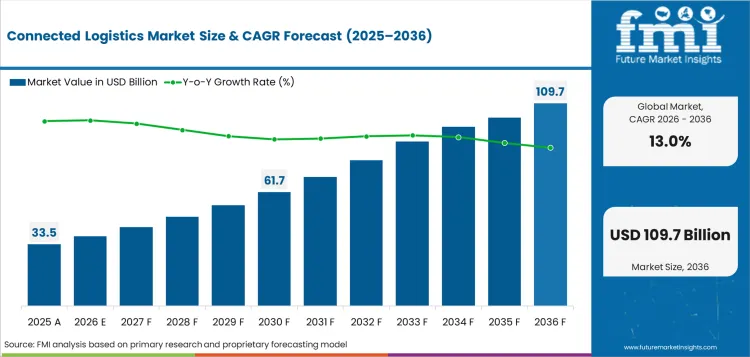
Key Takeaways, Market Size, and Forecast
| Metric | Value |
|---|---|
| Market Size (2025) | USD 33.5 Billion |
| Market Size (2036) | USD 109.7 Billion |
| CAGR (2026–2036) | 11.3% |
| Incremental Opportunity (2026–2036) | USD 72.0 Billion |
| Leading Organization Size (2026) | Large Enterprises |
| Large Enterprises Share (2026) | 61.30% |
| Fastest-Growing Country | China |
| China CAGR | 16.2% |
| 2nd Fastest-Growing Country | India |
| India CAGR | 15.0% |
Freight companies need better control over shipment data across carriers and public systems. India’s ULIP platform shows how logistics data access is being organized through one digital gateway. It connects 39 systems across 11 ministries. It also uses 125 APIs for data exchange. This helps platform vendors build tools linking government data with carrier shipment records. Road freight is the main operating area for connected logistics. The UK moved 168 billion tonne-kilometres by road in 2024, with road carrying 82% of domestic freight. This makes vehicle tracking and delivery alerts important for truck-based networks. Cloud logistics is also becoming more useful as warehouses need shared shipment records. SAP’s October 2025 logistics release targets smaller local warehouses through a cloud-native system, which helps companies add connected tools without heavy internal IT work.
Connected Logistics Market Definition
Connected Logistics Market includes digital systems used to monitor freight, vehicles, assets, warehouses, and shipment activity. Scope includes GPS tracking devices, RFID tags, data loggers, telematics devices, fleet software, asset tracking software, security tools, integration services, and maintenance services. Applications include fleet management, asset tracking, shipment visibility, inventory control, and risk management. Finished freight transport services without connected tracking are outside scope.
Connected Logistics Market Inclusions
Market scope covers all commercially traded connected logistics products and services categorized by component, including connected logistics devices, connected logistics software, and connected logistics services; transportation, including roadways, railways, airways, and seaways; verticals, including manufacturing, automotive, retail and consumer goods, e-commerce logistics, food and beverages, healthcare, energy and utilities, IT and telecom; deployment mode, including cloud based, on premise, and hybrid systems; organization size, including large enterprises and small and medium enterprises; technology, including IoT based logistics, AI enabled logistics, blockchain enabled logistics, and cloud based logistics platforms; and applications, including fleet management, asset tracking, supply chain visibility, inventory management, and security and risk management. Revenue scope covers 2026 to 2036. Key participants include connected logistics platform providers, telematics device manufacturers, cloud service providers, IoT sensor suppliers, fleet operators, freight carriers, warehouse operators, logistics service providers, enterprise supply chain teams, system integrators, software vendors, distributors, and regulatory bodies.
Connected Logistics Market Exclusions
Scope does not include manual freight brokerage, general transport services without digital monitoring, standalone ERP software, non-connected warehouse equipment, or consumer delivery services without enterprise tracking.
Connected Logistics Market Research Methodology
- Primary Research: FMI analysts talked to logistics software providers, fleet operators, telematics firms, warehouse technology providers, and enterprise supply chain teams.
- Desk Research: Desk research combined public logistics data, company product information, transport digitization references, and adjacent fleet management coverage.
- Market sizing and forecasting: Forecasting used base-year market values, segment shares, country CAGRs, platform use patterns, and adoption by component type.
- Data validation: Forecasts were checked against annual market values, country CAGRs, freight activity signals, and company portfolio coverage.
Why is the Connected Logistics Market Growing?
- Freight teams are using connected tools to reduce blind spots across vehicle movement and shipment status.
- Cloud platforms are helping enterprise logistics teams manage carrier data without heavy on-site software upkeep.
- Sensors and telematics are improving operating visibility across road freight and warehouse-linked movement.
Connected logistics demand is rising as freight teams need better cost visibility across transport networks. India placed national logistics cost at 7.97% of GDP for 2023 to 2024 in a DPIIT study. Total logistics cost was estimated at INR 24.01 lakh crore in the same assessment. This cost level makes connected tracking useful for large shippers and logistics service providers during contract planning. LEADS 2025 adds another digital use case as objective data makes up 32.5% of its framework. This improves the need for logistics platforms tracking journey time and truck speed across transport corridors.
Road freight creates a large operating base for connected logistics systems across daily transport operations. Truck networks need vehicle tracking and dispatch control to manage delays during freight movement cycles. Cargo status tools help transport teams monitor exceptions and improve coordination between warehouses and carriers. Connected platforms gain use as teams need faster alerts from trucks and warehouse systems during daily operations.
Market Segmentation Analysis
- Connected logistics devices are estimated to capture 52.60% of the component segment in 2026 as tracking hardware creates the first shipment data layer.
- Roadways are expected to represent 49.80% of the transportation mix in 2026 since truck freight needs frequent location updates.
- Manufacturing is projected to account for 21.40% of vertical use by 2026 as plant-to-customer movement needs better shipment visibility.
- Cloud-based systems are expected to hold 57.60% share across deployment modes in 2026 as logistics teams reduce IT upkeep.
- Fleet management is expected to make up 44.70% of application share in 2026 as transport teams need better vehicle control.
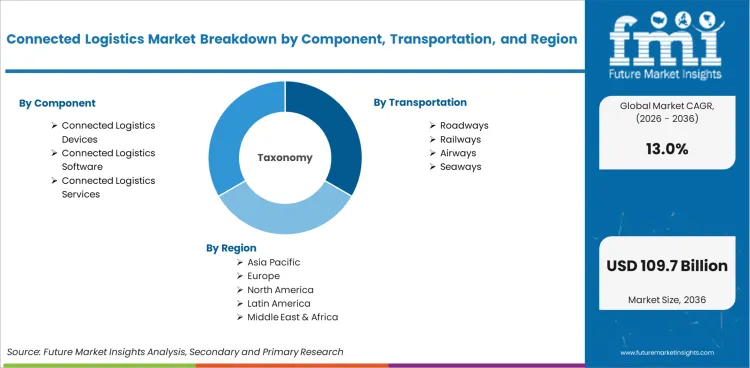
Connected logistics market is divided into primary segment groups based on component, transportation, vertical, deployment mode, organization size, technology, and application. Component includes devices, software, and services. Transportation includes roadways, railways, airways, and seaways. Vertical includes manufacturing, automotive, retail and consumer goods, e-commerce logistics, food and beverages, healthcare, energy and utilities, IT and telecom, and others. Deployment mode includes cloud based, on premise, and hybrid deployment. Organization size includes large enterprises and small and medium enterprises. Technology includes IoT logistics, AI logistics, blockchain logistics, and cloud based logistics platforms.
Insights into Connected Logistics Market by Component
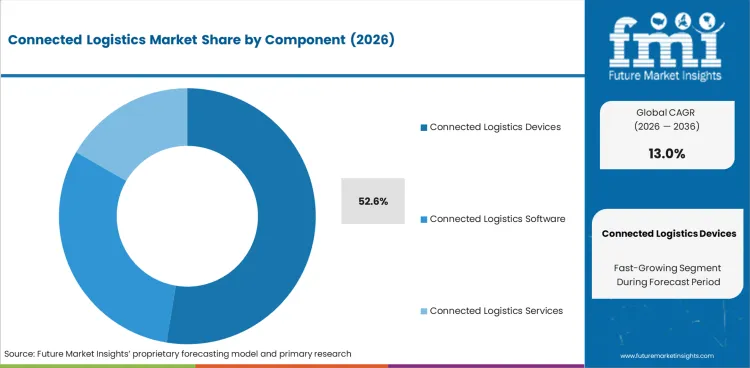
- In 2026, connected logistics devices are expected to make up 52.60% of component demand. Tracking hardware forms the first data layer for shipment visibility across freight networks.
- GPS trackers and RFID tags set field-level records before software turns movement into alerts. Data loggers add value in shipments needing condition checks during transit.
Insights into Connected Logistics Market by Transportation
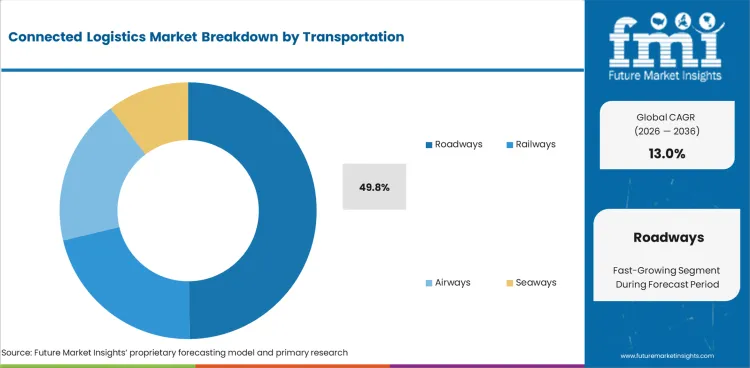
- Roadways are projected to account for 49.80% of transportation demand in 2026. Truck freight needs frequent updates across loading points and delivery locations.
- Road fleets create steady demand for smart fleet management systems. Transport teams use location data and vehicle status records to improve dispatch control.
Insights into Connected Logistics Market by Vertical
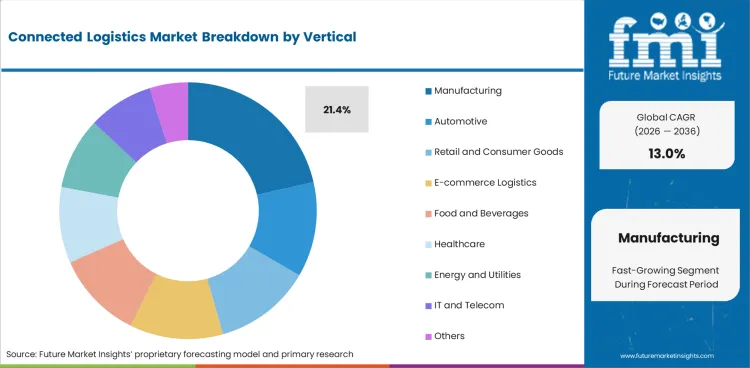
- Manufacturing is expected to hold 21.40% share of vertical segment in 2026. Plant-linked freight requires shipment visibility between production sites and distribution partners.
- Finished goods movement raises a strong need for connected logistics tools. Manufacturers use these systems to track delays and reduce coordination gaps across carriers.
Insights into Connected Logistics Market by Deployment Mode
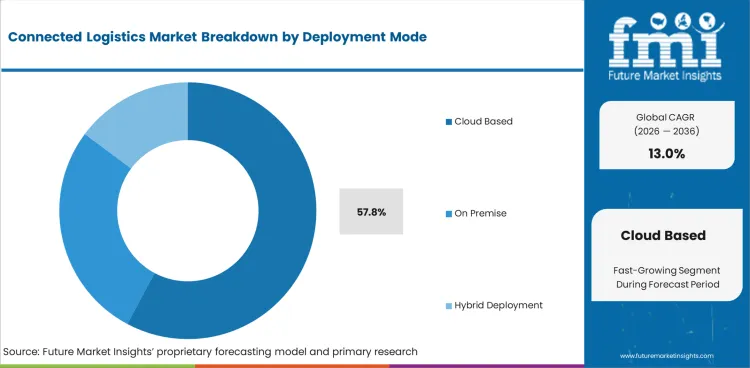
- In 2026, Cloud Based systems are projected to account for 57.60% of deployment mode demand. Logistics teams prefer cloud access for multi-site shipment control.
- Cloud platforms reduce internal server burden for logistics teams. Their value improves as carriers and warehouses need access to shared shipment records.
Insights into Connected Logistics Market by Application
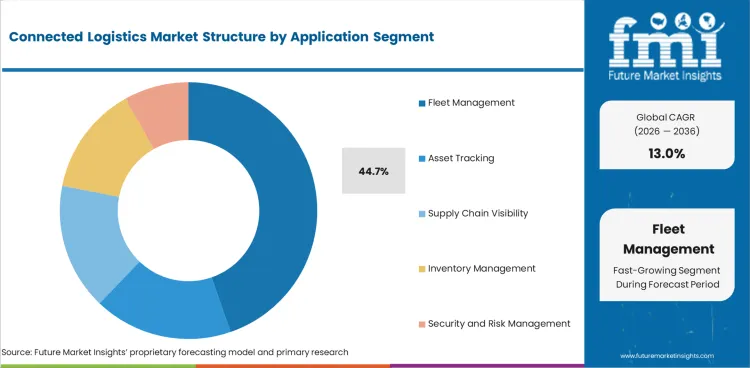
- Fleet management is expected to account for 44.70% of application demand in 2026. Vehicle-heavy freight networks need better control over location and service timing.
- Fleet users need driver behavior records and maintenance alerts to protect delivery performance. Connected tools help transport teams manage vehicles across daily freight operations.
Connected Logistics Market Drivers, Restraints, and Opportunities
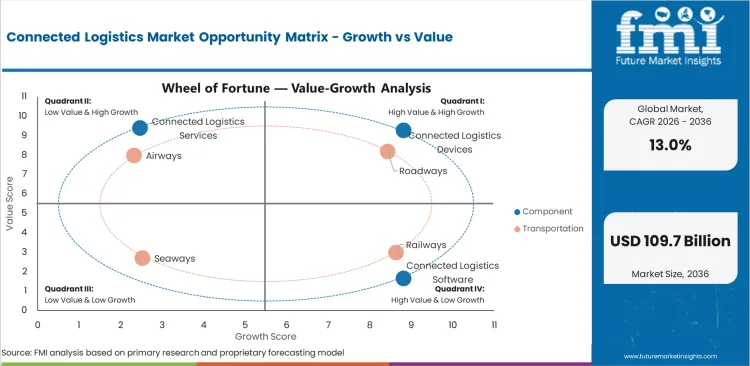
- Vehicle telematics demand is creating wider use of tracking devices across freight trucks and commercial vehicle networks.
- Cloud logistics platforms are reducing software upkeep for enterprises managing many transport partners.
- Integration cost increases pressure for smaller logistics firms as sensors and data mapping raise first-year spending.
- AI-based exception alerts create room for adoption as teams reduce manual delay checks across freight operations.
Demand for connected logistics systems is rising as freight fleets need live shipment data and clearer vehicle control across delivery operations. Cost pressure and platform integration issues can slow adoption among smaller transport firms. Demand continues through cloud based platforms and fleet management applications.
E-Commerce Order Density Is Lifting Platform Pricing
In the connected logistics market, price movement is being shaped by the cost of serving denser digital-order flows alongside software licensing. The USA Census Bureau’s March 2026 report said, fourth-quarter 2025 retail e-commerce sales reached USD 316.1 billion on an adjusted basis, up 1.7% from the previous quarter, and full-year 2025 e-commerce sales reached USD 1,233.7 billion. For logistics buyers, this supports higher spending on shipment visibility and routing tools. It enables premium pricing for exception alerts and API integrations that improve response time. Control-tower capacity helps delivery teams manage peak periods. Vendors with parcel and warehouse connectivity can hold usage-based pricing where retailers need faster delivery confirmation and fewer failed deliveries.
Ocean Volatility Is Repricing Visibility Tools
Connected logistics pricing is also being reset by maritime uncertainty as shippers pay for risk detection alongside shipment tracking. UNCTAD’s September 2025 statement said, global shipping moves over 80% of merchandise trade, and seaborne trade volumes were expected to rise only 0.5% in 2025 after rerouting lifted ton-miles by nearly 6% in 2024. This trend supports pricing for ocean visibility modules and predictive ETA tools. It also supports port congestion alerts and supplier risk dashboards for planning. Vendors may charge more for lane level intelligence where rerouting or skipped port calls raise operational uncertainty. Longer transit times also increase working capital exposure and inventory buffer costs support pricing for visibility tools.
Analysis of Connected Logistics Market By Key Countries
.webp "Top Country Growth Comparison Connected Logistics Market Cagr (2026 2036)")
| Country | CAGR |
|---|---|
| China | 16.2% |
| India | 15.0% |
| Germany | 13.8% |
| Brazil | 12.6% |
| USA | 11.4% |
| UK | 10.2% |
| Japan | 9.0% |
Source: Future Market Insights, 2026.
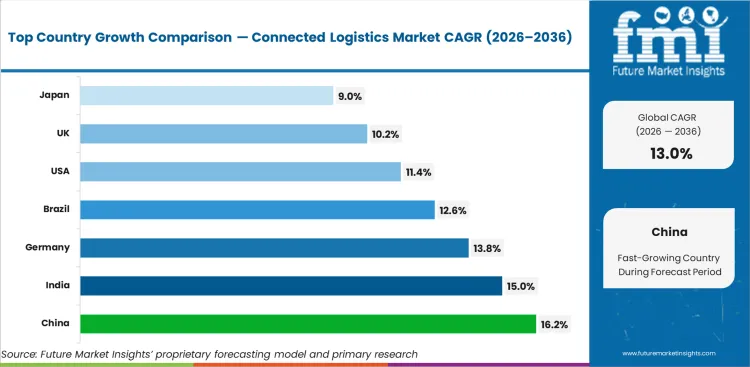
Connected Logistics Market CAGR Analysis By Country
- China is projected to lead country demand with a 16.2% CAGR over the forecast period as industrial freight systems adopt better digital transport tools.
- India is expected to record 15.0% CAGR from 2026 to 2036 as logistics data platforms improve freight visibility.
- Germany is forecast to expand at 13.8% CAGR during the assessment period as manufacturing corridors require better road freight monitoring.
- Brazil is projected to grow at 12.6% CAGR across 2026 to 2036 as long domestic corridors increase the need for freight visibility.
- USA is expected to register 11.4% CAGR over the ten-year forecast as enterprise logistics networks upgrade fleet monitoring systems.
- UK is forecast to record 10.2% CAGR during 2026 to 2036 as road freight intensity raises digital logistics use.
- Japan is projected to expand at 9.0% CAGR across the forecast window as mature logistics networks adopt vehicle data upgrades.
Demand for connected logistics is forecast to rise at 11.3% CAGR from 2026 to 2036. Country-level analysis covers major markets contributing to this forecast, with the key markets listed below.
Demand Outlook for Connected Logistics Market in China
Connected logistics industry in China is projected to record a CAGR of 16.2% through 2036. Industrial freight and e-commerce distribution are increasing the need for connected tracking across China’s logistics network. Air cargo activity adds pressure for better shipment visibility across high-volume transport operations. Connected logistics tools help carriers manage delays and improve exception alerts across busy freight networks.
- Large freight corridors raise demand for connected tracking across road and air cargo networks.
- E-commerce distribution raises use of shipment alerts and warehouse visibility platforms.
- Local platform vendors gain from firms seeking faster freight control across domestic supply chains.
Sales Analysis of Connected Logistics Market in India
Connected logistics sector in India is expected to expand at a CAGR of 15.0% during the assessment period. Public logistics digitization is helping Indian carriers and exporters connect shipment records with operational data more easily. Platform providers gain a wider base for connected logistics tools as government-backed data access improves across freight operations. Digital access improves transport visibility and reduces manual coordination for logistics teams during shipment planning.
- Logistics Data Bank usage creates a better container visibility base across export and import cargo.
- Digital freight systems help firms reduce manual follow-up across carriers and terminals.
- Road freight users need tracking tools with simple integration and lower setup burden.
Demand Outlook for Connected Logistics Market in Germany
Germany’s connected logistics industry is forecast to grow at a CAGR of 13.8% by 2036. Industrial transport networks need reliable vehicle data across motorways and production-linked freight flows. German truck toll mileage for trucks with four or more axles declined 0.7% in April 2026 compared with March 2026, Destatis reported. This short-term movement data increases the value of freight monitoring and planning systems.
- Manufacturing logistics raises demand for route planning and shipment status checks.
- Toll-linked truck data improves visibility into freight movement patterns.
- Platform vendors need strong integration with warehouse and transport planning systems.
Opportunity Analysis of Connected Logistics Market in Brazil
Connected logistics segment in Brazil is expected to advance at 12.6% CAGR over the forecast years. Road freight and cargo storage activity creates a strong need for shipment control across long domestic distances. IBGE reported, freight transport grew 0.9% from January to February 2026, with transport activity helped by road freight and logistics storage. This movement supports fleet tracking and cargo visibility tools.
- Long domestic corridors make vehicle location and delivery status important for shippers.
- Road freight activity creates demand for device-led monitoring and dispatch visibility.
- Logistics storage operators need software able to connect warehouse activity with transport events.
Future Outlook for Connected Logistics Market in the United States
USA connected logistics demand is projected to rise at 11.4% CAGR from 2026 to 2036. Enterprise transport networks already use advanced software, yet cross-border freight scale keeps the upgrade base large. BTS reported, USD 1.6 trillion in USA freight flows with Canada and Mexico during 2025, with trucks moving USD 1.0 trillion of freight. This scale supports steady use of fleet and shipment visibility tools.
- Cross-border trade raises demand for shipment tracking across truck and rail corridors.
- Large enterprises need connected data across transport partners and warehouse networks.
- Cloud platforms improve freight control for firms handling high shipment volume.
Demand Outlook for Connected Logistics Market in the United Kingdom
UK connected logistics industry is expected to post 10.2% CAGR over the assessment period. Road freight carries a large domestic workload, creating demand for connected fleet control and delivery visibility. UK transport statistics reported 82% of domestic freight moved by road in 2024, compared with 10% by water and 8% by rail. Road intensity keeps fleet management at the center of UK connected logistics demand.
- Road freight share favors steady use of vehicle tracking and dispatch systems.
- Retail distribution networks need reliable delivery alerts across regional transport operations.
- Logistics providers benefit from end-to-end multimodal shipment visibility platforms across complex freight moves.
In-depth Analysis of Connected Logistics Market in Japan
Connected logistics industry in Japan is expected to post 9.0% CAGR during the forecast years. Mature logistics networks and labor pressure are moving attention toward digital vehicle and freight tools. METI and MLIT formulated the Mobility DX Strategy in May 2024, with data utilization aimed at improving logistics efficiency and Japanese SDVs targeted at 30% of global SDV sales in 2030 and 2035. This policy direction helps connected vehicle data move into logistics planning.
- Driver workload pressure raises interest in fleet data and routing systems.
- Mobility DX policy supports broader use of connected vehicle and logistics data.
- Logistics firms are expected to adopt targeted upgrades instead of full system replacement.
Competitive Structure and Strategic Positioning
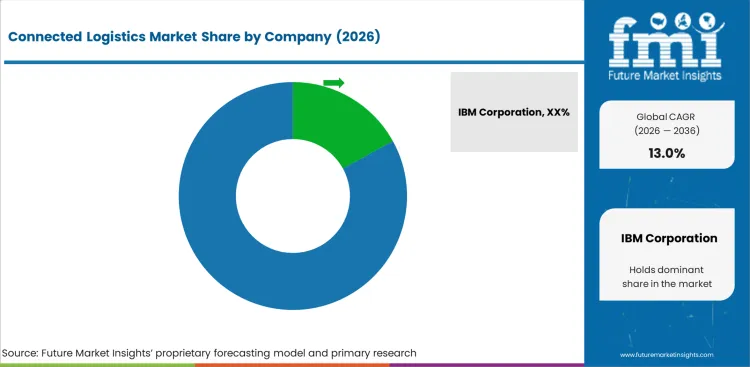
- IBM Corporation leads through enterprise software depth and supply chain integration capability across large connected logistics programs.
- Cisco Systems and AT&T Inc. compete on secure network coverage and IoT connectivity for freight data movement.
- SAP SE and AWS strengthen cloud platform use for connected logistics through planning systems and scalable data tools.
- Oracle Corporation and Microsoft Corporation add cloud infrastructure and analytics services for enterprise freight networks.
Competition in the connected logistics market is shaped by platform depth and network reach. IBM Corporation has a strong position through enterprise workflow systems and supply chain data tools. SAP SE and Oracle Corporation use logistics planning and business network integration. Cisco Systems and AT&T Inc. add secure connectivity for freight data movement. Intel Corporation contributes hardware and edge computing strength across connected logistics systems. Huawei Technologies and Bosch Connected Logistics hold specialist roles in logistics platforms and connected transport tools.
Integration cost and device maintenance create entry barriers for smaller vendors. Platform lock-in and data ownership concerns also affect supplier selection during large enterprise rollouts. Successful vendors need to offer easier onboarding and better security across freight operations. Vendors able to connect devices and cloud dashboards with limited internal work are more likely to win. Broader software coverage and reliable network capability can reduce coordination pressure for logistics teams.
Key Companies in the Connected Logistics Market
Key global companies leading Connected Logistics Market include:
- IBM Corporation, SAP SE, and Oracle Corporation have strong enterprise platform coverage for logistics workflow and supply chain integration.
- Cisco Systems, Intel Corporation, and AT&T Inc. serve logistics firms through IoT connectivity, secure networks, and edge computing.
- AWS, Microsoft Corporation, Huawei Technologies Co., Ltd., and Bosch Connected Logistics hold strong positions across cloud logistics and connected transport tools.
Competitive Benchmarking: Connected Logistics Market
| Company | Platform Integration Depth | IoT Connectivity Coverage | Freight Data Capability | Geographic Footprint |
|---|---|---|---|---|
| IBM Corporation | High | Medium | Strong | Global |
| Cisco Systems, Inc. | Medium | High | Strong | Global |
| SAP SE | High | Medium | Strong | Global |
| Intel Corporation | Medium | High | Medium | Global |
| AT&T Inc. | Medium | High | Strong | North America with global enterprise coverage |
| Amazon Web Services | High | Medium | Strong | Global |
| Oracle Corporation | High | Medium | Strong | Global |
| Microsoft Corporation | High | Medium | Strong | Global |
| Huawei Technologies Co., Ltd. | High | High | Strong | Asia Pacific with global coverage |
| Bosch Connected Logistics | Medium | High | Strong | Europe with global logistics coverage |
Source: Future Market Insights, 2026.
Key Developments in Connected Logistics Market
- In May 2025, Maersk began rolling out a next-generation IoT connectivity platform across 450 vessels, including all Maersk-owned vessels and over 100 time-chartered vessels. The upgrade moves onboard infrastructure from 2G to 4G, improving real-time cargo tracking, reefer monitoring, supply chain visibility, and data granularity for connected container operations.
- In April 2025, Tive launched Solo Pro, a validated real-time visibility tracker for biologics and pharmaceutical shipments. The device supports live location and condition monitoring across global shipments, including temperature, humidity, light, shock, motion, and tilt tracking, helping logistics teams reduce cold-chain excursions and release delays.
Key Players in the Connected Logistics Market
Major Global Players:
- IBM Corporation
- Cisco Systems, Inc.
- SAP SE
- Intel Corporation
- AT&T Inc.
- Amazon Web Services
- Oracle Corporation
- Microsoft Corporation
- Huawei Technologies Co., Ltd.
Specialist Players:
- Bosch Connected Logistics
Report Scope and Coverage
| Parameter | Details |
|---|---|
| Quantitative Units | USD 37.7 billion to USD 109.7 billion, at a CAGR of 11.3% |
| Market Definition | Connected Logistics Market covers digital systems used to monitor freight, vehicles, assets, warehouses, and shipment activity. |
| Regions Covered | North America, Latin America, Europe, East Asia, South Asia and Pacific, Middle East and Africa |
| Countries Covered | USA, UK, Germany, China, India, Japan, Brazil, and 30 plus countries |
| Key Companies Profiled | IBM Corporation, Cisco Systems, Inc., SAP SE, Intel Corporation, AT&T Inc., AWS, Oracle Corporation, Microsoft Corporation, Huawei Technologies Co., Ltd., Bosch Connected Logistics |
| Forecast Period | 2026 to 2036 |
| Approach | Hybrid bottom-up and top-down methodology using base-year market values, segment shares, and country CAGR inputs. |
Connected Logistics Market by Segments
Connected Logistics Market Segmented by Component:
- Connected Logistics Devices
- Connected Logistics Software
- Connected Logistics Services
Connected Logistics Market Segmented by Transportation:
- Roadways
- Railways
- Airways
- Seaways
Connected Logistics Market Segmented by Vertical:
- Manufacturing
- Automotive
- Retail and Consumer Goods
- E-commerce Logistics
- Food and Beverages
- Healthcare
- Energy and Utilities
- IT and Telecom
- Others
Connected Logistics Market Segmented by Deployment Mode:
- Cloud Based
- On Premise
- Hybrid Deployment
Connected Logistics Market Segmented by Organization Size:
- Large Enterprises
- Small and Medium Enterprises
Connected Logistics Market Segmented by Technology:
- IoT-Based Logistics
- AI-Enabled Logistics
- Blockchain-Enabled Logistics
- Cloud-Based Logistics Platforms
Connected Logistics Market Segmented by Application:
- Fleet Management
- Asset Tracking
- Supply Chain Visibility
- Inventory Management
- Security and Risk Management
Connected Logistics Market by Region:
- North America
- USA
- Canada
- Mexico
- Latin America
- Brazil
- Chile
- Rest of Latin America
- Europe
- Germany
- UK
- Italy
- Spain
- France
- Rest of Europe
- East Asia
- China
- Japan
- South Korea
- South Asia and Pacific
- India
- ASEAN
- Australia & New Zealand
- Rest of South Asia and Pacific
- Middle East and Africa
- Saudi Arabia
- Other GCC Countries
- South Africa
- Rest of Middle East and Africa
Research Sources and Bibliography
- Press Information Bureau. (2025, November 27). From growth engine to global edge: Supercharging India’s logistics. Ministry of Commerce and Industry, Government of India.
- UN Trade and Development. (2025, September 24). Stormy seas for global shipping: UNCTAD warns of uncertainty, volatility and rising costs.
- United States Census Bureau. (2026, March 10). Quarterly Retail E-Commerce Sales Report.
- A.P. Moller - Maersk. (2025, May 5). Smart Shipping: Maersk upgrades IoT connectivity across its fleet.
- Tive. (2025, April 9). Tive launches Solo Pro: All-in-one, validated, real-time visibility solution to accelerate pharmaceutical product releases.
- Amazon Web Services. (2024, January). Announcing AWS Supply Chain Supply Planning.
- Bosch Media Service. (2024, June). Bosch offers software, services, and smart technology for mobility.
- Bureau of Transportation Statistics. (2026, March). Transborder Freight Data Annual Report: 2025.
- Department for Transport. (2025, December). Transport Statistics Great Britain: 2024 Freight.
- Federal Statistical Office of Germany. (2026, May). Truck toll mileage index in April 2026: -0.7% on the previous month.
- IBGE News Agency. (2026, April). Services advance 0.1% in February, driven by information and communication and road freight transport.
- Ministry of Commerce and Industry. (2024, December). ULIP launch simplifies industry access to data through API-based integration.
- Ministry of Economy, Trade and Industry. (2024, May). Mobility Digital Transformation Strategy Formulated.
- SAP News Center. (2024, April). RISE with SAP: Finance and Supply Chain Add-On Packages.
- SAP News Center. (2025, October). Innovative Updates for Supply Chain Management.
This Report Answers
- What is the current and future size of Connected Logistics Market?
- How fast is Connected Logistics Market expected to expand between 2026 and 2036?
- Which component segment is expected to lead the market by 2026?
- Which transportation segment is expected to account for the highest demand by 2026?
- What factors are driving demand for connected logistics globally?
- How are cloud platforms influencing connected logistics adoption?
- Why are large enterprises the main demand base for connected logistics systems?
- How are road freight networks creating demand for connected fleet tools?
- Which countries are projected to record faster expansion through 2036?
- What is driving market expansion in China and India?
- Who are the key companies active in Connected Logistics Market?
- How does FMI estimate and validate the market forecast?
Frequently Asked Questions
What is the global market demand for Connected Logistics in 2026?
In 2026, Connected Logistics Market is expected to be worth USD 37.7 billion.
How big will Connected Logistics Market be in 2036?
By 2036, Connected Logistics Market is expected to be worth USD 109.7 billion.
How much is demand for Connected Logistics expected to expand between 2026 and 2036?
Between 2026 and 2036, demand for connected logistics is expected to expand at a CAGR of 11.3%.
Which component segment is likely to be the best seller globally by 2026?
Connected Logistics Devices will make up 52.60% of the component segment in 2026.
What is causing demand to rise in China?
China Connected Logistics Market is projected to record 16.2% CAGR through 2036, helped by industrial freight and digital transport systems.
What is causing demand to rise in India?
India Connected Logistics Market is projected to expand at 15.0% CAGR through 2036, helped by logistics data platforms and freight visibility tools.
What does Connected Logistics Market definition include?
Connected Logistics Market includes digital systems used to track freight, vehicles, assets, warehouses, and shipment activity.
How does FMI make the Connected Logistics forecast and check it?
Forecasting uses base values, segment shares, CAGRs, and freight checks.
Preview the report firsthand - request a free sample
Get SampleGet the brochure for pricing and purchase details.
Get PDFTable of Content
- Executive Summary
- Global Market Outlook
- Demand-side Trends
- Supply-side Trends
- Technology Roadmap Analysis
- Analysis and Recommendations
- Market Overview
- Market Coverage / Taxonomy
- Market Definition / Scope / Limitations
- Research Methodology
- Chapter Orientation
- Analytical Lens and Working Hypotheses
- Market Structure, Signals, and Trend Drivers
- Benchmarking and Cross-market Comparability
- Market Sizing, Forecasting, and Opportunity Mapping
- Research Design and Evidence Framework
- Desk Research Programme (Secondary Evidence)
- Company Annual and Sustainability Reports
- Peer-reviewed Journals and Academic Literature
- Corporate Websites, Product Literature, and Technical Notes
- Earnings Decks and Investor Briefings
- Statutory Filings and Regulatory Disclosures
- Technical White Papers and Standards Notes
- Trade Journals, Industry Magazines, and Analyst Briefs
- Conference Proceedings, Webinars, and Seminar Materials
- Government Statistics Portals and Public Data Releases
- Press Releases and Reputable Media Coverage
- Specialist Newsletters and Curated Briefings
- Sector Databases and Reference Repositories
- FMI Internal Proprietary Databases and Historical Market Datasets
- Subscription Datasets and Paid Sources
- Social Channels, Communities, and Digital Listening Inputs
- Additional Desk Sources
- Expert Input and Fieldwork (Primary Evidence)
- Primary Modes
- Qualitative Interviews and Expert Elicitation
- Quantitative Surveys and Structured Data Capture
- Blended Approach
- Why Primary Evidence is Used
- Field Techniques
- Interviews
- Surveys
- Focus Groups
- Observational and In-context Research
- Social and Community Interactions
- Stakeholder Universe Engaged
- C-suite Leaders
- Board Members
- Presidents and Vice Presidents
- R&D and Innovation Heads
- Technical Specialists
- Domain Subject-matter Experts
- Scientists
- Physicians and Other Healthcare Professionals
- Governance, Ethics, and Data Stewardship
- Research Ethics
- Data Integrity and Handling
- Primary Modes
- Tooling, Models, and Reference Databases
- Desk Research Programme (Secondary Evidence)
- Data Engineering and Model Build
- Data Acquisition and Ingestion
- Trends
- Scenario Forecast
- Demand in Optimistic Scenario
- Demand in Likely Scenario
- Demand in Conservative Scenario
- Opportunity Map Analysis
- Product Life Cycle Analysis
- Supply Chain Analysis
- Investment Feasibility Matrix
- Value Chain Analysis
- PESTLE and Porter’s Analysis
- Regulatory Landscape
- Regional Parent Market Outlook
- Production and Consumption Statistics
- Import and Export Statistics
- Global Market Analysis 2021 to 2025 and Forecast, 2026 to 2036
- Historical Market Size Value (USD Million) Analysis, 2021 to 2025
- Current and Future Market Size Value (USD Million) Projections, 2026 to 2036
- Y-o-Y Growth Trend Analysis
- Absolute $ Opportunity Analysis
- Global Market Pricing Analysis 2021 to 2025 and Forecast 2026 to 2036
- Global Market Analysis 2021 to 2025 and Forecast 2026 to 2036, By Component
- Introduction / Key Findings
- Historical Market Size Value (USD Million) Analysis By Component , 2021 to 2025
- Current and Future Market Size Value (USD Million) Analysis and Forecast By Component , 2026 to 2036
- Connected Logistics Devices
- Connected Logistics Software
- Connected Logistics Services
- Connected Logistics Devices
- Y-o-Y Growth Trend Analysis By Component , 2021 to 2025
- Absolute $ Opportunity Analysis By Component , 2026 to 2036
- Global Market Analysis 2021 to 2025 and Forecast 2026 to 2036, By Transportation
- Introduction / Key Findings
- Historical Market Size Value (USD Million) Analysis By Transportation, 2021 to 2025
- Current and Future Market Size Value (USD Million) Analysis and Forecast By Transportation, 2026 to 2036
- Roadways
- Railways
- Airways
- Seaways
- Roadways
- Y-o-Y Growth Trend Analysis By Transportation, 2021 to 2025
- Absolute $ Opportunity Analysis By Transportation, 2026 to 2036
- Global Market Analysis 2021 to 2025 and Forecast 2026 to 2036, By Vertical
- Introduction / Key Findings
- Historical Market Size Value (USD Million) Analysis By Vertical, 2021 to 2025
- Current and Future Market Size Value (USD Million) Analysis and Forecast By Vertical, 2026 to 2036
- Manufacturing
- Automotive
- Retail and Consumer Goods
- E-commerce Logistics
- Food and Beverages
- Healthcare
- Energy and Utilities
- IT and Telecom
- Others
- Manufacturing
- Y-o-Y Growth Trend Analysis By Vertical, 2021 to 2025
- Absolute $ Opportunity Analysis By Vertical, 2026 to 2036
- Global Market Analysis 2021 to 2025 and Forecast 2026 to 2036, By Deployment Mode
- Introduction / Key Findings
- Historical Market Size Value (USD Million) Analysis By Deployment Mode, 2021 to 2025
- Current and Future Market Size Value (USD Million) Analysis and Forecast By Deployment Mode, 2026 to 2036
- Cloud Based
- On Premise
- Hybrid Deployment
- Cloud Based
- Y-o-Y Growth Trend Analysis By Deployment Mode, 2021 to 2025
- Absolute $ Opportunity Analysis By Deployment Mode, 2026 to 2036
- Global Market Analysis 2021 to 2025 and Forecast 2026 to 2036, By Application
- Introduction / Key Findings
- Historical Market Size Value (USD Million) Analysis By Application, 2021 to 2025
- Current and Future Market Size Value (USD Million) Analysis and Forecast By Application, 2026 to 2036
- Fleet Management
- Asset Tracking
- Supply Chain Visibility
- Inventory Management
- Security and Risk Management
- Fleet Management
- Y-o-Y Growth Trend Analysis By Application, 2021 to 2025
- Absolute $ Opportunity Analysis By Application, 2026 to 2036
- Global Market Analysis 2021 to 2025 and Forecast 2026 to 2036, By Region
- Introduction
- Historical Market Size Value (USD Million) Analysis By Region, 2021 to 2025
- Current Market Size Value (USD Million) Analysis and Forecast By Region, 2026 to 2036
- North America
- Latin America
- Western Europe
- Eastern Europe
- East Asia
- South Asia and Pacific
- Middle East & Africa
- Market Attractiveness Analysis By Region
- North America Market Analysis 2021 to 2025 and Forecast 2026 to 2036, By Country
- Historical Market Size Value (USD Million) Trend Analysis By Market Taxonomy, 2021 to 2025
- Market Size Value (USD Million) Forecast By Market Taxonomy, 2026 to 2036
- By Country
- USA
- Canada
- Mexico
- By Component
- By Transportation
- By Vertical
- By Deployment Mode
- By Application
- By Country
- Market Attractiveness Analysis
- By Country
- By Component
- By Transportation
- By Vertical
- By Deployment Mode
- By Application
- Key Takeaways
- Latin America Market Analysis 2021 to 2025 and Forecast 2026 to 2036, By Country
- Historical Market Size Value (USD Million) Trend Analysis By Market Taxonomy, 2021 to 2025
- Market Size Value (USD Million) Forecast By Market Taxonomy, 2026 to 2036
- By Country
- Brazil
- Chile
- Rest of Latin America
- By Component
- By Transportation
- By Vertical
- By Deployment Mode
- By Application
- By Country
- Market Attractiveness Analysis
- By Country
- By Component
- By Transportation
- By Vertical
- By Deployment Mode
- By Application
- Key Takeaways
- Western Europe Market Analysis 2021 to 2025 and Forecast 2026 to 2036, By Country
- Historical Market Size Value (USD Million) Trend Analysis By Market Taxonomy, 2021 to 2025
- Market Size Value (USD Million) Forecast By Market Taxonomy, 2026 to 2036
- By Country
- Germany
- UK
- Italy
- Spain
- France
- Nordic
- BENELUX
- Rest of Western Europe
- By Component
- By Transportation
- By Vertical
- By Deployment Mode
- By Application
- By Country
- Market Attractiveness Analysis
- By Country
- By Component
- By Transportation
- By Vertical
- By Deployment Mode
- By Application
- Key Takeaways
- Eastern Europe Market Analysis 2021 to 2025 and Forecast 2026 to 2036, By Country
- Historical Market Size Value (USD Million) Trend Analysis By Market Taxonomy, 2021 to 2025
- Market Size Value (USD Million) Forecast By Market Taxonomy, 2026 to 2036
- By Country
- Russia
- Poland
- Hungary
- Balkan & Baltic
- Rest of Eastern Europe
- By Component
- By Transportation
- By Vertical
- By Deployment Mode
- By Application
- By Country
- Market Attractiveness Analysis
- By Country
- By Component
- By Transportation
- By Vertical
- By Deployment Mode
- By Application
- Key Takeaways
- East Asia Market Analysis 2021 to 2025 and Forecast 2026 to 2036, By Country
- Historical Market Size Value (USD Million) Trend Analysis By Market Taxonomy, 2021 to 2025
- Market Size Value (USD Million) Forecast By Market Taxonomy, 2026 to 2036
- By Country
- China
- Japan
- South Korea
- By Component
- By Transportation
- By Vertical
- By Deployment Mode
- By Application
- By Country
- Market Attractiveness Analysis
- By Country
- By Component
- By Transportation
- By Vertical
- By Deployment Mode
- By Application
- Key Takeaways
- South Asia and Pacific Market Analysis 2021 to 2025 and Forecast 2026 to 2036, By Country
- Historical Market Size Value (USD Million) Trend Analysis By Market Taxonomy, 2021 to 2025
- Market Size Value (USD Million) Forecast By Market Taxonomy, 2026 to 2036
- By Country
- India
- ASEAN
- Australia & New Zealand
- Rest of South Asia and Pacific
- By Component
- By Transportation
- By Vertical
- By Deployment Mode
- By Application
- By Country
- Market Attractiveness Analysis
- By Country
- By Component
- By Transportation
- By Vertical
- By Deployment Mode
- By Application
- Key Takeaways
- Middle East & Africa Market Analysis 2021 to 2025 and Forecast 2026 to 2036, By Country
- Historical Market Size Value (USD Million) Trend Analysis By Market Taxonomy, 2021 to 2025
- Market Size Value (USD Million) Forecast By Market Taxonomy, 2026 to 2036
- By Country
- Kingdom of Saudi Arabia
- Other GCC Countries
- Turkiye
- South Africa
- Other African Union
- Rest of Middle East & Africa
- By Component
- By Transportation
- By Vertical
- By Deployment Mode
- By Application
- By Country
- Market Attractiveness Analysis
- By Country
- By Component
- By Transportation
- By Vertical
- By Deployment Mode
- By Application
- Key Takeaways
- Key Countries Market Analysis
- USA
- Pricing Analysis
- Market Share Analysis, 2025
- By Component
- By Transportation
- By Vertical
- By Deployment Mode
- By Application
- Canada
- Pricing Analysis
- Market Share Analysis, 2025
- By Component
- By Transportation
- By Vertical
- By Deployment Mode
- By Application
- Mexico
- Pricing Analysis
- Market Share Analysis, 2025
- By Component
- By Transportation
- By Vertical
- By Deployment Mode
- By Application
- Brazil
- Pricing Analysis
- Market Share Analysis, 2025
- By Component
- By Transportation
- By Vertical
- By Deployment Mode
- By Application
- Chile
- Pricing Analysis
- Market Share Analysis, 2025
- By Component
- By Transportation
- By Vertical
- By Deployment Mode
- By Application
- Germany
- Pricing Analysis
- Market Share Analysis, 2025
- By Component
- By Transportation
- By Vertical
- By Deployment Mode
- By Application
- UK
- Pricing Analysis
- Market Share Analysis, 2025
- By Component
- By Transportation
- By Vertical
- By Deployment Mode
- By Application
- Italy
- Pricing Analysis
- Market Share Analysis, 2025
- By Component
- By Transportation
- By Vertical
- By Deployment Mode
- By Application
- Spain
- Pricing Analysis
- Market Share Analysis, 2025
- By Component
- By Transportation
- By Vertical
- By Deployment Mode
- By Application
- France
- Pricing Analysis
- Market Share Analysis, 2025
- By Component
- By Transportation
- By Vertical
- By Deployment Mode
- By Application
- India
- Pricing Analysis
- Market Share Analysis, 2025
- By Component
- By Transportation
- By Vertical
- By Deployment Mode
- By Application
- ASEAN
- Pricing Analysis
- Market Share Analysis, 2025
- By Component
- By Transportation
- By Vertical
- By Deployment Mode
- By Application
- Australia & New Zealand
- Pricing Analysis
- Market Share Analysis, 2025
- By Component
- By Transportation
- By Vertical
- By Deployment Mode
- By Application
- China
- Pricing Analysis
- Market Share Analysis, 2025
- By Component
- By Transportation
- By Vertical
- By Deployment Mode
- By Application
- Japan
- Pricing Analysis
- Market Share Analysis, 2025
- By Component
- By Transportation
- By Vertical
- By Deployment Mode
- By Application
- South Korea
- Pricing Analysis
- Market Share Analysis, 2025
- By Component
- By Transportation
- By Vertical
- By Deployment Mode
- By Application
- Russia
- Pricing Analysis
- Market Share Analysis, 2025
- By Component
- By Transportation
- By Vertical
- By Deployment Mode
- By Application
- Poland
- Pricing Analysis
- Market Share Analysis, 2025
- By Component
- By Transportation
- By Vertical
- By Deployment Mode
- By Application
- Hungary
- Pricing Analysis
- Market Share Analysis, 2025
- By Component
- By Transportation
- By Vertical
- By Deployment Mode
- By Application
- Kingdom of Saudi Arabia
- Pricing Analysis
- Market Share Analysis, 2025
- By Component
- By Transportation
- By Vertical
- By Deployment Mode
- By Application
- Turkiye
- Pricing Analysis
- Market Share Analysis, 2025
- By Component
- By Transportation
- By Vertical
- By Deployment Mode
- By Application
- South Africa
- Pricing Analysis
- Market Share Analysis, 2025
- By Component
- By Transportation
- By Vertical
- By Deployment Mode
- By Application
- USA
- Market Structure Analysis
- Competition Dashboard
- Competition Benchmarking
- Market Share Analysis of Top Players
- By Regional
- By Component
- By Transportation
- By Vertical
- By Deployment Mode
- By Application
- Competition Analysis
- Competition Deep Dive
- IBM Corporation
- Overview
- Product Portfolio
- Profitability by Market Segments (Product/Age /Sales Channel/Region)
- Sales Footprint
- Strategy Overview
- Marketing Strategy
- Product Strategy
- Channel Strategy
- Cisco Systems, Inc.
- SAP SE
- Intel Corporation
- AT&T Inc.
- Amazon Web Services
- Oracle Corporation
- Microsoft Corporation
- Huawei Technologies Co., Ltd.
- Bosch Connected Logistics
- IBM Corporation
- Competition Deep Dive
- Assumptions & Acronyms Used


