

- Industry Size (2026)
- USD 420.0 Mn
- Forecast (2036)
- USD 1080.0 Mn
- CAGR (2026 to 2036)
- 9.9%
Bamboo Straw Market Size, Market Forecast and Outlook By FMI
The bamboo straw market value stood at USD 382.2 million in 2025 with a robust expansion of the sector anticipated to cross USD 420.0 million in 2026 at a projected CAGR of 9.9% during the forecast period. Demand outlook takes total valuation to an estimate USD 1,080.0 million by 2036 as reusable use cases remain easier to explain than single-use claims, sellers keep positioning bamboo as a low-tech but credible material choice, and buying interest stays strongest in settings where material appearance matters almost as much as function.
Summary of Bamboo Straw Market
- The bamboo straw industry is forecast to reach USD 1,080.0 million by 2036.
- Demand for the sector is expected to scale at a CAGR of 9.9% from 2026 to 2036.
- The bamboo straw market value secured USD 382.2 million in 2025.
- Industry sales are expected to surpass USD 420.0 million in 2026.
- Reusable bamboo straws are poised to lead product type with an estimated 68.0% share in 2026.
- Foodservice is set to remain the leading end use with an expected 52.0% share in 2026.
- Natural bamboo is ready to secure a lead in material type with an anticipated 82.0% share in 2026.
- Hospitality bulk packs are set to secure an estimated 46.0% share in pack format.
- Direct ecommerce is poised to lead the sales-channel segment with a projected 54.0% share in 2026.
- East Asia is expected to hold the largest regional share at 38.0% in 2026, while India is projected to record the fastest country-level expansion through 2036.
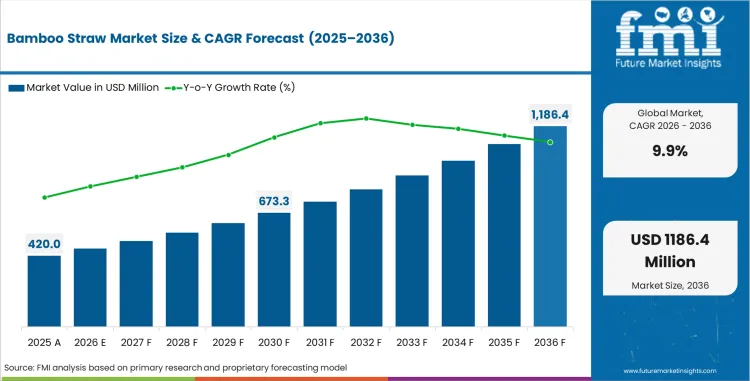
Key Takeaways, Market Size, and Forecast
| Metric | Value |
|---|---|
| Market Size (2025) | USD 382.2 Million |
| Market Size (2026) | USD 420.0 Million |
| Market Size (2036) | USD 1,080.0 Million |
| CAGR (2026–2036) | 9.9% |
| Incremental Opportunity (2026–2036) | USD 660.0 Million |
| Leading Product Type (2026) | Reusable Bamboo Straws (68.0%) |
| Fastest-Growing Country | India (12.8% CAGR through 2036) |
Bamboo Straw Market Key Takeaways (Table)
| Parameter | Details |
|---|---|
| Market value (2026) | USD 420.0 million |
| Forecast value (2036) | USD 1,080.0 million |
| CAGR (2026 to 2036) | 9.9% |
| Estimated market value (2025) | USD 382.2 million |
| Leading end use | Foodservice |
| End-use share (2026) | 52.0% |
| Leading product type | Reusable bamboo straws |
| Product-type share (2026) | 68.0% |
| Leading material type | Natural bamboo |
| Material-type share (2026) | 82.0% |
| Leading sales channel | Direct ecommerce |
| Sales-channel share (2026) | 54.0% |
| Leading diameter | Standard diameter |
| Diameter share (2026) | 56.0% |
| Leading pack format | Hospitality bulk packs |
| Pack-format share (2026) | 46.0% |
| Leading region | East Asia |
| Regional share (2026) | 38.0% |
| Fastest-growing country | India |
| India CAGR | 12.8% |
Source: Future Market Insights, 2026.
Food outlets and small lifestyle retailers now face a different decision from the one they faced a few years ago. Earlier purchases were often about finding any plastic replacement that looked acceptable on the counter. Current buying logic is narrower and more practical. Operators want a straw that looks natural, survives service, and does not create awkward explanation at the point of use. Reusable formats often answer that need better than throwaway formats, which is why reusable straws and eco-friendly straws remain the closest internal reference points for how substitution is playing out. Low processing can help the product story, yet the same raw feel can raise questions around cleaning and uniformity in fast-moving beverage settings. Category progress depends on whether natural bamboo appearance can be retained without creating extra cleaning, service, or consistency friction in daily beverage use.
Repeat demand becomes easier once buyers stop treating bamboo straws as a symbolic switch and start treating them as a normal line item with a clear use case. Material trust is the gate condition in this category. Café counters, hotel beverage service, and eco-lifestyle stores all help trigger it when the product arrives clean, sized for common drinks, and easy to explain beside other straw demand options.
Wider adoption usually follows once service staff and end users feel no need to ask why bamboo was chosen in the first place. Familiarity reduces hesitation, and that simple shift makes the next order easier to justify than the first. Scale improves only after that routine trust settles into normal ordering behaviour. As Helen Giles, Managing Director of Environmental Sustainability at Southwest Airlines, reported, "We expect our new bamboo cold cup, wood stir stick, and other initiatives to exceed our goal to reduce plastics from inflight service by 50% by weight by 2025, and we're excited to continue collaborating with our suppliers to work toward our goal of fully eliminating, where feasible, single-use plastics from inflight service by 2030."
India is expected to record the fastest pace at 12.8% because raw material familiarity and visible non-plastic positioning can work together in the same demand base. China seemingly follows at a projected 11.6% where manufacturing depth and export-oriented supply support category continuity. Indonesia is likely to expand at an anticipated 9.9% as handcrafted origin stories remain commercially useful in direct-to-consumer packs. Sales in the USA are projected to rise at a CAGR of 8.8% by 2036 as eco-lifestyle retail and café usage keep the category visible, while the United Kingdom at 7.9%, Germany at 7.6%, and Japan at 7.1% are expected to expand on steadier replacement-led demand. Divergence across countries reflects differences in raw-material familiarity, retail storytelling strength, and substitute pressure from paper, metal, and other reusable straw formats. Supply-side confidence matters as much as policy language in a category that still competes with paper, metal, and fiber-based alternatives.
Segmental Analysis
Key Facts About Segments
- Beverage outlets keep foodservice as the largest end-use segment, with an anticipated 52.0% share expected in 2026. Daily service at cafés, juice counters, bars, and quick beverage points creates the clearest reorder pattern for bamboo straws.
- Reusable bamboo straws are projected to account for 68.0% of the market in 2026 because the value proposition is easier to justify when the straw can be washed and reused. Disposable bamboo straws remain relevant where buyers want a natural visual cue for events or quick service without taking on post-use cleaning.
- Material preference stays concentrated in natural bamboo, which is expected to contribute 82.0% share in 2026. Simple cut-stem construction keeps the product easy to explain and easier to merchandise in foodservice and eco-retail.
- Online-first selling keeps direct ecommerce in the lead, with an anticipated 54.0% share anticipated in 2026. This channel gives enough room to explain cleaning brushes, diameter choice, and care instructions before purchase.
- Disposable bamboo straws garner an expected 22.0% share where buyers want a natural look for events or quick service without adding cleaning work after use.
- Treated bamboo fiber is expected to hold 12.0% share in 2026. It can improve finish consistency, though added processing makes the raw bamboo story less direct for buyers.
Bamboo Straw Market Analysis by End Use
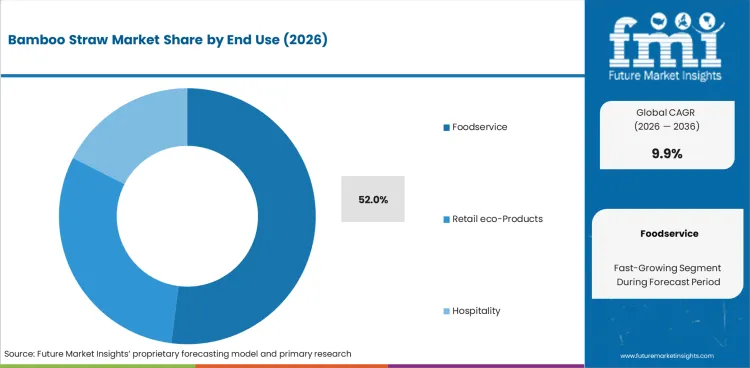
Drink service decides where bamboo straws move from idea to repeat order. Foodservice is anticipated to hold 52.0% share in 2026 because cafés, juice counters, bars, and quick beverage outlets create the clearest daily need for a visible non-plastic straw. Retail eco-products work better as a discovery channel than as the main volume engine because purchase cycles are slower and comparison with paper or steel happens on the shelf. Hospitality contributes where guest experience and table presentation matter, yet housekeeping routines and consistency needs can narrow faster adoption. Foodservice thereby accounts as the clearest commercial base, while bagasse tableware products and other fiber substitutes keep pressure on outlets that want a simpler single-use story.
- Outlet Turnover: Beverage counters reorder faster because straw use is tied to daily service rather than occasional household need.
- Shelf Comparison: Retail packs face more direct comparison with paper, steel, and silicone alternatives before purchase.
- Service Discipline: Hospitality demand improves when presentation standards and cleaning routines can be maintained without extra friction.
Bamboo Straw Market Analysis by Product type
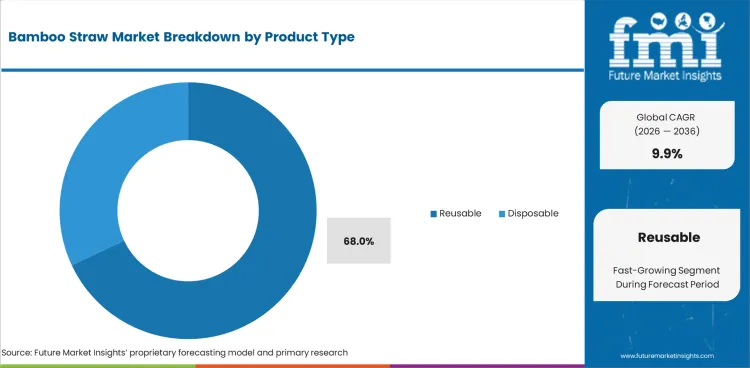
Product type matters because bamboo works best when the buyer sees a reason to accept natural variation. Reusable bamboo straws are projected to account for 68.0% of the market in 2026 because the product story becomes easier to justify when the straw can be washed and used again. Disposable bamboo straws remain relevant where buyers want a natural look for events or quick service yet do not want ongoing cleaning. Reusable formats also benefit from stronger storytelling across direct-to-consumer sets and café counter displays. Disposable formats still face a harder question around cost versus paper. Category behaves more like a reuse-led lifestyle item than a pure throwaway utensil, which is why bamboo outlook offers a closer internal read than broad single-use substitution alone.
- Reuse Logic: Repeat use helps justify the material choice and helps bamboo stand apart from paper.
- Event Demand: Disposable packs stay relevant in occasions where cleanup speed matters more than repeat use.
- Story Strength: Reusable sets usually carry a clearer visual and gifting appeal across eco-focused channels.
Bamboo Straw Market Analysis by Material Type
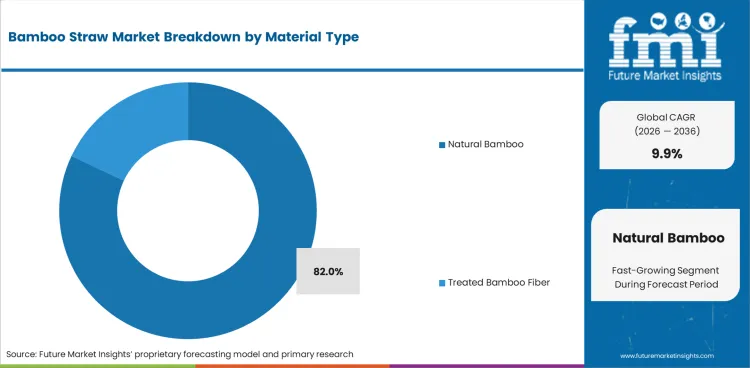
Material choice shapes how buyers read authenticity in this category. Natural bamboo is expected to capture 82.0% share in 2026 because simple cut-stem construction keeps the product familiar and keeps the raw material story intact. Treated bamboo fiber contributes where smoother finish or engineered consistency matters more than the look of a direct bamboo stem. Natural bamboo also supports easier explanation in stores and restaurants because the product looks exactly like the material it claims to use. Treated formats can widen design options, yet added processing can make the item feel closer to a generic sustainable utensil than a distinct bamboo straw. Future Market Insights analysis therefore places basic raw form at the center of category identity, with bamboo demand giving useful context on how bamboo value perception carries into finished goods.
- Visual Trust: Buyers often respond better when the raw material can be seen directly in the finished product.
- Finish Control: Treated fiber can improve uniformity where raw stem variation becomes a concern.
- Category Identity: Natural form keeps bamboo straws distinct from wider molded or blended eco-product formats.
Bamboo Straw Market Analysis by Sales Channel
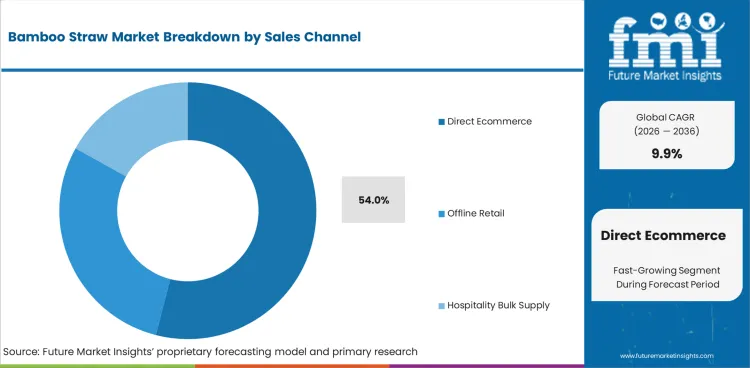
Sales channel determines how much explanation the product needs before it is bought. Direct ecommerce is anticipated to secure 54.0% share in 2026 because sellers can show cleaning brushes, mixed diameters, and use cues in one place. Offline retail still matters where eco-living shelves support discovery, yet online space makes it easier to answer care questions before purchase. Hospitality bulk supply remains important where outlet demand is steady and repeat ordering matters more than display value.
- Digital Explanation: Online selling gives enough space to explain care, size variation, and reuse logic.
- Shelf Appeal: Offline retail works best when the straw is part of a broader eco-living assortment.
- Bulk Repeatability: Hospitality supply depends on steady pack availability and fewer service complaints after purchase.
Bamboo Straw Market Analysis by Diameter
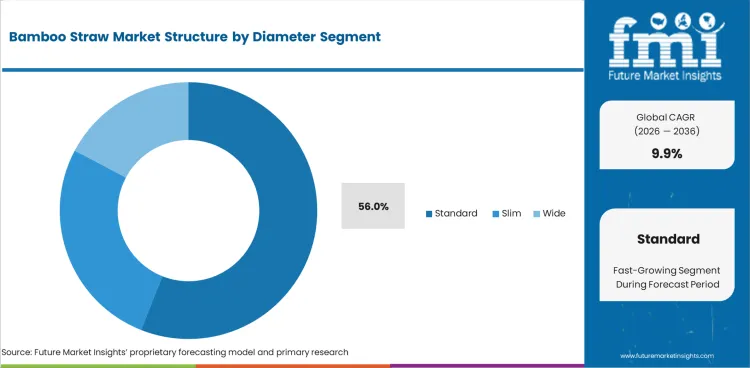
Diameter becomes decisive once buyers connect the straw to a real drink menu. Slim options still matter in lighter beverages, while wide formats remain tied to smoothies and thicker drinks. Category fit improves when sellers keep the range practical rather than overextending assortment. Standard diameter is expected to garner 56.0% share in 2026 because it suits water, juices, iced coffee, and many everyday cold drinks without narrowing use too sharply.
- Drink Fit: Flow rate and beverage thickness shape which diameter feels practical at first use.
- Assortment Burden: More diameter options can improve fit yet can also complicate inventory planning.
- Menu Relevance: Wide formats matter most in smoothie-heavy outlets rather than across all beverage counters.
Bamboo Straw Market Analysis by Pack Format
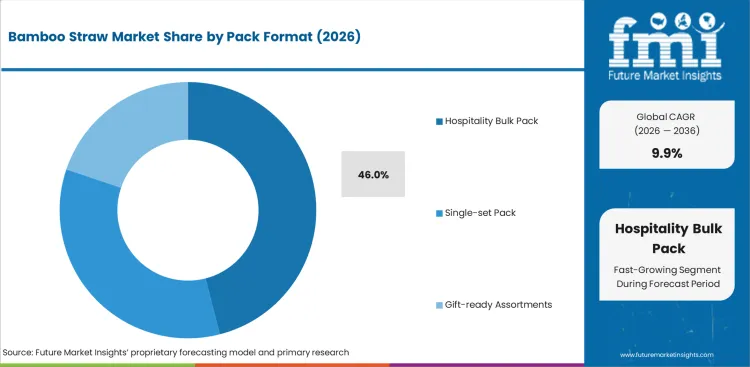
Pack format affects whether bamboo straws feel like a household item or a service supply. Hospitality bulk packs are poised to secure an estimated 46.0% share in 2026 because foodservice leads overall demand and reorder convenience matters in commercial use. Single-set packs remain useful for trial and gifting, while gift-ready assortments work better in seasonal retail than in steady outlet replenishment. Commercial momentum stays stronger where pack counts match routine beverage service.
- Trial Entry: Small packs lower hesitation for first-time users who want to test cleaning and drink fit.
- Restock Logic: Bulk packs suit service outlets that care more about continuity than gifting appeal.
- Bundle Value: Gift-ready formats perform better when sold beside other reusable dining and lifestyle items.
Bamboo Straw Market Drivers, Restraints, and Opportunities
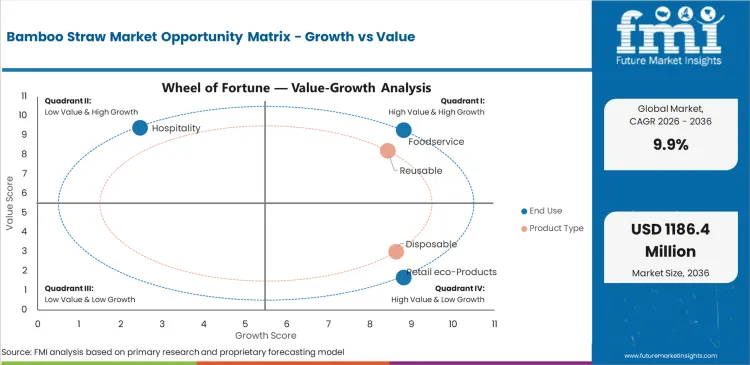
Plastic reduction pressure keeps the category visible, yet visibility alone does not guarantee repeat demand. Beverage outlets and eco-lifestyle retailers still need a product that is easy to explain in one sentence and easy to place beside drinks or reusable bundles. Bamboo works when that explanation stays simple. Natural look, low processing, and a recognizable material story all help. Repeat use adds another layer of credibility because buyers can justify the purchase beyond one occasion. Gifting also supports movement because the product is small, readable, and easy to bundle with other low-waste items. Demand is building through café counters, eco-gifting, reusable household kits, and low-volume hospitality use rather than broad institutional conversion. Category growth depends less on technical performance claims and more on how easily the product fits the way drinks are sold, served, and displayed.
Cleaning discipline and consistency control remain the main restraints. Bamboo straws can look appealing on shelf or on a café counter, yet daily use raises questions around drying time, inner cleaning, diameter variation, and long-term finish. Paper straws compete on simplicity in quick single-use service. Metal and glass alternatives compete on durability in premium reuse settings. Natural variation also changes the product experience from pack to pack, which can be part of the charm for some users and a source of hesitation for others. Hospitality settings feel that tension most clearly because service standards are tight. Future Market Insights analysis therefore sees adoption slowing where operators want full uniformity or where staff routines leave little room for extra care after service ends.
- Foodservice Reset: Café and juice-bar demand can widen when sellers offer standard sizes and clear care guidance without overcomplicating the product story.
- Bundle Selling: Reusable kits, drinkware bundles, and zero-waste gift sets can improve conversion where a single straw pack feels too narrow on its own.
- Supply Clarity: Better finish consistency and cleaner bulk assortment design can improve confidence in hospitality and repeat commercial ordering.
Regional Analysis
Key Facts About Country
- Raw material familiarity and visible non-plastic positioning keep India in the strongest growth position. Bamboo straw demand in India is expected to rise at a CAGR of 12.8% by 2036.
- Manufacturing depth supports steady category continuity in China, where sales of bamboo straws are projected to increase at a CAGR of 11.6% by 2036.
- Handcrafted origin stories continue to carry commercial value in Indonesia. By 2036, the bamboo straw market in Indonesia is anticipated to post 9.9% CAGR.
- Eco-lifestyle retail and café use keep the USA commercially relevant in this study. Bamboo straw demand across the United States is projected to increase at 8.8% CAGR by 2036.
- Retail storytelling and replacement demand support the United Kingdom, where the market is expected to expand at a CAGR of 7.9% by 2036.
- Steadier replacement logic shapes Germany, which is likely to record an anticipated 7.6% CAGR during the forecast period.
- Mature buying patterns leave Japan at the lower end of the country range. By 2036, bamboo straw sales in Japan are expected to progress at a CAGR of 7.1%.
.webp "Top Country Growth Comparison Bamboo Straw Market Cagr (2026 2036)")
| Country | CAGR (2026 to 2036) |
|---|---|
| China | 11.6% |
| USA | 8.8% |
| Germany | 7.6% |
| India | 12.8% |
| Indonesia | 9.9% |
Source: Future Market Insights analysis
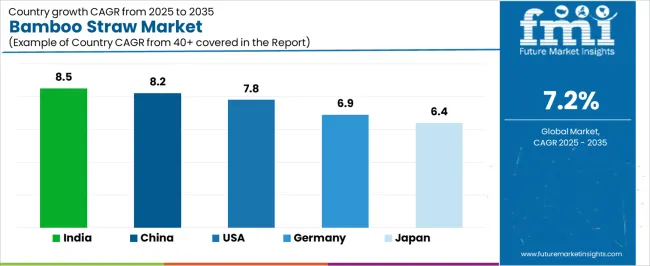
Regional performance in bamboo straws follows two different logics at once. Supply-linked geographies benefit from bamboo familiarity, small-batch conversion skill, and easier product storytelling. Mature consumer regions move on a different path where demand depends more on channel fit, hygiene comfort, and substitute comparison.
Asia Pacific Bamboo Straw Market Analysis
East Asia sets the tone for this category because bamboo is not an abstract material in the region. South Asia and ASEAN matter for reasons that go beyond their current combined regional share. Product familiarity is higher, supply chains are closer to processing, and visual acceptance of bamboo in daily-use goods is easier to sustain. Commercial activity also benefits from sellers who can present bamboo as both a craft-linked product and a practical beverage accessory. Natural finish does not need as much translation here as it does in some Western retail settings. Regional growth is tied to bamboo familiarity and to the ability of local makers to turn a simple natural input into a visible consumer product. Domestic demand is also improving as plastic alternatives become easier to spot in cafés, gifting channels, and eco-lifestyle retail.
- China: Manufacturing depth keeps China close to the center of bamboo straw trade and domestic use. Demand for the sector in the country is expected to rise at a CAGR of 11.6% by 2036 because supply continuity, export familiarity, and strong access to bamboo-based goods reduce entry friction for sellers. Material variety also helps. Buyers can move across gift packs, retail assortments, and service-oriented supply without leaving the broader bamboo value chain. Substitute pressure from paper and metal still exists, yet bamboo keeps a place when a natural visual cue matters. Product movement is therefore shaped by both supply confidence and end-use presentation. China stays important because the country supports how the category is made as much as how it is sold. Domestic familiarity also lowers early hesitation.
- Japan: Japan approaches bamboo straws with a steadier adoption pattern. Clean presentation, compact lifestyle products, and careful product finishing matter strongly in this setting. Uniformity expectations can slow faster expansion, especially where natural variation is read as inconsistency rather than craft value. Reusable products still have room when finish quality and pack presentation are handled well. Market progress therefore looks measured rather than rapid. The country remains relevant because it rewards refined positioning in a category that can easily look too rustic when presentation slips. Japan is likely to post an anticipated 7.1% CAGR by 2036 in bamboo straws because demand builds through design-sensitive retail and selective hospitality use rather than through broad low-cost rollout. Quality perception remains central to repeat demand. Repeat demand in Japan depends on whether finish consistency, hygiene confidence, and presentation quality remain strong after initial purchase.
- India: India is set to record the strongest development in this sector at a projected 12.8% by 2036 because bamboo availability, a widening sustainability conversation, and stronger consumer comfort with natural materials all support that outlook. Foodservice and eco-product retail both matters here, yet the larger point is that bamboo does not need heavy explanation in the same way it might in less familiar markets. Small-batch makers and broader packaging innovators also keep the material visible across adjacent categories. Adoption is not automatic, since product finish and cleaning confidence still affect repeat use. Even with that limit, India remains the fastest-growing country because demand, supply familiarity, and material relevance move in the same direction. Local familiarity supports faster trial. Repeat demand depends on whether first-time users find the product easy to clean, visually credible, and practical in routine beverage use.
- Indonesia: Handmade origin gives Indonesia a different role in the bamboo straw story. Craft value, tourism-linked retail, and direct-to-consumer positioning all help the category stay commercially readable. Indonesia is expected to scale at 9.9% CAGR by 2036, with movement supported by product narratives that connect bamboo sourcing to finished reusable goods. Domestic scale is smaller than in China or India, yet the country remains commercially meaningful because it reinforces authenticity in a category that depends heavily on material story. Bulk standardization can be harder when handmade identity is part of the appeal. Even so, Indonesia stays important because handcrafted origin supports both export storytelling and local niche demand at the same time. Handmade identity keeps the product distinctive. In Indonesia, repeat demand depends on whether handcrafted appeal is supported by acceptable finish consistency and practical everyday usability.
FMI assesses, East Asia remains the clearest structural anchor for bamboo straws. China gives the category manufacturing depth and broader commercial range. Japan shows where the same material can move through a more selective and design-sensitive route. South Asia and ASEAN do not yet carry the largest share in bamboo straws, yet both regions influence how the category is understood. India shows what happens when demand growth aligns with bamboo familiarity. Indonesia shows how craft origin can hold commercial value even when scale is narrower. Regional importance therefore sits in depth rather than only size.
North America Bamboo Straw Market Analysis
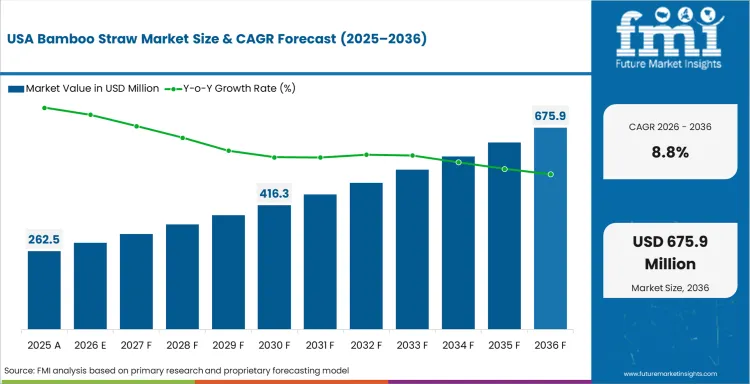
North America remains one of the clearest demand-led regions for bamboo straws. Commercial activity here is shaped less by raw material access and more by where the product fits inside retail and beverage service. Eco-lifestyle stores, cafés, gift assortments, and reusable household kits all help keep the item visible. Paper and metal alternatives are strong in this region, so bamboo has to justify itself through feel, look, and use case rather than through novelty alone. North America is a region where category success depends on positioning discipline. Products that look charming but feel inconvenient tend to lose ground quickly. Channel choice matters every step of the way. Regional fit still matters for repeat ordering.
- USA: Material appeal helps, yet commercial progress depends more on where bamboo straws are placed than on raw environmental messaging alone. Retailers can move them through reusable kits, bar accessories, and gift-ready assortments. Café use also matters where a natural look fits the brand image. Faster growth is limited by strong substitute presence from paper, stainless steel, and silicone. Cleaning comfort also affects repeat use. Adoption demand for the country is estimated to rise at a CAGR of 8.8% by 2036 as eco-lifestyle retail and beverage-led foodservice keep the category visible. USA remains a solid growth country because the category can find several workable channels, even if no single channel dominates the way foodservice does in Asia. Channel diversity supports that resilience. In the USA, repeat demand depends on whether bamboo straws remain easy to explain, easy to clean, and visually aligned with reusable lifestyle positioning after first purchase.
FMI reports, North America offers breadth rather than raw material advantage. Sales opportunities are real because reusable dining and low-waste accessories already have visible shelf space across the region. Substitute pressure stays high, so weak execution is punished quickly. Bamboo therefore performs best when sellers define a clear use case and avoid vague sustainability claims. North America remains important because it can absorb differentiated eco-products, yet only when packaging, cleaning logic, and channel placement are handled well. Regional value comes from commercial variety. Long-term success still depends on keeping the product easy to understand after the first purchase, not only at the moment of sale. Clear positioning remains the deciding factor. Commercial discipline will keep shaping outcomes.
Europe Bamboo Straw Market Analysis
Buyers across the region are already familiar with non-plastic alternatives, which means bamboo enters a more competitive substitute set rather than an empty space. Product acceptance depends on finish consistency, foodservice practicality, and how well bamboo compares with paper or metal in daily use. Eco-retail channels stay relevant, yet hospitality and café use can be selective because presentation expectations remain high. Future Market Insights analysis sees Europe as a region where sustainability interest is present, but category growth still has to survive close comparison on hygiene, convenience, and visual uniformity before it becomes repeatable. Buyer discipline shapes the whole regional pattern. Regional fit still matters for repeat ordering.
- Germany: Germany moves through bamboo straws with a careful commercial filter. Eco-conscious retail exists, reusable habits are visible, and non-plastic options are already familiar in the country. Germany is anticipated to garner 7.6% by 2036 in bamboo straws because interest is real yet adoption stays measured where buyers compare material integrity and service practicality very closely. Cafés and specialty stores provide room for the category, though widespread rollout can slow when natural variation feels harder to manage than paper or steel alternatives. Product finish matters strongly here. Repeat use needs to feel orderly. Germany remains relevant because it rewards well-executed bamboo products, even if it does not forgive inconsistency very easily. Control and reliability still guide repeat buying. In Germany, repeat demand depends on whether product finish, material consistency, and day-to-day practicality hold up under close buyer scrutiny.
- United Kingdom: Retail visibility and hospitality experimentation keep the United Kingdom active in bamboo straws. Bamboo can work well when it supports a casual premium feel and when care instructions are simple. Growth remains steadier than in India or China because substitute options are already common and quick-service operators often choose simpler disposable routes. United Kingdom still holds good commercial value because lifestyle-led buying remains supportive when product presentation stays clear. Lifestyle positioning still carries weight. In the United Kingdom, repeat demand depends on whether bamboo straws continue to feel brand-fit, easy to maintain, and credible against substitute options after first use. Demand in the country is likely to advance at an expected CAGR of 7.9% through 2036 as cafés, gifting channels, and zero-waste assortments maintain room for natural reusable items. Brand fit matters more than price-led volume in many parts of this demand base.
FMI assesses, Europe remains important because it tests whether bamboo straws can earn repeat use in a region where alternatives are already well known. Germany shows the value of finish discipline and controlled product presentation. United Kingdom shows how lifestyle retail and hospitality can still support the format when brand fit is strong. Regional progress is therefore selective rather than broad. Future Market Insights analysis expects Europe to retain a meaningful role because credibility matters strongly here. Products that look thoughtful and easy to use can move well. Products that rely only on novelty or loose sustainability language usually struggle to keep repeat demand alive. Selective demand can still be commercially meaningful. Commercial discipline will keep shaping outcomes. Buyer caution will continue to shape pace.
Competitive Aligners for Market Players
Fragmentation defines competition in bamboo straws. Bambaw, Jungle Straws, Wisefood, Bambrew, PT Strawland, bambu, and BambooMN all participate in a category where scale matters less than finish consistency and clear use positioning. Many buyers are not looking for deep technical difference. Buyers want a straw that arrives clean, feels believable as bamboo, and fits the drink it is meant to serve. Brand trust still matters because natural products can vary in size and feel from pack to pack. Sellers who explain that variation well can keep buyer confidence. Sellers who leave the product story vague often lose ground quickly. Future Market Insights analysis therefore sees credibility in this category as a practical matter tied to handling, sizing, and repeat satisfaction rather than to broad sustainability claims alone.
Bambaw and Jungle Straws benefit from strong reuse-led presentation and from product storytelling that keeps bamboo close to a visible lifestyle choice. bambu and BambooMN also hold relevance because both speak clearly to size, use, and basic product form without overcomplicating the offer. Wisefood sits closer to a wider eco-tableware and low-waste assortment logic, which can help when buyers want bamboo straws as part of a broader sustainable dining basket. Bambrew and PT Strawland matter from a different angle because supply-side credibility and bamboo familiarity can support commercial trust even when brand visibility is more regional. Competitive strength in this space therefore comes from how clearly each company connects bamboo identity to everyday drink use. Simple positioning often works better than overly polished messaging.
Commercial success in bamboo straws rarely comes from one feature alone. Diameter choice, brush inclusion, bulk pack logic, and finish consistency all influence repeat demand after the first order. Café operators usually care about service fit and fast explanation. Retail buyers often care about bundle value and shelf appeal. Gift-led assortments reward presentation while hospitality orders reward consistency. Companies that match those needs can hold their place even without large scale. Future Market Insights analysis reads the category as a specialist field where many brands can coexist because customer expectations are split across channels. Winning therefore depends on matching the right pack and the right product story to the right use setting, not on claiming a universal answer for every buyer.
Material composition in bamboo straw packaging remains relatively simple because the product is dry, rigid, and not highly barrier-sensitive, so most formats avoid the multilayer films and heavy barrier builds used in moisture- or oxygen-critical food packaging. Retail multipacks are usually based on paperboard cartons, kraft sleeves, or flexible paper pouches, while horeca and e-commerce shipments rely more on corrugated outers with limited inner wrapping. Premium reusable packs may add a fabric pouch or cleaning-brush insert, but the substrate mix still stays weighted toward fiber-based components rather than plastic-rich laminates. Structure is therefore typically mono- or low-complexity, with one primary fiber substrate and minimal coatings, where the main performance needs are abrasion control, hygiene protection, and shelf presentation rather than gas barrier performance.
UK official statistics for 2024 show paper and cardboard packaging achieved a 74.3% recycling rate, compared with 51.0% for plastic under methodology 1, reinforcing the commercial case for simpler fiber-led pack formats with better recovery outcomes. Regulatory backdrop is also tightening, as the European Commission confirmed on 11 February 2025 that the Packaging and Packaging Waste Regulation entered into force, with measures intended to improve recyclability, reduce unnecessary packaging, and encourage more resource-efficient formats.
Converter capacity in the bamboo straw market remains decentralized and format-driven, with manufacturing capability shaped more by production flexibility than by large-scale line concentration. Output is typically organized around cutting, sizing, surface finishing, hygiene treatment, diameter sorting, and pack configuration for retail, horeca, event supply, and private-label requirements. Capacity advantage therefore sits with converters that can manage multiple straw specifications and adjacent sustainable foodservice formats within the same operating base. Model aligns with broader converter development in sustainable serveware, where Restaurantware reported in January 2025 that products made from sustainable materials recorded 374% growth over two years, indicating that manufacturing capability is increasingly being built through wider eco-format portfolios rather than single-format specialization. For bamboo straws, this supports a market structure in which converters with broader format coverage, customization capability, and more adaptable fulfillment capacity are better positioned to serve variable commercial demand across channels.
Recent Developments
- In June 2024, the City of Burbank announced its waste-reduction ordinance would take effect on July 1, 2024, requiring straws and other single-use foodware to be provided only on request and setting up later shifts toward recyclable or compostable PFAS-free foodware.
- In October 2025, Bambrew published an official company update welcoming India’s move to reduce GST on certain qualifying biodegradable and compostable packaging from 18% to 5%.
- In February 2026, Bambrew announced that it is onboarding Myntra as a strategic partner to supply Myntra-branded paper mailer bags directly through its website.
Key Players in Bamboo Straw Market
- Bambaw
- Jungle Straws
- Wisefood
- Bambrew
- PT Strawland
- bambu
- BambooMN
Scope of the Report
| Item | Value |
|---|---|
| Quantitative Units | USD 382.2 million in 2025, USD 420.0 million in 2026, and USD 1,080.0 million by 2036 at a CAGR of 9.9% |
| Market Definition | Bamboo drinking straws sold in reusable or disposable form for beverage use across foodservice, hospitality, and retail eco-product channels. |
| Segmentation | End Use, Product Type, Material Type, Sales Channel, Diameter, Pack Format, Region |
| Regions Covered | East Asia, North America, Europe, South Asia, ASEAN |
| Countries Covered | China, Japan, India, Indonesia, USA, Germany, United Kingdom |
| Key Companies Profiled | Bambaw, Jungle Straws, Wisefood, Bambrew, PT Strawland, bambu, BambooMN |
| Forecast Period | 2026 to 2036 |
| Approach | FMI analysis based on category benchmarking, seller mapping, foodservice usage logic, retail assortment reading, and country-level demand interpretation. |
Source: Future Market Insights analysis
Bamboo Straw Market Analysis by Segments
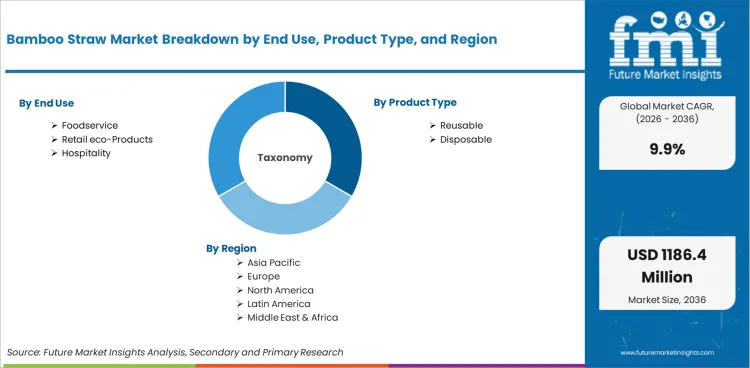
By End Use:
- Foodservice
- Retail eco-products
- Hospitality
By Product Type:
- Reusable bamboo straws
- Disposable bamboo straws
By Material Type:
- Natural bamboo
- Treated bamboo fiber
By Sales Channel:
- Direct ecommerce
- Offline retail
- Hospitality bulk supply
By Diameter:
- Slim
- Standard
- Wide
By Pack Format:
- Single-set packs
- Hospitality bulk packs
- Gift-ready assortments
By Region:
- Asia Pacific & ASEAN
- China
- Japan
- India
- Indonesia
- North America
- USA
- Europe
- Germany
- United Kingdom
Bibliography
- Bambrew. (2025, October 13). 5% GST on compostable packaging: A win for businesses, consumers and nature.
- Bambrew. (2026, February 27). Bambrew becomes strategic supply partner for Myntra paper mailer bags.
- City of Burbank. (2024, June 28). Waste reduction regulations ordinance takes effect July 1.
- European Commission. (2025, February 11). New rules for more sustainable and competitive packaging in the economy.
- Department for Environment, Food & Rural Affairs. (2025, July 23). UK statistics on waste. GOV.UK.
- Restaurantware. (2025, January 28). Restaurantware Reports Record Year of Growth in Sustainable Innovation and Reinforces Mission for 2025. PR Newswire.
- USA Food and Drug Administration. (2024, March 21). Packaging & Food Contact Substances (FCS).
- USA Food and Drug Administration. (2024, March 5). Safe Food Handling.
- World Bamboo Organization. (2024, December 30). Global Bamboo Resource Report 2024.
- National Bamboo Mission. (2025). Operational Guidelines of National Bamboo Mission (2024).
- Shi, X., Zhang, L., & coauthors. (2025). Next-Generation Bioplastics for Food Packaging. Materials, 18(12), 2919.
- Bambrew. (2025, March 21). Bamboo to Bambrew: A Celebration of Innovation on World Wood Day, International Day of Forests, World Sparrow Day.
This bibliography is provided for reader reference. The full FMI report contains the complete reference list with primary source documentation.
This Report Addresses
- Market intelligence for foodservice, retail eco-products, hospitality supply, reusable packs, disposable packs, and natural bamboo formats.
- Market size estimation and forecast assessment for 2025, 2026, and 2036 with a projected CAGR of 9.9% across the study period.
- Growth mapping across end use, product type, material type, sales channel, diameter, and pack format with emphasis on real drink-service fit.
- Regional and country analysis covering East Asia, North America, Europe, South Asia, ASEAN, China, Japan, India, Indonesia, USA, Germany, and the United Kingdom.
- Competitive reading across Bambaw, Jungle Straws, Wisefood, Bambrew, PT Strawland, bambu, and BambooMN with attention to positioning, finish, and pack architecture.
- Commercial interpretation of reusable sets, disposable packs, natural bamboo stems, treated bamboo fiber formats, direct ecommerce, offline retail, and hospitality bulk supply.
- Demand review across cafés, juice counters, bars, eco-lifestyle stores, gifting channels, and selected hospitality settings where visible plastic substitution matters.
- Report delivery designed for product planning, channel review, geography prioritization, supplier benchmarking, and execution-focused category assessment.
Frequently Asked Questions
How large is the market in 2026?
The Bamboo straw industry demand is expected to cross USD 420.0 million in 2026, which shows the category is still niche but commercially visible.
What value is expected by 2036?
Market value is forecast to reach USD 1,080.0 million by 2036 as reuse-led adoption keeps the product relevant in foodservice and eco-retail.
What CAGR is projected for the forecast period?
Scale in demand for the sector is anticipated to garner a CAGR of 9.9% from 2026 to 2036, reflecting a fast-growing but still selective non-plastic substitute category.
Which end-use segment leads the industry?
Foodservice is poised to lead with an expected 52.0% share in 2026 because beverage outlets create the clearest replacement volume and the most regular reorder pattern.
Which product type stays ahead through the study period?
Reusable bamboo straws set to garner an expected 68.0% share in 2026 since repeat-use logic strengthens the material story and lifts value above disposable comparison.
Which material type holds the largest share?
Natural bamboo is anticipated to hold 82.0% share in 2026 because buyers usually prefer a product that visibly looks like the raw material it claims.
What is the main growth driver?
Visible plastic substitution in cafés, bars, gifting, and eco-product retail remains the clearest driver because bamboo is easy to explain at purchase.
What restrains broader adoption?
Cleaning discipline, size variation, and competition from paper or metal limit wider rollout in channels that need simpler handling and tighter uniformity.
Which country grows the fastest?
India is poised to lead at a projected 12.8% by 2036 because bamboo familiarity, domestic relevance, and a rising non-plastic conversation support faster category acceptance.
Why does China remain important?
China matters because it supports both demand and supply, which gives bamboo straws a stronger commercial base than a pure end-market role.
How does the USA differ from India?
USA is anticipated to scale at 8.8% depending more on channel fit and substitute comparison, while India at a projected 12.8% benefits from stronger material familiarity by 2036.
Why is hospitality smaller than foodservice?
Hospitality use is more selective because presentation standards and housekeeping routines make natural variation and cleaning demands harder to absorb.
Why do reusable formats outperform disposable ones?
Reusable use gives buyers a clearer reason to accept bamboo on price, care effort, and product identity than a single-use positioning does.
Where does retail eco-product demand come from?
Retail eco-product demand comes from gifting, zero-waste assortments, and household trial purchases rather than from the daily service volume seen in cafés.
How important is East Asia in regional terms?
East Asia is set to lead with an expected 38.0% share in 2026 because supply familiarity and category acceptance come together more naturally than in most other regions.
What role does North America play?
North America is likely to account for an estimated 26.0% share in 2026 and acts as a demand-led region where channel placement, care communication, and product explanation shape repeat sales.
How does Europe behave in this industry?
Europe is projected to hold a 20.0% share in 2026 and is expected to expand more selectively because buyers compare bamboo closely with paper and metal on daily-use practicality, hygiene, and consistency.
What makes Indonesia commercially relevant?
Indonesia is important because handcrafted origin supports authenticity, which helps bamboo straws keep a distinct identity in direct-to-consumer and gift channels.
Is the industry concentrated or fragmented?
Competition is fragmented, with specialist brands and regional suppliers competing on finish consistency, pack design, diameter fit, and cleaning ease.
Which companies are most visible in the report?
Bambaw, Jungle Straws, Wisefood, Bambrew, PT Strawland, bambu, and BambooMN represent the core company set reviewed in this study.
What does the report include?
Coverage spans end use, product type, material type, sales channel, diameter, pack format, regional share, country CAGR, and competitive positioning.
Who uses this analysis the most?
Manufacturers, category planners, distributors, investors, and brand teams use this analysis to judge channel fit, geography choice, and product positioning.
Preview the report firsthand - request a free sample
Get SampleGet the brochure for pricing and purchase details.
Get PDFTable of Content
- Executive Summary
- Global Market Outlook
- Demand-side Trends
- Supply-side Trends
- Technology Roadmap Analysis
- Analysis and Recommendations
- Market Overview
- Market Coverage / Taxonomy
- Market Definition / Scope / Limitations
- Research Methodology
- Chapter Orientation
- Analytical Lens and Working Hypotheses
- Market Structure, Signals, and Trend Drivers
- Benchmarking and Cross-market Comparability
- Market Sizing, Forecasting, and Opportunity Mapping
- Research Design and Evidence Framework
- Desk Research Programme (Secondary Evidence)
- Company Annual and Sustainability Reports
- Peer-reviewed Journals and Academic Literature
- Corporate Websites, Product Literature, and Technical Notes
- Earnings Decks and Investor Briefings
- Statutory Filings and Regulatory Disclosures
- Technical White Papers and Standards Notes
- Trade Journals, Industry Magazines, and Analyst Briefs
- Conference Proceedings, Webinars, and Seminar Materials
- Government Statistics Portals and Public Data Releases
- Press Releases and Reputable Media Coverage
- Specialist Newsletters and Curated Briefings
- Sector Databases and Reference Repositories
- FMI Internal Proprietary Databases and Historical Market Datasets
- Subscription Datasets and Paid Sources
- Social Channels, Communities, and Digital Listening Inputs
- Additional Desk Sources
- Expert Input and Fieldwork (Primary Evidence)
- Primary Modes
- Qualitative Interviews and Expert Elicitation
- Quantitative Surveys and Structured Data Capture
- Blended Approach
- Why Primary Evidence is Used
- Field Techniques
- Interviews
- Surveys
- Focus Groups
- Observational and In-context Research
- Social and Community Interactions
- Stakeholder Universe Engaged
- C-suite Leaders
- Board Members
- Presidents and Vice Presidents
- R&D and Innovation Heads
- Technical Specialists
- Domain Subject-matter Experts
- Scientists
- Physicians and Other Healthcare Professionals
- Governance, Ethics, and Data Stewardship
- Research Ethics
- Data Integrity and Handling
- Primary Modes
- Tooling, Models, and Reference Databases
- Desk Research Programme (Secondary Evidence)
- Data Engineering and Model Build
- Data Acquisition and Ingestion
- Cleaning, Normalisation, and Verification
- Synthesis, Triangulation, and Analysis
- Quality Assurance and Audit Trail
- Market Background
- Market Dynamics
- Drivers
- Restraints
- Opportunity
- Trends
- Scenario Forecast
- Demand in Optimistic Scenario
- Demand in Likely Scenario
- Demand in Conservative Scenario
- Opportunity Map Analysis
- Product Life Cycle Analysis
- Supply Chain Analysis
- Investment Feasibility Matrix
- Value Chain Analysis
- PESTLE and Porter’s Analysis
- Regulatory Landscape
- Regional Parent Market Outlook
- Production and Consumption Statistics
- Import and Export Statistics
- Market Dynamics
- Global Market Analysis 2021 to 2025 and Forecast, 2026 to 2036
- Historical Market Size Value (USD Million) Analysis, 2021 to 2025
- Current and Future Market Size Value (USD Million) Projections, 2026 to 2036
- Y-o-Y Growth Trend Analysis
- Absolute $ Opportunity Analysis
- Global Market Pricing Analysis 2021 to 2025 and Forecast 2026 to 2036
- Global Market Analysis 2021 to 2025 and Forecast 2026 to 2036, By End Use
- Introduction / Key Findings
- Historical Market Size Value (USD Million) Analysis By End Use , 2021 to 2025
- Current and Future Market Size Value (USD Million) Analysis and Forecast By End Use , 2026 to 2036
- Foodservice
- Retail eco-Products
- Hospitality
- Foodservice
- Y-o-Y Growth Trend Analysis By End Use , 2021 to 2025
- Absolute $ Opportunity Analysis By End Use , 2026 to 2036
- Global Market Analysis 2021 to 2025 and Forecast 2026 to 2036, By Product Type
- Introduction / Key Findings
- Historical Market Size Value (USD Million) Analysis By Product Type, 2021 to 2025
- Current and Future Market Size Value (USD Million) Analysis and Forecast By Product Type, 2026 to 2036
- Reusable
- Disposable
- Reusable
- Y-o-Y Growth Trend Analysis By Product Type, 2021 to 2025
- Absolute $ Opportunity Analysis By Product Type, 2026 to 2036
- Global Market Analysis 2021 to 2025 and Forecast 2026 to 2036, By Material Type
- Introduction / Key Findings
- Historical Market Size Value (USD Million) Analysis By Material Type, 2021 to 2025
- Current and Future Market Size Value (USD Million) Analysis and Forecast By Material Type, 2026 to 2036
- Natural Bamboo
- Treated Bamboo Fiber
- Natural Bamboo
- Y-o-Y Growth Trend Analysis By Material Type, 2021 to 2025
- Absolute $ Opportunity Analysis By Material Type, 2026 to 2036
- Global Market Analysis 2021 to 2025 and Forecast 2026 to 2036, By Sales Channel
- Introduction / Key Findings
- Historical Market Size Value (USD Million) Analysis By Sales Channel, 2021 to 2025
- Current and Future Market Size Value (USD Million) Analysis and Forecast By Sales Channel, 2026 to 2036
- Direct Ecommerce
- Offline Retail
- Hospitality Bulk Supply
- Direct Ecommerce
- Y-o-Y Growth Trend Analysis By Sales Channel, 2021 to 2025
- Absolute $ Opportunity Analysis By Sales Channel, 2026 to 2036
- Global Market Analysis 2021 to 2025 and Forecast 2026 to 2036, By Diameter
- Introduction / Key Findings
- Historical Market Size Value (USD Million) Analysis By Diameter, 2021 to 2025
- Current and Future Market Size Value (USD Million) Analysis and Forecast By Diameter, 2026 to 2036
- Standard
- Slim
- Wide
- Standard
- Y-o-Y Growth Trend Analysis By Diameter, 2021 to 2025
- Absolute $ Opportunity Analysis By Diameter, 2026 to 2036
- Global Market Analysis 2021 to 2025 and Forecast 2026 to 2036, By Pack Format
- Introduction / Key Findings
- Historical Market Size Value (USD Million) Analysis By Pack Format, 2021 to 2025
- Current and Future Market Size Value (USD Million) Analysis and Forecast By Pack Format, 2026 to 2036
- Hospitality Bulk Pack
- Single-set Pack
- Gift-ready Assortments
- Hospitality Bulk Pack
- Y-o-Y Growth Trend Analysis By Pack Format, 2021 to 2025
- Absolute $ Opportunity Analysis By Pack Format, 2026 to 2036
- Global Market Analysis 2021 to 2025 and Forecast 2026 to 2036, By Region
- Introduction
- Historical Market Size Value (USD Million) Analysis By Region, 2021 to 2025
- Current Market Size Value (USD Million) Analysis and Forecast By Region, 2026 to 2036
- North America
- Latin America
- Western Europe
- Eastern Europe
- East Asia
- South Asia and Pacific
- Middle East & Africa
- Market Attractiveness Analysis By Region
- North America Market Analysis 2021 to 2025 and Forecast 2026 to 2036, By Country
- Historical Market Size Value (USD Million) Trend Analysis By Market Taxonomy, 2021 to 2025
- Market Size Value (USD Million) Forecast By Market Taxonomy, 2026 to 2036
- By Country
- USA
- Canada
- Mexico
- By End Use
- By Product Type
- By Material Type
- By Sales Channel
- By Diameter
- By Pack Format
- By Country
- Market Attractiveness Analysis
- By Country
- By End Use
- By Product Type
- By Material Type
- By Sales Channel
- By Diameter
- By Pack Format
- Key Takeaways
- Latin America Market Analysis 2021 to 2025 and Forecast 2026 to 2036, By Country
- Historical Market Size Value (USD Million) Trend Analysis By Market Taxonomy, 2021 to 2025
- Market Size Value (USD Million) Forecast By Market Taxonomy, 2026 to 2036
- By Country
- Brazil
- Chile
- Rest of Latin America
- By End Use
- By Product Type
- By Material Type
- By Sales Channel
- By Diameter
- By Pack Format
- By Country
- Market Attractiveness Analysis
- By Country
- By End Use
- By Product Type
- By Material Type
- By Sales Channel
- By Diameter
- By Pack Format
- Key Takeaways
- Western Europe Market Analysis 2021 to 2025 and Forecast 2026 to 2036, By Country
- Historical Market Size Value (USD Million) Trend Analysis By Market Taxonomy, 2021 to 2025
- Market Size Value (USD Million) Forecast By Market Taxonomy, 2026 to 2036
- By Country
- Germany
- UK
- Italy
- Spain
- France
- Nordic
- BENELUX
- Rest of Western Europe
- By End Use
- By Product Type
- By Material Type
- By Sales Channel
- By Diameter
- By Pack Format
- By Country
- Market Attractiveness Analysis
- By Country
- By End Use
- By Product Type
- By Material Type
- By Sales Channel
- By Diameter
- By Pack Format
- Key Takeaways
- Eastern Europe Market Analysis 2021 to 2025 and Forecast 2026 to 2036, By Country
- Historical Market Size Value (USD Million) Trend Analysis By Market Taxonomy, 2021 to 2025
- Market Size Value (USD Million) Forecast By Market Taxonomy, 2026 to 2036
- By Country
- Russia
- Poland
- Hungary
- Balkan & Baltic
- Rest of Eastern Europe
- By End Use
- By Product Type
- By Material Type
- By Sales Channel
- By Diameter
- By Pack Format
- By Country
- Market Attractiveness Analysis
- By Country
- By End Use
- By Product Type
- By Material Type
- By Sales Channel
- By Diameter
- By Pack Format
- Key Takeaways
- East Asia Market Analysis 2021 to 2025 and Forecast 2026 to 2036, By Country
- Historical Market Size Value (USD Million) Trend Analysis By Market Taxonomy, 2021 to 2025
- Market Size Value (USD Million) Forecast By Market Taxonomy, 2026 to 2036
- By Country
- China
- Japan
- South Korea
- By End Use
- By Product Type
- By Material Type
- By Sales Channel
- By Diameter
- By Pack Format
- By Country
- Market Attractiveness Analysis
- By Country
- By End Use
- By Product Type
- By Material Type
- By Sales Channel
- By Diameter
- By Pack Format
- Key Takeaways
- South Asia and Pacific Market Analysis 2021 to 2025 and Forecast 2026 to 2036, By Country
- Historical Market Size Value (USD Million) Trend Analysis By Market Taxonomy, 2021 to 2025
- Market Size Value (USD Million) Forecast By Market Taxonomy, 2026 to 2036
- By Country
- India
- ASEAN
- Australia & New Zealand
- Rest of South Asia and Pacific
- By End Use
- By Product Type
- By Material Type
- By Sales Channel
- By Diameter
- By Pack Format
- By Country
- Market Attractiveness Analysis
- By Country
- By End Use
- By Product Type
- By Material Type
- By Sales Channel
- By Diameter
- By Pack Format
- Key Takeaways
- Middle East & Africa Market Analysis 2021 to 2025 and Forecast 2026 to 2036, By Country
- Historical Market Size Value (USD Million) Trend Analysis By Market Taxonomy, 2021 to 2025
- Market Size Value (USD Million) Forecast By Market Taxonomy, 2026 to 2036
- By Country
- Kingdom of Saudi Arabia
- Other GCC Countries
- Turkiye
- South Africa
- Other African Union
- Rest of Middle East & Africa
- By End Use
- By Product Type
- By Material Type
- By Sales Channel
- By Diameter
- By Pack Format
- By Country
- Market Attractiveness Analysis
- By Country
- By End Use
- By Product Type
- By Material Type
- By Sales Channel
- By Diameter
- By Pack Format
- Key Takeaways
- Key Countries Market Analysis
- USA
- Pricing Analysis
- Market Share Analysis, 2025
- By End Use
- By Product Type
- By Material Type
- By Sales Channel
- By Diameter
- By Pack Format
- Canada
- Pricing Analysis
- Market Share Analysis, 2025
- By End Use
- By Product Type
- By Material Type
- By Sales Channel
- By Diameter
- By Pack Format
- Mexico
- Pricing Analysis
- Market Share Analysis, 2025
- By End Use
- By Product Type
- By Material Type
- By Sales Channel
- By Diameter
- By Pack Format
- Brazil
- Pricing Analysis
- Market Share Analysis, 2025
- By End Use
- By Product Type
- By Material Type
- By Sales Channel
- By Diameter
- By Pack Format
- Chile
- Pricing Analysis
- Market Share Analysis, 2025
- By End Use
- By Product Type
- By Material Type
- By Sales Channel
- By Diameter
- By Pack Format
- Germany
- Pricing Analysis
- Market Share Analysis, 2025
- By End Use
- By Product Type
- By Material Type
- By Sales Channel
- By Diameter
- By Pack Format
- UK
- Pricing Analysis
- Market Share Analysis, 2025
- By End Use
- By Product Type
- By Material Type
- By Sales Channel
- By Diameter
- By Pack Format
- Italy
- Pricing Analysis
- Market Share Analysis, 2025
- By End Use
- By Product Type
- By Material Type
- By Sales Channel
- By Diameter
- By Pack Format
- Spain
- Pricing Analysis
- Market Share Analysis, 2025
- By End Use
- By Product Type
- By Material Type
- By Sales Channel
- By Diameter
- By Pack Format
- France
- Pricing Analysis
- Market Share Analysis, 2025
- By End Use
- By Product Type
- By Material Type
- By Sales Channel
- By Diameter
- By Pack Format
- India
- Pricing Analysis
- Market Share Analysis, 2025
- By End Use
- By Product Type
- By Material Type
- By Sales Channel
- By Diameter
- By Pack Format
- ASEAN
- Pricing Analysis
- Market Share Analysis, 2025
- By End Use
- By Product Type
- By Material Type
- By Sales Channel
- By Diameter
- By Pack Format
- Australia & New Zealand
- Pricing Analysis
- Market Share Analysis, 2025
- By End Use
- By Product Type
- By Material Type
- By Sales Channel
- By Diameter
- By Pack Format
- China
- Pricing Analysis
- Market Share Analysis, 2025
- By End Use
- By Product Type
- By Material Type
- By Sales Channel
- By Diameter
- By Pack Format
- Japan
- Pricing Analysis
- Market Share Analysis, 2025
- By End Use
- By Product Type
- By Material Type
- By Sales Channel
- By Diameter
- By Pack Format
- South Korea
- Pricing Analysis
- Market Share Analysis, 2025
- By End Use
- By Product Type
- By Material Type
- By Sales Channel
- By Diameter
- By Pack Format
- Russia
- Pricing Analysis
- Market Share Analysis, 2025
- By End Use
- By Product Type
- By Material Type
- By Sales Channel
- By Diameter
- By Pack Format
- Poland
- Pricing Analysis
- Market Share Analysis, 2025
- By End Use
- By Product Type
- By Material Type
- By Sales Channel
- By Diameter
- By Pack Format
- Hungary
- Pricing Analysis
- Market Share Analysis, 2025
- By End Use
- By Product Type
- By Material Type
- By Sales Channel
- By Diameter
- By Pack Format
- Kingdom of Saudi Arabia
- Pricing Analysis
- Market Share Analysis, 2025
- By End Use
- By Product Type
- By Material Type
- By Sales Channel
- By Diameter
- By Pack Format
- Turkiye
- Pricing Analysis
- Market Share Analysis, 2025
- By End Use
- By Product Type
- By Material Type
- By Sales Channel
- By Diameter
- By Pack Format
- South Africa
- Pricing Analysis
- Market Share Analysis, 2025
- By End Use
- By Product Type
- By Material Type
- By Sales Channel
- By Diameter
- By Pack Format
- USA
- Market Structure Analysis
- Competition Dashboard
- Competition Benchmarking
- Market Share Analysis of Top Players
- By Regional
- By End Use
- By Product Type
- By Material Type
- By Sales Channel
- By Diameter
- By Pack Format
- Competition Analysis
- Competition Deep Dive
- Competition Deep Dive
- Assumptions & Acronyms Used


