

- Industry Size (2026)
- USD 4.2 Bn
- Forecast (2036)
- USD 7.5 Bn
- CAGR (2026 to 2036)
- 6.0%
Agricultural Adjuvant Market Size, Market Forecast and Outlook By FMI
The agricultural adjuvant market is expected to expand from USD 4.2 billion in 2026 to USD 7.5 billion by 2036. The market is anticipated to register a 6.0% CAGR during the forecast period. Activator adjuvants are likely to lead with 24.1% share, and herbicide adjuvants are projected to account for 39.3% of application demand in 2026.
Summary of the Agricultural Adjuvant Market
- Demand and Growth Drivers
- Precision farming programs are expected to raise demand for adjuvants used to improve spray coverage and input efficiency.
- Environmental rules are anticipated to increase preference for bio-based formulations with lower residue and aquatic toxicity concerns.
- Resistance management needs are likely to increase adoption of adjuvants across herbicide programs and crop protection plans.
- Product and Segment View
- Activator adjuvants are expected to lead the product type segment through their role in wetting and penetration improvement.
- Herbicide adjuvants are likely to dominate application demand as post-emergence weed control needs stronger coverage and uptake.
- Fruits and vegetables are anticipated to create strong crop-level demand as quality standards require controlled spray performance.
- Geography and Competitive Outlook
- The United Kingdom is expected to lead country-level expansion as integrated pest management practices gain stronger policy backing.
- Japan is likely to record steady expansion as smart agriculture adoption raises interest in precision spraying inputs.
- Companies with field validation data and tank-mix compatibility strength are anticipated to improve their competitive position.
- Analyst Opinion
- Nandini Roy Choudhury, Principal consultant for Food and Beverage at FMI, suggests, “The agricultural adjuvant market is likely to shift toward performance-tested formulations able to improve spray efficiency across regulated crop protection programs. Suppliers with agronomy networks and validated compatibility data are expected to gain advantage as growers seek reliable application results.”
- Agricultural Adjuvant Market Value Analysis
- The agricultural adjuvant market is moving from a spray additive segment into a performance-focused crop protection input area.
- Demand is likely to rise as growers seek stronger deposition and uptake across complex field conditions.
- Adoption is expected to gain pace as precision spraying creates higher need for repeatable tank-mix performance.
- Spending is anticipated to be backed by environmental stewardship rules and stronger focus on pesticide efficiency.
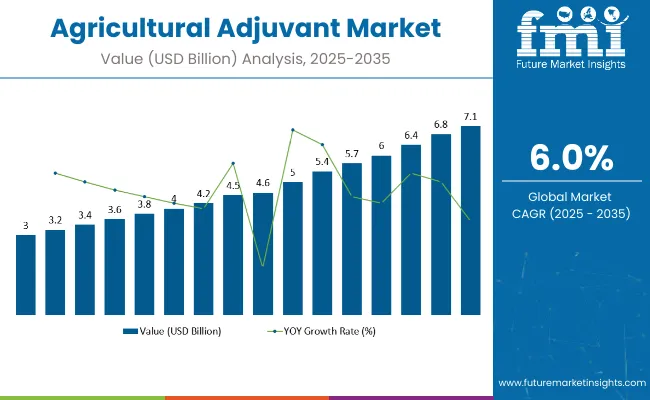
Key Takeaways, Market Size, and Forecast
| Metric | Value |
|---|---|
| Market Size (2026) | USD 4.2 Billion |
| Market Size (2036) | USD 7.5 Billion |
| CAGR (2026–2036) | 6.0% |
| Leading Product Type (2026) | Activator Adjuvants |
| Activator Adjuvants Share (2026) | 24.1% |
| Leading Application (2026) | Herbicide Adjuvants |
| Herbicide Adjuvants Share (2026) | 39.3% |
| Fastest-Growing Country | United Kingdom |
| United Kingdom CAGR | 5.4% |
Agricultural Adjuvant Market Key Takeaways
| Metric | Value |
|---|---|
| Industry Size (2026) | USD 4.2 Billion |
| Industry Value (2036) | USD 7.5 Billion |
| CAGR (2026-2036) | 6.0% |
Source: Future Market Insights analysis, supported by a proprietary forecasting model and primary research
Which Food and Beverage KPIs should be tracked to justify activator adjuvant adoption in crop protection programs?
Activator adjuvants are adopted when they improve spray wetting, coverage, deposition, and uptake in ways that can be translated into measurable operational outcomes for downstream food and beverage supply chains. Authoritative agronomy and extension guidance consistently frames adjuvants as performance enhancers that influence how spray solutions behave on plant surfaces and how effectively active ingredients are delivered, which makes them relevant to both efficacy and risk control. Instead of relying on general claims, firms tie adoption to specific internal metrics: Cost and efficiency is tracked through COGS, yield percentage, and OEE; Customer experience through CSAT and NPS; Safety and compliance through safety incident rate and compliance rate; Inventory and waste through inventory turnover ratio and waste percentage; Operations and workforce through on-time delivery rate and employee turnover rate; and Sustainability through energy consumption per unit.
How Is the Agricultural Adjuvant Market Segmented Across Key Categories?
Global landscape is intricately segmented to address diverse requirements of the crop protection industry, categorizing sector by product functionality, application target, crop specificity, and regional farming practices. Structural division allows stakeholders to identify specific enhancement targets, such as rising demand for rain-fast formulations in humid climates or preference for drift-reduction technologies in sensitive areas. By analyzing these segments, manufacturers can tailor formulation strategies to meet distinct needs of integrated pest management practitioners versus conventional farming operations. Segmentation also highlights shift from generic adjuvant approaches to targeted enhancement interventions. As industry matures, granular segmentation becomes essential for understanding application pathways and regulatory compliance, ensuring product development aligns with evolving agricultural guidelines.
Why do activator adjuvants maintain product dominance?
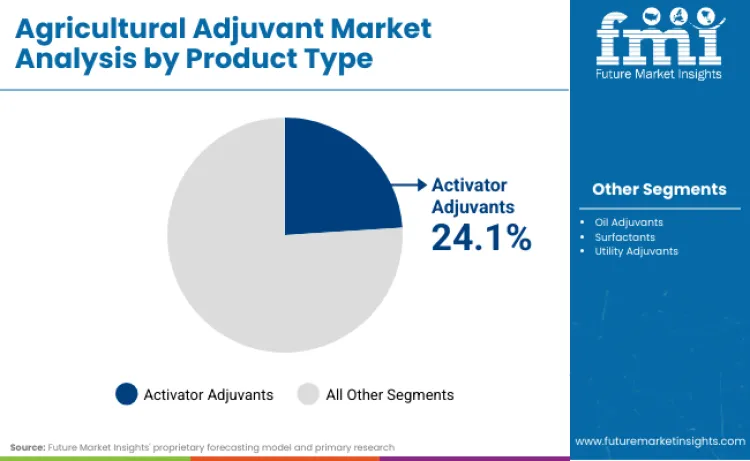
Activator adjuvants hold 24.1% of product type share in 2026 because they are selected to improve spray performance at the leaf surface. They support better wetting, spreading, retention, and penetration, which helps crop protection actives perform more consistently across variable canopy density, humidity, and leaf wax conditions. Their dominance is reinforced by repeated field validation and broader regulatory comfort around efficacy enhancement use cases, keeping them embedded in mainstream tank mix decisions.
Formulation progress also sustains leadership. Polymer enabled sticker and spreader systems extend rainfastness by improving droplet adhesion and reducing wash off risk, while spray quality functions help maintain uptake and coverage when application conditions are difficult. As per FMI’s estimates, increased R and D focus on biocompatible adjuvant chemistries is also renewing interest among organic aligned users where allowable.
Key dominance factors
- Improves wetting and spreading on hydrophobic leaf cuticles, supporting more uniform coverage
- Enhances retention and penetration, helping actives move through waxy surfaces and dense canopies
- Supports rainfastness through deposit adhesion and stabilization approaches
- Improves spray quality by reducing bounce, runoff, and uneven deposits
- Aligns with precision agriculture priorities focused on input optimization and repeatable performance
Why do herbicide adjuvants lead application categories?
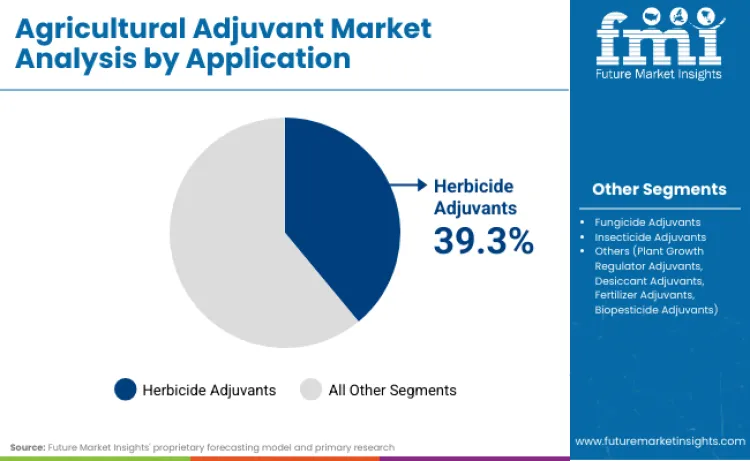
Herbicide adjuvants lead with 39.3% share in 2026 because weed control outcomes are highly sensitive to coverage, retention, and absorption, especially in post emergence programs where leaf interaction determines kill performance. Growers and crop protection brands prioritize adjuvant pairing because it improves compatibility and delivery efficiency compared to relying on formulation changes alone.
This dominance is strengthened by the complexity of modern weed programs. With continued emphasis on resistance management, herbicide strategies increasingly use layered modes of action and precise timing, where surfactant led systems support uptake and help maintain consistent deposition across diverse weed surfaces.
Key reasons herbicide adjuvants stay dominant
- Strong fit with post emergence herbicides where leaf uptake is the limiting step
- Surfactant technologies support absorption and systemic movement for many herbicide actives
- Improves performance on waxier weeds and under stress conditions where uptake is harder
- Helps deliver more reliable results across multi product tank mixes
- Ongoing efficacy pressure drives continued innovation in herbicide enhancement packages
Why do fruits and vegetables lead crop applications?
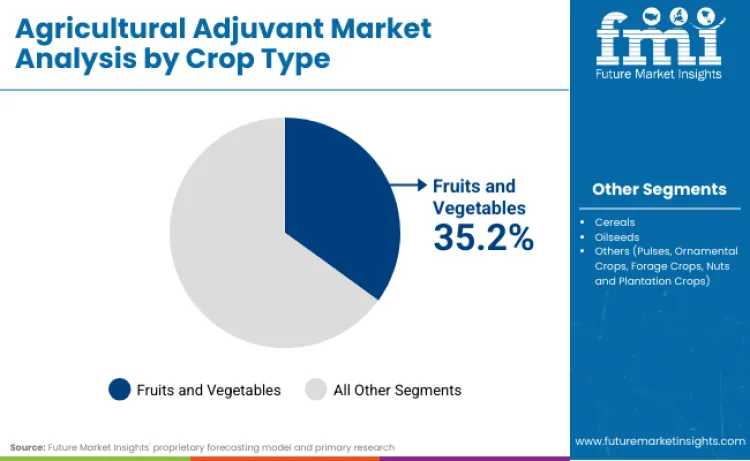
Fruits and vegetables capture 35.2% share in 2026 because they are high value and quality sensitive crops with strict commercial tolerances. Appearance, shelf life, and market access are directly influenced by pest and disease control performance and residue discipline. Higher spray frequency in horticulture, combined with complex canopies in orchards, vines, and protected cultivation, increases the value of deposition and coverage improvements delivered by adjuvants.
As per FMI’s projection, growers adopt these enhancement solutions to protect premium yields and maintain market access while staying compatible with integrated pest management practices. Suppliers that develop residue focused, harvest safe positioning and application compatible systems often secure repeat adoption in commercial horticulture.
Why horticulture drives higher adjuvant use
- Better economics for incremental protection in premium crops
- Greater need for uniform coverage in dense foliage and complex canopies
- Strong residue management focus for buyer and export compliance
- Frequent spray programs magnify the benefit of retention and deposition gains
- Good fit with integrated pest management programs and precision application practices
How will precision agriculture integration impact adoption?
Precision spraying is pushing adjuvants out of the “optional add-on” bucket and into the application plan itself. When growers are running section control, variable rate prescriptions, and tighter droplet targets, adjuvants have to perform consistently across shifting carrier volumes, nozzle pressures, and tank mix combinations. That makes dose window clarity and mixing discipline commercially important, because inconsistent behavior shows up immediately as coverage gaps, drift complaints, or re-spray costs.
FMI is of the opinion that adoption will rise fastest for adjuvants that can be specified like a repeatable recipe inside precision workflows, with performance tied to measurable outcomes such as deposition uniformity, retention, drift control support, and uptake consistency.
How will environmental regulations transform formulation development?
Environmental and stewardship requirements are increasingly influencing what can be used as co-formulants, not just what active ingredient is sprayed. This shifts formulation work toward redesigning surfactant and solvent systems to meet tighter safety expectations while still working in hard water, low carrier volumes, and variable field conditions.
In 2026, the competitive edge is moving toward products that can show both performance and reduced off-target risk. It is no longer enough to claim “sustainable.” Buyers want adjuvants that help hit spray objectives with fewer corrective passes and fewer complaint-driven adjustments.
How will resistance management requirements affect product innovation?
Resistance management is putting more emphasis on application quality, because uneven deposition and poor retention can leave survivors and increase selection pressure. That makes adjuvants more central to stewardship programs when they improve delivery consistency and reduce variability across a field, especially under challenging weather or canopy conditions.
As per FMI’s estimates, proof requirements are rising. Buyers want field-backed evidence that an adjuvant improves coverage uniformity and retention in real use, not just lab claims. That raises development cost, but it also creates room for premium stewardship-positioned products.
How Will the Agricultural Adjuvant Industry Evolve in Major Nations?
Global landscape for crop protection enhancers is characterized by diverse regulatory frameworks, influenced by agricultural policies and environmental practice standards. Established markets prioritize scientifically validated formulations and sustainable enhancement manufacturing, whereas emerging economies focus on accessible pricing and basic performance improvement. Western Europe is emerging as rapid growth hub due to increasing environmental compliance and expanding organic farming sectors. Conversely, North American markets pivot towards precision technology and specialized enhancement protocols. Government initiatives in developing nations supporting agricultural modernization ensure sustained demand for efficiency-enhancing adjuvant products across all farming segments.
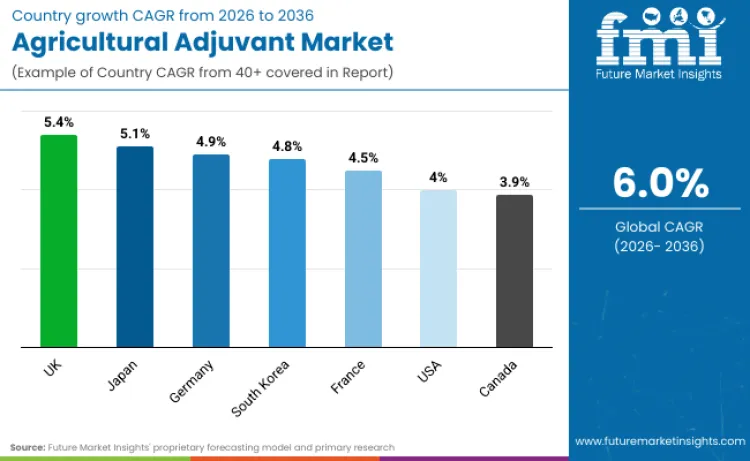
| Country | CAGR (2026 to 2036) |
|---|---|
| UK | 5.4% |
| Japan | 5.1% |
| Germany | 4.9% |
| France | 4.5% |
| USA | 4.0% |
| South Korea | 4.8% |
| Canada | 3.9% |
Source: Future Market Insights’ proprietary forecasting model and primary research
Why is the Agricultural Adjuvant Industry in UK Growing?
Sales of crop protection enhancers in UK are set to grow at 5.4% CAGR through 2036. Expansion is underpinned by national direction that prioritizes integrated pest management adoption and improved application practices to support more sustainable pesticide use. The UK Pesticides National Action Plan 2025 explicitly promotes integrated pest management approaches and points to IPM actions and pesticide precision application actions available through the Sustainable Farming Incentive, which creates a clear pathway for growers to invest in application efficiency tools and supporting inputs. DEFRA has also continued to publish updated IPM guidance for farmers and land managers, reinforcing the shift toward practices that reduce reliance on blanket chemical use and increase focus on performance per spray pass.
Why is the Agricultural Adjuvant Sector in Japan Expanding?
Demand for agricultural enhancement solutions in Japan is projected to rise at 5.1% CAGR during the assessment period. Expansion is supported by policy emphasis on productivity and sustainability under labor constraints, which increases interest in precision and smart agriculture solutions where spray quality and consistency matter. Japan’s MAFF FY2024 reporting includes initiatives that support environmental burden reduction and related measurement approaches, which strengthens demand for inputs and practices that improve efficacy without increasing active ingredient load. OECD reporting on Japan also notes MAFF budget allocation to accelerate smart agriculture technology adoption, aligning with greater use of precision spraying and automation that typically benefits from compatibility and performance oriented adjuvants.
Why is the Agricultural Adjuvant Industry in Germany Showing Innovation Leadership?
Agricultural adjuvant industry in Germany is poised to expand at 4.9% CAGR. Growth is largely linked to a compliance led shift toward lowering risks to humans and the environment from plant protection products, which increases focus on application discipline and measurable mitigation. BMEL describes the National Action Plan on the Sustainable Use of Plant Protection Products as aiming to further reduce risks and impacts, reinforcing a preference for solutions that improve targeting, reduce off target movement, and support documented best practice in the field. The national NAP portal also frames the plan around risk reduction for humans, animals, and the environment, supporting steady adoption of spray optimization tools and inputs that improve deposition and reduce losses. FMI is of the opinion that Germany’s risk mitigation focus will continue to reward adjuvant suppliers that can demonstrate measurable gains in coverage and drift control.
Why is the Agricultural Adjuvant Industry in France Growing?
Sales of agricultural enhancers in France are set to grow at 4.5% CAGR through 2036. Expansion is reinforced by France’s Ecophyto 2030 strategy, which sets objectives for reducing risks and use of plant protection products while supporting farmers with methods and alternatives that enable practice change. A core element is PARSADA, which is designed to help sectors anticipate potential withdrawal of active substances and develop alternative techniques from research to deployment, which increases interest in efficiency enablers and application optimization solutions within transition programs.
Why is the Agricultural Adjuvant Sector in USA Expanding?
Revenue from agricultural enhancers in USA is set to grow at 4.0% CAGR. Expansion is driven by measured adoption of input optimization and stewardship practices in large scale farming systems, rather than rapid regulatory driven substitution. EPA documentation within its pesticide registration materials defines agricultural chemical adjuvants as chemicals added by users to improve pesticide efficacy, anchoring their role as performance and application support inputs. USDA NRCS conservation programs also include practices aimed at reducing pesticide related risks, which can support demand for adjuvants used to improve deposition, reduce drift, and limit unintended movement into water and non target areas.
Why is the Agricultural Adjuvant Industry in South Korea Growing?
Sales of agricultural enhancers in South Korea are set to grow at 4.8% CAGR through 2036. Expansion is supported by the national push to scale smart farming, particularly in greenhouse cultivation where controlled spray performance and uniform coverage are critical. MAFRA’s smart farming master plan targets adoption of smart agricultural technologies in a substantial share of greenhouse area and broader field crop mechanization, which supports increased use of precision application practices and related formulation aids. FMI is of the opinion that protected cultivation expansion and smart farm deployment will sustain demand for adjuvants that improve wetting, retention, and consistency under high frequency spray regimes.
Why is the Agricultural Adjuvant Sector in Canada Expanding?
Revenue from agricultural enhancers in Canada is set to grow at 3.9% CAGR through 2036. Expansion is anchored in compliance and label aligned spray practices, especially for tank mixes that frequently involve adjuvant recommendations and use conditions. Health Canada PMRA has published guidance on tank mix labelling to clarify expectations for stakeholders, reinforcing disciplined use patterns and documented compatibility requirements. This supports steady demand for adjuvants that fit within label directions and tank mix frameworks, even as growth remains more incremental than in markets with stronger incentive driven IPM adoption.
What is the Competitive Outlook for the Agricultural Adjuvant Market?
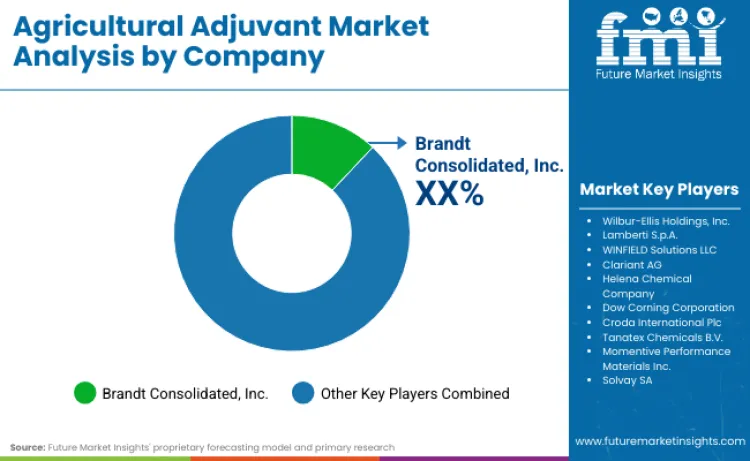
Competition in agricultural adjuvants is increasingly centered on measurable field performance, not just surfactant chemistry claims. Buyers, especially large growers and crop input distributors, expect adjuvants to prove compatibility across multiple tank-mix combinations, water qualities, spray systems, and crop types. This has pushed leading suppliers such as Brandt Consolidated and Wilbur-Ellis to emphasize field validation programs, agronomy support, and performance data rather than only formulation descriptions.
A noticeable shift in the market is toward precision adjuvant positioning. Instead of selling one broad utility product, companies are aligning specific adjuvant formulations with herbicide, fungicide, insecticide, and biological programs. Drift reduction, droplet spread control, and improved leaf penetration are being tailored to modern spraying equipment and regulatory pressure around off-target movement.
Partnerships with pesticide manufacturers and crop input suppliers are also shaping competition. Adjuvants are increasingly recommended as part of a complete spray protocol, not an optional add-on, especially in high-value crops and regulated geographies. Formulation innovation is focusing on compatibility with new chemistries and biological crop protection products where traditional surfactants can cause instability.
FMI is of the opinion that brands with strong agronomy networks, validated tank-mix compatibility data, and crop-specific adjuvant portfolios will hold competitive advantage, as growers prioritize reliability and application efficiency over generic enhancement claims.
Key Players in Agricultural Adjuvant Market
- Brandt Consolidated, Inc.
- Wilbur-Ellis Holdings, Inc.
- Lamberti S.p.A.
- WINFIELD Solutions LLC
- Clariant AG
- Helena Chemical Company
- Dow Corning Corporation
- Croda International Plc
- Tanatex Chemicals B.V.
- Momentive Performance Materials Inc.
- Solvay SA
- Adjuvant Plus Inc.
- Interagro Ltd.
- Loveland Products, Inc.
- Precision Laboratories, LLC
- Garrco Products, Inc.
- Innvictis Crop Care, LLC
- Kalo Inc.
- Miller Chemical & Fertilizer, LLC
- Nufarm Limited
Scope of Report
| Items | Values |
|---|---|
| Quantitative Units | USD Billion |
| Product Type Segments | Activator Adjuvants; Oil Adjuvants; Surfactants; Utility Adjuvants |
| Application Categories | Fungicide Adjuvants; Insecticide Adjuvants; Herbicide Adjuvants; Others (Plant Growth Regulator Adjuvants, Desiccant Adjuvants, Fertilizer Adjuvants, Biopesticide Adjuvants) |
| Crop Type Applications | Cereals; Oilseeds; Fruits & Vegetables; Others (Pulses, Ornamental Crops, Forage Crops, Nuts and Plantation Crops) |
| Regional Markets | North America; Latin America; Western Europe; Eastern Europe; East Asia; South Asia & Pacific; Middle East & Africa |
| Regions Covered | North America, Europe, East Asia, South Asia, Latin America, Middle East & Africa |
| Key Countries | UK, Japan, Germany, France, USA, South Korea, Canada |
| Key Companies Profiled | Brandt Consolidated, Inc.; Wilbur-Ellis Holdings, Inc.; Lamberti S.p.A.; WINFIELD Solutions LLC; Clariant AG; Helena Chemical Company; Dow Corning Corporation; Croda International Plc; Tanatex Chemicals B.V.; Momentive Performance Materials Inc.; Solvay SA; Adjuvant Plus Inc.; Interagro Ltd.; Loveland Products, Inc.; Precision Laboratories, LLC; Garrco Products, Inc.; Innvictis Crop Care, LLC; Kalo Inc.; Miller Chemical & Fertilizer, LLC; Nufarm Limited |
| Additional Attributes | Dollar sales measured for agricultural adjuvants used in crop protection and agricultural enhancement applications, specified by enhancement mechanism type (wetting agents, penetration enhancers, drift reduction agents, compatibility improvers), formulation chemistry, application method preference, crop focus (field crops, specialty crops, horticultural crops and plantation crops), farming model (conventional vs. organic), and compliance alignment with evolving environmental standards and pesticide stewardship regulations. |
Agricultural Adjuvant Market by Segments
Product Type
- Activator Adjuvants
- Oil Adjuvants
- Surfactants
- Utility Adjuvants
Application
- Fungicide Adjuvants
- Insecticide Adjuvants
- Herbicide Adjuvants
- Others (Plant Growth Regulator Adjuvants, Desiccant Adjuvants, Fertilizer Adjuvants, Biopesticide Adjuvants)
Crop Type
- Cereals
- Oilseeds
- Fruits & Vegetables
- Others (Pulses, Ornamental Crops, Forage Crops, Nuts and Plantation Crops)
Region
- North America
- Latin America
- Western Europe
- Eastern Europe
- East Asia
- South Asia & Pacific
- Middle East & Africa
Bibliography
- United States Environmental Protection Agency. (2024). Pesticide registration and labeling requirements: Guidance for pesticide formulators and applicators. USA EPA.
- Food and Agriculture Organization of the United Nations. (2024). The state of the world’s biodiversity for food and agriculture 2024: Main report. FAO.
- Organisation for Economic Co‑operation and Development. (2023). OECD guidance document on spray application technology and pesticide formulations. OECD Publishing.
- United States Department of Agriculture, Natural Resources Conservation Service. (2024). Conservation practice standard: Integrated pest management (Code 595).
Frequently Asked Questions
How big is the global agricultural adjuvant market?
The global agricultural adjuvant market is valued at USD 4.2 billion in 2026.
What is the growth outlook for the agricultural adjuvant market over the next 10 years?
The market is projected to grow at a CAGR of 6.0% from 2026 to 2036, reaching USD 7.5 billion by 2036.
Which applications or end uses drive demand for agricultural adjuvants?
Demand is primarily driven by herbicide applications, where adjuvants improve spray coverage, retention, and uptake efficiency in post-emergence weed control programs.
Who are the leading suppliers, and how is market leadership defined?
Market leadership is defined by field-validated performance, agronomy support networks, and tank-mix compatibility expertise, with Brandt Consolidated, Wilbur-Ellis, Clariant, and Lamberti among the leading suppliers.
How do regulations and standards impact the agricultural adjuvant market?
Environmental stewardship rules, pesticide registration frameworks, and residue risk standards strongly shape formulation choices, product approval, and adoption across regulated agricultural markets.
Preview the report firsthand - request a free sample
Get SampleGet the brochure for pricing and purchase details.
Get PDFTable of Content
- Executive Summary
- Global Market Outlook
- Demand Side Trends
- Supply Side Trends
- Technology Roadmap Analysis
- Analysis and Recommendations
- Market Overview
- Market Coverage / Taxonomy
- Market Definition / Scope / Limitations
- Research Methodology
- Chapter Orientation
- Analytical Lens and Working Hypotheses
- Market Structure, Signals, and Trend Drivers
- Benchmarking and Cross-market Comparability
- Market Sizing, Forecasting, and Opportunity Mapping
- Research Design and Evidence Framework
- Desk Research Programme (Secondary Evidence)
- Company Annual and Sustainability Reports
- Peer-reviewed Journals and Academic Literature
- Corporate Websites, Product Literature, and Technical Notes
- Earnings Decks and Investor Briefings
- Statutory Filings and Regulatory Disclosures
- Technical White Papers and Standards Notes
- Trade Journals, Industry Magazines, and Analyst Briefs
- Conference Proceedings, Webinars, and Seminar Materials
- Government Statistics Portals and Public Data Releases
- Press Releases and Reputable Media Coverage
- Specialist Newsletters and Curated Briefings
- Sector Databases and Reference Repositories
- FMI Internal Knowledge Base and Historical Datasets
- Subscription Datasets and Paid Sources
- Social Channels, Communities, and Digital Listening Inputs
- Additional Desk Sources
- Expert Input and Fieldwork (Primary Evidence)
- Primary Modes
- Qualitative Interviews and Expert Elicitation
- Quantitative Surveys and Structured Data Capture
- Blended Approach
- Why Primary Evidence is Used
- Field Techniques
- Interviews
- Surveys
- Focus Groups
- Observational and In-context Research
- Social and Community Interactions
- Stakeholder Universe Engaged
- C-suite Leaders
- Board Members
- Presidents and Vice Presidents
- R&D and Innovation Heads
- Technical Specialists
- Domain Subject-matter Experts
- Scientists
- Physicians and Other Healthcare Professionals
- Governance, Ethics, and Data Stewardship
- Research Ethics
- Data Integrity and Handling
- Primary Modes
- Tooling, Models, and Reference Databases
- Desk Research Programme (Secondary Evidence)
- Data Engineering and Model Build
- Data Acquisition and Ingestion
- Cleaning, Normalisation, and Verification
- Synthesis, Triangulation, and Analysis
- Quality Assurance and Audit Trail
- Market Background
- Market Dynamics
- Drivers
- Restraints
- Opportunity
- Trends
- Scenario Forecast
- Demand in Optimistic Scenario
- Demand in Likely Scenario
- Demand in Conservative Scenario
- Opportunity Map Analysis
- Product Life Cycle Analysis
- Supply Chain Analysis
- Investment Feasibility Matrix
- Value Chain Analysis
- PESTLE and Porter's Analysis
- Regulatory Landscape
- Regional Parent Market Outlook
- Production and Consumption Statistics
- Import and Export Statistics
- Market Dynamics
- Global Market Analysis 2021 to 2025 and Forecast, 2026 to 2036
- Historical Market Size Value (USD Billion) Analysis, 2021 to 2025
- Current and Future Market Size Value (USD Billion) Projections, 2026 to 2036
- Y-o-Y Growth Trend Analysis
- Absolute $ Opportunity Analysis
- Global Market Pricing Analysis 2021 to 2025 and Forecast 2026 to 2036
- Y-o-Y Growth Trend Analysis 2021 to 2025
- Absolute $ Opportunity Analysis 2026 to 2036
- Global Market Analysis 2021 to 2025 and Forecast 2026 to 2036, By Product Type
- Introduction / Key Findings
- Historical Market Size Value (USD Billion) Analysis By Product Type, 2021 to 2025
- Current and Future Market Size Value (USD Billion) Analysis and Forecast By Product Type, 2026 to 2036
- Activator Adjuvants
- Oil Adjuvants
- Surfactants
- Utility Adjuvants
- Y-o-Y Growth Trend Analysis By Product Type, 2021 to 2025
- Absolute $ Opportunity Analysis By Product Type, 2026 to 2036
- Global Market Analysis 2021 to 2025 and Forecast 2026 to 2036, By Application
- Introduction / Key Findings
- Historical Market Size Value (USD Billion) Analysis By Application, 2021 to 2025
- Current and Future Market Size Value (USD Billion) Analysis and Forecast By Application, 2026 to 2036
- Fungicide Adjuvants
- Insecticide Adjuvants
- Herbicide Adjuvants
- Others
- Y-o-Y Growth Trend Analysis By Application, 2021 to 2025
- Absolute $ Opportunity Analysis By Application, 2026 to 2036
- Global Market Analysis 2021 to 2025 and Forecast 2026 to 2036, By Crop Type
- Introduction / Key Findings
- Historical Market Size Value (USD Billion) Analysis By Crop Type, 2021 to 2025
- Current and Future Market Size Value (USD Billion) Analysis and Forecast By Crop Type, 2026 to 2036
- Cereals
- Oilseeds
- Fruits & Vegetables
- Others
- Y-o-Y Growth Trend Analysis By Crop Type, 2021 to 2025
- Absolute $ Opportunity Analysis By Crop Type, 2026 to 2036
- Global Market Analysis 2021 to 2025 and Forecast 2026 to 2036, By Region
- Introduction
- Historical Market Size Value (USD Billion) Analysis By Region, 2021 to 2025
- Current Market Size Value (USD Billion) Analysis and Forecast By Region, 2026 to 2036
- North America
- Latin America
- Western Europe
- Eastern Europe
- East Asia
- South Asia and Pacific
- Middle East & Africa
- Market Attractiveness Analysis By Region
- North America Market Analysis 2021 to 2025 and Forecast 2026 to 2036, By Country
- Historical Market Size Value (USD Billion) Trend Analysis By Market Taxonomy, 2021 to 2025
- Market Size Value (USD Billion) Forecast By Market Taxonomy, 2026 to 2036
- By Country
- USA
- Canada
- Mexico
- By Product Type
- By Application
- By Crop Type
- By Country
- Market Attractiveness Analysis
- By Country
- By Product Type
- By Application
- By Crop Type
- Key Takeaways
- Latin America Market Analysis 2021 to 2025 and Forecast 2026 to 2036, By Country
- Historical Market Size Value (USD Billion) Trend Analysis By Market Taxonomy, 2021 to 2025
- Market Size Value (USD Billion) Forecast By Market Taxonomy, 2026 to 2036
- By Country
- Brazil
- Chile
- Rest of Latin America
- By Product Type
- By Application
- By Crop Type
- By Country
- Market Attractiveness Analysis
- By Country
- By Product Type
- By Application
- By Crop Type
- Key Takeaways
- Western Europe Market Analysis 2021 to 2025 and Forecast 2026 to 2036, By Country
- Historical Market Size Value (USD Billion) Trend Analysis By Market Taxonomy, 2021 to 2025
- Market Size Value (USD Billion) Forecast By Market Taxonomy, 2026 to 2036
- By Country
- Germany
- UK
- Italy
- Spain
- France
- Nordic
- BENELUX
- Rest of Western Europe
- By Product Type
- By Application
- By Crop Type
- By Country
- Market Attractiveness Analysis
- By Country
- By Product Type
- By Application
- By Crop Type
- Key Takeaways
- Eastern Europe Market Analysis 2021 to 2025 and Forecast 2026 to 2036, By Country
- Historical Market Size Value (USD Billion) Trend Analysis By Market Taxonomy, 2021 to 2025
- Market Size Value (USD Billion) Forecast By Market Taxonomy, 2026 to 2036
- By Country
- Russia
- Poland
- Hungary
- Balkan & Baltic
- Rest of Eastern Europe
- By Product Type
- By Application
- By Crop Type
- By Country
- Market Attractiveness Analysis
- By Country
- By Product Type
- By Application
- By Crop Type
- Key Takeaways
- East Asia Market Analysis 2021 to 2025 and Forecast 2026 to 2036, By Country
- Historical Market Size Value (USD Billion) Trend Analysis By Market Taxonomy, 2021 to 2025
- Market Size Value (USD Billion) Forecast By Market Taxonomy, 2026 to 2036
- By Country
- China
- Japan
- South Korea
- By Product Type
- By Application
- By Crop Type
- By Country
- Market Attractiveness Analysis
- By Country
- By Product Type
- By Application
- By Crop Type
- Key Takeaways
- South Asia and Pacific Market Analysis 2021 to 2025 and Forecast 2026 to 2036, By Country
- Historical Market Size Value (USD Billion) Trend Analysis By Market Taxonomy, 2021 to 2025
- Market Size Value (USD Billion) Forecast By Market Taxonomy, 2026 to 2036
- By Country
- India
- ASEAN
- Australia & New Zealand
- Rest of South Asia and Pacific
- By Product Type
- By Application
- By Crop Type
- By Country
- Market Attractiveness Analysis
- By Country
- By Product Type
- By Application
- By Crop Type
- Key Takeaways
- Middle East & Africa Market Analysis 2021 to 2025 and Forecast 2026 to 2036, By Country
- Historical Market Size Value (USD Billion) Trend Analysis By Market Taxonomy, 2021 to 2025
- Market Size Value (USD Billion) Forecast By Market Taxonomy, 2026 to 2036
- By Country
- Kingdom of Saudi Arabia
- Other GCC Countries
- Turkiye
- South Africa
- Other African Union
- Rest of Middle East & Africa
- By Product Type
- By Application
- By Crop Type
- By Country
- Market Attractiveness Analysis
- By Country
- By Product Type
- By Application
- By Crop Type
- Key Takeaways
- Key Countries Market Analysis
- USA
- Pricing Analysis
- Market Share Analysis, 2025
- By Product Type
- By Application
- By Crop Type
- Canada
- Pricing Analysis
- Market Share Analysis, 2025
- By Product Type
- By Application
- By Crop Type
- Mexico
- Pricing Analysis
- Market Share Analysis, 2025
- By Product Type
- By Application
- By Crop Type
- Brazil
- Pricing Analysis
- Market Share Analysis, 2025
- By Product Type
- By Application
- By Crop Type
- Chile
- Pricing Analysis
- Market Share Analysis, 2025
- By Product Type
- By Application
- By Crop Type
- Germany
- Pricing Analysis
- Market Share Analysis, 2025
- By Product Type
- By Application
- By Crop Type
- UK
- Pricing Analysis
- Market Share Analysis, 2025
- By Product Type
- By Application
- By Crop Type
- Italy
- Pricing Analysis
- Market Share Analysis, 2025
- By Product Type
- By Application
- By Crop Type
- Spain
- Pricing Analysis
- Market Share Analysis, 2025
- By Product Type
- By Application
- By Crop Type
- France
- Pricing Analysis
- Market Share Analysis, 2025
- By Product Type
- By Application
- By Crop Type
- India
- Pricing Analysis
- Market Share Analysis, 2025
- By Product Type
- By Application
- By Crop Type
- ASEAN
- Pricing Analysis
- Market Share Analysis, 2025
- By Product Type
- By Application
- By Crop Type
- Australia & New Zealand
- Pricing Analysis
- Market Share Analysis, 2025
- By Product Type
- By Application
- By Crop Type
- China
- Pricing Analysis
- Market Share Analysis, 2025
- By Product Type
- By Application
- By Crop Type
- Japan
- Pricing Analysis
- Market Share Analysis, 2025
- By Product Type
- By Application
- By Crop Type
- South Korea
- Pricing Analysis
- Market Share Analysis, 2025
- By Product Type
- By Application
- By Crop Type
- Russia
- Pricing Analysis
- Market Share Analysis, 2025
- By Product Type
- By Application
- By Crop Type
- Poland
- Pricing Analysis
- Market Share Analysis, 2025
- By Product Type
- By Application
- By Crop Type
- Hungary
- Pricing Analysis
- Market Share Analysis, 2025
- By Product Type
- By Application
- By Crop Type
- Kingdom of Saudi Arabia
- Pricing Analysis
- Market Share Analysis, 2025
- By Product Type
- By Application
- By Crop Type
- Turkiye
- Pricing Analysis
- Market Share Analysis, 2025
- By Product Type
- By Application
- By Crop Type
- South Africa
- Pricing Analysis
- Market Share Analysis, 2025
- By Product Type
- By Application
- By Crop Type
- USA
- Market Structure Analysis
- Competition Dashboard
- Competition Benchmarking
- Market Share Analysis of Top Players
- By Regional
- By Product Type
- By Application
- By Crop Type
- Competition Analysis
- Competition Deep Dive
- Brandt Consolidated, Inc.
- Wilbur-Ellis Holdings, Inc.
- Lamberti S.p.A.
- WINFIELD Solutions LLC
- Clariant AG
- Helena Chemical Company
- Dow Corning Corporation
- Croda International Plc
- Tanatex Chemicals B.V.
- Momentive Performance Materials Inc.
- Solvay SA
- Adjuvant Plus Inc.
- Interagro Ltd.
- Loveland Products, Inc.
- Precision Laboratories, LLC
- Garrco Products, Inc.
- Innvictis Crop Care, LLC
- Kalo Inc.
- Miller Chemical & Fertilizer, LLC
- Nufarm Limited
- Competition Deep Dive
- Assumptions & Acronyms Used


